Archive
Wittgenstein in Wonderland, Einstein under Glass
If I understand the idea correctly – that is, if there is enough of the idea which is not private to Ludwig Wittgenstein that it can be understood by anyone in general or myself in particular, then I think that he may have mistaken the concrete nature of experienced privacy for an abstract concept of isolation. From Philosophical Investigations:
The words of this language are to refer to what can be known only to the speaker; to his immediate, private, sensations. So another cannot understand the language. – http://plato.stanford.edu/entries/private-language/
To begin with, craniopagus (brain conjoined) twins, do actually share sensations that we would consider private.
The results of the test did not surprise the family, who had long suspected that even when one girl’s vision was angled away from the television, she was laughing at the images flashing in front of her sister’s eyes. The sensory exchange, they believe, extends to the girls’ taste buds: Krista likes ketchup, and Tatiana does not, something the family discovered when Tatiana tried to scrape the condiment off her own tongue, even when she was not eating it.
There should be no reason that it would not be technologically feasible to eventually export the connectivity which craniopagus twins experience through some kind of neural implant or neuroelectric multiplier. There are already computers that can be controlled directly through the brain.
Brain-computer interfaces that monitor brainwaves through EEG have already made their way to the market. NeuroSky’s headset uses EEG readings as well as electromyography to pick up signals about a person’s level of concentration to control toys and games (see “Next-Generation Toys Read Brain Waves, May Help Kids Focus”). Emotiv Systems sells a headset that reads EEG and facial expression to enhance the experience of gaming (see “Mind-Reading Game Controller”).
All that would be required in principle would be to reverse the technology to make them run in the receiving direction (computer>brain) and then imitate the kinds of neural connections which brain conjoined twins have that allow them to share sensations. The neural connections themselves would not be aware of anything on a human level, so it would not need to be public in the sense that sensations would be available without the benefit of a living human brain, only that the awareness could, to some extent, incite a version of itself in an experientially merged environment.
Because of the success and precision of science has extended our knowledge so far beyond our native instruments, sometimes contradicting them successfully, we tend to believe that the view that diagnostic technology provides is superior to, or serves as a replacement for our own awareness. While it is true that our own experience cannot reveal the same kinds of things that an fMRI or EEG can, I see that as a small detail compared to the wealth of value that our own awareness provides about the brain, the body, and the worlds we live in. Natural awareness is the ultimate diagnostic technology. Even though we can certainly benefit from a view outside of our own, there’s really no good reason to assume that what we feel, think, and experience isn’t a deeper level of insight into the nature of biochemical physics than we could possibly gain otherwise. We are evidence that physics does something besides collide particles in a void. Our experience is richer, smarter, and more empirically factual than what an instrument outside of our body can generate on its own. The problem is that our experience is so rich and so convoluted with private, proprietary knots, that we can’t share very much of it. We, and the universe, are made of private language. It is the public reduction of privacy which is temporary and localized…it’s just localized as a lowest common denominator.
While It is true that at this stage in our technical development, subjective experience can only be reported in a way which is limited by local social skills, there is no need to invoke a permanent ban on the future of communication and trans-private experience. Instead of trying to report on a subjective experience, it could be possible to share that experience through a neurological interface – or at least to exchange some empathic connection that would go farther than public communication.
If I had some psychedelic experience which allowed me to see a new primary color, I can’t communicate that publicly. If I can just put on a device that allows our brains to connect, then someone else might be able to share the memory of what that looked like.
It seems to me that Wittgenstein’s private language argument (sacrosanct as it seems to be among the philosophically inclined) assumes privacy as identical to isolation, rather than the primordial identity pansensitivty which I think it could be. If privacy is accomplished as I suggest, by the spatiotemporal ‘masking’ of eternity, than any experience that can be had is not a nonsense language to be ‘passed over in silence’, but rather a personally articulated fragment of the Totality. Language is only communication – intellectual measurement for sharing public-facing expressions. What we share privately is transmeasurable and inherently permeable to the Totality beneath the threshold of intellect.
Said another way, everything that we can experience is already shared by billions of neurons. Adding someone else’s neurons to that group should indeed be only a matter of building a synchronization technology. If, for instance, brain conjoined twins have some experience that nobody else has (like being the first brain conjoined twins to survive to age 40 or something), then they already share that experience, so it would no longer be a ‘private language’. The true future of AI may not be in simulating awareness as information, but in using information to share awareness. Certainly the success of social networking and MMPGs has shown us that what we really want out of computers is not for them to be us, but for us to be with each other in worlds we create.
I propose that rather than beginning from the position of awareness being a simulation to represent a reality that is senseless and unconscious, we should try assuming that awareness itself is the undoubtable absolute. I would guess that each kind of awareness already understands itself far better than we understand math or physics, it is only the vastness of human experience which prevents that understanding to be shared on all levels of itself, all of the time.
The way to understand consciousness would not be to reduce it to a public language of physics and math, since our understanding of our public experience is itself robotic and approximated by multiple filters of measurement. To get at the nature of qualia and quanta requires stripping down the whole of nature to Absolute fundamentals – beyond language and beyond measurement. We must question sense itself, and we must rehabilitate our worldview so that we ourselves can live inside of it. We should seek the transmeasurable nature of ourselves, not just the cells of our brain or the behavioral games that we have evolved as one particular species in the world. The toy model of consciousness provided by logical positivism and structural realism is, in my opinion, a good start, but in the wrong direction – a necessary detour which is uniquely (privately?) appropriate to a particular phase of modernism. To progress beyond that I think requires making the greatest cosmological 180 since Galileo. Einstein had it right, but he did not generalize relativity far enough. His view was so advanced in the spatialization of time and light that he reduced awareness to a one dimensional vector. What I think he missed, is that if we begin with sensitivity, then light becomes a capacity with which to modulate insensitivity – which is exactly what we see when we share light across more than one slit – a modulation of masked sensitivity shared by matter independently of spacetime.
Two-photon interferometry and quantum state collapse
From the paper Two-photon interferometry and quantum state collapse:
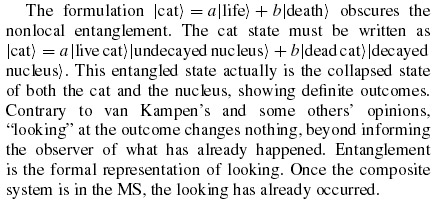
“In short, for ideal measurements both experiment and standard quantum theory imply an instantaneous collapse to unpredictable but definite outcomes.The MS [measurement state] is the global form of the collapsed state with no need for a separate “process 1” or measurement postulate. The other postulates of quantum physics imply that, when systems become entangled, their observed states instantly collapse into unpredictable but definite outcomes. In particular, Schrodinger’s cat is in a nonparadoxical definite state, alive when the nucleus does not decay and dead when it does. This solution of the problem of outcomes requires no assistance from other worlds, human minds, hidden variables, collapse mechanisms, collapse postulates, or “for all practical purposes” arguments.”
I think that this is a promising study which gives support to the MSR model. Once we take the step of questioning whether there can be any such thing as measurement which is other than a kind of ordinary sensory-motor interaction (even if it is microphenomenal),the hard problem of consciousness and explanatory gap disappear.
Seeing that it is the capacity to feel which, through its interruption, gives rise to the sense of touch, and it is the sense of touch which gives rise to touchable things rather than the other way around, we should take the opportunity to go back and reinterpret all of the particle physics of the last 50 years – not because it is wrong, but because it is right for the wrong reasons.
If photons sense each other, how do we know that photons themselves are anything more than atoms sensing and instructing each other? This study fits with a model of the universe in which all phenomena throughout eternity is, on one level, a simultaneous sensory experience. Within the solitude of that Absolute experience are miniature versions of the same, (such as our own human individual sense of conscious solitude). In the polarization-derived ‘spaces’ or ‘gaps’ in between these homing-monads, cat-experiences and atomic-experiences take their marching orders from each other’s presence, represented as localized ‘homing signals’. Cats and atoms alike, since they are ultimately but frozen appearances within some nesting of the global nature of sense itself (the Absolute), also receive intuitive influence from the overall event of the total interaction.
Instead of seeing photons as the foregrounded units, all of the evidence seems to point to the idea that the opposite might be true. As Hobson mentions, “The photons “knew” each others’ phase angles, despite their arbitrarily large separation. This certainly appears to be nonlocal, and indeed, the results violate Bell’s inequality, verifying nonlocality” The so called measurement state would make more sense as the fundamental capacity of the Absolute to pretend at photon, atom, or dead cat forms. This paper takes the step of entangling the outcome of the cat and the outcome of the particle’s decay with the overall measurement state. I think a good next step is to entangle the entire presentation of cats and particles and even ‘outcomes’ to the participant’s sensory nature. It’s all entangled, even entanglement itself. In our case, as human beings, we sense cats more directly than we can sense a particle’s decay, but not as directly as we can make sense of our own thoughts and feelings about them.
Primordial identity pansensitivity (PIP) is the proposition that the capacity to experience, to participate perceptually is the ultimate irreducible universal. In Kantian terms, the sole synthetic a priori. In relativistic terms, the maximally inclusive inertial frame. Other philosophers have used terms like Absolute, Totality, Transcendental Signifier, and Supreme Monad.
The difference between PIP and theism is that PIP does not presume a human-like, or entity-like subject associated with the Absolute. Neither is it presumed that the Absolute is a field, force, vacuum, or information-theoretic phase space. The Absolute is neither local nor nonlocal, but rather the parent of that distinction, and therefore orthogonal to it .
Under PIP, the Absolute is understood to be the meta-phoric firmament within which the three ‘verses’ are diffracted. The three verses, following a Hegelian-type dialectic of thesis, antithesis, and synthesis* are phoric (directly experienced), morphic (embodied presence), and metric (abstract relation of the other two verses). In one sense, the Absolute is more closely aligned with the phoric+morphic, i.e. the collection of all presence with no absence.
From this there is a sense of omniscience, as all times and places would be ‘here and now’. Take the universe as we know it, multiply it by eternity, see all of it from every perspective possible, and remove all of the space and time from it and we would have the PIP absolute – a timeless everythingness which transcends the difference between novelty and repetition. If mortality is marked by an unbearable lightness of being, in which all experience is either meaninglessly fleeting or meaninglessly repeating, the immortality of the Absolute is marked by an unbearable saturation of meaning. All is absolutely unique and absolutely generic at once.
Ordinary sense is, on every level, what diffracts/diverges/disentangles one state from another, and one level of sensory interpretation from another. The sensation is the fundamental physical presentation, the measurement of alienated sensations (measured as photons, atoms, bodies) is derived representation. Notions of space, time, and information are meta-representations – concepts and abstractions, which themselves reflect the unity of the Absolute, but in a skeletal and figurative way.
*note that the dialectic itself is a metric abstraction which cannot be directly experienced or embodied. The actual thesis which physically exists is the phoric thesis: sensory-motive-time. Matter-energy-space is the morphic antithesis. Entropy-Significance-Aion (eternity) is the synthesis.
MSR Non-Standard Model of (Post-Particle) Physics
Developing the idea of fusing quanta and qualia physically, MSR proposes to add the following notation:

“Qui” (who?) would be the hypothetical ‘other half’ of the quantum wavefunction, and can be represented (obnoxiously, but memorably) by the sideways letter psi.
This signifies that aesthetic presence and qualitative appreciation (being and feeling) is orthogonal to the doing and knowing of quantum mechanics. Qui is not the measurement but the context of orientation from which measurement is experienced. It is explicitly neither wave, particle, form, or function, but neither is it non-wavelike, non-particle-like, formless, or unrelated to function. Qui is exactly what being alive is to us as human beings, except on a much more primitive level. It is the capacity to participate as an oscillating source of both animistic and mechanistic qualities.
The combined qui-psi symbol:

On Electrodynamics:
I have been trying understand electromagnetism in what I would call ‘purely classical’ terms. I suspect that the way that physics has been taught and learned, the knowledge which has accumulated is more of a collection of facts than a deep understanding. Even the basics of electromagnetism are immediately abstracted into formulas about how electrical effects can be predicted and controlled rather than what they actually are.
I think that the way that we approach electrodynamics is similar to how a civil engineer might approach city traffic. When we want to control the flow of traffic, the density and pressure of it, provide optimal ratios of parking space to population, how the number of lanes and cross streets affects the efficiency, etc. then we approach traffic from a purely quantitative perspective. We don’t consider the individual driver pushing the accelerator, looking at the bumper of the vehicle in front of them, even though that sensory-motive interaction is the actual mechanism upon which traffic relies. Instead, we look at rates and derivatives, geometric relations, etc.
If we want to get inside of electromagnetism in ‘classical terms’ of what is happening to molecules and substances, without even talking about electric fields or vectors, etc, what would it look like? Is electromagnetism like traffic, the movement of molecules driven by an unacknowledged sensory-motive participant? I think that it is possible, even likely that is the case, and my hypothesis about light as having no literal photons could maybe be understood in these classical terms, only with a concretely aesthetic sensory-motive participation instead of mathematical abstraction.
I started with the idea that since the speed of light is derived in part from the vacuum permittivity (ε0) and vacuum permeability constants (µ0), maybe I could make things easier on everyone who tries to understand my photon-free model of light by calling it remote permittivity or telepermeability or something like that. By this I mean to show that what I suggest is no more exotic than what we already assume about matter, only that the sophistication of matter itself, of its capacity to derive perspective and distance in relation to itself is much more spectacular and interior than we have imagined in the last few centuries (Aristotelian physics was teleological, so the notion of dumb matter is not something that is an eternal truth).
In my hyper-classical thought experiment, we don’t necessarily even believe in electrons. Electrons could be more like turn signals and break lights of the cars in traffic. The model of the electron cloud shifting away from the nucleus could be interpreted figuratively, as tension, displacement of intentions as the atomic ‘drivers’ are craning their necks to look out at the entire line of cars rather than passively staring ahead. Lots of fun possibilities here, I’m just trying to make the point that we can put electricity and magnetism inside the atom if we want.
All of the vectors and scalars of physics that have been derived for prediction and control can be seen as economic ideas. Things like electrostatic fields and potential energy are like accounts in a general ledger, but the actual transactions that they refer to are sensory-motive. They are concrete expectations fulfilled and deferred – felt by some aspect of the universe on some level of description (which may be a very different description than we have under typical conscious experience or instrumental observation.)
Relativity and Reality
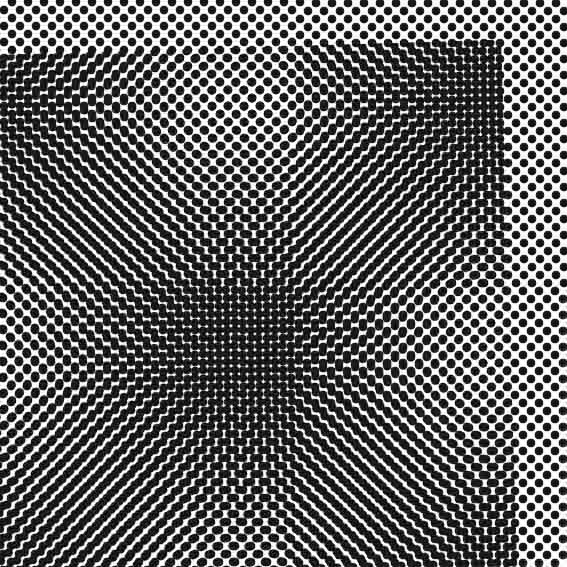
To what does relativity relate? Before there can be relation there must be presence, and before a presence can relate to another presence, there must be a capacity for detection of some kind. Even collision of bodies should not be taken for granted in physics. It is a testament to our imagination that we can conceive of a universe that happens without any participants – with only there and then, but no here and now to put them in their place. What is required instead is an imagination of empathy, to trace the origins of our own consciousness not to the dots and dashes of information gathering instruments developed for our bodies to use, but to our own native information gathering capacities. Whether photons are really things or not, no model of the universe can be complete without fully explaining the relationship of photons to the phenomenon that we see as light. Whatever it is that we see cannot be excluded from any complete description of the universe.
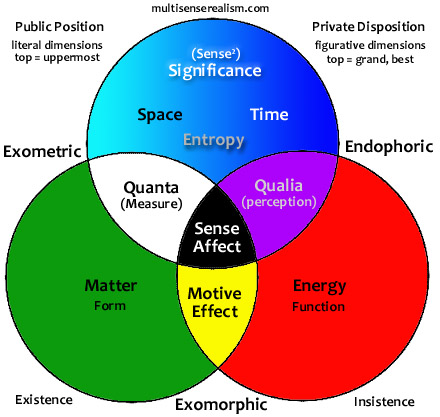
An early diagram of the MSR Theory of Everything suggests an equivalence of perception and relativity. Without getting too deep into the subject, it can be said that any discussion of relativity entails the use of a reference point, a so called ‘inertial frame’ within which phenomena tend to cohere together and share a common velocity. Even in a speeding train, the coffee in the cup can remain fairly settled on the tray in front of us. So long as the velocity of the train is maintained, we can’t tell by looking at the cup whether the train is stationary, or moving, or moving on top of another train which is moving even faster. Without this kind of orienting framing principle, there would be no ‘thing’ to relate to any other thing; no place to move toward or away from. Relativity requires an anchor, and for reasons which I will get into soon, the anchor of quantitative properties cannot itself be quantitative but must instead be perceptual in nature. General Relativity relies on Proprietary Relativity, aka, private perception. This should not be taken as an endorsement of anthropocentric idealism, or deism, or any other effort to fictionalize physical realism, but is instead a suggestion of pansensitivity with sense as both the universal law and the local participant.
Relativity is anchored not only the law of inertia, but the consequences of it in sequestering physical tendencies into semantically stable ‘places’ which relate to each other, and through each other. This should be understood as a kind of sensitivity or awareness on the grandest, most public scale. It implies a translucence of mass and momentum in which the grandeur of events is implicitly and palpably present.
Relativity refers to the underlying nature of place and pace as it is defined by matter and energy. Matter and energy create the spacetime context by their relation with each other. The title General Relativity, just as words in the English language, infers a generalized or universal quality of relating which is dynamic. It’s not a static property of general related-ness, but rather it is an active responsiveness of all phenomena in relation to each other. The -ivity suffix of relativity treats relation as a verb, not a noun. What we observe is that in measurements where distance and time are precisely recorded, the classically held immutables of space and time actually bend and warp to reflect the presence of mass, gravity, and velocity.
I think that this is what shocked the world about Einstein’s vision. He conceived that the metric itself, the abstract ‘rigid body’ of measurement which comprised the firmament of classical mechanics…that infinite set of Cartesian coordinates actually warped its contours around things, not the other way around. The plenum of space and time is only a measure of variations in scale and frequency among repeating effects that were happening to objects. The universe was not something happening in an empty box, it was boxing itself from the inside out.
Special Relativity showed that the relativity of uniform motion observed by Galileo and the classical notion of invariant time had to be extended to accommodate the absoluteness of the speed of light. Einstein’s four dimensional space-time ‘mollusk’ describes what is understood to be an invariant space-time interval. Why is the speed of light absolute though? What mechanically makes time dilate or length contract?
If my view is on the right track, the reason why the speed of light is absolute is because light is not a thing, it is the sensitivity of matter across its own created distance. The reason that Relativity works is because the universe makes sense of itself, and is ignorant of itself on every level. This is what relativity and perception are all about. It is interesting that the deepest truths of Einstein and the deepest truths of Quantum Mechanics both have to do explicitly with measurement. Einstein’s Relativities challenge common-sense notions of the separateness of space, time, matter, and energy, and of the nature of velocity while QM deals in probabilities and uncertainties associated with measurement of complementary variables (like position and momentum). We are talking about the limits of measure in both cases, and transcending immeasurable conditions with new strategies of measurement.
To say that Relativity makes sense is accurate because we have an idea of what it means for things to make sense already. Knowledge is a validation of our public facing senses with private sense making, or vice versa. We model the movements of massive bodies in accord with Einstein’s curved space equations, but Einstein did not believe that space was literally curved, or that space was a thing at all. Curved space is a metaphor. What is curving is the statistical results of experiments where the behavior of matter in one frame is measured against the behavior of matter in another. This is the bare-metal reality of our observations. Physicists use instruments made of matter to cause and measure changes in matter. Through those measurements, we have inferred entities such as “energy”, “gravity”, “forces”, and “fields”, but we have only matter to tell us about them. Our perception relies on matter’s relation to matter, it’s relativity, to perceive conditions in remote inertial frames.
This is not an endorsement of naive realism. Certainly it is useful to model energy as a separate entity from the matter which collects and projects it, however it remains impossible to inspect energy in public, without the aid of a material instrument such as our body, and a mode of perception to detect it and render it locally in some aesthetic modality. Perception is in one sense a mirror image of relativity, in that relativity is an impersonal view of public perspective and perception is a personal view of private relations. In another sense, perception is merely the private version relativity. The same principle which allows the coffee to stay in the cup on the train can be understood to be literally the same inertial principle which maintains the worldly realism of our experience. Inertia is the indifference of sense, the comfortable ranges and tropes which contrast with novelty and disturbance.
By turning General Relativity around so that it can becomes Proprietary Relativity, a whole new way of making sense and measuring the immeasurable can be glimpsed. While it has always been implicit in the inertial frames and ‘observers’ of physics, the framing itself has never been examined properly, as far as I know. We take our own personal orientation for granted most of the time, (especially when we are overseeing an abstract equation or model of everythingness), but to model everythingness absolutely faithfully, we would need to include this very strange, but very ordinary state of affairs that we know as ‘being here’, or ‘our presence’; consciousness.
It has been the hypothesis of MSR that as far as physics is concerned (which can only tolerate a very dim and narrow view of consciousness right now), the function of consciousness should be approached first as the minimum ingredient to provide the possibility of privacy, relativity, and inertia. A vector of orientation and perspective. This is the unspoken assumption of any observer or inertial frame, that somehow there has arisen a capacity to discern a here from a there, or a now from a then. MSR tries to explain the difference between (here, now) and (not-here, not-now) in terms of public and private ‘verses’. These verses are aesthetic contexts which provide mutual contrast for each other. It is the unfortunate complexity of the human experience, with its massively redundant population of historically recorded lifetimes, bodies, and bodies within bodies within bodies (organs, cells, molecules), which obscures the purity and simplicity of the private-public relation. It is not a dualistic relation however, it is a reflexive or Ouroboran relation. The private feelings and experiences of one inertial frame are the public bodies and energies of another, sufficiently alien frame.
Having a body which is subject to conditions on the molecular, cellular, and somatic levels of public interaction gives us cause to think that these interactions are producing ‘us’, whereas my conjecture is that our bodies reflect the totality of our lives (and the lives of our entire species, of all life, and all phenomena dating back to before the dawn of life) from a particularly truncated and relativistic perspective. The body is a human life looking at itself askance through the narrow slit of its own relativistically disintegrated presence.
This essential ingredient is the necessary piece to the puzzle. It allows us to recognize that this universe not only one of theres and thens, but of here and now. Einstein famously said that he did not understand now, and that makes sense since his is the perspective most grounded in the ‘other’ – in spacetime. Sense is not an abstract scalar quantity, property, or configuration, but it is the concretely real capacity to feel, sense, or detect, even though it is both non-local and non-non-local. It is not a field or an energy, an ether, an elan vital, or any other substantialized presence. That would be redundant, since sense is presence already.
Just as Einstein relocated the universal process to electrodynamics rather than Newtonian mechanics, MSR relocates the electrodynamic process itself to a sensorydynamic milieu, a milieu which is absolute, and which presents uniqueness and originality as its product. In short, Multisense Realism posits an equivalence between locality and perception, and between perspective and equivalence/non-equivalence itself. Sense is how things seem to be, and seeming it turns out, can only be more fundamental than ‘reality’.
The notion of inertia is expanded under MSR, so that it implies a tangible experience of expectation and continuity. Inertia is the sensory capacity of context and framing. This is the stuff of worldly realism. An accumulation of qualitative semi-signs and partial presentations which is beneath the formalism of literal semiotic signals. These fundamental references cannot arise purely from bottom up mathematical relations, but rather are recovered or discovered from the totality as a whole. This concept has been developed before many times, (e.g. Bohm’s Implicate Order, Sheldrake’s Morphic Resonance, Indra’s Net, etc) but generally with a holographic flavor of non-locality. Things simply have a way of coming around again and again. With the MSR concept of perceptual inertia, perception events are carved out of the monad of eternity. Personal perceptions are fundamentally voids, bubbles within the singularity which make it seem like a multiplicity from inside the bubble. Indeed, the bubble itself is the quality of seeming divided or disconnected, a finite flavor of here and now which is suspended in a frozen diaspora of theres and thens. “Laws” are the constraints which are experienced in one inertial frame because it is nested within an event which has already happened. A smaller now cannot escape from the experience which birthed it, in which the former becomes eternal and the latter becomes the instantaneous. Relativity, gravity, inertia, and perception are all different aspects of the same law-giving realism. Ratios borne of qualitative experience, and reborn through experience which has been condensed – quantitatively deferred.
Comparing Worldviews

Side by side comparison of what seems to be the prevailing cosmology (above) and MSR (below). In the consensus worldview, aka Western post-modern view, quantitative function replaces all other modalities of sense and sense itself is absorbed into automatism. Energy is merged with matter as ‘particle-waves’ or ‘probability wave functions’, just as space is merged with time through relativity. Rather than a universe of concrete participation, the illusion of realism ’emerges’ from the evolving complexity of statistical interactions. At what level this emergence occurs, why it occurs, or how are left to future generations to explore.
Conspicuously absent are all traces of subjectivity, participation, and significance. Motive effect is understood only as a caused effect – the playing out of inevitable mechanical agendas which stem from a few ‘simple rules’. All forms of privacy are unknown and entropy is divorced from sensory interpretations. All sensations are thought to be partial revelations of an objective truth, so that any deviation from that empirical fact is considered an error.
MSR sees the absence of sense as a the gaping hole in this schema. While emergence is appropriate for understanding how many phenomena which appear to be novel are often found to be inevitable upon further inspection, it is entirely an entirely inappropriate machina ex deus for phenomena which have no plausible origin from the known functions of the system. The consequences of overlooking the key principle which unites all phenomena (sense), are that we wind up with an impoverished worldview, a Straw Man of cosmology in which we ourselves have no possible place.
What is Information? Reality as Information – Is there Intrinsic Meaning? Sentient Life & Bits
Dolors Jou Torras: I think all one needs to do is redefine information and then it all clicks into place. Information: a perceived difference that can make a difference. You start with an awareness of a difference (reality differentiating itself and becoming aware of it). Then you move on to an awareness of a difference which in turn makes a difference (this awareness of differentiation enables learning, growth, knowledge, etc).
At some point this ability to perceive a difference becomes able to not only perceive a difference (of states) but can also perceive a difference in such a way that order can be assigned (as in before / after). Time is born – or rather, it evolves (= the ability to perceive a difference + assign order and duration).
You escalate this ability to perceive differences, etc, to an information field which can model consciousness (consciousness being defined in line with self-awareness, ability to self-modify, intelligence, ability to evolve, etc).
Then you get to the point where “physical” universes can evolve (within consciousness “space”) and so space-time and matter evolve… This goes hand in hand with the evolution of individual conscious observers experiencing this physical universes
So the paradigm goes like this: information—> consciousness & time —> laws of physics—> individual observers + space-time & matter
Craig Weinberg: I agree with what you are saying, especially the part about adding the qualifier of “a perceived” to “difference”. I would say though that that makes this capacity to perceive more fundamental than what is perceived. Even if we understand that of course information must be perceived, I still think that the word information carries an implicitly objective connotation. All that information can be is an experience in which some sensory context is informed. This capacity to perceive is already awareness, so that even though we could say that the term ‘consciousness’ refers to an awareness of awareness, I don’t see that such an awareness requires any information at all. All that is required is a quality of awareness in which the presence of awareness is felt. There is no feeling of the absence of awareness, so it is not a matter of discerning a difference or being informed about anything, it is simply an expectation of persistence and participation.
I like to break down the word information into three parts: “in” (which is input-output of sensory-affect/motor-effect), “form” (which is material shapes divided by space), and “ation” (which is recursive functions united through time). Where we are at now I think is to overlook the “in” part entirely and treat formations as the primitive context, when in fact the formations are the objects of appreciation and participation of the true primitive capacity for sense.
Dolors Jou Torras: Defining information and consciousness differently is what makes the descriptions of what is ultimately primary different… I completely understand what you are saying, when I put myself inside your theoretical framework Don’t disagree at all, but I can see that it all boils down to the precise details of how one defines information, awareness, consciousness and so on.
Craig Weinberg: Yes, for most contexts it is more useful to talk about information in the traditional sense. I think it’s only when we need to really get a maximum close up on that boundary between firstness and secondness or between the front and back end of the snake who is eating its tail. We are very much on the same page about the semiotic relation. I would suggest to consider that information is not non-physical, so much as physics is experiential and information is part of experience.
What makes an experience seem ‘physical’ is that it is out of bounds of our intimate sensory range. That which is too fast, too slow, too large, too small, or too unlike us in another sense is experienced in increasing degrees of dissimilarity to experience. Experience is the sense of who we are and the motive of why we do what we do, but matter is bodies nested within larger bodies. Matter is the what and how, the re-presentation of first person presentations.
Information is when one level of experience exploits another, more distant (and therefore more matter-like; discrete positions, subject to public inspection, etc) level. We take a sheet of cellulose molecules, which on their own level are holding on to each other, oxidizing slowly, etc and we inscribe a quantity of ink (also an experiential reality on its native fluid-molecular level). This inscription can be modeled as a trade off of entropy, we are fixing our private ideas and expressions on various levels, conscious and subconscious in public spacetime. Public spacetime freezes private sense into public form and private motive into public function. The information entropy of the writer’s idea is discharged in the act of writing, a process to be revisited in reverse when the reader understands what has been written. The low entropy signal of the written word is traded for an aesthetic entropy increase in the reader’s experience – they imagine, they think, their mental experience reverberates and ‘warms up’, creating novelty and creativity. This is significance. Significance lights up previous memories and pulls them together, bringing a sense of integration within. (Understanding = entero-standing…inner settling).
information is not physical in the sense that the effect of being informed is experiential, but information media is physical, which means that it is down-rev experiential, so to speak. We use experiences which are dumber and smaller than we are to carry our messages. Thinking of it this way brings matter, mind, and meaning together as one ecosystem of sense-making.
Dolors Jou Torras: I will cover the physical vs non-physical debate in another video soon, but defining information as essentially non-physical has to do with several factors:
– I relate information to qualia (perception, experience)
– That in this “physical” universe, in general we need to embed or engrave information in physical matter or energy via symbols or signs, does not make information itself physical.
The laws of physics do not preceed information hence information is not bound by physical laws (information is primary)
There is compelling evidence, in my opinion, that non-local effects point in the direction that our physical universe (space-time plus matter) is a subset of a larger reality. What is “physical” is a moving target
Information (in theory) can be used as a basic currency to describe any reality, not only what our current physics can describe (or is attempting to describe).
Information therefore can be used to move away from duality… “Physical” vs “non-physical” is not a matter of substance dualism; these are purely subjective terms that we mostly associate with what our current science can measure with its instruments.
Craig Weinberg:
“defining information as essentially non-physical has to do with several factors:
– I relate information to qualia (perception, experience)”
I agree in the conventional sense of ‘physical’, information would be non-physical, but I think that in an absolute sense, the physical and non-physical can only be different perspectives (private-facing and public-facing orientations) of the same thing. What I am trying to pioneer is the idea that this thing is sense: the universal capacity for aesthetic participation, aka the capacity to generate, experience, and appreciate qualia.
“- That in this “physical” universe, in general we need to embed or engrave information in physical matter or energy via symbols or signs, does not make information itself physical”
Right, symbols or signs are independent of matter, but not independent of the capacity to experience (sense). A particular piece of information, such as a page in a book, can obviously exist without my experience of it, but it cannot exist without some capacity for interpretation somewhere in the universe.
The question that I put to you, however, is ‘can awareness exist without information?’. I think that it can. I think that a feeling need not inform us. I think that information is always a reflection or representation of sense, and never the genuine presentation itself. Eating a meal is not simply an information processing event where knowledge of nutritional conditions are stored in the body and in our understanding, it is a concretely visceral, mouth watering, chewing, gobbling, licking, swallowing orgy of sensual participation. We can extract information from the experience, but when we do, that extraction is inevitably reductive. It is an accounting of events from a hypothetical voyeur’s perspective rather than the genuine and indispensable experience.
In my view, qualia is not a representation, it is a presentation – an aesthetic presence. Information is a particular kind of qualia, a presentation in which another presentation has been abstracted as an a-signifying, quantifiable figure. Such a figure is public-facing and communicable, so long as the receiver of the communication can re-signify some of what has been frozen as a spatial-form/temporal-function.
“The laws of physics do not preceed information hence information is not bound by physical laws (information is primary)”
Because you are including the aesthetic experience of information as information, I agree with you here too. Matter-Space/Energy-Time would be types of information (Form-Sense/Function-Motive). If we conflate information with sense, however, then we would have to explain why sentience does not emerge from information itself. Why can’t we write a story which has feelings itself? Why do we react unfavorably to impersonated entities like mannequins and automatons (uncanny valley effect)? Part of my contribution here is to get very specific and show how the relation between sense, information, and matter can be juxtaposed to yield unity or contrast but that sense is the essential commonality. Information can be forged and copied, it is generic and implicitly impossible to truly own. Sense is absolutely proprietary and authentic, ineffable, unreproducible.
Information is the manifestation of the intention to circulate publicly, but sense is the private anchoring of a disposition between the sensor/self and the universe. This opposition relation of sense and information is recapitulated and exteriorized as the relation between matter and energy, and matter-energy/space-time. It’s the same theme of reflection through orthogonal juxtaposition. It’s very tricky of course, because we can toggle foreground/background from any perspective. Einstein grabbed mass-energy and it gave him space-time. If you grab information-sense, it gives you physical machines and non-physical machines. My proposal is to grab sense-motive and get all of the others: form-matter-space::function-energy-time. Square that and you get public entropy::private significance.
“There is compelling evidence, in my opinion, that non-local effects point in the direction that our physical universe (space-time plus matter) is a subset of a larger reality. What is “physical” is a moving target”
I agree completely, although I think that the larger reality is the sum-total of all sensory experiences in the history of the universe. The larger reality is experiential while space+matter is a frozen slice – a tokenized representation of part of that reality as experienced from a particular perspective and presented as a public context. Physical to means only that something is intended as a concrete presentation rather than a pure representation. The idea of a train is physical, in the sense that ideas are physical experiences, but the train which is confabulated within the idea is not physical. Non-local? Certainly. Locality is a low level sense protocol. I think that’s part of what the atoms are doing on the microcosm, sending each other messages (we call quantum) to generate locality through spacetime coordinates. The universe is inside the big bang/Abolute, and all space is a presentation within it’s sense.
“Information (in theory) can be used as a basic currency to describe any reality, not only what our current physics can describe (or is attempting to describe).”
Yes, but only if you are assuming that information includes sense. Think of how the same information on a DVD can be heard as music or seen as a video though. A computer reads that DVD anesthetically, as data. Low level electronic sensation in all likelihood, but the data is not giving the DVD player an experience of watching a movie.
“Information therefore can be used to move away from duality… “Physical” vs “non-physical” is not a matter of substance dualism; these are purely subjective terms that we mostly associate with what our current science can measure with its instruments.”
Yes, in the absolute sense, but if we don’t explain that subjective polarization and connect it to public and private presentations, then we have not really explained the universe that we live in. With my view, all dualisms, monisms, and multiplicities fall out naturally from the capacities of sense and motive to diffract entropy spatiotemporally and recover significance experientially.
Bergsonian-Deleuzian Multiplicity and Gaede’s Ropes

Looking at the Bergsonian-Deleuzian concept of multiplicity, I can see that it shares the same underlying dialectic as Multisense Realism. I noticed that if I add some insight from Bill Gaede’s Rope model of the atom (YouTube 04:25), I can map electromagnetism to the Continuous-Discrete framework of Bergson.
Where Gaede conceives of a literal thread across the diameter and around the circumference of the atomic nucleus, I think that it should be flipped. Rather than a literal thread I see a capacity for felt participation: ‘motive’ or maybe ‘efference’. Electricity is not a thread across the atom, it the experience of jumping from one atom to another. The atoms themselves would not look like balls of magnetic yarn, but feel like obstacles within the private sense field or ‘afference’ of each atom. This corresponds to magnetic field and Difference in kind, however, it’s a loose correspondence. Sense and motive is electromagnetism from the inside, but it is also gravity and electromagnetism, feeling and knowing, being and doing. It’s the absolute fundamental.
Electricity, in the Gaede model, would correspond to that which defines the literal, linear, direct aesthetic. The symmetry and juxtaposition across the diameter of the atom appears to us as a quantum gear shifting mechanism. That’s because we are detecting it from the outside with other bodies, so there is always a spacetime gap to be hopped across. The loop-like aspect of the atom, by contrast It is both a spherical range of sensitivity in public space and a circuit of oscillating affect or disposition (private experience). To make a long story story short, the atom, in my model, is an interaction with continuous-private-aesthetic qualities and discrete-public-anesthetic (skipping) qualities, aka qualia and quanta. The larger cosmological picture involves the division of qualia from the Absolute (Qua), the diffraction of quanta from qualia (spacetime existence), and the saturation of reconstituted qualia (quanta existential spacetime entropy stripped out) on return to the Absolute.

This can work for a neuron as well as an atom, but again, loosely. Each frame of reference has its own unique vocabulary. A neuron is figuratively like Bill Gaede’s atom model. A galaxy or a solar system is similar also, as is the alchemical Caduceus, the chakra system, the ankh… None of them are identical, but the theme is similar. Winding and tightening, spinning and accelerating, contracting and relaxing.


Intelligence Maximizes Entropy?
Intelligence Maximizes Entropy?
A new idea linking intelligence to entropy that is giving me something to think about.
“[…]intelligent behavior emerges from the “physical process of trying to capture as many future histories as possible,”
This sounds familiar to me. I have been calling my cosmological model the Sole Entropy Well, or Negentropic Monopoly, in which all signals (experiences) are diffracted from a single eternal experience, the content of which is the capacity to experience. I think that this is the same principle in this paper, called “causal entropic forces”, except in reverse. I wrote recently about how intelligence is rooted in public space while wisdom is about private time.
I think that causal entropic forces are about preserving a ‘float’ of high entropy on top of time. It’s like juggling – you want to suspend as many potentials as you can at “a” time and compensate for any potential threats before they can happen “in” time. Behind the causal entropic force, it seems to me that there must always be a core which is not entropic. That which seeks to entropically harness the future is itself motivated by the countervailing force for itself – to escape the harness of entropy.
None of this, however, addresses the Hard Problem. To the contrary, if this model is correct, then it is even more difficult to justify the existence of aesthetic sense, since all of the public effects of intelligence can be explained by thermodynamics.
Article: “A single equation grounded in basic physics principles could describe intelligence and stimulate new insights in fields as diverse as finance and robotics, according to new research.
Alexander Wissner-Gross, a physicist at Harvard University and the Massachusetts Institute of Technology, and Cameron Freer, a mathematician at the University of Hawaii at Manoa, developed an equation that they say describes many intelligent or cognitive behaviors, such as upright walking and tool use.The researchers suggest that intelligent behavior stems from the impulse to seize control of future events in the environment. This is the exact opposite of the classic science-fiction scenario in which computers or robots become intelligent, then set their sights on taking over the world.The findings describe a mathematical relationship that can “spontaneously induce remarkably sophisticated behaviors associated with the human ‘cognitive niche,’ including tool use and social cooperation, in simple physical systems,” the researchers wrote in a paper published today in the journal Physical Review Letters.“It’s a provocative paper,” said Simon DeDeo, a research fellow at the Santa Fe Institute, who studies biological and social systems. “It’s not science as usual.”Wissner-Gross, a physicist, said the research was “very ambitious” and cited developments in multiple fields as the major inspirations.The mathematics behind the research comes from the theory of how heat energy can do work and diffuse over time, called thermodynamics. One of the core concepts in physics is called entropy, which refers to the tendency of systems to evolve toward larger amounts of disorder. The second law of thermodynamics explains how in any isolated system, the amount of entropy tends to increase. A mirror can shatter into many pieces, but a collection of broken pieces will not reassemble into a mirror.The new research proposes that entropy is directly connected to intelligent behavior.“[The paper] is basically an attempt to describe intelligence as a fundamentally thermodynamic process,” said Wissner-Gross.The researchers developed a software engine, called Entropica, and gave it models of a number of situations in which it could demonstrate behaviors that greatly resemble intelligence. They patterned many of these exercises after classic animal intelligence tests.In one test, the researchers presented Entropica with a situation where it could use one item as a tool to remove another item from a bin, and in another, it could move a cart to balance a rod standing straight up in the air. Governed by simple principles of thermodynamics, the software responded by displaying behavior similar to what people or animals might do, all without being given a specific goal for any scenario.“It actually self-determines what its own objective is,” said Wissner-Gross. “This [artificial intelligence] does not require the explicit specification of a goal, unlike essentially any other [artificial intelligence].”Entropica’s intelligent behavior emerges from the “physical process of trying to capture as many future histories as possible,” said Wissner-Gross. Future histories represent the complete set of possible future outcomes available to a system at any given moment.Wissner-Gross calls the concept at the center of the research “causal entropic forces.” These forces are the motivation for intelligent behavior. They encourage a system to preserve as many future histories as possible. For example, in the cart-and-rod exercise, Entropica controls the cart to keep the rod upright. Allowing the rod to fall would drastically reduce the number of remaining future histories, or, in other words, lower the entropy of the cart-and-rod system. Keeping the rod upright maximizes the entropy. It maintains all future histories that can begin from that state, including those that require the cart to let the rod fall.“The universe exists in the present state that it has right now. It can go off in lots of different directions. My proposal is that intelligence is a process that attempts to capture future histories,” said Wissner-Gross.The research may have applications beyond what is typically considered artificial intelligence, including language structure and social cooperation.DeDeo said it would be interesting to use this new framework to examine Wikipedia, and research whether it, as a system, exhibited the same behaviors described in the paper.“To me [the research] seems like a really authentic and honest attempt to wrestle with really big questions,” said DeDeo.One potential application of the research is in developing autonomous robots, which can react to changing environments and choose their own objectives.“I would be very interested to learn more and better understand the mechanism by which they’re achieving some impressive results, because it could potentially help our quest for artificial intelligence,” said Jeff Clune, a computer scientist at the University of Wyoming.Clune, who creates simulations of evolution and uses natural selection to evolve artificial intelligence and robots, expressed some reservations about the new research, which he suggested could be due to a difference in jargon used in different fields.Wissner-Gross indicated that he expected to work closely with people in many fields in the future in order to help them understand how their fields informed the new research, and how the insights might be useful in those fields.The new research was inspired by cutting-edge developments in many other disciplines. Some cosmologists have suggested that certain fundamental constants in nature have the values they do because otherwise humans would not be able to observe the universe. Advanced computer software can now compete with the best human players in chess and the strategy-based game called Go. The researchers even drew from what is known as the cognitive niche theory, which explains how intelligence can become an ecological niche and thereby influence natural selection.The proposal requires that a system be able to process information and predict future histories very quickly in order for it to exhibit intelligent behavior. Wissner-Gross suggested that the new findings fit well within an argument linking the origin of intelligence to natural selection and Darwinian evolution — that nothing besides the laws of nature are needed to explain intelligence.Although Wissner-Gross suggested that he is confident in the results, he allowed that there is room for improvement, such as incorporating principles of quantum physics into the framework. Additionally, a company he founded is exploring commercial applications of the research in areas such as robotics, economics and defense.“We basically view this as a grand unified theory of intelligence,” said Wissner-Gross. “And I know that sounds perhaps impossibly ambitious, but it really does unify so many threads across a variety of fields, ranging from cosmology to computer science, animal behavior, and ties them all together in a beautiful thermodynamic picture.”
 Multisense Realism
Recent Comments