Archive
Making Sense of Computation
In my view, matter and energy are the publicly reflected tokens* of sense and motive respectively. As human experiences, we are a complicated thing to try to use as an example – like trying to learn arithmetic by starting with an enormous differential equation. When we look at a brain, we are using the eyes of a simian body. That’s what the experience of a person looks like when it is stepped all the way down from human experience, to animal experience, to cellular experience, to molecular experience, and all the way back up to the animal experience level. Plus we are seeing it from the wrong angle. If I’m right, experience is a measure of time, not space, so looking at the body associated with an experience that lasts 80 or 100 years from a sampling rate of a few milliseconds would be a radically truncated view, even if we were looking at it in its native, subjective form. Every moment we are alive, we are surfing on a wave that has been growing since our birth – growing not just in synch with clock time, but changing in response to the significance of the experiences in which we participate directly. This is what I mean by sense. A concretely real accumulation of experience, a single wave in constant modulation as the local surface of an arbitrarily deep ocean.
Information is not sense, and neither is it matter or energy. Information is the shadow of all of these, of their relation to each other, which is cast by sense. Information is like sense as far as it being neither substantial nor insubstantial, but it is the opposite of sense also. Matter, energy, and information are all opposite to each other and opposite to sense. They are the projections of sense. If you break down the word information into three bites, the “in” would be sensory input, the ‘form’ would be ‘matter-space’ and the ‘ation’ would be ‘energy-time’. When most people think about information though, they undersignify the input/output aspect, the “in”, – which is sense, and conflate consciousness with senseless formations. Formations with no participating perceiver are non-sense and no-thing.
The difference between sense and information is that sense is anchored tangibly in the totality of events in all of history. It is the meta-firmament; the Absolute, and it potentially makes sense of itself in every sense modality. Information only makes sense from one particular angle or method of interpretation. It is a facade. As soon as information is removed from its context, its ungrounded, superficial nature is exposed. Information so removed does not react or adapt to make itself understood – it is sterile and evacuated of feeling or being. It is purely a feeling being’s idea of doing or knowing and does not exist independently of its ‘host’. Because of this it is tempting to conceptualize information as self-directing memes, but that would only be true figuratively. In an absolute sense, memes are a figure-ground inversion, i.e it puts the cart before the horse and sucks us into strong computationalism and the Pathetic fallacy. From what I can see, information has no autonomy, no motive. It is an inert recording of past motives and sensations.
Previously, I have written about computation, numbers, mathematics as being the flattest category of qualia. Flattest in the sense of being almost purely an tool for knowing or doing that has to borrow rely on being output in some aesthetic form to yield any feeling or ‘being’.
Computation can be represented publicly through material things like positions of beads on an abacus, the turns of mechanical gears, the magnetic dispositions of microelectronic switches, the opening and closing of valves in a plumbing system, the timing and placement of traffic signals on a street grid, etc. All of these bodies rely on the ability to detect or sense each others passive states and to respond to them in some motor effect. It makes no difference how it is represented, because the function will be the same. This is precisely the opposite of consciousness, in which rich aesthetic details provide the motivation and significance. Evolutionary functions are never nakedly revealed as a-signifying generic processes. For humans, food and sex are profoundly aesthetic, social engagements, not just automatic functions.
Computation can also be represented publicly through symbols. One step removed from literally embodied aesthetics, computation can be transferred figuratively between a person’s thoughts and written symbols through the sensory-motor medium of mathematical literacy. We can imagine that there is a similar ferrying of meaning between the mathematician’s thoughts and some non-local source of arithmetic truth. Arithmetic truth seems to us certain, rational, internally consistent, universal but it is also impersonal. Arithmetic laws cannot be made proprietary or changed. They are eternal and unchanging. We can only borrow local copies of numbers for temporary use, but they cannot be touched or controlled. They represent disembodied knowledge, but no doing, no being, and no feeling.
In the first sense, mathematics is represented by mechanical positions of public bodies, and therefore almost completely ‘flat’ qualitatively. Binary interactions of go/on-stop/off have no sense to them other than loops and recursive enumeration. In the second sense, a written mathematical language adds more qualia, clothing the naked digital states in conceptual symbols. The language of mathematics allows the thinker to bridge the gap between public doing of machines and private knowing of arithmetic truth.
Although strong computationalists will disagree, it seems to me that a deeper understanding reveals of computation reveals that arithmetic truth itself requires an even deeper set of axioms which are pre-arithmetic. The third sense of mathematics is the first sense we encounter. Before there is mathematical literacy, there is counting. Counting to three gives way to counting on fingers (digits), as we learn the essential skills of mental focus required. As we learn more about odd and even numbers, addition and subtraction, the aesthetics of symmetry and succession are not so much introduced into the psyche as foreign concepts, but are recovered by the psyche as natural, familiar expectations. Math, like music, is felt. Before we can use it to help us know essential truths or to cause existential effects, we have to be able to participate in counting and the solving of problems in our mind. When we do these kinds of problems, our awareness must be very focused. We are accessing an impersonal level of truth. Our human bodies and lives are distractions. Machines and computers have always been conspicuously lacking in what people refer to as ‘soul’, or ‘warmth’, feeling, empathy, personality, etc. This is consistent with the view of computation that I am trying to explain. Whatever warmth or personality it can carry must originate in a being – an experience which is anchored in the aesthetic presentation of sense rather than the infinite representation of information.
*or orthomodular inversions to be more precise
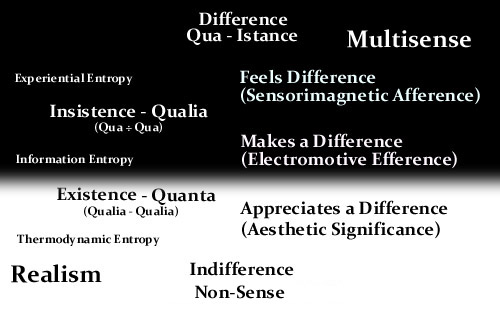
Bergsonian-Deleuzian Multiplicity and Gaede’s Ropes

Looking at the Bergsonian-Deleuzian concept of multiplicity, I can see that it shares the same underlying dialectic as Multisense Realism. I noticed that if I add some insight from Bill Gaede’s Rope model of the atom (YouTube 04:25), I can map electromagnetism to the Continuous-Discrete framework of Bergson.
Where Gaede conceives of a literal thread across the diameter and around the circumference of the atomic nucleus, I think that it should be flipped. Rather than a literal thread I see a capacity for felt participation: ‘motive’ or maybe ‘efference’. Electricity is not a thread across the atom, it the experience of jumping from one atom to another. The atoms themselves would not look like balls of magnetic yarn, but feel like obstacles within the private sense field or ‘afference’ of each atom. This corresponds to magnetic field and Difference in kind, however, it’s a loose correspondence. Sense and motive is electromagnetism from the inside, but it is also gravity and electromagnetism, feeling and knowing, being and doing. It’s the absolute fundamental.
Electricity, in the Gaede model, would correspond to that which defines the literal, linear, direct aesthetic. The symmetry and juxtaposition across the diameter of the atom appears to us as a quantum gear shifting mechanism. That’s because we are detecting it from the outside with other bodies, so there is always a spacetime gap to be hopped across. The loop-like aspect of the atom, by contrast It is both a spherical range of sensitivity in public space and a circuit of oscillating affect or disposition (private experience). To make a long story story short, the atom, in my model, is an interaction with continuous-private-aesthetic qualities and discrete-public-anesthetic (skipping) qualities, aka qualia and quanta. The larger cosmological picture involves the division of qualia from the Absolute (Qua), the diffraction of quanta from qualia (spacetime existence), and the saturation of reconstituted qualia (quanta existential spacetime entropy stripped out) on return to the Absolute.

This can work for a neuron as well as an atom, but again, loosely. Each frame of reference has its own unique vocabulary. A neuron is figuratively like Bill Gaede’s atom model. A galaxy or a solar system is similar also, as is the alchemical Caduceus, the chakra system, the ankh… None of them are identical, but the theme is similar. Winding and tightening, spinning and accelerating, contracting and relaxing.


Ehh, How Do You Say…
The use of fillers in language are not limited to spoken communication.
In American Sign Language, UM can be signed with open-8 held at chin, palm in, eyebrows down (similar to FAVORITE); or bilateral symmetric bent-V, palm out, repeated axial rotation of wrist (similar to QUOTE).
This is interesting to me because it helps differentiate communication which is unfolding in time and communication which is spatially inscribed. When we speak informally, most people use a some filler words, sounds, and gestures. Some support for embodied cognition theories has come from studies which show that
“Gestural Conceptual Mapping (congruent gestures) promotes performance. Children who used discrete gestures to solve arithmetic problems, and continuous gestures to solve number estimation, performed better. Thus, action supports thinking if the action is congruent with the thinking.”
The effective gestures that they refer to aren’t exactly fillers, because they mimic or indicate conceptual experiences in a full-body experience. The body is used as a literal metaphor. Other gestures however, seem relatively meaningless, like filler. There seems to be levels of filler usage which range in frequency and intensity from the colorful to the neurotic in which generic signs are used as ornament/crutch, or like a carrier tone to signify when the speaker is done speaking, (know’am’sayin?’).
In written language, these fillers are generally only included ironically or to simulate conversational informality. Formal writing needs no filler because there is no relation in real time between participating subjects. The relation with written language was traditionally as an object. The book can’t control whether the reader continues to read or not, so there is no point in gesturing that way. With the advent of real time text communication, we have experimented with emoticons and abbreviations to animate the frozen medium of typed characters. In this article, John McWhorter points out that ‘LOL isn’t funny anymore’ – that it has entered sort of a quasi-filler state where it can mean many different things or not much of anything.
In terms of information entropy, fillers are maximally entropic. Their meaning is uncertain, elastic, irrelevant, but also, and this is cryptic but maybe significant…they point to the meta-conversational level. They refer back to the circumstance of the conversation rather than the conversation itself. As with the speech carrier tone fillers like um… or ehh…, or hand gestures, they refer obliquely to the speaker themselves, to their presence and intent. They are personal, like a signature. Have you ever noticed that when people you have known die that it is their laugh which is most immediately memorable? Or their quirky use of fillers. High information entropy ~ High personal input. Think of your signature compared to typing your name. Again, signatures are occurring in real time, they represent a moment of subjective will being expressed irrevocably. The collapse of information entropy which takes place in formal, traditional writing is a journey from the private perpetual here of subjectivity to the world of public objects. It is a passage* from the inner semantic physics, through initiative or will, striking a thermodynamically irreversible collision with the page. That event, I think, is the true physical nature of public time – instants where private affect is projected as public effect.
Speakers who are not very fluent in a language seem to employ a lot of fillers. For one thing they buy time to think of the right word, and they signal an appeal for patience, not just on a mechanical level (more data to come, please stand by), but on a personal level as well (forgive me, I don’t know how to say…). Is it my imagination or are Americans sort of an exception to the rule, preferring stereotypically to yell words slowly rather than using the ‘ehh’ filler. Maybe that’s not true, but the stereotype is instructive as it implies an association between being pushy and adopting the more impersonal, low-entropy communication style.
This has implications for AI as well. Computers can blink a cursor or rotate an hourglass icon at you, and that does convey some semblance of personhood to us, I think, but is it real? I say no. The computer doesn’t improve its performance by these gestures to you. What we might subtly read as interacting with the computer personally in those hourglass moments is a figment of the Pathetic fallacy rather than evidence of machine sentience. It has a high information entropy in the sense that we don’t know what the computer is doing exactly, if it’s going to lock up or what, but it has no experiential entropy. It is superficially animated and reflects no acknowledgement to the user. Like the book, it is thermodynamically irreversible as far as the user is concerned. We can only wait and hope that it stops hourglassing.
The meanings of filler words in different languages are interesting too. They say things like “you see/you know”, “it means”, “like”, “well”, and “so”. They talk about things being true or actual. “Right?” “OK?”. Acknowledgment of inter-subjective synch with the objective perception. Agreement. Positive feedback. “Do you copy?” relates to “like”…similarity or repetition. Symmetric continuity. Hmm.
*orthomodular transduction to be pretentiously precise
Absolute View vs Western View: Comparing Supreme Ultimate Diagrams

Contrasting two models of consciousness: The Multisense Realism model above uses an Absolute view, which accounts for all known phenomena, subjective and objective. Postulating a root “Qua” (aka, the Absolute, Totality) from which qualia are divided through quanta, Quanta is conceived of as a constraint on Qua, a partition within it. Qua is sense capacity or presence, and so Quanta is the diminished reflection of that capacity…non-sense, entropy, uncertainty, and an expectation of absence. I am trying to show this as the horizontal arrows between qualia, indicating that quanta is nothing more than a kind of negotiation protocol which allows qualia to coexist in the same public space while retaining their private integrity. This is a complete reversal of the Western view, which features Quanta in the role of Qua, as the arithmetic-logical source of all phenomena.
On the left side of the diagram, there is a very general sketch of how Qua recovers itself ‘with interest’ as a qualitative enhancement – a consequence of having reunited on the other side of entropy-disorientation. On a human level, our experience yields a net human significance. Civilization is the residue left behind, a collective perceptual inertial of technology which echoes the individual’s narrative journey of exposure to the exteriorized spaces and the celebrated return home. Significance is literally a promiscuity of association among qualia, a depth of feeling and meaning which compels participation. My view is that this principle motivates on many, if not every level of the cosmos, and is not limited to human beings or animals (even though arguably significance is exponentially more…significant for human beings, at least in our own eyes).
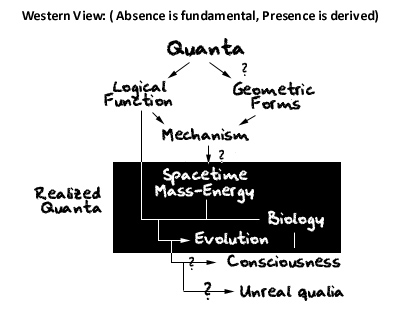
The Western view is a local rather than Absolute view. It does not account for sense or order itself, rather it begins from the assumption of physical matter and works backward to primitive mathematical functions. There are question marks included on the links which seem poorly understood or unjustified by the model as a whole. These include:
Why does geometry exist? I propose this as the Death of Computationalism. Along with the lack of support for Real numbers in computation, the universe or multiverse as a Turing emulation fails to account for the existence of forms like lines, circles, angles, etc. We know from our own computing and calculating devices that it is not necessary to physically draw a triangle in order to approximate correct computations about numbers which could correspond to triangular coordinates, so it really doesn’t make sense that any cosmic computation could or would invent geometric presentations of any kind. We don’t even need to get into questions of qualia, because computationalism fails to explain any sort of aesthetic forms to embody its functions. Mathematics is disembodied and anesthetic, and it works perfectly that way – no need for any strange magical fanfare.
Why do mathematical relations and laws give rise to physics? It’s all very well to have forms and functions mingle with each other as articulate mechanisms, but why should they ‘materialize’ as space-time, matter and energy?
The question of why consciousness exists when it does not appear to have any particular advantage over unconscious mechanism is a mystery. It is very difficult not to smuggle in our own retrospective view of consciousness as having enormous utility for our survival, but this is in no way an endorsement from the prospective view. If our immune system can orchestrate phenomenally complex responses to pathogens without a conscious experience attached to it, then why would a hominid’s humdrum quest for sustenance and reproduction lend itself to such an absurdly ornate aesthetic phenomenon? Indeed, if evolution can make a human brain, with all the trimmings, using unconscious methods, surely the operation of that brain would be better suited to that tried and true option.
The final question mark is related, but not identical. Even if you have consciousness as an option for some reason, and that option works better for humans than turtles or clouds of methane for some reason, why should such a phenomenon as consciousness produce feelings which are other than a record of the physical events which they represent? Why should there be different kinds of sensory experiences when all logical functions can be reduced more effectively to a single binary format of data processing? This alternative to reality is cast aside from the Western view, but what metaphysical never-never land is it cast to? How did we get outside of the real universe and into an ‘illusion’?
Biocentrism Demystified: A Response to Deepak Chopra and Robert Lanza’s Notion of a Conscious Universe.
1. I hope we all agree that our information about facts is incomplete, and will always remain so, at least in the foreseeable future.2. The only reality that makes sense to me is what Stephen Hawking calls ‘model-dependent reality’ (MDR).3. Other uses of the word ‘reality’ (other than MDR) imply ‘absolute reality’. If you disagree with this statement, please try defining ‘absolute reality’ in a logical way, using words which mean the same thing to everybody. My belief is that you will not be able to do that, and that means that MDR is all you have for discussion purposes.4. Naturally, there can be many models of reality. So which of the MDRs is the right one, and who will decide that? In view of (1) above, this is a hopeless situation, and that is why I avoid getting into philosophical discussions.5. At any time in human history, there are more humans favouring a particular MDR over other MDRs. Let us call it the majority MDR (MMDR).
6. An MMDR may well prove to be wrong when we humans acquire more information; from then we have a new MMDR, till even that gets demolished.
7. I believe that materialism is a better MDR than its opposite (called idealism, subjectivism, or whatever). For more on this, please read my article at http://nirmukta.com/2011/06/19/stephen-hawkings-grand-design-for-us/. Here is an excerpt from that article:
‘ There are several umbrella words like ‘consciousness’, ‘reality’, etc., which have never been defined rigorously and unambiguously. H&M argue that we can only have ‘model-dependent reality’, and that any other notion of reality is meaningless.
Does an object exist when we are not viewing it? Suppose there are two opposite models or theories for answering this question (and indeed there are!). Which model of ‘reality’ is better? Naturally the one which is simpler and more successful in terms of its predicted consequences. If a model makes my head spin and entangles me in a web of crazy complications and contradictory conclusions, I would rather stay away from it. This is where materialism wins hands down. The materialistic model is that the object exists even when nobody is observing it. This model is far more successful in explaining ‘reality’ than the opposite model. And we can do no better than build models of whatever there is understand and explain.
In fact, we adopt this approach in science all the time. There is no point in going into the question of what is absolute and unique ‘reality’. There can only be a model-dependent reality. We can only build models and theories, and we accept those which are most successful in explaining what we humans observe collectively. I said ‘most successful’. Quantum mechanics is an example of what that means. In spite of being so crazily counter-intuitive, it is the most successful and the most repeatedly tested theory ever propounded. I challenge the creationists and their ilk to come with an alternative and more successful model of ‘reality’ than that provided by quantum mechanics. (I mention quantum mechanics here because the origin of the universe, like every other natural phenomenon, was/is governed by the laws of quantum mechanics. The origin of the universe was a quantum event.)
A model is a good model if: it is elegant; it contains few arbitrary or adjustable parameters; it agrees with and explains all the existing observations; and it makes detailed and falsifiable predictions.’
>”Other uses of the word ‘reality’ (other than MDR) imply ‘absolute reality’. If you disagree with this statement, please try defining ‘absolute reality’ in a logical way,”
Absolute reality is the capacity for perceptual participation, aka, sensory-motor presentation, aka qua(lia-nta). That is the bare-metal prerequisite for all forms of order or matter, subject or object. Not only metaphysics but meta-ontology. The cosmos is not something which is, the cosmos actually invents “is” by “seeming not to merely seem”.
Please try defining ‘model’ in a way that does not assume some form of sensory presentation and participation. What is a model except a sensory experience which seems to refer our minds to another?
While I agree that no participant within a given experience has an absolute perspective of that experience, I disagree that the MDR is a solipsistic ‘model’ which is generated locally. The fact that we recognize the relativism of perceptual inertial frames (PIF = my term for MDR) is itself a clue that the deeper reality is this very capacity for relativism of perspective. Although the relativism itself may be the only final commonality among all perspectives, that commonality is not a tabula rasa. We can say things about this ‘common sense’ – things which have to do with contrasts and inverted symmetry, with proximity and intensity, relationship, identity, and division. These principles are beneath all forms and functions, all sensations and ideas, substances and patterns, and through them, we can infer more elusive fundamentals. Pattern recognition which is beyond pattern. Gestalt habits which are beyond mereology or cardinality…higher octaves of simplicity. Trans-rational, non-quantitative properties.
All mechanisms and all physics rely on a root expectation of sanity and continuity – of causality and memory, position, recursive enumeration, input/output, etc. If you are going to get rid of absolute reality, then you have to explain the emergence of the first MDR – what is modeling? Why does the universe model itself rather than simply ‘be’ what it is?
My solution is to accept that this assumed ‘modeling’ is physics itself, and that physics is experienced-embodied relativity. In the absolute sense, matter a special case of a more general (non-human) perception or sense. Not a continuum or a ZPE vacuum flux, but ordinary readiness to experience private sensory affects and produce (intentionally or not) public facing motor effects. What the universe uses to model is not a mathematical abstraction floating in a vacuum, but a concrete participatory phenomena, which we know as human beings to be sensory-motor participation. Not everything is alive biologically, but everything that seems to us to exist naturally as matter probably has a panexperiential interaction associated with it on some level of description. It’s about turning the field-force model inside out, turning away from the de-personalized objectivity of the last few centuries and toward a realization of personal involvement in genuine presentations (customized and filtered though they may be) rather than assembled representations.
The MMDR should not embrace materialism or idealism by default because one seems simpler than the other. We should accept only a solution which honors the full spectrum of possible experiences in the cosmos, from the most empirically public to the most esoterically private. This does not mean weighting the ravings of one lunatic the same as a law of gravity, but rather acknowledging that if there is a lunatic, then the universe is in some sense potentially crazy also, and within that crazy is something even more interesting and universal than gravity…an agenda for aesthetic proliferation… a Multisense Realism.
Illusion is a meaningless term in science as far as I can see. Illusion is about an experience failing to meet expectations of consistency across perceptual frames (models)…except that we know that inconsistency is likely the only such consistency, beyond the root common sense. Whatever illusions we experience as people are not necessarily absent on other levels of inspection. Quantum illusions, classical illusions, biological illusions, etc. Every instrument relies on conditions which create their own confirmation bias, including the human mind. We should not, however, make the mistake of allowing non-human, inanimate instruments tell us what our reality is. They can’t see our consciousness in the first place, remember? Our human equipment is not as sensitive in detecting public phenomena, we cannot see more than a small range of E-M, etc, but neither is a gas spectrometer sensitive in detecting human privacy.
We see that when we adopt the frame of mechanism, idealism seems pathologically naive and if we adopt the frame of idealism, mechanism seems pathologically cynical. This should be regarded along the lines of the double-slit test: evidence that our assumptions are not the whole story, and to seek a deeper unity than mechanistic or idealistic appearances.

Entropy, Extropy, and Solitopy
By my reckoning, ‘order’ can only be an aesthetic consideration, which further means that it is dependent on the sensitivity of a given participant. Thermodynamic entropy, therefore, while overlapping on information entropy by some measures, does not in others.
I use the example of compressing a video of a glass of ice melting to illustrate how the image of ice changing over time, being more complex and therefore requiring more resources to compress with a general-purpose video codec, defies the underlying thermodynamic change from low entropy to high entropy. If you compressed a before and after video, the after video would encounter lower information entropy in executing the compression than the melting ice.
All this demonstrates is that not every expression or description of a phenomenon can be reduced to a quantitative expectation. The optical qualities of melting ice from a macroscopic perspective are not isomorphic to other levels, perspectives, and sense modalities.
Anyhow, my conjecture uses a term ‘solitropy’ which refers to the aesthetic drive which is similar to what has been called extropy or Eros, but solitropy is conceived as a quality which is not diametrically opposed to entropy. Simple negentropy would be a reduction in noise, but would not insist on the content of the signal itself improving qualitatively. You can make the type as clear as you like, but that won’t improve what is being said. Solitropy would extend entropy-extropy into a private quality of physics, so that we would be able to formalize in physics, for instance, the difference between the entropy produced by burning down a city and boiling water.
Free Will and the Fallibility of Science
One of the most significant intellectual errors educated persons make is in underestimating the fallibility of science. The very best scientific theories containing our soundest, most reliable knowledge are certain to be superseded, recategorized from “right” to “wrong”; they are, as physicist David Deutsch says, misconceptions:I have often thought that the nature of science would be better understood if we called theories “misconceptions” from the outset, instead of only after we have discovered their successors. Thus we could say that Einstein’s Misconception of Gravity was an improvement on Newton’s Misconception, which was an improvement on Kepler’s. The neo-Darwinian Misconception of Evolution is an improvement on Darwin’s Misconception, and his on Lamarck’s… Science claims neither infallibility nor finality.This fact comes as a surprise to many; we tend to think of science —at the point of conclusion, when it becomes knowledge— as being more or less infallible and certainly final. Science, indeed, is the sole area of human investigation whose reports we take seriously to the point of crypto-objectivism. Even people who very much deny the possibility of objective knowledge step onto airplanes and ingest medicines. And most importantly: where science contradicts what we believe or know through cultural or even personal means, we accept science and discard those truths, often enough wisely.
An obvious example: the philosophical problem of free will. When Newton’s misconceptions were still considered the exemplar of truth par excellence, the very model of knowledge, many philosophers felt obliged to accept a kind of determinism with radical implications. Give the initial-state of the universe, it appeared, we should be able to follow all particle trajectories through the present, account for all phenomena through purely physical means. In other words: the chain of causation from the Big Bang on left no room for your volition:
[[MORE]]
Determinism in the West is often associated with Newtonian physics, which depicts the physical matter of the universe as operating according to a set of fixed, knowable laws. The “billiard ball” hypothesis, a product of Newtonian physics, argues that once the initial conditions of the universe have been established, the rest of the history of the universe follows inevitably. If it were actually possible to have complete knowledge of physical matter and all of the laws governing that matter at any one time, then it would be theoretically possible to compute the time and place of every event that will ever occur (Laplace’s demon). In this sense, the basic particles of the universe operate in the same fashion as the rolling balls on a billiard table, moving and striking each other in predictable ways to produce predictable results.Thus: the movement of the atoms of your body, and the emergent phenomena that such movement entails, can all be physically accounted for as part of a chain of merely physical, causal steps. You do not “decide” things; your “feelings” aren’t governing anything; there is no meaning to your sense of agency or rationality. From this essentially unavoidable philosophical position, we are logically-compelled to derive many political, moral, and cultural conclusions. For example: if free will is a phenomenological illusion, we must deprecate phenomenology in our philosophies; it is the closely-clutched delusion of a faulty animal; people, as predictable and materially reducible as commodities, can be reckoned by governments and institutions as though they are numbers. Freedom is a myth; you are the result of a process you didn’t control, and your choices aren’t choices at all but the results of laws we can discover, understand, and base our morality upon.
I should note now that (1) many people, even people far from epistemology, accept this idea, conveyed via the diffusion of science and philosophy through politics, art, and culture, that most of who you are is determined apart from your will; and (2) the development of quantum physics has not in itself upended the theory that free will is an illusion, as the sorts of indeterminacy we see among particles does not provide sufficient room, as it were, for free will.
Of course, few of us can behave for even a moment as though free will is a myth; there should be no reason for personal engagement with ourselves, no justification for “trying” or “striving”; one would be, at best, a robot-like automaton incapable of self-control but capable of self-observation. One would account for one’s behaviors not with reasons but with causes; one would be profoundly divested from outcomes which one cannot affect anyway. And one would come to hold that, in its basic conception of time and will, the human consciousness was totally deluded.
As it happens, determinism is a false conception of reality. Physicists like David Deutsch and Ilya Prigogine have, in my opinion, defended free will amply on scientific grounds; and the philosopher Karl Popper described how free will is compatible in principle with a physicalist conception of the universe; he is quoted by both scientists, and Prigogine begins his book The End of Certainty, which proposes that determinism is no longer compatible with science, by alluding to Popper:
Earlier this century in The Open Universe: An Argument for Indeterminism, Karl Popper wrote,” Common sense inclines, on the one hand, to assert that every event is caused by some preceding events, so that every event can be explained or predicted… On the other hand, … common sense attributes to mature and sane human persons… the ability to choose freely between alternative possibilities of acting.” This “dilemma of determinism,” as William James called it, is closely related to the meaning of time. Is the future given, or is it under perpetual construction?Prigogine goes on to demonstrate that there is, in fact, an “arrow of time,” that time is not symmetrical, and that the future is very much open, very much compatible with the idea of free will. Thus: in our lifetimes we have seen science —or parts of the scientific community, with the rest to follow in tow— reclassify free will from “illusion” to “likely reality”; the question of your own role in your future, of humanity’s role in the future of civilization, has been answered differently just within the past few decades.
No more profound question can be imagined for human endeavor, yet we have an inescapable conclusion: our phenomenologically obvious sense that we choose, decide, change, perpetually construct the future was for centuries contradicted falsely by “true” science. Prigogine’s work and that of his peers —which he calls a “probabilizing revolution” because of its emphasis on understanding unstable systems and the potentialities they entail— introduces concepts that restore the commonsensical conceptions of possibility, futurity, and free will to defensibility.
If one has read the tortured thinking of twentieth-century intellectuals attempting to unify determinism and the plain facts of human experience, one knows how submissive we now are to the claims of science. As Prigogine notes, we were prepared to believe that we, “as imperfect human observers, [were] responsible for the difference between past and future through the approximations we introduce into our description of nature.” Indeed, one has the sense that the more counterintuitive the scientific claim, the eagerer we are to deny our own experience in order to demonstrate our rationality.
This is only degrees removed from ordinary orthodoxies. The point is merely that the very best scientific theories remain misconceptions, and that where science contradicts human truths of whatever form, it is rational to at least contemplate the possibility that science has not advanced enough yet to account for them; we must be pragmatic in managing our knowledge, aware of the possibility that some truths we intuit we cannot yet explain, while other intuitions we can now abandon.
It is vital to consider how something can be both true and not in order to understand science and its limitations, and even more the limitations of second-order sciences (like social sciences). Newton’s laws were incredible achievements of rationality, verified by all technologies and analyses for hundreds of years, before their unpredicted exposure as deeply flawed ideas applied to a limited domain which in total provide incorrect predictions and erroneous metaphorical structures for understanding the universe.
I never tire of quoting Karl Popper’s dictum:
Whenever a theory appears to you as the only possible one, take this as a sign that you have neither understood the theory nor the problem which it was intended to solve.It is hard but necessary to have this relationship with science, whose theories seem like the only possible answers and whose obsolescence we cannot imagine. A rational person in the nineteenth century would have laughed at the suggestion that Newton was in error; he could not have known about the sub-atomic world or the forces and entities at play in the world of general relativity; and he especially could not have imagined how a theory that seemed utterly, universally true and whose predictive and explanatory powers were immense could still be an incomplete understanding, revealed by later progress to be completely mistaken about nearly all of its claims.
Can you imagine such a thing? It will happen to nearly everything you know. Consider what “ignorance” and “knowledge” really are for a human, what you can truly know, how you should judge others given this overwhelming epistemological instability!
That’s a great article, IMO. He hits a lot of points dead on that I have tried many times to make in many different debates.
The only point of contention I might have is the idea of scientific paradigms being misconceptions rather than conceptions. It makes sense as far as it provides a good provocation for an audience, but if we were really being absolutely scientific about it, I would say that misconception has too much of a dismissive connotation. If it turns out that the Earth is actually a four dimensional shadow of a 19 dimensional interplanetary being, that doesn’t make our perceptions of the Sol-centric orbiting orb or the Jerusalem-centric flat garden misconceptions…but it does make the latter model a misconception *in comparison to the former*.
But yes, for the purposes of the waking up the average humdrum mind, the point is well made that we would all be well advised to keep in mind that odds are that everything we know is wrong, on some level or in some sense. That seems to be more important now than it usually does. Some moments in history appear to be more polarizing than others.
“the chain of causation from the Big Bang on left no room for your volition”
This is still the overwhelmingly popular assumption, in my experience.
“Of course, few of us can behave for even a moment as though free will is a myth; there should be no reason for personal engagement with ourselves, no justification for “trying” or “striving”; one would be, at best, a robot-like automaton incapable of self-control but capable of self-observation. One would account for one’s behaviors not with reasons but with causes; one would be profoundly divested from outcomes which one cannot affect anyway. And one would come to hold that, in its basic conception of time and will, the human consciousness was totally deluded.”
I have tried many times to communicate this exactly. Great way of pulling it together. I think that the fact that what he is saying is true gives us the vantage point from which to see that “trying” or “striving” is an aesthetic quality of intention which is actually perpendicular or orthomodular physical principle to the axis of the unintentional. As the privacy of physics is a spectrum of effort, courage, tenacity, boldness, surrender, release, etc, the public side of physics is monotonous: anesthetic, automatic qualities which describe a continuum between determinism and ‘accident’ (/error/random/mutation). Of course, it is only because we can alter our own degree of intentionality that we can discern between determinism and accident; were the universe plotted only on that single unintentional axis, that chain of causation, then there could be no conceivable difference between accident and non-accident. It is ironically our own distance from automatism which gives us the impression that automatism is rich enough to exist as a monopole.
“It is vital to consider how something can be both true and not in order to understand science and its limitations,”
Stealing that.
I’m generally in full agreement with everything here. He might be a bit more optimistic than I am about the current state of what is accepted by scientists and science buffs at this point. I feel that the mechanistic worldview is not going to die that easily. If this revolution does get off the ground, it could very well be another brief renaissance before being subsumed into the next revival of anesthetic totalism.
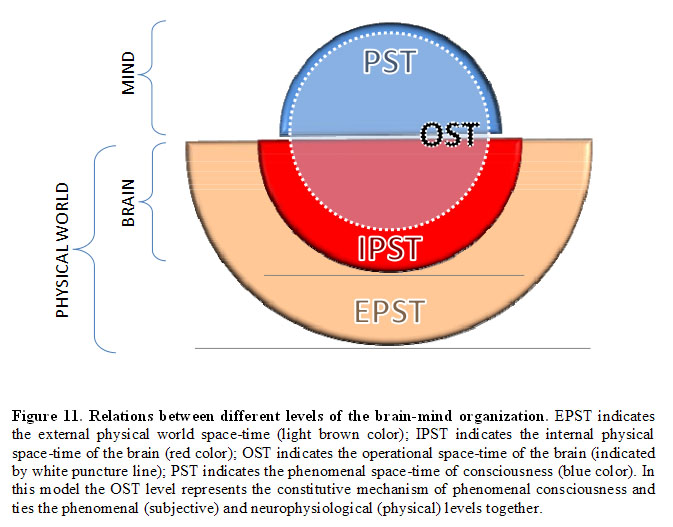

The first image is from a paper called Natural World Physical, Brain Operational,and Mind Phenomenal Space-Time. I haven’t read it yet, but from the looks of the image it seems like a step in the right direction. I have cannibalized their diagram to try to encapsulate the Multisense Realism model.
The bottom half remains almost unchanged, except for the removal of Time. In the original, the assumption was that SpaceTime is objectively real, but in my view this is an obstacle to understanding the relation between the public and private ranges of physics. The center of the bullseye then, in the modified chart, is the intersection of public space and private time, such that it reflects the ordinary sense we have of the public moment being infinitely fleeting so that the only remaining residue of any public moment is sustained exclusively through private memory. If we apply a strict literal read of public realism, the presence of the past is confined to a pure fiction of human sentiment. Past events must be inferred from material evidence and reconstructed deductively (forensics, archaeology).
The bottom half of the bullseye then recognizes this truth, that in fact public realism is devoid of temporal continuity, and exists as spatially nested bodies relative to the perspective of any particular private participant. The deeper into the IPS circle we get, the more the public structures of the brain are defined by electromagnetic and chemical activity which do not make sense without an inferred Time element. At this point, the EPT phenomenology similarly takes on its distributive spatial descriptions, such that private sensory affects are accessible as public motor effects. There is no transduction or homunculus translation, no cause and effect, the hypothesis is that there is a dual or multi-aspect spectrum of aesthetics.
The top of the bullseye is much more ambitious and experimental. I have rotated the private phenomenonlogy along a z-axis to underscore that sensory-motive experience is literally perpendicular or orthogonal to spacetime. The original diagram takes for granted that phenomenal consciousness should be considered to resemble space-time. It really doesn’t. To the contrary, our spatiotemporal memories merge seamlessly with imaginary places and times, or non-places and non-times. When we are sequestered from public interactions, we lose spatial and temporal continuity as daydream dissolves into dream or delusion and realism dissipates altogether. Significantly this total loss of realism is not generally missed. “Waking up” in a lucid dream, is typically not a cause of distress where we are terrified at having no idea where our body is, but tends to be very enjoyable and we would prefer to remain in the dream for as long as possible.
I apologize for the crazy looking bicycle gears look to the EPT and IPT, but I think it gives a hint of the kind of vast multivalence which would have to be included if we were to try to model visually the nature of private physics, which is implicitly anti-form and anti-function. (I call it Transrational Algebra or Apocatastatic Gestalt).
I have tried to give the impression of the presence of the past and anticipation of the future within what I call the ‘perceptual inertial frame’ known as ‘now’. Is now today? Is it last ten minutes? Is it 2013? Yes. It’s all of those things. The pointillised gears near the left hand side are labeled with a ‘memory’ bracket, indicating the complex nesting nature of temporal nesting. You can read these words without consciously remembering how to read English, but if you recall a particular memory, that gestalt can contribute to the feeling of the now, and can combine with other recollected associations, both conscious and subconscious. The nesting of meaning does not seem to have a finite capacity, and significance is constellated apocatastatically – as a rejoining of broken parts…increasingly transparent and reflective of other significant moments rather than dense and opaque with overloaded resource demands. This is just a fancy way of saying that our conscious experience is the tip of the iceberg of a vast reservoir of experiences which extends beyond our personal lives and into anthropology, zoology, biology, chemistry and physics.
On the far left is the legend showing the extension of private experience into public presentations necessitates an anesthetic gating or attenuation of sensory affect and motor effect. This is another fancy way of saying that public space is about defining limits to your private sense of omniscience and omnipotence…literally putting you in your place among countless local and universal agendas.
 Multisense Realism
Recent Comments