Archive
Non-Well-Founded Identity Principle
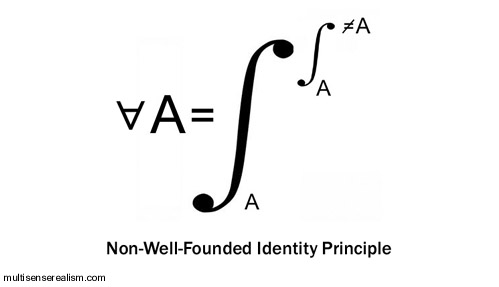
In an effort to clarify this concept, I wanted to add an update:
Edit 11/02/2018
The point of the Non-Well-Founded Identity principle is to characterize identity in a way which I propose is more accurate and makes fewer presumptions. Rather than following our scientific impulses to define all things in single, final ways, we can step back and instead integrate the full spectrum of epistemological and ontological nuances into our descriptions of math, logic, and science. What I propose here with the Non-Well-Founded Identity Principle is a redefinition of the identity principle to one which factors in the reality of perception, which I propose is not only a bottom up construction, but also a diffraction from the totality down. Unlike artificial intelligence, natural intelligence is kind of prism which opens up the ‘light’ of consciousness to its deeper nature, using both analytical steps and intuitive synthesis.
Rather than saying A=A (that everything is itself), I suggest that every phenomenon is:
- A spectrum of presentations/qualities/properties which can be said to be bounded on two ends.
- On one end, all things are bounded by a conserved identity. They are simply what they appear to be in whatever perspective and context they appear.
- On the other end, all things are a spectrum of resemblances/similarities/associations/dissimilarities that can be navigated poetically and reveal profound dimensions that echo the totality of experience.
In other words, rather than A=A, I propose instead that A equals a spectrum that runs from self equivalence (A=A) to a second spectrum of similarities that ultimately include diametric dissimilarity, i.e. running from A=A to A~!=A.
A= {the spectrum of identity running from A to (a nested spectrum of identity running from almost totally A to almost totally not A)}
This idea is extended further below so that “A” as a unit of identity is replaced by sense itself, so that any sense experience is a spectrum that runs from experience of a purely particular experience to the nested spectrum that runs from all particular experiences to all experiences to the particular experiences that define the sense spectrum itself.
End of update.
Beginning of previous article:
Here’s a crazy little number that I like to call the Non-Well-Founded Identity Principle. It woke my boiling brain up a few times last night, so I present it now in its raw state of lunacy.
The idea here is “For All A, A equals the integral between A and (the integral between A and not A)”.
This represents a refinement of trivial identity, A=A, to reflect the grounding of all propositions in the Absolute inertial frame of pansensitivity. The nested integral specifies that all integrations are themselves defined as that which is not disintegrated. Any object, subject, or sensory presentation or representation (A) is itself, and it is also the range of all possible relations, literal, figurative, and otherwise, between itself and all that is not itself (≠A).
This comes out of the idea that sense is the Explanatory Gap, i.e. the gap between private experience and public bodies is a non-well-founded set (non-well-founded sets contain themselves as members) in which primordial pansensitivity*defines its nested child sense experiences in a terms which are both unique, generic, and everything in between, depending on how the local perceptual inertia frames it.
*pansensitivity is plain old feeling, sensing, being and doing, but extended and universalized beyond Homo sapiens, as well as physics and arithmetic truth. Ontology itself – being; the is-ness and it-ness of all phenomena can be reduced further through the Non-Well-Founded Identity Principle, under which ontology becomes the nested gap between phenomenology and the sense of its own absence. This is a very tricky shell game, but it is not intended as a trick or a game. Said another way, ‘privacy is the difference between privacy and the difference between private and public experience.’
Applied to philosophy of mind, we would get: Naive realism equals the difference between naive realism and (the difference between naive realism and reductionism). Another one would be Sense equals the sense of the difference between the sense and (the difference between sense and logic). It could be said that X=/(=/≠) X, so that any number is a straight isomorphism with itself, but it is also a superposition of any potential combinations with or relativity upon any and all X that it is not.
The reductio ad absurdum can be seen in this second expression:
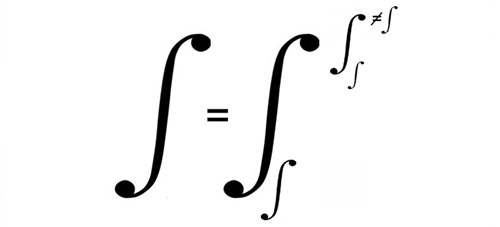
in which integration itself is the integral between integration and disintegration. Every set or process is defined by its own self-same initiation and termination.
Is this all insipid tautology? Is it another way of catching a glimpse of Heisenberg uncertainty or Gödel incompleteness through a fun house mirror? I don’t know much about calculus, so there may be a more conventional way of expressing these kinds of relations, but in the mean time, to me, it’s an absolutely interesting way of modeling the absolute: A universal capacity to simultaneously universalize and de-univeralize (proprietize) the universal experience.
Charting It All
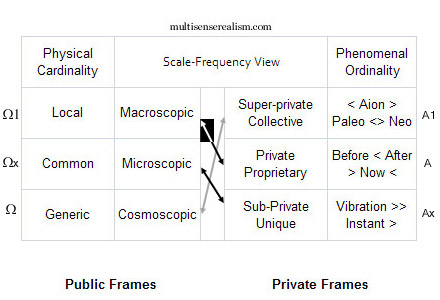
In an effort to provide a more straightforward view of pansensitivity and eigenmorphism, the chart above organizes all phenomena in the cosmos by scale of publicly extended body length and frequency range of privately experienced times. Going left to right (Metaphorically, Occident to Orient), the first and second column denote the public, physical scopes (perceptual inertial frames) according to cardinality and size. The bottom left frames (Ω) correspond to the outermost types of physical phenomena, i.e. absolutely gigantic or absolutely infinitessimal. This reflects the aesthetic intuition by which the atom comes out having more in common morphologically and dynamically with a solar system than a tree or coral reef, despite being at opposite ends of the scale of our awareness. The Ω range of frames is the envelope of physicality, where physical and mathematical ‘laws’ meet the most universally public perceptions.
Our awareness is extended technologically, which broadens our view of the public universe, however, since the awareness being extended is primarily visual and somatic (‘tangible’-kinesthetic rather than tactile), the telescoping of our sensory awareness is also narrowing our depth of field within the private (phenomenological) side of physics. My conjecture is that because of the nature of perceptual relativity, the more we focus on the the outer contexts, not only do we not see the private experience in the universe on these distant scales, but also our entire worldview will, by default, adjust to recontextualize the local experiences of the self. The fallacy of the instrument (if you have only a hammer, everything looks like a nail) might arise through this kind of empathetic feedback loop. This is likely to extend into so-called ‘supernatural’ phenomenon, which explains the increases in magnitude, frequency, and connectedness of coincidence experienced by subjects through altered states of consciousness. The higher up on the right hand column, the more large patterns of synchronicity, with deeper resonance (A1) are available for direct personal experience (A).
By contrast, the lower down on the Oriental, right hand scale we go, the more the needle of synchronicity tips toward mere statistical coincidence and the more top-down intuition, imagination, and eidetic narrative are collapsed into the stepped logic of bottom-up causality. The numbering schema is confusing, but intentional. The use of A in the middle row on the right side denotes that sense is always anchored centripetally. Perceptual capacity radiates as a range, often a literal circular, conic, or spherical perimeter, of awareness, but also sensitivity radiates figuratively as nested channels or layered modalities of sense.
The use of A1 and Ax above and below A respectively, implies the hierarchical pull from the superlative top, down to the personal, and the plummet from the personal middle down to the bottom. Ax would be the opposite of A1; insignificant, low status, shame and indignity. Looking at the Left side of the chart, the numbering scheme is even more confusing, but it is to emphasize the multiple levels of opposition that characterize the public and private aspects of physics-sense. The A1 range is the most universal private experience, (the ultimate being experience itself), which is meta-phorical. Experiences are associated to each other through metaphor, with the most tightly isomorphic metaphor being imitation or repetition. The higher up on the A column we go, the more latitude there is in recognizing common associations. Pareidolia and Apophenia are examples of having the aperture disproportionately dilated to the super-private, which becomes unsupportable within human society (delusions of grandeur, ideas of reference, mania, etc.)
Back to the Omega column on the left, the Ω1 is a different kind of magnificence than the private rapture of the Absolute. The public side is not centripetally oriented, but linear and circular. There is no radiant center, only jumps and slides. The Alpha/Aleph side in the East fills the gaps, it infers and elides, it puts two and two together. The Ω1 is mutation and fluke. Unintentional singularity. Its uniqueness is simply an inevitable accumulation of imperfectly repeating behaviors, so that the wonder of biology through evolution can be examined correctly in Darwinian terms. These are terms of the exteriors, however. Regardless of how complex and convoluted the patterns, they are patterns of insensitivity rather than awareness, automaticity rather than authenticity. This is individuality from the outside in – stochastic, social, generational rather than individual.
The cells of the bottom row have as much in common as the cells of the top row are polar opposites, but they are also skewed (this is what the arrows in the center are supposed to mean). This is what I call eigenmorphism. A to Ω1 has a half-black, half-white arrow, showing the relation between the human mind and its homid body. This is a maximal polarization, or so it seems to us. The black arrow from the Microscopic Ωx to the Sub-private Ax have in common the x, connoting the strong relation between mechanical appearances on the molecular level and the recursiveness of awareness in its least signifying, quantitative form. This is contrary to the idea that vibrations or energy are what we are, rather vibrate is what the various parts of our sub-private experience do – jiggling or wagging from position to disposition, from incident to co-incident.
The grey arrow from A1 to Ω points to what I call the profound edge of the continuum. This would be the level at which the Totality is an unbroken, Ouroboran monad. This is what happens ‘behind our backs’, hypnotically through evanescence. It is significance reclaimed and re-membered after having been diffracted into the entropy of spacetime. By contrast, the black and white split arrow corresponds to the ‘pedestrian fold’ – the level of the monad which appears most polarized and least evanescent – the terrestrial aesthetic of ‘ordinary’ experience.
In the top chart I have limited cardinality to the public side and ordinality to the private side to show the relation between morphic scale and phoric frequency. Privacy runs first to last (ordinal), publicity places astronomically numerous to few (cardinal).
Compare with Frame Set View:

Two-photon interferometry and quantum state collapse
From the paper Two-photon interferometry and quantum state collapse:
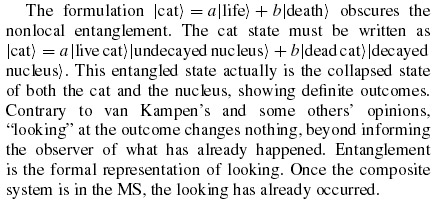
“In short, for ideal measurements both experiment and standard quantum theory imply an instantaneous collapse to unpredictable but definite outcomes.The MS [measurement state] is the global form of the collapsed state with no need for a separate “process 1” or measurement postulate. The other postulates of quantum physics imply that, when systems become entangled, their observed states instantly collapse into unpredictable but definite outcomes. In particular, Schrodinger’s cat is in a nonparadoxical definite state, alive when the nucleus does not decay and dead when it does. This solution of the problem of outcomes requires no assistance from other worlds, human minds, hidden variables, collapse mechanisms, collapse postulates, or “for all practical purposes” arguments.”
I think that this is a promising study which gives support to the MSR model. Once we take the step of questioning whether there can be any such thing as measurement which is other than a kind of ordinary sensory-motor interaction (even if it is microphenomenal),the hard problem of consciousness and explanatory gap disappear.
Seeing that it is the capacity to feel which, through its interruption, gives rise to the sense of touch, and it is the sense of touch which gives rise to touchable things rather than the other way around, we should take the opportunity to go back and reinterpret all of the particle physics of the last 50 years – not because it is wrong, but because it is right for the wrong reasons.
If photons sense each other, how do we know that photons themselves are anything more than atoms sensing and instructing each other? This study fits with a model of the universe in which all phenomena throughout eternity is, on one level, a simultaneous sensory experience. Within the solitude of that Absolute experience are miniature versions of the same, (such as our own human individual sense of conscious solitude). In the polarization-derived ‘spaces’ or ‘gaps’ in between these homing-monads, cat-experiences and atomic-experiences take their marching orders from each other’s presence, represented as localized ‘homing signals’. Cats and atoms alike, since they are ultimately but frozen appearances within some nesting of the global nature of sense itself (the Absolute), also receive intuitive influence from the overall event of the total interaction.
Instead of seeing photons as the foregrounded units, all of the evidence seems to point to the idea that the opposite might be true. As Hobson mentions, “The photons “knew” each others’ phase angles, despite their arbitrarily large separation. This certainly appears to be nonlocal, and indeed, the results violate Bell’s inequality, verifying nonlocality” The so called measurement state would make more sense as the fundamental capacity of the Absolute to pretend at photon, atom, or dead cat forms. This paper takes the step of entangling the outcome of the cat and the outcome of the particle’s decay with the overall measurement state. I think a good next step is to entangle the entire presentation of cats and particles and even ‘outcomes’ to the participant’s sensory nature. It’s all entangled, even entanglement itself. In our case, as human beings, we sense cats more directly than we can sense a particle’s decay, but not as directly as we can make sense of our own thoughts and feelings about them.
Primordial identity pansensitivity (PIP) is the proposition that the capacity to experience, to participate perceptually is the ultimate irreducible universal. In Kantian terms, the sole synthetic a priori. In relativistic terms, the maximally inclusive inertial frame. Other philosophers have used terms like Absolute, Totality, Transcendental Signifier, and Supreme Monad.
The difference between PIP and theism is that PIP does not presume a human-like, or entity-like subject associated with the Absolute. Neither is it presumed that the Absolute is a field, force, vacuum, or information-theoretic phase space. The Absolute is neither local nor nonlocal, but rather the parent of that distinction, and therefore orthogonal to it .
Under PIP, the Absolute is understood to be the meta-phoric firmament within which the three ‘verses’ are diffracted. The three verses, following a Hegelian-type dialectic of thesis, antithesis, and synthesis* are phoric (directly experienced), morphic (embodied presence), and metric (abstract relation of the other two verses). In one sense, the Absolute is more closely aligned with the phoric+morphic, i.e. the collection of all presence with no absence.
From this there is a sense of omniscience, as all times and places would be ‘here and now’. Take the universe as we know it, multiply it by eternity, see all of it from every perspective possible, and remove all of the space and time from it and we would have the PIP absolute – a timeless everythingness which transcends the difference between novelty and repetition. If mortality is marked by an unbearable lightness of being, in which all experience is either meaninglessly fleeting or meaninglessly repeating, the immortality of the Absolute is marked by an unbearable saturation of meaning. All is absolutely unique and absolutely generic at once.
Ordinary sense is, on every level, what diffracts/diverges/disentangles one state from another, and one level of sensory interpretation from another. The sensation is the fundamental physical presentation, the measurement of alienated sensations (measured as photons, atoms, bodies) is derived representation. Notions of space, time, and information are meta-representations – concepts and abstractions, which themselves reflect the unity of the Absolute, but in a skeletal and figurative way.
*note that the dialectic itself is a metric abstraction which cannot be directly experienced or embodied. The actual thesis which physically exists is the phoric thesis: sensory-motive-time. Matter-energy-space is the morphic antithesis. Entropy-Significance-Aion (eternity) is the synthesis.

Superpositioned Aion Hypothesis

Above, an ankh appropriated from here, superimposed on the MSR diagram. I have included Sense and Motive, reflecting the circuitous, super-personal nature of the Aion/Eternity (collective/Absolute sense) and the cross of what Bennett calls ‘Time’ (I call personal sensory awareness) vs what he calls Hyparxis (“an ableness-to-be”, aka motive participation).
“The English philosopher John G. Bennett posited a six-dimensional Universe with the usual three spatial dimensions and three time-like dimensions that he called time, eternity and hyparxis. Time is the sequential chronological time that we are familiar with. The hypertime dimensions called eternity and hyparxis are said to have distinctive properties of their own. Eternity could be considered cosmological time or timeless time. Hyparxis is supposed to be characterised as an ableness-to-be and may be more noticeable in the realm of quantum processes.” – source

- Aion and Gaia with four children, perhaps the personified seasons, mosaic from a Roman villa in Sentinum, first half of the 3rd century BCE, (Munich Glyptothek, Inv. W504)
The word aeon, also spelled eon, originally means “life” or “being”, though it then tended to mean “age”, “forever” or “for eternity”. It is a Latin transliteration from the koine Greek word (ho aion), from the archaic (aiwon). In Homer it typically refers to life or lifespan. Its latest meaning is more or less similar to the Sanskrit word kalpa and Hebrew word olam. A cognate Latin word aevum or aeuum for “age” is present in words such as longevity and mediaeval. source
The universe seems to want to be understood both in two contradictory presentations:
1. As the timeless eternity within which experiences are rationed out in recombinations of irreducible elements.
2. As the creative flow of authentically novel experiences, whose recombination is impossible.
If we can swallow the idea of superposition on the microcosmic level, why not the astrophysical-cosmological level? Whether the universe seems to be gyrating in a direction that paints your life in a meaningful and integrated light, or it has you struggling to swim against a sea of chaotic scorns is as universal an oscillator of probabilities as any quantum wavefunction.
These fateful cyclings of our personal aion are reflected also in the micro and macro of the Aion at large . With the unintentional dice game of quantum mechanics flickering in and out of existence far beneath us, and fate’s private wheel of fortune seemingly spinning in and out of our favor intentionally just beyond us, the ultimate superposition is that of the eternal and the new.
How can the universe be a relativistic body in which all times and spaces are objectively present, and an expanding moment of being which not only perpetually imagines new universes, but imagines imagination as well? Why not apply superposition?
“In physics and systems theory, the superposition principle, also known as superposition property, states that, for all linear systems, the net response at a given place and time caused by two or more stimuli is the sum of the responses which would have been caused by each stimulus individually. So that if input A produces response X and input B produces response Y then input (A + B) produces response (X + Y).” source
The universe is generic and proprietary, eternally closed but momentarily open and eternally open but momentarily closed. It/we are always changing in some sense, but remaining the same in every other. Within the Aion, all opposites are superpositioned – bothness, neitherness, and only-one-and-not-the-other ness.
Multisense Tree of Life

Multisense Tree of Life
I noticed that this formulation was starting to take on Kabbalistic dimensions, so I put it into that form. There’s some new propositions to consider here that have come out of this. Beginning with sense, which I symbolize as -ℵ (negative Aleph) and as =. This is the fundamental concept of MSR and the idea of ℵ in mathematics as cardinality fits with this definition, since equality ‘is equal to’ anti-cardinality. Sense is the unity which underlies all multiplicity, so that it can indeed be thought of as a kind of negative cardinality – not unity, but pre-cardinality.
Moving up and to the right from sense, there is Qualia, now defined as -ℵ/ש (Aleph over Shin), where ש (Shin) refers to the diffraction of the Absolute ॐ (Om). This means that Q = -ℵ/ש or, private sense is the sense of a share of eternal being – it is “a” being. In Leibniz terms this is a monad, and it is also the origin of origination, and of the number 1. From these two entities, we have the two parts of the Absolute, which mathematically would be “=1”. Eternal being is the likeness of a being, i.e. the ability to pretend. (Insert Joseph Campbell’s myths and Carl Jung’s archetypes, shamanism, imagination, etc..,) Fiction is ‘like something’, just as Qualia is what it is like to be, or what being ‘seems like’.
Rounding out the primordial trinity from sense along with Qualia is Quanta and Motive. I call the Absolute ‘Qua’ to symbolize its relation as the reconciling parent of Qualia and Quanta. Quanta (ω, lower case omega), here meaning the essence of computation, is given the formula √(ℵ),(root of Aleph). This works surprisingly well. Originally I was going with 0.00…1 and then 0.x to represent Quanta, to specify that Quanta is always the tiniest fragment of Qualia – the drive toward absolutely monotonous precision, but always beneath the threshold of unity, of wholeness. All quanta are parts and abstractions; information-theoretic rather than aesthetic/sensory-motive.
This ended up working well with √(ℵ) (root of Aleph) as it makes clear the complementarity-antagonism with Quanta and sense. Computation is the essence of cardinality, of difference. The stepped reckoning of mechanism is an impersonation of sense, it has no capacity to negate the separations and to build feeling from fragmented quantities. Since negative Aleph (-ℵ) corresponds to 1, then Quanta would be the square root of -1, or i. I used the symbol >.< as well, to denote the clipping of sense through measurement: digitization. Quantification is fantastically useful because it paralyzes whatever it fixes its gaze on.
Motive, the third leaf of the sense trinity, has the formula ℵ±ש (Aleph plus/minus Shin), which emphasizes its similarity to Quanta and Qualia but with an irreducible difference, will. Will is the ± (plus/minus) which requires a participant to end what sense started (thus the use of Ω, Omega). To have a motive is to de-cide, to kill off all options except one. This is the ‘waveform collapse’ of QM, but it is also ordinary ‘free will’. Will is the connection between unconscious cardinality and the Absolute. We don’t know how to make our body move or our how to focus our mind’s attention, we simply become our mind or body and the universe does the rest. There is a cost to our efforts, however. In the drive toward Significance (Solitrophy, Φ), entropy is born.
The unchosen path of Motive becomes the unintentional twin of Significance. Significance, -ℵ² (Aleph squared), while mathematically would equal ℵ (Aleph) as 1, there is an irreducible numinosity to the power relation. Significance holds Q not only as the sense of one quality out of the Totality (ש) (Shin, Qua) but it holds one Q as equal to any number of qualities or meta-qualitative relationships. This is semiotics. Not just = but =². Not phoric (sense) but meta-phoric. Quanta is not phoric but metric – it takes the ² nesting of Significance (Σ) (Sigma) but negates the feeling, leaving only the essence of that figurative quality. Significance is sense squared, Quanta is the square root of pretend sense, the meta-phor is inverted. Figurative language is loose. It draws from associations from within the Totality. Quanta is the opposite, drawing from strictly disambiguated logic. It has no phoric or morphic content, no feelings or forms, only the skeletal coordinates associated with them.
If Significance is like the universal bank account of metaphors and of experiences which have meant something in particular, then Entropy is the compost heap of all of the unchosen and unchoosability in the universe. It’s symbol H is taken from Shannon’s Information theory, and its formula here is ॐ/-Ω, (Om divided by negative Omega). Using the ॐ Om rather than the ש Shin is to emphasize that this relates to the ‘return trip’, the catabolic, arterial part of the cosmic circulation. Shin has more of a sense of the diffraction and creativity of the whole. With Entropy, it is the Totality’s raw, untamed nature which is divided by negative motive. This correctly applies to the nature of Entropy as indifferent, literally and figuratively. No motive. This is where the universe doesn’t care.
Between H of Entropy and Σ of Significance winds the Φ of what I call Solitrophy. Solitrophy is what makes the difference between something that can care and something that can’t. Burning a pile of garbage and burning down a town might produce the same amount of energy and entropy, but burning down a town has a human cost which doesn’t show up on a spreadsheet. As aesthetic significance accumulates, the range between one outcome and another increases. A human being has more at stake, simply by being a human being with a vastly rich aesthetic experience, than it seem like an ant has, or even an anthill. Solitrophy describes this great anchor of all sanities, and builder of worlds (I call them, perceptual inertial frames or castes).
This leaves Matter, Energy, and Qua itself. Matter and Space are listed together, as are Energy and Time. This is to emphasize their relation in MSR, teasing apart their differences rather than conflating them relativistically. The difference between time and space is Solitrophic. It doen’t show up in physics, because physics, by definition is conducted to reduce Solitrophy to an absolute minimum. Physics is asolirexic. Here. Space is defined ω+H and Time as ω*Φ, so that space is about entropy’s quantitative expansion and time is about the quantification of the growth through Solitrophy. The effect of Quanta on Φ is to limit the ‘size of the now’ – the frequency and range of memory of any given participant. Space and time are perpendicular, so that all of eternity is represented spatially by Quanta’s filtering of sense, but that representation is a vanishingly thin slice. Space, by comparison, allows access to the entire continuum of scales which have been accumulated through Solitrophy, but not in a way which allows us to experience it directly.
Matter’s formula is Σ*H, describing mass – the significance of Entropy. As everything is reflected and juxtaposed within MSR, Matter, mass, and space are aspects of the same thing, They are the unintentional, automatic consequences of all spatial scales, collapsed into a single scale. That’s how you get bodies which collide on one inertial frame, but pass right through each other if they are relevant to vastly different scales. This is obviously a rule of thumb – just a way of understanding how space is really an artifact of matter’s sense of its own non-sense and how time is about how functional tropes (routines), constrain and define energy. Energy, therefore, has the formula Ω ± ω (Omega plus minus lowercase omega), with Ω being Motive, now here given another nesting (Ω is already ±. so Ω ± is ±±) and ω being Quanta. Energy is a motive to motivate, or perhaps from to motorize, i.e. to translate a private effect publicly. The Quanta here emphasizes that this translation from motive to motor involves modulating both the frequency and the amplitude of the effect. Energy turns motive effect into work and power.
Finally, the crown of the tree, is Qua. I have covered this a lot already, but here the relation between sense, Qualia, and the Absolute can be seen. If sense is =, and Qualia is 1, then the Absolute is ‘=1’. The inclusiveness of the Absolute is total. It is the largest possible inertial frame. Our personal experiences are part of the whole, and the whole is every part of us.
MSR Legend 3
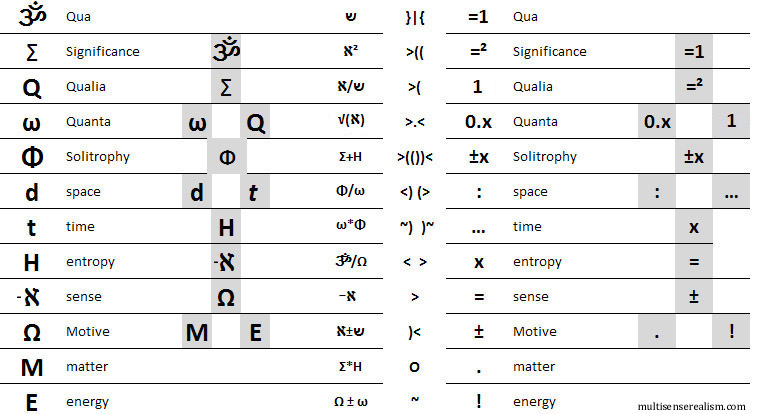
One more of these for tonight, as i’m still in a semiotic frenzy, as I’m sure you can tell.
What is Information? Reality as Information – Is there Intrinsic Meaning? Sentient Life & Bits
Dolors Jou Torras: I think all one needs to do is redefine information and then it all clicks into place. Information: a perceived difference that can make a difference. You start with an awareness of a difference (reality differentiating itself and becoming aware of it). Then you move on to an awareness of a difference which in turn makes a difference (this awareness of differentiation enables learning, growth, knowledge, etc).
At some point this ability to perceive a difference becomes able to not only perceive a difference (of states) but can also perceive a difference in such a way that order can be assigned (as in before / after). Time is born – or rather, it evolves (= the ability to perceive a difference + assign order and duration).
You escalate this ability to perceive differences, etc, to an information field which can model consciousness (consciousness being defined in line with self-awareness, ability to self-modify, intelligence, ability to evolve, etc).
Then you get to the point where “physical” universes can evolve (within consciousness “space”) and so space-time and matter evolve… This goes hand in hand with the evolution of individual conscious observers experiencing this physical universes
So the paradigm goes like this: information—> consciousness & time —> laws of physics—> individual observers + space-time & matter
Craig Weinberg: I agree with what you are saying, especially the part about adding the qualifier of “a perceived” to “difference”. I would say though that that makes this capacity to perceive more fundamental than what is perceived. Even if we understand that of course information must be perceived, I still think that the word information carries an implicitly objective connotation. All that information can be is an experience in which some sensory context is informed. This capacity to perceive is already awareness, so that even though we could say that the term ‘consciousness’ refers to an awareness of awareness, I don’t see that such an awareness requires any information at all. All that is required is a quality of awareness in which the presence of awareness is felt. There is no feeling of the absence of awareness, so it is not a matter of discerning a difference or being informed about anything, it is simply an expectation of persistence and participation.
I like to break down the word information into three parts: “in” (which is input-output of sensory-affect/motor-effect), “form” (which is material shapes divided by space), and “ation” (which is recursive functions united through time). Where we are at now I think is to overlook the “in” part entirely and treat formations as the primitive context, when in fact the formations are the objects of appreciation and participation of the true primitive capacity for sense.
Dolors Jou Torras: Defining information and consciousness differently is what makes the descriptions of what is ultimately primary different… I completely understand what you are saying, when I put myself inside your theoretical framework Don’t disagree at all, but I can see that it all boils down to the precise details of how one defines information, awareness, consciousness and so on.
Craig Weinberg: Yes, for most contexts it is more useful to talk about information in the traditional sense. I think it’s only when we need to really get a maximum close up on that boundary between firstness and secondness or between the front and back end of the snake who is eating its tail. We are very much on the same page about the semiotic relation. I would suggest to consider that information is not non-physical, so much as physics is experiential and information is part of experience.
What makes an experience seem ‘physical’ is that it is out of bounds of our intimate sensory range. That which is too fast, too slow, too large, too small, or too unlike us in another sense is experienced in increasing degrees of dissimilarity to experience. Experience is the sense of who we are and the motive of why we do what we do, but matter is bodies nested within larger bodies. Matter is the what and how, the re-presentation of first person presentations.
Information is when one level of experience exploits another, more distant (and therefore more matter-like; discrete positions, subject to public inspection, etc) level. We take a sheet of cellulose molecules, which on their own level are holding on to each other, oxidizing slowly, etc and we inscribe a quantity of ink (also an experiential reality on its native fluid-molecular level). This inscription can be modeled as a trade off of entropy, we are fixing our private ideas and expressions on various levels, conscious and subconscious in public spacetime. Public spacetime freezes private sense into public form and private motive into public function. The information entropy of the writer’s idea is discharged in the act of writing, a process to be revisited in reverse when the reader understands what has been written. The low entropy signal of the written word is traded for an aesthetic entropy increase in the reader’s experience – they imagine, they think, their mental experience reverberates and ‘warms up’, creating novelty and creativity. This is significance. Significance lights up previous memories and pulls them together, bringing a sense of integration within. (Understanding = entero-standing…inner settling).
information is not physical in the sense that the effect of being informed is experiential, but information media is physical, which means that it is down-rev experiential, so to speak. We use experiences which are dumber and smaller than we are to carry our messages. Thinking of it this way brings matter, mind, and meaning together as one ecosystem of sense-making.
Dolors Jou Torras: I will cover the physical vs non-physical debate in another video soon, but defining information as essentially non-physical has to do with several factors:
– I relate information to qualia (perception, experience)
– That in this “physical” universe, in general we need to embed or engrave information in physical matter or energy via symbols or signs, does not make information itself physical.
The laws of physics do not preceed information hence information is not bound by physical laws (information is primary)
There is compelling evidence, in my opinion, that non-local effects point in the direction that our physical universe (space-time plus matter) is a subset of a larger reality. What is “physical” is a moving target
Information (in theory) can be used as a basic currency to describe any reality, not only what our current physics can describe (or is attempting to describe).
Information therefore can be used to move away from duality… “Physical” vs “non-physical” is not a matter of substance dualism; these are purely subjective terms that we mostly associate with what our current science can measure with its instruments.
Craig Weinberg:
“defining information as essentially non-physical has to do with several factors:
– I relate information to qualia (perception, experience)”
I agree in the conventional sense of ‘physical’, information would be non-physical, but I think that in an absolute sense, the physical and non-physical can only be different perspectives (private-facing and public-facing orientations) of the same thing. What I am trying to pioneer is the idea that this thing is sense: the universal capacity for aesthetic participation, aka the capacity to generate, experience, and appreciate qualia.
“- That in this “physical” universe, in general we need to embed or engrave information in physical matter or energy via symbols or signs, does not make information itself physical”
Right, symbols or signs are independent of matter, but not independent of the capacity to experience (sense). A particular piece of information, such as a page in a book, can obviously exist without my experience of it, but it cannot exist without some capacity for interpretation somewhere in the universe.
The question that I put to you, however, is ‘can awareness exist without information?’. I think that it can. I think that a feeling need not inform us. I think that information is always a reflection or representation of sense, and never the genuine presentation itself. Eating a meal is not simply an information processing event where knowledge of nutritional conditions are stored in the body and in our understanding, it is a concretely visceral, mouth watering, chewing, gobbling, licking, swallowing orgy of sensual participation. We can extract information from the experience, but when we do, that extraction is inevitably reductive. It is an accounting of events from a hypothetical voyeur’s perspective rather than the genuine and indispensable experience.
In my view, qualia is not a representation, it is a presentation – an aesthetic presence. Information is a particular kind of qualia, a presentation in which another presentation has been abstracted as an a-signifying, quantifiable figure. Such a figure is public-facing and communicable, so long as the receiver of the communication can re-signify some of what has been frozen as a spatial-form/temporal-function.
“The laws of physics do not preceed information hence information is not bound by physical laws (information is primary)”
Because you are including the aesthetic experience of information as information, I agree with you here too. Matter-Space/Energy-Time would be types of information (Form-Sense/Function-Motive). If we conflate information with sense, however, then we would have to explain why sentience does not emerge from information itself. Why can’t we write a story which has feelings itself? Why do we react unfavorably to impersonated entities like mannequins and automatons (uncanny valley effect)? Part of my contribution here is to get very specific and show how the relation between sense, information, and matter can be juxtaposed to yield unity or contrast but that sense is the essential commonality. Information can be forged and copied, it is generic and implicitly impossible to truly own. Sense is absolutely proprietary and authentic, ineffable, unreproducible.
Information is the manifestation of the intention to circulate publicly, but sense is the private anchoring of a disposition between the sensor/self and the universe. This opposition relation of sense and information is recapitulated and exteriorized as the relation between matter and energy, and matter-energy/space-time. It’s the same theme of reflection through orthogonal juxtaposition. It’s very tricky of course, because we can toggle foreground/background from any perspective. Einstein grabbed mass-energy and it gave him space-time. If you grab information-sense, it gives you physical machines and non-physical machines. My proposal is to grab sense-motive and get all of the others: form-matter-space::function-energy-time. Square that and you get public entropy::private significance.
“There is compelling evidence, in my opinion, that non-local effects point in the direction that our physical universe (space-time plus matter) is a subset of a larger reality. What is “physical” is a moving target”
I agree completely, although I think that the larger reality is the sum-total of all sensory experiences in the history of the universe. The larger reality is experiential while space+matter is a frozen slice – a tokenized representation of part of that reality as experienced from a particular perspective and presented as a public context. Physical to means only that something is intended as a concrete presentation rather than a pure representation. The idea of a train is physical, in the sense that ideas are physical experiences, but the train which is confabulated within the idea is not physical. Non-local? Certainly. Locality is a low level sense protocol. I think that’s part of what the atoms are doing on the microcosm, sending each other messages (we call quantum) to generate locality through spacetime coordinates. The universe is inside the big bang/Abolute, and all space is a presentation within it’s sense.
“Information (in theory) can be used as a basic currency to describe any reality, not only what our current physics can describe (or is attempting to describe).”
Yes, but only if you are assuming that information includes sense. Think of how the same information on a DVD can be heard as music or seen as a video though. A computer reads that DVD anesthetically, as data. Low level electronic sensation in all likelihood, but the data is not giving the DVD player an experience of watching a movie.
“Information therefore can be used to move away from duality… “Physical” vs “non-physical” is not a matter of substance dualism; these are purely subjective terms that we mostly associate with what our current science can measure with its instruments.”
Yes, in the absolute sense, but if we don’t explain that subjective polarization and connect it to public and private presentations, then we have not really explained the universe that we live in. With my view, all dualisms, monisms, and multiplicities fall out naturally from the capacities of sense and motive to diffract entropy spatiotemporally and recover significance experientially.
Universal Schemas, Eternal Schisms
Having been introduced to Kent Palmer’s General Schemas Theory on Quora, I noticed some interesting overlap with my own under Multisense Realism*. In particular his use of a The paper identifies an emergent ontological hierarchy (of schemas) as follows:
· Pluriverse
· Kosmos
· World
· Domain
· Meta-system
· System
· Form
· Pattern
· Monad
· Facet
The paper also identifies an ontic hierarchy: “which might include gaia, social, organisms, organs, cells, molecules, atoms, particles, quarks, strings”. The paper goes on to explain that “any of the ontological schemas can be applied to any of the ontic hierarchy thresholds”. This is a very point, and while I have not explicitly talked about it in MR, part of the multi-sense aspects of implicitly includes this kind of portable mereology which applies to the continuum of public physics.
I’m not convinced that the ontological hierarchy terms he suggests are as different from each other as is implied…is a pattern different from a monad or form? Is a world something other than a meta-meta-meta system? My sense is that whatever qualitative differences are implied by this hierarchy are leaking in by association with the ontic hierarchy. We talk about worlds because we have the example of planets and forms because we have the example of macrocosmic objects that we can see and touch with our body.
I like the idea of the ontic vs ontological hierarchy and hope he doesn’t mind if I borrow it on occasion. I would describe the ontological hierarchy as a generalization of the ontic hierarchy such that the overall shape and design of public physics is preserved as an abstraction which can be applied to any level of any nested hierarchy. What separates the levels in the first place is a slightly different matter, one which I hope Multisense Realism helps illuminate: Science should not take these ‘leveling’ breakpoints, in which there is an aesthetic shift of attention from a complex multiplicity to a higher order of simplicity.
This shift does not happen out in space somewhere, it is not an objective mechanism, rather it is a natural relation of coherence which emerges from participants and parts as much as it is recovered from the whole. This spectrum-like quality of aesthetics is universal and is, in my view, the backbone of the cosmos – it is Sense in the grandest sense; a sanity which is truly uni-versal. I suspect that this unity of all ‘verses’ is what multiverse theories fail to factor in, as they neglect to investigate the role that wholeness has in experience and what role experience plays in the whole. I would therefore feel comfortable in clipping off the Pluriverse level of the ontological hierarchy.
The MR version of the ontological hierarchy seeks a purely quantitative sense:
· Meta systems (Mega-system, Giga-system, Tera-system…)
· System
· Root systems (micro-system, nano-system, pico-system…)
However, in addition to the ontic hierarchy, MR offers a perpendicular conjugate holarchy which relates to interior, qualitative phenomena. The physics of privacy is seen not as a parallel dimension to public physics, but rather that the continuum of sense is an Ouroboran monad in which endophoric and exometric polarities are only one of the fundamental discernments. The ontic schema of Multisense Realism is a matrix that ‘eats its own tail’ as well as pairs up the largest and smallest levels. The reason that the largest and smallest levels are paired is to reflect the order in which systems have been established. Rather than a chain of events on the micro level leading to cosmological scale events, it must be understood that without a human scale orientation to divide and compare against, the two scales are the same thing.
I propose instead that the evolution of the Cosmos or Kosmos (please stop me before I use the word Qosmos) is a ‘tunneling within’ nested systems, so that the outermost systems are the most distant from our human privacy. Regardless of the scale difference, our understanding of astrophysical meta-systems (Cosmos, Galaxy, Solar System) has a lot in common with our understanding of nuclear physics (atom, quantum, strings). The modeling of both relies on the same mathematical and logical principles, the same assumptions of eternal force-relations and statistical laws. The Western physical approach to both cosmology and microcosmology is identical and presents a united front of impersonal mechanisms. This outermost frame is generally considered to be the sine qua non of science and engineering. All causes and conditions are presumed to follow from the presence of these initial ontic realities and ontological-mathematical principles.
The first order of business then is to wrap the maximum and minimum ends of the schema around, so that the meta-systems of astrophysics meet up with the root-systems of nuclear physics. Notice that the phenomena are entirely related as well. We smash the smallest particles in the largest particle accelerators. The chain reactions of nuclear fusion, which a nearly instantaneous and of course infinitesimally small generate the largest and longest lasting events. This is important because it establishes the principle of perceptual relativity. It’s not merely that things are too large/slow or too small/fast for us to relate to directly, it’s also that the too large-slow/small-fast phenomena are the same things. To get to phenomena which we find familiar, we have to go to the mid-range, to phenomena which last between 0.1 seconds and 24 hours. This kind of range in which direct human perception is appropriate.
To link the meta and root schemas then (and this is for the public facing ‘exometric’ ontic hierarchy) I would offer:
Exometric Ontic Schemas
- Astrophysics ⊇ Quantum Mechanics
- Geology ⊇ Chemistry
- Evolution ⊇ Genetics
- Zoology⊇ Biology
- Anthropology⊇ Sociology
- Neuroscience ⊇ Cognitive-Science
The corresponding revised ontological hierarchy then would be:
Exometric Ontological Schemas
- Maximum ⊇ minimum
- Tera⊇ pico
- Giga⊇ nano
- Mega⊇ micro
- Meta⊇ root
- System/phenomenon
Another change that I would add is to recognize that these hierarchies of external metrics are meaningless without internal experiences which yoke them together along the transverse axis. Every real, whole phenomenon has its roots in the outermost aesthetics of physics (1.) and the innermost idiosyncratic aesthetics of its own experience (6.) The continuity between the two, and the correlation of that continuity with uniqueness and privacy is the perhaps the most revolutionary idea within MR. That uniqueness itself is a physical property, a strange attractor of significance which is perpendicular/orthogonal to generic-cardinality-entropy is radical and exotic at first, but I do suspect that this is the Holy Grail to integrating consciousness with matter. Awareness looks up and down through the nested external hierarchies, as well as within its own internal histories (in the case of humans at least).
Because of the perpendicular symmetry between public and private schemas, private schemas are not only different from public schemas, they are fundamentally different in how they schematize. Public systems are forms and functions which are literally nested within each other by scale. Forms exist within the physical boundaries of other forms and functions are sequential processes which are composed of sub-functions, steps within steps which are timed to different orders of oscillatory magnitude. Private experiences are not only steps and structures but the are the appreciation of phenomena. Experiences inhabit other experiences in ways which are not mathematically well-founded. We can apply a loose, meta ⊇ root hierarchy as follows:
Endophoric Ontic Schemas
- Absolute⊇ Sense
- Archetypes ⊇ Qualia
- Intuition ⊇ Emotion
- Significance⊇ Instinct
- Being⊇ Doing
- Afference⊇ Efference
Unlike the well-founded exometric schemas, the endophoric shemas are a multivalent fugue. The physics of privacy requires precisely the conditions which public physics lacks. There is a law of conservation of mystery which keeps any given experience isolated from others in some senses but united in others. It is an unfolding narrative in which the joke is not revealed until the punchline, but the punchline is implicit in the intent of the joke from the start. Teleology therefore is a function of a larger, more meta endophoric schema exerting its sense, or harmonizing with itself on lower, down-root schemas.
Endophoric Ontological Schemas
- Univeral ⊇ schematic
- Perennial⊇ ephemeral
- Solitary⊇ oscillating
- Essential⊇ existential
- Irreducible⊇ related
- Experience
Putting it all together, the Endophoric and Exometric schemas can be seen to wrap in the horizontal sense as well as the vertical meta/root sense:
- Astrophysics ⊇ Quantum Mechanics ⊥ Absolute⊇ Sense
- Geology ⊇ Chemistry⊥ Archetypes ⊇ Qualia
- Evolution ⊇ Genetics⊥ Intuition ⊇ Emotion
- Zoology⊇ Biology⊥ Significance⊇ Instinct
- Anthropology⊇ Sociology⊥ Being⊇ Doing
- Neuroscience ⊇ Cognitive-Science⊥ Afference⊇ Efference
These can be further consolidated into single Super-Schema formula:
Literally Nested Public Metric ⊥ Figuratively Nested Private Experience
Public Space, Private Time, and the Aperture of Consciousness

In the first diagram, I’m trying to show the relation between public and private physics, and how the aperture of consciousness modulates which range is emphasized. Contrary to the folk model of time that we currently use, multisense realism proposes that time is only conceivable from the perspective of a experiential narrative. Time cannot be translated literally into the public range of experience, only inferred figuratively by comparing the positions of objects.
Through general relativity, we can understand spacetime as a single entity defined by gravity and acceleration – to quote Einstein, a
“non-rigid reference-body, which might appropriately be termed a “reference-mollusk,” is in the main equivalent to a Gaussian four-dimensional co-ordinate system chosen arbitrarily”.
While space and time can indeed be modeled that way successfully, what has been overlooked is the opportunity to see another profoundly fundamental symmetry. What GR does is to spatialize time. This is a great boon to physics since physics has focused exclusively on public phenomena (for good reason, initially), GR has enabled accurate computations on astronomical scales, taught us how to make cell phone networks work on a global scale, send satellites into orbit, etc. Einstein accomplished this by collapsing the subjective experience of time passing (which can change depending on how you feel about what’s going on) into a one dimensional vector of ‘observation’. Not any special kind of observation, just a point of reference without aesthetic dimensions of feeling, hearing, tasting – only a generic sense of position and acceleration. This is the public perspective of privacy, i.e. not private at all, but a footprint which points to the privacy which has been overlooked but assumed.
This is great for modeling some aspects of public phenomena, but in reality, there is no actual public perspective that we can conceive of. There is no voyeur’s view from nowhere which defines perspectives without any mode of sensory description. That view from ‘out there’ is purely an intellectual abstraction, a hypothetical vantage point. Why is this a big deal? It’s not until you want to really understand subjectivity in its own terms – private terms. By spatializing time, GR strips out the orthogonal symmetry of space vs time which we experience and redefines it as an illusion. Our native experience of time is as much the opposite of space as it is similar. Time is autobiographical, it is memory and anticipation. We can stay in the same place while time passes. Our time also moves with us, with our thoughts and actions.
Space, by contrast, is a public field in which we are tangibly located. If we want our thoughts to stay somewhere, we must leave some material trace – write a note or make a sign. When we want to meet someone, establishing the spatial coordinate for the meeting is based on a literal location – a physical address or reference (by the palm tree in the South Square Mall). The time coordinate is more figurative. We look at clocks with made up numbers which we have intentionally synchronized, or pick an event in our shared narrative experience (after the movie is over). If our watches are wrong, it doesn’t matter as long as they are both wrong in the same way. If we actually need to be a specific palm tree, it doesn’t matter if we are both wrong in the same way, we will still be at the wrong location. Time, in this sense is a social convention, while space is an objective fact.
Looking at the diagram, I have put this sense of time as a social convention in the center right, as the clip art alarm clock. This is the familiar sense of time as personal commodity. Running out of time. The bells emphasize the intrusive nature of this face of time – our behavior is constrained by conflicting agendas between self and others, home and school or work, etc. There is a pie to be allotted and when the clock strikes X, the agenda is expected to follow the X schedule. The label just under this clock marks the point of punctuality, where the time that you care about personally no longer matters, and the public expectation of time takes over.
Above this personal, work-a-day agenda sense of time, I have included a Mayan calendar to reference a super-personal sense of time. Time which stretches from eternity to the eternal now. Time which is measured in fleeting flashes and awe-inspiring syzygies. Time as cosmological poetry, shedding light on experience through experience. This is time as a dance with wholeness.
Beneath the alarm clock I have used the guts of a digital clock to emphasize the sub-personal sense of time. The alarm clock face of time collapses the mandala-calendar’s eternal cycle into personal cycles, but the digital clock breaks down even the numbers themselves into spatial configurations. Time is no longer moving forward or even cycling, but blinking on and off instantaneously.
This all correlates to the diagram, where I tried to juxtapose the public space side of the camera with the private experience side. The subjective disposition of our awareness contracts and dilates to influence our view. At the subjective extreme, the view is near sighted publicly and far sighted privately. For the objective-minded individuals and cultures, the view outside is clear and deep, but the interior view is purely technical. The little icons have some subtle details that came out serendipitously too – with the headless guy on top vs the camera guy on the bottom, but I won’t go into that…rabbit hole alert. The last few posts on psychedelics and language relate…it’s all about how spacetime extends intentionality from private aesthetics to public realism through diffraction of experience.

 Multisense Realism
Recent Comments