Archive
What is Information? Reality as Information – Is there Intrinsic Meaning? Sentient Life & Bits
Dolors Jou Torras: I think all one needs to do is redefine information and then it all clicks into place. Information: a perceived difference that can make a difference. You start with an awareness of a difference (reality differentiating itself and becoming aware of it). Then you move on to an awareness of a difference which in turn makes a difference (this awareness of differentiation enables learning, growth, knowledge, etc).
At some point this ability to perceive a difference becomes able to not only perceive a difference (of states) but can also perceive a difference in such a way that order can be assigned (as in before / after). Time is born – or rather, it evolves (= the ability to perceive a difference + assign order and duration).
You escalate this ability to perceive differences, etc, to an information field which can model consciousness (consciousness being defined in line with self-awareness, ability to self-modify, intelligence, ability to evolve, etc).
Then you get to the point where “physical” universes can evolve (within consciousness “space”) and so space-time and matter evolve… This goes hand in hand with the evolution of individual conscious observers experiencing this physical universes
So the paradigm goes like this: information—> consciousness & time —> laws of physics—> individual observers + space-time & matter
Craig Weinberg: I agree with what you are saying, especially the part about adding the qualifier of “a perceived” to “difference”. I would say though that that makes this capacity to perceive more fundamental than what is perceived. Even if we understand that of course information must be perceived, I still think that the word information carries an implicitly objective connotation. All that information can be is an experience in which some sensory context is informed. This capacity to perceive is already awareness, so that even though we could say that the term ‘consciousness’ refers to an awareness of awareness, I don’t see that such an awareness requires any information at all. All that is required is a quality of awareness in which the presence of awareness is felt. There is no feeling of the absence of awareness, so it is not a matter of discerning a difference or being informed about anything, it is simply an expectation of persistence and participation.
I like to break down the word information into three parts: “in” (which is input-output of sensory-affect/motor-effect), “form” (which is material shapes divided by space), and “ation” (which is recursive functions united through time). Where we are at now I think is to overlook the “in” part entirely and treat formations as the primitive context, when in fact the formations are the objects of appreciation and participation of the true primitive capacity for sense.
Dolors Jou Torras: Defining information and consciousness differently is what makes the descriptions of what is ultimately primary different… I completely understand what you are saying, when I put myself inside your theoretical framework Don’t disagree at all, but I can see that it all boils down to the precise details of how one defines information, awareness, consciousness and so on.
Craig Weinberg: Yes, for most contexts it is more useful to talk about information in the traditional sense. I think it’s only when we need to really get a maximum close up on that boundary between firstness and secondness or between the front and back end of the snake who is eating its tail. We are very much on the same page about the semiotic relation. I would suggest to consider that information is not non-physical, so much as physics is experiential and information is part of experience.
What makes an experience seem ‘physical’ is that it is out of bounds of our intimate sensory range. That which is too fast, too slow, too large, too small, or too unlike us in another sense is experienced in increasing degrees of dissimilarity to experience. Experience is the sense of who we are and the motive of why we do what we do, but matter is bodies nested within larger bodies. Matter is the what and how, the re-presentation of first person presentations.
Information is when one level of experience exploits another, more distant (and therefore more matter-like; discrete positions, subject to public inspection, etc) level. We take a sheet of cellulose molecules, which on their own level are holding on to each other, oxidizing slowly, etc and we inscribe a quantity of ink (also an experiential reality on its native fluid-molecular level). This inscription can be modeled as a trade off of entropy, we are fixing our private ideas and expressions on various levels, conscious and subconscious in public spacetime. Public spacetime freezes private sense into public form and private motive into public function. The information entropy of the writer’s idea is discharged in the act of writing, a process to be revisited in reverse when the reader understands what has been written. The low entropy signal of the written word is traded for an aesthetic entropy increase in the reader’s experience – they imagine, they think, their mental experience reverberates and ‘warms up’, creating novelty and creativity. This is significance. Significance lights up previous memories and pulls them together, bringing a sense of integration within. (Understanding = entero-standing…inner settling).
information is not physical in the sense that the effect of being informed is experiential, but information media is physical, which means that it is down-rev experiential, so to speak. We use experiences which are dumber and smaller than we are to carry our messages. Thinking of it this way brings matter, mind, and meaning together as one ecosystem of sense-making.
Dolors Jou Torras: I will cover the physical vs non-physical debate in another video soon, but defining information as essentially non-physical has to do with several factors:
– I relate information to qualia (perception, experience)
– That in this “physical” universe, in general we need to embed or engrave information in physical matter or energy via symbols or signs, does not make information itself physical.
The laws of physics do not preceed information hence information is not bound by physical laws (information is primary)
There is compelling evidence, in my opinion, that non-local effects point in the direction that our physical universe (space-time plus matter) is a subset of a larger reality. What is “physical” is a moving target
Information (in theory) can be used as a basic currency to describe any reality, not only what our current physics can describe (or is attempting to describe).
Information therefore can be used to move away from duality… “Physical” vs “non-physical” is not a matter of substance dualism; these are purely subjective terms that we mostly associate with what our current science can measure with its instruments.
Craig Weinberg:
“defining information as essentially non-physical has to do with several factors:
– I relate information to qualia (perception, experience)”
I agree in the conventional sense of ‘physical’, information would be non-physical, but I think that in an absolute sense, the physical and non-physical can only be different perspectives (private-facing and public-facing orientations) of the same thing. What I am trying to pioneer is the idea that this thing is sense: the universal capacity for aesthetic participation, aka the capacity to generate, experience, and appreciate qualia.
“- That in this “physical” universe, in general we need to embed or engrave information in physical matter or energy via symbols or signs, does not make information itself physical”
Right, symbols or signs are independent of matter, but not independent of the capacity to experience (sense). A particular piece of information, such as a page in a book, can obviously exist without my experience of it, but it cannot exist without some capacity for interpretation somewhere in the universe.
The question that I put to you, however, is ‘can awareness exist without information?’. I think that it can. I think that a feeling need not inform us. I think that information is always a reflection or representation of sense, and never the genuine presentation itself. Eating a meal is not simply an information processing event where knowledge of nutritional conditions are stored in the body and in our understanding, it is a concretely visceral, mouth watering, chewing, gobbling, licking, swallowing orgy of sensual participation. We can extract information from the experience, but when we do, that extraction is inevitably reductive. It is an accounting of events from a hypothetical voyeur’s perspective rather than the genuine and indispensable experience.
In my view, qualia is not a representation, it is a presentation – an aesthetic presence. Information is a particular kind of qualia, a presentation in which another presentation has been abstracted as an a-signifying, quantifiable figure. Such a figure is public-facing and communicable, so long as the receiver of the communication can re-signify some of what has been frozen as a spatial-form/temporal-function.
“The laws of physics do not preceed information hence information is not bound by physical laws (information is primary)”
Because you are including the aesthetic experience of information as information, I agree with you here too. Matter-Space/Energy-Time would be types of information (Form-Sense/Function-Motive). If we conflate information with sense, however, then we would have to explain why sentience does not emerge from information itself. Why can’t we write a story which has feelings itself? Why do we react unfavorably to impersonated entities like mannequins and automatons (uncanny valley effect)? Part of my contribution here is to get very specific and show how the relation between sense, information, and matter can be juxtaposed to yield unity or contrast but that sense is the essential commonality. Information can be forged and copied, it is generic and implicitly impossible to truly own. Sense is absolutely proprietary and authentic, ineffable, unreproducible.
Information is the manifestation of the intention to circulate publicly, but sense is the private anchoring of a disposition between the sensor/self and the universe. This opposition relation of sense and information is recapitulated and exteriorized as the relation between matter and energy, and matter-energy/space-time. It’s the same theme of reflection through orthogonal juxtaposition. It’s very tricky of course, because we can toggle foreground/background from any perspective. Einstein grabbed mass-energy and it gave him space-time. If you grab information-sense, it gives you physical machines and non-physical machines. My proposal is to grab sense-motive and get all of the others: form-matter-space::function-energy-time. Square that and you get public entropy::private significance.
“There is compelling evidence, in my opinion, that non-local effects point in the direction that our physical universe (space-time plus matter) is a subset of a larger reality. What is “physical” is a moving target”
I agree completely, although I think that the larger reality is the sum-total of all sensory experiences in the history of the universe. The larger reality is experiential while space+matter is a frozen slice – a tokenized representation of part of that reality as experienced from a particular perspective and presented as a public context. Physical to means only that something is intended as a concrete presentation rather than a pure representation. The idea of a train is physical, in the sense that ideas are physical experiences, but the train which is confabulated within the idea is not physical. Non-local? Certainly. Locality is a low level sense protocol. I think that’s part of what the atoms are doing on the microcosm, sending each other messages (we call quantum) to generate locality through spacetime coordinates. The universe is inside the big bang/Abolute, and all space is a presentation within it’s sense.
“Information (in theory) can be used as a basic currency to describe any reality, not only what our current physics can describe (or is attempting to describe).”
Yes, but only if you are assuming that information includes sense. Think of how the same information on a DVD can be heard as music or seen as a video though. A computer reads that DVD anesthetically, as data. Low level electronic sensation in all likelihood, but the data is not giving the DVD player an experience of watching a movie.
“Information therefore can be used to move away from duality… “Physical” vs “non-physical” is not a matter of substance dualism; these are purely subjective terms that we mostly associate with what our current science can measure with its instruments.”
Yes, in the absolute sense, but if we don’t explain that subjective polarization and connect it to public and private presentations, then we have not really explained the universe that we live in. With my view, all dualisms, monisms, and multiplicities fall out naturally from the capacities of sense and motive to diffract entropy spatiotemporally and recover significance experientially.
The Elephant In Every Room

Above: The Multisense Realism take on the Blind Men and The Puzzle of the Elephant. (Original art below borrowed from here).
In this version, the small elephants can see what the parts of the elephant actually are – their sense is empirically valid. They are not blind men who mistake the trunk for a snake, but they are so focused on what they see that they do not notice that each of them are part of the large, blind elephant.
The blind elephant is the totality/Absolute. Not a perfect omniscient deity, but a flawed singularity which sees indirectly through the smaller sighted elephants. Meanwhile, the interior of the Absolute reveals the elephant dreaming of fictional impressions…seeing not the public parts of the body from the outside, but seeing the totality of all of the experiences in a compressed and mythic form.
The mandala illustrates the continuity between the endophoric and exometric verses, the head and tail of Ouroboran monism.

Likelihood is the ultimate unlikelihood: Notes on sense as sole synthetic a priori manifestation of improbability
In the contemporary Western model of the universe, mechanism is presumed to be the sole synthetic a priori. The general noumenal schema which can only be considered an eternal given and without which no phenomena can arise. In particular, the mechanism of statistical probability is seen as the engine of all possibility. Richard Dawkins title “The Blind Watchmaker” is an apt description – a kind of deism with no deity. Lawrence Krauss’ “A Universe From Nothing” is another apt title. The implication of both is that the universality of statistical distribution is the inevitable and inescapable self-evident truth of all phenomena.
What is overlooked in these models is the nature of probability itself – the concept of likelihood, and indeed the concept of ‘like’. The etymology of the word probable extends from French and Latin meanings of ‘provable’ and ‘agreeable’, a sense of credibility. What we like and what we find acceptable are similar concepts which both relate to, well, similarity. Agreement and likeness are in agreement. The two words are a-like. What is like alikeness though? What is similar to similarity or equivalent to equivalence?
Consider the equal sign. “=” is a visual onomatopoeia. It is a direct icon which looks like what it represents. Two parallel lines which illustrate precise congruence by their relation to each other. It’s an effective sign only because no further description is possible. So ubiquitous is the sense of comparison by similarity that we can’t easily get under it. It simply is the case that one line appears identical to the other, and when something is identical to another thing, we can notice that, and it doesn’t matter if its a thought, feeling, sensation, experience…anything can be similar to something. It could be said also that anything can be similar to anything in some sense. The universe can’t include something which is not similar to the universe in the exact way in which constitutes its inclusion. Inclusion by definition is commonality and commonality is some kind of agreement.
Agreement is not a concept, it is the agent of all coherence, real and imagined – all forms and functions, all things and experiences are coherent precisely because they are ‘like’ other things and experiences, and that there is (to quote David Chalmers) ‘something that it is like’ to experience those phenomena. Without this ontological glue, this associative capacity which all participants in the universe share, there can be no patterns or events, no consistency or parts, only unrelated fragments. That would truly be a universe from nothing, but it would not be a universe.
The question then of where this capacity for agreement comes from is actually moot, since we know that nothing can come from anything which does not already possess this synthetic a priori capacity for inclusion – to cohere as that which seems similar in some sense to itself in spite of dissimilarity in other ways. Something that happens which is similar to something that happened at a different time is said to be happening again. A thing which is similar to another thing in a different location can be said to be ‘the same kind of thing’. This is what consciousness is all about and it is what physics, mathematics, art, philosophy, law, etc are all about. It is what nature is all about. The unity behind multiplicity and the multiplicity behind unity. Indra’s Net, Bohm’s Implicate Order, QM’s vacuum energy, etc, are all metaphors for this same quality…a quality which is embodied as metaphor itself in human psychology. Metaphor is meta-likeness. It links essential likeness across the existential divide. Metaphor bridges the explanatory gap, not by explanation, but by example. Like the = sign, the medium is the message.
Aside from their duty of ‘ferrying-over meaning’ from the public example to private experience and private example to public application, metaphors tell the story of metaphors themselves. Implicitly within each metaphor is the bootstrap code, the instruction set for producing metaphors. Metaphor is the meta-meme and memes are meta-metaphors. This self nesting is a theme (a meme theme, ugh) of sense, and a hint that sense itself is insuperable. Mathematically, you could say that the axiom of foundation is itself a non-well-founded set. The rule of rules does not obey any rules. Regularity is, by definition, the cardinal irregularity, as it can only emerge from its own absence if it emerges at all. If it does not emerge, then is still the cardinal exception to its own regularity since everything else in the universe does emerge from something. First cause then, by being uncaused itself, is the ultimate un-likelihood. First cause by definition is singular and cannot be like anything else and there can be nothing that it is like to be it. At the same time, everything that is not the first cause is like the first cause and there is something that it is like to be that difference from the first cause – some aesthetic dissimilarity which constitutes some sense of partial separation (diffraction).
To get at the probability which is assumed by the Western mindset’s mechanistic universe, we have to begin with the Absolutely improbable. This is akin to realizing that dark is the absence of light when it was formerly assumed that dark was only something which could be added to a light background. Improbability is the fundamental, the synthetic a priori from which commonality is derived. Statistical analysis is a second or third order abstraction, not a primary mechanism. The primary mechanism is likeness itself, not likelihood. Likelihood follows from likeness, which follows from Absolute uniqueness, from the single all-but-impossible Everythingness rather than a plurality of inevitable nothingness.
Universal Schemas, Eternal Schisms
Having been introduced to Kent Palmer’s General Schemas Theory on Quora, I noticed some interesting overlap with my own under Multisense Realism*. In particular his use of a The paper identifies an emergent ontological hierarchy (of schemas) as follows:
· Pluriverse
· Kosmos
· World
· Domain
· Meta-system
· System
· Form
· Pattern
· Monad
· Facet
The paper also identifies an ontic hierarchy: “which might include gaia, social, organisms, organs, cells, molecules, atoms, particles, quarks, strings”. The paper goes on to explain that “any of the ontological schemas can be applied to any of the ontic hierarchy thresholds”. This is a very point, and while I have not explicitly talked about it in MR, part of the multi-sense aspects of implicitly includes this kind of portable mereology which applies to the continuum of public physics.
I’m not convinced that the ontological hierarchy terms he suggests are as different from each other as is implied…is a pattern different from a monad or form? Is a world something other than a meta-meta-meta system? My sense is that whatever qualitative differences are implied by this hierarchy are leaking in by association with the ontic hierarchy. We talk about worlds because we have the example of planets and forms because we have the example of macrocosmic objects that we can see and touch with our body.
I like the idea of the ontic vs ontological hierarchy and hope he doesn’t mind if I borrow it on occasion. I would describe the ontological hierarchy as a generalization of the ontic hierarchy such that the overall shape and design of public physics is preserved as an abstraction which can be applied to any level of any nested hierarchy. What separates the levels in the first place is a slightly different matter, one which I hope Multisense Realism helps illuminate: Science should not take these ‘leveling’ breakpoints, in which there is an aesthetic shift of attention from a complex multiplicity to a higher order of simplicity.
This shift does not happen out in space somewhere, it is not an objective mechanism, rather it is a natural relation of coherence which emerges from participants and parts as much as it is recovered from the whole. This spectrum-like quality of aesthetics is universal and is, in my view, the backbone of the cosmos – it is Sense in the grandest sense; a sanity which is truly uni-versal. I suspect that this unity of all ‘verses’ is what multiverse theories fail to factor in, as they neglect to investigate the role that wholeness has in experience and what role experience plays in the whole. I would therefore feel comfortable in clipping off the Pluriverse level of the ontological hierarchy.
The MR version of the ontological hierarchy seeks a purely quantitative sense:
· Meta systems (Mega-system, Giga-system, Tera-system…)
· System
· Root systems (micro-system, nano-system, pico-system…)
However, in addition to the ontic hierarchy, MR offers a perpendicular conjugate holarchy which relates to interior, qualitative phenomena. The physics of privacy is seen not as a parallel dimension to public physics, but rather that the continuum of sense is an Ouroboran monad in which endophoric and exometric polarities are only one of the fundamental discernments. The ontic schema of Multisense Realism is a matrix that ‘eats its own tail’ as well as pairs up the largest and smallest levels. The reason that the largest and smallest levels are paired is to reflect the order in which systems have been established. Rather than a chain of events on the micro level leading to cosmological scale events, it must be understood that without a human scale orientation to divide and compare against, the two scales are the same thing.
I propose instead that the evolution of the Cosmos or Kosmos (please stop me before I use the word Qosmos) is a ‘tunneling within’ nested systems, so that the outermost systems are the most distant from our human privacy. Regardless of the scale difference, our understanding of astrophysical meta-systems (Cosmos, Galaxy, Solar System) has a lot in common with our understanding of nuclear physics (atom, quantum, strings). The modeling of both relies on the same mathematical and logical principles, the same assumptions of eternal force-relations and statistical laws. The Western physical approach to both cosmology and microcosmology is identical and presents a united front of impersonal mechanisms. This outermost frame is generally considered to be the sine qua non of science and engineering. All causes and conditions are presumed to follow from the presence of these initial ontic realities and ontological-mathematical principles.
The first order of business then is to wrap the maximum and minimum ends of the schema around, so that the meta-systems of astrophysics meet up with the root-systems of nuclear physics. Notice that the phenomena are entirely related as well. We smash the smallest particles in the largest particle accelerators. The chain reactions of nuclear fusion, which a nearly instantaneous and of course infinitesimally small generate the largest and longest lasting events. This is important because it establishes the principle of perceptual relativity. It’s not merely that things are too large/slow or too small/fast for us to relate to directly, it’s also that the too large-slow/small-fast phenomena are the same things. To get to phenomena which we find familiar, we have to go to the mid-range, to phenomena which last between 0.1 seconds and 24 hours. This kind of range in which direct human perception is appropriate.
To link the meta and root schemas then (and this is for the public facing ‘exometric’ ontic hierarchy) I would offer:
Exometric Ontic Schemas
- Astrophysics ⊇ Quantum Mechanics
- Geology ⊇ Chemistry
- Evolution ⊇ Genetics
- Zoology⊇ Biology
- Anthropology⊇ Sociology
- Neuroscience ⊇ Cognitive-Science
The corresponding revised ontological hierarchy then would be:
Exometric Ontological Schemas
- Maximum ⊇ minimum
- Tera⊇ pico
- Giga⊇ nano
- Mega⊇ micro
- Meta⊇ root
- System/phenomenon
Another change that I would add is to recognize that these hierarchies of external metrics are meaningless without internal experiences which yoke them together along the transverse axis. Every real, whole phenomenon has its roots in the outermost aesthetics of physics (1.) and the innermost idiosyncratic aesthetics of its own experience (6.) The continuity between the two, and the correlation of that continuity with uniqueness and privacy is the perhaps the most revolutionary idea within MR. That uniqueness itself is a physical property, a strange attractor of significance which is perpendicular/orthogonal to generic-cardinality-entropy is radical and exotic at first, but I do suspect that this is the Holy Grail to integrating consciousness with matter. Awareness looks up and down through the nested external hierarchies, as well as within its own internal histories (in the case of humans at least).
Because of the perpendicular symmetry between public and private schemas, private schemas are not only different from public schemas, they are fundamentally different in how they schematize. Public systems are forms and functions which are literally nested within each other by scale. Forms exist within the physical boundaries of other forms and functions are sequential processes which are composed of sub-functions, steps within steps which are timed to different orders of oscillatory magnitude. Private experiences are not only steps and structures but the are the appreciation of phenomena. Experiences inhabit other experiences in ways which are not mathematically well-founded. We can apply a loose, meta ⊇ root hierarchy as follows:
Endophoric Ontic Schemas
- Absolute⊇ Sense
- Archetypes ⊇ Qualia
- Intuition ⊇ Emotion
- Significance⊇ Instinct
- Being⊇ Doing
- Afference⊇ Efference
Unlike the well-founded exometric schemas, the endophoric shemas are a multivalent fugue. The physics of privacy requires precisely the conditions which public physics lacks. There is a law of conservation of mystery which keeps any given experience isolated from others in some senses but united in others. It is an unfolding narrative in which the joke is not revealed until the punchline, but the punchline is implicit in the intent of the joke from the start. Teleology therefore is a function of a larger, more meta endophoric schema exerting its sense, or harmonizing with itself on lower, down-root schemas.
Endophoric Ontological Schemas
- Univeral ⊇ schematic
- Perennial⊇ ephemeral
- Solitary⊇ oscillating
- Essential⊇ existential
- Irreducible⊇ related
- Experience
Putting it all together, the Endophoric and Exometric schemas can be seen to wrap in the horizontal sense as well as the vertical meta/root sense:
- Astrophysics ⊇ Quantum Mechanics ⊥ Absolute⊇ Sense
- Geology ⊇ Chemistry⊥ Archetypes ⊇ Qualia
- Evolution ⊇ Genetics⊥ Intuition ⊇ Emotion
- Zoology⊇ Biology⊥ Significance⊇ Instinct
- Anthropology⊇ Sociology⊥ Being⊇ Doing
- Neuroscience ⊇ Cognitive-Science⊥ Afference⊇ Efference
These can be further consolidated into single Super-Schema formula:
Literally Nested Public Metric ⊥ Figuratively Nested Private Experience
Quora: What effect has the computer had on philosophy?
Quora: What effect has the computer had on philosophy?
What effect has the computer had on philosophy in general and philosophy of mind in particular?
Obviously, computing has facilitated a lot of scientific advances that allow us to study the brain. e.g., neuroscience research would not exist as it does today without the computer. However, I’m more interested in how theories of computation, computer science and computer metaphors have shaped brain research, philosophy of mind, our understanding of human intelligence and the big questions we are currently asking. (Quora)
I’m not familiar enough with the development of philosophy of mind in the academic sense to comment on it, but the influence of the computer on popular philosophy includes the relevance of themes such as these:
Simulation Dualism: The success of computer graphics and games has had a profound effect on the believability of the idea of consciousness-as-simulation. Films like The Matrix have, for better or worse, updated Plato’s Allegory of The Cave for the cybernetic era. Unlike a Cartesian style substance dualism, where mind and body are separate, the modern version is a kind of property dualism where the metaphor of the hardware-software relation stands in for the body-mind relation. As software is an ordered collection of the functional states of hardware, the mind or self is the similarly ordered collection of states of the brain, or neurons, or perhaps something smaller than that (microtubules, biophotons, etc).
Digital Emergence: From a young age we now learn, at least in a general sense, how the complex organization of pixels or bits leads to something which we see as an image or hear as music. We understand how combinations of generic digits or simple rules can be experienced as filled with aesthetic quality. Terms like ‘random’ and ‘virtual’ have become part of the vernacular, each having been made more relevant through experience with computers. The revelation of genetic sequences have further bolstered the philosophical stance of a modern, programmatic determinism. Through computational mathematics, evolutionary biology and neuroscience, a fully impersonal explanation of personhood seems imminent (or a matter of settled science, depending on who you ask). This emergence of the personal consciousness from impersonal unconsciousness is thought to be a merely semantic formality, rather than a physics or functional one. Just as the behavior of a flock of birds flying in formation can be explained as emerging inevitably from the movements of each individual bird responding to the bird in front of them, the complex swarm of ideas and feelings that we experience are thought to also emerge inevitably from the aggregate behavior of neuron processes.
Information Supremacy: One impact of the computer on society since the 1980’s has been to introduce Information Technology as an economic sector. This shift away from manufacturing and heavy industry seems to have paralleled a historic shift in philosophy from materialism to functionalism. It no longer is in fashion to think in terms of consciousness emerging from particular substances, but rather in terms of particular manipulations of data or information. The work of mathematicians and scientists such as Kurt Gödel, Claude Shannon, and Alan Turing re-defined the theory of what math can and cannot do, making information more physical in a sense, and making physics more informational. Douglas Hofstadter’s books such as Gödel, Escher, Bach: an Eternal Golden Braid continue to have a popular influence, bringing the ideas of strange loops and self referential logic to the forefront. Computationally driven ideas like Chaos theory, fractal mathematics, and Bayesian statistics also have gained traction as popular Big-Picture philosophical principles.
The Game of Life: Biologist Richard Dawkins’ The Blind Watchmaker (following his other widely popular and influential work, The Selfish Gene) utilized a program to illustrate how natural selection produces biomorphs from a few simple genetic rules and mutation probabilities. An earlier program Conway’s Game of Life, similarly demonstrates how life-like patterns evolve without input from a user, given only initial conditions and simple mathematical rules. Philosopher Daniel Dennett has been another extremely popular influence who maintains both a ‘brain-as-computer’ view and a ‘consciousness-as-pure-evolutionary-adaptation’ position. Dawkins coined the word ‘meme’ in The Selfish Gene, a word which has now itself become a meme. Dennett makes use of the concept as well, naming the repetitive power of memes as the blind architect of culture. Author Susan Blackmore further spread the meme meme with her book The Meme Machine. I see all of these ideas as fundamentally connected – the application of the information-first perspective to life and consciousness. To me they spell the farthest extent of the pendulum swing in philosophy to the West, a critique of naturalized subjectivity and an embrace of computational inevitability.
The Interior Strikes Back: When philosopher David Chalmers introduced the Hard Problem of Consciousness, he opened the door for a questioning of the eliminative materialism of Dawkins and Dennett. His contribution at that time, along with that of philosophers John Searle and Galen Strawson has been to show the limitation of mechanism. The Hard Problem asks innocently, why is there any conscious experience at all, given that these information processes are driven entirely by their own automatic agendas? Chalmers and Strawson have championed the consideration of panpsychism or panexperientialism – that consciousness is a fundamental ingredient in the universe like charge, or perhaps *the* fundamental ingredient of the universe. My own view, Multisense Realism is based on the same kinds of observations of Chalmers and Strawson, that physics and mathematics have a blind spot for some aspects, the most important aspects perhaps, of consciousness. Neuroscientist Raymond Tallis’ book Aping Mankind: Neuromania, Darwinitis and the Misrepresentation of Humanity provides a focused critique of the evidence upon which reductionist perspectives of human consciousness are built.
The bottom line for me is that computers, while wonderful tools, exploit a particular facet of consciousness – counting. The elaboration of counting into mathematics and calculus-based physics is undoubtedly the most powerful influence on civilization in the last 400 years, its success has been based on the power to control exterior bodies in public space. With the development of designer pharmaceuticals and more immersive internet experiences, we have good reason to expect that this power to control extends to our entire existence. With the computer’s universality as evidence that doing and knowing are indeed all there is to the universe, including ourselves, it is nonetheless difficult to ignore that beyond all that seems to exist, there is some thing or some one else who seems to ‘insist’. On further inspection, all of the simulations, games, memes, information, can be understood to supervene on a deeper level of nature. When addressing the ultimate questions, it is no longer adequate to take the omniscient voyeur and his ‘view from nowhere’ for granted. The universe as a program makes no sense without a user, and a user makes no sense for a program to develop for itself.
It’s not the reflexive looping or self-reference, not the representation or semiotics or Turing emulation that is the problem, it is the aesthetic presentation itself. We have become so familiar with video screens and keyboards that we forget that those things are for the user, not the computer. The computer’s world, if it had a world, is a completely anesthetic codescape with no plausible mechanism for or justification of any kind of aesthetic decoding as experience. Even beyond consciousness, computation cannot even justify a presentation of geometry. There is no need to draw a triangle itself if you already have the coordinates and triangular description to access at any time. Simulations need not actually occur as experiences, that would be magical and redundant. It would be like the government keeping a movie of every person’s life instead of just keeping track of drivers licenses, birth certificates, tax returns, medical records, etc. A computer has no need to actualize or simulate – again that is purely for the aesthetic satisfaction of the user.
David Sosa on Free Will in Waking Life
(my comments:
I think that just as free will spans the entire continuum from profound mystery to ordinary fact to most-convincing illusion to least convincing reality, so too does consciousness as a whole.
Will seems to be a self-contained, primordial feature of nature – intentional force. The projection of a single motive sequence from a multiplicity of private motives into a thermodynamically irreversible public consequence. The power to participate in public realism; from motive to motor, emotion to intention to extension as a unified gestalt at the personal level, but smeared across smaller spaces and times at the sub-personal levels (cellular, neurochemical). Will is consciousness oscillating from being to feeling to doing to knowing, an Ouroboran double-binary knot of sensory-motor qualities, pushing and pulling between private times and public spaces.
The ‘free’ part of free will seems more conceptual. Free compared to what? Nevertheless, it too has an aesthetic subtext which is compelling. Freedom is somehow the epitome of will. It suggests self seeking to amplify itself by transcending itself. When people use the expression ‘willful’ there is a sense of being unpredictable or ‘wild’. This connection comes up again and again in philosophy and science and is rejected again and again as well. Vital force. Kundalini. Qi. Animal Magnetism. We are ambivalent about physicalizing this most direct of all experiences – perhaps the only truly direct experience there is.
What I propose is sort of a ‘if you can’t beat em, join em’ strategy. Put the phenomena which we can’t explain in the center of the model. Neither sensory perception nor motive participation can, in my view, be reduced in any way. They are primordial, such that any conceivable physical force or field, any mathematical principle or information process would by definition supervene on some form of aesthetic presentation – some detection-participation capacity. Without such a capacity, nothing which has sense, or is itself defined by sense could possibly contact this non-sensed existence in any way. In this way, we can begin to see that being and sensory-motive participation are ultimately the same thing.
The effects of free will are cumulative, and as we free ourselves again and again from our own collective inertial consequences, initiating novel sequences out of personal preference, we also cut ourselves off from many experiences. We de-cide; kill off possibilities…we make a difference not only by what we choose but what our choice makes us indifferent to. The wild personal impulse gradually pivots to its opposite, and Homo sapiens raw nomadic drive to explore becomes the impersonal impulse of self-domestication. Now that the pendulum has perhaps reached the apogee of its swing, we seek to define the impulse in terms of its absence. This is an opportunity to step out of the system and look at the phenomenon as a whole – as we modulate with it through history. The unexpected truth – that free will and mechanism are two sides of the same oscillating coin is hard to consider, but like free will itself, we should place this enigma in the center of the model rather than try to flatten it into either mechanism or spirituality. Let it be what it is. Let us be who we are.)
Bergsonian-Deleuzian Multiplicity and Gaede’s Ropes

Looking at the Bergsonian-Deleuzian concept of multiplicity, I can see that it shares the same underlying dialectic as Multisense Realism. I noticed that if I add some insight from Bill Gaede’s Rope model of the atom (YouTube 04:25), I can map electromagnetism to the Continuous-Discrete framework of Bergson.
Where Gaede conceives of a literal thread across the diameter and around the circumference of the atomic nucleus, I think that it should be flipped. Rather than a literal thread I see a capacity for felt participation: ‘motive’ or maybe ‘efference’. Electricity is not a thread across the atom, it the experience of jumping from one atom to another. The atoms themselves would not look like balls of magnetic yarn, but feel like obstacles within the private sense field or ‘afference’ of each atom. This corresponds to magnetic field and Difference in kind, however, it’s a loose correspondence. Sense and motive is electromagnetism from the inside, but it is also gravity and electromagnetism, feeling and knowing, being and doing. It’s the absolute fundamental.
Electricity, in the Gaede model, would correspond to that which defines the literal, linear, direct aesthetic. The symmetry and juxtaposition across the diameter of the atom appears to us as a quantum gear shifting mechanism. That’s because we are detecting it from the outside with other bodies, so there is always a spacetime gap to be hopped across. The loop-like aspect of the atom, by contrast It is both a spherical range of sensitivity in public space and a circuit of oscillating affect or disposition (private experience). To make a long story story short, the atom, in my model, is an interaction with continuous-private-aesthetic qualities and discrete-public-anesthetic (skipping) qualities, aka qualia and quanta. The larger cosmological picture involves the division of qualia from the Absolute (Qua), the diffraction of quanta from qualia (spacetime existence), and the saturation of reconstituted qualia (quanta existential spacetime entropy stripped out) on return to the Absolute.

This can work for a neuron as well as an atom, but again, loosely. Each frame of reference has its own unique vocabulary. A neuron is figuratively like Bill Gaede’s atom model. A galaxy or a solar system is similar also, as is the alchemical Caduceus, the chakra system, the ankh… None of them are identical, but the theme is similar. Winding and tightening, spinning and accelerating, contracting and relaxing.


Absolute View vs Western View: Comparing Supreme Ultimate Diagrams

Contrasting two models of consciousness: The Multisense Realism model above uses an Absolute view, which accounts for all known phenomena, subjective and objective. Postulating a root “Qua” (aka, the Absolute, Totality) from which qualia are divided through quanta, Quanta is conceived of as a constraint on Qua, a partition within it. Qua is sense capacity or presence, and so Quanta is the diminished reflection of that capacity…non-sense, entropy, uncertainty, and an expectation of absence. I am trying to show this as the horizontal arrows between qualia, indicating that quanta is nothing more than a kind of negotiation protocol which allows qualia to coexist in the same public space while retaining their private integrity. This is a complete reversal of the Western view, which features Quanta in the role of Qua, as the arithmetic-logical source of all phenomena.
On the left side of the diagram, there is a very general sketch of how Qua recovers itself ‘with interest’ as a qualitative enhancement – a consequence of having reunited on the other side of entropy-disorientation. On a human level, our experience yields a net human significance. Civilization is the residue left behind, a collective perceptual inertial of technology which echoes the individual’s narrative journey of exposure to the exteriorized spaces and the celebrated return home. Significance is literally a promiscuity of association among qualia, a depth of feeling and meaning which compels participation. My view is that this principle motivates on many, if not every level of the cosmos, and is not limited to human beings or animals (even though arguably significance is exponentially more…significant for human beings, at least in our own eyes).
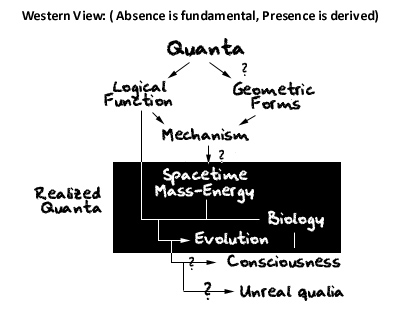
The Western view is a local rather than Absolute view. It does not account for sense or order itself, rather it begins from the assumption of physical matter and works backward to primitive mathematical functions. There are question marks included on the links which seem poorly understood or unjustified by the model as a whole. These include:
Why does geometry exist? I propose this as the Death of Computationalism. Along with the lack of support for Real numbers in computation, the universe or multiverse as a Turing emulation fails to account for the existence of forms like lines, circles, angles, etc. We know from our own computing and calculating devices that it is not necessary to physically draw a triangle in order to approximate correct computations about numbers which could correspond to triangular coordinates, so it really doesn’t make sense that any cosmic computation could or would invent geometric presentations of any kind. We don’t even need to get into questions of qualia, because computationalism fails to explain any sort of aesthetic forms to embody its functions. Mathematics is disembodied and anesthetic, and it works perfectly that way – no need for any strange magical fanfare.
Why do mathematical relations and laws give rise to physics? It’s all very well to have forms and functions mingle with each other as articulate mechanisms, but why should they ‘materialize’ as space-time, matter and energy?
The question of why consciousness exists when it does not appear to have any particular advantage over unconscious mechanism is a mystery. It is very difficult not to smuggle in our own retrospective view of consciousness as having enormous utility for our survival, but this is in no way an endorsement from the prospective view. If our immune system can orchestrate phenomenally complex responses to pathogens without a conscious experience attached to it, then why would a hominid’s humdrum quest for sustenance and reproduction lend itself to such an absurdly ornate aesthetic phenomenon? Indeed, if evolution can make a human brain, with all the trimmings, using unconscious methods, surely the operation of that brain would be better suited to that tried and true option.
The final question mark is related, but not identical. Even if you have consciousness as an option for some reason, and that option works better for humans than turtles or clouds of methane for some reason, why should such a phenomenon as consciousness produce feelings which are other than a record of the physical events which they represent? Why should there be different kinds of sensory experiences when all logical functions can be reduced more effectively to a single binary format of data processing? This alternative to reality is cast aside from the Western view, but what metaphysical never-never land is it cast to? How did we get outside of the real universe and into an ‘illusion’?
Biocentrism Demystified: A Response to Deepak Chopra and Robert Lanza’s Notion of a Conscious Universe.
1. I hope we all agree that our information about facts is incomplete, and will always remain so, at least in the foreseeable future.2. The only reality that makes sense to me is what Stephen Hawking calls ‘model-dependent reality’ (MDR).3. Other uses of the word ‘reality’ (other than MDR) imply ‘absolute reality’. If you disagree with this statement, please try defining ‘absolute reality’ in a logical way, using words which mean the same thing to everybody. My belief is that you will not be able to do that, and that means that MDR is all you have for discussion purposes.4. Naturally, there can be many models of reality. So which of the MDRs is the right one, and who will decide that? In view of (1) above, this is a hopeless situation, and that is why I avoid getting into philosophical discussions.5. At any time in human history, there are more humans favouring a particular MDR over other MDRs. Let us call it the majority MDR (MMDR).
6. An MMDR may well prove to be wrong when we humans acquire more information; from then we have a new MMDR, till even that gets demolished.
7. I believe that materialism is a better MDR than its opposite (called idealism, subjectivism, or whatever). For more on this, please read my article at http://nirmukta.com/2011/06/19/stephen-hawkings-grand-design-for-us/. Here is an excerpt from that article:
‘ There are several umbrella words like ‘consciousness’, ‘reality’, etc., which have never been defined rigorously and unambiguously. H&M argue that we can only have ‘model-dependent reality’, and that any other notion of reality is meaningless.
Does an object exist when we are not viewing it? Suppose there are two opposite models or theories for answering this question (and indeed there are!). Which model of ‘reality’ is better? Naturally the one which is simpler and more successful in terms of its predicted consequences. If a model makes my head spin and entangles me in a web of crazy complications and contradictory conclusions, I would rather stay away from it. This is where materialism wins hands down. The materialistic model is that the object exists even when nobody is observing it. This model is far more successful in explaining ‘reality’ than the opposite model. And we can do no better than build models of whatever there is understand and explain.
In fact, we adopt this approach in science all the time. There is no point in going into the question of what is absolute and unique ‘reality’. There can only be a model-dependent reality. We can only build models and theories, and we accept those which are most successful in explaining what we humans observe collectively. I said ‘most successful’. Quantum mechanics is an example of what that means. In spite of being so crazily counter-intuitive, it is the most successful and the most repeatedly tested theory ever propounded. I challenge the creationists and their ilk to come with an alternative and more successful model of ‘reality’ than that provided by quantum mechanics. (I mention quantum mechanics here because the origin of the universe, like every other natural phenomenon, was/is governed by the laws of quantum mechanics. The origin of the universe was a quantum event.)
A model is a good model if: it is elegant; it contains few arbitrary or adjustable parameters; it agrees with and explains all the existing observations; and it makes detailed and falsifiable predictions.’
>”Other uses of the word ‘reality’ (other than MDR) imply ‘absolute reality’. If you disagree with this statement, please try defining ‘absolute reality’ in a logical way,”
Absolute reality is the capacity for perceptual participation, aka, sensory-motor presentation, aka qua(lia-nta). That is the bare-metal prerequisite for all forms of order or matter, subject or object. Not only metaphysics but meta-ontology. The cosmos is not something which is, the cosmos actually invents “is” by “seeming not to merely seem”.
Please try defining ‘model’ in a way that does not assume some form of sensory presentation and participation. What is a model except a sensory experience which seems to refer our minds to another?
While I agree that no participant within a given experience has an absolute perspective of that experience, I disagree that the MDR is a solipsistic ‘model’ which is generated locally. The fact that we recognize the relativism of perceptual inertial frames (PIF = my term for MDR) is itself a clue that the deeper reality is this very capacity for relativism of perspective. Although the relativism itself may be the only final commonality among all perspectives, that commonality is not a tabula rasa. We can say things about this ‘common sense’ – things which have to do with contrasts and inverted symmetry, with proximity and intensity, relationship, identity, and division. These principles are beneath all forms and functions, all sensations and ideas, substances and patterns, and through them, we can infer more elusive fundamentals. Pattern recognition which is beyond pattern. Gestalt habits which are beyond mereology or cardinality…higher octaves of simplicity. Trans-rational, non-quantitative properties.
All mechanisms and all physics rely on a root expectation of sanity and continuity – of causality and memory, position, recursive enumeration, input/output, etc. If you are going to get rid of absolute reality, then you have to explain the emergence of the first MDR – what is modeling? Why does the universe model itself rather than simply ‘be’ what it is?
My solution is to accept that this assumed ‘modeling’ is physics itself, and that physics is experienced-embodied relativity. In the absolute sense, matter a special case of a more general (non-human) perception or sense. Not a continuum or a ZPE vacuum flux, but ordinary readiness to experience private sensory affects and produce (intentionally or not) public facing motor effects. What the universe uses to model is not a mathematical abstraction floating in a vacuum, but a concrete participatory phenomena, which we know as human beings to be sensory-motor participation. Not everything is alive biologically, but everything that seems to us to exist naturally as matter probably has a panexperiential interaction associated with it on some level of description. It’s about turning the field-force model inside out, turning away from the de-personalized objectivity of the last few centuries and toward a realization of personal involvement in genuine presentations (customized and filtered though they may be) rather than assembled representations.
The MMDR should not embrace materialism or idealism by default because one seems simpler than the other. We should accept only a solution which honors the full spectrum of possible experiences in the cosmos, from the most empirically public to the most esoterically private. This does not mean weighting the ravings of one lunatic the same as a law of gravity, but rather acknowledging that if there is a lunatic, then the universe is in some sense potentially crazy also, and within that crazy is something even more interesting and universal than gravity…an agenda for aesthetic proliferation… a Multisense Realism.
Illusion is a meaningless term in science as far as I can see. Illusion is about an experience failing to meet expectations of consistency across perceptual frames (models)…except that we know that inconsistency is likely the only such consistency, beyond the root common sense. Whatever illusions we experience as people are not necessarily absent on other levels of inspection. Quantum illusions, classical illusions, biological illusions, etc. Every instrument relies on conditions which create their own confirmation bias, including the human mind. We should not, however, make the mistake of allowing non-human, inanimate instruments tell us what our reality is. They can’t see our consciousness in the first place, remember? Our human equipment is not as sensitive in detecting public phenomena, we cannot see more than a small range of E-M, etc, but neither is a gas spectrometer sensitive in detecting human privacy.
We see that when we adopt the frame of mechanism, idealism seems pathologically naive and if we adopt the frame of idealism, mechanism seems pathologically cynical. This should be regarded along the lines of the double-slit test: evidence that our assumptions are not the whole story, and to seek a deeper unity than mechanistic or idealistic appearances.
 Multisense Realism
Recent Comments