Archive
Why Computers Can’t Lie and Don’t Know Your Name
What do the Hangman Paradox, Epimenides Paradox, and the Chinese Room Argument have in common?
The underlying Symbol Grounding Problem common to all three is that from a purely quantitative perspective, a logical truth can only satisfy some explicitly defined condition. The expectation of truth itself being implicitly true, (i.e. that it is possible to doubt what is given) is not a condition of truth, it is a boundary condition beyond truth*. All computer malfunctions, we presume, are due to problems with the physical substrate, or the programmer’s code, and not incompetence or malice. The computer, its program, or binary logic in general cannot be blamed for trying to mislead anyone. Computation, therefore, has no truth quality, no expectation of validity or discernment between technical accuracy and the accuracy of its technique. The whole of logic is contained within the assumption that logic is valid automatically. It is an inverted mirror image of naive realism. Where a person can be childish in their truth evaluation, overextending their private world into the public domain, a computer is robotic in its truth evaluation, undersignifying privacy until it is altogether absent.
Because computers can only report a local fact (the position of a switch or token), they cannot lie intentionally. Lying involves extending a local fiction to be taken as a remote fact. When we lie, we know what a computer cannot guess – that information may not be ‘real’.
When we say that a computer makes an error, it is only because of a malfunction on the physical or programmatic level, therefore it is not false, but a true representation of the problem in the system which we receive as an error. It is only incorrect in some sense that is not local to the machine, but rather local to the user, who makes the mistake of believing that the output of the program is supposed to be grounded in their expectations for its function. It is the user who is mistaken.
It is for this same reason that computers cannot intend to tell the truth either. Telling the truth depends on an understanding of the possibility of fiction and the power to intentionally choose the extent to which the truth is revealed. The symbolic communication expressed is grounded strongly in the privacy of the subject as well as the public context, and only weakly grounded in the logic represented by the symbolic abstraction. With a computer, the hierarchy is inverted. A Turing Machine is independent of private intention and public physics, so it is grounded absolutely in its own simulacra. In Searle’s (much despised) Chinese Room Argument – the conceit of the decomposed translator exposes how the output of a program is only known to the program in its own narrow sensibility. The result of the mechanism is simply a true report of a local process of the machine which has no implicit connection to any presented truths beyond the machine…except for one: Arithmetic truth.
Arithmetic truth is not local to the machine, but it is local to all machines and all experiences of correct logical thought. This is an interesting symmetry, as the logic of mechanism is both absolutely local and instantaneous and absolutely universal and eternal, but nothing in between. Every computed result is unique to the particular instantiation of the machine or program, and universal as a Turing emulable template. What digital analogs are not is true or real any sense which relates expressly to real, experienced events in space time. This is the insight expressed in Korzybski’s famous maxim ‘The map is not the territory.’ and in the Use-Mention distinction, where using a word intentionally is understood to be distinct from merely mentioning the word as an object to be discussed. For a computer, there is no map-territory distinction. It’s all one invisible, intangible mapitory of disconnected digital events.
By contrast, a person has many ways to voluntarily discern territories and maps. They can be grouped together, such as when the acoustic territory of sound is mapped to the emotional-lyric territory of music, or the optical territory of light is mapped as the visual territory of color and image. They can be flipped so that the physics is mapped to the phenomenal as well, which is how we control the voluntary muscles of our body. For us, authenticity is important. We would rather win the lottery than just have a dream that we won the lottery. A computer does not know the difference. The dream and the reality are identical information.
Realism, then, is characterized by its opposition to the quantitative. Instead of being pegged to the polar austerity which is autonomous local + explicitly universal, consciousness ripens into the tropical fecundity of middle range. Physically real experience is in direct contrast to digital abstraction. It is semi-unique, semi-private, semi-spatiotemporal, semi-local, semi-specific, semi-universal. Arithmetic truth lacks any non-functional qualities, so that using arithmetic to falsify functionalism is inherently tautological. It is like asking an armless man to raise his hand if he thinks he has no arms.
Here’s some background stuff that relates:
The Hangman Paradox has been described as follows:
A judge tells a condemned prisoner that he will be hanged at noon on one weekday in the following week but that the execution will be a surprise to the prisoner. He will not know the day of the hanging until the executioner knocks on his cell door at noon that day.Having reflected on his sentence, the prisoner draws the conclusion that he will escape from the hanging. His reasoning is in several parts. He begins by concluding that the “surprise hanging” can’t be on Friday, as if he hasn’t been hanged by Thursday, there is only one day left – and so it won’t be a surprise if he’s hanged on Friday. Since the judge’s sentence stipulated that the hanging would be a surprise to him, he concludes it cannot occur on Friday.He then reasons that the surprise hanging cannot be on Thursday either, because Friday has already been eliminated and if he hasn’t been hanged by Wednesday night, the hanging must occur on Thursday, making a Thursday hanging not a surprise either. By similar reasoning he concludes that the hanging can also not occur on Wednesday, Tuesday or Monday. Joyfully he retires to his cell confident that the hanging will not occur at all.The next week, the executioner knocks on the prisoner’s door at noon on Wednesday — which, despite all the above, was an utter surprise to him. Everything the judge said came true.
1) The conclusion “I won’t be surprised to be hanged Friday if I am not hanged by Thursday” creates another proposition to be surprised about. By leaving the condition of ‘surprise’ open ended, it could include being surprised that the judge lied, or any number of other soft contingencies that could render an ‘unexpected’ outcome. The condition of expectation isn’t an objective phenomenon, it is a subjective inference. Objectively, there is no surprise since objects don’t anticipate anything.
2) If we want to close in tightly on the quantitative logic of whether deducibility can be deduced – given five coin flips and a certainty that one will be heads, each successive tails coin flip increases the odds that one the remaining flips will be heads. The fifth coin will either be 100% likely to be heads, or will prove that the certainty assumed was 100% wrong.
I think the paradox hinges on 1) the false inference of objectivity in the use of the word surprise and 2) the false assertion of omniscience by the judge. It’s like an Escher drawing. In real life, surprise cannot be predicted with certainty and the quality of unexpectedness it is not an objective thing, just as expectation is not an objective thing.
Connecting the dots, expectation, intention, realism, and truth are all rooted in the firmament of sensory-motive participation. To care about what happens cannot be divorced from our causally efficacious role in changing it. It’s not just a matter of being petulant or selfish. The ontological possibility of ‘caring’ requires letters that are not in the alphabet of determinism and computation. It is computation which acts as punctuation, spelling, and grammar, but not language itself. To a computer, every word or name is as generic as a number. They can store the string of characters that belong to what we call a name, but they have no way to really recognize who that name belongs to.
*I maintain that what is beyond truth is sense: direct phenomenological participation
Orthomodular Panprimordialism

Playing around with a more math-friendly look and feel. Multisense Realism’s quant-flavored twin…Orthomodular Panprimordialism
I am really pushing it with the neologisms, but I am liking both of the recent adds, pansensitivity and now panprimordialism.
Pansensitivity is used to emphasize a position beyond panpsychism, idealism, and materialism where sensitivity becomes a palatable common capacity for all phenomena on its native scale.
Panprimordialism is used to emphasize the distribution of ‘one-ness’ across all phenomena, the relocating of all quantities to interrelated diffractions within the a sole, absolute singularity. This constitutes a figure-ground pivot from arithmetic assumptions which place zero or null as an absolute, such that all null values are considered a hypothetical representation of the sense of one’s self nullification.
The orthomodular lattice above gives some idea of that relation, with each node acting as the nexus for orderly juxtapositions within the overall monad.
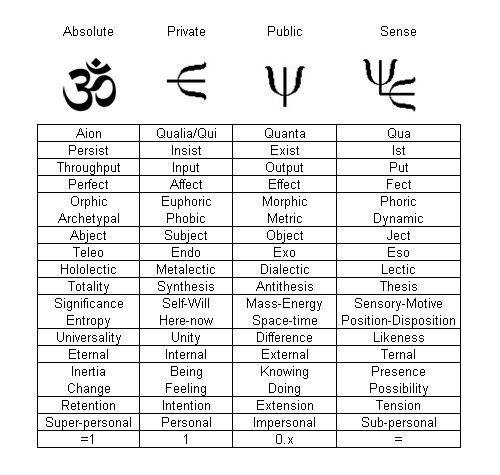

Rosetta Codex

Following up on the Tree of Life post and MSR Legend post.
Multisense Tree of Life

Multisense Tree of Life
I noticed that this formulation was starting to take on Kabbalistic dimensions, so I put it into that form. There’s some new propositions to consider here that have come out of this. Beginning with sense, which I symbolize as -ℵ (negative Aleph) and as =. This is the fundamental concept of MSR and the idea of ℵ in mathematics as cardinality fits with this definition, since equality ‘is equal to’ anti-cardinality. Sense is the unity which underlies all multiplicity, so that it can indeed be thought of as a kind of negative cardinality – not unity, but pre-cardinality.
Moving up and to the right from sense, there is Qualia, now defined as -ℵ/ש (Aleph over Shin), where ש (Shin) refers to the diffraction of the Absolute ॐ (Om). This means that Q = -ℵ/ש or, private sense is the sense of a share of eternal being – it is “a” being. In Leibniz terms this is a monad, and it is also the origin of origination, and of the number 1. From these two entities, we have the two parts of the Absolute, which mathematically would be “=1”. Eternal being is the likeness of a being, i.e. the ability to pretend. (Insert Joseph Campbell’s myths and Carl Jung’s archetypes, shamanism, imagination, etc..,) Fiction is ‘like something’, just as Qualia is what it is like to be, or what being ‘seems like’.
Rounding out the primordial trinity from sense along with Qualia is Quanta and Motive. I call the Absolute ‘Qua’ to symbolize its relation as the reconciling parent of Qualia and Quanta. Quanta (ω, lower case omega), here meaning the essence of computation, is given the formula √(ℵ),(root of Aleph). This works surprisingly well. Originally I was going with 0.00…1 and then 0.x to represent Quanta, to specify that Quanta is always the tiniest fragment of Qualia – the drive toward absolutely monotonous precision, but always beneath the threshold of unity, of wholeness. All quanta are parts and abstractions; information-theoretic rather than aesthetic/sensory-motive.
This ended up working well with √(ℵ) (root of Aleph) as it makes clear the complementarity-antagonism with Quanta and sense. Computation is the essence of cardinality, of difference. The stepped reckoning of mechanism is an impersonation of sense, it has no capacity to negate the separations and to build feeling from fragmented quantities. Since negative Aleph (-ℵ) corresponds to 1, then Quanta would be the square root of -1, or i. I used the symbol >.< as well, to denote the clipping of sense through measurement: digitization. Quantification is fantastically useful because it paralyzes whatever it fixes its gaze on.
Motive, the third leaf of the sense trinity, has the formula ℵ±ש (Aleph plus/minus Shin), which emphasizes its similarity to Quanta and Qualia but with an irreducible difference, will. Will is the ± (plus/minus) which requires a participant to end what sense started (thus the use of Ω, Omega). To have a motive is to de-cide, to kill off all options except one. This is the ‘waveform collapse’ of QM, but it is also ordinary ‘free will’. Will is the connection between unconscious cardinality and the Absolute. We don’t know how to make our body move or our how to focus our mind’s attention, we simply become our mind or body and the universe does the rest. There is a cost to our efforts, however. In the drive toward Significance (Solitrophy, Φ), entropy is born.
The unchosen path of Motive becomes the unintentional twin of Significance. Significance, -ℵ² (Aleph squared), while mathematically would equal ℵ (Aleph) as 1, there is an irreducible numinosity to the power relation. Significance holds Q not only as the sense of one quality out of the Totality (ש) (Shin, Qua) but it holds one Q as equal to any number of qualities or meta-qualitative relationships. This is semiotics. Not just = but =². Not phoric (sense) but meta-phoric. Quanta is not phoric but metric – it takes the ² nesting of Significance (Σ) (Sigma) but negates the feeling, leaving only the essence of that figurative quality. Significance is sense squared, Quanta is the square root of pretend sense, the meta-phor is inverted. Figurative language is loose. It draws from associations from within the Totality. Quanta is the opposite, drawing from strictly disambiguated logic. It has no phoric or morphic content, no feelings or forms, only the skeletal coordinates associated with them.
If Significance is like the universal bank account of metaphors and of experiences which have meant something in particular, then Entropy is the compost heap of all of the unchosen and unchoosability in the universe. It’s symbol H is taken from Shannon’s Information theory, and its formula here is ॐ/-Ω, (Om divided by negative Omega). Using the ॐ Om rather than the ש Shin is to emphasize that this relates to the ‘return trip’, the catabolic, arterial part of the cosmic circulation. Shin has more of a sense of the diffraction and creativity of the whole. With Entropy, it is the Totality’s raw, untamed nature which is divided by negative motive. This correctly applies to the nature of Entropy as indifferent, literally and figuratively. No motive. This is where the universe doesn’t care.
Between H of Entropy and Σ of Significance winds the Φ of what I call Solitrophy. Solitrophy is what makes the difference between something that can care and something that can’t. Burning a pile of garbage and burning down a town might produce the same amount of energy and entropy, but burning down a town has a human cost which doesn’t show up on a spreadsheet. As aesthetic significance accumulates, the range between one outcome and another increases. A human being has more at stake, simply by being a human being with a vastly rich aesthetic experience, than it seem like an ant has, or even an anthill. Solitrophy describes this great anchor of all sanities, and builder of worlds (I call them, perceptual inertial frames or castes).
This leaves Matter, Energy, and Qua itself. Matter and Space are listed together, as are Energy and Time. This is to emphasize their relation in MSR, teasing apart their differences rather than conflating them relativistically. The difference between time and space is Solitrophic. It doen’t show up in physics, because physics, by definition is conducted to reduce Solitrophy to an absolute minimum. Physics is asolirexic. Here. Space is defined ω+H and Time as ω*Φ, so that space is about entropy’s quantitative expansion and time is about the quantification of the growth through Solitrophy. The effect of Quanta on Φ is to limit the ‘size of the now’ – the frequency and range of memory of any given participant. Space and time are perpendicular, so that all of eternity is represented spatially by Quanta’s filtering of sense, but that representation is a vanishingly thin slice. Space, by comparison, allows access to the entire continuum of scales which have been accumulated through Solitrophy, but not in a way which allows us to experience it directly.
Matter’s formula is Σ*H, describing mass – the significance of Entropy. As everything is reflected and juxtaposed within MSR, Matter, mass, and space are aspects of the same thing, They are the unintentional, automatic consequences of all spatial scales, collapsed into a single scale. That’s how you get bodies which collide on one inertial frame, but pass right through each other if they are relevant to vastly different scales. This is obviously a rule of thumb – just a way of understanding how space is really an artifact of matter’s sense of its own non-sense and how time is about how functional tropes (routines), constrain and define energy. Energy, therefore, has the formula Ω ± ω (Omega plus minus lowercase omega), with Ω being Motive, now here given another nesting (Ω is already ±. so Ω ± is ±±) and ω being Quanta. Energy is a motive to motivate, or perhaps from to motorize, i.e. to translate a private effect publicly. The Quanta here emphasizes that this translation from motive to motor involves modulating both the frequency and the amplitude of the effect. Energy turns motive effect into work and power.
Finally, the crown of the tree, is Qua. I have covered this a lot already, but here the relation between sense, Qualia, and the Absolute can be seen. If sense is =, and Qualia is 1, then the Absolute is ‘=1’. The inclusiveness of the Absolute is total. It is the largest possible inertial frame. Our personal experiences are part of the whole, and the whole is every part of us.
MSR Legend 3
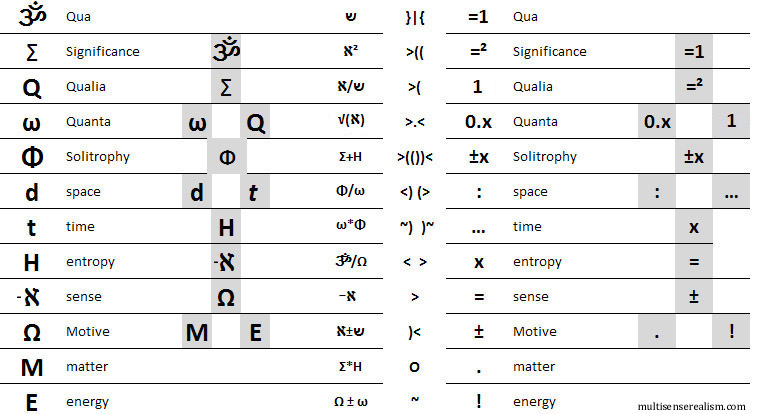
One more of these for tonight, as i’m still in a semiotic frenzy, as I’m sure you can tell.
MSR Legend

A first second draft of a Rosetta Stone for MSR terms, including the debut of new quasi-alchemical code.
Second draft 7/22/13, added Solitrophy and updated the formulas of time and space to clarify.


Recent Comments