Determinism: Tricks of the Trade
The objection that the terms ‘consciousness’ or ‘free will’ are used in too many different ways to be understandable is one of the most common arguments that I run into. I agree that it is a superficially valid objection, but on deeper consideration, it should be clear that it is a specious and ideologically driven detour.
The term free will is not as precise as a more scientific term might be (I tend to use motive, efferent participation, or private intention), but it isn’t nearly the problem that it is made to be in a debate. Any eight year old knows well enough what free will refers to. Nobody on Earth can fail to understand the difference between doing something by accident and intentionally, or between enslavement and freedom. The claim that these concepts are somehow esoteric doesn’t wash, unless you already have an expectation of a kind of verbal-logical supremacy in which nothing is allowed to exist until we can agree on a precise set of terms which give it existence. I think that this expectation is not a neutral or innocuous position, but actually contaminates the debate over free will, stacking the deck unintentionally in favor of the determinism.
It’s subtle, but ontologically, it is a bit like letting a burglar talk you into opening up the door to the house for them since breaking a window would only make a mess for you to clean up. Because the argument for hard determinism begins with an assumption that impartiality and objectivity are inherently desirable in all things, it asks that you put your king in check from the start. The argument doubles down on this leverage with the implication that subjective intuition is notoriously naive and flawed, so that not putting your king in check from the start is framed as a weak position. This is the James Randi kind of double-bind. If you don’t submit to his rules, then you are already guilty of fraud, and part of his rules is that you have no say in what his rules will be.
This is the sleight of hand which is also used by Daniel Dennett as well. What poses as a fair consideration of hard determinism is actually a stealth maneuver to create determinism – to demand that the subject submit to the forced disbelief system and become complicit in undermining their own authority. The irony is that it is only through a personal/social, political attack on subjectivity that the false perspective of objectivity can be introduced. It is accepted only by presentation pf an argument of personal insignificance so that the subject is shamed and bullied into imagining itself an object. Without knowing it, one person’s will has been voluntarily overpowered and confounded by another person’s free will into accepting that this state of affairs is not really happening. In presenting free will and consciousness as a kind of stage magic, the materialist magician performs a meta-magic trick on the audience.
Some questions for determinist thinkers:
- Can we effectively doubt that we have free will?
Or is the doubt a mental abstraction which denies the very capacity for intentional reasoning upon which the doubt itself is based? - How would an illusion of doubt be justified, either randomly or deterministically? What function would an illusion of doubt serve, even in the most blue-sky hypothetical way?
- Why wouldn’t determinism itself be just as much of an illusion as free will or doubt under determinism?
Another common derailment is to conflate the position of recognizing the phenomenon of subjectivity as authentic with religious faith, naive realism, or soft-headed sentimentality. This also is ironic, as it is an attack on the ego of the subject, not on the legitimacy of the issue. There is no reason to presume any theistic belief is implied just because determinism can be challenged at its root rather than on technicalities.
If consciousness cannot be explained by algorithms, then, by default, would you have to rely on a supernatural explanation?
Answer by Lev Lafayette:
No.
The following is copy-paste, but dammit, I wrote it in the first place and it's (exhaustively) on-topic.
tl;dr. The foundation of consciousness is having shared symbolic values. Whilst consciousness cannot be reduced to physical phenomena, this doesn't mean it doesn't arise from physical phenomena in a social setting (supervenience).
Mary, the Swampy Philosophical Zombie, Is In Your Chinese Room! Problems With Reductionist Theories of Consciousness
(I intend to use this title for a journal article on the subject)
1.0 What Is Consciousness?
"Consciousness is a fascinating but elusive phenomenon. Nothing worth reading has been written about it."
Stuart Sutherland in the 1989 International Dictionary of Psychology1.1 Consciousness is variously defined along with sentience (from the Latin “to feel”) and sapience (Latin “to know”, or “to be wise”). "Consciousness" derives from Latin conscientia which primarily means moral conscience (knowledge-with, shared knowledge). Descartes was the first to use it in the sense of the individual ego, but which was expanded by Locke to include moral responsibility. Consciousness is typically described in terms of phenomenological subjectivity; awareness, a sense of self, which is also applied in contemporary medicine as a continuum (from being fully alert and cognisant to being disorientated, to delerious, to being unconscious and unresponsive). The historical definition suggested social co-knowledge (con- "together" + scire "to know") suggesting moral reasoning (conscientia, conscience) and language. This original use is still applied in law with the concept of legal responsibility with consciousness.
1.2 Consciousness is distinguished by Ned Block between “phenomenal consciousness” (P-consciousness) of pure experience, sounds, emotions etc., and “access consciouness” (A-awareness) of introspection, memory etc. The exploration of consciouness as experience and memory is in the philosophical school and psychology of phenomenology. There is also a theoretical distinction between the "easy problem of consciousness", such as functional responses, perceptual discrimination etc, and the the "hard problems of consciousness" (qualia, such as colours, tastes). The hard problem is answering why physical processing gives rise to an inner life at all (Chalmers, 1995).
1.3 The philosophical concept of consciousness has been criticised from sources as varied as Marx, Nietzsche and Foucault. Marx considered that social relations preceeded consciousness (“It is not the consciousness of men that determines their existence, but their social existence that determines their consciousness.”), whereas Nietzsche reversed the conception of free will and moral action ("they give you free will only to later blame yourself"). Some philosophers, elimintavist physical monists, deny the extistence of consciousness at all.
1.4 There is a strong tie between consciousness and language (in its broadest sense). Medical and legal opinion both agree that assessments of consciousness must include the capacity to engage in communication. A concept of 'self' that is beyond the instinctual is only formulated through language and culture with the handful of 'feral children' (e.g., the Genie experience) serving as evidence. Descartes also argued that the lack of language in animals indicated a lack of lack of access to res cogitans, the realm of thought (although many animals have since been shown to engage in fairly sophisticated communication).
"The limits of my language mean the limits of my world.", Ludwig Wittgenstein, Tractatus Logico-Philosophicus (1922), Section 5.62.0 Models of Consciousness
2.1 There are two broad models of consciousness as they relate to the mind-body problem (and related subjects such as materialism and idealism). Monism argues that the mind and the body are the same; dualism argues that they are separate. Within monism is there is essentially two types; idealistic monism and physicalist monism; they have a perhaps surprisingly degree of similarity.
2.2 The former, particularly common in some branches of religion, consider that all is consciousness. A particularly strong example is that of Bishop George Berkeley, who argued for "empirical idealism", who argued (effectively) that the universe, and all that is experienced, is a figment of God's imagination. This is very similar to the Hindu notion of Brahman ("non-dual pure consciousness, indivisible, incorporeal, infinite, and all-pervading"), but distinct from the Buddhist dharmic samara/nirvana dichotomy.
2.3 Physicalist monism argues that there is no distinct mental states from physical brain and nervous-system states. Eliminativism, for example, argues that like astrology and alchemy eventually eliminated false folkloric notions from the sciences of astronomy and chemistry, so to will the mental states of everyday discourse (e.g., intent, belief, desire, love, pain) will be shown to be false, as will the study of psychology. The proposition is argued by philosophers such as Wilfrid Sellars, Richard Rorty, Paul and Patricia Churchland and Daniel Dennett. Some eliminativists, such as Frank Jackson, claim that consciousness does not exist except as an epiphenomenon of brain function; others, such as Georges Rey, claim that the concept will eventually be eliminated as neuroscience progresses.
2.4 A related form of physical monism is reductive materialism, also known "Type Physicalism", argues that that mental events can be grouped into types, and can then be correlated with types of physical events in the brain. Its origins are with the psychologist Edwin Boring (The Physical Dimensions of Consciousness, 1933) and further developed by Ullin Place, Herbert Feigl, and Jack Smart. One conflict that arises in type physicalism is the possibility of the type-token distinction. If type physicalism is true, then mental state M1 would be identical to brain state B1. However token-physicalism, such as argued by Hilary Putnam and Jerry Fodor, argues for "multiple realisability"; the same mental state can be produced from many different physical brain states. Experiments with colour recognistion seem to support multiple realisability.
3.0 Chinese Rooms, Mary The Scientist, Swamp-men and Philosophical Zombies
3.1 Reductive monism, whether physical or ideal, can be challenged by four related thought experiments; the Chinese Room by John Searle (1980), Frank Jackson (1982), Swampman (1987) by Donald Davidson, and Philosophical Zombies by David Chalmers (1996). All three are examples of arguments that emphasise not just the importance of subjectivity and qualia, but also introduce issues relating to understanding, meaning, and language.
3.2 The Chinese Room article is specifically presented as an argument against artificial consciousness, however it is particularly important as a challenge to physicalist monism which, like the AI advocates of computationalism, argue that the mind is a information processing system operating on symbols (c.f., Alan Turing Test). "The Chinese Room" takes Chinese characters as input and, by following the instructions of a computer program, produces other Chinese characters, which it presents as output. Whilst it (being the system, or the individual processing the data) can carry on a conversation, at no point does it understand the characters. As Searle (1999) argues: "The program enables the person in the room to pass the Turing Test for understanding Chinese but he does not understand a word of Chinese".
3.3 One strong response to the Chinese Room argument concedes the example, but challenges it with a robot that has extended sensory system and therefore attaches semantic correlations from sensory input to symbols. The "Robot Reply" has been endorsed at different points by Margaret Boden, Daniel Dennett, Jerry Fodor, Hans Moravec et al. For Searle, this is just additional input, and whilst it may strengthen the rule-based system, still doesn't provide understanding. Tim Crane eventually ties this criticism with social interaction, something which Searle neglected to make sufficiently explicit – and therefore was prone to accusations that he was begging the question; "… if Searle had not just memorized the rules and the data, but also started acting in the world of Chinese people, then it is plausible that he would before too long come to realize what these symbols mean" (The Mechanical Mind, 1996)
3.4 Frank Jackson's "Mary's Room" is a thought experiment that is aimed against physicalism in particular. Mary is a scientist of the neurophysiology of vision, but who has done all their work in a black-and-white environment. She knows all about the physical properties of colour, wavelengths, the effects on the retina and brain etc., but has never experienced color. Once she experiences color, does she learn anything new? If she does, then not all knowledge is physical knowledge; Mary has learned about qualia; subjective, qualitative properties of experiences. Arguably, Mary has gained an acquantaince to facts or abilities that she already had.
3.5 In the Swampman argument Donald Davidson explores the mind of a replicant: "Suppose Davidson goes hiking in the swamp and is struck and killed by a lightning bolt. At the same time, nearby in the swamp another lightning bolt spontaneously rearranges a bunch of molecules such that, entirely by coincidence, they take on exactly the same form that Davidson's body had at the moment of his untimely death." Swampman would make noises that his friends and family would interpret as language, but, according to teleological theories (and Davidson's own theory of content) Swampman has no ideas about philosophy, no perceptions of his surroundings and no beliefs or desires about anything at all; Swampman has no intentional states.
3.6 A variant on Swampman is Philosophical Zombies by David Chalmers (although it dates back to Robert Kirk, 1974). It is a being that is physically indistinguishable from a normal human being, even down to neurological effects, however it lacks conscious experience and qualia; "all is silent and dark within" (Iris Murdoch). The strength of the philosophical zombie argument is that (a) we recognise that people have periods without consciousness and (b) that human behaviour to occur automatically (e.g., sleepwalking). Elaborating these to the extreme, philosophical zombies are logically conceivable (even if practically improbable).
3.7 According to the physicalists, everything – including consciousness – is reducible to pure physicality. If physicalism is true, then conscious experience must exist in such all such possible worlds that contain the same physical facts as our world (P). However it is possible to conceive of a possible world (Q) where there is no consciousness (where p-zombies exist), but the physical facts are the same. Therefore, physicalism is false. This is known as modus tollens in predicate logic. If P then Q; not Q, therefore not P.
4.0 Never Mind, It Doesn't Matter; Escaping Monist Reductionism and Avoiding Substance Dualism
4.1 In contrast with monist approaches (whether physicalist or idealist), there are a variety of dualist approaches, which argues that the mind and the brain are ontologically separate categories. There are three basic types; substance dualism, property dualism, and predicate dualism.
4.2 Substance dualism is the argument that the mind and brain are different substances. Originating with Descartes (and famously resulting in "Cartesian dualism" of res cogitans versus res extensa) it argues that the mental universe is not extensible into space, and the material cannot think. It is considered compatible with most theological perspectives that distinguish in substance between the body and the mental "soul". Whilst extremely influential in the history of the mind-body problem, substance dualism is not considered a popular theory due to numerous problems that show that the brain and mind at least have high levels of correlation (e.g., the mental effects of brain damage is indisputable e.g., Phineas Gage).
4.3 Property dualism argues that whilst there is but one type of substance (physical or ideal), but two types of properties that result; physical and mental; non-physical, mental properties (such as beliefs, desires and emotions) correlate in some physical substances (the brain), but are not reducible to these. Examples include emergentism or supervenience, with advocates ranging as far as John Stuart Mill and Jaegwon Kim. In this model mental states emerge or depend on brain states, but cannot be reduced to brain states as they have different properties. Emergence and supervenience is notably popular among biological scientists (e.g. Philip Kitcher, Elliot Sober, Alexander Rosenberg). Property dualist can be further split into epiphenomenalism and interactionism. In the former, physical states can give rise to mental states, but not the reverse. Interactionism, claims that mental states can produce material effects (and vice-versa).
4.5 Predicate dualism, advocated by Donald Davidson and Jerry Fodor, argue that while there is only one ontological category of substances and properties of substances, the predicates that we use to describe mental events cannot be reduced physical predicates of natural languages. Another description of predicate dualism, used by Donald Davidson, is "anomalous monism" (Mental Events, 1970). The theory states that (a) mental events are identical with physical events, (b) the mental events are anomalous, and are not regulated by strict physical laws. Davidson also developed the notion of supervenience to answer critics that noted that this wasn't really a form of physicalism.
4.6 A final argument against reductive physicalism is that its pragmatically impossible. Physicalism can only provides statements of facticity; quantity and spatio-temporal location. It cannot provide any information on moral norms or aesthetic expressions. Although physical facts, moral norms, and aesthetic expressions all depend, or emerge, from empirical foundations, any one approach cannot provide answer to the others; they are pragmatically incommensurable; David Dennet's Consciousness Explained, 1991, is particularly noteworthy for this category error. It is as risible to argue that morals and aesthetics are reducible to facts as it is to suggest that aesthetics or facts are reducible to moral norms etc.

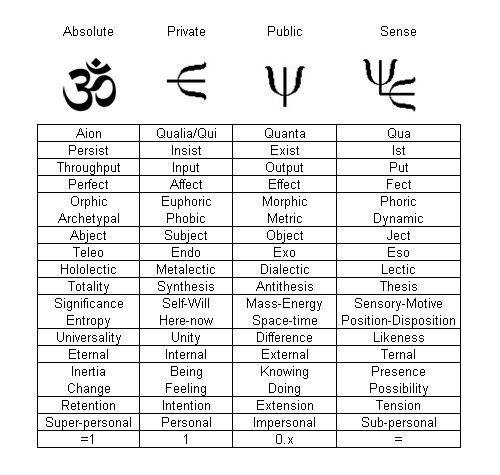
MSR Non-Standard Model of (Post-Particle) Physics
Developing the idea of fusing quanta and qualia physically, MSR proposes to add the following notation:

“Qui” (who?) would be the hypothetical ‘other half’ of the quantum wavefunction, and can be represented (obnoxiously, but memorably) by the sideways letter psi.
This signifies that aesthetic presence and qualitative appreciation (being and feeling) is orthogonal to the doing and knowing of quantum mechanics. Qui is not the measurement but the context of orientation from which measurement is experienced. It is explicitly neither wave, particle, form, or function, but neither is it non-wavelike, non-particle-like, formless, or unrelated to function. Qui is exactly what being alive is to us as human beings, except on a much more primitive level. It is the capacity to participate as an oscillating source of both animistic and mechanistic qualities.
The combined qui-psi symbol:

On Electrodynamics:
I have been trying understand electromagnetism in what I would call ‘purely classical’ terms. I suspect that the way that physics has been taught and learned, the knowledge which has accumulated is more of a collection of facts than a deep understanding. Even the basics of electromagnetism are immediately abstracted into formulas about how electrical effects can be predicted and controlled rather than what they actually are.
I think that the way that we approach electrodynamics is similar to how a civil engineer might approach city traffic. When we want to control the flow of traffic, the density and pressure of it, provide optimal ratios of parking space to population, how the number of lanes and cross streets affects the efficiency, etc. then we approach traffic from a purely quantitative perspective. We don’t consider the individual driver pushing the accelerator, looking at the bumper of the vehicle in front of them, even though that sensory-motive interaction is the actual mechanism upon which traffic relies. Instead, we look at rates and derivatives, geometric relations, etc.
If we want to get inside of electromagnetism in ‘classical terms’ of what is happening to molecules and substances, without even talking about electric fields or vectors, etc, what would it look like? Is electromagnetism like traffic, the movement of molecules driven by an unacknowledged sensory-motive participant? I think that it is possible, even likely that is the case, and my hypothesis about light as having no literal photons could maybe be understood in these classical terms, only with a concretely aesthetic sensory-motive participation instead of mathematical abstraction.
I started with the idea that since the speed of light is derived in part from the vacuum permittivity (ε0) and vacuum permeability constants (µ0), maybe I could make things easier on everyone who tries to understand my photon-free model of light by calling it remote permittivity or telepermeability or something like that. By this I mean to show that what I suggest is no more exotic than what we already assume about matter, only that the sophistication of matter itself, of its capacity to derive perspective and distance in relation to itself is much more spectacular and interior than we have imagined in the last few centuries (Aristotelian physics was teleological, so the notion of dumb matter is not something that is an eternal truth).
In my hyper-classical thought experiment, we don’t necessarily even believe in electrons. Electrons could be more like turn signals and break lights of the cars in traffic. The model of the electron cloud shifting away from the nucleus could be interpreted figuratively, as tension, displacement of intentions as the atomic ‘drivers’ are craning their necks to look out at the entire line of cars rather than passively staring ahead. Lots of fun possibilities here, I’m just trying to make the point that we can put electricity and magnetism inside the atom if we want.
All of the vectors and scalars of physics that have been derived for prediction and control can be seen as economic ideas. Things like electrostatic fields and potential energy are like accounts in a general ledger, but the actual transactions that they refer to are sensory-motive. They are concrete expectations fulfilled and deferred – felt by some aspect of the universe on some level of description (which may be a very different description than we have under typical conscious experience or instrumental observation.)

Superpositioned Aion Hypothesis

Above, an ankh appropriated from here, superimposed on the MSR diagram. I have included Sense and Motive, reflecting the circuitous, super-personal nature of the Aion/Eternity (collective/Absolute sense) and the cross of what Bennett calls ‘Time’ (I call personal sensory awareness) vs what he calls Hyparxis (“an ableness-to-be”, aka motive participation).
“The English philosopher John G. Bennett posited a six-dimensional Universe with the usual three spatial dimensions and three time-like dimensions that he called time, eternity and hyparxis. Time is the sequential chronological time that we are familiar with. The hypertime dimensions called eternity and hyparxis are said to have distinctive properties of their own. Eternity could be considered cosmological time or timeless time. Hyparxis is supposed to be characterised as an ableness-to-be and may be more noticeable in the realm of quantum processes.” – source

- Aion and Gaia with four children, perhaps the personified seasons, mosaic from a Roman villa in Sentinum, first half of the 3rd century BCE, (Munich Glyptothek, Inv. W504)
The word aeon, also spelled eon, originally means “life” or “being”, though it then tended to mean “age”, “forever” or “for eternity”. It is a Latin transliteration from the koine Greek word (ho aion), from the archaic (aiwon). In Homer it typically refers to life or lifespan. Its latest meaning is more or less similar to the Sanskrit word kalpa and Hebrew word olam. A cognate Latin word aevum or aeuum for “age” is present in words such as longevity and mediaeval. source
The universe seems to want to be understood both in two contradictory presentations:
1. As the timeless eternity within which experiences are rationed out in recombinations of irreducible elements.
2. As the creative flow of authentically novel experiences, whose recombination is impossible.
If we can swallow the idea of superposition on the microcosmic level, why not the astrophysical-cosmological level? Whether the universe seems to be gyrating in a direction that paints your life in a meaningful and integrated light, or it has you struggling to swim against a sea of chaotic scorns is as universal an oscillator of probabilities as any quantum wavefunction.
These fateful cyclings of our personal aion are reflected also in the micro and macro of the Aion at large . With the unintentional dice game of quantum mechanics flickering in and out of existence far beneath us, and fate’s private wheel of fortune seemingly spinning in and out of our favor intentionally just beyond us, the ultimate superposition is that of the eternal and the new.
How can the universe be a relativistic body in which all times and spaces are objectively present, and an expanding moment of being which not only perpetually imagines new universes, but imagines imagination as well? Why not apply superposition?
“In physics and systems theory, the superposition principle, also known as superposition property, states that, for all linear systems, the net response at a given place and time caused by two or more stimuli is the sum of the responses which would have been caused by each stimulus individually. So that if input A produces response X and input B produces response Y then input (A + B) produces response (X + Y).” source
The universe is generic and proprietary, eternally closed but momentarily open and eternally open but momentarily closed. It/we are always changing in some sense, but remaining the same in every other. Within the Aion, all opposites are superpositioned – bothness, neitherness, and only-one-and-not-the-other ness.
Relativity and Reality
To what does relativity relate? Before there can be relation there must be presence, and before a presence can relate to another presence, there must be a capacity for detection of some kind. Even collision of bodies should not be taken for granted in physics. It is a testament to our imagination that we can conceive of a universe that happens without any participants – with only there and then, but no here and now to put them in their place. What is required instead is an imagination of empathy, to trace the origins of our own consciousness not to the dots and dashes of information gathering instruments developed for our bodies to use, but to our own native information gathering capacities. Whether photons are really things or not, no model of the universe can be complete without fully explaining the relationship of photons to the phenomenon that we see as light. Whatever it is that we see cannot be excluded from any complete description of the universe.
An early diagram of the MSR Theory of Everything suggests an equivalence of perception and relativity. Without getting too deep into the subject, it can be said that any discussion of relativity entails the use of a reference point, a so called ‘inertial frame’ within which phenomena tend to cohere together and share a common velocity. Even in a speeding train, the coffee in the cup can remain fairly settled on the tray in front of us. So long as the velocity of the train is maintained, we can’t tell by looking at the cup whether the train is stationary, or moving, or moving on top of another train which is moving even faster. Without this kind of orienting framing principle, there would be no ‘thing’ to relate to any other thing; no place to move toward or away from. Relativity requires an anchor, and for reasons which I will get into soon, the anchor of quantitative properties cannot itself be quantitative but must instead be perceptual in nature. General Relativity relies on Proprietary Relativity, aka, private perception. This should not be taken as an endorsement of anthropocentric idealism, or deism, or any other effort to fictionalize physical realism, but is instead a suggestion of pansensitivity with sense as both the universal law and the local participant.
Relativity is anchored not only the law of inertia, but the consequences of it in sequestering physical tendencies into semantically stable ‘places’ which relate to each other, and through each other. This should be understood as a kind of sensitivity or awareness on the grandest, most public scale. It implies a translucence of mass and momentum in which the grandeur of events is implicitly and palpably present.
Relativity refers to the underlying nature of place and pace as it is defined by matter and energy. Matter and energy create the spacetime context by their relation with each other. The title General Relativity, just as words in the English language, infers a generalized or universal quality of relating which is dynamic. It’s not a static property of general related-ness, but rather it is an active responsiveness of all phenomena in relation to each other. The -ivity suffix of relativity treats relation as a verb, not a noun. What we observe is that in measurements where distance and time are precisely recorded, the classically held immutables of space and time actually bend and warp to reflect the presence of mass, gravity, and velocity.
I think that this is what shocked the world about Einstein’s vision. He conceived that the metric itself, the abstract ‘rigid body’ of measurement which comprised the firmament of classical mechanics…that infinite set of Cartesian coordinates actually warped its contours around things, not the other way around. The plenum of space and time is only a measure of variations in scale and frequency among repeating effects that were happening to objects. The universe was not something happening in an empty box, it was boxing itself from the inside out.
Special Relativity showed that the relativity of uniform motion observed by Galileo and the classical notion of invariant time had to be extended to accommodate the absoluteness of the speed of light. Einstein’s four dimensional space-time ‘mollusk’ describes what is understood to be an invariant space-time interval. Why is the speed of light absolute though? What mechanically makes time dilate or length contract?
If my view is on the right track, the reason why the speed of light is absolute is because light is not a thing, it is the sensitivity of matter across its own created distance. The reason that Relativity works is because the universe makes sense of itself, and is ignorant of itself on every level. This is what relativity and perception are all about. It is interesting that the deepest truths of Einstein and the deepest truths of Quantum Mechanics both have to do explicitly with measurement. Einstein’s Relativities challenge common-sense notions of the separateness of space, time, matter, and energy, and of the nature of velocity while QM deals in probabilities and uncertainties associated with measurement of complementary variables (like position and momentum). We are talking about the limits of measure in both cases, and transcending immeasurable conditions with new strategies of measurement.
To say that Relativity makes sense is accurate because we have an idea of what it means for things to make sense already. Knowledge is a validation of our public facing senses with private sense making, or vice versa. We model the movements of massive bodies in accord with Einstein’s curved space equations, but Einstein did not believe that space was literally curved, or that space was a thing at all. Curved space is a metaphor. What is curving is the statistical results of experiments where the behavior of matter in one frame is measured against the behavior of matter in another. This is the bare-metal reality of our observations. Physicists use instruments made of matter to cause and measure changes in matter. Through those measurements, we have inferred entities such as “energy”, “gravity”, “forces”, and “fields”, but we have only matter to tell us about them. Our perception relies on matter’s relation to matter, it’s relativity, to perceive conditions in remote inertial frames.
This is not an endorsement of naive realism. Certainly it is useful to model energy as a separate entity from the matter which collects and projects it, however it remains impossible to inspect energy in public, without the aid of a material instrument such as our body, and a mode of perception to detect it and render it locally in some aesthetic modality. Perception is in one sense a mirror image of relativity, in that relativity is an impersonal view of public perspective and perception is a personal view of private relations. In another sense, perception is merely the private version relativity. The same principle which allows the coffee to stay in the cup on the train can be understood to be literally the same inertial principle which maintains the worldly realism of our experience. Inertia is the indifference of sense, the comfortable ranges and tropes which contrast with novelty and disturbance.
By turning General Relativity around so that it can becomes Proprietary Relativity, a whole new way of making sense and measuring the immeasurable can be glimpsed. While it has always been implicit in the inertial frames and ‘observers’ of physics, the framing itself has never been examined properly, as far as I know. We take our own personal orientation for granted most of the time, (especially when we are overseeing an abstract equation or model of everythingness), but to model everythingness absolutely faithfully, we would need to include this very strange, but very ordinary state of affairs that we know as ‘being here’, or ‘our presence’; consciousness.
It has been the hypothesis of MSR that as far as physics is concerned (which can only tolerate a very dim and narrow view of consciousness right now), the function of consciousness should be approached first as the minimum ingredient to provide the possibility of privacy, relativity, and inertia. A vector of orientation and perspective. This is the unspoken assumption of any observer or inertial frame, that somehow there has arisen a capacity to discern a here from a there, or a now from a then. MSR tries to explain the difference between (here, now) and (not-here, not-now) in terms of public and private ‘verses’. These verses are aesthetic contexts which provide mutual contrast for each other. It is the unfortunate complexity of the human experience, with its massively redundant population of historically recorded lifetimes, bodies, and bodies within bodies within bodies (organs, cells, molecules), which obscures the purity and simplicity of the private-public relation. It is not a dualistic relation however, it is a reflexive or Ouroboran relation. The private feelings and experiences of one inertial frame are the public bodies and energies of another, sufficiently alien frame.
Having a body which is subject to conditions on the molecular, cellular, and somatic levels of public interaction gives us cause to think that these interactions are producing ‘us’, whereas my conjecture is that our bodies reflect the totality of our lives (and the lives of our entire species, of all life, and all phenomena dating back to before the dawn of life) from a particularly truncated and relativistic perspective. The body is a human life looking at itself askance through the narrow slit of its own relativistically disintegrated presence.
This essential ingredient is the necessary piece to the puzzle. It allows us to recognize that this universe not only one of theres and thens, but of here and now. Einstein famously said that he did not understand now, and that makes sense since his is the perspective most grounded in the ‘other’ – in spacetime. Sense is not an abstract scalar quantity, property, or configuration, but it is the concretely real capacity to feel, sense, or detect, even though it is both non-local and non-non-local. It is not a field or an energy, an ether, an elan vital, or any other substantialized presence. That would be redundant, since sense is presence already.
Just as Einstein relocated the universal process to electrodynamics rather than Newtonian mechanics, MSR relocates the electrodynamic process itself to a sensorydynamic milieu, a milieu which is absolute, and which presents uniqueness and originality as its product. In short, Multisense Realism posits an equivalence between locality and perception, and between perspective and equivalence/non-equivalence itself. Sense is how things seem to be, and seeming it turns out, can only be more fundamental than ‘reality’.
The notion of inertia is expanded under MSR, so that it implies a tangible experience of expectation and continuity. Inertia is the sensory capacity of context and framing. This is the stuff of worldly realism. An accumulation of qualitative semi-signs and partial presentations which is beneath the formalism of literal semiotic signals. These fundamental references cannot arise purely from bottom up mathematical relations, but rather are recovered or discovered from the totality as a whole. This concept has been developed before many times, (e.g. Bohm’s Implicate Order, Sheldrake’s Morphic Resonance, Indra’s Net, etc) but generally with a holographic flavor of non-locality. Things simply have a way of coming around again and again. With the MSR concept of perceptual inertia, perception events are carved out of the monad of eternity. Personal perceptions are fundamentally voids, bubbles within the singularity which make it seem like a multiplicity from inside the bubble. Indeed, the bubble itself is the quality of seeming divided or disconnected, a finite flavor of here and now which is suspended in a frozen diaspora of theres and thens. “Laws” are the constraints which are experienced in one inertial frame because it is nested within an event which has already happened. A smaller now cannot escape from the experience which birthed it, in which the former becomes eternal and the latter becomes the instantaneous. Relativity, gravity, inertia, and perception are all different aspects of the same law-giving realism. Ratios borne of qualitative experience, and reborn through experience which has been condensed – quantitatively deferred.
Updates to Pretentious Mystical Formula
Supreme Ultimate Grand Unified Formulation
The MSR model of the universe can be expressed simply in single formula and mapped schematically in the frame set view below:

The list on the left hand side describes the “Entropic Frames”, so called because they are governed by entropic tendencies of matter divided across public space. At the top, (H←d) represents this relation, with distance d expanding in one direction only ← as entropy H perpetually grinds down coherent differences into incoherence and indifference. Originality and uniqueness dissolves into generic multiplicity, or at least it appears that way on this side of the cosmic balance sheet.
The role of distance d or scale is to make localization tangible, allowing larger, denser accumulations of mass, dispersing particles and also collecting them as massive objects. From an information entropy perspective, d would be understood as the mismatch of sense ranges across gaps of unfamiliarity (the metaphorical sense of ‘distance’), which leads to a loss of intelligibility and the perception of insignificance by disproportion of magnitude. It is proposed that the magnitude of this mismatch increases logarithmically from the microcosmic scales, so that what is perceived as space on the macro scale is the summary of communication/identification failures on lower levels. H←d is the attenuation of significance and also depletion of autonomy or motive.
“ωª ↑”
At the bottom left, ωª ↑ denotes that frames on this Western side of the frame set are bottom-up, existential, and nested within each other telescopically. This nesting by literal metric scale is represented by ª. The intent here is to refer to all of the physical scales of functional interaction, from the microcosmic to astrophysical, as well as the sub-physical principles of logic, mathematics, and quantity which they embody. The reductive, deterministic sensibility which is governed by indifference and consciousness-less is represented by the upward arrow (↑), for bottom-up causality. This is the arrow of unintentional effect. In MSR, the totality of the Western conception of the universe is reduced to the formula
ωª ↑(H←d)”
The right hand side of the chart (the Eastern or Oriental half) and reverses the unintentionality of ωª ↑ . In the public “Western” half of the chart, quanta is seen to be unintentionally building the universe probabilistically, without effort or awareness. The opposite is true for the view from the perspective of the actual participant in any given experience of the universe. The natural or naive perspective, so alien and repugnant to science in this phase of its development, is difficult to even consider as a legitimate phenomenon without risking ridicule. This should not be considered a scientific view. In fact, all functions of physics or mathematics begin with the unacknowledged presence of an observer. This observer is generally reduced to absolutely minimal significance – a single abstract position or frame of reference. Einstein saw that this was in fact only a theoretical device, and that the conditions of the observer are actually critical to the function of all physics. It is my contention that General Relativity did not go far enough, and that subjectivity is not only a real feature of physics, but that it is the primary feature of ontology. The fact of subjectivity, and its existence in the universe, literally changes everything, and the universe which contains even a single subject is the only universe that has ever been or can ever be. Physics exists within sense, not the other way around.
The guiding principle of the Orienting half of the chart then, is not the sequel to the half which exposes matter and space to subjects, but it is “↓ºt”, which is the original and authentic principle of top down significance and intention which precedes all spatial extension. Before there was unintention, there was intention, and before there was intention, there was sense. “-ℵ↔Ω” tells the story of sense and motive, oscillating beyond time. -ℵ plays on the use of Aleph numbers to denote infinite cardinality in mathematics. In MSR, negative Aleph stands for the underlying coherence which transcends all cardinality, all separation, and thus is the ground of being for all ‘thing’-ness and ‘it-ness’. -ℵ is ‘phoric’, the carrier of meaning and presence. It is consciousness beneath even qualia (which is generated through the ordinality of experience, which is related to significance, which is here labelled º)
Rather than distance and entropy, phenomena on the right side is governed by the opposite principles; difference, aesthetic participation, and motivation by both promise (positively charged significance º) and threat (negatively charged significance º). Just as the universe has developed different frames on which the drama of existence takes place, MSR speculates that every experience in the universe is part of a single overall experience. This proposed maximum inertial frame, known as ॐ, stands for the Absolute, or Totality, but has many other names in mystical and philosophical traditions, including Brahman, Tao and Ein Sof. The Ankh sign is related as well, but for those who are not interested in such concepts, the Absolute can be understood simply as ‘Eternity’. A key proposition of MSR is that the Absolute is one and the same as -ℵ, although from our vantage point, the Absolute is the accumulated totality of all sense. In the strange mathematics of singularity and infinite cardinality, they are actually the same thing in the absolute sense and not the same thing in the local sense. I use the = sign also to denote sense, as a deep understanding of what that sign means gives good insight into sense itself – the translucence of multiplicity and the unity of translucence… mystical, perhaps, but no more so than the exotic ideas which populate theoretical physics and cutting edge mathematics.
The Supreme Ultimate Grand Unified Formulation specifies how the Absolute modulates, attenuates, and diffracts itself reflexively to arrive at an ‘orthomodularity’ or juxtaposition of public and private verses of itself (sense).
ॐ ⊇ { ((-ℵ↔Ω) ↓ ºt) ⊥ (ωª ↑ (H←d) ) }
“⊇”
This sign is used to denote ‘superset or equal to, which is a good way of describing the relation of ॐ to the diffracted parts of itself (which I call ש also) that make up ‘everythingness’.
Because sense insists rather than exists, and the local sense is both identical and non-identical to the Absolute, “ℵ↔Ω” refers also to the totality of states of consciousness, aka the Multisense Continuum; the range of richness of perspectives, meanings and experience. On this higher octave of collective sense, the Aleph symbol (-ℵ) refers to the maximally transcendental state of consciousness, in which personal significance appears fused with the Absolute, and the presence of eternity aesthetically saturates experience. This psychedelic state, in which the ‘psychic aperture’ is blown wide open, permits a liberal superposition of eidetic-metaphorical contents. The Omega symbol (Ω) represents the converse extreme of the subjective spectrum. Where ℵ is personal fusion with artistic and trans-rational dimension of the Absolute, Ω is the impersonal rapture of science. the canon of literal forms and ideal functions, Platonic ratios, and arithmetic-logical truths.
Getting back to ºt in this higher context, participation adds something to the frames on the right side which are lacking in the Entropic Frames. Beyond mere differences in scale which sequester the macro from the micro, the hierarchy which has been dubbed the ‘Holotrophic Frames’ presents a completely different, though related kind of nesting. The Holotrophic Frames cut across all Entropic levels vertically. Experiential ordinality, º refers to the elevation of qualitative rank, rather than quantitative ‘file’, so to speak. This elaboration of significance and awareness is made possible through the sequential continuity of experiences (time). Phenomena like color and music are testaments to the pervasiveness of sense, and its perpetual coherence which clothes itself in new experiences that carve themselves out of eternity. A universe which contains humans presumably contains the potential for experiences which are more fantastic and more awful than a universe of only simple organisms or inorganic systems.
“⊥”
reflects the orthomodular/perpendicular nature between the private-phoric-trophic (“Oriental”) side of the equation and the public-morphic-metric (“Western”) side.


Recent Comments