Why Likeness is Not, Like, the Same as Sameness

Why do we like to like the same things, until the thing we liked becomes the same old thing?
Why is there “Good as New” and “Like New”, but not “Same as New”?
I think that the difference between like and same are especially related to consciousness and support the idea of awareness (and therefore attention) as more ‘like’ novelty and ‘like-ness’ than it is ‘the same as’ the integration or processing of information.
Machines are characterized by their ability to do the same thing, over and over. The idea behind digital technology is really to be able to do the exact same thing, over and over and over, forever. Does this kind of behavior wake us up or does it lull us into a stupor? What kinds of things put us to sleep and what kinds of experiences wake us up?
Waking up is not an abstract theory. Waking up instantiates us into the directly and concretely sensed now, into public time. The now and the new are unrepeatable and unique, thus there can be nothing which is ‘the same as’ new without actually being new. When we say that something is ‘the same’ as something else, we are often speaking metaphorically. What we mean is that the difference is not important, and that one thing is functionally equivalent to another.
Anti-Metaphor
Within the world of mathematics, ‘the same’ or “=” is a metaphor for that which is literally identical or interchangeable in all circumstances. Unlike physical reality, the whole of mathematics is a symbolic abstraction – a metaphor for anti-metaphor:
Where metaphors are ‘like’ conceptual rhymes or semantic likeness which cut across the whole of human intuition poetically and aesthetically, mathematical metaphors are aiming for the opposite effect in which meaning is frozen into position, clear, defined, and unambiguous. This is meaning which has been reflected in the looking glass of thermodynamic irreversibility. It is the privatized essence of publicity.
When we look out of ourselves, we see only that which can be decomposed and measured. Feeling is presented as figures, and figuring them out literally gives us a feeling of transcending the ambiguity, fluidity, and obscurity our own subjective awareness.
I see the opportunity that lies before us is to recover the authenticity of awareness without sacrificing the reliability of its substitute. The worldview that is driven by quantitative formula alone cannot locate the now, other than as a promise that it will eventually be found – under a heap of accidents. Accidents and probability are the inverted image of intention and likeness. They are what you get when sameness is assumed to be primitive. The universe is failed sameness and broken symmetry – serial mutation.
To overcome the prejudices inherent in this worldview, an important step is to understand the irony that the intention behind measurement leads to its own perfect illogical fallacy. To count and codify is to try to escape from personal bias and fuzzy ‘likeness’ which is not the ‘exact same thing’ as truth, but what we have found increasingly, is that we cannot be immune from an equally toxic bias toward the impersonal. As much as we want to be ‘certainly in the right’, and to put ‘everything under the sun’ in tune, the enlightenment of the Western mind is eclipsed by its own insensitivity and denial. The more that we seek out the next product or service to make us feel ‘like new’, the faster it becomes the same old crap.
The Lowdown on Empty Space and the Speed of Light
Your task is to explain why are you trying to buck the mainstream view that space has qualities. I’m no acolyte of the mainstream but I do recognize the need to explain deviations therefrom. It so happens that there are good reasons why today’s view is that empty space has physical qualities. The main shortcoming of the mainstream view, from my viewpoint, is the artificial and unnecessary light speed speed limit. Einstein hypothesized a universe with such a limit without ever even suggesting why such a limit makes any sense. And the problem is: it doesn’t.
I think that Einstein hypothesized a speed limit in the universe because he understood or intuited that speed itself is a continuum between stillness and the opposite of stillness, rather than an unbounded scale. He saw that light does not behave like anything else – that it had properties which made it unlike things which can accelerate. Velocity is (not unrelatedly) like ‘straightness’ – there is an upper limit on how straight something can be, how little something can weigh, and the extent to which a signal can be unambiguously present or absent at a given location at any given moment.
What he did not see, IMO is that light is only one kind of signal – one way that the universe makes sense of itself. The speed of light is the speed of space, or perhaps, the speed of ‘here’, and it scales up in proportion to larger scaled ‘here’s. Light, or ‘sense’ or ‘universal public signal’, actually has no speed at all, unless you mix reference frames and thereby measure a large frame from a small one. The degree to which light has a speed is the ratio between the scale of the measurer and the scale of the measurement.
The mainstream view that space has qualities makes perfect sense when we misunderstand and overlook the role of sense in signal production. Rather than extending the relation that living things have with light (or sound, smell, thought, etc) to the microcosm, we have so far only consider the *apparent* relation that non-living things have with each other, which is limited to touch. We have yet to entertain the notion that microphysical phenoemena are, in some sense, seeing each other and signaling each other directly, and thereby creating ‘space’ and ‘time’ on the macrophysical level, from our perspective. From the microphenomenal level, it might appear just the opposite, that spacetime is being created from above, on higher levels. Both are probably true and untrue to a similar extent.
There is no reason to believe that space has properties except to maintain the assumption that physical processes are unconscious and isolated. When we hold that belief, we are forced to take a phenomenon which is transdimensional, and flatten it into a finite number of topological fields in which forms can touch each other directly. That’s a great way of doing the math so that we can predict and control the conditions of (relatively) inanimate objects, but it falls apart when we try to include more subtle sense-making phenomena.
I’m fully aware, of course, that this is a radical conjecture. My position is not that this is a complete theory or that I know how it must work, but that it is a theoretical possibility which could work, has not been explored, and should not contradict any observation of physics made thus far
Free Will Isn’t a Predictive Statistical Model
Free will is a program guessing what could happen if resources were spent executing code before having to execute it.
I suggest that Free Will is not merely the feeling of predicting effects, but is the power to dictate effects. It gets complicated because when we introspect on our own introspection, our personal awareness unravels into a hall of sub-personal mirrors. When we ask ourselves ‘why did I eat that pizza’, we can trace back a chain of ‘because…I wanted to. Because I was hungry…Because I saw a pizza on TV…’ and we are tempted to conclude that our own involvement was just to passively rubber stamp a course of multiple-choice actions that were already in motion.
If instead, we look at the entire ensemble of our responses to the influences, from TV image, to the body’s hunger, to the preference for pizza, etc as more of a kaleidoscope gestalt of ‘me’, then we can understand will on a personal level rather than a mechanical level. On the sub-personal level, where there is processing of information in the brain and competing drives in the mind, we, as individuals do not exist. This is the mistake of the neuroscientific experiments thus far. They assume a bottom-up production of consciousness from unconscious microphysical processes, rather than seeing a bi-directional relation between many levels of description and multiple kinds of relation between micro and macro, physical and phenomenal.
My big interest is in how intention causes action
I think that intention is already an action, and in a human being that action takes place on the neurochemical level if we look at it from the outside. For the motive effect of the brain to translate into the motor effect of the rest of the body involves the sub-personal imitation of the personal motive, or you could say the diffraction of the personal motive as it is made increasingly impersonal, slower, larger, and more public-facing (mechanical) process.
Metanoia: A New Vision of Nature
It’s great to hear someone make liberal use of the words ‘sensible’ and ‘sense making’ in describing nature. I like the point that he makes about simulations of evolution improve when the software and hardware improves. He seems to share my view that ‘the universe has to make sense before we can make sense of it’. He even hints at what I call eigenmorphism in saying that “if we only focus on the random changes in the code underlying a virtual organism, we will only see chance at work, whereas if we focus on the entire system, we will see intelligence at work.” 23:30
I would disagree with the idea that ‘consciousness’ evolves, unless we are using that word to mean ‘the set of hypertrophied human psychological traits’. Also I use ‘pansensitivity’ rather than ‘natural intelligence’ because I think that the foundation of nature is semi- rather than fully teleological. Intelligence to me implies a cognitive sensibility of intentional learning, where I would attribute the morphological consequences of evolution to sensual responsiveness. I doubt that sea slug is engrossed in aloof deliberation about when the most judicious time to squirt ink all over the place, I would be more inclined to assume that the gap between intuition and urge is much thinner than in our own human experience. Intelligence seems to me a state which arises out of the midrange between the sub-personal desires and the super-personal hunches. Intelligence puts the brakes on the excesses of both ranges, but evolution itself seems to have no such restraint.
These are minor differences though, overall, great stuff, impressive production – check it out.
Residential Proprietors and Commercial Pirates
Another metaphor to add to the list of private vs public, experience vs structure, etc. It’s a stretch, but has interesting implications as far as the Westernization of society. Referring generally to categories of real estate, residential and commercial also reflect a broad dialectic of civilization. Early cities were often walled, but even after walls became obsolete, the social context of insiders and outsiders continues under the cosmopolitan aesthetic vs rural aesthetic. Rural inhabitants have long been considered inferior by urbanites. With the exception of projection of their own lost innocence into a noble savage/salt of the Earth archetype, people who live outside of cities or inside of nature are considered rubes and recluses by those who live inside of cities and outside of ‘nature’.
It’s notable that to live or work ‘inside’ of a city is to be immersed in a world of commercial exteriors. The word commerce denotes a coming together (com-) to trade; market; merchant; merchandise. Commerce is inter-national and inter-cultural. To conduct trade is to travel to a location which is well regulated and protected, yet free from undue political influence. The neutrality and publicity of the milieu makes it a kind of anti-residence. The towering structures which define the skylines of modern cities are largely devoid of personal contents. Even during the hours which they are occupied, the residing (etymologically re-siding is like re-sedentary, a reference to sitting-again (and again)) in an office building is by contract. Sitting around when you are contracted to work standing, or standing around when you are contracted to work sitting, is not permitted. By and large, what happens in an office building is comings and goings. The office building itself is a structure, a monument to the generic and unnatural state of the industry that it unintentionally represents.

The word industry contains the same root as structure, which ties back to the realization of public-facing private agendas rather than private or experiential values. Similarly, the word enterprise contains the prefix enter for within or between, and prise is about taking and reaching (prehensile, apprehend, comprehend). Industry, commerce, and trade are all active motivations. The word trade shares etymology with tread, as in to tread a path. They are literally outgoing and extroverted. It is unsurprising then, that the conquest of the New World and rise of mercantilism are tied together with the dawn of the Enlightenment Era and explosive progress in physics and the physical sciences.
What has happened since the latter half of the 20th century, is that the wheel of progress has turned so as to eclipse the residential values entirely with the commercial. In the last 30 years in particular, we have seen a trend away from public spaces which are hospitable to individual people and toward public facing real estate as a hardened asset. Office ‘parks’ leverage landscaping and architectural techniques to minimize loitering or curious visitors. Pleasant looking bushes and flowers are manicured to disguise as well as subtly amplify the artless emptiness of the place. James Howard Kuntsler has called them ‘nature band-aids‘:
the little juniper shrubs in the universal bark-mulch bed deployed in front of a building so depressing and inept that it would dismay even the criminal class of great-granddads’ day. I call these little landscape fantasias nature band-aids.
Everywhere that we look, change seems to come in the form of increasing inconvenience. Packaging that requires special tools to open. Homes built with features that require industrial equipment to perform basic maintenance. Technology which has no user serviceable parts. Where the 19th and 20th century oversaw the obsolescence of hand made and hand repairable objects, the 21st century has brought a level of commercialization which is mandatory and impenetrable. The future of social interaction suggests a menu-driven, pre-fabricated extension of commercial enterprise into the private ‘space’. Ontologically, it is privacy itself which is been spatialized, auctioned off like the broadband spectrum and privatized like the DNA of designer organisms.
The choices being offered thus far have been to either join in a futile resistance, or to embrace the Borg of commercial domination. Some try to effect a Bartleby-like passive protest, hoping that perhaps their preferences in consuming or slacking will contribute to a wave of imitation. It’s probably not going to be that easy. Unlike the revolutionary crucibles of the past, the Western colonization of mind is so thorough that people no longer recognize their own significance. We have accepted the evidence of our own irrelevance, and of the cheap currency of our lives in exchange for the magic beans of structured realism. Any call to progress beyond commercialism are rejected out of hand as both politically naive and unscientific.
While religious fundamentalism thrives, perhaps the popularity of Pope Francis signals the possibility of a future cavalry to the rescue in the form of rehabilitated spiritual traditions? If the Western Imperial drive can yang so far that it has eaten the yin, maybe the yin can flow into the public mind through the back door? Sit-ins and occupations were one way of reclaiming the Residential, but with a deeper understanding of the physics of privacy, it may be that a revolution of enlightened non-doing is already underway within us.
Strawson on Realistic Monism
In this brief essay “Realistic Monism: Why Physicalism Entails Panpsychism”, Galen Strawson covers a lot of the territory that I have tried to write about here. From the fallacy of brute emergence to the necessity of sensation as a concrete physical phenomenon, he gives a great overview of how to see the problem and where to look for a solution. I would like to think that my conjectures are designed to pick up where he leaves off, in the sense that they relate to filling in the gaps between micropsychism and realism. He writes:
“The experiential/non-experiential divide, assuming that it exists at all, is the most fundamental divide in nature (the only way it can fail to exist is for there to be nothing non-experiential in nature)”
Here my response is that the fundamental divide can exist conditionally – IF – nature’s monism is the division-providing sense itself. In that case nothing in nature is non-experiential from an absolute perspective, but locally, our experience can consist of side views and rear views of other experiences which are so foreign to our own in scale and character that they seem to be inert to us and all those who inhabit a similar perceptual inertial frame as we do (other humans, animals, organisms…).
“Emergence can’t be brute”
Exactly (see The Failure of Emergence). I can follow his reasoning with perfect clarity as it is very close to my own regarding the appeal to emergence as a kind of metaphysical Santa Claus clothed in a magical wardrobe of arbitrary inevitability. He does an exemplary job of covering the core issue of why emergence makes sense to explain liquidity from non-liquidity, but not experiences from non-experiences. To paraphrase David Chalmers, since physics is consistent with the absence of consciousness, consciousness must be a further fact about the world.
Strawson gets into spatial extension and how it can or cannot emerge from non-space. MSR, PIP, and Eignemorphism work together to explain how space, time, and entropy are forms of insensitivity – gaps and range constraints within the primordial pansensitivity which privatize one perspective by mechanizing all other perspectives to different degrees. The monism can be conceived, metaphorically, as a prism in which both the white beam of extended publicity and the diffracted spectrum of intentional privacy are within the prism itself, and change places depending on how the prism is viewed.
It’s difficult because rather than comparing (private phenomenal) apples to (public structural) apples, Eigenmorphism is the proposal that the former and latter apples have absolutely opposite orientations. Public structures are identifiable as isolated obstructions in space or stepped procedures through time (forms and functions), while the proposed view is for phenomenal privacy to persist as a subtractive phenomenon – a ‘hole in wholeness’ through which particular qualities of experience are disentangled along a temporal gradient from the event horizon of eternal experience. Rather than functions or forms, private physics is appreciation and participation.
Under eigenmorphism, awareness would not be produced from the dynamics of microstructures any more than multi-level parking lots are produced by the parking behaviors of vehicles. Instead of presuming that the micro-apples of physics are producing a macro-apple of phenomenology, Eigenmorphism expects that all of the apples of phenomenology (micro, macro, and cosmo) are more like apples of the metaphorical variety; apple images, flavors, logos, memories. A Beatles album. A personal computer from the 1980s. Une pomme. Not to say that phenomenology is metaphorical from the absolute perspective, but from our local perspective, the contents of the psyche are real as qualia and metaphor while the perimeter of the local awareness is staged with seemingly non-experiential quanta (public realism). MSR imagines that these perspectives fit like lock and key – not with each other, but with the underlying unity of primordial sense.
Strawson’s Micropsychism is very similar to what I have proposed, although by MSR, every experience is to some extent micro or mega relative to some other experience, as our top-down awareness is informed from ‘above the top’ intuition as well. We’re not just built of psychic Legos, but are also a megapsychic Taj Mahal executed in micropsychic Legos.
Highly recommend.
So the followin…
So the following disjunctive conclusion is inevitable: Either mathematics is incompletable in this sense, that its evident axioms can never be comprised in a finite rule, that is to say, the human mind (even within the realm of pure mathematics) infinitely surpasses the powers of any finite machine, or else there exist absolutely unsolvable diophantine problems of the type specified . . . (Gödel 1995: 310)
Minds, Machines and Gödel, First published in Philosophy, XXXVI, 1961, pp.
The Lucas-Penrose Argument about Gödel’s Theorem, Internet Encyclopedia of Philosophy
To me it’s clear from the above quote that Gödel understands incompleteness as revealing that mathematics is not completable in the sense that it is not enough to contain the reality of human consciousness. I disagree with those who use incompleteness to suggest the opposite position, that incompleteness demonstrates the incompleteness of the powers of human approximation to contain the grandeur of computable truth. Certainly human understanding is limited, but that our understanding of the limitations of arithmetic mechanism is part of what falls outside of that limit.
Proving that we cannot prove ourselves consistent assumes, erroneously, that doubt is not also a form of belief which depends on an expectation of consistency. The mistake that is often made, in the Western mind’s eye, is that since belief in belief is the ultimate bad, then belief in disbelief must be the ultimate good. This bit of Manichean simplicity is exacerbated when the skeptic no longer sees their own skepticism as a form of belief, and takes it for granted that absolute doubt is possible, reasonable, and independent of unscientific bias.
Even the term ‘belief’ is a second order logic which presumes a first order doubt beneath any given feeling, thought, understanding, intuition, etc. We can see that we should question our own authority, but we forget that authority includes the very authority to question itself, and that such an inescapable authority can only be more primitive than either fact or fiction. Before fact can be wrestled from fiction, or fiction can be confabulated from fact, there must be a capacity to discern one from the other, and that capacity cannot be fiction. Descartes, in my view, didn’t go far enough in saying “Je pense donc je suis”, because it doesn’t specify whether I exist in thought, whether thought exists in me, or whether, as I suggest, thought and I are distinctions of sense which are within the primordial pansensitivity that underlies both uni- and -verse.
Instead of seeing the limits of our human perspective as evidence that all privacy is solipsistic and isolated, I suggest that our perspective is imperfect only to the extent that it is human. When we compare human perceptions to the low level common behaviors of measured objects, then there is a lot that we can learn from physics which we could not learn from human introspection alone.
The fallacy is to conflate our human ignorance with the superiority of measurement to sensation and to overlook that the ontology of measurement supervenes on some form of sensation. Once we compare (absolute experiential) apples to (absolute measurable) apples, we find that the latter cannot be more complete than the former. Physics and math are more complete than human experience, but as they are only experiences in which other experiences are reduced and measured to a generic abstraction, they are less complete than experience itself. No map of France actually leads to Paris, no matter how precise the directions are. A map of France can only contain a map of Paris, and a map of Paris can’t be Paris itself, because it is only a pattern built from generic measurements which do not know anything about Paris itself.
Topography of Eigenmorphism Part II
Another visual metaphor:
Eigenmorphism visualization part II
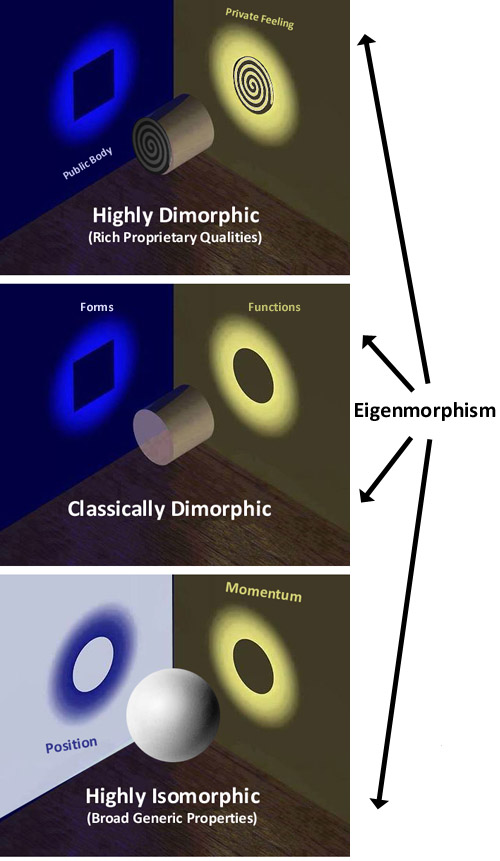
This diagram shows how elemental phenomena (bottom image) appear to us to have very little going on inside. Their public properties are not very body-like and their behaviors are imagined not to be very experiential. Eigenmorphism is the idea that as phenomena progress to richer experiential qualities, their interior and exterior nature expands in opposite directions. In biological organisms, the public and private view not only differ by perspective, but the interior perspective can increasingly elaborate itself (spiral grows) without the exterior perspective (square shadow) revealing any change.
It should be noted that this is a metaphor, not a diagram of matter or quantum. What the yellow wall refers to is actually shapeless, as it is the appreciation of and participation in experiences. The increasing elaboration of the shape stands for increasingly rich and varied modalities of sensitivity. MSR suggests that the three dimensional figure in the center is not real at all, and a better diagram would show the shadow from the blue wall and the shadow from the yellow wall gradually morphing into each other in stages.
The difference between the high and low ends of the eigenmorphic spectrum are not only in the degree to which their interior qualities differ from their exterior properties, or in the kinds of qualities which higher experiences contain, but also in ubiquity vs uniqueness. The generic nature of low level phenomena make them comparatively interchangeable and universal, so that physical and mathematical laws have a universal reach. The highest level phenomena can be esoteric to the point of near-solipsism, with meanings that are so multiplexed and poetic that they apply only to a single moment or perspective.
Free Will and the Unconscious
The key oversight, in my opinion, in the approach taken by neuroscientific research into free will (Libet et al) is in the presumption that all that is not available to us personally is ‘unconscious’ rather than conscious sub-personally. When we read these words, we are not conscious of their translation from pixels to patches of contrasting optical conditions, to loops and lines, to letters and words. From the perspective of our personal awareness, the words are presented as a priori readable and meaningful. We are not reminded of learning to read in kindergarten and have no feeling for what the gibberish that we are decoding would look like to someone who could not read English. The presentation of our world is materially altered at the sub-personal, but not ‘unconscious’ level. If it were unconscious, then we would be shocked to find that words were made of lines and loops or pixels.
In the same way, a robotic task is quickly anticipated, even 10 seconds ahead of time, without our personality getting involved. This does not mean that it is not ‘us’ making the choice, only that there is no need for such an easy and insignificant choice to be recognized by another layer of ‘us’, and reported by a third layer of ‘us’ to the personal layer of us.
When we work on the sub-personal level of neurons, we are addressing a layer of reality in which we, as persons, do not exist. Because we have not yet factored in perceptual relativity as a defining existential influence, we are making the mistake of treating a human being as if they were made of generic Legos instead of a single unique and unrepeatable living cell which has intentionally reproduced itself a trillion times over – each carrying the potential for intention and self-modifying teleology.


Recent Comments