Biology From The Inside

This gif is one of the set that has been going around, but it reminds me of the concept that I have of biological awareness (as opposed to primordial awareness which is embodied by physics and does not require biology). Whether the inorganic universe is four dimensional (3 + 1 time) or just seems that way from within a two dimensional hologram, it seems likely to me that the experience of biological organisms is best modeled along a fifth axis (aesthetic qualities as more than the sum of their conditional parts).
What I like about the repeating gif, besides the coincidental “5” relating to the fifth dimension, is that it suggests a kind of morphological respiration. Front to back, parts to whole, a seamless, self-metabolizing transformation. As a biological organism, my experience of the outside world is limited to that which can be modeled as objects – that is, through an aesthetically reduced feature set in which a bunch of five dimensional urges and responses are flattened into a four dimensional narrative on multiple levels.
In a previous post, I was looking at how sensitivity might be understood as being ‘key composited’ or perhaps ‘discomposed’ across multiple frames of reference. By this I mean that the apparent distribution of our psychological interface across the tissue of the brain can be compared to a flatland visualization:
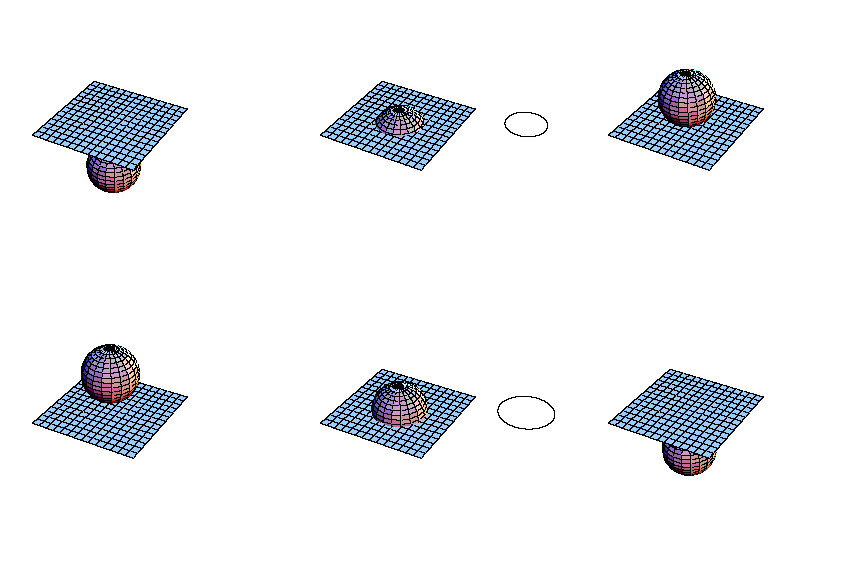
If instead of the sphere, it were a hand passing through the flatland plane, it would appear to the omniscient flatlander that there were five separate circles appearing separately, yet somehow seeming coordinated in their action. The fingers are part of a single hand, but within the constraint of the two dimensional sensitivity, the unity of the hand is discomposed across space in the literal sense, but figuratively some kind of unity can be inferred through the synchronized coincidence of the movement.
Now imagine that instead of another graphable dimension, the fifth dimension is one which is as orthogonal to spacetime as the three dimensions of space are to the one dimension of time. Feeling, like pain and pleasure, are like a coloring, or keying which cuts across multiple layers of seemingly unrelated public events. Not only is feeling a different kind of thing as forms or functions but it is a dimension in which dimension itself is transcended. Feeling is not a model or a measure, but rather it is the primordial context from which all measure is derived and all modeling is made demonstrable.
From the discomposed perspective ‘out there’, we are a coincidence of coincidences. A mysteriously synchronized, dynamic orchestration of hundreds of billions of neurons, organelles, molecules, etc which corresponds to the behavior of an animal’s body.

The feelings which we experience are not located in the tissue of the brain, rather the brain itself is part of the wider landscape of the totality of experience. The brain as a whole is, like our body as a whole and all of the cells and molecules that make it up at any given time, a four dimensional reduction of a transdimensional privacy.
Under Eigenmorphism, the base of each pyramid of perception is made up of the apex of countless low level pyramids of perception. When we look at an fMRI or the brain, we are trying to look at the view from top of our own pyramid through the blind eyes of its own bottom. Feeling is stripped out (not to mention the higher dimensions of meta-feeling/emotion/cognition/intuition) and we are left with a four dimensional mechanical skeleton with no interiority.
Being so impressed with ourselves and what we have accomplished by questioning our naive introspection with science, we naturalize the discomposed view and epiphenomenalize the native, gestalt perspective. All of this makes perfect sense within the flatlanded context of topological physics, where spontaneous appearances and disappearances are assumed only to reflect each other, rather than private transdimensional presentations.
I suspect that the universe which is experienced in the absence of all living organisms is a much different thing that it would appear to us. What we see as a four or two dimensional manifold is only a snapshot of discomposed histories. It seems inanimate to us because we seem so animated to ourselves. The highest awareness of our own interior physics seems to us unreal and crazy…and it is, relative to the inertia of human awareness as a whole. Like the inverted image of our retina however, I think that because our disposition spans so many levels of life and physical experience, we tend to see the mechanical patterns which all of the layers have in common, rather than the coincidence which is also animating them from the top down.
Like the transformer car in the gif, the signature of our presence and intention coincides with the interplay of entropy and significance. The living cell, from our perspective looking through our eyes and a microscope’s lens, looks like a homeostatic emergence. Seemingly conjured, like Brownian motion, from the statistical collisions of countless microphysical conditions.
This is not completely untrue. The mechanical conditions of a cell can be disrupted mechanically. There is bottom up causality. What has not been properly investigated yet is the other perspective. The one responsible for the biological property of healing and global integrity. If we think of the flux between entropy and significance as a carrier tone for biological life, then it might be easier to conceptualize how the universe is as much a dynamic interaction of nested simplicities as it is a mechanical progression from simplicity to complexity. The image of the metabolic transformer stands in contrast to the stillness of the axis of its transformation.
The Keys to Sensitivity


Chroma key compositing typically uses a green or blue screen to key a particular color to be recorded as transparent. In the example above, I have placed green keys on a cosmic (astrophysical + microphysical) background to give an idea of how to conceive of the relation between publicized and privatized experience.
The green of the keys represents the intrinsically singular sensitivity which is ‘behind’ the key silhouettes, just as wearing a green shirt on camera in front of a green screen chroma key will, in a sense, portray your shirt as a ‘receiver’ of the composite image.
This metaphor is closer to what I propose for psychophysical unity – not so much a Receiver theory of consciousness where the brain acts as an antenna for metaphysical signals, or an Emergent theory of consciousness where brain functions accumulate as a representation of signals, but as a Divergent theory in which sensitivity is whole within its private frame of reference, but fragmented across what appears to be space and time from the perspective of a similarly keyed sensitivity*.
Consider that if you are far enough away from a mosaic, it looks like an image, but if you are very close, you see only colored tiles. The difference in spatial ratios on our visual sense influences whether we see the artist private-personal intentions to express the picture’s content, or their public-impersonal technique in placing tiles. If instead of a static mosaic tiles, we think of it as a dynamic television screen of pixels, the metaphor can be extended through narrative time. The pixels do not tell a story, but the image does…over time…to a human audience.
The pixels are not “producing” the story, nor are they “receiving” it, although there is both receiving and projecting of electromagnetic sensations on the public-impersonal level. The complexity of the sequence of patterns on the screen also does not produce the story either, and no amount of complication within the hardware will cause stories to be experienced, just as no degree in the complication of a plot will cause the story itself to become sensitive. Patterns are representations within experience, not experiences themselves. Consciousness is not the green of the key, it is the transparent sensitivity that the green represents. If there is receiving or emerging, it is sensitivity receiving sensitivity, and sensitivity emerging from sensitivity.
*Sensitivity here could mean ‘person’ or ‘observer’ but I want to make it clear that what I propose does not depend on human like experience. I see all forms of observation as participation, and I want to break the automatic association that we have between experience and Homo sapiens personal subjectivity. For pansensitivity to replace energy or information as the primordial identity, it must be understood that all objects, forms, and physical conditions diverge from the totality of sense (not just primitive sub-personal sense, but the whole band of sub-personal, personal, super-personal, and impersonal sense).
Why an Atom is More Like a Person Than a Doll Is
Another thing that really puzzles me is the way that you agree with me that nothing is inanimate, and yet you repeatedly use arguments that are based on the premise that some things are inanimate. Is this just an *apparent* contradiction because we use the term ‘inanimate’ in fundamentally different ways, or is it a contradiction in your thinking? Could you perhaps explain this?
It makes sense that it would seem contradictory, as this issue is really a more advanced concept that goes beyond accepting the initial premises which we agree on. Lets say that we want to create a whole other Everything from scratch. In my view, as long as we keep things relatively simple, as in no complex organic life, our views are pretty much interchangeable. It doesn’t matter whether information processes are irreducibly animate as you say, or whether information processes are actually the self-diffracted gaps in the primordial identity pansensitivity, as I suggest. The effect is indistinguishable and we have cool stuff going on, with physics, aesthetics, entropy all naturally falling out as parameters.
The question of primordial identity begins to seem more important as multicellular life begins and we have to choose to bet on whether the body of any dividing cell is type identical to the experience associated with the organism as a whole, or whether there are multiple layers of experience going on. If there are multiple layers of awareness going on, does one of the layers act as an umbrella for the others, and if so, is it a summary/identity layer as the color white would be to the visible spectrum of colors, or is it an emergent layer which is produced by transfers of quantitative results, so that the cellular experiences are a priori ‘real’ and the macrophenomenal experiences are generated as a kind of projection which is less than primitively real.
What I do with MSR is to assume that the primary relation is perceptual relativity. This means that spacetime is scaled to the significance of experiences rather than fixed to a scalar index. By this I mean that the cell level microphenomenal experience is simultaneous with the organism level macrophenomenal experience, but that their simultaneity is asymmetric, as the macro appears smeared across time from the micro perspective. When we use microscopic scales to poke around in the body and brain, we are essentially driving a wedge between the macro and micro, but without recognizing that microphysical effects refer only to microphenomenal affects and not macrophenomenal affects.
At the level of the cell or molecule, the organism as a whole, if it is a complex organism, does not exist. Literally. There is no {your name here} to your DNA. Its a completely different level of description in which the public side relates mechanically (molecules must functionally produce cells and be produced by cells), and the private side relates *metaphorically*. It’s a complete divergence which does not appear prominently in pre-biotic phenomena. Each organism is evolving separately on the inside than it is on the outside, and that dimorphism is getting exponentially more pronounced as it evolves. The public body side appears to be physically recapitulating itself as a growing, multiplying, dividing structure in space, while the private experiential side has no appearance and is felt as the invariant nexus of a story about the world which appears to be repeating in nested cycles and progressing in a linear narrative.
The two stories are different. The microphenomenal story appears to relate to physical events, which we can observe in everything from a viral infection to changes in temperature or pressure in the environment. The macrophenomenal story, at least for us, is consumed by history and teleology. We respond to the environment based on our accumulated experience and intention. This so-called mind-body split is actually worse than that. Coming from a time where we had no understanding of microphysics, the simplistic mind-body mapping flattens human awareness into a single horizontal dualism. What I suggest is that dualism is actually an orthogonal monism, but that each horizontal dualism is part of a vertical stack. The cell that is seen by the organism in the organisms world is only a snapshot that it can see during one if its moments. To look at one of your blood cells under a microscope is for the cell to see itself from two different evolutionary times, with the newer, larger experience looking at a moment of the older, smaller experience and seeing it from the outside, as an object or machine. This is how the aesthetics of distance works for us – when we outgrow an experience, the here and now associated with us is recontextualized aesthetically as a there and then which is associated with “it”.
I don’t know if that makes it seem even more confusing, but what I am trying to get at is that the more the universe recapitulates itself as increasingly nested experiences, the more important it is that we see that which is nesting itself as primary and the overall nest as ‘inanimate’. Pragmatically, we can’t walk around the house worried about how the carpet fibers feel, or whether we have underestimated the feelings of the avatar we have created in a computer game. If it is the nesting instead which is primary rather than what is being nested, then we have no justification at all for our intuitions about life and death or organic vs artificial processes and we can only turn to a kind of gradient of probable intelligence based on complexity.
There are a lot of problems with that, not the least of which is that we are required to take the word of any sufficiently sophisticated machine over our own understanding. We become unable to justify any significant difference between an interactive cartoon character that acts like a person, and a fellow human being. A successful stock market trading program would be entitled to staff companies entirely with copies of itself and reduce the entire human population to an unemployed resource liability. I’m just throwing out a few wild examples, but there are many less extreme but undesirable consequences to personifying information processes, as we are starting to see with the rise of corporate personhood in the US. A corporation is an information process, as is a city, but we have to decide whether the employees and citizens ultimately serve the motives of the process or whether the processes are to extend from their motives. If process is primary, then we are mere spectators to the process of our own irrelevance. If sense and motive are primary, then the process is ours to do with it as we wish. Nothing short of the future of the universe hangs in the balance. It is more convenient to work with measurable processes and theories than messy emotions and sensations, yet the universe has found a way to do that, and I think so should we.
If we think of the world that we see through our eyes as an experience in the moment rather than the whole truth of existence, it is no longer a given that configurations and complexity are creators of life. The cellular machinery only relates to extra-cellular machinery on far micro and far macro levels of description. The most dynamic range is the fertile middle. Humans have, as far as we know, the broadest range between the mechanistic ‘out there’ and animistic ‘in here’. This is what makes us human. Any theory which does not clearly understand why that is important is not a complete theory, and is therefore ultimately a theory of the destruction of humanity. I’m not a huge fan of humanity myself, so I say this not as some Cassandra-esque wolf crying, but as a consequence of what seems to be the case when I add up everything to get a big picture. Information cannot feel. These words are not generic patterns produced by inevitable process alone. They are my words, and I am instantiating them directly on my own irreducibly macrophenomenal level.
I/O w/o O/I
A little note on the difference between Gods and Monsters. As ever, I return to the symmetry of the continuum, where we find the far end to seem unfeeling and unnatural. The monster is driven by relentless urges. It is all Output and no Input. Insensitive power, and the power of the insensitive. All that is mindless or heartless and artificial can be mythologized as monstrous. A freak of nature, or a Frankensteinian attempt to transcend nature.
If the monster is an embodied urge, then a god is the opposite; a disembodied personality whose output is that of unbounded teleos. The spirit world is supernatural and all knowing. There can be a god of faith, which receives prayer and devotion as Input, but whose Output is only indirect as signs, miracles, and other synchronistic effects. The supernatural emerges from the seemingly unexplainable unfolding of events and conditions or projection of reasoned intention. The power of the supernatural is figurative and must be inferred by genuine belief. It has no motive power of its own and must borrow that of individuals to worship and serve, whether out of hope and gratitude or fear and dread.
This relates to a conversation about information vs sensation, where I tried, as ever, to make the case for sense as the progenitor of all phenomena, including information-theoretic phenomena. I thought that a straightforward way of understanding this is that turning on a computer or turning the gears of a machine is not substitutable. There can be no symbolic code which has an effect to stop or start a Turing machine, except virtually. Software cannot turn on its own hardware once it has been turned off completely. This comes up a lot in managing server farms at data centers. If you remote into a server and accidentally shut it down rather than reboot. You may have to make a call to someone to physically walk down to your cage and push the button to turn it back on. Even if you’ve got layers of fault tolerance built in, with power switches that can be remotely controlled, it is still inevitable to find yourself calling for a manual reset when that software fails.
This is what I think distinguishes the sensory-motive from input/output. I/O can be virtual – it designates a flow of information in a theoretical topology, but sense must always be literally present at the lowest and most fundamental level of the universe. It can only be a uniquely experienced event which occupies a fixed spacetime coordinate relative to all experiences in the history of the universe. It cannot be simulated or emergent from code. Without genuine sense, the motive power of mechanical output is a monster or zombie. Blind automation. Without genuine motive, an aesthetic sense is bound to the mytho-poetic realm of fiction or psychic intuition.
There is no Objective Color thread
That’s really interesting, too much for me to all read but I appreciate the effort put into this.
I do disagree on your first point though. There is such a thing as objective color. Photons have wavelengths, and specific wavelengths are specific colors, regardless of how our eyes and brains interpret them.I read a part of the article you linked, and if you do take into account how the eye and brain interpret colors, there is still objective color. Apparently we do all have different ratio’s of red vs green vs blue cone cells, but as the article says, our brains are still in agreement over what exactly is yellow. So our eyes might be different, but our brains correct that difference.
Think about the nature of the visible spectrum. We perceive it as being composed of soft but distinct bands of hues, usually seven or eight: red, orange, yellow, green, cyan, indigo, violet, and sometimes fuchsia, which is not a spectral color. Colors such as grey, white, brown, beige, and pink do not correspond to any one frequency, so they cannot be said to map to the wavelength of any particular photon, yet we perceive them as discernible colors.

The color palette is of course, also a wheel in which colors are seen as ‘opposite’ to each other, and which generate various effects when placed adjacent to each other, as seen in various optical ‘illusions’:

I put scare quotes around the word illusions because this information has helped me understand that what we see is never an illusion, only our cognitive expectations about what we see can be illusory. By manipulating the various layers of sensation and perception to expose their conflicts, we can tease out the truth about color, and by extension consciousness. There is no ‘actually’, there is only ‘seems like from some perspective’. The experiment showed that our color perception can be altered for weeks after subjects return to an unaltered optical state*. Our brains correct the difference because they are not translating the wavelength of photons but mimicking relations within the optical experience as a whole.
Now think about the visible range of the electromagnetic spectrum. Does it have seven soft bands or is it an absolutely smooth quantitative continuum? Does the continuum form a wheel with primary and secondary oppositions, or is it an unbounded linear progression? Does it repeat in octaves, where one frequency suddenly recapitulates and merges the beginning and ending of a sequence, or does it monotonously extend into the invisible spectrum?

Our eyes tend to differ, and photons might be the same, but color is not photons. In fact, photons from the outside world only do one thing in our retina, and that’s isomerize rhodopsin molecules – meaning that the proteins in our rod and cone cells are studded with vitamin A molecules which stretch out in the presence of visible light. From there, the folded proteins in the cells sort of swell open and actually cut off what is know as ‘Dark Current’ – the continuous flow of glutamate which is interpreted as seeing light *in its absence*. Physical light, in a sense turns our experience of darkness off.

Once we let all of this information sink in, it should be clear that the experience of color is just that – an experience. It correlates to optical conditions, but it also correlates to conditions in which there are no optical inputs at all. Even where it is isomorphic to exterior measurements, there are no colored photons inside of the brain that we are seeing. We are seeing the same neural conditions that we feel, smell, taste, and hear, and synesthesia confirms that as well. This does not mean that neural conditions are a solipsistic simulation, however, but that’s a whole other conversation (which I have my own ‘crackpot’ theory for 🙂 http://multisenserealism.com)
*http://color.psych.upenn.edu/brainard/papers/AIC01.pdf
Mapping the Continuum with Words
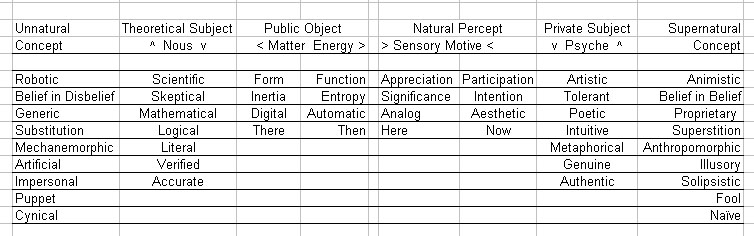
This chart of the MSR Continuum highlights symmetric nature of the spectrum. New in this edition is the category of “Theoretical Subject”. This is a piece to the puzzle that has had me curious for several years. The theoretical subject is also know as the view from nowhere – an unacknowledged voyeuristic perspective which is central to science, but which had never perfectly clicked into the continuum before. Now it’s easier for me to understand how thinking relates to objectification of the self, and how math and science amplify and refine that perspective.
I’m also liking the label of “Unnatural” to balance the opposite “Supernatural” category. The uncanny quality of artificial substitutes and robotic behavior fits in well as the extreme end of Nous or mind. The oversignification of psyche is overly proprietary and solipsistic.
The Matter of Objects and The Idea of Subjects
The Matter of Objects
What do we mean by an object? As usual, the term can be used both literally and figuratively. A friend of mine who insists that the universe can be boiled down to objects or concepts* and that the definition of object is simply ‘that which has a shape’.
I argue that this is, (like all pure dichotomies) too simplistic, and that both objects and concepts are more like bookends on a spectrum-continuum of what could be called percepts. We can dream in shapes and places of varying levels of realism, we can see a phantom image which has a light bulb shape when we look at a light bulb. Likewise we can encounter the objective reality of humidity or a foul odor without being aware of any shape associated with them. This is a pretty clear indication to me that shape can be abstract or concrete. We have no trouble talking about a circle and a cycle in the same breath, even though one is a shape and one is a ‘concept’. The unity between them seems at least as relevant as the distinction, especially if we are reducing the universe to the most primitive principles possible**.
The word object is also used as a verb. “I object!”, which implies the intentional assertion of personal will into a public social context. When we use subject figuratively, it is in a lowly political sense, or at least a passive sense. When we are subject to laws or another person’s will, we may not be able to object, or not effectively anyhow. On the other hand, if nobody is subject to our influence, then nobody cares what we object to, and we are just as ineffective as if we were being passive subjects.
Looking at this slide from Kelvin Abraham’s Tetryonics,

I started thinking about how his distinction between 3D matter and 2D mass-energy translates into MSR sensory-motive terms. I see the sensory-motive primitive as the commonality between both the 2D and 3D phenomena, with the 2D mass-energy being sensory-motive (temporal) and the 3D being 2D-once-removed (spatialized publicly).
If we think about our naive experience of what solid matter, it could be defined as a “sense of invariant insensitivity” – a relatively static obstruction within a public facing sensory modality. We mostly rely on optical and tactile sense to navigate the public space, so solid objects are mostly defined a phenomena that is tangible and visible. If I had to define object in the way that I think that we literally mean it, it might suffice to day that an object is any phenomena which can be removed without being destroyed.
With the ghost silhouette of the light bulb for example, which has a shape and a location relative to my field of vision, I cannot take that shape from my vision and put it somewhere else. I can’t give it to someone and nobody can take it from me. It seems that objecthood is tied more to a conserved identity of public position than anything else. Obstruction of sense and conserved identity may really mean the same thing. Obstruction or sensitivity-of-insensitivity provides the iconic reflection that relates back to the totality.
If you have ever programmed a computer game with moving avatars, you know that collision detection is not just automatic. You need to have the program check to see whether the pixels are adjacent to each other and then define that as ‘touching’ to initiate a bounce or splat or whatever. The sense of touch or tangible boundaries is not a given. It takes a perception, a sensory interpretation to motivate object-like behavior. The object must object!, but it must object in the presence of others who can detect the objection and who ‘care’ enough to respond, or whose response is the primitive ancestor of what we call care. Significance. Reading a signal as a signal and integrating it as distinct from noise or nothing (entropy).
The difference between geometry and topology is relevant as well:
If a structure has a discrete moduli (if it has no deformations, or if a deformation of a structure is isomorphic to the original structure), the structure is said to be rigid, and its study (if it is a geometric or topological structure) is topology. If it has non-trivial deformations, the structure is said to be flexible, and its study is geometry.
Because matter doesn’t have to be literally rigid, and clearly occupies space in non-solid, self-deforming states, I would suggest that it could be topo-genic, and that the rigidity or ‘topo-cality’ of matter is a continuum from the semi-topological fluid to the nearly-topological solid. The 3-dimensionality of matter is, by contrast, not a continuum. It either has volume or it doesn’t, and if it doesn’t have volume than it must be energy (mass) only. It could be said that mass-energy is 2+1 dimensional, as it is the source of experienced ‘time’, but matter qua matter may have no dimension of time. It is 3D bodies divided across space. The animation we experience of matter is all subjective (or “conceptual” if you are an RSM fan).
If Abraham is right, and matter is 3D mass, it may be redundant to say that matter has mass. Matter may add to mass-energy-time only volume-related scalars like pressure. The contrast between the 2D and the 3D also may only be conceivable within a 5D (individualized) privacy, which is biological life. The biological is also a continuum, like the topological, which is bio-genic rather than fixed. The kingdoms of biology are comparable to the physical states of matter. They evolve through embodied experiences, unlike matter which are (pre-somatic) experiences over an unlimited time that we perceive in limited cross-sections as matter.
The Idea of Subjects
I do not argue against the existence of any one thing that we can apprehend, either by sense or reflection. That the things I see with mine eyes and touch with my hands do exist, really exist, I make not the least question. The only thing whose existence we deny, is that which philosophers call matter or corporeal substance. And in doing of this, there is no damage done to the rest of mankind, who, I dare say, will never miss it. – George Berkeley
In all of the arguments that I have had about physics and metaphysics, I have never heard from any strong critic who would be able to understand what Berkeley meant in the above quotation. In every case, their argument makes it clear that they are psychologically incapable of differentiating Idealism from Solipsism. Several times each week I go through the same rebuttal to their straw man of idealism in which I supposedly deny that the Moon or some other object exists when I am not looking at it. Each time, my correction of their misrepresentation passes right through their ears without any apparent effect. Instead, they go on, again and again, pushing against this paper pussy cat of nobody’s solipsism, regardless of how many different ways that I try to explain that idealism need not deny the reality of the experience of matter, only that matter is fundamentally interactive and experiential rather than an entity which is independent of *all* perspective. Nobody is saying that matter doesn’t exist independently of any particular perspective or sense modality, but that it could be independent of all possibilities of sensation is really an abstraction that is even more naive than naive realism. It’s a purely unconsidered presumption of existence-ness without any connection to aesthetics. Berkeley understood that even a description of nature without awareness such as Whitehead’s; “a dull affair, soundless, scentless, colourless; merely the hurrying of material, endless and meaningless.” would be much too generous. There could be no hurrying or material without some perspective in which those qualities were being presented.
John Locke (Berkeley’s predecessor) states that we define an object by its primary and secondary qualities. He takes heat as an example of a secondary quality. If you put one hand in a bucket of cold water, and the other hand in a bucket of warm water, then put both hands in a bucket of lukewarm water, one of your hands is going to tell you that the water is cold and the other that the water is hot. Locke says that since two different objects (both your hands) perceive the water to be hot and cold, then the heat is not a quality of the water.
While Locke used this argument to distinguish primary from secondary qualities, Berkeley extends it to cover primary qualities in the same way. For example, he says that size is not a quality of an object because the size of the object depends on the distance between the observer and the object, or the size of the observer. Since an object is a different size to different observers, then size is not a quality of the object. Berkeley rejects shape with a similar argument and then asks: if neither primary qualities nor secondary qualities are of the object, then how can we say that there is anything more than the qualities we observe? – Wiki
Berkeley sees that there is no difference in kind, but only a difference in degree between the so called primary and secondary qualities, and that if anything, the more impersonal qualities make more sense as secondary reductions of the more personal qualities than the other way around.
We cannot see carbon dioxide gas, but that doesn’t mean that there is no aspect of our extended sub-personal sensitivity which is not embodied (from our perspective) by cellular and molecular interactions. We don’t see it or smell it, but we feel our lungs distress when it can’t get rid of it fast enough. If it were the other way around, and the more public facing qualities were primary, then we get all of the problems of Philosophy of Mind that have to do with binding and the Explanatory Gap. There’s not any plausible justification for personal qualities to emerge from the impersonal. Privacy could only be a subset of public conditions, and rather than emotions or sensations, we should have only shapes and positions which represent a sum of more complex shapes and positions.
Berkeley is interesting. He had some ideas which were 200 years before their time. Although his intuitions defied the prevailing Early Modern views, they are right at home in the 20th century with Relativity, Positivism, and Quantum Theory. It makes sense to me that someone like that would of course see Deist philosophy and Classical mechanics as being rooted in a fundamental error of mistaking the form for the content. For him, the content was God, so he cast those who were devoted to that error, the free-thinkers and Enlightenment era mathematicians, as infidels.
In 1732, he published Alciphron, a Christian apologetic against the free-thinkers, and in 1734†, he published The Analyst, an empiricist critique of the foundations of infinitesimal calculus, which was influential in the development of mathematics.
It seems to me that while he was radical and progressive in his prescience of a post-Newtonian, immaterial physics based on relativity, his enthusiasm for this view was too far ahead of his time. His unfortunate rejection of the foundations of modernism put him in on the wrong side of history. He could see clearly the problem of substances which were absolute, but he could only express the alternative solution in pre-scientific terms, which in his tribe meant God and Christianity. He wrote:
“Whatever power I may have over my own thoughts, I find the ideas actually perceived by Sense have not a like dependence on my will. When in broad daylight I open my eyes, it is not in my power to choose whether I shall see or no, or to determine what particular objects shall present themselves to my view; and so likewise as to the hearing and other senses; the ideas imprinted on them are not creatures of my will. There is therefore some other Will or Spirit that produces them.
Here I think that he is making very much the same mistake that he has seen his opponents make when considering his positions. That we cannot change what we see when we open our eyes does not mean that something else must be able to change it, but he jumps to that conclusion because he has not considered the possibility that sense itself could be the parent of God just as it is of heat and matter. A sense which is semi-teleological and semi-mechanistic.
In the 21st century, beginning with a few lone proponents of panpsychism and a growing school of computationalism, I think that we are working our way back to where Berkeley was before he got all churchy in the 1730s. With the intellectual tools provided by figures like Einstein, Planck, Gödel, and Turing, we have all of the pieces necessary to put together the puzzle of a completed physics. It may be still too soon for that. Instead of going forward all the way to a pansensitive physics, we may have to pass through yet another era of compromise, filtering the provocative immanence of primordial qualia through the comparatively familiar neo-Rationalism of information science.
The information revolution is undeniably compelling, however it still orphans the aesthetic qualities of realism into an unacknowledged dualism of ‘emergence’. It may seem like a minor detail, but on the level of the Absolute, this particular detail is all-important. What we see when we open our eyes is not only the Will of God or the mechanism of his absence, not only nested abstract structures and functions, but the sensible awareness in which those frameworks are defined. It is a big picture which can make sense in many ways, and each perspective implicates all that the others seem to lack. To get around the problems of idealism, all that we need to do is to shed the presumption of subjectivity in favor of a physical dimension of privacy. Lose the subject as defining experience, and you have subjectivity itself as one particular kind of sensory-motive participation. One particular dance in the cosmic disco which is shared by this clan of fancy pants hominids. Human experience is subjective, not because all experience is subjective, but because the story of an animal’s life is inherently self-directed. It makes sense that this selfish theme would be hard to separate from awareness itself, but Eastern yogas and Western occultism insist that it is possible to do just that. NDEs, OBEs, and other paranormal phenomena also seem to hint at such disembodied awareness, or they hint at the fallibility and self-deception of the brain, depending on who you are. At this time, going along with the non-subjective view of pansensitivity, I suggest that the pre-scientific notion of souls, like chakras, and God, are better understood as semi-metaphors than literal entities. A soul is the gestalt of autobiographical quality which disperses across time. It is not an energy which animates the body, it is the story which is represented publicly by the body, voice, personality, behaviors, ideas, etc. It’s not a subject or an idea, it is the idea of the subject as an object.
*”and never the twain shall meet”
**There are other examples also. If the object “The Sun” were to move twice as close to the Earth, the relation between the two, which RSM defines as a concept (“concepts are the relations between object”) evidently causes the seas (objects) to boil on Earth. That sounds like the twain are meeting to me. Besides that whole “never the twain shall meet” is really substance dualism, isn’t it? Substance dualism has the homunculus regress…something has to bridge the gap between the twain, which would then have to either be a third substance, or an infinite sandwich of non-meeting ‘twains. Another example is accounting. Accounting has no problem classifying goods (objects) and services (“concepts”) in the same categories of expenses or revenue. It all converts to money, so what is money?
†In 1734 he also became a Roman Catholic Bishop in Ireland (Bishop of Coyne), which is why George Berkeley is also Bishop Berkeley.
Is Quantum Theory Naive?
To me, the issue with interpreting quantum systems as real is not that they are not observable or that they contradict naive realism, but that the contradiction is not explained.
Our naive realism might tell us that we are surrounded by empty space rather than a mixture of invisible gases and vaporized particles, but it makes sense that our perception has finite limits, so that particles which are too small for us to resolve visually or tangibly would seem identical to empty space to us. There is no paradox in the nature of air, and we can cool it down to a liquid and see that it is in fact matter.
The nature of quantum systems, however, not only challenges our expectations about what can be detected, it really demands that we relinquish expectations altogether. The idea of a formless, unobservable ‘system’ which takes on paradoxical forms contradicts the ontology of form itself. That doesn’t mean it’s wrong – to the contrary, obviously the model is a complete success – however there are many ways to interpret phenomena which are empirically valid but miss the point entirely. I would imagine that a theory of human personality could be derived from correlating traffic patterns in a city and the make, model, and color of vehicles, and given a certain margin of probability, it too would be compelling. That does not, however, mean that we should attribute human personality to automobiles, or that there is a real but unobservable system which is making determinations about which cars belong to what personalities.
All I’m saying is that for many people, it is too soon to decide that QM is settled science that we will just have to accept on its face. For some, it may indeed just be stubborn habits of naive thinking, but for others, I think that it is an intuition that there can also be a such thing as “naive theoreticism” as well. Just because QM is counter-intuitive and complex does not make it sophisticated or insightful. To me, it makes more sense as a consequence of overlooking the fundamental role that sensory-motive participation plays in the universe. Quantum systems are not only observable, they are observation itself – feeling, seeing, knowing, measuring. Seeing quantum as something outside of that only complicates things unnecessarily. Is it not possible that disembodied probabilities are fictional?
Free Will and the Square Root of Entropy

A first draft remix of the previous ortho-lattice diagram.
This view introduces a new factor, the square root of Entropy (√H). If the universe is founded on pansensitivity or Sense (–ℵ), then the initial fracture is between the particular aesthetic qualities which stand out (Qualia æ), and which are anesthetized* (√H).
This primal choice between what gains attention and what loses it is equal to Motive (Ω), and represents the midway oscillation between sense and entropy.
Entropy or Panentropy (H) is defined as the contents of the formula in the box, ω = E/∞.
Quanta (mechanism or minimum possible qualia) equals Energy (E) divided by spacetime,
i.e. when “energy”** it means that a sub-personal sensation is quantified, it is decomposed spatially to position or temporally to disposition. This branching of quanta is also the branching of analog (proprietary likeness) and digital (generic substitution).
This accumulation of ‘live’ experiences taking place here and now is continuously breaking down into the scale nested multiplicity of theres and thens. This breaking down process is quantum/entropy, and it is the conjugate to sensory-motive, which are both together the conjugate of the Absolute (ॐ)
The formula on the top is more or less a rewording of E=MC², only with Matter (M) instead of Mass, and Quanta compressing the notions of energy and spacetime. Adding Significance (Σ)† to the formula makes it about the concrete realism of physical substance, rather than conceptual inertia or drag on acceleration. Unlike mass, matter is a three dimensional presence which is an anesthetized embodiment of significance.
Note the inverted parentheses in the sensory-motive formula denotes its fundamental receptivity and interiority relative to the Matter-Significance formula on the top (denoting exterior forms/bodies).
* Anesthetized = unintentionally ignored, masked, elided, alienated, automated, mechanized, or ablated. To be made ‘other’, impersonal, inanimate, etc.
** Energy = anesthetized motive
† Significance is the sum of sense squared (–ℵ² = ℵ) or cardinality; sense of proprietary motivation – identifiable likeness.
On Human Specialness
Often, it comes up in arguments that the idealistic position stems from a mental weakness – a sentimental attachment to all things human and familiar and a deep-seated fear of losing self-worth. When the term ‘special’ is brought up, it has a pejorative connotation*. The disdain for specialness makes sense to me as the mechanistic ideology is founded (under Multisense Realism) in the supremacy of the generic and impersonal. The fundamentals of the cosmos are spoken in terms of units of measure, not unique and unrepeatable aesthetic experiences. Underneath this scientific impartiality however, I maintain that there is another level of unacknowledged specialness. To see the universe as it is rather than as we wish it to be is a romantic idea of the anti-romantic. To become purely logical and reasonable is ultimately a kind of ethnic cleansing of the psyche. Transhumanist specialness is even more special because we think that we have outgrown trying to be special.
I think there’s more to the idea of human specialness than it might seem.
I see an important differences between:
- “Specialness” as a measure of aesthetic prestige.
- Human superiority as a function of ego projection.
- Human exceptionalism as a function of species comparison.
The quality of specialness is not limited to human beings. I think that significance in the sense of aesthetic prestige is a universal property, from the subatomic level to the cosmological level. The particular content and intensity of significance varies widely, but the fact of significance is not a fictional invention of Homo sapiens. The problem with machines is that they lack any aesthetic awareness at all. What may seem to some to be a pure, unselfish quality which falls out of mathematics is actually, in my view, merely pre-selfish.
This admiration for the unseflish qualities of pristine objects is, I think, ultimately a romantic simplification. It is like dreaming a blind world as a better world, since so many terrible things are rooted in valuing appearances over realities. The impulse to move beyond selfish forms of human awareness is indeed noble, necessary, and inevitable, but I think that part of that involves a deeper consideration of self. We cannot transcend the self by amputating it.
As far as human exceptionalism goes, I completely agree with transhumanists – humans are not so great, and not so different from other species. The extent to which we are objectively ‘better’ than other organisms, even if it could be ascertained, is dwarfed by our exaggeration of it. That’s not what the issue that I’m bringing up at all though. What I’m talking about is true even if Homo sapiens had never existed.
I sometimes use inflammatory language to describe machines as stupid not because I don’t like them, but to make clear that my position is that what a machine does for us is precisely the opposite of what our own awareness is. It’s about the ontology of unity, multiplicity, and spacetime positions vs experiential dispositions.
The machine does not serve WalMart any more than they do a disservice to the displaced worker. It serves whatever agenda that it is being employed by. It is only because of our profound lack of compassion that we allow what should be a celebration of freedom from work to become a liability. Losing a job, ontologically means gaining freedom. It is only we who equate that with being undeserving of the benefits of civilization, and we who back that up with real deprivations. Machines are stupid because they don’t care. They don’t care whether they are burning baby kittens or diesel fuel to run.
WalMart is stupid for the same reason (and it is no less a machine than any computer). WalMart does not think that it is special, it simply executes a program which privatizes profits and socializes costs. The program can’t wake up though. It can’t fix itself. We are the only ones who can recover the positive side of our exceptional sensitivity…a sensitivity which just happens to be human in this particular case, but which in all cases is the polar opposite of mechanism/insensitivity.
*”special pleading” is a logical fallacy which gets thrown around a lot too, with the same sort of condescension.


Recent Comments