Simpler Format

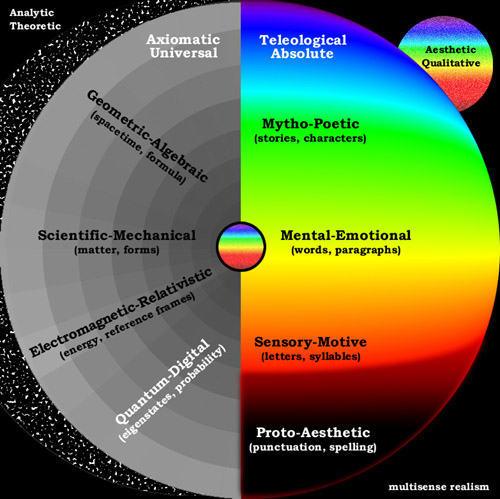
This latest chart improves on previous versions, hopefully simplifying and clarifying without losing anything important.
Note the comments in parentheses are critical for those who do not understand the basic premise of Pansensitvity, which is that sense* is the Primordial Identity and therefore cannot be truly absent**.
Logic is listed as Indirect Sense, emphasizing that in fact logic relies on local sensation and sense-making but is mediated through distance; rationally or empirically + rationally, experience can be conditioned and refined by observation, deduction, measurement etc. Rationality, like ratio, is always a comparison between known features – a reading between the lines of fact to arrive at a more universal and conclusive truth.
Logic then is sense making which is theoretically independent of sense. It reaches for evidence and what is evidence through the evidence, but it can never be manifested directly without being clothed in some sensible aesthetic. The great mistake of our era, in my opinion, is the failure to recognize and accept this, preferring, as people have done since Plato and beyond, to conceive of a perfect nature beyond sense. A landless land of formless forms, working its magic from behind the scenes. In my view, the key to understanding why this is unlikely is to understand that the possibility of pattern recognition must precede the constellation of the first pattern. That capacity for recognition, that sense, can in theory be other things, feel other ways than as a pattern. It doesn’t need to be coherent, or rational, or subjective or objective, it only needs to participate in making and appreciating aesthetic phenomena. From there, order and forms can follow, but order and forms can’t in and of themselves, invent the sense that they are composed of.
The numbers seem like a good addition also. The 1 row is the the basic unit, so the physical unit is Electro-Magnetic Dynamism and the phenomenal unit is Sensory-Motive Presence. The E-M unit is the Logical equivalent, i.e., it is dependent on Sensory Motive presence and does not exist independently. There was matter around even before biology evolved, but I think only because what we call molecules are, within their own inertial frame, nothing but sensations. The repetition and significance of sensations gave rise to time, not the other way around. There can be no such thing as unconscious particles in a void. That is mistaking the inferences of logic about structure for concrete sensory presentations. Voids in a void unseen by a void-seer is a failed cosmology in my view.
The 0 row is such a void. The digital underpinnings of inference technologies like statistical analysis and computation, allow us to construct artificial aesthetics and prosthetic powers to amplify our motives. My conjecture that the entire subatomic substrate may be in some sense theoretical, or gradually evanescent into inference can seem like a huge red flag for crackpottery, and it could be, but my hunch is that everyone is wrong and I’m right :).
By this I mean that literally atoms are slightly less real than molecules, and sub-atomic particles are perhaps exponentially less real. Because we are pushing the envelope of our own range of participation in the cosmos, our measurements increasingly feed back on themselves, and we are actually doing surgery on the scalpel that we forgot we are using. Ok, that sounds insane, but if you add up everything that we have observed about quantum mechanics – the uncertainty, the entanglement, the particle-wave ambiguity…it is not out of the question that what we are looking at is that the nature of light is actually seeing itself. Again, not human seeing, but molecular seeing, astrophysical seeing…light is sensitivity. That’s why it has an absolute speed in every frame of reference, and why there are reference frames in the first place.
The Row 2 level is where we live most of the time. We feel like a private person in a body which is a form in a world of forms. Can we all agree that most of us feel like that most of the time when we are awake? Waking up, gaining consciousness (or more consciousness) seems to bring us back to where we left off in our world – our public world. The private “world” is ok as a metaphor, but does it really seem like a world, or does it seem more like a fugue of intentions and distractions – of performances and rehearsals. It’s not a world so much as it is a story that you are co-writing with a partner who might not exist. Maybe that’s just me?
Row 3 is not only higher on the scale, in the sense of a higher frequency, but higher in the sense of being logarithmic to Row 2. Unlike the Row 0 logic of computation, the Geometric-Algebraic level is equivalent to poetry – it has deep and austere mathematical elegance. Topological forms tie out to Algebraic functions. Perfection is revealed conceptually and with purity that can be demonstrated visibly. You can see the sacredness of sacred geometry, and you can prove the significance of algebra factually. On the ‘East side’ of Row 3 is the equal but opposite aesthetic channel of the mytho-poetic. The counterpoint to masculine mathematical ideal space/world is the floridly eidetic, feminine story. The collective unconscious is a cast of characters, ever changing, but, like strange attractors, chaotically repeating themselves…or else they remain fixed as archetypes and repeat the universe around them chaotically, depending on your frame of reference.
The top row contrasts the West side’s ultimate faith in meaningless knowledge with the East side’s faith in unknown meaning. The supreme irony here is that for all of science’s focus on certainty and skepticism, it’s roots emerge directly from the void. Quantum mechanics represents the ultimate triumph of certainty about uncertainty – a final gasp of human reason before sinking into its own self-negation. QM is the reverse of machina ex deus, or a savior of senselessness, ensuring that the futility of all feelings and even ideas and understanding is a fact, and that mathematical fact is all that there can ever be. The irony on the Spiritual side is that for all the praising of God or Spirit, the identity is a question mark. All of the deep meanings that can be derived from worshiping and communing with the divine gives us almost nothing that we can count on other than faith itself. All of the worlds holy scriptures and prophecies have nothing to say about refrigeration or radio broadcasting. If the spirit is eternally full, it is mainly full of advertisements for itself…which turns out to be the bootstrap that science needs to plug in to its cosmology instead of the ‘fertile void’ concept it has fixated on at the moment.
*sense is the full spectrum of sensation, emotion, participation, appreciation, meaning, but not limited to humans, living organisms, minds, or selves. Pansensitivity is the capacity to present and be present, to experience, project, and represent experience.
**Nothingness can only be an abstraction conceived a posteriori of the existence of something which can conceive of absence. There cannot be a priori nothingness, because the potential to change into something else is not nothing. Nothing at all can come from absolutely nothing, so even if such a nothing were to non-exist, we could never contact it in any way.
Metaphor, Electricity, Sun and Moon…
Electrophoric Magnetemorphism
If you had walked up to someone living in prehistoric times and had a conversation about the Sun and the Moon, it would probably be an easy way of talking about the concept of opposites. It’s an embodied metaphor which is almost absurdly plain. The Sun, a featureless disk of blinding radiance, unchanging yet burning – it looks like it could be a circular window into pure and infinite energy. The Moon is like everything that the Sun is not like. Its changing phases reveal shapes and features on the surface, sometimes orb-like, sometimes disc-like. The Moon’s darkness reveals that it reflects and receives the Sun’s light rather than produces its own, and because of that, and its association with the night and the tides, seems cool, and silvery to the sun’s golden warmth. Moonlight isn’t bright enough to allow us to see color, as noted in that Moody Blues song:
Cold hearted orb that rules the night
Removes the colours from our sight
Red is gray and yellow, white
But we decide which is right
And which is an illusion
How surprised a prehistoric astronomer would be to travel into the 21st century AD and find that all of that is complete horseshit. We now understand that most of what makes the Sun and Moon perfectly alike and unlike, from their similar apparent size to their duality, to their role in marking time and mytho-poetic extremes are purely coincidental. We just so happen to orbit one star, and be orbited by one natural satellite. The ratio of distance to size just happens to equal out so that the discs in the sky can often appear to be the same size, especially in conjunction. Indeed, the Sun is not only just an unremarkable star, but stars are just balls of exploding gas – huge spheres that have life cycles of their own.
There are some things that both the archaic and modern astronomer could use as a basis to preserve some symmetry of comparison. The Earth is to the Sun as the Moon is to the Earth as far as orbits are concerned. The Earth metabolizes the Suns energy with a biosphere generated atmosphere, where the Moon mainly reflects it.
The way that we treat the Sun and Moon now, compared to the way that humans had always treated them before science can be understood as a four dimensional dipole – a circuit through time, or really a meta-circuit since the dipole begins with a polar mytho-poetic understanding and ends with an elliptical mass-energetic understanding. Which leads me to some crazed ideas about electrostatic and magnetic force.
Notes on magnetism:
Watching the Khan Academy Introduction to Magnetism, I feel like I am finally making some headway into understanding the difference between electric and magnetic force. As he explains in the video, magnetic fields have are dipoles, they have North and South poles no matter how you break them up*. Electrostatic force is about positive and negative charge, but they can stand alone…at least (I’m thinking), alone at any given time.
What’s the difference? If we think of magnetic force as a spatial dipole, because its polarity is always adjacent, then why not think of electric charge as a dipole across time? But wait, it gets better. Because time is not fixed and is open ended, the electric metaphor poses charge like a question which can be answered at any time, and which wants to be answered and asked again and again. For the positively charged mass, negative charge exists as an image, an expectation of a presence which is currently absent but must eventually be present in the fullness of time (eternity, if necessary).
It could be said that the electric force, figuratively if not literally (but maybe literally, given a rehabilitated view of physics), creates time. It is the animation of circuitry. Electricity is algebraic and logical as it arcs from vector to vector directly, like a lightning bolt, hopping across gaps in logical steps. It is a path finder and path maker.
The magnetic force would then make sense as the creator or projector of space. It is the container of time, flattening cycles to circles. The magnetic force doesn’t draw lines, it aligns and orients, receives and presents spatial aesthetics to and from surrounding territories. If electricity is sensory motivation, then magnetism is motive sensation – a spatial feeling and knowing to match electrostatic being and doing.
Through Maxwell and then Einstein, we understand that these two modalities of interaction are the same thing but phase shifted by relativistic frame of reference. My understanding now leans toward seeing electricity as marking the “arctic” polar extremes in reference frames; the Innermost Metaphorical and the Outermost Binary kinds of relation, while magnetism presents the “tropic” counterpoint, describing how smaller and larger scaled bodies are nested within each other. Current flowing through a wire creates a magnetic force around the wire, it’s about the embodiment of the wire as a whole and how it relates to other macroscopically. The electric force is universal and infinitesimal, but it has no sense of figure and form, no orientation (needs a Ground).
This nugget came across my screen recently…it kind of makes sense, but I’ll leave that to you to interpret.
In Larry Niven’s story “The Kiteman,” we learn that the most important maxim in the Smoke Ring is: “East takes you Out, Out takes you West, West takes you In, In takes you East. North and South bring you back.”
Parting shot: Relativity is based on frames of reference, while Quantum Theory uses digital probability – eigenstates. Like magnetism and electricity, they are both the same thing seen from a different frame of reference. Together they describe how ‘reference’ is ‘framed’, but they both share the same blind spot, which is explaining what ‘ference’ is that these frames ‘re-fer’ to. I think that ference can only be one thing – not energy, and not information (which are really metaphors for spatial-magnetic and temporal-algebraic), but awareness itself: sensory-motive aesthetics.
*Some claim there might be magnetic monopoles also.
Breaking the Nth Wall

- Eliminative Materialism: The picture is the only reality, so the artist is an illusion.
- Idealism: The artist is real and the picture is an illusion.
- Dual Aspect: The artist and the painting are two halves of the whole.
- Monotheism: Norman Rockwell is omnipotent and immortal.
- Computationalism: Norman Rockwell is an emergent property of jpeg compression. Any sufficiently complex compression becomes Norman Rockwell.
- Multisense Realism: The picture, artist, audience, illusion, Norman Rockwell, and computation are all sensory experiences which make sense in different but sensibly related ways.
A Couple of Physics Clips
Great short video that fits into the Twins Paradox. If we imagine that which ever set of particles seems to be moving is a small clock or calendar which seems to be slowing, then it helps me make my point about elapsed time not being elastic. For the cat aligned with the electrons, time always passes normally, but for the cat, the positively charged clocks are slowing down as the repulsive force increases and the motion of the particles in space speed up.
This helps me get an intuitive feel for what is supposed to be going on also. This idea of motion being sticky, so that the greater the ratio between your velocities (not just acceleration), the harder that ratio pulls on time…time in the remote frame of reference is tightening up as the spatiotemporal balance tips from temporal equality to spatial inequality.
The paradox is that, as we see, the tightening of time goes both ways, so that for the cat, it is already June but the wire’s calendar says April. For the wire, it is June and the cat’s calendar says April instead. When these two come together, I don’t see how the time difference would be undone, since the untightening of time would not jump ahead and recover elapsed time, it would only return to parity with the other frame of reference.
No account of the Twins Paradox mentions this though, and they all focus on just one of the two reference frames. The twin who comes back to Earth is younger than the one who stayed home. To me that is true only from the Earth twin’s perspective. From the space twin’s perspective, he returns to a relatively younger Earth than he would expect without relativity and a twin who is younger than he is.
I like these better than the other gee-whiz-science or physics videos that I’ve seen. I still have no reason to doubt my view that the whole standard model needs to be re-interpreted so that it bends into virtuality toward the bottom. There should be a new kind of relativity, where the realism of the phenomenon – its publicity, is a relativistic vector rather than a flat axiom. I would like to see a video which focus exclusively on exactly how we are measuring subatomic phenomena with the same level of infinitesimal detail.
This is what science cares about, right? “What is REALLY REAL?”…so, give reality a number, and notice how unreal quarks gluon flux is compared to protons, and how unreal protons are to molecules. Then notice how quarks are real to each other, but not to molecules, etc. This is, in my opinion, what the universe is made of: Not the mathematical invariance which cuts across all frames of reference, but the aesthetic variance of the frames themselves – experience is really real, on every frame of reference, except when the expectations of one frame are projected onto another.
Why Likeness is Not, Like, the Same as Sameness

Why do we like to like the same things, until the thing we liked becomes the same old thing?
Why is there “Good as New” and “Like New”, but not “Same as New”?
I think that the difference between like and same are especially related to consciousness and support the idea of awareness (and therefore attention) as more ‘like’ novelty and ‘like-ness’ than it is ‘the same as’ the integration or processing of information.
Machines are characterized by their ability to do the same thing, over and over. The idea behind digital technology is really to be able to do the exact same thing, over and over and over, forever. Does this kind of behavior wake us up or does it lull us into a stupor? What kinds of things put us to sleep and what kinds of experiences wake us up?
Waking up is not an abstract theory. Waking up instantiates us into the directly and concretely sensed now, into public time. The now and the new are unrepeatable and unique, thus there can be nothing which is ‘the same as’ new without actually being new. When we say that something is ‘the same’ as something else, we are often speaking metaphorically. What we mean is that the difference is not important, and that one thing is functionally equivalent to another.
Anti-Metaphor
Within the world of mathematics, ‘the same’ or “=” is a metaphor for that which is literally identical or interchangeable in all circumstances. Unlike physical reality, the whole of mathematics is a symbolic abstraction – a metaphor for anti-metaphor:
Where metaphors are ‘like’ conceptual rhymes or semantic likeness which cut across the whole of human intuition poetically and aesthetically, mathematical metaphors are aiming for the opposite effect in which meaning is frozen into position, clear, defined, and unambiguous. This is meaning which has been reflected in the looking glass of thermodynamic irreversibility. It is the privatized essence of publicity.
When we look out of ourselves, we see only that which can be decomposed and measured. Feeling is presented as figures, and figuring them out literally gives us a feeling of transcending the ambiguity, fluidity, and obscurity our own subjective awareness.
I see the opportunity that lies before us is to recover the authenticity of awareness without sacrificing the reliability of its substitute. The worldview that is driven by quantitative formula alone cannot locate the now, other than as a promise that it will eventually be found – under a heap of accidents. Accidents and probability are the inverted image of intention and likeness. They are what you get when sameness is assumed to be primitive. The universe is failed sameness and broken symmetry – serial mutation.
To overcome the prejudices inherent in this worldview, an important step is to understand the irony that the intention behind measurement leads to its own perfect illogical fallacy. To count and codify is to try to escape from personal bias and fuzzy ‘likeness’ which is not the ‘exact same thing’ as truth, but what we have found increasingly, is that we cannot be immune from an equally toxic bias toward the impersonal. As much as we want to be ‘certainly in the right’, and to put ‘everything under the sun’ in tune, the enlightenment of the Western mind is eclipsed by its own insensitivity and denial. The more that we seek out the next product or service to make us feel ‘like new’, the faster it becomes the same old crap.
The Lowdown on Empty Space and the Speed of Light
Your task is to explain why are you trying to buck the mainstream view that space has qualities. I’m no acolyte of the mainstream but I do recognize the need to explain deviations therefrom. It so happens that there are good reasons why today’s view is that empty space has physical qualities. The main shortcoming of the mainstream view, from my viewpoint, is the artificial and unnecessary light speed speed limit. Einstein hypothesized a universe with such a limit without ever even suggesting why such a limit makes any sense. And the problem is: it doesn’t.
I think that Einstein hypothesized a speed limit in the universe because he understood or intuited that speed itself is a continuum between stillness and the opposite of stillness, rather than an unbounded scale. He saw that light does not behave like anything else – that it had properties which made it unlike things which can accelerate. Velocity is (not unrelatedly) like ‘straightness’ – there is an upper limit on how straight something can be, how little something can weigh, and the extent to which a signal can be unambiguously present or absent at a given location at any given moment.
What he did not see, IMO is that light is only one kind of signal – one way that the universe makes sense of itself. The speed of light is the speed of space, or perhaps, the speed of ‘here’, and it scales up in proportion to larger scaled ‘here’s. Light, or ‘sense’ or ‘universal public signal’, actually has no speed at all, unless you mix reference frames and thereby measure a large frame from a small one. The degree to which light has a speed is the ratio between the scale of the measurer and the scale of the measurement.
The mainstream view that space has qualities makes perfect sense when we misunderstand and overlook the role of sense in signal production. Rather than extending the relation that living things have with light (or sound, smell, thought, etc) to the microcosm, we have so far only consider the *apparent* relation that non-living things have with each other, which is limited to touch. We have yet to entertain the notion that microphysical phenoemena are, in some sense, seeing each other and signaling each other directly, and thereby creating ‘space’ and ‘time’ on the macrophysical level, from our perspective. From the microphenomenal level, it might appear just the opposite, that spacetime is being created from above, on higher levels. Both are probably true and untrue to a similar extent.
There is no reason to believe that space has properties except to maintain the assumption that physical processes are unconscious and isolated. When we hold that belief, we are forced to take a phenomenon which is transdimensional, and flatten it into a finite number of topological fields in which forms can touch each other directly. That’s a great way of doing the math so that we can predict and control the conditions of (relatively) inanimate objects, but it falls apart when we try to include more subtle sense-making phenomena.
I’m fully aware, of course, that this is a radical conjecture. My position is not that this is a complete theory or that I know how it must work, but that it is a theoretical possibility which could work, has not been explored, and should not contradict any observation of physics made thus far
Free Will Isn’t a Predictive Statistical Model
Free will is a program guessing what could happen if resources were spent executing code before having to execute it.
I suggest that Free Will is not merely the feeling of predicting effects, but is the power to dictate effects. It gets complicated because when we introspect on our own introspection, our personal awareness unravels into a hall of sub-personal mirrors. When we ask ourselves ‘why did I eat that pizza’, we can trace back a chain of ‘because…I wanted to. Because I was hungry…Because I saw a pizza on TV…’ and we are tempted to conclude that our own involvement was just to passively rubber stamp a course of multiple-choice actions that were already in motion.
If instead, we look at the entire ensemble of our responses to the influences, from TV image, to the body’s hunger, to the preference for pizza, etc as more of a kaleidoscope gestalt of ‘me’, then we can understand will on a personal level rather than a mechanical level. On the sub-personal level, where there is processing of information in the brain and competing drives in the mind, we, as individuals do not exist. This is the mistake of the neuroscientific experiments thus far. They assume a bottom-up production of consciousness from unconscious microphysical processes, rather than seeing a bi-directional relation between many levels of description and multiple kinds of relation between micro and macro, physical and phenomenal.
My big interest is in how intention causes action
I think that intention is already an action, and in a human being that action takes place on the neurochemical level if we look at it from the outside. For the motive effect of the brain to translate into the motor effect of the rest of the body involves the sub-personal imitation of the personal motive, or you could say the diffraction of the personal motive as it is made increasingly impersonal, slower, larger, and more public-facing (mechanical) process.
 Multisense Realism
Recent Comments