Archive
Two-photon interferometry and quantum state collapse
From the paper Two-photon interferometry and quantum state collapse:
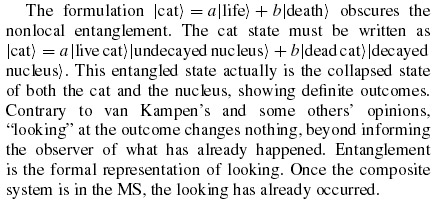
“In short, for ideal measurements both experiment and standard quantum theory imply an instantaneous collapse to unpredictable but definite outcomes.The MS [measurement state] is the global form of the collapsed state with no need for a separate “process 1” or measurement postulate. The other postulates of quantum physics imply that, when systems become entangled, their observed states instantly collapse into unpredictable but definite outcomes. In particular, Schrodinger’s cat is in a nonparadoxical definite state, alive when the nucleus does not decay and dead when it does. This solution of the problem of outcomes requires no assistance from other worlds, human minds, hidden variables, collapse mechanisms, collapse postulates, or “for all practical purposes” arguments.”
I think that this is a promising study which gives support to the MSR model. Once we take the step of questioning whether there can be any such thing as measurement which is other than a kind of ordinary sensory-motor interaction (even if it is microphenomenal),the hard problem of consciousness and explanatory gap disappear.
Seeing that it is the capacity to feel which, through its interruption, gives rise to the sense of touch, and it is the sense of touch which gives rise to touchable things rather than the other way around, we should take the opportunity to go back and reinterpret all of the particle physics of the last 50 years – not because it is wrong, but because it is right for the wrong reasons.
If photons sense each other, how do we know that photons themselves are anything more than atoms sensing and instructing each other? This study fits with a model of the universe in which all phenomena throughout eternity is, on one level, a simultaneous sensory experience. Within the solitude of that Absolute experience are miniature versions of the same, (such as our own human individual sense of conscious solitude). In the polarization-derived ‘spaces’ or ‘gaps’ in between these homing-monads, cat-experiences and atomic-experiences take their marching orders from each other’s presence, represented as localized ‘homing signals’. Cats and atoms alike, since they are ultimately but frozen appearances within some nesting of the global nature of sense itself (the Absolute), also receive intuitive influence from the overall event of the total interaction.
Instead of seeing photons as the foregrounded units, all of the evidence seems to point to the idea that the opposite might be true. As Hobson mentions, “The photons “knew” each others’ phase angles, despite their arbitrarily large separation. This certainly appears to be nonlocal, and indeed, the results violate Bell’s inequality, verifying nonlocality” The so called measurement state would make more sense as the fundamental capacity of the Absolute to pretend at photon, atom, or dead cat forms. This paper takes the step of entangling the outcome of the cat and the outcome of the particle’s decay with the overall measurement state. I think a good next step is to entangle the entire presentation of cats and particles and even ‘outcomes’ to the participant’s sensory nature. It’s all entangled, even entanglement itself. In our case, as human beings, we sense cats more directly than we can sense a particle’s decay, but not as directly as we can make sense of our own thoughts and feelings about them.
Primordial identity pansensitivity (PIP) is the proposition that the capacity to experience, to participate perceptually is the ultimate irreducible universal. In Kantian terms, the sole synthetic a priori. In relativistic terms, the maximally inclusive inertial frame. Other philosophers have used terms like Absolute, Totality, Transcendental Signifier, and Supreme Monad.
The difference between PIP and theism is that PIP does not presume a human-like, or entity-like subject associated with the Absolute. Neither is it presumed that the Absolute is a field, force, vacuum, or information-theoretic phase space. The Absolute is neither local nor nonlocal, but rather the parent of that distinction, and therefore orthogonal to it .
Under PIP, the Absolute is understood to be the meta-phoric firmament within which the three ‘verses’ are diffracted. The three verses, following a Hegelian-type dialectic of thesis, antithesis, and synthesis* are phoric (directly experienced), morphic (embodied presence), and metric (abstract relation of the other two verses). In one sense, the Absolute is more closely aligned with the phoric+morphic, i.e. the collection of all presence with no absence.
From this there is a sense of omniscience, as all times and places would be ‘here and now’. Take the universe as we know it, multiply it by eternity, see all of it from every perspective possible, and remove all of the space and time from it and we would have the PIP absolute – a timeless everythingness which transcends the difference between novelty and repetition. If mortality is marked by an unbearable lightness of being, in which all experience is either meaninglessly fleeting or meaninglessly repeating, the immortality of the Absolute is marked by an unbearable saturation of meaning. All is absolutely unique and absolutely generic at once.
Ordinary sense is, on every level, what diffracts/diverges/disentangles one state from another, and one level of sensory interpretation from another. The sensation is the fundamental physical presentation, the measurement of alienated sensations (measured as photons, atoms, bodies) is derived representation. Notions of space, time, and information are meta-representations – concepts and abstractions, which themselves reflect the unity of the Absolute, but in a skeletal and figurative way.
*note that the dialectic itself is a metric abstraction which cannot be directly experienced or embodied. The actual thesis which physically exists is the phoric thesis: sensory-motive-time. Matter-energy-space is the morphic antithesis. Entropy-Significance-Aion (eternity) is the synthesis.
Eigenmorphism: The Politics of Pansensitive Entanglement

Eigenmorphism is a neologism which refers to a hypothesis about fundamental laws of how natural phenomena persist in relation to each other. The thesis draws on some principles of General and Special Relativity, Quantum Mechanics, and semiotics, to integrate phenomenal awareness and physics at a fundamental and ontological level. In philosophy of mind, the idea that awareness is something like a fundamental force coexisting with other forces of physics in some way is known as panpsychism, however, within Multisense Realism, the conjecture that is used is an even more radical one. For reasons explained later, MSR uses the term pansensitivity rather than panpsychism, and it conceives of forces of physics to be second order divergences from the fundamental and irreducible capacity which is assumed to act as the common parent of all action and all being, all feeling and all knowing. This is not to be confused with a creationist account or theism, as it does not assume a single being who is human like and feels all and does all, rather primordial identity pansensitivity (PIP) is a weaker assertion that claims only that it makes more sense to view the cosmos, or at least the sense that the cosmos makes to itself, as originating from an agenda which is aesthetic and participatory rather than one which is automatic and functionalist.
Eigenmorphism is used here to explain how phenomena in general are presented and translated and to each other at an ontological level, thus the “identity” of primordial identity pansensitivity is that the realism of nested sensory presentation is identical to existence. Eigenmorphism attempts to point out a single pattern of diffraction and calibration through which presentations and representations are privatized and generalized, both locally and universally. I have used David Chalmers paper, The Combination Problem of Panpsychism as a jumping off point for applying PIP to the problems of binding and combining of subjective experience. The linked article provides an excellent discussion of the issues surrounding panpsychism, and how it is that physical and phenomenal states might coexist at a fundamental level. The central focus of his paper is to clarify the various schools of thought on how microphysical and or microphenomenal states might combine and relate to so called macrophysical and macrophenomenal states. He writes:
“The combination problem for panpsychism is: how can microphenomenal properties combine to yield macrophenomenal properties? […] The combination problem can be broken down into at least three subproblems, […] These three aspects yield what we might call the subject combination problem , the quality combination problem, and the structure combination problem.
[…]The subject combination problem is roughly: how do microsubjects combine to yield macro-subjects? Here microsubjects are microphysical subjects of experience, and macrosubjects are macroscopic subjects of experience such as ourselves. […] An especially pressing aspect of the subject combination problem is the subject-summing problem [in principle it seems that a macrosubject would not necessarily emerge from microsubjects].
[…]The quality combination problem is roughly: how do microqualities combine to yield macroqualities? Here macroqualities are specific phenomenal qualities such as phenomenal redness (what it is like to see red), phenomenal greenness, and so on. It is natural to suppose that microexperience involves microqualities, which might be primitive analogs of macroqualities. How do these combine? An especially pressing aspect of the quality combination problem is what we might call the palette problem [..] How can this limited palette of microqualities combine to yield the vast array of macroqualities?
[…]The structure combination problem is roughly: how does microexperiential structure (and microphysical structure) combine to yield macroexperiential structure? Our macroexperience has a rich structure, involving the complex spatial structure of visual and auditory fields, a division into many different modalities, and so on. How can the structure in microexperience and microstructure yield this rich structure? An especially pressing aspect of the structure combination problem is the structural mismatch problem. Microphysical structure (in the brain, say) seems entirely different from the macrophenomenal structure we experience. “
Panpsychism has already suffered from a somewhat dubious reputation in the past, perhaps because it is often conceived of in simplistic terms by those unfamiliar with it. In many minds, panpsychism is presumed to imply a cartoonish idea of nature which imbues every speck of dust or atom with a human-like mind. While there may be no philosophical justification to rule out such a view, I think that all of the common forms of panpsychism offer far more sophisticated ideas. I would consider any view which disregards the primitive nature of microphysical systems relative to macrophenomenal states to be more of an anthropomorphic panpsychism; what I call pananthropism, There are weaker forms of panpsychism, such as panexperientialism or panprotoexperientialism which do honor the difference in complexity between micro and macro scale phenomena, but these forms also dilute the effectiveness in resolving the Hard Problem of Consciousness. If we say that microphenomenal states aren’t really phenomenal or subjective, then we still are faced with having to explain why and how they become that way on the macro, human scale.
In between the two extremes, I introduce the word ‘pansensitivity‘, which posits a universal minimal capacity for sense in naturally presented phenomena (not phenomenal representations). This sensitivity operates within its own scale and inertial frame of reference, and need not be very similar to human consciousness. Inertial frame is intended literally as well, as part of the hypothesis includes the idea that experiences themselves accumulate and take on a kind of gravitation-like tropism, similar to Rupert Sheldrake’s Morphic Resonance and David Bohm’s Implicate Order, which I refer to within MSR as Solitrophy, If solitrophy is the world builder, then significance (the nesting of representation within sensed presence) is its bricks and mortar.
Pansensitivity need not have a subjective or self-like quality, only a univeral commonality of being and doing which is rooted in sensory-motor participation. By emphasizing the primacy of perception and participation as the heart of all possible experience, pansensitivity lays the foundation for a full scale integration with physical conjugates such as mass-energy, space-time, electro-magnetism. Additional conjugates from information science and mathematics integrate smoothly as well, such as form-function, signal-noise, geometry-algebra, and ordinality-cardinality. The consequence of moving ‘down’ from panpsychism to pansensitivity would be the loss of the anthropomorphic baggage imposed on primitive phenomena, and the consequence of moving ‘up’ from panprotoexperientialism would be to un-ask the Hard Problem on the micro-level.
Primordial Pansensitivity
Starting from the hypothesis that all phenomena are sensed or sensing phenomena*, and that nothing can said to be exist beyond the scope of sense, the entire Combination Problem is turned on its head to become one of breaking apart rather than merging together. Because all distinctions of micro and macro, phenomenal and physical are subsumed within the absolute primordialism of pansensitivity, we must employ a different way of thinking about the Combination Problem entirely. This revision of thought extends to a re-imagining of some of the underpinnings of mathematics and cosmology. In all respects, where recent Western views assumes a universe from nothing, or an arithmetic beginning with zero, primordial pansensitivity supposes the opposite perspective; a multiplicity carved out of unity, a near infinity of quantities diffracted as ratios within the number one. Separation becomes the derived local condition, while singularity is the absolute fundamental condition. It is not ‘a singularity’, or ‘a universe’, it is The singularity, and The universe.
Because the orientation of this model flips the traditional ranking of physics and phenomenology, and awareness is the sole defining principle, Professor Chalmers three subproblems would have to be restated to assume divergence rather than emergence. Emergence would be the local appearance of diffraction of the single whole rather than combination of isolated parts. At this level, PIP can be considered a form of idealism, in that the head end of the Ouroboros is phenomenal presence and the tail end is diffracted by time (subjective self), space (objective matter), and sense itself (represented information), however the very categorization of sense as ‘ideal’ is a materialistic bias which draws on Platonic notions of information supremacy rather than the sensory supremacy envisioned by PIP/MSR. Sense is not an ideal, it is concrete. It moves bodies and births galaxies. The sense of the human intellect is idealizing. Our mental life is a special case as far as we know. The rest of the universe does not seem to strive for perfection, it simply presents itself as perfect or imperfect by default. The human mindscape, by contrast, is often fixated on perfecting forms and functions, removing entropy from signal.
The Genius of Palette
When we consider the relation of the colors of the visible spectrum to white light, we can get a sense of how singularity and multiplicity coexist qualitatively, and how that coexistence differs from quantitative-logical structures. The difference between projected light and reflected color is instructive. As we know, converging three spotlights of competing colors gets us closer to white in the overlap, while mixing three paints of different colors gets us closer to grey or black. Similar displays of order can be found in the other senses as well, with harmonic progressions and white noise within sound, and other symmetric patterns which circumscribe the palette of olfactory sense. The palette of the color wheel, however, is uniquely suited to modeling aspects of sense combination. We might as why that is. What makes vision seem more fully exposed to us than something like smell? How does the neurological emphasis on visual sensitivity translate into this ‘seeing is believing’ sense of trust?
In particular, the color wheel or visible spectrum presents two themes within palette formulation. The first I will call the prospectively sensible theme. If we had never seen color before, and were presented for the first time with green and blue paint, it seems plausible that we could imagine a color in between green and blue as being turquoise or cyan. If we were presented with red and green paint instead, it seems completely implausible that anyone could imagine the existence of the color yellow. Yellow is not ‘prospectively’ sensible. Once we see yellow however, and see the flow of the visible spectrum as it progresses smoothly from red to orange to yellow to green, the quality of yellow seems to fit in perfectly, so it is retrospectively sensible, In this example, cyan has both prospective and retrospective sensibility, but yellow only has retrospective sensibility. This gives the origin of yellow an unprecedented quality. I call this idiopathic property, which is common to all sense palettes, the ‘genius’ of the palette. The genius provides tentpoles, primary differences in kind from which secondary and tertiary differences of kind blend seamlessly into a multiplicity of differences in degree. There is a view of the territory of the pansensitivity’s version of the Combination Problem (or primary Divergence Problem).
The problem of the origin of palette genius is still an issue, but it is an issue which is diffused somewhat by the totality and unity of primordial sense, and the inversion of our expectation of nothingness rather than primordial everythingness. These genius qualia are manifestations of sense which may be more primitive than spacetime itself, so that the ingression of spacetime leaves certain critical pieces to the puzzle missing. Simply stated, the whole idea of causality and origin depends on time and sequence, so that these primary colors and sensations are as fundamental as sequence itself, and as any question that we can ask about it. Questions themselves are presumably no more fundamental than these elemental experiences.
Combinatory Eigenmorphism
Once a palette of sense has diverged and multiplied into spacetime availibility, it is proposed that the role of subjective participants is to recover unity and simultaneity, completing a kind of sensory-semantic conservation cycle (which is also a palette of sense). The hypothesis of combinatory eigenmorphism is that the relation between any and all phenomenal experiences, whether they are cognitive, perceptual, or physical, can be characterized by specific categorical differences which are themselves ordered in a sensible schema.
Borrowing the eigen- prefix, used in terms such as eigenstate and eigenvector, and the root ‘morph’ as it is used in isomorphism and homomorphism, eigenmorphism is intended to describe an ordered set of elementary mappings within a closed continuum of possible mappings. Comparing two compasses, for example, the closed continuum of possible mappings would be the 360 x 360 degree matrix of possible needle direction combinations. Only one type of combination (a group of 360 out of the total 129,600 combinations) would be isomorphic, with both needles facing the same direction. Another group of 360 would be anti-isomorphic (one compass needle points North and the other points South). In between these two poles would be various shades and angles of disagreement. The right angles would be in perpendicular disagreement to both the isomorphic and anti-isomorphic combinations.

The use of eigenmorphism here is not intended as a mathematical abstraction, however. There may be more precise terms within algebra or geometry to describe such a rotating cycle of polarization stages, but the point of using morphism here is not to limit the combinations to one dimensional differences. Unlike a geometric degree or radian, this usage of morphism must apply to every kind of difference between any phenomena, not just to differences in shapes or orientation. This is potentially possible because of the holism of primordial pansensitivity. The divergence of every singularity into multiplicity can be described as tectonic – every diffracted palette and diffraction within a palette is like Pangea, breaking into continents which fit each other like puzzle pieces. Adages like ‘as above, so below’, and ‘opposites attract’ can be grounded in this foundational continuity.
Eigenmorphism must, therefore, apply not just to mathematical transformations, but to fully realized sense experiences, complete with personal participation and felt content. If we extend the compass metaphor and imagine that on the top of each compass is a tiny video screen which shows the other, and that the position of the needle determines the composition of that video image (not just brightness and contrast, but focus, size, realism, etc), we can begin to get a sense of what is meant by eigenmorphism. It is intended as a common schema to unite quality and quantity, or in Deleuzian-Bergsonian terms, differences in kind and differences in degree.
The full conjecture of eigenmorphism is that differences in kind are orthogonal to differences in degree, but that they are both part of the same cycle of sense which discerns all difference and through that experienced discernment, effects a reproduction of order which is expressed through all phenomena. To be clear, the scope of the juxtaposition of this schema is absolute. We are comparing poetry to baseballs, and deja vu to carbide steel. The goal is to recognize a subtle framework which weaves together all phenomena, whether physical, phenomenal, or semiotic, and on the scale of the microcosmic, macrocosmic, or cosmic. Eigenmorphism can help organize, in one conceptual framework, the relation between micro and macro scales or across physical and phenomenal lines, where similarities may be found only in the extremity of their incommensurable difference. Eigenmorphism is a response to Einstein’s famous quote “God does not play dice with the universe” in disbelief of Quantum Mechanical probability, God plays dice, dice plays God but only sense can make a difference.
Eigenlinguistics
Language provides a good example of how physical objects and experience can coexist seamlessly within a single schema. Onomatopoetic words like bang! or pow! rely on high degree of isomorphism between 1) sounds that we hear, 2) sensible generalizations of those sounds, and 3) sounds that can be spoken. Such sound-alike words are more universal than other kinds of words, as they require no translation from language to language. People of all ages and backgrounds intuitively understand that these words refer directly to events associated with those sounds. It seems likely that language itself must have originated with this kind of imitative behavior – the recording and replaying of sounds and gestures. The combination of literal imitation (bottom-up) and figurative association (top-down) yielded more abstract metaphors with more eigenmorphic combinations. Complex communications extended the step of sensible generalization (2) and, perhaps surprisingly, made communication and representation more difficult to separate from that which is represented.
With each extension from the literal to the figurative, the poetic and the abstract, we effect certain translations, each of which stand on their own as sensible connections, and which take their own most sensible places in the universal context. Again, going back to the color wheel. Each hue and shade makes sense as its own unique individual experience, and as a mathematical vector within any number of sensible topologies (wheels, cylinders, cubes, parabolas, triangles, etc). It makes sense in many different ways, including the intuitively idiopathic sense of its palette genius.
Within language we find a vast context of meanings which have developed accidentally and intentionally, intuitively and counter-intuitively. Conventions of grammar and spelling reflect similar mixtures of logic, intuition, spontaneity, and inherited formalism. Beneath all of these is a semiotic foundation. To communicate is to represent, and to represent is to infer comparisons among subjects, objects, other subjects, and other comparisons. To discern differences between ‘things’ implies first a capacity to sense ‘things’, and to experience sensibility itself – an expectation of presence and participation.
Semiosis is a particular cognitive version of what I suggest is this fundamental sensibility; the capacity to mentally record and generalize or iconicize perceptions, and to record those essentialized perceptions to be abstracted further. If information is a perceived difference that makes a difference, then information itself depends on a more primitive capacity to discern difference from indifference, to care about that discernment, and the power to do something about it. The polarization of afferent sensory receptivity is the power of efferent motive projection; to participate intentionally in some way which promises to have an effect on what has been sensed. This, to me, is the ultimate firmament of all metaphysics. The universe is an eigenmorphic-relativistic singularity of all experience, and experience is a nested multiplicity of sensory-motives.
Eigenmorphism assumes this universal continuum of sense in which the degrees and kinds of nestings deform the context of perception itself. As mass deforms spacetime in General Relativity, experiential qualities warp experiential perspectives under Multisense Realism. Rather than assuming a one-to-one, isomorphic relation, in which, for instance, a particular neurotransmitter’s binding in the brain equals a particular particle of a subjective experience, there is a lattice of translation which shifts in direct proportion to the scale and nature of the pairing (micro to macro, private to public, familiar to foreign, etc). As macro scale entities, our human scope is dictated not only by size and frequency of our conscious frame-rate relative to other experiential entities, but by the character and history of our intentional participation. If we want to put a Buddhist twist on it, it could be said that karma is the gravity of consciousness, and eigenmorphism is the warping of consciousness that mirrors back its own warped condition as well as the phenomenal translation of all external conditions through that lensing.
From Relativity to Improbability
As Relativity uses the concept of inertial frames, eigenmorphism describes the holistic constitution of experience. As a prism can be seen to split a beam of white light or combine beams of colored light into one, our human experience unites the spectrum of zoological, biological, chemical, and physical experience. We can choose to see ourselves as animals, or meta-animals, or temporarily embarrassed deities. Our personal experience is proprietary and unique not just to the fingerprint or genome, but to the irreducibly absolute. The primordial pansensitivity hypothesis predicts that every experience, while seemingly composed of reducible, recombinant elements, is actually its own solitary universe – a vector of sense which cannot be reproduced completely. It is proposed that appearances of generality and duplication are a local effect, an artifact of eigenmorphic translation from plurality to singlularity in which the discernment of differences is necessarily truncated at an appropriate level. We can see this, for example, in how we look at sand on the beach, and generalize the grains of sand in our mind. Under a microscope, we can see more of the unique character of each grain. Because we assume that sense is primordial, we can predict that the microscope too has its limit, beyond which discernment falls to zero and that which we are measuring becomes indiscernible from the instrument being used to measure.
The pansensitive conjecture equalizes unlikelihood and inevitability in the totality, since it is not within the entropic displacement of spacetime. Within spacetime, probability is a mechanistic absolute, but that conditionality is, under eigenmorphism, a local inversion of the larger conditions of non-probability. Like the yellow and the cyan, the expectation of predictable order is itself emergent from utter unpredictability. Probability is a palette genius. Because the assumption of the improbable is taken as an anthropic necessity of all possible universes, the unlikelihood of life in the universe is nullified. It is not certain physical conditions which give rise to life, it is life experience which is expressed through certain physical conditions. By analogy, Shakespeare did not arise from the combination of certain words, vast groups of words were employed by Shakespeare to express human stories.
Bodies and Experience, Scale and Frequencies
As a rule of thumb, the closer the scale of forms, the greater the range of possible eigenmorphic relations. Bodies which are of similar size and private experiences which share similar histories and qualities have more potential kinds of relations and more degrees of relation than phenomena of disparate scale or history. From our perspective, it appears that entities which are on the extreme range of scale in the universe like subatomic particles and galactic superclusters seem equally unlikely to host any kind of awareness. It could be that this is objectively** true, even beyond the prejudiced relativity of our human scale eigenmorphism, but it is not clear that there can ever be a difference between human truth and objective truth as long as we are human. For us, even if stars are bits of the Gods as ancient astronomers imagined, their experience is on such a remote scale to ours that our phenomenal states are inaccessible to each other.
More likely it seems that the great and infinitesimal entities do have objectively limited palettes compared with our own, but that those limitations are exaggerated because the eigenmorphic range of our own extended human sensitivity projects its own envelope of significance. Try as we might, the significance of an ant’s life is not on par with a human life, and even if ants looked like human beings, their tiny size relative to our body would make it hard for us to take them seriously. This is all part of the natural intuitive ordering by scale in the universe. Eigenmorphism describes the character of that ordering.
There are many fanciful ways to imagine microphenomenal or astrophenomenal states. Maybe all such entities are one collective experience just as ours is a collective experience of neurons, maybe there is only one proton-star experience and only appears to replay within the stories of younger, more mid-sized entities. It’s just as likely that microphenomenal states are unknowable, alien, and not worth thinking about.
The Pathetic Constant and Pathetic Fallacy
The degree to which we feel that another entity is capable of feeling could be called its pathetic constant, as it remains constant according to form/scale. The more familiar something is to us, the more we ‘like it’ and it is ‘like’ us, the higher the level of empathy we can sustain for it. The pathetic constant which we have to ourselves, ironically may not be as high as that which we reserve for those we admire. That kind of super-significance is a whole other story, but for the purposes of this consideration, it can be said that the pathetic constant toward the idealized self would be the maximum. While bigotry may allow some humans to feel that other humans are less worthy than other members of human society, this prejudice manifests as hatred and fear rather than a low pathetic constant. A true low pathetic constant would be associated with impersonal insignificance rather than personal malice.
Human history points to instances in which certain animals or objects or bodies of dead nobility were revered with high pathetic values, but human societies in general tend to support a general pecking order of pathetic values which place humans before most animals, most animals before most insects, most insects before mold, and mold before minerals. We seem to have an idea about what is ‘like us’ which is relatively free of cultural variation, even if we choose to intentionally prefer one entity into a higher caste.
This may seem a trivial observation, or that this folk hierarchy is derived from mechanical measures of complexity and familiarity, and on one level that might be true, however it becomes necessary, when considering the sentience of technologies like artificial intelligence, to have a place to start. The pathetic fallacy is one where human experiential qualities are attributed to an inanimate object or machine, i.e. ‘the camera loves you’. Even the most ardent supporter of Strong AI must admit that at some level, say, the level of a trash can lid which flaps down to “say THANK YOU” every time a tray is removed, there is a gap between the appearance of the behavior to a human audience and the subjective intent behind that behavior. We can understand that the trash can lid is in fact motivated by tension of physical materials, not politeness. Since we assign to the trash can a pathetic constant which is absolutely minimal, we do not read into its behavior personally, and the eigenmorphic relation between any proposed internal state of the trash can and the polite behavior we might interpret is null; any attribution of meaning between what we experience and what the trash can experiences is purely one-sided and non-coincidental, or else super-signified as part of a manic or psychotic episode.
Should the polite words ‘Thank you!’ come from a human being instead, there is a much more rich field of eigenmorphic mappings to use for interpretation. The meaning of the exchange can range from the trivial and impersonal, as in the case of a consumer transaction with a public-facing employee of a corporation. or it could be heartfelt and genuine, even life changing under some circumstance. The aperture of possibilities is open where the pathetic constant is maximized, as it is those who you most resemble or would like to resemble can hurt you or heal you most.
Artificial Intelligence
In the case of the trash can lid, the intent is for the exchange not to be examined very deeply. For the operators of such restaurants, superficial gestures of politeness support an impression of ‘good service’, particularly in a mechanized and personally impoverished environment of a fast food outlet which some might find unpleasant if the impersonality of the operation were fully disclosed. This ‘polite face’ is functionally similar to the GUI which modern computer systems employ, which dresses up a command line interface which the general public may find difficult. Of course, even the command lines are a polite face superimposed on the more mechanistic levels of hexadecimal or binary code, and finally microelectronic switch configurations. The phrase user-friendly refers to enhancements which are intended to increase the pathetic constant in public facing systems, promoting psychological ease, as well as more intuitive functionality. It’s interesting to note the role that scale and frequency plays in this. A cell phone would not be very user-friendly if you could on use it the same distance away that your computer screen sits from your face.
The binary code is roughly isomorphic to microelectronic switch configurations, or any Turing machine’s configurations. So much so, that there is a branch of computing devoted to developing programs from languages based on bit geometry rather than conventional number representations. The future of nanocomputing or quantum computing may use code that looks very much like what it is and what it does. For now though, the relation between digital bits, and between binary 1’s and 0’s remains slightly more abstracted than the nearly absolute isomorphism of embodied computation. It is important to realize that on the microelectronic level, where the pathetic constant approaches zero for most of us, our commands and programs are not understood by the electronics (or gears or punch cards). Like vast collections of trash can lids, the physical components of any machine are involuntarily moved and changed intentionally, by us, from the outside. The hammer hits the bell, the bell jiggles the float, and so on in Rube Goldberg fashions of mechanical interaction among objects in space.
What is the difference between outside-in and inside-out interaction? Some have argued nothing. Philosophical arguments from Leibniz to Searle notwithstanding, the appearance of the brain as a physical machine is so persuasive and complete that for many, the prospect of empathy emerging from mechanical complexity alone seems to be the only possibility, and a possibility which, from their perspective, is undeniable. We see neurons firing, and it reminds us of a computer. We see software running and it reminds us of our mental experience. Case closed. The pathetic constant is pushed to the maximum, organic and inorganic process become identical, and all eigenmorphism is collapsed to isomorphism…the trash can lid becomes, at least to some small degree, polite. This is the kind of panpsychism that we should avoid. Not only for the sake of poor computer scientists who would automatically become guilty of atrocities in developing experimental beings, and not for the sake of human supremacy, but for the sake of understanding the whole truth about presentation and representation.
Conclusion
Eigenmorphism is a difficult to conceive of properly without fully comprehending the implications of panpsychism, pansensitivity, primordial identity, and perceptual relativity. The idea that both General Relativity and Quantum Mechanics both expose opposite poles of what is ultimately identical with ordinary perception can be used as a basis for modeling a translation lattice. This envelope or matrix of perception which unites the microcosmic and the astrophysical, acts as a lens through which all subjective and objective appearances are presented. Like the eigenstates of QM, the relation of experience to itself has selective positions, settled inertial frames which evolve and recapitulate their own evolution. Participatory sense provides a richer context than mathematical spaces, so that forms and functions are only the publicly measurable tip of an immeasurable iceberg of private appreciation and participation which is unbounded by spacetime.
*that there are no proto-phenomenal or non-experienced properties possible, since ontology itself is treated as supervening on sense.
**true objectivity would require that we discard eigenmorphism, as only the absolute frame of reference would be without relativistic distortion, but objectivity requires that some sensory translation is objectifying another sense experience. Having no other sense experience to translate, the absolute frame can only diagonalize its own diffraction within itself.
Orthomodular Panprimordialism

Playing around with a more math-friendly look and feel. Multisense Realism’s quant-flavored twin…Orthomodular Panprimordialism
I am really pushing it with the neologisms, but I am liking both of the recent adds, pansensitivity and now panprimordialism.
Pansensitivity is used to emphasize a position beyond panpsychism, idealism, and materialism where sensitivity becomes a palatable common capacity for all phenomena on its native scale.
Panprimordialism is used to emphasize the distribution of ‘one-ness’ across all phenomena, the relocating of all quantities to interrelated diffractions within the a sole, absolute singularity. This constitutes a figure-ground pivot from arithmetic assumptions which place zero or null as an absolute, such that all null values are considered a hypothetical representation of the sense of one’s self nullification.
The orthomodular lattice above gives some idea of that relation, with each node acting as the nexus for orderly juxtapositions within the overall monad.
Philosophical Gender

Like sexual gender, the psyche tends to favor hovering around one aesthetic preference at a time. So much of philosophy seems to be rooted in just that, the aesthetic preferences of the psyche. How else should we explain why we are so often personally attached to our philosophical views – why we are in fact attracted to them, and to writers and speakers who have espoused similar perspectives.
Many are traditional in their philosophical tastes, and find that even the thought of experimenting with other views makes them very uncomfortable. Others find it natural to consume philosophy of all sorts, the more the better, but at the same time they may favor one particular flavor, or they may get sick of the whole intellectual-masturbatory scene eventually.
Philosophy engenders a feeling of firm orientation within it, despite the many other options available which might directly contradict it. That’s sort of the hook. A particular way of looking at things makes you feel that you are on the right track, maybe for the first time. It can change the way that you feel about other ways of acting and thinking. Like hitting puberty, what was once merely charged with social naughtiness and furtive mystery becomes irrepressibly intense. Childish ways of behaving, especially those which cross gender or leave it undeveloped are often discarded in shame and become repulsive, at least publicly. Gender is suddenly unexpectedly prominent, and exaggerated to the point of caricature.

Philosophy is almost inevitably tied to politics. Views on what the universe is, though seemingly esoteric and remote, have a way of filtering into our attitudes about everything from nature and technology, to society, personal responsibility, money, possessions, art, drugs, literature, etc. Early math is practically inseparable from philosophy.
There are many polarities and nested polarities within philosophy, especially philosophy of mind. I often focus on reducing those polarities (reductive vs non-reductive…there’s another polarity) to a single hetero-normative gender which I am lately calling Anthropmorphism and Mechanemorphism, but have also referred to it as ACME and OMMM, Oriental Animism and Western Mechanism, Public-entropic and Private-holotrophic, and for those with a symbol fetish, ((-ℵ↔Ω) ↓ ºt) and (ωª ↑ (H←d)).
In the course of studying this swirl of gender, it became apparent that the swirl itself could be transcended philosophically. While the battle between mind-firsters and body-firsters rages on forever, the battle itself can be seen as their most powerful overlap. Somehow even in the antiquated writings of long dead thinkers (well, the thinkers who were deemed white enough and male enough to be published anyways), fresh controversy can be sparked. It’s remarkable, really. The enduring conflict, a perpetually circulating difference of opinion on everything, the difference between differences, and different ways of defining difference, and defining definition.
Is philosophy is a strange attractor?
“The Lorenz attractor is an example of a strange attractor. Strange attractors are unique from other phase-space attractors in that one does not know exactly where on the attractor the system will be. Two points on the attractor that are near each other at one time will be arbitrarily far apart at later times. The only restriction is that the state of system remain on the attractor. Strange attractors are also unique in that they never close on themselves — the motion of the system never repeats (non-periodic). The motion we are describing on these strange attractors is what we mean by chaotic behavior.”
If there were an ‘end’ to all of this (which is what exactly?) I think that it can be found not in being and nothingness or in difference and repetition, but in recognizing the commonality of conflict – the sense which discerns between differences and which also is the motivation which negates indifference. Carrying this principle into physics, and then mathematics, what it looks like is that a revolution of the most primordial propositions should be considered:
- The number ‘one’ should be reinvented and restored as the root of the number line.
- Zero should be regarded as neither a real or imaginary number, but rather an imaginary absence of all number.
- The Big Bang singularity should be reinterpreted to reflect this new understanding of 1 and 0, beginnings and endings.
Here is the main insight: Since the difference between a difference (1) and indifference (no difference = 0) is in fact a difference, the two concepts are not perfectly symmetrical negations of each other, but rather, indifference, like nonsense or disorder, is a qualifier of difference. Zero is just 1 minus itself. In a universe of just the concept of 1 and subtraction, 1 would have to reproduce itself once in order to have another one to subtract, and then reproduce itself once more in order to carry out the subtraction. One cannot disappear, and zero cannot generate any numbers or operations. They don’t cancel each other out, they nest within each other in strange loops.
In this way, as I have posted before, the Big Bang must never be considered an explosion in space at some particular moment in the past, but rather it is the frame of all events, and all spaces. We are within the Big Bang, which was not a 1 emerging from 0, not a Universe from Nothing, but the opposite. What I call the Big Diffraction is “The Universe Within Everything”. The whole of physics can be seen as pieces to the puzzle which is getting more piece-ier and peace-ier as it goes on. The whole of mathematics can be seen as taking place within the number one, transformed, non-Euclidean style into the Absolute set of all sets. One is not an object, it is a primordial language of experience, of sense and sense making – a singularity not only of quantity, but of ontological-psychophysical gender.
But wait. Sense is not just a matter of being and knowing, it is also a matter of sensing and thinking, of comparing. It does not resolve the Material and the Experiential as being ‘the same thing’, it resolves them as both being equal to the same thing (1) in the opposite way. The Big Bang is not just 1, it is more like “=1”. This is a more primordial opposite even than being and nothingness, since nothingness can only be imagined by something. The relation of = to 1 is as opposite of that of 1 and 0 but more subtle. Just look at the characters. Parallel horizontal lines compared with an arrow-like stroke of singular effort. I guess I’m getting too into this, but whatever, consider it a piece of Suprematist art. It’s a before and after, an open canal, and an erect figure. An invitation and an expression. There’s a whole philosophy lurking in there just in the shapes of arithmetic symbols. Hmm.

MSR Non-Standard Model of (Post-Particle) Physics
Developing the idea of fusing quanta and qualia physically, MSR proposes to add the following notation:

“Qui” (who?) would be the hypothetical ‘other half’ of the quantum wavefunction, and can be represented (obnoxiously, but memorably) by the sideways letter psi.
This signifies that aesthetic presence and qualitative appreciation (being and feeling) is orthogonal to the doing and knowing of quantum mechanics. Qui is not the measurement but the context of orientation from which measurement is experienced. It is explicitly neither wave, particle, form, or function, but neither is it non-wavelike, non-particle-like, formless, or unrelated to function. Qui is exactly what being alive is to us as human beings, except on a much more primitive level. It is the capacity to participate as an oscillating source of both animistic and mechanistic qualities.
The combined qui-psi symbol:

On Electrodynamics:
I have been trying understand electromagnetism in what I would call ‘purely classical’ terms. I suspect that the way that physics has been taught and learned, the knowledge which has accumulated is more of a collection of facts than a deep understanding. Even the basics of electromagnetism are immediately abstracted into formulas about how electrical effects can be predicted and controlled rather than what they actually are.
I think that the way that we approach electrodynamics is similar to how a civil engineer might approach city traffic. When we want to control the flow of traffic, the density and pressure of it, provide optimal ratios of parking space to population, how the number of lanes and cross streets affects the efficiency, etc. then we approach traffic from a purely quantitative perspective. We don’t consider the individual driver pushing the accelerator, looking at the bumper of the vehicle in front of them, even though that sensory-motive interaction is the actual mechanism upon which traffic relies. Instead, we look at rates and derivatives, geometric relations, etc.
If we want to get inside of electromagnetism in ‘classical terms’ of what is happening to molecules and substances, without even talking about electric fields or vectors, etc, what would it look like? Is electromagnetism like traffic, the movement of molecules driven by an unacknowledged sensory-motive participant? I think that it is possible, even likely that is the case, and my hypothesis about light as having no literal photons could maybe be understood in these classical terms, only with a concretely aesthetic sensory-motive participation instead of mathematical abstraction.
I started with the idea that since the speed of light is derived in part from the vacuum permittivity (ε0) and vacuum permeability constants (µ0), maybe I could make things easier on everyone who tries to understand my photon-free model of light by calling it remote permittivity or telepermeability or something like that. By this I mean to show that what I suggest is no more exotic than what we already assume about matter, only that the sophistication of matter itself, of its capacity to derive perspective and distance in relation to itself is much more spectacular and interior than we have imagined in the last few centuries (Aristotelian physics was teleological, so the notion of dumb matter is not something that is an eternal truth).
In my hyper-classical thought experiment, we don’t necessarily even believe in electrons. Electrons could be more like turn signals and break lights of the cars in traffic. The model of the electron cloud shifting away from the nucleus could be interpreted figuratively, as tension, displacement of intentions as the atomic ‘drivers’ are craning their necks to look out at the entire line of cars rather than passively staring ahead. Lots of fun possibilities here, I’m just trying to make the point that we can put electricity and magnetism inside the atom if we want.
All of the vectors and scalars of physics that have been derived for prediction and control can be seen as economic ideas. Things like electrostatic fields and potential energy are like accounts in a general ledger, but the actual transactions that they refer to are sensory-motive. They are concrete expectations fulfilled and deferred – felt by some aspect of the universe on some level of description (which may be a very different description than we have under typical conscious experience or instrumental observation.)

Superpositioned Aion Hypothesis

Above, an ankh appropriated from here, superimposed on the MSR diagram. I have included Sense and Motive, reflecting the circuitous, super-personal nature of the Aion/Eternity (collective/Absolute sense) and the cross of what Bennett calls ‘Time’ (I call personal sensory awareness) vs what he calls Hyparxis (“an ableness-to-be”, aka motive participation).
“The English philosopher John G. Bennett posited a six-dimensional Universe with the usual three spatial dimensions and three time-like dimensions that he called time, eternity and hyparxis. Time is the sequential chronological time that we are familiar with. The hypertime dimensions called eternity and hyparxis are said to have distinctive properties of their own. Eternity could be considered cosmological time or timeless time. Hyparxis is supposed to be characterised as an ableness-to-be and may be more noticeable in the realm of quantum processes.” – source

- Aion and Gaia with four children, perhaps the personified seasons, mosaic from a Roman villa in Sentinum, first half of the 3rd century BCE, (Munich Glyptothek, Inv. W504)
The word aeon, also spelled eon, originally means “life” or “being”, though it then tended to mean “age”, “forever” or “for eternity”. It is a Latin transliteration from the koine Greek word (ho aion), from the archaic (aiwon). In Homer it typically refers to life or lifespan. Its latest meaning is more or less similar to the Sanskrit word kalpa and Hebrew word olam. A cognate Latin word aevum or aeuum for “age” is present in words such as longevity and mediaeval. source
The universe seems to want to be understood both in two contradictory presentations:
1. As the timeless eternity within which experiences are rationed out in recombinations of irreducible elements.
2. As the creative flow of authentically novel experiences, whose recombination is impossible.
If we can swallow the idea of superposition on the microcosmic level, why not the astrophysical-cosmological level? Whether the universe seems to be gyrating in a direction that paints your life in a meaningful and integrated light, or it has you struggling to swim against a sea of chaotic scorns is as universal an oscillator of probabilities as any quantum wavefunction.
These fateful cyclings of our personal aion are reflected also in the micro and macro of the Aion at large . With the unintentional dice game of quantum mechanics flickering in and out of existence far beneath us, and fate’s private wheel of fortune seemingly spinning in and out of our favor intentionally just beyond us, the ultimate superposition is that of the eternal and the new.
How can the universe be a relativistic body in which all times and spaces are objectively present, and an expanding moment of being which not only perpetually imagines new universes, but imagines imagination as well? Why not apply superposition?
“In physics and systems theory, the superposition principle, also known as superposition property, states that, for all linear systems, the net response at a given place and time caused by two or more stimuli is the sum of the responses which would have been caused by each stimulus individually. So that if input A produces response X and input B produces response Y then input (A + B) produces response (X + Y).” source
The universe is generic and proprietary, eternally closed but momentarily open and eternally open but momentarily closed. It/we are always changing in some sense, but remaining the same in every other. Within the Aion, all opposites are superpositioned – bothness, neitherness, and only-one-and-not-the-other ness.
Relativity and Reality
To what does relativity relate? Before there can be relation there must be presence, and before a presence can relate to another presence, there must be a capacity for detection of some kind. Even collision of bodies should not be taken for granted in physics. It is a testament to our imagination that we can conceive of a universe that happens without any participants – with only there and then, but no here and now to put them in their place. What is required instead is an imagination of empathy, to trace the origins of our own consciousness not to the dots and dashes of information gathering instruments developed for our bodies to use, but to our own native information gathering capacities. Whether photons are really things or not, no model of the universe can be complete without fully explaining the relationship of photons to the phenomenon that we see as light. Whatever it is that we see cannot be excluded from any complete description of the universe.
An early diagram of the MSR Theory of Everything suggests an equivalence of perception and relativity. Without getting too deep into the subject, it can be said that any discussion of relativity entails the use of a reference point, a so called ‘inertial frame’ within which phenomena tend to cohere together and share a common velocity. Even in a speeding train, the coffee in the cup can remain fairly settled on the tray in front of us. So long as the velocity of the train is maintained, we can’t tell by looking at the cup whether the train is stationary, or moving, or moving on top of another train which is moving even faster. Without this kind of orienting framing principle, there would be no ‘thing’ to relate to any other thing; no place to move toward or away from. Relativity requires an anchor, and for reasons which I will get into soon, the anchor of quantitative properties cannot itself be quantitative but must instead be perceptual in nature. General Relativity relies on Proprietary Relativity, aka, private perception. This should not be taken as an endorsement of anthropocentric idealism, or deism, or any other effort to fictionalize physical realism, but is instead a suggestion of pansensitivity with sense as both the universal law and the local participant.
Relativity is anchored not only the law of inertia, but the consequences of it in sequestering physical tendencies into semantically stable ‘places’ which relate to each other, and through each other. This should be understood as a kind of sensitivity or awareness on the grandest, most public scale. It implies a translucence of mass and momentum in which the grandeur of events is implicitly and palpably present.
Relativity refers to the underlying nature of place and pace as it is defined by matter and energy. Matter and energy create the spacetime context by their relation with each other. The title General Relativity, just as words in the English language, infers a generalized or universal quality of relating which is dynamic. It’s not a static property of general related-ness, but rather it is an active responsiveness of all phenomena in relation to each other. The -ivity suffix of relativity treats relation as a verb, not a noun. What we observe is that in measurements where distance and time are precisely recorded, the classically held immutables of space and time actually bend and warp to reflect the presence of mass, gravity, and velocity.
I think that this is what shocked the world about Einstein’s vision. He conceived that the metric itself, the abstract ‘rigid body’ of measurement which comprised the firmament of classical mechanics…that infinite set of Cartesian coordinates actually warped its contours around things, not the other way around. The plenum of space and time is only a measure of variations in scale and frequency among repeating effects that were happening to objects. The universe was not something happening in an empty box, it was boxing itself from the inside out.
Special Relativity showed that the relativity of uniform motion observed by Galileo and the classical notion of invariant time had to be extended to accommodate the absoluteness of the speed of light. Einstein’s four dimensional space-time ‘mollusk’ describes what is understood to be an invariant space-time interval. Why is the speed of light absolute though? What mechanically makes time dilate or length contract?
If my view is on the right track, the reason why the speed of light is absolute is because light is not a thing, it is the sensitivity of matter across its own created distance. The reason that Relativity works is because the universe makes sense of itself, and is ignorant of itself on every level. This is what relativity and perception are all about. It is interesting that the deepest truths of Einstein and the deepest truths of Quantum Mechanics both have to do explicitly with measurement. Einstein’s Relativities challenge common-sense notions of the separateness of space, time, matter, and energy, and of the nature of velocity while QM deals in probabilities and uncertainties associated with measurement of complementary variables (like position and momentum). We are talking about the limits of measure in both cases, and transcending immeasurable conditions with new strategies of measurement.
To say that Relativity makes sense is accurate because we have an idea of what it means for things to make sense already. Knowledge is a validation of our public facing senses with private sense making, or vice versa. We model the movements of massive bodies in accord with Einstein’s curved space equations, but Einstein did not believe that space was literally curved, or that space was a thing at all. Curved space is a metaphor. What is curving is the statistical results of experiments where the behavior of matter in one frame is measured against the behavior of matter in another. This is the bare-metal reality of our observations. Physicists use instruments made of matter to cause and measure changes in matter. Through those measurements, we have inferred entities such as “energy”, “gravity”, “forces”, and “fields”, but we have only matter to tell us about them. Our perception relies on matter’s relation to matter, it’s relativity, to perceive conditions in remote inertial frames.
This is not an endorsement of naive realism. Certainly it is useful to model energy as a separate entity from the matter which collects and projects it, however it remains impossible to inspect energy in public, without the aid of a material instrument such as our body, and a mode of perception to detect it and render it locally in some aesthetic modality. Perception is in one sense a mirror image of relativity, in that relativity is an impersonal view of public perspective and perception is a personal view of private relations. In another sense, perception is merely the private version relativity. The same principle which allows the coffee to stay in the cup on the train can be understood to be literally the same inertial principle which maintains the worldly realism of our experience. Inertia is the indifference of sense, the comfortable ranges and tropes which contrast with novelty and disturbance.
By turning General Relativity around so that it can becomes Proprietary Relativity, a whole new way of making sense and measuring the immeasurable can be glimpsed. While it has always been implicit in the inertial frames and ‘observers’ of physics, the framing itself has never been examined properly, as far as I know. We take our own personal orientation for granted most of the time, (especially when we are overseeing an abstract equation or model of everythingness), but to model everythingness absolutely faithfully, we would need to include this very strange, but very ordinary state of affairs that we know as ‘being here’, or ‘our presence’; consciousness.
It has been the hypothesis of MSR that as far as physics is concerned (which can only tolerate a very dim and narrow view of consciousness right now), the function of consciousness should be approached first as the minimum ingredient to provide the possibility of privacy, relativity, and inertia. A vector of orientation and perspective. This is the unspoken assumption of any observer or inertial frame, that somehow there has arisen a capacity to discern a here from a there, or a now from a then. MSR tries to explain the difference between (here, now) and (not-here, not-now) in terms of public and private ‘verses’. These verses are aesthetic contexts which provide mutual contrast for each other. It is the unfortunate complexity of the human experience, with its massively redundant population of historically recorded lifetimes, bodies, and bodies within bodies within bodies (organs, cells, molecules), which obscures the purity and simplicity of the private-public relation. It is not a dualistic relation however, it is a reflexive or Ouroboran relation. The private feelings and experiences of one inertial frame are the public bodies and energies of another, sufficiently alien frame.
Having a body which is subject to conditions on the molecular, cellular, and somatic levels of public interaction gives us cause to think that these interactions are producing ‘us’, whereas my conjecture is that our bodies reflect the totality of our lives (and the lives of our entire species, of all life, and all phenomena dating back to before the dawn of life) from a particularly truncated and relativistic perspective. The body is a human life looking at itself askance through the narrow slit of its own relativistically disintegrated presence.
This essential ingredient is the necessary piece to the puzzle. It allows us to recognize that this universe not only one of theres and thens, but of here and now. Einstein famously said that he did not understand now, and that makes sense since his is the perspective most grounded in the ‘other’ – in spacetime. Sense is not an abstract scalar quantity, property, or configuration, but it is the concretely real capacity to feel, sense, or detect, even though it is both non-local and non-non-local. It is not a field or an energy, an ether, an elan vital, or any other substantialized presence. That would be redundant, since sense is presence already.
Just as Einstein relocated the universal process to electrodynamics rather than Newtonian mechanics, MSR relocates the electrodynamic process itself to a sensorydynamic milieu, a milieu which is absolute, and which presents uniqueness and originality as its product. In short, Multisense Realism posits an equivalence between locality and perception, and between perspective and equivalence/non-equivalence itself. Sense is how things seem to be, and seeming it turns out, can only be more fundamental than ‘reality’.
The notion of inertia is expanded under MSR, so that it implies a tangible experience of expectation and continuity. Inertia is the sensory capacity of context and framing. This is the stuff of worldly realism. An accumulation of qualitative semi-signs and partial presentations which is beneath the formalism of literal semiotic signals. These fundamental references cannot arise purely from bottom up mathematical relations, but rather are recovered or discovered from the totality as a whole. This concept has been developed before many times, (e.g. Bohm’s Implicate Order, Sheldrake’s Morphic Resonance, Indra’s Net, etc) but generally with a holographic flavor of non-locality. Things simply have a way of coming around again and again. With the MSR concept of perceptual inertia, perception events are carved out of the monad of eternity. Personal perceptions are fundamentally voids, bubbles within the singularity which make it seem like a multiplicity from inside the bubble. Indeed, the bubble itself is the quality of seeming divided or disconnected, a finite flavor of here and now which is suspended in a frozen diaspora of theres and thens. “Laws” are the constraints which are experienced in one inertial frame because it is nested within an event which has already happened. A smaller now cannot escape from the experience which birthed it, in which the former becomes eternal and the latter becomes the instantaneous. Relativity, gravity, inertia, and perception are all different aspects of the same law-giving realism. Ratios borne of qualitative experience, and reborn through experience which has been condensed – quantitatively deferred.
 Multisense Realism
Recent Comments