Archive
What can we learn from psychedelics?
“For example, hallucinogens such as mushrooms/shrooms, DMT, acid/LSD, peyote, etc. Do they have serious philosophical or psychological implications, and if so, what are they?
For example, Alan Watts and Terrance McKenna are people who seem to think we can learn a lot from psychedelic “realities”. Are they right about anything, and if so, what?”
It depends on what Timothy Leary called Set and setting: who is taking it and under what circumstances. It also depends on how interested you are in consciousness and the effects of drugs. Leary hypothesized that psychedelics put you into a metaprogramming state in which you could use your intelligence to examine itself. I think that there is some pharmacological justification for that.
One hypothesis holds that these substances inhibit some of the inhibitors which regulate perception and awareness throughout the brain.
“The major hallucinogens appear to activate the right hemisphere, influence thalamic functioning, and in- crease metabolism in paralimbic structures and in the frontal cortex…
The predominant hypothesis on how indole hallucinogens affect serotonin (5-HT) is summarized as follows: LSD acts to preferentially inhibit serotonergic cell firing while sparing postsynaptic serotonergic receptors from upregulation/downregulation…
One major target of these is the locus coeruleus (LC), which controls the release of norepinephrine, which regulates the sympathetic nervous system.
… In general, 5-HT may be seen as a mainly inhibitory transmitter; thus, when its activity is decreased, the next neuron in the chain is freed from inhibition and becomes more active. …
Since serotonergic systems appear to be intimately involved in the control of sensation, sleep, attention, and mood, it may be possible to explain the actions of LSD and other hallucinogens by their disinhibition of these critical systems
A recent study on psilocybin in the brain concluded:
“As predicted, profound changes in consciousness were observed after psilocybin, but surprisingly, only decreases in cerebral blood flow and BOLD signal were seen, and these were maximal in hub regions, such as the thalamus and anterior and posterior cingulate cortex”
This research can be construed to corroborate Leary’s suggestion to some degree. The combination of disinhibiting signal dampening and cutting off blood flow to the hub regions could, in my opinion, correspond to putting the psyche into an ad-hoc mode. As we grow up and learn about ourselves and the world, I think that we are constantly absorbing conscious experience into sub-conscious availability. As you read these words, your years of learning how to read English are not consciously present, yet these words are presented to you on a personal level as if no learning had been necessary.
The same is true of our entire lives. Everything that we do, what we wear, eat, where we go, what we say, etc, are experiential texts which, once we have learned to read, are no longer presented as personal texts, but are pushed out to the periphery into sub-personal and super-personal ranges. As we get older, our personal tunnel reality tends to become more rigid and contracted, although perhaps gaining greater depth of field. This reminds me of the relation between aperture and depth of field, and I think that this may be more than a figurative association.

This idea of a metaprogramming state and the neuroscientific research indicate a tremendously vunerable psychological state. Like a newborn baby, the subject on a trip has their aperture wide open. Whatever they are focused on is saturated with intensity – be it a thought, a feeling, a perception or hallucination, any moment can stretch into a super-signifying eternity. The heavens and hells of experience are thus brought to the surface as they are not diluted or dampened. As in a dream, emotions can snowball into ecstasy or nightmare, although unlike in a dream, you cannot wake up and must rely on something to change or distract you from your echo chamber.
If you were a middle aged Harvard psychology professor like Leary, it is easy to see why accessing this kind of a state in which psychological foundations are disabled for hours at a time would be seen as a powerful psychotherapeutic tool. Most of the early psychedelic pioneers had a similar ‘set’, as earnest seekers of understanding the relation of consciousness to nature. Others of course have much different reasons for taking drugs, and much different experiences.
I read an interview with one of the Beatles once where they said that everything that they learned with drugs they probably would have learned anyways with age. Others, like Ram Dass were quoted as saying that he felt that the drugs were important at first but later became an obstacle in spiritual practice. I think of it as comparable to plane travel. Taking a psychedelic is like being given a ticket on an international flight, but you don’t know where. It’s not a comfortable flight at first, nausea and anxiety are normal. You may learn a lot, and you may wind up spending what seems like a long time in an exotic location which you may find both magical and terrifying, and finding your way back home can be either a welcome relief or a depressing return from vacation. I have also read one person’s account of his trip as a realization of the profound emptiness of existence which haunted him. It’s completely unpredictable. People should really be very careful about the setting in which they experiment with psychedelics, and that they are with people whom they trust.
I think that in the long run, the best thing about these kind of substances is that they do wear off. That little detail can be very important, if you find that you seemed to have misplaced your identity and at a total loss to find your way back home…it doesn’t matter if you panic, or if you lose all hope that you’ll ever be normal again, the body takes care of itself. If you learn anything of value, it is usually after it wears off that you can begin to integrate it, although the memories of the experience can still teach you things over a lifetime. Some people manage to take these kinds of drugs frequently and often though, but I can’t relate to that personally. I think even Jim Morrison, when asked about the future of drug use in the 70s said something like “People will still be smoking grass forever, but I don’t see how people will sustain this level of tripping indefinitely.”
So what can you really learn from psychedelics?
“All matter is merely energy condensed to a slow vibration – that we are all one consciousness experiencing itself subjectively. There’s no such thing as death, life is only a dream, and we’re the imagination of ourselves” – Bill Hicks
“There’s no place like home.” – Dorothy
If “the self” is the product of internal cognitive processes communicating with each other, then where do “attention” and “willpower” com…
If “the self” is the product of internal cognitive processes communicating with each other, then where do “attention” and “willpower” come from?
Who or what is deciding to focus on something, and who or what is asserting one internal view over another (“exerting willpower”)?
As a more general question, how are such purely internal, subjective, yet fully pervasive experiences such as attention as a resource that can be focused, and willpower as a resource that can be used and depleted, explained in terms of an emergent view of consciousness where the self is an illusion?
In my view, the emergent view of consciousness lacks the depth of understanding of subjectivity to be viable. At this time, emergence and the illusory self is seen as a scientific alternative to discredited spiritualist views. This would make sense if we have painted ourselves into a corner, rejecting immaterialism on one hand and embracing the lack of evidence of any ‘feelings of self’ produced in the brain.
There is another option which is not religious, and not based on a disembodied entity haunting the cells of your brain, and I think that is to understand experience itself as a concrete physical conjugate to all forms and functions. Physics becomes the ordering not just of forces and fields in spacetime, but of feelings and beings through experience or lifetime.
In this question for example, willpower could only be a mechanical condition of the brain. How much willpower you have would be a consequence of your genetic capacities and how your brain has developed. In our real world experience however, willpower has at least as much to do with the semantic content of our experience. The conventional wisdom has been, and not without merit, that we are responsible for participating in our own exercise of willpower. It would be argued that whatever we might do to build our focus and discipline would also improve whatever neurological functions are involved, but it seems more like it has to be a push-pull.
In the end, no emergent view of consciousness can plausibly justify the sensory experience of consciousness itself. The idea of the illusory self, while seemingly supported by a consensus of inanimate instruments, can only be accepted or rejected by the self itself. The existence of an epiphenomenal self-model which is experienced aesthetically rather than loops of anesthetic self-referential data processing is really a deal breaker. Regardless of whether our private expectation of the effectiveness of our will match the public effect of it, the fact that there is any such thing as an expectation of self in the first place cannot be explained mechanically. The only way we can even entertain this fallacy is to smuggle our own undeniably real self awareness into the argument without noticing and then using our own minds to consider the idea of their own absence by the very evidence that it is actively weighing. You can’t have it both ways. If you are real enough to do science, then you can’t be irrelevant enough to be illusory.
Making Sense of Computation
In my view, matter and energy are the publicly reflected tokens* of sense and motive respectively. As human experiences, we are a complicated thing to try to use as an example – like trying to learn arithmetic by starting with an enormous differential equation. When we look at a brain, we are using the eyes of a simian body. That’s what the experience of a person looks like when it is stepped all the way down from human experience, to animal experience, to cellular experience, to molecular experience, and all the way back up to the animal experience level. Plus we are seeing it from the wrong angle. If I’m right, experience is a measure of time, not space, so looking at the body associated with an experience that lasts 80 or 100 years from a sampling rate of a few milliseconds would be a radically truncated view, even if we were looking at it in its native, subjective form. Every moment we are alive, we are surfing on a wave that has been growing since our birth – growing not just in synch with clock time, but changing in response to the significance of the experiences in which we participate directly. This is what I mean by sense. A concretely real accumulation of experience, a single wave in constant modulation as the local surface of an arbitrarily deep ocean.
Information is not sense, and neither is it matter or energy. Information is the shadow of all of these, of their relation to each other, which is cast by sense. Information is like sense as far as it being neither substantial nor insubstantial, but it is the opposite of sense also. Matter, energy, and information are all opposite to each other and opposite to sense. They are the projections of sense. If you break down the word information into three bites, the “in” would be sensory input, the ‘form’ would be ‘matter-space’ and the ‘ation’ would be ‘energy-time’. When most people think about information though, they undersignify the input/output aspect, the “in”, – which is sense, and conflate consciousness with senseless formations. Formations with no participating perceiver are non-sense and no-thing.
The difference between sense and information is that sense is anchored tangibly in the totality of events in all of history. It is the meta-firmament; the Absolute, and it potentially makes sense of itself in every sense modality. Information only makes sense from one particular angle or method of interpretation. It is a facade. As soon as information is removed from its context, its ungrounded, superficial nature is exposed. Information so removed does not react or adapt to make itself understood – it is sterile and evacuated of feeling or being. It is purely a feeling being’s idea of doing or knowing and does not exist independently of its ‘host’. Because of this it is tempting to conceptualize information as self-directing memes, but that would only be true figuratively. In an absolute sense, memes are a figure-ground inversion, i.e it puts the cart before the horse and sucks us into strong computationalism and the Pathetic fallacy. From what I can see, information has no autonomy, no motive. It is an inert recording of past motives and sensations.
Previously, I have written about computation, numbers, mathematics as being the flattest category of qualia. Flattest in the sense of being almost purely an tool for knowing or doing that has to borrow rely on being output in some aesthetic form to yield any feeling or ‘being’.
Computation can be represented publicly through material things like positions of beads on an abacus, the turns of mechanical gears, the magnetic dispositions of microelectronic switches, the opening and closing of valves in a plumbing system, the timing and placement of traffic signals on a street grid, etc. All of these bodies rely on the ability to detect or sense each others passive states and to respond to them in some motor effect. It makes no difference how it is represented, because the function will be the same. This is precisely the opposite of consciousness, in which rich aesthetic details provide the motivation and significance. Evolutionary functions are never nakedly revealed as a-signifying generic processes. For humans, food and sex are profoundly aesthetic, social engagements, not just automatic functions.
Computation can also be represented publicly through symbols. One step removed from literally embodied aesthetics, computation can be transferred figuratively between a person’s thoughts and written symbols through the sensory-motor medium of mathematical literacy. We can imagine that there is a similar ferrying of meaning between the mathematician’s thoughts and some non-local source of arithmetic truth. Arithmetic truth seems to us certain, rational, internally consistent, universal but it is also impersonal. Arithmetic laws cannot be made proprietary or changed. They are eternal and unchanging. We can only borrow local copies of numbers for temporary use, but they cannot be touched or controlled. They represent disembodied knowledge, but no doing, no being, and no feeling.
In the first sense, mathematics is represented by mechanical positions of public bodies, and therefore almost completely ‘flat’ qualitatively. Binary interactions of go/on-stop/off have no sense to them other than loops and recursive enumeration. In the second sense, a written mathematical language adds more qualia, clothing the naked digital states in conceptual symbols. The language of mathematics allows the thinker to bridge the gap between public doing of machines and private knowing of arithmetic truth.
Although strong computationalists will disagree, it seems to me that a deeper understanding reveals of computation reveals that arithmetic truth itself requires an even deeper set of axioms which are pre-arithmetic. The third sense of mathematics is the first sense we encounter. Before there is mathematical literacy, there is counting. Counting to three gives way to counting on fingers (digits), as we learn the essential skills of mental focus required. As we learn more about odd and even numbers, addition and subtraction, the aesthetics of symmetry and succession are not so much introduced into the psyche as foreign concepts, but are recovered by the psyche as natural, familiar expectations. Math, like music, is felt. Before we can use it to help us know essential truths or to cause existential effects, we have to be able to participate in counting and the solving of problems in our mind. When we do these kinds of problems, our awareness must be very focused. We are accessing an impersonal level of truth. Our human bodies and lives are distractions. Machines and computers have always been conspicuously lacking in what people refer to as ‘soul’, or ‘warmth’, feeling, empathy, personality, etc. This is consistent with the view of computation that I am trying to explain. Whatever warmth or personality it can carry must originate in a being – an experience which is anchored in the aesthetic presentation of sense rather than the infinite representation of information.
*or orthomodular inversions to be more precise
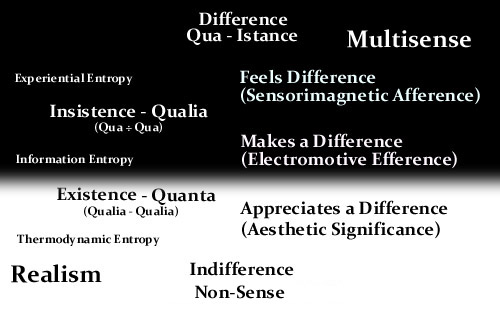
Bergsonian-Deleuzian Multiplicity and Gaede’s Ropes

Looking at the Bergsonian-Deleuzian concept of multiplicity, I can see that it shares the same underlying dialectic as Multisense Realism. I noticed that if I add some insight from Bill Gaede’s Rope model of the atom (YouTube 04:25), I can map electromagnetism to the Continuous-Discrete framework of Bergson.
Where Gaede conceives of a literal thread across the diameter and around the circumference of the atomic nucleus, I think that it should be flipped. Rather than a literal thread I see a capacity for felt participation: ‘motive’ or maybe ‘efference’. Electricity is not a thread across the atom, it the experience of jumping from one atom to another. The atoms themselves would not look like balls of magnetic yarn, but feel like obstacles within the private sense field or ‘afference’ of each atom. This corresponds to magnetic field and Difference in kind, however, it’s a loose correspondence. Sense and motive is electromagnetism from the inside, but it is also gravity and electromagnetism, feeling and knowing, being and doing. It’s the absolute fundamental.
Electricity, in the Gaede model, would correspond to that which defines the literal, linear, direct aesthetic. The symmetry and juxtaposition across the diameter of the atom appears to us as a quantum gear shifting mechanism. That’s because we are detecting it from the outside with other bodies, so there is always a spacetime gap to be hopped across. The loop-like aspect of the atom, by contrast It is both a spherical range of sensitivity in public space and a circuit of oscillating affect or disposition (private experience). To make a long story story short, the atom, in my model, is an interaction with continuous-private-aesthetic qualities and discrete-public-anesthetic (skipping) qualities, aka qualia and quanta. The larger cosmological picture involves the division of qualia from the Absolute (Qua), the diffraction of quanta from qualia (spacetime existence), and the saturation of reconstituted qualia (quanta existential spacetime entropy stripped out) on return to the Absolute.

This can work for a neuron as well as an atom, but again, loosely. Each frame of reference has its own unique vocabulary. A neuron is figuratively like Bill Gaede’s atom model. A galaxy or a solar system is similar also, as is the alchemical Caduceus, the chakra system, the ankh… None of them are identical, but the theme is similar. Winding and tightening, spinning and accelerating, contracting and relaxing.


Ehh, How Do You Say…
The use of fillers in language are not limited to spoken communication.
In American Sign Language, UM can be signed with open-8 held at chin, palm in, eyebrows down (similar to FAVORITE); or bilateral symmetric bent-V, palm out, repeated axial rotation of wrist (similar to QUOTE).
This is interesting to me because it helps differentiate communication which is unfolding in time and communication which is spatially inscribed. When we speak informally, most people use a some filler words, sounds, and gestures. Some support for embodied cognition theories has come from studies which show that
“Gestural Conceptual Mapping (congruent gestures) promotes performance. Children who used discrete gestures to solve arithmetic problems, and continuous gestures to solve number estimation, performed better. Thus, action supports thinking if the action is congruent with the thinking.”
The effective gestures that they refer to aren’t exactly fillers, because they mimic or indicate conceptual experiences in a full-body experience. The body is used as a literal metaphor. Other gestures however, seem relatively meaningless, like filler. There seems to be levels of filler usage which range in frequency and intensity from the colorful to the neurotic in which generic signs are used as ornament/crutch, or like a carrier tone to signify when the speaker is done speaking, (know’am’sayin?’).
In written language, these fillers are generally only included ironically or to simulate conversational informality. Formal writing needs no filler because there is no relation in real time between participating subjects. The relation with written language was traditionally as an object. The book can’t control whether the reader continues to read or not, so there is no point in gesturing that way. With the advent of real time text communication, we have experimented with emoticons and abbreviations to animate the frozen medium of typed characters. In this article, John McWhorter points out that ‘LOL isn’t funny anymore’ – that it has entered sort of a quasi-filler state where it can mean many different things or not much of anything.
In terms of information entropy, fillers are maximally entropic. Their meaning is uncertain, elastic, irrelevant, but also, and this is cryptic but maybe significant…they point to the meta-conversational level. They refer back to the circumstance of the conversation rather than the conversation itself. As with the speech carrier tone fillers like um… or ehh…, or hand gestures, they refer obliquely to the speaker themselves, to their presence and intent. They are personal, like a signature. Have you ever noticed that when people you have known die that it is their laugh which is most immediately memorable? Or their quirky use of fillers. High information entropy ~ High personal input. Think of your signature compared to typing your name. Again, signatures are occurring in real time, they represent a moment of subjective will being expressed irrevocably. The collapse of information entropy which takes place in formal, traditional writing is a journey from the private perpetual here of subjectivity to the world of public objects. It is a passage* from the inner semantic physics, through initiative or will, striking a thermodynamically irreversible collision with the page. That event, I think, is the true physical nature of public time – instants where private affect is projected as public effect.
Speakers who are not very fluent in a language seem to employ a lot of fillers. For one thing they buy time to think of the right word, and they signal an appeal for patience, not just on a mechanical level (more data to come, please stand by), but on a personal level as well (forgive me, I don’t know how to say…). Is it my imagination or are Americans sort of an exception to the rule, preferring stereotypically to yell words slowly rather than using the ‘ehh’ filler. Maybe that’s not true, but the stereotype is instructive as it implies an association between being pushy and adopting the more impersonal, low-entropy communication style.
This has implications for AI as well. Computers can blink a cursor or rotate an hourglass icon at you, and that does convey some semblance of personhood to us, I think, but is it real? I say no. The computer doesn’t improve its performance by these gestures to you. What we might subtly read as interacting with the computer personally in those hourglass moments is a figment of the Pathetic fallacy rather than evidence of machine sentience. It has a high information entropy in the sense that we don’t know what the computer is doing exactly, if it’s going to lock up or what, but it has no experiential entropy. It is superficially animated and reflects no acknowledgement to the user. Like the book, it is thermodynamically irreversible as far as the user is concerned. We can only wait and hope that it stops hourglassing.
The meanings of filler words in different languages are interesting too. They say things like “you see/you know”, “it means”, “like”, “well”, and “so”. They talk about things being true or actual. “Right?” “OK?”. Acknowledgment of inter-subjective synch with the objective perception. Agreement. Positive feedback. “Do you copy?” relates to “like”…similarity or repetition. Symmetric continuity. Hmm.
*orthomodular transduction to be pretentiously precise
Absolute View vs Western View: Comparing Supreme Ultimate Diagrams

Contrasting two models of consciousness: The Multisense Realism model above uses an Absolute view, which accounts for all known phenomena, subjective and objective. Postulating a root “Qua” (aka, the Absolute, Totality) from which qualia are divided through quanta, Quanta is conceived of as a constraint on Qua, a partition within it. Qua is sense capacity or presence, and so Quanta is the diminished reflection of that capacity…non-sense, entropy, uncertainty, and an expectation of absence. I am trying to show this as the horizontal arrows between qualia, indicating that quanta is nothing more than a kind of negotiation protocol which allows qualia to coexist in the same public space while retaining their private integrity. This is a complete reversal of the Western view, which features Quanta in the role of Qua, as the arithmetic-logical source of all phenomena.
On the left side of the diagram, there is a very general sketch of how Qua recovers itself ‘with interest’ as a qualitative enhancement – a consequence of having reunited on the other side of entropy-disorientation. On a human level, our experience yields a net human significance. Civilization is the residue left behind, a collective perceptual inertial of technology which echoes the individual’s narrative journey of exposure to the exteriorized spaces and the celebrated return home. Significance is literally a promiscuity of association among qualia, a depth of feeling and meaning which compels participation. My view is that this principle motivates on many, if not every level of the cosmos, and is not limited to human beings or animals (even though arguably significance is exponentially more…significant for human beings, at least in our own eyes).
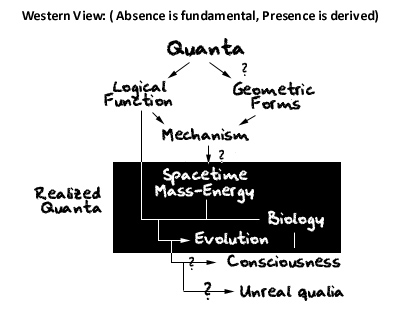
The Western view is a local rather than Absolute view. It does not account for sense or order itself, rather it begins from the assumption of physical matter and works backward to primitive mathematical functions. There are question marks included on the links which seem poorly understood or unjustified by the model as a whole. These include:
Why does geometry exist? I propose this as the Death of Computationalism. Along with the lack of support for Real numbers in computation, the universe or multiverse as a Turing emulation fails to account for the existence of forms like lines, circles, angles, etc. We know from our own computing and calculating devices that it is not necessary to physically draw a triangle in order to approximate correct computations about numbers which could correspond to triangular coordinates, so it really doesn’t make sense that any cosmic computation could or would invent geometric presentations of any kind. We don’t even need to get into questions of qualia, because computationalism fails to explain any sort of aesthetic forms to embody its functions. Mathematics is disembodied and anesthetic, and it works perfectly that way – no need for any strange magical fanfare.
Why do mathematical relations and laws give rise to physics? It’s all very well to have forms and functions mingle with each other as articulate mechanisms, but why should they ‘materialize’ as space-time, matter and energy?
The question of why consciousness exists when it does not appear to have any particular advantage over unconscious mechanism is a mystery. It is very difficult not to smuggle in our own retrospective view of consciousness as having enormous utility for our survival, but this is in no way an endorsement from the prospective view. If our immune system can orchestrate phenomenally complex responses to pathogens without a conscious experience attached to it, then why would a hominid’s humdrum quest for sustenance and reproduction lend itself to such an absurdly ornate aesthetic phenomenon? Indeed, if evolution can make a human brain, with all the trimmings, using unconscious methods, surely the operation of that brain would be better suited to that tried and true option.
The final question mark is related, but not identical. Even if you have consciousness as an option for some reason, and that option works better for humans than turtles or clouds of methane for some reason, why should such a phenomenon as consciousness produce feelings which are other than a record of the physical events which they represent? Why should there be different kinds of sensory experiences when all logical functions can be reduced more effectively to a single binary format of data processing? This alternative to reality is cast aside from the Western view, but what metaphysical never-never land is it cast to? How did we get outside of the real universe and into an ‘illusion’?

A Deeper Look at Peripheral Vision

Often, when peripheral vision is being explained, an image like the one on the right is often used to show how only a small area around our point of focus is defined in high resolution. The periphery is shown to be blurry. While this gets the point across, I think that it actually obscures the subtle nature of perception.
If I focus on some part of the image on the left, while it is true that my visual experience of the other quadrants is diminished, it is somehow less available experientially rather than degraded visually. At all times I can clearly tell the difference between the quality of left image and the right image. If I focus on a part of the right hand image, the unfocused portion does not blur further into a uniform grey, but retains the suggestion of separate fuzzy units.
If peripheral vision were truly a blur, I would also expect that when focusing on the left hand image, the peripheral boxes would look more like the one on the right, but it doesn’t. I can see that the peripherized blocks of the left image are not especially blurry. No matter how I squint or unfocus or push both images wayy into the periphery of my sight, I can easily tell that the two images are quite different. I can’t resolve detail, but I can see that there is potentially detail to be resolved. If I look directly at any part of the blurry image on the right I can easily count the fuzzies when I look at them, even through they are blurred. By contrast, with the image on the left, I can’t count the number of blocks or dots that are there even though I can see that they are block-like. There is an attenuation of optical acuity, but not in a way which diminishes the richness of the visual textures. There is uncertainty but only in a top-down way. We still have a clear picture of the image as a whole, but the parts which we aren’t looking at directly are seen as in a dream – distinct but generic, and psychologically slippery.
What I think this shows that there are two different types of information-related entropy and two different categories of physics – one public and quantitative, and one private and qualitative or aesthetic. Peripheral vision is not a lossy compression in any aesthetic sense. If perception were really driven by bottom up processing exclusively, we should be able to reproduce the effect of peripheral vision in an image literally, but we can’t. The best we can do is present this focused-in-the-center, blurry-everywhere-else kind of image which suggests peripheral vision figuratively, but the aesthetic quality of the peripheral experience cannot be represented.
I suggest that the capacity to see is more than a detection of optical information, and it is not a projection of a digital simulation (otherwise we would be able to produce the experience literally in an image). Seeing is the visual quality of attention, not a quantity of data. It is not only a functional mechanism to acquire data, it is more importantly an aesthetic experience.
Entropy, Extropy, and Solitopy
By my reckoning, ‘order’ can only be an aesthetic consideration, which further means that it is dependent on the sensitivity of a given participant. Thermodynamic entropy, therefore, while overlapping on information entropy by some measures, does not in others.
I use the example of compressing a video of a glass of ice melting to illustrate how the image of ice changing over time, being more complex and therefore requiring more resources to compress with a general-purpose video codec, defies the underlying thermodynamic change from low entropy to high entropy. If you compressed a before and after video, the after video would encounter lower information entropy in executing the compression than the melting ice.
All this demonstrates is that not every expression or description of a phenomenon can be reduced to a quantitative expectation. The optical qualities of melting ice from a macroscopic perspective are not isomorphic to other levels, perspectives, and sense modalities.
Anyhow, my conjecture uses a term ‘solitropy’ which refers to the aesthetic drive which is similar to what has been called extropy or Eros, but solitropy is conceived as a quality which is not diametrically opposed to entropy. Simple negentropy would be a reduction in noise, but would not insist on the content of the signal itself improving qualitatively. You can make the type as clear as you like, but that won’t improve what is being said. Solitropy would extend entropy-extropy into a private quality of physics, so that we would be able to formalize in physics, for instance, the difference between the entropy produced by burning down a city and boiling water.
 Multisense Realism
Recent Comments