Archive
All You Touch and All You See
“All you touch and all you see is all your life will ever be.” – Pink Floyd
Beginnings
Option 1: In the beginning, there was X. At some point, some iteration of X(X) bridged the presumably senseless world of X to the real world which we know.
Option 2: In the beginning, there was X and X was sentient.
Option 3: In the beginning, there was sense.
Option 4: The idea of beginning is a function of sense, so that sense is more fundamental than beginnings and sequences.
Option 5: The universe could be a perpetual collection of conditions without any fundamental capacities or beginnings.
Sense from the senseless
To see a universe as brought into being by senseless effects such as the spontaneous appearance of physical ‘forces’ or as a permanent physical fact leaves sense itself unexplained. How do several things operate as a ‘group’, simply by spatial proximity? What makes a pattern or signal different from noise? What really is a ‘beginning’ other than a distinction made from an expectation of sequence?
This may seem to be a silly issue, but I think that whether or not we take sense for granted guides the entire future of science. From physics to neuroscience to computer science, our assumptions about the capacity to sense and makes sense lead us either to discover a fundamental physical principle of orientation uniting subjectivity and objectivity, or drives us further into alienation. Without sense, we are forced to double down on either the primacy of object-hood or the primacy of disembodied simulation, either route leading inevitably to an orphaning of the self – a ghost-machine within a machine-ghost.
Digital Oblivion
Understanding the relation between symbols and reality is notoriously difficult, partly because our experience of reality is overrun symbols to the extent that the vast majority of what we consider real has been mediated through symbolic description rather than direct experience. Our appreciation for direct experience has naturally tended to atrophy in adaptation to this environment so that we no longer consider ourselves to be an authoritative source on any subject. We define our own presence in terms of learned knowledge to the extent that many people find it impossible to separate their actual sensory-motor experience from the understanding of neurology. The former is relegated to the trash heap of ‘illusion’ or ‘models’ and the latter is elevated to the status of objective reality.
Giulio Tononi’s recent Integrated Information Theory, (covered in a SciAm article by Christof Koch) takes a good first step at measuring consciousness by quantifying in formulas the degree to which information is integrated, but by working from the outside in, it fails to grasp the absolute authenticity of awareness itself, and the role that it plays in putting the ‘in’ into ‘in-formation’.
For example, from the Wiki, the diagram showing how to decompose systems into overlapping complexes assumes some primitive level of association that just comes built in with math, or physics, or reality.

Unfortunately this oversight really makes the question of what consciousness is fade out completely, as we have already assumed some sort of discernment and attachment among digits, bytes, or other theoretical ensembles of data.
Philosophers seem to have an advantage over many scientists in being able to question pattern recognition itself and to see semiotic relations between minds and matter rather than data as objective facts. Almost without exception, information science and quantum physics theories seem fuzzy on the difference, and often staunchly deny map-territory distinctions at all. Cognitive science and neurology both seem to be unaware or dismissive of the depth of the Explanatory Gap and Hard Problem of Consciousness, which are seen to be purely philosophical indulgences. In fact, the location of meaning in subjective sense capacities rather than objects is an essential key to understanding the relation of consciousness and physics.
Divorced from physics, computational theories posit a Platonic universe of digital perfection, unhampered by tangible resources. Neglecting the fact that all computation we know of occurs as the result of physical interaction, modern information-centric theories have little to bring numbers down to Earth. Rather than seeing numbers as a counting of static, memorable, locatable, digitally addressable objects, the enthusiasm for Boolean logic seems to have transcended materiality altogether and replaced consciousness itself. Every week there seems to be a new article proclaiming the possibility of digital simulation, each one more cavalier than the last in its dismissal of concrete realism. It is as if to say ‘With our simulated awareness of simulated logic, we simulate understanding that the only reality of sense stems from the unreality of senseless imitation (whatever that is).’
Truth or Consequences
My point in all of this is that our straying from realism has been a fruitful excursion this far, but that we are now seem to be approaching a fork in the road where we will have to place our bets on the authenticity of ourselves or that of objects or information. If we continue to define the self in terms of unrelated bits and pieces of not-self, we will have successfully disappeared our opportunity to thrive and explore the universe in favor of an automatic cataloging and curating of emptiness. What difference does it make what we choose for our supreme X, as we have already determined its nature in advance.
For all possible X, be it genetic, quantum-universal, information-theoretic, we can be sure that they will share the same curious quality of not resembling ourselves in any way. Where we are irrational, indecisive, sentimental, X is inevitable, automatic, and without need for aesthetic presence. We envision an endless web of digital patterns, racing around each other, working out probabilistic games by necessity rather than choice. Yet somehow, we remain the ones who see and touch this world – still unexplained perceiving participants; translators between one meaningless ensemble of data and another.
Neologisms For Physics
The addition of a sensory-motor primitive in physics would entail new terms to reflect the shift away from thermodynamic and electromagnetic and toward terms which consider the distinction between private-tempo and public-spatial to be more relevant. Thermal qualities of temperature are understood to be tactile reads of the same molecular tempos (frequencies) which are read visually as colors, but they are both private signifying experiences (endophoric).
Kinetic-based measurements such as velocity and pressure are correlated to molecular tempo but from an exterior view. The public consequences of endophoric tempos are received as topographical presentations of an exometric sort (wavelengths and ranges for example). Exometrics can be frozen and analyzed as static positions and vectors.
Endophoric – A privately meaningful signal, affect, or subjective disposition based on frequency of oscillating or cycling through experienced sensory qualities.
Exometric – A public effect on embodied participants and their ‘objective’ positions (relative to one another). Measurement by scale, scope, distance, and mechanical interaction of forms.
The nature of endophorics can be understood in more detail using monochord type models such as the visible spectrum or musical scale, where frequency correlates to a specific sensed quality which cannot be described publicly. The contrast between the mathematical contexts of cardinality vs ordinality are useful here, as well as position vs disposition.
Endophorics: Affect, disposition, appreciation
ordinal qualities (significance > entropy)
cardinal qualities (unique > common)
Exometrics: Effect, position, function
quantified ordinality (consequences of coordinates)
quantified cardinality (consequences of redundancy)
Endophorics can be conceived of as tempos, tropes (to turn, alter, change), or even ‘verses’ (turns, bends). A sense of progress through cycles of tension and relaxation (wag and weigh from PIE). This is the experience sensory input, as through a read head or antenna responding to exterior conditions.
Exometrics by contrast are public measurables, based on literal rigid bodies and their figurative extension into rigid scientific indexes. Navigation, for example, compares known stable positions and ratios to local unknown variables. By isolating invariance, common sense can be established with relative independence of endophoric fluctuations.
Pan vs Pan: The War for What Matters
The debate over the origin and nature of consciousness in the universe, in my analysis, boils down to this:
Panexperientialism vs Panmechanism
We must consider whether it is likely that
- Experience is possible without a mechanism.
At first consideration, many people will immediately disagree.- We are the only thing in the universe which has experience,
- we know that experience relies on a brain,
- and we know that a brain is a biological mechanism.
Case closed.
Or is it?That position seems to inevitably also adhere to the view that there can only be one competing hypothesis; naive idealism. This is typically summed up as “So, if you die, then the universe disappears?” or “So, the Moon disappears if you aren’t looking at it.”*
The implicit assumptions behind this rebuke of idealism are:
a: Human consciousness is the only form of consciousness possible, and
b. Matter itself functions with no possibility of awareness. - Mechanism is possible without some form of experience.
Whether it is planets orbiting the Sun or atoms colliding in a void, there is a logical pattern that can be observed. Rather than every object falling through each other, or turning into an unexpected form, there is a strict coherence of interactions. We speak of ‘Laws of Physics’.If we were to summon a statement of naive counter-idealism, it would take ‘Law’ literally and demand to see the Parliament and legislature, the law enforcement apparatus, and most of all, the law-abiding agents who have received, understood, and retain a capacity to follow ‘laws’ to the letter. In the absence of any proposal for the mechanism of physical law itself, It would seem that the presumption of law is little more than a pacifier for the mind. There are simply things, and they simply do what they do.
This puts the proposition of experience-without-mechanism (EWM) on exactly the same level of religious faith as mechanism without experience (MWE), however the difference is (and it is an important difference), that we personally can verify our own experience and cannot verify the lack of experience in another. We can have a hunch, by the rigor mortis for example, that Zed’s dead, but we still have a cadaver, full of microscopic tributes to the wonder that was Zed’s body. If we want to get really hippie, we can say too that the Earth still has another crumb of lovely fragrant organic matter with which to fertilize the air and soil. Zed is no more, but the body formerly known as Zed is still part of the many stories of biochemistry, history, anthropology, etc that remain.
It seems to me that the assumption of Laws which govern a universe of existence without experience is actually more likely a function of our own naive assumption that our experience relies on automatic laws. In fact, when we turn that assumption on its head, we find that once we let go of the idea of being the only active participant in the universe, any law of physics can easily be understood as a sensory-motor experience, and the dream of pristine non-witnessed mechanism may in fact be the more comforting psychological blanket compared to the brave new universe of en-ploding meaning and significance..
- Anything can be proved or if it matters.
All that the foregoing suggests is that we may be wrong to assume that the capacity to experience appears out of matter, and that it is wrong because such an appearance makes no sense at any point in the history of the universe. We assume that experience is complex or emerges from ‘complexity’ itself, but that may be because our human awareness is complex. In reality, without awareness, there is no quality of ‘complexity’ in the universe. Something has to be able to interpret a given pattern as complex for it to be distinct from just ‘lots and lots of simplicity’. We assume that simple forms of life or matter have no experience, but how would we be able to tell the difference?The answer to whether it matters if we are an accidentally conscious body in a meaningless machine or a human experience in a universe made of meaningful experiences is to me, an obvious yes. The implications of the former vs the latter radiate out in every direction of our personal and social lives. Are we automatons who inexplicably dream of freedom, or are we free agents who are sensibly bound to a multitude of other experiences interdependently?
Since it is potentially such an important issue (really what more important issue for the world as a whole could there be in the long run?) and that the answer could reconcile science, philosophy, and religion if properly understood, the issue of proof is important. Just as modern rationality has become accustomed to the unquestioned assumption of panmechanism, so too have we become accustomed to the corresponding assumption of pan-objectivity.
Like the laws of physics, our law of proof is a disembodied soldier with no home. We have become subjects of proof rather than provers of fact. Having turned the most miraculous epistemological tool in our arsenal on ourselves, we have found a way to lose sight that it is we ourselves who are doing the proving. We have lost our orientation and now face ourselves through our own human idea of a stranger’s eyes. The eyes of a neuron, of collections of cells and ion channels, of spike trains and action potentials. These, we state confidently, are what we really are. These strange microworlds are reality, while the only reality which humanity has ever known before this, has been mere advertisements for the hidden processes that really matter.
A closer look, however, at that history which we used to think was real and we find the roots of objectivity itself – not handed down by fiat by the unmovable object of matter but by thousands of years of thinking and reasoning, philosophy and mysticism. From the alchemist’s flasks to the monk’s viniculture, and from the astrologer’s star maps to Galileo’s telescope, it has all been a process of human discovery – of trial and error but also of intuition and insight. We have come to this place in history as a function of agreement and disagreement, not of a single inevitable monolith of unquestioned fact or faith.
*this Strawman seems to be based on a misinterpretation of Idealism, perhaps handed down from the successively more superficial readings of George Berkeley’s A Treatise Concerning the Principles of Human Knowledge (1710)
23. But, say you, surely there is nothing easier than for me to imagine trees, for instance, in a park, or books existing in a closet, and nobody by to perceive them. I answer, you may so, there is no difficulty in it; but what is all this, I beseech you, more than framing in your mind certain ideas which you call BOOKS and TREES, and the same time omitting to frame the idea of any one that may perceive them? BUT DO NOT YOU YOURSELF PERCEIVE OR THINK OF THEM ALL THE WHILE? This therefore is nothing to the purpose; it only shows you have the power of imagining or forming ideas in your mind: but it does not show that you can conceive it possible the objects of your thought may exist without the mind.
As Berkeley’s ideas rippled and meandered through the minds of writers and thinkers over the decades, they crossed over from philosophy to science. By 1884, Scientific American echoed Berkeley’s idealism, stating
“Sound is vibration, transmitted to our senses through the mechanism of the ear, and recognized as sound only at our nerve centers. The falling of the tree or any other disturbance will produce vibration of the air. If there be no ears to hear, there will be no sound.”
(reblogging from my If A Philosophical Cliche Falls In A Forest)
Can someone please explain my existence to me?
You are a personal experience within a universe of experiences. Your experience is at once composed of multiple sub-personal experiences (sensations, perceptions and drives ) and super-signifying experiences (social, cultural ideals and inspirations).
There is a corresponding impersonal context in which your personal experience takes place. It’s a bit complicated, but there is a symmetry between public and private, similar to horizontal versus vertical, in which experiences which are not yours personally are presented as objects in spatial relation. In this impersonal, public view scale and size are the relevant factors, so that your ability to participate directly is limited by the proximity of the public bodies to your own body, both in distance and scale.
Together, these two aspects of experience form a single unbroken continuum through which fantastic quantities of interrelated experiences are enacted.
Three Layers of Any Message
Excerpts from Gödel, Escher, Bach by Douglas Hofstadter (via Occam’s Beard)
In these examples of decipherment of out-of-context messages, we can separate out fairly clearly three levels of information: (1) the frame message; (2) the outer message; (3) the inner message. The one we are most familiar with is (3), the inner message; it is the message which is supposed to be transmitted: the emotional experiences in music, the phenotype in genetics, the royality and rites of ancient civilations in tablets, etc.
To understand the inner message is to have extracted the meaning intended by the sender.
The frame message is the message “I am a message; decode me if you can!”; and it is implicitly conveyed by the gross structural aspects of any information-bearer.
To understand the frame message is to recognize the need for a decoding-mechanism.
If the frame message is recognized as such, then attention is switched to level (2), the outer message. This is information, implicitly carried by symbol-patterns and structures in the message, which tells how to decode the inner message.
To understand the outer message is to build, or know how to build, the correct decoding mechanism for the inner message.
This outer level is perforce an implicit message, in the sense that the sender cannot ensure that it will be understood. It would be a vain effort to send instructions which tell how to decode the outer message, for they would have to be part of the inner message, which can only be understood once the decoding mechanism has been found. For this reason, the outer message is necessarily a set of triggers, rather than a message which can be revealed by a known decoder.
The formulation of these three “layers” is only a rather crude beginning at how meaning is contained in messages. There may be layers and layers of outer and inner messages, rather than just one of each. Think, for instance, of how intricately tangled are the inner and outer messages of the Rosetta stone. To decode a message fully, one would have to reconstruct the entire semantic structure which underlay its creation— and thus to understand the sender in every deep way. Hence one could throw away the inner message, because if one truly understood all the finesse of the outer message, the inner message would be reconstructible.
What makes us see a frame message in certain objects, but none in others? Why should an alien civilization suspect, if they intercept an errant record, that a message lurks within? What should make a record any different from a meteorite? Clearly its geometric shape is the first clue that “something funny is going on”. The next clue is that, on a more microscopic scale, it consists of a very long aperiodic sequence of patters, arranged in a spiral. If we were to unwrap the spiral, we would have one huge linear sequence (around 2000 feet long) of minuscule symbols. This is not so different from a DNA molecule, whose symbols, drawn from a meager “alphabet” of four different chemical bases, are arrayed in a one-dimensional sequence, and then coiled up into a helix. Before Avery had established the connection between genes and DNA, the physicist Erwin Schrödinger predicted, on purely theoretical grounds, that genetic information would have to be stored in “aperiodic crystals”, in his influential book What is Life? In fact, books themselves are aperiodic crystals contained inside neat geometrical forms. These examples suggest that, where an aperiodic crystal is found “packaged” inside a very regular geometric structure, there may lurk an inner message.
The three levels are very clear in the case of a message found in a bottle washed up on a beach. The first level, the frame message, is found when one picks up the bottle and sees that it is sealed, and contains a dry piece of paper. Even without seeing writing, one recognizes this type of artifact as an information-bearer, and at this point it would take an extraordinary—almost inhuman—lack of curiosity, to drop the bottle and not look further. Next, one opens the bottle and examines the marks on the paper. Perhaps they are Japanese: this can be discovered without any recognition of the inner message being understood—it merely comes from a recognition of the characters. The outer message can be stated as an English sentence: “I am in Japanese.” Once this has been discovered, then one can proceed to the inner message, which may be a call for help, a haiku poem, a lover’s lament…
It would be of no use to include in the inner message a translation of the sentence “This message is in Japanese”, since it would take someone who knew Japanese to read it. And before reading it, he would have to recognize the fact that, as it is in Japanese, he can read it. You might try to wriggle out of this by including translations of the statement “This message is in Japanese” into many different languages. That would help in a practical sense, but in a theoretical sense the same difficulty is there. An English-speaking person still has to recognize the “Englishness” of the message; otherwise it does no good. Thus one cannot avoid the problems that one has to find out how to decipher the inner message from the outside; the inner message itself may provide clues and confirmations, but those are at best triggers acting upon the bottle finder (or upon the people whom he enlists to help).
Similar kinds of problem confront the shortwave radio listener. First, he has to decide whether the sounds he hears actually constitute a message, or are just static. The sounds in themselves do not give the answer, not even in the unlikely case that the inner message is in the listener’s own native language, and is saying, “These sounds actually constitute a message and are not just static!” If the listener recognizes a frame message in the sounds, then he tries to identify the language the broadcast is in— and clearly, he is still on the outside; he accepts triggers from the radio, but they cannot explicitly tell him the answer.
It is in the nature of outer messages that they are not conveyed in any explicit language. To find an explicit language in which to convey outer messages would not be a breakthrough— it would be a contradiction in terms! It is always the listener’s burden to understand the outer message. Success lets him break through into the inside, at which point the ratio of triggers to explicit meanings shifts drastically towards the latter. By comparison with the previous stages, understand the inner message seems effortless. It is as if it just gets pumped in.
Commentary:
In multisense realism, I think of the three levels of GEB semiotics not as absolutes of frame, outer, and inner, but as relative frames of increasingly inner qualities. The bottle is read optically (inner to your visual experience but outer to your body and self), the text is read optically and typographically (inner to your semiotic experience but outer to your ‘self’) and the message is understood linguistically and cognitively (inner to your conscious mental experience or executive/self awareness but outer to your visual experience and absent from your body experience). The letters are more outer to your mind than the words, but not as outer as the optics available through your eyes. It’s all sensory experience and it is all inner, outer, and frame relative to different levels of participation. All sense is a frame making, breaking, and preserving experience which recontextualizes other frames as inner and outer.
Phototheque: A Danceable View of Light
“Thus, the word ‘electron’ should be regarded as no more than a name by which we call attention to a certain aspect of the holomovement, an aspect that can be discussed only by taking into account the entire experimental situation and that cannot be specified in terms of localized objects moving autonomously through space. And of course, every kind of ‘particle’ which in current physics is said to be a basic constituent of matter will have to be discussed in the same sort of terms (so that such ‘particles’ are no longer considered as autonomous and separately existent). Thus we come to a new general physical description in which ‘everything implicates everything’ in an order of undivided wholeness.” – David Bohm, Wholeness and the Implicate Order
If you aren’t familiar with physicist David Bohm, he was one of the pioneers of Quantum Physics who dared to go beyond mere calculation. He dared to integrate quantum observations into a cosmology which includes consciousness. In many ways his ideas parallel my own approach. His term holomovement is very similar to what I have looked at in breaking down the word universe to its etymological roots. Both holo and uni refer to singularity-wholeness, the Absolute or solitrope. Verse and movement are related (re-verse, in-verse, ob-verse), although Bohm’s sensibility of holomovement implies a motorized realization of cosmos, while universe is a broader more ‘vers-atile’ ‘vers-ion’, allowing for the full range of information-theoretic-material realizations. Some other obnoxious portmanteau neologisms could include ‘soliwegh’, ‘monoteleos’, ‘unimotive’.
Polarization is interesting to me because it supports what Bohm is saying. We use the term ‘polarizing filter’ for substances with these particular optical properties, but filters would not behave the way that these lenses do. As you can see in the YouTube, when it comes to these kinds of filters, ‘two wrongs can make a right’, so to speak.
In my mind, there is no way that we can honestly describe photons as particles as we see that unlike a conventional filter, the amount of light passing through these lenses can increase as well as decrease the illumination of the target. It’s like having a second coffee filter which undoes half of the effect of the first.
Following is a simple chart showing a conventional understanding of polarized light. Note that the source of the light and the target of the beam are not featured – symptomatic I think of the dominance of the theoretical approach to understanding light. We are meant to imagine quali-invisible waves which make up ‘light’ itself. traveling through the air and undergoing mathematical transformations.

This is indeed a great way of modeling the phenomenon as an idea, but I think that the concrete reality of the thing, keeping in mind Bohm’s words about there not really being fundamental particles which autonomously exist, is obscured. My conjecture takes Bohm seriously and ventures further into realism. This new view suggests that rather than a generalized holomovement or implicate order, the materials themselves – light bulbs, laser diodes, dicrhroic crystal doped lenses and films, ordinary walls and screens…these are the materials which are the actual holodynamic ensemble. What they are made of all have sensory-motor properties which are both generic-universal, chemical-specific, and spatiotemporal-unique. Each element is a presentation of this ontological continuum, with topological peaks as an unrepeatable performance out of the plenum of the inescapable repetition of the permanently generic. Quantum is only half of the picture. Qualia is both the cause and effect of quantum.
This next figure is a diagram to illustrate this idea of light or quantum, not as some mysterious invisible magic, or as a simple mathematical idea, but as a concrete sensory-motor reality. It may not be obvious, but what is intended here is to show that the actual agents are not waves but in illuminated matter: light bulb filament, lens, wall. It is the excitement of the filament which is imitated in different ways by the other participants in this ensemble. Each participating piece of matter is imitating or re-verse imitating, con-verting or di-verting not beams of light but their own energetic disposition. The molecules of the lens are responding in a specific way. The lens is changing its image, not bending a literal beam. The light which we see is a part of us interacting directly with a part of something else, separated only by empty space. Seeing is a way of touching without literally touching.

While Bohm was ahead of his time (quote was from 1980) in recognizing the significance of holistic coherence and going beyond the model of autonomous particles, the view that I propose applies this same radical departure to perception. Just as the polarizing glass can either block out or recover signals, every sense channel we have brings with it its own unique contribution to our sense of realism. Our models of physics would not be the same if human beings were not primarily visually oriented. What we assume and what we question depends entirely on which sense modalities we rely on most.
Consider then, that our human eyes are not special because they are eyes, but because they are eyes which have been executed on a fantastically human scale. Eyes can be simple. In zooplankton, we can see viable eyes composed of just two cells. Let this sink in for a moment. Eyes are simple. Vision is invertebrate simple. Plankton simple. No brain is required. It’s not much of a leap to imagine that rather than eyes being the only way to detect visible events, they are an evolutionary step in division of labor rather than perceptual simulation and optical detection.
Chlorophyll shows us that response to visible light occurs on the molecular level, and ionization suggests this sensitivity is atomic. Neither of these imply, however, a separate currency of photons which autonomously transit between surfaces in a vacuum. Our own optical sense begins and ends at the surface of retinal molecules (vitamin A) embedded in the folded proteins of our rods and cones as they become erect in the presence of light. This is what our neurons are translating, not photons, but the cascading sensory-motor changes among molecules, cells, tissues, and organs that make up the living organism. Rather than a mathematical transduction of ‘information’, there are personal experiences of sub-beings (or sub-personal experiences of one being).
Realize then, that although we as human beings cannot see without eyes, hear without ears, etc, it is arbitrary bias to presume that these human organs are the source of all sensory access in the universe. To the contrary, the multisense realism view proposes that primitive cells, molecules, and atoms, may possess a less differentiated sense capacity. Just as our human night vision loses the discernment of color sensing cone cells, it may be the case that all eukaryotes have a kind of stem-qualia, the root verse from which our hypertrophied modalities of sight, sound, tactile, olfactory-gustatory, kinesthetic-vestibular, etc. senses are descended. The molecular-atomic ‘inorganisms’ could have an even more primordial unisense, to the point of proto-tangibility. A level of experience in which spacetime, unity and diversity, semiosis itself begin to emerge from the void-bottom end of the Absolute.
The light bulb filament’s molecules may themselves be bright and hot, maybe they are screaming and smell of ozone, all at once, but diluted into the catastrophe of fragments. On this least unified yet least diversified layer of uni-verse, the rules of community and locality are likely beyond our recognition. Every atomic whisper and supernova blast may be equally present in some sense at the bottom of the semantic event horizon. As Einstein warped spacetime and quantum mechanics digitized energy, this model extends that ambition to the Absolute. Perceptual relativity, seen as the ultimate and sole cosmological constant, crushes its own ontology at the periphery. Isness – being, collapses in on itself with the exhaustion of discernment.

Quantum Zeno Twilight Zone
The Quantum Zeno Effect
It is easy to show using standard theory that if a system starts in an eigenstate of some observable, and measurements are made of that observable N times a second, then, even if the state is not a stationary one, the probability that the system will be in the same state after, say, one second, tends to one as N tends to infinity; that is, that continual observations will prevent motion …
— Alan Turing
“…an unstable particle, if observed continuously, will never decay. One can “freeze” the evolution of the system by measuring it frequently enough in its (known) initial state.” – Wiki
It’s so strange to me that in all of the incredibly exotic implications of quantum mechanics and relativity, including the obliteration of matter and time, the possibility that what is being measured is measurement itself is never considered. We would rather assume that we are telepathically controlling the outcome of subatomic events than imagine that perhaps the events we are witnessing are the atoms which compose the measuring instruments which are imitating, in their own language, our intention to witness and objectify.
Think of it like a mirror image of divination. If you have played at all with the I Ching or Tarot cards, you will find that whatever insights they might seem to provide about your situation, they seem to present an even more insightful mirror to your question itself. Unlike quantum mechanics, we can see that divination can be falsified. Or can it? Like any cold reading sham psychic, we can pull the wool over our own eyes and reinterpret any previous prophecy which turns out false and find that on another level it could seem true, or that we had to believe that false prophecy at the time in order for some more important thing to happen, etc.
There was a Twilight Zone where William Shatner is trapped by his own obsessive superstition, unable to leave the room because of a tabletop oracle’s innuendos.
Nick of Time, 11/18/1960
Shatner: “Does anything exciting ever happen around here?”
Mystic Seer: “It is quite possible”.
“Am I gonna be promoted, for Pete’s sake?” is Shatner’s second question.
“It has been decided in your favor” is the response from the card from the box underneath the bobble headed Old Nick.

His fiancee fondles his keychain with a rabbit’s foot and four leaf clover and as Shatner calls his office and validates the oracle’s prophecy, he falls into a compulsive dependency on the oracle’s increasingly menacing fortunes.
Superficially, this reads as a simplistic cautionary tale of confirmation bias and the perils of superstition, but if it were that simple, all ideas of luck and fate would little appeal in this post modern age. Instead, it seems that more than ever people openly express gratitude to divine providence for their ‘blessings’.
Shatner’s insistence on using the same machine at the same table reflects this kind of proprietary intimacy with the super-personal. Superstition, or over-personal sense-making is a kind of inflammation of the pattern recognition faculties on the top end, the executive end of the psyche. The surprising thing, however, and the thing which can throw us into a recursive paranoia or delusional optimism if we are not careful, is that our capacity to see and know is not completely separate from the fabric of events themselves. In the moment of divination, there is inherently a kernel the truth of that moment, and in subsequent moments, the narrowness of that truth is exposed, just as all conditional truths of any moment are eventually exposed in the infinity of the unconditional.
Serling: “Two people permanently enslaved by the tyranny of fear and superstition, facing the future with a kind of helpless dread. Two others facing the future with confidence, having escaped one of the darker places in The Twilight Zone*.”
What does this have to do with Quantum Mechanics?
If my conjecture is right, then photons and other particle/wave functions are not literally objects, in the same way that exchanging smiles is not a literal exchange of projectiles across space. The exchange of smiles is procedural-semantic. It is to see and imitate an expression of subjective feeling which cannot be meaningfully broken down. The contortion of facial muscles, baring of teeth, etc has some evolutionary roots, sure, yes it does. The activity of neurotransmitters, ion pumps, and contracting proteins in sequence from the brain to those muscle fibers also presents an impersonal mechanism, relative to us, which can be credited for producing the smiles – mirror neurons, oxytocin, dopamine, sex hormones also after puberty, all kinds of microscopic amazing that we would not care at all about if it did not theoretically explain something personal about ourselves.
The teeth baring and the synapse doping are the meta and root impersonal perspectives respectively. The former posits a behavioral cause built on stochastic extractions of accumulated chance (the opposite of Shatner’s Nick, which is driven by unfalsifiable retro-correspondence – overly tele teleology which projects a future based on an ungrounded relativism of the past) while the latter posits a deterministic cause built on inevitable consequences of static universal law (math and physics). In the chart below, I try to show how these levels form the top and bottom of only half of the picture – the Realism half. Occidental reasoning is objective and impersonal, squeezing all of consciousness and identity into a mosaic of digital permutations and Bayesian feedback loops.
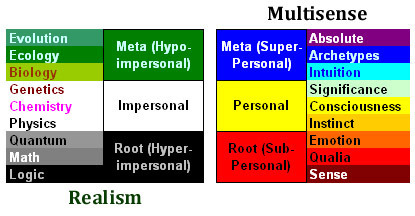
The missing half of quantum mechanics is the Eastern half or Orientverse. In order for logic to exist, something has to make sense of it. There has to be some capacity for discernment to detect, compare detections, and cause changes based on those comparisons. There has to be choice. This isn’t some sentimental appeal for naive anthropocentrism, this is, in my understanding, an inescapable ontological axiom – *the* axiom beneath all axioms.
How to discern on our own level then, between superstition and coincidence? How can we know anything for sure if we are in some sense participating in the creation of our own reality. What the Quantum Zeno Effect really is, finally, is a clue to how participation itself drives significance in the identical way that motion drives mass. It ‘matters’ how much you do and how much you care – it is what makes things matter. We can’t help but wanting to matter, and that means wanting to participate in something that matters.
What matters is generally located on the Eastern, Multisense side of the chart: Peer involvement. Consciousness is that ego driven stream of thoughts and intentions – the means through which subconscious instincts must be conditioned by hand into significance. Significance is accessed through language and ideas, in memory and esteem. It’s that charismatic glow and undeniable glamor of substantial power. Something that matters, not just to my own mind, but to everyone. Whether they like it or hate it, significance cannot be ignored – literally. Significance is the personal experience of signal promiscuity, a contagious association factor which runs through our experience longitudinally, connecting the dots through our days, years, and lives. To signify is literally to arrest one’s attention. To reduce personal choice over one’s own interest is an invasion (often a welcome invasion) of sorts.
This is what the Zeno Effect is all about: The equivalence of attention, significance, and time.
Quantum anti-Zeno effect studies are interesting too.
“The essence of the quantum Zeno effect is that repeated interrogation if the system is still in the inital state tends to quench the system in this state as the frequency of interrogations grows. The reason for that is that the quantum evolution generated by the hermitian Hamiltonian is time reversible, and hence the probability p(t) of intial state occupancy behaves as p(t) ≃ 1 − (t/ τ)² for short times t, with τ being the characteristic time scale. […] If we make N interrogations within the time T For this reason, the Zeno effect in decay processes is very hard to observe.”
[…]
“Frequent observing if the Schördinger cat is alive, kills it faster. Such experiment requires “tuning” of atomic transition frequency, or the photon band gap edge within the range of, which can be for instance done using external static electromagnetic field and Zeeman, or Stark effect. Summarizing, we have shown that near threshold decay can be exploited to observe the quantum anti-Zeno effect. Typical near threshold decay processes are characterized by ultra short period of quadratic decay, followed by a long phase of non-exponential decay, with a very large rate at the begining, gradually slowing down in the course of the dynamics. Monitoring if the decaying system remains in the initial state, shifts the system back to the fast initial phase of the non-exponential decay. In effect,
more frequent measurement, cause faster decay.”
Not that the Zeno and Anti-Zeno effects do not contradict each other, although it can be confusing. It’s a bit like remembering a car crash, and seeing the car in your memory speeding ahead at 80mph forever. It is frozen at high speed. In the same way, when we look at something which gradually decays less and less, we can make it decay faster by interrogating it more often during it’s high rate of decay phase. At least I think that’s what they are saying here. In the other study it seems like maybe they are using random measurements to accelerate anti-Zeno, but I’m not sure. That could make sense too – shifting the burden of choice onto the receiving/interrogated instrument rather than the transmitting instrument. Either way, I still think it makes more sense to see the measurement of quantum as a complex interaction among instruments rather than literal particles – what is being transmitted is like a smile, not like separate thing-which-is-not-a-thing.
*Twilight Zone trivia – the name comes from the submarine exploration, the point at which the ocean is so deep that sunlight begins to be unable to penetrate it.
Unified Formulation
If you want a formula, here’s what I’ve got for you at this point. I’m not saying it’s pretty (to everyone), but think of what calculus looked like to Newton’s critics (not to compare myself to Newton):
The United Formulation for the equivalence of proprietary temporal-algebraic signifying phenomenology (ℵ↔Ω) and public spatio-topological relativity (ωª) is
ॐ ⊇ { ((ℵ↔Ω) ↑ºt ) ⊥ (ωª ↓ (H←d)) }
or
“Everything is the superset or equal to {(Psyche (multiplying through time) as ordinal qualities) juxtaposed (aka ‘versed’) against (Cosmos dividing Psyche through telescopically scaled relativistic spatial cardinality)}
TL;DR to follow:
*ॐ* stands for Asolute Totality-Singularity: A proposed maximum inertial frame : an Everythingness which exists as ground of being in contradistinction to it’s own self-diffraction. The formula explains the self-diffraction as a private phenomenological multiplication through time and public morphological division across space.
“ℵ↔Ω”
refers to the expansion of the range of possible experiences along an x axis from eidetic-metaphorical to entopic-literal phenomenology.
“↑ ºt”
refers to the elevation of qualitative rank through time. The universe which contains human society presumably contains the potential for deeper and richer experiences – more fantastic and more awful than a universe of only simple organisms or inorganic systems.
“⊥”
reflects the orthogonal/perpendicular nature between the temporal-subjective side of the equation and the spatial-objective side.
“ωª ↓”
is anomalously symmetric to ℵ↔Ω, such that ω is the bottom-up, outside-in perspective of fundamental particles which are nested within each other telescopically (ª), from microcosmic to astrophysical scales of mechanism. This reductive determinism (↓) presents the mirror image to the intentionality of “↑ ºt”, which motivates with promise (high º) and threat (high negative º).
“H←d”
describes thermodynamic entropy (H) and the arrow of time (←) which relentlessly crushes or grinds all somethings into anythings and nothings. The role of distance (d) or space is to magnify this process, allowing larger, denser accumulations of mass and wider fields of dispersal into dust.
From an information entropy perspective, “d” would be understood as the metaphorical ‘distance’ instead; the mismatch of sense channels across different scales leads to a loss of intelligibility that increases exponentially from the microcosmic scales up, so that what is perceived as space on the macro scale is literally a failure to communicate on lower levels. It is the accumulated gating of sensory-motive uncertainty (noise).
Meta and Root
Here are some proposed scale/scope relations between interior phenomenology and exterior realism. The idea that mathematics is the root of quantum physics should be clear enough without much explanation. Taking that relation literally and applying it throughout, the sense of the whole picture can maybe be understood.
Math is to QM as Physics is to Math, as Chemistry is to Physics, etc. These, I propose are convenient break points on the ‘impersonal’ range of the universal continuum. These are nested algebraic topologies in spacetime. They are the exteriorized representations of the personal range experiences. There is a presentation-representation and agent-world relation here, so that the world in which a person relates to other persons is scoped as physics (classical mechanics and thermodynamics) chemistry and genetics. The impersonal view of a person is that: genetic, chemical, and physical activity in the body. Biology, ecology, and evolution extend this world into broader dis-identification categories – evolutionary species, environmental ecology, biological anatomy.
The impersonal side deals with structures extended in public space. The corresponding agents to these large scale worlds are the ephemeral, super-personal levels of awareness. Less real, but potentially more personally meaningful; characters, influences from culture, myth, family, etc are tied to ideas of the afterlife and luck – experiences above and beyond individual control.
Taking it down to the bottom third of the chart, the correlations work here too. Quantum is the world of emotion (which I describe as quorum mechanics – quantum is ‘atomic mood’), Math is the world of qualia (i.e. the interqualitative space – trigonometric functions, symmetries, algebraic equivalence), and Logic is the world of sense (the inevitable shadow of sense cast by the interaction of multiple participants).
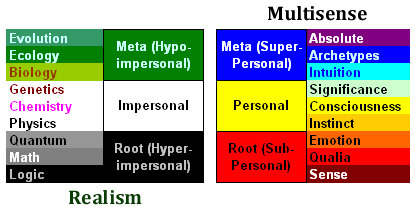
[Hypo-Impersonal] Evolution :: Meta (Super-Personal) Absolute
[Hypo-Impersonal] Ecology :: Meta (Super-Personal) Archetypes
[Hypo-Impersonal] Biology :: Meta (Super-Personal) Intuition
[Impersonal] Genetics :: (Personal) Significance
[Impersonal] Chemistry :: (Personal) Consciousness
[Impersonal] Physics :: (Personal) Instinct
[Hyper-impersonal root] Quantum :: (Sub-personal root) Emotion
[Hyper-impersonal root] Math :: (Sub-personal root) Qualia
[Hyper-impersonal root] Logic :: (Sub-personal root) Sense
Leibniz and Life Thread
I agree with what you say, but there’s no need to humanizethe coffee filters nor humanize intelligence or consciousness.I’m not talking here about IQ. My point (speaking here as Leibniz) is thatnature down to the lowliest beings (a grain of sand) has intelligenceof some sort. Nature is alive, and life is intelligence.
My point though is just because we put fibers into a mold or dots on a page into a form we can recognize doesn’t mean that we have created new life and intelligence. There is a difference between assembling something from tiny spatial-object parts and something reproducing itself from teleological-experiential wholes. A mannequin is not a person. The plaster and steel the mannequin is made of may certainly have a quality of experience, and although it is hard to speculate on exactly what kinds of experiences those are or what level of microcosm or macrocosm they are associated with, one thing that I am quite certain of is that the plaster and steel mannequin is not having the experience of a human person, no matter how convincing of a mannequin it looks to us to be. The same goes for cartoons, drawings, photos, movies..those things aren’t alive or intelligent, but they are made of things which, on some level, are capable of sense participation. Computers are just a more pronounced example. As they improve they may be more convincing imitations of our human intelligence, but that quality of awareness is only a recorded reflection of our own, it is not being generated by nature directly and it is neither alive nor intelligent.
You hit on a weak point. There is no agreed-upon version of Leibniz’s definition of substance.
Leibniz [snip] considers substance as “a being gifted with the power of action”.
visit this group at http://groups.google.com/group/everything-list?hl=en.
I think it’s circular to define a monad as a being gifted with the power of action if we are using the monad hypothesis to try to explain consciousness, which can be considered the power of action in the sense that L intends here. I don’t think that in that sentence he is suggesting that the mechanical automatons which were built in his lifetime would be beings gifted with the power of action. Machines don’t exactly have a ‘power’ of action, but their operation results in the effect of the action of their parts.
In the 17th century, it was easier to say that rather than having the power of actions, machines are simply subject to reaction, and as such are not beings and not monads. However, it can be said that since that time the gap has closed, because
1. Genetics and evolution reveal mechanistic sub-personal and super-personal levels which paint our power of action as dual mechanisms of reaction. Scripted from below and selected naturally from above, we are functionally indistinct from a machine, or so it would seem logically.
2. Nuclear physics reveals a microcosm replete with action-reaction dynamism. If they are monads, then the question of why some of their configurations are gifted beings and others are reactive non-beings becomes the more relevant question.
3. Fully automatic mechanisms; everything from automatic transmissions to Google computer driven cars show that mechanical reactions seem to be a fair substitute in many cases for the functions and behaviors of gifted beings. We now have interactive machines and the promise of robots and even nanobots which can seek out their own energy sources and reproduce.
Those three add up to a pretty strong case for functionalism ruling out any meaningful difference between man, monad, and machine. Most people who understand that case are understandably persuaded that it must be the case, especially with what seems to be a strengthening of the case continuously with studies which seem to undermine the authenticity of free will and the veracity of our personal perception. At the same time, AI would seem to be making gains in the application of mechanically-intelligent systems, at least to a wider and wider range of technologies.
Why I think that this is actually not the whole truth is that because of
1. The Hard Problem and Explanatory Gap. Logically, and with automatic mechanism, there is no reason for any such thing as experience to exist in the universe and no justification for strong emergence. Not only is there no reason for an eyeball to open the brain up to a world of color and images, and nothing for color and images to be made of, and nowhere for them to exist in the universe, even the idea of something like geometric logic to exist in the universe is ultimately as superfluous as consciousness. There is simply no plausible function for any kind of aesthetic richness. There is no material support for any more than a single channel of information transfer, as is revealed by the lack of utility within computers for anything other than invisible, intangible execution of binary coded voltage manipulations. The computer doesn’t need to experience anything visual, you do. But why?
2. The Brain as Reducing Valve. Studies such as the recent one on psilocybin (http://www.pnas.org/content/early/2012/01/17/1119598109), the 1995 Crick & Koch study showing that the visual cortex doesn’t contain visual experience (http://papers.klab.caltech.edu/26/1/69.pdf), and now this study on neuroimaging trance states (http://www.plosone.org/article/info%3Adoi%2F10.1371%2Fjournal.pone.0049360) are part of a body of evidence suggesting that activity in the brain is not correlated with what we might expect. Complex, aesthetic experiences like a psychedelic trip or composing an intricately worded message seem to coincide with lower activity in the relevant areas of the brain rather than higher levels. The Koch study tells me that the visual cortex is about using our brain to pay attention to visual patterns, but not about actually seeing. The images are not there in the brain, despite those blurry blobs (http://us.gizmodo.com/5843117/scientists-reconstruct-video-clips-from-brain-activity) which are being extracted by analyzing the neural evidence of that attention. I think that we are painting digital pictures based on where we are looking, not what we are seeing, and that these blurry images, rather than heralding an age of better and better images lifted from fMRIs of brain activity, should be understood to be the end of the line for phrenological assumptions about the brain where images literally reside inside the brain. This ultimately is no different from looking for small kitchens in the brain where the smells of remembered aromas are cooked up. It’s a category error. Stop it.
3. The Fundamental Wonder of Consciousness. Awareness is not remotely like anything else from our perspective. The visceral depth of realism cannot be easily accounted for by mere arithmetic equivalences. For a computer, ‘trying harder’ simply means allocating more resources to a job. If you want your human robot to lose weight, you simply instruct the robot to do so programmatically, and it will consume less calories and exercise more. What we face as conscious beings is much different. We may logically understand that it is critical to our survival and well being to lose weight, yet in practice, we are loathe to actually do the simple tasks which we know will cause that to happen.
What stops us is a feeling which, like pain or blue, has to be experienced to be understood. We are compelled by a subjective, semantic experience which we not only find unpleasant and therefore modifies our behavior mechanically, but it has qualities that somehow compel the interpretation of the experience as being unpleasant in the first place. The qualities can even be separated out so that we can learn to like the unpleasant sensations and addicted to them as in anorexia or bulimia. Besides the Hard Problem question of ‘Why does experience exist in the universe?’ and the Explanatory Gap of ‘How is qualia appearing from my brain?’, the nature of qualia itself is orders of magnitude more subtle and interesting than any underlying information-theoretic function behind it. It’s like creating a symphony orchestra to play every time a traffic signal turns red, or a thousand traffic signals turn red in a row. Where are these qualities coming from? Why are they so wonderful and awful?
4. Multisense Realism. I have put together what I think is a better explanation which makes sense of all of the above. By placing sense or experience itself as the fabric of the cosmos (not matter, not information, not quantum), then it makes sense that aesthetic richness rather than pure function would be the primary product of the cosmos. This product, which I call significance is accomplished through the juxtaposition of one kind of presentation (of private sequential experiences of a highly plastic, dynamic, and multivalent nature) with its opposite (a public spatial relativity of objects in discrete, static, literal positions and scales).
This juxtaposition of presentations and nested meta-presentation levels give rise to analytic geometry vs algebra on one ‘side’, and synthetic metaphor and gestalt on the other. The interplay not only created significance in the form of more meaningful subjective experiences for evolved living organisms, but a more magnificent collection of objects on the exterior side. The felt ordinality of our superior interiority (we’re number one!) is matched in some ways by the known cardinality of our place in an increasingly vast exteriority.
The quantitative and qualitative sides both make their own aesthetic contribution, but ultimately it is the aesthetics of the thing and not the computable function of the thing which is worthwhile. Without the subjective experience, the vastness of stars in the universe or molecules in a grain of sand on a beach is indistinguishable from nothing at all. Without either the sense of a universe within us or a universe without us, there would be no possibility of what we know as ‘realism’. Significance alone can create a beautiful experience, but without the appearance of entropy and loss, that significance can gain no traction, grounding. I suspect that it’s not the Higgs Boson or any other particle, but external realism itself which ‘causes’, or rather embodies gravity.
 Multisense Realism
Recent Comments