Archive
Breaking the Nth Wall

- Eliminative Materialism: The picture is the only reality, so the artist is an illusion.
- Idealism: The artist is real and the picture is an illusion.
- Dual Aspect: The artist and the painting are two halves of the whole.
- Monotheism: Norman Rockwell is omnipotent and immortal.
- Computationalism: Norman Rockwell is an emergent property of jpeg compression. Any sufficiently complex compression becomes Norman Rockwell.
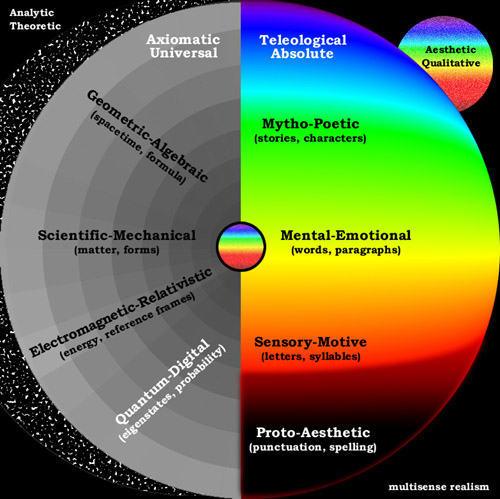
- Multisense Realism: The picture, artist, audience, illusion, Norman Rockwell, and computation are all sensory experiences which make sense in different but sensibly related ways.
Free Will Isn’t a Predictive Statistical Model
Free will is a program guessing what could happen if resources were spent executing code before having to execute it.
I suggest that Free Will is not merely the feeling of predicting effects, but is the power to dictate effects. It gets complicated because when we introspect on our own introspection, our personal awareness unravels into a hall of sub-personal mirrors. When we ask ourselves ‘why did I eat that pizza’, we can trace back a chain of ‘because…I wanted to. Because I was hungry…Because I saw a pizza on TV…’ and we are tempted to conclude that our own involvement was just to passively rubber stamp a course of multiple-choice actions that were already in motion.
If instead, we look at the entire ensemble of our responses to the influences, from TV image, to the body’s hunger, to the preference for pizza, etc as more of a kaleidoscope gestalt of ‘me’, then we can understand will on a personal level rather than a mechanical level. On the sub-personal level, where there is processing of information in the brain and competing drives in the mind, we, as individuals do not exist. This is the mistake of the neuroscientific experiments thus far. They assume a bottom-up production of consciousness from unconscious microphysical processes, rather than seeing a bi-directional relation between many levels of description and multiple kinds of relation between micro and macro, physical and phenomenal.
My big interest is in how intention causes action
I think that intention is already an action, and in a human being that action takes place on the neurochemical level if we look at it from the outside. For the motive effect of the brain to translate into the motor effect of the rest of the body involves the sub-personal imitation of the personal motive, or you could say the diffraction of the personal motive as it is made increasingly impersonal, slower, larger, and more public-facing (mechanical) process.
So the followin…
So the following disjunctive conclusion is inevitable: Either mathematics is incompletable in this sense, that its evident axioms can never be comprised in a finite rule, that is to say, the human mind (even within the realm of pure mathematics) infinitely surpasses the powers of any finite machine, or else there exist absolutely unsolvable diophantine problems of the type specified . . . (Gödel 1995: 310)
Minds, Machines and Gödel, First published in Philosophy, XXXVI, 1961, pp.
The Lucas-Penrose Argument about Gödel’s Theorem, Internet Encyclopedia of Philosophy
To me it’s clear from the above quote that Gödel understands incompleteness as revealing that mathematics is not completable in the sense that it is not enough to contain the reality of human consciousness. I disagree with those who use incompleteness to suggest the opposite position, that incompleteness demonstrates the incompleteness of the powers of human approximation to contain the grandeur of computable truth. Certainly human understanding is limited, but that our understanding of the limitations of arithmetic mechanism is part of what falls outside of that limit.
Proving that we cannot prove ourselves consistent assumes, erroneously, that doubt is not also a form of belief which depends on an expectation of consistency. The mistake that is often made, in the Western mind’s eye, is that since belief in belief is the ultimate bad, then belief in disbelief must be the ultimate good. This bit of Manichean simplicity is exacerbated when the skeptic no longer sees their own skepticism as a form of belief, and takes it for granted that absolute doubt is possible, reasonable, and independent of unscientific bias.
Even the term ‘belief’ is a second order logic which presumes a first order doubt beneath any given feeling, thought, understanding, intuition, etc. We can see that we should question our own authority, but we forget that authority includes the very authority to question itself, and that such an inescapable authority can only be more primitive than either fact or fiction. Before fact can be wrestled from fiction, or fiction can be confabulated from fact, there must be a capacity to discern one from the other, and that capacity cannot be fiction. Descartes, in my view, didn’t go far enough in saying “Je pense donc je suis”, because it doesn’t specify whether I exist in thought, whether thought exists in me, or whether, as I suggest, thought and I are distinctions of sense which are within the primordial pansensitivity that underlies both uni- and -verse.
Instead of seeing the limits of our human perspective as evidence that all privacy is solipsistic and isolated, I suggest that our perspective is imperfect only to the extent that it is human. When we compare human perceptions to the low level common behaviors of measured objects, then there is a lot that we can learn from physics which we could not learn from human introspection alone.
The fallacy is to conflate our human ignorance with the superiority of measurement to sensation and to overlook that the ontology of measurement supervenes on some form of sensation. Once we compare (absolute experiential) apples to (absolute measurable) apples, we find that the latter cannot be more complete than the former. Physics and math are more complete than human experience, but as they are only experiences in which other experiences are reduced and measured to a generic abstraction, they are less complete than experience itself. No map of France actually leads to Paris, no matter how precise the directions are. A map of France can only contain a map of Paris, and a map of Paris can’t be Paris itself, because it is only a pattern built from generic measurements which do not know anything about Paris itself.
Topography of Eigenmorphism Part II
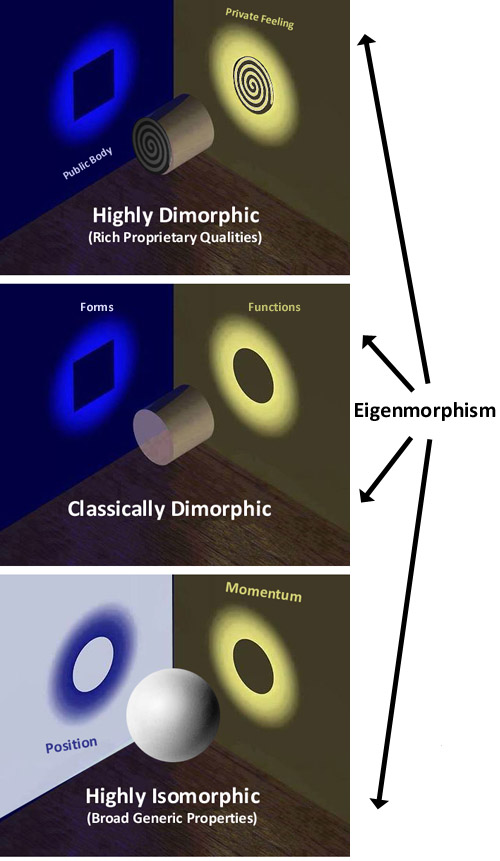
Another visual metaphor:
Eigenmorphism visualization part II
This diagram shows how elemental phenomena (bottom image) appear to us to have very little going on inside. Their public properties are not very body-like and their behaviors are imagined not to be very experiential. Eigenmorphism is the idea that as phenomena progress to richer experiential qualities, their interior and exterior nature expands in opposite directions. In biological organisms, the public and private view not only differ by perspective, but the interior perspective can increasingly elaborate itself (spiral grows) without the exterior perspective (square shadow) revealing any change.
It should be noted that this is a metaphor, not a diagram of matter or quantum. What the yellow wall refers to is actually shapeless, as it is the appreciation of and participation in experiences. The increasing elaboration of the shape stands for increasingly rich and varied modalities of sensitivity. MSR suggests that the three dimensional figure in the center is not real at all, and a better diagram would show the shadow from the blue wall and the shadow from the yellow wall gradually morphing into each other in stages.
The difference between the high and low ends of the eigenmorphic spectrum are not only in the degree to which their interior qualities differ from their exterior properties, or in the kinds of qualities which higher experiences contain, but also in ubiquity vs uniqueness. The generic nature of low level phenomena make them comparatively interchangeable and universal, so that physical and mathematical laws have a universal reach. The highest level phenomena can be esoteric to the point of near-solipsism, with meanings that are so multiplexed and poetic that they apply only to a single moment or perspective.
Biology From The Inside

This gif is one of the set that has been going around, but it reminds me of the concept that I have of biological awareness (as opposed to primordial awareness which is embodied by physics and does not require biology). Whether the inorganic universe is four dimensional (3 + 1 time) or just seems that way from within a two dimensional hologram, it seems likely to me that the experience of biological organisms is best modeled along a fifth axis (aesthetic qualities as more than the sum of their conditional parts).
What I like about the repeating gif, besides the coincidental “5” relating to the fifth dimension, is that it suggests a kind of morphological respiration. Front to back, parts to whole, a seamless, self-metabolizing transformation. As a biological organism, my experience of the outside world is limited to that which can be modeled as objects – that is, through an aesthetically reduced feature set in which a bunch of five dimensional urges and responses are flattened into a four dimensional narrative on multiple levels.
In a previous post, I was looking at how sensitivity might be understood as being ‘key composited’ or perhaps ‘discomposed’ across multiple frames of reference. By this I mean that the apparent distribution of our psychological interface across the tissue of the brain can be compared to a flatland visualization:
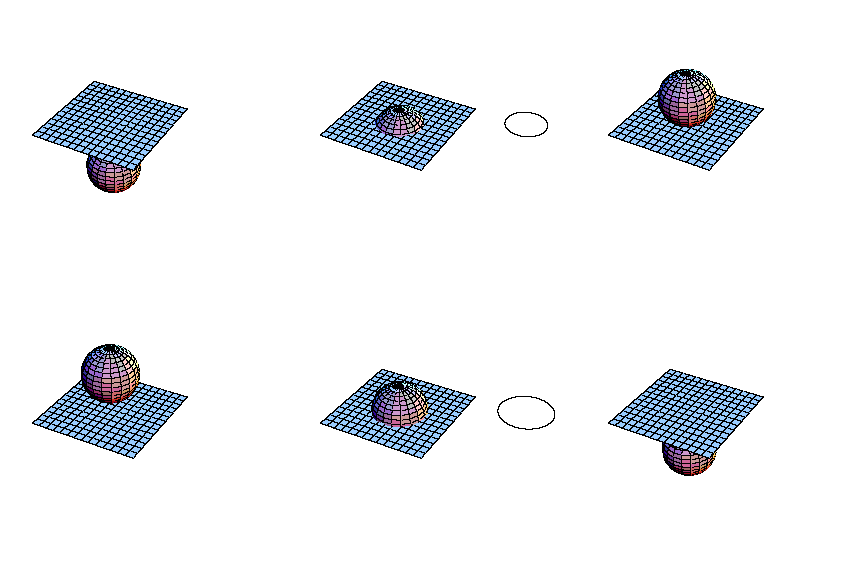
If instead of the sphere, it were a hand passing through the flatland plane, it would appear to the omniscient flatlander that there were five separate circles appearing separately, yet somehow seeming coordinated in their action. The fingers are part of a single hand, but within the constraint of the two dimensional sensitivity, the unity of the hand is discomposed across space in the literal sense, but figuratively some kind of unity can be inferred through the synchronized coincidence of the movement.
Now imagine that instead of another graphable dimension, the fifth dimension is one which is as orthogonal to spacetime as the three dimensions of space are to the one dimension of time. Feeling, like pain and pleasure, are like a coloring, or keying which cuts across multiple layers of seemingly unrelated public events. Not only is feeling a different kind of thing as forms or functions but it is a dimension in which dimension itself is transcended. Feeling is not a model or a measure, but rather it is the primordial context from which all measure is derived and all modeling is made demonstrable.
From the discomposed perspective ‘out there’, we are a coincidence of coincidences. A mysteriously synchronized, dynamic orchestration of hundreds of billions of neurons, organelles, molecules, etc which corresponds to the behavior of an animal’s body.

The feelings which we experience are not located in the tissue of the brain, rather the brain itself is part of the wider landscape of the totality of experience. The brain as a whole is, like our body as a whole and all of the cells and molecules that make it up at any given time, a four dimensional reduction of a transdimensional privacy.
Under Eigenmorphism, the base of each pyramid of perception is made up of the apex of countless low level pyramids of perception. When we look at an fMRI or the brain, we are trying to look at the view from top of our own pyramid through the blind eyes of its own bottom. Feeling is stripped out (not to mention the higher dimensions of meta-feeling/emotion/cognition/intuition) and we are left with a four dimensional mechanical skeleton with no interiority.
Being so impressed with ourselves and what we have accomplished by questioning our naive introspection with science, we naturalize the discomposed view and epiphenomenalize the native, gestalt perspective. All of this makes perfect sense within the flatlanded context of topological physics, where spontaneous appearances and disappearances are assumed only to reflect each other, rather than private transdimensional presentations.
I suspect that the universe which is experienced in the absence of all living organisms is a much different thing that it would appear to us. What we see as a four or two dimensional manifold is only a snapshot of discomposed histories. It seems inanimate to us because we seem so animated to ourselves. The highest awareness of our own interior physics seems to us unreal and crazy…and it is, relative to the inertia of human awareness as a whole. Like the inverted image of our retina however, I think that because our disposition spans so many levels of life and physical experience, we tend to see the mechanical patterns which all of the layers have in common, rather than the coincidence which is also animating them from the top down.
Like the transformer car in the gif, the signature of our presence and intention coincides with the interplay of entropy and significance. The living cell, from our perspective looking through our eyes and a microscope’s lens, looks like a homeostatic emergence. Seemingly conjured, like Brownian motion, from the statistical collisions of countless microphysical conditions.
This is not completely untrue. The mechanical conditions of a cell can be disrupted mechanically. There is bottom up causality. What has not been properly investigated yet is the other perspective. The one responsible for the biological property of healing and global integrity. If we think of the flux between entropy and significance as a carrier tone for biological life, then it might be easier to conceptualize how the universe is as much a dynamic interaction of nested simplicities as it is a mechanical progression from simplicity to complexity. The image of the metabolic transformer stands in contrast to the stillness of the axis of its transformation.
The Keys to Sensitivity


Chroma key compositing typically uses a green or blue screen to key a particular color to be recorded as transparent. In the example above, I have placed green keys on a cosmic (astrophysical + microphysical) background to give an idea of how to conceive of the relation between publicized and privatized experience.
The green of the keys represents the intrinsically singular sensitivity which is ‘behind’ the key silhouettes, just as wearing a green shirt on camera in front of a green screen chroma key will, in a sense, portray your shirt as a ‘receiver’ of the composite image.
This metaphor is closer to what I propose for psychophysical unity – not so much a Receiver theory of consciousness where the brain acts as an antenna for metaphysical signals, or an Emergent theory of consciousness where brain functions accumulate as a representation of signals, but as a Divergent theory in which sensitivity is whole within its private frame of reference, but fragmented across what appears to be space and time from the perspective of a similarly keyed sensitivity*.
Consider that if you are far enough away from a mosaic, it looks like an image, but if you are very close, you see only colored tiles. The difference in spatial ratios on our visual sense influences whether we see the artist private-personal intentions to express the picture’s content, or their public-impersonal technique in placing tiles. If instead of a static mosaic tiles, we think of it as a dynamic television screen of pixels, the metaphor can be extended through narrative time. The pixels do not tell a story, but the image does…over time…to a human audience.
The pixels are not “producing” the story, nor are they “receiving” it, although there is both receiving and projecting of electromagnetic sensations on the public-impersonal level. The complexity of the sequence of patterns on the screen also does not produce the story either, and no amount of complication within the hardware will cause stories to be experienced, just as no degree in the complication of a plot will cause the story itself to become sensitive. Patterns are representations within experience, not experiences themselves. Consciousness is not the green of the key, it is the transparent sensitivity that the green represents. If there is receiving or emerging, it is sensitivity receiving sensitivity, and sensitivity emerging from sensitivity.
*Sensitivity here could mean ‘person’ or ‘observer’ but I want to make it clear that what I propose does not depend on human like experience. I see all forms of observation as participation, and I want to break the automatic association that we have between experience and Homo sapiens personal subjectivity. For pansensitivity to replace energy or information as the primordial identity, it must be understood that all objects, forms, and physical conditions diverge from the totality of sense (not just primitive sub-personal sense, but the whole band of sub-personal, personal, super-personal, and impersonal sense).
If human beings are nothing more than matter, why are you conscious as yourself?
If human beings are nothing more than matter, why are you conscious as yourself?
Quora question:
Philosophy: If human beings are nothing more than matter, why are you conscious as yourself?
The implication of materialism is that we are in essence wet robots, without free will, just chemical reactions. But if this is true and we are conscious, then does it logically follow that all chemical reactions have “consciousness” to some degree? If the human mind is just an extremely advanced computer, then at what point does “consciousness” occur?
We don’t know that chemical reactions are unconscious, but if they were, then it makes sense that the entire universe would also be unconscious. It is very tricky to examine the issue of consciousness and to draw parallels within common experience without unintentionally smuggling in our own expectations from consciousness itself. This is the Petito principii or circular reasoning which derails most fair considerations of consciousness before they even begin in earnest.
Unlike a clock which is made up of gears, or a particular sized pile of hay, the addition of consciousness has no conceivable consequence to the physical function of a body. While we can observe a haystack burst into flames because it has grown too hot, we cannot look at the behavior of a human body see any special difference from the behavior of any other physical body. There is complexity, but complexity alone need not point to anything beyond an adjacency of simple parts and isolated chains of effects.
Just as no degree of complication within a clock’s mechanism would suddenly turn into a Shakespearean sonnet, the assumption of universal substitution is not necessarily appropriate for all phenomena, and for consciousness in particular. To get a color image, for instance, we need to print in colored dots, not black and white. Color TV programs cannot be broadcast over a monochrome display without losing their color.
Unlike chemical or mechanical transformation, the nature of awareness is not implicated in the shuffling of material particles from one place or another. Any natural force can be used to do that. We have no scientific reason to insist that conscious participation and aesthetic appreciation is derived from some simpler functioning of complex systems. To the contrary, ‘complexity’, and ‘system’ can only make sense in the context of a window of perception and attention. Without some teleological intent to see one part as part of a whole, and to compare remembered events with current perceptions, there is no such thing as ‘function’ at all.
There are several important points wrapped up in this question, which I will try to sum up.
1. The failure to consider consciousness metaphysically.
This is the most important and most intractable issue, for three reasons:
- because it is difficult for anyone to try to put their mind outside of mind. It’s annoying, and winds up feeling foolish and disoriented.
- because it is difficult in particular for the very people who need most to get past the difficulty. I have found that most people who are good with logic and scientific reasoning are not necessarily capable of doing what others can. The skillset appears to be neurological, like handedness or gender orientation.
- because those who do have difficulty with thinking this way are often not used to intellectual challenges that escape their grasp, their reaction is so defensive that they react with intolerance. It’s not their fault, but it cannot be cured it seems. Some people cannot see 3-D Magic Eye art. Some cannot program their way out of a paper bag. In this case it is the ability to consider consciousness from a prospective rather than a retrospective view which can prove so inaccessible to so many people, that frothing at the mouth and babbling about unicorns, magic, and the supernatural is considered a reasonable and scientific, skeptical response. Of course, it is none of those things, but it takes a lot of patience and courage to be able to recognize one’s own prejudices, especially when we are used to being the ones telling others about their biases.
2. The taboo against metaphysics, panpsychism, and transrationality
Long after Einstein, Gödel, and Heisenberg shattered the Humpty Dumpty certainties of classical math and physics, we are still trying to piece him back together. Regardless of how much we learn about the strange properties of matter, time, energy, biology, and neurology, there are a huge number of very intelligent people who are convinced that we will only know the truth about the universe when it all looks like a vast deterministic mechanism.
The compulsion to reduce awareness to passive mathematical or physical states is ironic, given that the defense of automaticity is often accompanied by very hands on personal intention. Even when it is pointed out that arguing against free will is futile (since someone without free will could not change their own opinion about it even if they wanted to, let alone someone else’s opinion), the mind of the determined determinist will always find a way of insist upon being in the right, even when they are ultimately sawing of the limb that they are sitting on.
When it comes to anything that suggests the possibility of non-human awareness, many people not only become personally uncomfortable, but they become socially uncomfortable as well. The taboo against unconventional views on science (even when backed by anthropological universality) is so pervasive and xenophobic that it is career suicide for a working scientist to publicly acknowledge them in any but the most condescending tones.
3. The pathetic fallacy
The pathetic fallacy is to take a metaphor in which some inanimate object is given a human quality (“The camera loves you”), and take it literally. While I count myself among those who once saw computation and pattern as being the only ingredient necessary for awareness or life, my understanding now is that no pattern can exist without a capacity for pattern recognition. The ability to receive and make sense of the real world is not a matter of generic relations of disembodied bits of “information”, but is in fact the concrete reality of the cosmos. The universe does not exist for us humans, but it cannot exist as silent, unconscious, intangible physics for billions of years and then suddenly invent the whole of sensation, emotion, intuition, cognition, etc, just for some hominids on this backwater planet. It now strikes me as profoundly anthropocentric to imagine that the entire universe could be devoid of perceptual content until life evolved.
In my view, the universe itself is nothing but a continuum of qualities of consciousness. These qualities, however, relate to experienced contexts. We cannot take the human-ness out of a human and put it into a machine. Biology has mechanisms and performs computation, but if that’s all it was doing then the inside of the brain would look like logic, not like sex and violence and musical theater.
 Multisense Realism
Recent Comments