Archive
If human beings are nothing more than matter, why are you conscious as yourself?
If human beings are nothing more than matter, why are you conscious as yourself?
Quora question:
Philosophy: If human beings are nothing more than matter, why are you conscious as yourself?
The implication of materialism is that we are in essence wet robots, without free will, just chemical reactions. But if this is true and we are conscious, then does it logically follow that all chemical reactions have “consciousness” to some degree? If the human mind is just an extremely advanced computer, then at what point does “consciousness” occur?
We don’t know that chemical reactions are unconscious, but if they were, then it makes sense that the entire universe would also be unconscious. It is very tricky to examine the issue of consciousness and to draw parallels within common experience without unintentionally smuggling in our own expectations from consciousness itself. This is the Petito principii or circular reasoning which derails most fair considerations of consciousness before they even begin in earnest.
Unlike a clock which is made up of gears, or a particular sized pile of hay, the addition of consciousness has no conceivable consequence to the physical function of a body. While we can observe a haystack burst into flames because it has grown too hot, we cannot look at the behavior of a human body see any special difference from the behavior of any other physical body. There is complexity, but complexity alone need not point to anything beyond an adjacency of simple parts and isolated chains of effects.
Just as no degree of complication within a clock’s mechanism would suddenly turn into a Shakespearean sonnet, the assumption of universal substitution is not necessarily appropriate for all phenomena, and for consciousness in particular. To get a color image, for instance, we need to print in colored dots, not black and white. Color TV programs cannot be broadcast over a monochrome display without losing their color.
Unlike chemical or mechanical transformation, the nature of awareness is not implicated in the shuffling of material particles from one place or another. Any natural force can be used to do that. We have no scientific reason to insist that conscious participation and aesthetic appreciation is derived from some simpler functioning of complex systems. To the contrary, ‘complexity’, and ‘system’ can only make sense in the context of a window of perception and attention. Without some teleological intent to see one part as part of a whole, and to compare remembered events with current perceptions, there is no such thing as ‘function’ at all.
There are several important points wrapped up in this question, which I will try to sum up.
1. The failure to consider consciousness metaphysically.
This is the most important and most intractable issue, for three reasons:
- because it is difficult for anyone to try to put their mind outside of mind. It’s annoying, and winds up feeling foolish and disoriented.
- because it is difficult in particular for the very people who need most to get past the difficulty. I have found that most people who are good with logic and scientific reasoning are not necessarily capable of doing what others can. The skillset appears to be neurological, like handedness or gender orientation.
- because those who do have difficulty with thinking this way are often not used to intellectual challenges that escape their grasp, their reaction is so defensive that they react with intolerance. It’s not their fault, but it cannot be cured it seems. Some people cannot see 3-D Magic Eye art. Some cannot program their way out of a paper bag. In this case it is the ability to consider consciousness from a prospective rather than a retrospective view which can prove so inaccessible to so many people, that frothing at the mouth and babbling about unicorns, magic, and the supernatural is considered a reasonable and scientific, skeptical response. Of course, it is none of those things, but it takes a lot of patience and courage to be able to recognize one’s own prejudices, especially when we are used to being the ones telling others about their biases.
2. The taboo against metaphysics, panpsychism, and transrationality
Long after Einstein, Gödel, and Heisenberg shattered the Humpty Dumpty certainties of classical math and physics, we are still trying to piece him back together. Regardless of how much we learn about the strange properties of matter, time, energy, biology, and neurology, there are a huge number of very intelligent people who are convinced that we will only know the truth about the universe when it all looks like a vast deterministic mechanism.
The compulsion to reduce awareness to passive mathematical or physical states is ironic, given that the defense of automaticity is often accompanied by very hands on personal intention. Even when it is pointed out that arguing against free will is futile (since someone without free will could not change their own opinion about it even if they wanted to, let alone someone else’s opinion), the mind of the determined determinist will always find a way of insist upon being in the right, even when they are ultimately sawing of the limb that they are sitting on.
When it comes to anything that suggests the possibility of non-human awareness, many people not only become personally uncomfortable, but they become socially uncomfortable as well. The taboo against unconventional views on science (even when backed by anthropological universality) is so pervasive and xenophobic that it is career suicide for a working scientist to publicly acknowledge them in any but the most condescending tones.
3. The pathetic fallacy
The pathetic fallacy is to take a metaphor in which some inanimate object is given a human quality (“The camera loves you”), and take it literally. While I count myself among those who once saw computation and pattern as being the only ingredient necessary for awareness or life, my understanding now is that no pattern can exist without a capacity for pattern recognition. The ability to receive and make sense of the real world is not a matter of generic relations of disembodied bits of “information”, but is in fact the concrete reality of the cosmos. The universe does not exist for us humans, but it cannot exist as silent, unconscious, intangible physics for billions of years and then suddenly invent the whole of sensation, emotion, intuition, cognition, etc, just for some hominids on this backwater planet. It now strikes me as profoundly anthropocentric to imagine that the entire universe could be devoid of perceptual content until life evolved.
In my view, the universe itself is nothing but a continuum of qualities of consciousness. These qualities, however, relate to experienced contexts. We cannot take the human-ness out of a human and put it into a machine. Biology has mechanisms and performs computation, but if that’s all it was doing then the inside of the brain would look like logic, not like sex and violence and musical theater.
If You See Wittgenstein on the Road… (you know what to do)
Me butting into a language based argument about free will:
> I don’t see anything particularly contentious about Wittgenstein’s claim that the meaning of a word lies in how it is used.
Can something (a sound or a spelling) be used as a word if it has no meaning in the first place though?
>After all, language is just an activity in which humans engage in order to influence (and to be influenced by) the behaviour of other humans.
Not necessarily. I imagine that the origin of language has more to do with imitation of natural sounds and gestures. Onomatopoeia, for example. Clang, crunch, crash… these are not arbitrary signs which derive their meaning from usage alone. C. S. Pierce was on the right track with discerning between symbols (arbitrary signs whose meaning is attached by use alone), icons (signs which are isomorphic to their referent), and index (signs which refer by inevitable association as smoke is an index of fire). Words would not develop out of what they feel like to say and to hear, and the relation of that feeling to what is meant.
>I’m inclined to regard his analysis of language in the same light as I regard Hume’s analysis of the philosophical notion of ‘substance’ (and you will be aware that I side with process over substance) – i.e. there is no essential essence to a word. Any particular word plays a role in a variety of different language games, and those various roles are not related by some kind of underlying essence but by what Wittgenstein referred to as a family resemblance. The only pertinent question becomes that of what role a word can be seen to play in a particular language game (i.e. what behavioural influences it has), and this is an empirical question – i.e. it does not necessarily have any metaphysical connotations.
While Wittgenstein’s view is justifiably influential, I think that it belongs to the perspective of modernism’s transition to postmodernity. As such, it is bound by the tenets of existentialism, in which isolation, rather than totality is assumed. I question the validity of isolation when it comes to subjectivity (what I call private physics) since I think that subjectivity makes more sense as a temporary partition, or diffraction within the totality of experience rather than a product of isolated mechanisms. Just as a prism does not produce the visible spectrum by reinventing it mechanically – colors are instead revealed through the diffraction of white light. Much of what goes on in communication is indeed language games, and I agree that words do not have an isolated essence, but that does not mean that the meaning of words is not rooted in a multiplicity of sensible contexts. The pieces that are used to play the language game are not tokens, they are more like colored lights that change colors when they are put together next to each other. Lights which can be used to infer meaning on many levels simultaneously, because all meaning is multivalent/holographic.
> So if I wish to know the meaning of a word, e.g. ‘choice’, I have to LOOK at how the word is USED rather than THINK about what kind of metaphysical scheme might lie behind the word (Philosophical Investigations section 66 and again in section 340).
That’s a good method for learning about some aspects of words, but not others. In some case, as in onomatopoeia, that is the worst way of learning anything about it and you will wind up thinking that Pow! is some kind of commentary about humorous violence and has nothing to do with the *sound* of bodies colliding and it’s emotional impact. It’s like the anthropologist who gets the completely wrong idea about what people are doing because they are reverse engineering what they observe back to other ethnographers interpretations rather than to the people’s experienced history together.
> So, for instance, when Jane asks me “How should I choose my next car?” I understand her perfectly well to be asking about the criteria she should be employing in making her decision. Similarly with the word ‘free’ – I understand perfectly well what it means for a convict to be set free. And so to the term ‘free will’; As Hume pointed out, there is a perfectly sensible way to use the term – i.e. when I say “I did it of my own free will”, all I mean is that I was not coerced into doing it, and I’m conferring no metaphysical significance upon my actions (the compatibilist notion of free will in contrast to the metaphysical notion of free will).
Why would that phrase ‘free will’ be used at all though? Why not just say “I was not coerced” or nothing at all, since without metaphysical (or private physical) free will, there would be no important difference between being coerced by causes within your body or beyond your body. Under determinism, there is no such thing as not being coerced.
> The word ‘will’ is again used in a variety of language games, and the family resemblance would appear to imply something about the future (e.g. “I will get that paper finished today”). When used in the free will language game, it shares a significant overlap with the choice language game. But when we lift a word out of its common speech uses and confer metaphysical connotations upon it, Wittgenstein tells us that language has ceased doing useful work (as he puts it in the PI section 38, “philosophical problems arise when language goes on holiday”).
We should not presume that work is useful without first assuming free will. Useful, like will, is a quality of attention, an aesthetic experience of participation which may be far more important than all of the work in the universe put together. It is not will that must find a useful function, it is function that acquires use only through the feeling of will.
> And, of course, the word ‘meaning’ is itself employed in a variety of different language games – I can say that I had a “meaningful experience” without coming into conflict with Wittgenstein’s claim that the meaning of a word lies in its use.
Use is only one part of meaning. Wittgenstein was looking at a toy model of language that ties only to verbal intellect itself, not to the sensory-motor foundations of pre-communicated experience. It was a brilliant abstraction, important for understanding a lot about language, but ultimately I think that it takes the wrong things too seriously. All that is important about awareness and language would, under the Private Language argument, be passed over in silence.
> Regarding Wheeler’s delayed choice experiment, the experimenter clearly has a choice as to whether she will deploy a detector that ignores the paths by which the light reaches it, or a detector that takes the paths into account. In Wheeler’s scenario that choice is delayed until the light has already passed through (one or both of) the slits. I really can’t take issue with the word ‘choice’ as it is being used here.
I think that QM also will eventually be explained by dropping the assumption of isolation. Light is visual sense. It is how matter sees and looks. Different levels of description present themselves differently from different perspectives, so that if you put matter in the tiniest box you can get, you give it no choice but to reflect back the nature of the limitation of that specific measurement, and measurement in general.
P, PP, PIP, MSR Disambiguation
Pansensitivity (P) proposes that sensation is a universal property.
Primordial Pansensitivity (PP) proposes that because sensation is primitive, mechanism is derived from insensitivity. Whether it is mechanism that assumes form without sensibility (materialism) or function without sensation (computationalism), they both can only view feeling as a black box/epiphenomenon/illusion.
Under PP, both materialism and computationalism make sense as partial negative images of P, so that PP is the only continuum or capacity needed to explain feeling and doing (sense-motive), objective forms and functions (mass-energy), and informative positions and dispositions (space-time).
PP says that the appearance of forms and functions are, from an absolute perspective, sensory-motive experiences which have been alienated through time and across space.
Primordial Identity Pansensitivity (PIP) adds to the Ouroboran Monism of PP, (sense twisted within itself = private experience vs public bodies) by suggesting that PP is not only irreducible, but it is irreducibility itself.
PIP suggests that distance is a kind of insensitivity, so that all other primitive possibilities which are grounded in mechanism, such as information or energy, are reductionist in a way which oversignifies the distanced perspective, while anthropomorphic primitives such as love or divinity are holistic in a way which oversignifies the local perspective. Local and distant are assumed to be Cartesian opposites, but PIP maps locality and distance as the same in terms of being two opposite branches of insensitivity. Both the holistic and reductionist views ignore the production of distance which they both rely on for their perspective, both take perspective itself, perception, and relativity for granted.
MSR (Multisense Realism) tries to rehabilitate reductionism and holism by understanding them as bifocal strategies which arise naturally, each appropriate for a particular context of perceived distance. Both are near-sighted and far-sighted in opposite ways, as the subject seeks to first project anthropomorphism outward onto the world and then, following a crisis of disillusionment, seeks the opposite – to project exterior mechanism into the self. MSR invites us to step outside of the bifocal antagonism and into a balanced appreciation of the totality.
Wittgenstein in Wonderland, Einstein under Glass
If I understand the idea correctly – that is, if there is enough of the idea which is not private to Ludwig Wittgenstein that it can be understood by anyone in general or myself in particular, then I think that he may have mistaken the concrete nature of experienced privacy for an abstract concept of isolation. From Philosophical Investigations:
The words of this language are to refer to what can be known only to the speaker; to his immediate, private, sensations. So another cannot understand the language. – http://plato.stanford.edu/entries/private-language/
To begin with, craniopagus (brain conjoined) twins, do actually share sensations that we would consider private.
The results of the test did not surprise the family, who had long suspected that even when one girl’s vision was angled away from the television, she was laughing at the images flashing in front of her sister’s eyes. The sensory exchange, they believe, extends to the girls’ taste buds: Krista likes ketchup, and Tatiana does not, something the family discovered when Tatiana tried to scrape the condiment off her own tongue, even when she was not eating it.
There should be no reason that it would not be technologically feasible to eventually export the connectivity which craniopagus twins experience through some kind of neural implant or neuroelectric multiplier. There are already computers that can be controlled directly through the brain.
Brain-computer interfaces that monitor brainwaves through EEG have already made their way to the market. NeuroSky’s headset uses EEG readings as well as electromyography to pick up signals about a person’s level of concentration to control toys and games (see “Next-Generation Toys Read Brain Waves, May Help Kids Focus”). Emotiv Systems sells a headset that reads EEG and facial expression to enhance the experience of gaming (see “Mind-Reading Game Controller”).
All that would be required in principle would be to reverse the technology to make them run in the receiving direction (computer>brain) and then imitate the kinds of neural connections which brain conjoined twins have that allow them to share sensations. The neural connections themselves would not be aware of anything on a human level, so it would not need to be public in the sense that sensations would be available without the benefit of a living human brain, only that the awareness could, to some extent, incite a version of itself in an experientially merged environment.
Because of the success and precision of science has extended our knowledge so far beyond our native instruments, sometimes contradicting them successfully, we tend to believe that the view that diagnostic technology provides is superior to, or serves as a replacement for our own awareness. While it is true that our own experience cannot reveal the same kinds of things that an fMRI or EEG can, I see that as a small detail compared to the wealth of value that our own awareness provides about the brain, the body, and the worlds we live in. Natural awareness is the ultimate diagnostic technology. Even though we can certainly benefit from a view outside of our own, there’s really no good reason to assume that what we feel, think, and experience isn’t a deeper level of insight into the nature of biochemical physics than we could possibly gain otherwise. We are evidence that physics does something besides collide particles in a void. Our experience is richer, smarter, and more empirically factual than what an instrument outside of our body can generate on its own. The problem is that our experience is so rich and so convoluted with private, proprietary knots, that we can’t share very much of it. We, and the universe, are made of private language. It is the public reduction of privacy which is temporary and localized…it’s just localized as a lowest common denominator.
While It is true that at this stage in our technical development, subjective experience can only be reported in a way which is limited by local social skills, there is no need to invoke a permanent ban on the future of communication and trans-private experience. Instead of trying to report on a subjective experience, it could be possible to share that experience through a neurological interface – or at least to exchange some empathic connection that would go farther than public communication.
If I had some psychedelic experience which allowed me to see a new primary color, I can’t communicate that publicly. If I can just put on a device that allows our brains to connect, then someone else might be able to share the memory of what that looked like.
It seems to me that Wittgenstein’s private language argument (sacrosanct as it seems to be among the philosophically inclined) assumes privacy as identical to isolation, rather than the primordial identity pansensitivty which I think it could be. If privacy is accomplished as I suggest, by the spatiotemporal ‘masking’ of eternity, than any experience that can be had is not a nonsense language to be ‘passed over in silence’, but rather a personally articulated fragment of the Totality. Language is only communication – intellectual measurement for sharing public-facing expressions. What we share privately is transmeasurable and inherently permeable to the Totality beneath the threshold of intellect.
Said another way, everything that we can experience is already shared by billions of neurons. Adding someone else’s neurons to that group should indeed be only a matter of building a synchronization technology. If, for instance, brain conjoined twins have some experience that nobody else has (like being the first brain conjoined twins to survive to age 40 or something), then they already share that experience, so it would no longer be a ‘private language’. The true future of AI may not be in simulating awareness as information, but in using information to share awareness. Certainly the success of social networking and MMPGs has shown us that what we really want out of computers is not for them to be us, but for us to be with each other in worlds we create.
I propose that rather than beginning from the position of awareness being a simulation to represent a reality that is senseless and unconscious, we should try assuming that awareness itself is the undoubtable absolute. I would guess that each kind of awareness already understands itself far better than we understand math or physics, it is only the vastness of human experience which prevents that understanding to be shared on all levels of itself, all of the time.
The way to understand consciousness would not be to reduce it to a public language of physics and math, since our understanding of our public experience is itself robotic and approximated by multiple filters of measurement. To get at the nature of qualia and quanta requires stripping down the whole of nature to Absolute fundamentals – beyond language and beyond measurement. We must question sense itself, and we must rehabilitate our worldview so that we ourselves can live inside of it. We should seek the transmeasurable nature of ourselves, not just the cells of our brain or the behavioral games that we have evolved as one particular species in the world. The toy model of consciousness provided by logical positivism and structural realism is, in my opinion, a good start, but in the wrong direction – a necessary detour which is uniquely (privately?) appropriate to a particular phase of modernism. To progress beyond that I think requires making the greatest cosmological 180 since Galileo. Einstein had it right, but he did not generalize relativity far enough. His view was so advanced in the spatialization of time and light that he reduced awareness to a one dimensional vector. What I think he missed, is that if we begin with sensitivity, then light becomes a capacity with which to modulate insensitivity – which is exactly what we see when we share light across more than one slit – a modulation of masked sensitivity shared by matter independently of spacetime.
Diogenes Revenge: Cynicism, Semiotics, and the Evaporating Standard
Diogenes was called Kynos — Greek for dog — for his lifestyle and contrariness. It was from this word for dog that we get the word Cynic.
Diogenes is also said to have worked minting coins with his father until he was 60, but was then exiled for debasing the coinage. – source
In comparing the semiotics of CS Pierce and Jean Baudrillard, two related themes emerge concerning the nature of signs. Pierce famously used trichotomy arrangements to describe the relations, while Baudrillard talked about four stages of simulation, each more removed from authenticity. In Pierce’s formulation, Index, Icon, and Symbol work as separate strategies for encoding meaning. An index is a direct consequence or indication of some reality. An icon is a likeness of some reality. A symbol is a code which has its meaning assigned intentionally.
Baudrillard saw sign as a succession of adulterations – first in which an original reality is copied, then when the copy masks the original in some way, third, as a denatured copy in which the debasement has been masked, and fourth as a pure simulacra; a copy with no original, composed only of signs reflecting each other.
Whether we use three categories or four stages, or some other number of partitions along a continuum, an overall pattern can be arranged which suggests a logarithmic evaporation, an evolution from the authentic and local to the generic and universal. Korzybski’s map and territory distinction fits in here too, as human efforts to automate nature result in maps, maps of maps, and maps of all possible mapping.
The history of human timekeeping reveals the earthy roots of time as a social construct based on physical norms. Timekeeping was, from the beginning linked with government and control of resources.
According to Callisthenes, the Persians were using water clocks in 328 BC to ensure a just and exact distribution of water from qanats to their shareholders for agricultural irrigation. The use of water clocks in Iran, especially in Zeebad, dates back to 500BC. Later they were also used to determine the exact holy days of pre-Islamic religions, such as the Nowruz, Chelah, or Yalda- – the shortest, longest, and equal-length days and nights of the years. The water clocks used in Iran were one of the most practical ancient tools for timing the yearly calendar. source
Anything which burns or flows at a steady rate can be used as a clock. Oil lamps, candles, can incense have been used as clocks, as well as the more familiar sand hourglass, shadow clocks, and clepsydrae (water clocks). During the day, a simple stick in the ground can provide an index of the sun’s position. These kinds of clocks, in which the nature of physics is accessed directly would correspond to Baudrillard’s first level of simulation – they are faithful copies of the sun’s movement, or of the depletion of some material condition.
Staying within this same agricultural era of civilization, we can understand the birth of currency in the same way. Trading of everyday commodities could be indexed with concentrated physical commodities like livestock, and also other objects like shells which had intrinsic value for being attractive and uncommon, as well as secondary value for being durable and portable objects to trade. In the same way that coins came to replace shells, mechanical clocks and watches came to replace physical index clocks. The notions of time and money, while different in that time refers to a commodity beyond the scope of human control and money referring specifically to human control, both serve as regulatory standards for civilization, as well as equivalents for each other in many instances (‘man hours’, productivity).
In the next phase of simulation, coins combined the intrinsic and secondary values of things like shells with a mint mark to ensure transactional viability on the token. The icon of money, as Diogenes discovered, can be extended much further than the index, as anything that bears the official seal will be taken as money, regardless of the actual metal content of the coin. The idea of bank notes was as a promise to pay the bearer a sum of coins. In the world of time measurement, the production of clocks, clocktowers, and watches spread the clock face icon around the world, each one synchronized to a local, and eventually a coordinated universal time. Industrial workers were divided into shifts, with each crew punching a timeclock to verify their hours at work and breaks. While the nature of time makes counterfeiting a different kind of prospect, the practice of having others clock out for you or having a cab driver take the long way around to run the meter longer are ways that the iconic nature of the mechanical clock can be exploited. Being one step removed from the physical reality, iconic technologies provide an early opportunity for ‘hacking’.
| physical territory > index | local map > icon | symbol > universal map |
| water clock, sand clock | sundial/clock face | digital timecode |
| trade > shells | coins > check > paper | plastic > digital > virtual |
| production > organization | bonds > stock | futures > derivatives |
| real estate | mortgage, rent | speculation > derivatives |
| genuine aesthetic | imitation synthetic | artificial emulation |
| non-verbal communication | language | data |
The last three decades have been marked by the rise of the digital economy. Paper money and coins have largely been replaced by plastic cards connected to electronic accounts, which have in turn entered the final stage of simulacra – a pure digital encoding. The promissory note iconography and the physical indexicality of wealth have been stripped away, leaving behind a residue of immediate abstraction. The transaction is not a promise, it is instantaneous. It is not wealth, it is only a license to obtain wealth from the coordinated universal system.
Time has entered its symbolic phase as well. The first exposure to computers that consumers had in the 1970s was in the form of digital watches and calculators. Time and money. First LED, and then LCD displays became available, both in expensive and inexpensive versions. For a whole generation of kids, their first electronic devices were digital calculators and watches. There had been digital clocks before, based on turning wheels or flipping tiles, but the difference here was that the electronic numbers did not look like regular numbers. Nobody had ever seen numbers rendered as these kind of generic combinatorial figures before. Every kid quickly learned how to spell out words by turning the numbers upside down (you couldn’t make much.. 710 77345 spells ShELL OIL)…sort of like emoticons.
Beneath the surface however, something had changed. The digital readout was not even real numbers, they were icons of numbers, and icons which exposed the mechanics of their iconography. Each number was only a combinatorial pattern of binary segments – a specific fraction of the full 8.8.8.8.8.8.8.8. pattern. You could even see the faint outlines of the complete pattern of 8’s if you looked closely, both in LED and LCD. The semiotic process had moved one step closer to the technological and away from the consumer. Making sense of these patterns as numbers was now part of your job, and the language of Arabic numerals became data to be processed.
Since that time, the digital revolution has shaped the making and breaking of world markets. Each financial bubble spread out, Diogenes style, through the banking and finance industry behind a tide of abstraction. Ultra-fast trading which leverages meaningless shifts in transaction patterns has become the new standard, replacing traditional market analysis. From leveraged buyouts in the 1980s to junk bonds, tech IPOs, Credit Default Swaps, and the rest, the world economy is no longer an index or icon of wealth, it is a symbol which refers only to itself.
The advent of 3D printing marks the opposite trend. Where conventional computer printing to allow consumers to generate their own 2D icons from machines running on symbols, the new wave of micro-fabrication technology extend that beyond the icon and the index level. Parts, devices, food, even living tissue can be extruded from symbol directly into material reality. Perhaps this is a fifth level of simulation – the copy with no original which replaces the need for the original…a trophy in Diogenes’ honor.
Charting It All
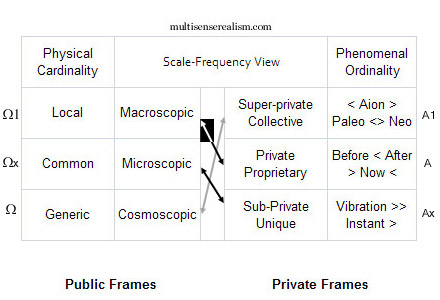
In an effort to provide a more straightforward view of pansensitivity and eigenmorphism, the chart above organizes all phenomena in the cosmos by scale of publicly extended body length and frequency range of privately experienced times. Going left to right (Metaphorically, Occident to Orient), the first and second column denote the public, physical scopes (perceptual inertial frames) according to cardinality and size. The bottom left frames (Ω) correspond to the outermost types of physical phenomena, i.e. absolutely gigantic or absolutely infinitessimal. This reflects the aesthetic intuition by which the atom comes out having more in common morphologically and dynamically with a solar system than a tree or coral reef, despite being at opposite ends of the scale of our awareness. The Ω range of frames is the envelope of physicality, where physical and mathematical ‘laws’ meet the most universally public perceptions.
Our awareness is extended technologically, which broadens our view of the public universe, however, since the awareness being extended is primarily visual and somatic (‘tangible’-kinesthetic rather than tactile), the telescoping of our sensory awareness is also narrowing our depth of field within the private (phenomenological) side of physics. My conjecture is that because of the nature of perceptual relativity, the more we focus on the the outer contexts, not only do we not see the private experience in the universe on these distant scales, but also our entire worldview will, by default, adjust to recontextualize the local experiences of the self. The fallacy of the instrument (if you have only a hammer, everything looks like a nail) might arise through this kind of empathetic feedback loop. This is likely to extend into so-called ‘supernatural’ phenomenon, which explains the increases in magnitude, frequency, and connectedness of coincidence experienced by subjects through altered states of consciousness. The higher up on the right hand column, the more large patterns of synchronicity, with deeper resonance (A1) are available for direct personal experience (A).
By contrast, the lower down on the Oriental, right hand scale we go, the more the needle of synchronicity tips toward mere statistical coincidence and the more top-down intuition, imagination, and eidetic narrative are collapsed into the stepped logic of bottom-up causality. The numbering schema is confusing, but intentional. The use of A in the middle row on the right side denotes that sense is always anchored centripetally. Perceptual capacity radiates as a range, often a literal circular, conic, or spherical perimeter, of awareness, but also sensitivity radiates figuratively as nested channels or layered modalities of sense.
The use of A1 and Ax above and below A respectively, implies the hierarchical pull from the superlative top, down to the personal, and the plummet from the personal middle down to the bottom. Ax would be the opposite of A1; insignificant, low status, shame and indignity. Looking at the Left side of the chart, the numbering scheme is even more confusing, but it is to emphasize the multiple levels of opposition that characterize the public and private aspects of physics-sense. The A1 range is the most universal private experience, (the ultimate being experience itself), which is meta-phorical. Experiences are associated to each other through metaphor, with the most tightly isomorphic metaphor being imitation or repetition. The higher up on the A column we go, the more latitude there is in recognizing common associations. Pareidolia and Apophenia are examples of having the aperture disproportionately dilated to the super-private, which becomes unsupportable within human society (delusions of grandeur, ideas of reference, mania, etc.)
Back to the Omega column on the left, the Ω1 is a different kind of magnificence than the private rapture of the Absolute. The public side is not centripetally oriented, but linear and circular. There is no radiant center, only jumps and slides. The Alpha/Aleph side in the East fills the gaps, it infers and elides, it puts two and two together. The Ω1 is mutation and fluke. Unintentional singularity. Its uniqueness is simply an inevitable accumulation of imperfectly repeating behaviors, so that the wonder of biology through evolution can be examined correctly in Darwinian terms. These are terms of the exteriors, however. Regardless of how complex and convoluted the patterns, they are patterns of insensitivity rather than awareness, automaticity rather than authenticity. This is individuality from the outside in – stochastic, social, generational rather than individual.
The cells of the bottom row have as much in common as the cells of the top row are polar opposites, but they are also skewed (this is what the arrows in the center are supposed to mean). This is what I call eigenmorphism. A to Ω1 has a half-black, half-white arrow, showing the relation between the human mind and its homid body. This is a maximal polarization, or so it seems to us. The black arrow from the Microscopic Ωx to the Sub-private Ax have in common the x, connoting the strong relation between mechanical appearances on the molecular level and the recursiveness of awareness in its least signifying, quantitative form. This is contrary to the idea that vibrations or energy are what we are, rather vibrate is what the various parts of our sub-private experience do – jiggling or wagging from position to disposition, from incident to co-incident.
The grey arrow from A1 to Ω points to what I call the profound edge of the continuum. This would be the level at which the Totality is an unbroken, Ouroboran monad. This is what happens ‘behind our backs’, hypnotically through evanescence. It is significance reclaimed and re-membered after having been diffracted into the entropy of spacetime. By contrast, the black and white split arrow corresponds to the ‘pedestrian fold’ – the level of the monad which appears most polarized and least evanescent – the terrestrial aesthetic of ‘ordinary’ experience.
In the top chart I have limited cardinality to the public side and ordinality to the private side to show the relation between morphic scale and phoric frequency. Privacy runs first to last (ordinal), publicity places astronomically numerous to few (cardinal).
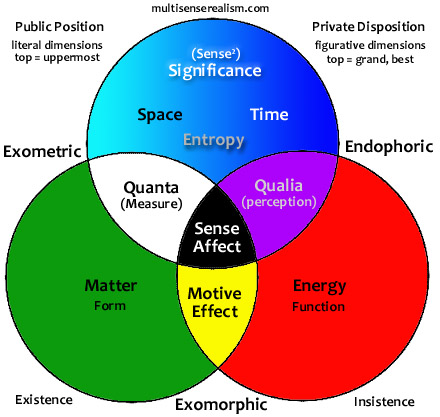
Compare with Frame Set View:



Recent Comments