I have noticed that people most often compare Multisense Realism to Leibniz’ Monadology. While I had not read much Leibniz before, two people have suggested that I do so in the same week, one of them taking the time to send me an annotated pdf. Since its relatively short as philosophical source materials go, I decided to reproduce it here with my own notes.
1. My topic here will be the monad, which is just a simple
substance. By calling it ‘simple’ I mean that it has no parts,
though it can be a part of something composite.
It is a bit confusing right off the bat. To say that a something is a substance in a colloquial sense implies already that is a ‘thing’ distinct from other things. What I am after is a much deeper simplicity. To me a true monad could only be a boundaryless unity. An everythingness-nothingness ‘carrier-tone’ of experiential readiness from which all experiences are diffracted (divided from within, as ‘chips off the old block’, so to speak). This is what I mean by the Big Diffraction. The monad itself has no parts, but its only nature is the possibility that it imparts. My version of monad does not ‘exist’ as a simple substance but rather it insists as the simplicity and essential wholeness of all experiences. It is sense.
2. There must be simple substances, because there are composites.
A composite thing is just a collection of simple ones
that happen to have come together.
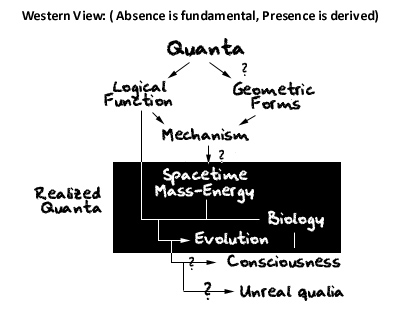
This assumes a naive realism arrow of time. The true monad precedes causality and time, so that it is as much the end result as the beginning condition. Things grow and divide, fuse and multiply regardless of their simplicity or complexity. This is important because I think it is one of the intellectual turns where the materialism of science is founded – in microcosmic simple causes rather than an interplay of causes and effects on all levels of the cosmos simultaneously.
3. Something that has no parts can’t be extended, can’t have
a shape, and can’t be split up. So monads are the true atoms
of Nature—the elements out of which everything is made.
Why can’t it be split up? If the monad is truly boundaryless, there is nothing to stop it from ‘becoming’ something else. If you are a boundaryless monad, the only way to become something else is to split yourself into parts. To invent boundaries. Of course, since these boundaries are invented, the underlying monad must precede them.
4. We don’t have to fear that a monad might fall to pieces;
there is no conceivable way it could •go out of existence
naturally.
Yes, the monad would have nowhere to disappear to. Any pieces it ‘falls into’ are themselves unified in the plurality of solitude that the monad becomes when it divides/multiplies itself within itself. The monad is both the solitude, the solvent, and the tension of the apartness relation between an ‘I’ and an ‘it’
5. For the same reason, there is no way for a simple substance
to •come into existence naturally, for that would
involve its being put together, assembled, composed, and a
simple substance couldn’t be formed in that way because it
has no parts.
6. So we can say that the only way for monads to begin
or end—to come into existence or go out of existence—is
•instantaneously, being created or annihilated all at once.
Composite things, in contrast with that, can begin or end
•gradually, through the assembling or scattering of their
parts.
He is forgetting that the primacy of monad is what allows existence itself to occur. Any kind of existence supervenes upon this underlying sense of ontological fertility-fulfillment. Things come into or out of existence relative to the experience of an ‘I’ apartment within the monad. To the monad, nothing is lost or gained, only split into smaller and smaller fibers, tied into larger and larger knots of knots (metaphorically speaking – they are not literal strings, but figurative strings of sense-events making sense of each other in different ways). The key difference between Leibniz monad and my TSM (Totality-Singularity Monad) is that I assume that if there is only one thing, it can only be ‘everythingness’. There must be nothing that the monad is not, and it must resist all possible definitions and other than its own. In working with the TSM intellectually, we must proceed with finality from the outset – we must allow it first to escape all concepts and expectations at all costs. It must precede even sanity and causality, matter, entropy, etc. It is the base of bases…baseness itself.
7. It doesn’t make sense to suppose that a monad might
be altered or re-arranged internally by any other created
thing. Within a monad there’s nothing to re-arrange, and
there is no conceivable internal motion in it that could be
started, steered, sped up, or slowed down,
Speed is a sense relation. No sense = no speed and no time. The division/multiplication of the monad is what modulates different rhythms and scales of experience into motion-like temporal relations. Like an old fashioned (Freemason’s) compass, the span between the two points on paper hinges on the moving joint between them. It is there, at the joint, that we find the monad – dividing into ratios what is external to itself but extended through its projected ‘legs’.
as can happen in
a composite thing that has parts that can change in relation
to one another. ….[The passage from here to * is not by Leibniz. It
makes explicit what was presumably at work in his mind
when he made his remarkable jump.] That rules out every
sort of influence that one might think a created thing might
have on something else. (I stress ‘created’ because of course
I don’t rule out God’s affecting a monad.)
I do rule out God affecting a monad. The TSM is God – or that’s one name for it. I don’t like that name because of the implication that it is an anthropomorphic entity and because of all of the religious baggage, but if you have the TSM, you don’t need any other God.
Some philosophers
have held that one thing can affect another by sending an
‘accident’ across to it, understanding an accident to be an
instance of a property as distinct from the thing that has the
property. According to these philosophers, in addition to
the •universal property heat and the •particular thing this
poker there is a •particular property, an instance, an accident,
namely the heat of this poker; and they hold that when
the poker is plunged into cold water which then becomes
warmer, the poker sends an accident—some of its particular
heat—across to the water. Now, you might think that
although a created thing can’t cause re-arrangements in a
simple substance it might be able to affect it in a different
way by sending an accident across to it. And because you
might think this I should add that *….monads have no windows
through which anything could come in or go out! And
·anyway, quite apart from the imperviousness of monads to
them, these supposed migrating accidents are philosophical
rubbish·: accidents can’t detach themselves and stroll about
outside of substances!. . . . So neither substance nor accident
can come into a monad from outside.
8. Monads, ·although they have no parts·, must have some
qualities.
Wouldn’t qualities be the parts of monads? Why not? The visible spectrum is like a monad (it may be the TSM itself expressed visually) When squeezed together, it’s colorful qualities are cancelled out and augmented as intensity of white. This diffraction-condensation of qualities is the monad and the monad is the experience of the relation of those qualities. This is what Einstein neglected – that light is also color and color is light – without any speed. Our experience of light exists within a qualitative inertial frame of visual perception; it is not a temporal experience, it is a personal orientation between subject and object relation. It is the joint end of the compass as well as the physical relativity between the two extended compass points on paper. Quality does not represent this condensation of objective extension into subjective experience – it presents it. Experience consists of qualia in its entirety.
There are two reasons why this must be so. (1)
If they didn’t have qualities they wouldn’t be real things at
all. (2) If they didn’t differ from one another in their qualities,
there would be no detectable changes in the world ·of
composite things·. Here is why. [Leibniz starts the next sentence
‘If monads had no qualities,’ but this is obviously a slip.] If monads
all had the same qualities, they would be indistinguishable
from one another (given that they don’t differ in any quantitative
way, e.g. in size). That would make all composite
things ·such as portions of matter· indistinguishable from
one another also, because whatever is the case about a composite
thing has to come from its simple ingredients. ·Even
if every portion of matter were exactly like every other, there
might still be variety in the material world through differences
in patterns of distribution of portions of matter in
empty space. I think there is no empty space—the extended
world is entirely full, a plenum·. So, assuming a plenum and
no qualitative variety, any moving around of matter would
only result in each place containing something exactly like
what it had contained previously, so that one state of things
would be indistinguishable from another.
I agree with the idea of the plenum and further suggest that we go further to say that spacetime is relations within the plenum and therefore not literally things, but relations through which concrete experiences are solved, dissolved, and resolved. The plenum therefore is pure sense when experienced directly, or, as experienced indirectly from the outside, matter. We are the plenum as it has evolved, revolved, and involved us teleologically (intentionally) and teleonomically (by accident).
9. ·That shows that some monads must be qualitatively unlike
some others; but now I go further·. Indeed, every monad
must be qualitatively unlike every other. That is because in
Nature no two things are perfectly alike; between any two
things a difference can be found that is internal—i.e. based
on what each is like in its own nature ·rather than merely on
how they relate to other things, e.g. where they are in space·.
10. I take it for granted that every created thing can change,
and thus that created monads can change. I hold in fact
that every monad changes continually.
Changes continually at what rate? Compared to what? It is only through the nesting of monadic recapitulations within the TSM that anything like change or rate can be conceived. The nesting isn’t a change, it is the sense that underlies change itself…identity, coherence, memory of a pre-change state and the capacity to compare and contrast intuitively against the post-change state.
11. From what I said in 7 it follows that natural changes in
a monad—·ones that don’t come from divine intervention·—
come from an internal force, since no external causes could
ever influence its interior.
Why not? I think this is an oversight by Leibniz. If the monad can be, why can’t it be influenced by other monads being as well? What is stopping it if one part of the plenum is really not primitively separated from any other part? On the TSM level at least, all the monads are really the same unity.
12. But in addition to this ·general· force for change ·that is
the same in all monads·,
There can’t be a general force for change that is the same in all monads unless the force for change is what monads are entirely (since he says that monads have no parts). What is change but an apartness derived from before and after causality? A force-for-change then, implies an intention to drive apart a before and after condition yet retain the memory of the before and appreciate the difference…hence: sense. The monad is that force+field+action+expectation, doing-being-sensing-sensemaking, isness-aboutness.
there must be the detailed nature of
the ·individual· changing simple substance, this being what
makes it belong to one species rather than another.
Think of it like a subnet. As the TSM multiplies itself, the schema of elaboration grows to accommodate new classes. The schema is only the form that the content providers use to organize the traffic, it does not generate or experience the content. By building out more diffraction (think fractal), the broad generality of the TSM can manifest its reflection in relentless granularity of form. An incoherence of coherence to complement precisely the coherence of pre-coherence that it its source.
13. This detailed nature must bring a •multiplicity within
the •unity of the simple substance. ·The latter’s detailed
nature is a ‘multiplicity’ in the sense that it has many components
that don’t stand or fall together·. That is because every
natural change happens by degrees, gradually, meaning that
something changes while something else stays the same.
Yes!! This is what it is all about. Something changes while something else stays the same. Except I reconcile this with the TSM by saying that everything changes in every way except one, and the monad stays the same in every way except one (its dream/desire of change…mood, tone).
So
although there are no •parts in a simple substance, there
must be a plurality of •states and of relationships.
14. The passing state that incorporates and represents a
multitude within a unity—i.e. within the simple substance—
is nothing but what we call •perception. This must be carefully
distinguished from •awareness or consciousness, as
will become clear in what follows. [‘Awareness’ here translates
aperception. French had no noun for that job (nor did English), so Leibniz
coined the aperception on the basis of the verb phrase s’apercevoir de,
which meant and still means ‘to be aware of’.] In that the Cartesians
failed badly, entirely discounting perceptions whose owners
were not aware of them. That made them think that the only
monads are minds, which led them to deny that animals have
souls ·because those would be simple substances below the
level of minds· . . . . Like the uneducated man in the street
they confused a long stupor with death, ·whereas really a
long period of unconsciousness is different from death· in
the strict sense. This led them further into the Aristotelians’
wrong belief in souls that are entirely separated ·from any
body·, as well as confirming misguided minds in the belief
that souls are mortal.
Speculating about the afterlife is like speculating about a color that nobody has seen. Our reasoning can never fill in the gap between our understanding of what might happen and the quality of the experience of what will happen.
15. The action of the internal force that brings about
change—brings the monad from one perception to another—
can be called •appetition. Appetite cannot always get the
whole way to the perception towards which it is tending, but
it always gets some of the way, and reaches new perceptions—
·that is, new temporary states of the monad·.
16. A simple substance that incorporates a multiplicity—
that’s something we experience in ourselves. ·We are simple
substances·, and we find that every perception we can be
aware of—right down to the least of them—involves variety
in its object; ·and a perception representing variety in the
object that it is of must itself be variegated in some way·.
Thus everyone who accepts that the soul is a simple substance
should accept this multiplicity in the monad, and
Bayle oughtn’t to have found any difficulty in it, as he did in
the article ‘Rorarius’ in his Dictionary.
17. It has to be acknowledged that •perception can’t be
explained by mechanical principles,
Yes! This must be one reason why people think I have been influenced by Leibniz.
that is by shapes and
motions, and thus that nothing that •depends on perception
can be explained in that way either. ·Suppose this were
wrong·. Imagine there were a machine whose structure produced
thought, feeling, and perception; we can conceive of
its being enlarged while maintaining the same relative proportions
·among its parts·, so that we could walk into it as
we can walk into a mill. Suppose we do walk into it; all
we would find there are cogs and levers and so on pushing
one another, and never anything to account for a perception.
So perception must be sought in simple substances, not in
composite things like machines.
Indeed, G.W.
And that is all that can
be found in a simple substance—•perceptions and •changes
in perceptions; and those changes are all that the internal
actions of simple substances can consist in.
If he had the benefit of General Relativity hindsight that I do, I think Leibniz would agree that what he is talking about with simple substances are really inertial frames. A clustering of common sense and motive channels that give rise to reasonable and coherent narratives of realism.
18. [The word ‘entelechy’, used in this section, is a Greek label that
Leibniz gives to monads, especially when he wants to emphasize the
monad’s role as a source of power, energy, or the like. He connects it
here with the monad’s ‘perfection’, apparently meaning this in the sense
of completeness, self-sufficiency, causal power. In 62 he will connect ‘entelechy’
with the monad’s central role in the life of a body of which it is
the soul.] We could give the name ‘entelechy’ to all simple substances
or created monads, because they have within them
a certain perfection. . . .; there is a kind of self-sufficiency
which makes them sources of their own internal actions—
makes them immaterial automata, as it were.
19. [In this section, the French word sentiment is left untranslated. It
could mean ‘feeling’ or ‘sensation’ or ‘belief’.] If we are willing to label
as a ‘soul’ anything that has perceptions and appetites in
the general sense that I have just explained, then all simple
substances—all created monads—could be called ‘souls’. But
as there is more to sentiment than mere perception, I think
that the general name ‘monad’ or ‘entelechy’ is adequate for
substances that have mere perception and nothing more,
and that we should reserve ‘soul’ for the ones with perceptions
that are more distinct and accompanied by memory.
·In this context I shall use the phrase ‘mere monad’ to mean
‘monad whose perceptions have nothing special about them,
are not distinct or accompanied by memory, are merely perceptions
with nothing more to be said about them·.
20. For we experience ourselves being a state in which we
remember nothing and have no distinct perception—for example
when we fall into a faint, or are overtaken by a deep
dreamless sleep. While our soul is in that state, there is
nothing to mark it off from a mere monad; but for our soul
that state doesn’t last—the soul recovers from it—which is
why it is a soul, something more than a mere monad.
21. But it doesn’t at all follow that a mere monad has no
perceptions at all. ·It not only doesn’t follow·; it couldn’t be
true, for a three-part reason that I have given: •a monad
can’t go out of existence, but •to stay in existence it has to
be in some state or other, and •its states are all perceptions.
But ·having perceptions is compatible with being in a very
confused state, as we know from our own experience·. When
we have a great many small perceptions none of which stand
out, we are dazed; for example when you spin around continually
in one direction for a time, you become dizzy, you can’t
distinguish anything, and you may faint. That is the state
animals are in, temporarily, when they meet their ·so-called·
death.
22. And every momentary state of a simple substance is a
natural consequence of its ·immediately· preceding one, so
that the present is pregnant with the future.
23. When you recover from your dizzy spell and are aware
of having perceptions, you obviously must have been having
perceptions just before then, though you weren’t aware of
them. That is because, ·as I said in 22·, in the course of
Nature a perception can come only from another perception,
just as a motion can come only from another motion.
24. We can see from this that if none of our perceptions
stood out, if none were (so to speak) highly seasoned and
more strongly flavoured than the rest, we would be in a permanent
daze. And that is the state that bare monads—·what
I am here calling ‘mere monads’·—are in ·all the time·.
I agree with his intuitions here, and get into them in more depth in multisense realism. Without the divisions and multiplications of being a monad of monads within monads, there would only be the everythingness of the outermost monad. As these levels of monad-in-monad nestings accumulate, they present the nesting as meta-qualitative or super-signifying richness of experience. This is how the ‘soul’ or human self differs from other classes of selves (in our own eyes if nothing else) – through significance; exponential sense-on-sense properties which are recovered from the TSM’s promise-potential rather than emerging from nothingness.
25. Nature has given highly seasoned perceptions to animals.
We can see this in the care Nature has taken to provide
animals with sense-organs that bring together a number of
light-rays or air-waves, increasing their effectiveness by combining
them. Something like this ·also· happens with scent,
taste and touch, and perhaps with numerous other senses
that we don’t know about. ·That concentration of influence
on the •sense-organs is relevant to my present topic, which
is the occurrence of ‘highly flavoured’ perceptions in the
•soul·. I shall explain shortly how what happens in the •soul
represents what goes on in the •organs.
26. Memory provides souls with a kind of following from
which mimics reason but must be distinguished from it. It is
what we see in an animal that has a perception of something
striking of which it has previously had a similar perception;
the representations in its memory lead it to expect •this time
the same thing that happened •on the previous occasion,
and to have the same feelings •now as it had •then. For
example, when you show a stick to a dog, it remembers how
the stick hurt it ·on a previous occasion·, and it whines or
runs away.
27. The animal in this case is impressed and stirred up by
a powerful imagining; and its power comes either from •the
size [here = ‘strength’ or ‘intensity’] of the preceding perceptions
or from •there being many of them. ·Either would do the
job·; for the effect of •a long habituation, the repetition of
many mild perceptions, is often achieved in a moment by
•one powerful impression
Repetition of mild perceptions vs the impact of one powerful impression brings up the relation between interior quality and exterior quantity. Exterior realism is often characterized by the opposite principle, where small considerations can and do add up to gigantic chain-reactions.
28. In human beings, the perceptions often follow from other
perceptions under the influence of memory; as with empiric
physicians, who have elementary technique without theory.
[An ‘empiric’ is someone who cares about which generalizations hold up
in practice, but not about why.] We are all mere •empirics in three
quarters of what we do. For example, we are empirics in our
expectation that the sun will rise tomorrow because it has
always done so up to now. Only the •astronomer believes it
on the basis of reason. In this empiric aspect of their lives,
humans operate in the same way as the lower animals do.
The astronomer believes it intellectually, but she does not experience this belief as a visceral reality. Even astronomers see the sun setting and not the horizon lifting.
29. What distinguishes us from the lower animals is our
knowledge of necessary and eternal truths ·and, associated
with that, our having a kind of ‘following from’ that •involves
necessity and •depends on reason, rather than merely the
‘following from’ of the animals, which •is wholly contingent
and depends on memory·. This is what gives us reason and
science, raising us to the knowledge of ourselves and of God.
And it’s what is called ‘rational soul’ or ‘mind’ in us.
30. Our knowledge of necessary truths, and ·our grasp of·
the abstractions they involve, raise us to the level of acts
of reflection [= ‘looking in on oneself’], which make ·each of· us
aware of the thing that is called I, and lets us have thoughts
about this or that thing in us. And by thinking of ourselves
in this way we think of •being, of •substance, of •simples and
•composites, of •what is immaterial—and of •God himself,
through the thought that what is limited in us is limitless
in him. And so these acts of reflection provide the principal
objects of our reasonings.
31. Our reasonings are based on two great principles: •the
principle of contradiction, on the strength of which we judge
to be false anything that involves contradiction, and as true
whatever is opposed or contradictory to what is false.
32. And •the principle of sufficient reason, on the strength
of which we hold that no fact can ever be true or existent,
no statement correct, unless there is a sufficient reason why
things are as they are and not otherwise—even if in most
cases we can’t know what the reason is.
33. There are also two kinds of truth: those of reasoning
and those of fact.
•Truths of reasoning are necessary, and their opposite
is impossible.
•Truths of fact are contingent, and their opposite is
possible.
To me this is where he starts getting into the more antiquated philosophical notions of human exceptionalism, truth, perfection, and God. Passages like this:
41. From which it follows that God is absolutely perfect.
·Why?· Because a thing’s perfection is simply the total
amount of positive reality it contains, using ‘positive’ in its
precise sense,
make me lose interest as they seem (understandably) steeped in pre-Darwinian absolutism and Abrahamic faith. I feel like he sells the monad short, as when he says
43. Also, God is the source not only of existences but also
of essences insofar as they are real; that is, he is the source
of what reality there is among possibilities. This is because
God’s understanding is the realm of eternal truths, or the
realm of the ideas on which such truths depend. Without
God’s understanding there would be no reality among possibilities.
. . .
Where he uses ‘God’s understanding’, I substitute ‘sense’, or if you like ‘thense’ or ‘ence’… something to denote the primordial isness-aboutness which embodies the difference that makes a difference to itself. He has the monad already, all he needs is to really commit to its ultimate Totality and Singularity to realize that all seeming Godness or understandingness must also be divisible by and through the monad, the everthingness of self-division/self-recovery. It’s not the 1s and 0s of ‘information’, it is the expectation that forms can refer to other forms or experiences and the power to generate forms and actions.
Besides being an interesting example of diachronicity for me, with his use of both of the e-words, I feel like my mission is to help Leibniz finish what he started, to redeem and update his philosophies that work and maybe correct those that are no longer relevant.
In particular, this passage:
48. In God there is
(i) power, which is the source of everything, then
(ii) knowledge, which contains every single idea, and then
finally
(iii) will, which produces changes in accordance with the
principle of what is best.
And these are what correspond, respectively, to what in
created monads constitute
(i) the subject, or base, ·or basic nature of the monad
itself·,
(ii) the faculty of perception, and
(iii) the appetitive faculty.
But in God these attributes are absolutely infinite or perfect,
whereas in created monads. . . .they are only imitations ·of
the divine attributes·, imitations that are more or less close
depending on how much perfection they possess.
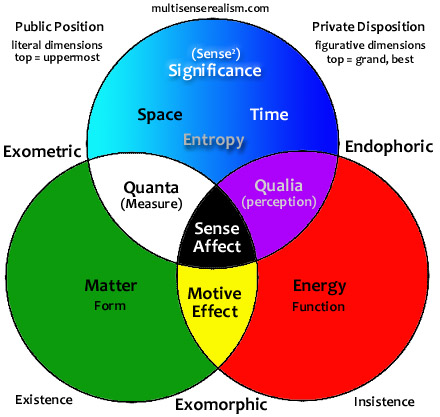
reminds me of my six-sided syzygy ideas. We both are focusing on the same principle that is embodied in a transistor – the base (i – I, subject, ground of being), collector (ii-perceptive/sensory/afferent), and emitter (iii -appetitive/motive/efferent). I see the qualitative distinctions he makes between God and monad as mere points on the continuum of qualitative richness but his intuition of 3 + 3 symmetry are matched by my own. The difference is that I see the power, knowledge, and will of God as being the supersignifiers which we project above us and his ‘basic nature, perception, and appetition’ as the sub-signifiers which we project upon ourselves from the outside – ie mechanemorphic elemental complements to our anthropomorphic cosmological superlatives.
For my own Big Six, I see an interchangeable multi-sense relation between three interiors (who, why, and when :: sense, motive, and timespace) and three exteriors (what, how, and where :: matter, energy, and spacetime). Later on, he gets into his universal harmony, which is very similar to what I call perceptual inertia. I think that we are both talking about the same thing, only that by inertial I am talking about what perception is while universal harmony refers to what it does. Perception binds us harmonically, orients us to the realism and meaning that our experience of the universe potentially holds for us. It is the stuff of self-revealing intuition juxtaposed with self-concealing gaps or lapsing of these nested inertial frames of sense and significance.
56. Now, this interconnection, or this adapting of all created
things to each one, and of each one to all the others, brings
it about that each simple substance has relational properties
that express all the others, so that each monad is a perpetual
living mirror of the universe.)
I think he was too hasty in saying that a monad is representative by nature. While his point is well taken that, as he says earlier “each monad is a perpetual living mirror of the universe”, I think that the other half of this profound truth is that each monad is also a non-perpetual presentation of nothing except itself.
60. Anyway, what I have just been saying yields reasons
why things couldn’t have gone otherwise. ·Here they are·.
In regulating the whole universe God had regard to each
part, and especially to each monad; ·so each monad has
features that are given to it in the light of the features of
every other monad—it won’t be restricted to having correspondences
with only a part of the universe·. And since a
monad is by nature representative, ·so that all its features
are representations·, nothing could restrict it to representing
only a part of the universe. ·I am not saying that each monad
is omniscient, or anything like that!· A created monad’s representation
of the details of the whole universe is confused;
it can be distinct only with respect to a small part of things,
namely things that are either closest or largest in relation
to it. Otherwise every monad would be divine! Monads are
limited not in how widely their knowledge spreads, but in
what kind of knowledge it is. They all reach confusedly to
infinity, to everything; but they are limited and differentiated
by their different levels of distinct perception.
61. And in this respect composite things are analogous to
simple ones. ·In the world of composites, the world of matter·,
everything is full, which means that all matter is interlinked.
·If there were empty space, a body might move in it without
affecting any other body; but that is not how things stand·.
In a plenum [= ‘world that is full’], any movement must have an
effect on distant bodies, the greater the distance the smaller
the effect, ·but always some effect. Here is why·. Each body
is affected by •the bodies that touch it, and feels some effects
of everything that happens to •them; but also through •them
it also feels the effects of all the bodies that touch •them, and
so on, so that such communication extends indefinitely. As a
result, each body feels the effects of everything that happens
in the universe, so that he who sees everything could read off
from each body what is happening everywhere; and, indeed,
Here he describes a framework for what I have elaborated as Quorum Mechanics. It seems to contradict his assertions that the monad has no parts and cannot be impacted by external causes. Here, bodies are affected by bodies, and the relation between bodies, monads, and plenum are not clear. Quorum mechanics picks up where Leibniz leaves off, specifying that the existence of bodies is propagated through the space-diffracted insistence of selves (and vice versa; the insistence of selves is localized spatiotemporally by the existence of bodily relations). These bodies make both a horizontal sense as evolving structures, and a vertical sense as evolving stories which cannot be told outside of their own native perceptual inertial frame. Cinderella cannot be told using only molecules or cells as characters. Each layer or caste of external realism is clutched together (elided through time) by qualia.
because he could see in its present state what is distant both
in space and in time, he could read also what has happened
and what will happen. . . . But a soul can read within itself
only what is represented there distinctly; it could never bring
out all at once everything that is folded into it, because its
folds go on to infinity.
62. Thus, although each created monad represents the
whole universe, it represents more distinctly the body that
is exclusively assigned to it, and of which it forms the entelechy
[see note in 18]. And just as that •body expresses the
whole universe through the interconnection of all matter in
the plenum, the •soul also represents the entire universe by
representing its particular body.
Again, the monad doesn’t represent the body that is assigned to it, I say that it presents it directly. I also say that the interconnection of all matter in the plenum that he speaks of (which is just the universe with all of the space vacuumed out) is only half of the monad story. We also have to look at time as the anti-plenum; the ‘not-now’ which cuts across the plenum orthogonally, generating a figurative grouping in which many events co-insist.
63. What we call a ‘living thing’ is
a body that has a monad as its entelechy or its soul,
together with
that entelechy or soul.
And we call a living thing ‘an animal’ if its entelechy or central
monad is a soul [see 19]. Now this body of a living thing
or animal is always highly organized. ·Here is why·:
•The universe is regulated in a perfectly orderly manner;
and
•every monad is a mirror of the universe in its own
way; so
•the representing monad must itself be orderly; so
•the body that it represents (thereby representing the
universe) must be orderly.
I would turn it around to say that the monad is a presentation of the difference between orderly inertial qualities. It is not only orderly, it is also chaotic. Feeling as well as unfeeling in tunable meta-modulations.
64. Thus every organized body of a living thing is a kind of
divine machine or natural automaton. It infinitely surpasses
any artificial automaton, because a man-made machine isn’t
a machine in every one of its parts. For example, a cog on a
brass wheel has parts or fragments which to us are no longer
anything artificial, and bear no signs of their relation to the
intended use of the wheel, signs that would mark them out
as parts of a machine. But Nature’s machines—living bodies,
that is—are machines even in their smallest parts, right
down to infinity. That is what makes the difference between
•nature and •artifice, that is, between •divine artifice and
•our artifice.
Here Leibniz foreshadows our modern debates about Artificial Intelligence. His reasoning is characteristically pre-modern but not entirely wrong. Both inanimate objects and living organisms turn out to be made of the same smallest parts (whether those parts are ‘infinity’ is arguable, what with QM and vacuum flux). Each part of even a man made machine is made of smaller machines made of smaller wholes. The difference is not in what can be done with these wholes, it is in how the quality of experience scales up – not from being externally orchestrated like a puppet but growing, blooming, discovering recovered properties of entelechy from within.
What I see and what I think he might agree with me on now is that it is the experienced quality of awareness (rather than the presence or absence of mechanism) which differentiates inorganic objects from living organisms. I say that everything has mechanistic and experiential qualities, and further that those qualities are inversely proportionate – giving privilege to the vertical, qualitative depth at the expense of the horizontal, quantitative universality. We humans are like hothouse flowers, in constant need of countless conditions of homeostatic equilibrium to maintain our function and sanity. We are human to the extent that we are unlike animals, and we are animals to the extent that we are unlike vegetables, minerals, matter, quantum, or recursive enumerations of computation.
65. And ·God·, the author of Nature, was able to carry out
this divine and infinitely marvellous artifice because every
portion of matter is not only
divisible to infinity,
as the ancients realised, but is
actually sub-divided without end,
every part divided into smaller parts, each one of which has
some motion of its own ·rather than having only such motion
as it gets from the motion of some larger lump of which it
is a part·. Without this ·infinite dividedness· it would be
impossible for each portion of matter to express the whole
universe.
66. And from this we can see that there is a world of
creatures—of living things and animals, entelechies and
souls—in the smallest fragment of matter.
67. Every portion of matter can be thought of as a garden
full of plants or a pond full of fish. But every branch of the
plant, every part of the animal (every drop of its vital fluids,
even) is another such garden or pond.
68. And although the earth and air separating the plants in
the garden and the water separating the fish in the pond are
not themselves plants or fish, they contain other ·organisms·,
but usually ones that are too small for us to perceive them.
Here Leibniz is reaching for quantum mechanical concepts, and what I call the ‘profound edge’ which represents the blurry seam between ultra-microcosm and omni-cosmos. While we use Planck units to plug the drain of infinity he speaks of, they are figments of impressively ambitious dividedness. If an electron were the size of the Earth, one Planck length would still be measured in millionths of a millimeter. Planck time would be the time it takes light to travel that distance, if light was a billion-billion-billion times faster than it is (since the radius of an electron is on the order of 10^-20 meters, the radius of the Earth is around 25,512,000 meters, and Planck length is around 10^-35 meters.)
69. Thus there is nothing barren, sterile, dead in the universe;
nothing chaotic, nothing confused except in appearance.
·Here is an example of that·. If you see a pond from a
certain distance, you may see the swirling of the fish without
being able to pick out any individual fish; it may seem to
you that you are seeing confused movements of the fish, ·but
really nothing is confused in itself—what’s happening here
is that you are perceiving confusedly·.
As I see it, since the flux of realism is propagated through the quality of solitude through time and against the interruption of the multiplicities of space, there is no need for a literal infinity of microcosm, rather, it can be understood as a fixed potential which is forever receding in arctic sterility from a relatively florid and tropical mesocosm of novelty production. The universe is generated from the middle out to the ends, from the realism of the ordinary as well as the teleological-mechanistic attractors of the profoundly unreal. I would say that Leibniz is half right in his panpsychic optimism – indeed, on its own native scale of time and sense, there may be nothing which is not full of order and experience, but at the same time, that significance of focus can only exist at the expense of projecting insignificance and entropy. It is not a defect of perception, it is the very definition of perception – to orient and separate one quasi-solipsistic inertial frame from another. Death is as real as life, only it is always happening to someone else. This is anthropic and figurative, but I say it is also literal from a ‘cosmopic’ perspective. Space and matter are entropy and inertia seen from the outside. Death is the insiders triangulated view of their own outside.
70. We can see from this that every living body has one
dominant entelechy, which in an animal is its soul; but the
parts of that living body are full of other living things, plants,
animals, each of which also has its entelechy or dominant
soul.
71. Some people who have misunderstood my ideas have
thought ·me to have implied· that
every soul has a mass or portion of matter which is
its own and is assigned to it for ever, and therefore
every soul has other living things that are inferior to
it, destined always to be in its service.
That doesn’t follow; and it isn’t true, because all bodies are
in a perpetual state of flux, like rivers, with parts constantly
coming into them and going out.
72. Thus the soul changes its body only gradually, a bit
at a time, and is never suddenly stripped of all its organs.
So animals undergo a great deal of change of form [French
metamorphose] but they never undergo the transmigration of
souls from one body to another [metempsychose]. And no souls
are completely separated from matter—there are no spirits
without bodies. Only God is completely detached from
matter.
73. Another upshot of all this is that there is never either
•complete generation ·in which a living thing comes into existence
· or •complete death, which (taking ‘death’ in its strict
sense) consists in the soul’s becoming detached ·from its
body·. What we call generation is development and growth;
just as what we call death is envelopment and shrinking.
Here he is using words like soul and God when I think that if he had taken the monad to its absolute conclusion, he would have seen the symmetry of space, time, matter, energy, ‘perception’, and ‘appetition’ and found no need to force the cosmos into a master-servant hierarchy. We are all masters and servants.
He goes on to talk about a pre-established harmony but doesn’t specify that this would constitute a neutral monism from which the continuum from essence and existence are diffracted. I try to get at what this is about, using the TSM as a way to model how qualia can be both accumulated or recovered through experience as well as incommutable glimpses of a single holistic aeon. The only way this works is top-down: Diffraction and recapitulation, not assembly and emergence. Assembly and emergence are existential consequences, not essential sequences or autopoietic processes.
The last few pages get back into divinity and a City of God which are probably too antiquated for me to relate to seriously. Efficient causes, final causes, moral realm of grace, etc. do not translate well into the 21st century. For better or worse, the closest we are probably going to get to a City of God in the foreseeable future is going to be free Wi-Fi. This doesn’t mean I don’t take the prospect of correcting our dislocated metaphysics seriously, or that I don’t think that recovering our humanity isn’t of prime importance – I do, in fact, but I see that it can only happen through the reconciliation of both ‘positive’ and ‘negative’ considerations.


) cannot be moved around the surface and back to where it started so that it looks like its own mirror image (
). Otherwise the surface is non-orientable.




 Multisense Realism
Recent Comments