Archive

Posts Tagged ‘metaphysics’

AI is Inside Out

November 18, 2015 3 comments

The subjective world is an arena of sense that is surrounded by an unseen sensor. Unlike a computer, which finds its own data stored in precise and irreducibly knowable bits, we find our own introspection to be confoundingly mysterious. Both the interior and exterior world are presented to us as a natural given to be explored, but the methods of exploration are diametrically opposite. Penetrating the psyche leads to an examination of symbols that are both intensely personal as well as anthropologically universal.

Whether we explore the objective world or the subjective world, we do so from the inside out, as visitors in a universe that matters to us whether we like it or not. To understand how machine intelligence differs from natural consciousness, it is important to see that a machine’s world is taken rather than given. The machine’s world is assembled from the bottom up, through disconnected, instrumental samplings.

It can be argued that our sense of the world is also nothing more than a collection of readings taken by our sense organs, but if that were the case, we should not experience the outside world as a complete environment, but rather as a probabilistic blur that is punctuated by islands of known data. A machine’s view of the outside world should (and would) look like this:

bag

This showed that even when shown millions of photos, the computer couldn’t come up with a perfect Platonic form of an object. For instance, when asked to create a dumbbell, the computer depicted long, stringy arm-things stretching from the dumbbell shapes. Arms were often found in pictures of dumbbells, so the computer thought that sometimes dumbbells had arms.

Similarly, images that have been probabilistically ‘reconstructed’ from fMRI data show the same incoherence:

mqdefault

These are images that have been simulated from the outside in – a mosaic of meaningless elements spread out over a canvas seen by no one. These are not the kinds of visions that we have when we encounter the depths of our own psyche, which are invariably spectacular, if surreal, dreamscapes. By contrast, these early machine models of visual encoding show us a soulless sub-realism made of digital gas; a Bayesian partlessness gliding arbitrarily toward programmed compartments.

Although a machine’s introspection need not have any visual appearance at all, it makes sense that if it did, what would be seen might look something like a debugger interface, full of detailed, unambiguous data about the state of the machine.

debug2

It would be bizarre to have a layer of all-but-incomprehensible fiction in between the machine and its own functions. Even if the dashboard of such a complex machine used a lot of compression techniques, surely that compression would not be a mystery to the machine itself.

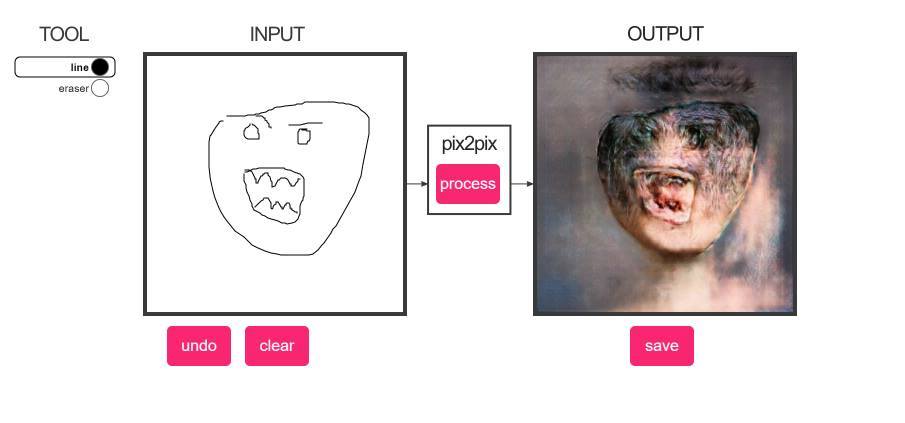
The point that I’m trying to get across here is that what we are developing in machines is actually an anti-subjectivity. Its world is fuzzy and delirious on the outside, and clearly circumscribed on the inside – exactly the reverse of our natural awareness. Machine psychology is a matter of compiling the appropriate reports and submitting them for error correction auditing, while machine perception is a tenuous process of probing and guessing in the dark. Our own inner depths seem to defy all machine expectations, containing neither useful reports on the state of our brain nor unnatural chaos. Our view of the world outside of ourselves is not one which seems to be manufactured on the fly but one which imparts a profound, pervasive sense of orientation and clarity.

Edit: 7/23/16, another example: http://www.fastcodesign.com/3062016/this-neural-network-makes-human-faces-from-scratch-and-theyre-terrifying

computerfaces

Edit 12/19/16, see also https://multisenserealism.com/2016/12/19/fooling-computer-image-recognition-is-easier-than-it-should-be/

Edit 5/19/17 https://arstechnica.com/information-technology/2017/05/an-ai-invented-a-bunch-of-new-paint-colors-that-are-hilariously-wrong/

image_recognition

Edit: 6/29/17 – https://wordpress.com/post/multisenserealism.com/5161
artmonstern

7/22/17 – https://blog.keras.io/the-limitations-of-deep-learning.html

“One very real risk with contemporary AI is that of misinterpreting what deep learning models do, and overestimating their abilities. A fundamental feature of the human mind is our “theory of mind”, our tendency to project intentions, beliefs and knowledge on the things around us. Drawing a smiley face on a rock suddenly makes it “happy”—in our minds. Applied to deep learning, this means that when we are able to somewhat successfully train a model to generate captions to describe pictures, for instance, we are led to believe that the model “understands” the contents of the pictures, as well as the captions it generates. We then proceed to be very surprised when any slight departure from the sort of images present in the training data causes the model to start generating completely absurd captions.”

1/6/18 – https://gizmodo.com/this-simple-sticker-can-trick-neural-networks-into-thin-1821735479/amp

banana

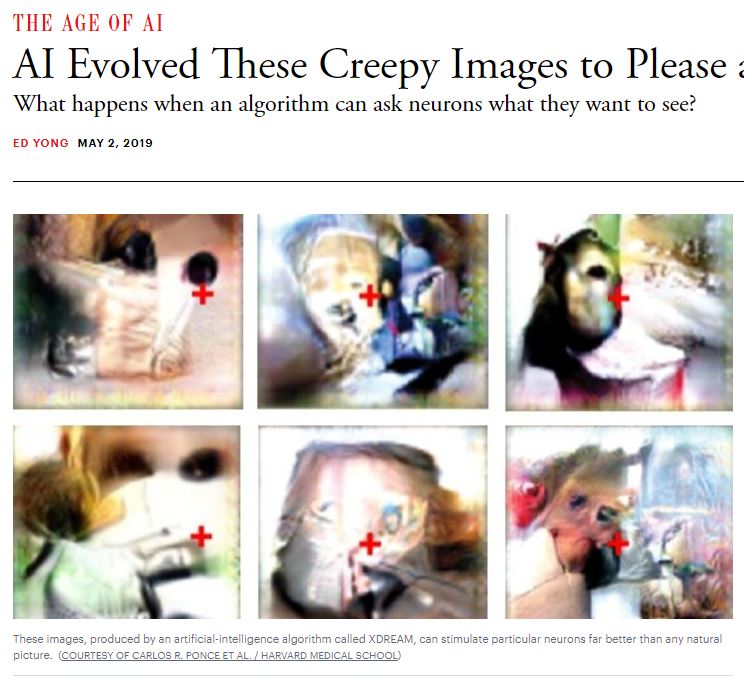
5/2/2019 – heatlantic.com/science/archive/2019/05/ai-evolved-these-trippy-images-to-please-a-monkeys-neurons/588517
ageofAI

Should Quantum and Consciousness be Connected?

October 13, 2015 1 comment

Quora question:

Are there any reasonable reasons to believe that there is a connection between quantum physics and consciousness?


I don’t think that we need to believe in such a connection, but there are certainly reasonable justifications for seeking it out.

From the consciousness side, the issue is that sooner or later we have to get around to asking exactly how experiential qualities like flavors and images come into being. There has to be an inflection point or event horizon…some process through which psychological phenomena are transduced or emerge from actual physical substances. For example, we can see exactly where a computer displays graphic phenomena, but that display is

1) not part of any computational process
2) not comparable to any part of the brain
3) dependant on the visual experience of a conscious user to interpret

This would seem to put our direct, ordinary experience outside of a detectable physical location. Since quantum phenomena violate our classical expectations of physical location, it might be a good place to start. Futher, we know that electromagnetic activity in the brain correlates to conscious experience, and that electromagnetism is reducible to QED.

From the quantum side, there are a few different issues. One is that it isn’t classical. It’s not merely the fact that QM is ‘weird’, but that the particular ways in which it is weird suggests more thought-like properties than stuff-like properties. If we are willing to surrender classical realism for an abstract, counter-intuitive universe, then why rule out that this universe is in fact the same as the one in which our interior experience resides?

Another issue that I think qualifies as a reasonable consideration is that we are finding more and more examples of quantum effects which are macroscopic and organic. Rather than quantum theory settling down into a more unified interpretation, it continues to spawn more possibilities and more strangeness. When we consider what is really meant by photons entangled through time rather than space (Weird! Quantum Entanglement Can Reach into the Past) are we really that far from a universal sense of memory?

The idea that consciousness is related to quantum need not be a reason for us to place ourselves, as Homo sapiens, into the fundamental fabric of existence. Instead, it may be that our human awareness and quantum share a common ancestor. Several of the founding fathers of Quantum Physics emphatically supported the idea that QM is grounded in participation and process rather than objective ‘things’.

I have proposed that QM and Relativity share a connection to rudimentary awareness: Frames of reference, worldlines, multiple worlds, holographic simulation, etc all speak to an influence which bridges a gap between a cosmos with no possibility of preference to one which is dominated by localized perspectives and irreversible change. To me, there is an obvious conceptual intersection between quantum uncertainty and special relativity, and that intersection is in the sharability of sensory experience. This seems to be the inflection point. Both spacetime and causality can be seen to be emergent from a foundation which is perceptual-participatory rather than information-theoretic, spatio-temporal, or mass-energetic. It’s a matter of flipping our expectation of inputs and outputs serving to distribute objective “information” units, to seeing information as the the appreciation of common throughput qualities.

The human qualities of consciousness may not have as direct an effect as some supporters of New Age metaphysics may like*, but it may very well have an effect on which aspects of physics we think we can explore and which aspects we are afraid of. Just as particles have biases in terms of spin and charge, human psychology tends to become polarized. We are only beginning to understand the connection between genes, gender, and what has been termed the empathizing-systemizing spectrum. Autism and psychosis have been linked to the extremes of the E-S spectrum, along with ties to gender influence in gene expression.

If we have built a science which concentrates an overwhelmingly ‘S‘ or genetically ‘male’ perspective, and then use academic processes which only serve to amplify that bias, then it should not be a surprise when the great missing links in our cosmology come to us as shadow projections: Despised foes from across a gap of prejudice. If your psychology is highly biased toward the Systemizing side of consciousness, then you will know it because reading these words will cause you unusually vivid anger and outrage. Rather than a calm consideration of these ideas, it seems (and this is borne out in brain lateralization studies also) that your certainty only grows more fanatical and rigid. It’s not your fault. Ironically the mind is controlled by chemical influences and evolutionary defense mechanisms which deny themselves in our awareness.

If your psychology is overwhelmingly ‘E‘, then I would expect that you might feel more hurt and confused when reading this. The feeling is that this information isn’t really ‘for you’, or that I haven’t developed my own consciousness enough to really understand spirituality. Where the S-minded scientist shouts ‘Woo-woo!’ and demands evidence, the E-minded mystic retires to aloofness. One demands submission to the truth, while the other resigns such demands with transcendence and pluralism. Both views dismiss the authority of subjectivity, but in opposite ways.

To resolve this tendency toward psychic extremism, we may need to go much further in our efforts to seek objectivity than we have imagined. We may need to update our understanding of subjectivity to make it more objective, and our understanding of objectivity to make it more subjective. QM makes this especially true, as objectivity itself has proved to be fundamentally elusive.

This is where Gödel comes in. Formal systems may not only not be enough, they may prevent us from grasping the most essential truths of nature…that we are not observers of an illusory world, but participants in a spectrum of world-like experiences ranging from the very real to the very surreal.

*or at least, not in every state of consciousness or in states of consciousness that are accessible to everybody.

Real Light

August 29, 2015 Leave a comment

If you like precise definitions, here you go. These are not official definitions from scientific consensus or recognized authority, nor do I make any claims to their completeness or accuracy. The point here is to convey an understanding of the relation between light and seeing, and by extension, all sensible phenomena and all sensation.
EM light: Electromagnetic radiation which can be generated and detected using specific material sources undergoing chemical and nuclear reactions. That is, matter which is being transformed by matter, either directly through unbroken physical continuity or from a distance at the molecular or atomic level of description.

EM light is a thermodynamic phenomenon which need not be visible to the human eye, so that frequencies of EM which are infrared and lower or ultraviolet and higher can be considered ‘light’, electromagnetically. Radio waves and gamma rays would be considered light also, but that we tend not to think of them using that term. It can be argued that is meaningless convention, but I suspect that our intuition here is valuable.

Optical Light: Here’s where it gets interesting. When our eyes are open, we either see optical light directly, or we do not. If we see optical light directly when our eyes are open, then everything that we see is optical light, not just the presence of ‘light-stuff’ such as rainbows and glare. Optical light can be separated into at least three categories

  • Optical Light One (OL1) refers to everything that we see through our open eyes which is deemed to be publicly and empirically real. Images, shapes, figures, etc. The three dimensional, real world that we see surrounding us can be considered to be entirely composed of optical light. What else could we be looking at through our eyes except that which is made available through the photosensitvity of our retinal cells?
  • Optical Light Two (OL2 or Optical Light Qua Optical Light) refers only to those instances of optical light which are seen purely as optical light by itself. Beams or rays of bright/white light, iridescent films, spectral projections, specular and diffuse reflections, etc. OL2 is manipulated using material instruments such as lenses and mirrors. Turning on a flashlight produces a beam of OL2 which illuminates a room with OL1.
  • Optical Light Three (OL3 or Partially Confabulated Optical Light) acknowledges that what we see is filtered and modified, if not wholly confabulated neurologically, so that even with our eyes open, what we see is not necessarily the public, empirical phenomenon of OL1, but is in fact wholly or partially a kind of entopic, private hallucination that is calibrated by the nervous system for isomorphic, veridical correspondence to the impersonal reality. This is how we can see optical illusions: Our visual sense of the world (OL1) is filtered and distorted by our psychological condition and conditioning such that OL3 is taken for granted as OL1.


Phenomenal Light:
Phenomenal light may or may not be optical, and it may or may not be directly electromagnetic. Having left off at optical illusions, we can further make the distinction between the unnoticed illusions which we presume are being taken as visual reality of the outside world routinely, and the consciously noticed instances of optical illusion. Note the parallel between OL1 and OL2.

  • Phenomenal Light One (PL1) – The entire field of private visual experience. All experiences of color, form, brightness, etc which deviate in fact from public measurements by material instruments. All dreaming, imagining, and visualizing, all medical conditions with consequences that affect sight, etc would be PL1, whether they are recognized as such or not. Any seeing at all is PL1.
  • Phenomenal Light Two (PL2) – Refers only to the specific visual experiences in which phenomenal light is revealed to be private and phenomenal rather than empirical and public facing. These include entopic and eidetic hallucinations*, illusions, altered and ambiguous images, phosphenes, moire patterns, defects in the visual system, etc. PL2 phenomena look unreal – sights which can seem supernatural or psychedelic.*entopic hallucinations refer to purely geometric designs, often repeating spatially like wallpaper, and which seem tied closely to the optical-visual system. Eidetic hallucinations are apophenic or pareidoliac, such as seeing images in a cloud or Rorschach inkblot. Eidetic hallucinations, (I think) are more tied to the cortical-limbic system so that they can reveal private, even subconscious psychological content, and they can sometimes be manipulated consciously, as in an ambiguous image or lucid dream.
  • Phenomenal Light Three (PL3) – Following the lead of Optical Light, the third type of Phenomenal Light is Fully Confabulated Phenomenal Light. This refers to those visual experiences which are fully disconnected from public facing measurements. Dreams, visions, visual memories, delusions, NDEs, etc which may or may not seem private and may be interpreted as real even if it is not.


SR Light:
Light conceived of in special relativity seems to me to be grounded in the sense of light as the propagation of physical signals. Light begins to transform away from classical notions of light and toward the idea of light as a fundamental part of how space, time, and velocity are defined. Einstein made light identical to, or a proxy for a cosmological constant.

MP ‘Light’: Stands for light which is derived from a metaphorical reference and/or literal reference to a supposed metaphysical being. . At this point, we lose the attention of those who will not intellectually break ‘the fourth wall’ in their view of nature. On one side of the wall, where we anchor our epistemology in the EM and Optical sense of light, it seems ridiculous to include metaphorical language and magical, mystical conceptions of light as part of our worldview. Who are we to say that our fantasies and linguistic conventions should be taken seriously in the grand scheme of nature?

On the other side of the wall, it seems ridiculous not to include them. Who are we to assume that our thoughts and intuitions can be safely excluded from a complete description of nature? How can we be so arrogant as to think that the collective wisdom of billions of people throughout history has contributed no clues as to the essential nature of light?

The view from both sides sees its logic as more objective, only the former sees objectivity tied to excluding all traces of subjectivity and the latter sees objectivity itself as a subjective assumption and subjectivity itself as an objectively real phenomenon, if not the only objectively/unquestionably real phenomenon.

Metaphorical uses of the word light generally serve to elevate the significance of natural phenomena such as mood and aesthetics. People are said to be ‘glowing’, or ‘dazzling’. Metaphysical uses, by contrast are literal, but the referent is supernatural rather than natural. MP light is the kind of light we talk about when we want to fictionalize the fact of personal influence over matter or when we want to factualize the influence of super-personal ‘fictions’ over our lives.

  • MP ‘Light’ One (ML1): Light as a figurative or semi-figurative sense of ‘positive’ universal qualities such as goodness, empathy, and spiritual connection. ‘The light’ in this sense is affirmation of harmony with the divine and implies qualities of healing, guidance, and protection from forces of (evil/negative) ‘darkness’. Light used in this way mixes ordinary kinds of human experience of light with extraordinary, transpersonal psychological experiences.
  • MP ‘Light Two (ML2): Light in a fully figurative, naturalistic, but still quasi-theological sense of clarity, knowledge and understanding complete truth. “Seeing the light”. “A lightbulb went on for me.’, enlightenment, illumination, visionary, bright mind, insightful, etc. Changing one’s beliefs suddenly from a clouded, false view to one which is dramatically truer and clearer.
  • MP ‘Light’ Three (ML3): Light as an indication of literal consciousness (until the light went out in his eyes) and/or ‘radiant’ aesthetic qualities of kindness, love, warmth, charisma, etc. Here, light is the sign of a person’s individuality and sanity – their ability to be present, aware, and sane.

To sum up:

0 EM Light: Detectable by a light meter, but might be invisible.
1 Optical Light 1: Visible in a photograph of the world.
2 Optical Light 2: Visible effect composed purely of optical light.
3 Optical Light 3: Meters agree but observers may disagree on qualities.*
4. Phenomenal Light 1: Can be seen with eyes open or closed.
5. Phenomenal Light 2: Visible effect composed purely of phenomenal light.
6. Phenomenal Light 3: Visible in a dream world.
7. SR Light: EM light speed used as a cosmological constant.
8. MP Light 1: Light as a transpersonal sense of benevolence.
9. MP Light
2: Light as a specific sense of revelation and genius.
10. MP Light 3: Light as an indicator of individual consciousness or soul.

In Optical Light, light makes itself visible and invisible. When we see a beam of light, or an electric spark, for example, we are not seeing light itself, we are seeing the illumination of something which is normally invisible to us. Sparks or lightning, for example, do not occur in a vacuum, they are both examples of air molecules being ionized. We are seeing air light up, not light itself. In the case of a laser beam, we are seeing particles in the air light up. Only when we look at something like a spectrum of color do we get a sense of the OL2 sense of light-as-light-itself. Most other light sources are a combination of OL1 visible objects and OL2 light effects.

In EM light, visible light is only a thin sliver of a vast electromagnetic spectrum that is invisible to us. In Meta light, the electromagnetic spectrum is only a sliver of a vast metaphenomenal spectrum that is potentially accessible to us.

In SR light, the relativity of simultaneity is a calculation of the relation of moments of time to each other. In MP light, I suggest that the relativity of simultaneity occurs in the opposite way,  as the degree of inclusiveness of the moment, or the ‘size of the now’ which can be experienced from a given conscious perspective. A hummingbird probably has a smaller scale ‘now’ than we do, and if we attribute awareness to the entire Earth, I would expect a planet sized ‘now’ whose window exists in a context of geological time.

Setting aside light, any sense can be substituted. We can talk about sound being waves of fluctuating density in matter, and then the three levels of acoustic sound as it turns to phenomenal and MP sound, etc. Finally we can talk about qualia in general as it passes through its semaphoric, phoric, and metaphoric descriptions. What I want to know now though, if c is the speed of light, then is c² the speed of phenomenal qualia? How about c³…could that be the metaphenomenal operator?

*as in the blue/gold dress.

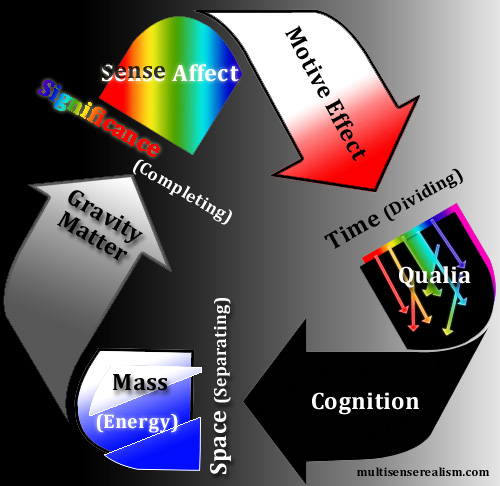
Arrow Cycle Diagram

July 10, 2015 Leave a comment

arrowcycle4

Thesis Rewrite Project

April 25, 2015 Leave a comment

MSR’s Case Against Emergence

Within the MSR website, there are several entries talking about the inadequacy of the concept of emergence when applied to consciousness emerging from unconsciousness. Briefly, emergence only has any explanatory power when applied to two phenomena which have a logical similarity. We can understand that water molecules which are tightly packed would seem to us to have the emergent property of being ice, where molecules which are contacting each other but sliding around would have the emergent property of seeming to us like a liquid. What is meant when emergence is applied to consciousness however, is not like that at all. There is no arrangement of particles in a void that is isomorphic to a flavor, color, or feeling like dizziness. Emergence which cannot be anticipated by the behavior of the fundamental phenomenon is known as Strong or Brute Emergence, and under the best of circumstances can be dismissed as an argument from ignorance. In the circumstance of consciousness emerging from objects or information processes, we are smuggling in our own evidence of experience as the entire explanation of that experience. To claim emergence of consciousness is to answer the question of why molecules seem like flavors or emotions by shrugging it off as the way that molecules seem…as if seeming could exist in physics in the absence of consciousness.

Here’s a thought experiment to consider:

Let’s say that you have a two dimensional collection of six squares in a cross formation, like this:

hi-d_figure3
Now we know that this could be folded into a cube, however, couldn’t we also have a program which treats the edges as if it were a cube, but use it as a graphic character in a 2d video game? In other words, can’t we show that just because the edges and corners of this figure behave in a way which is isomorphic to a 3d figure, no cube ’emerges’ necessarily? We could run this program in Flatland without folding it up as cube and all of the computational outcomes would be the same.

The emergentist position overlooks the difference between the squares and the cube, claiming the latter not to be anything additional added on top of the flat avatar. The idealist position is that there is a difference between a cube and the avatar, and that this difference is the most important and interesting thing…the whole point is that there doesn’t need to be a cube logically, but yet there is.

Intellectual fads come and go. Even long held scientific frameworks change over time to accommodate new knowledge. For centuries Ptolemaic astronomy was presumed accurate, so much so that when anomalies were found in the predictions of its deferent and epicycle model, the response was famously to ‘add epicycles’ to make finer tuned predictions rather than to suspect what Galileo and Copernicus later found. The heliocentric revolution changed our understanding of our position in the universe from one of divine center or paradise lost to a statistical fluke in a dying cosmos. For the 1200 years between 200 and 1400 AD, why did we stick to the geocentric model? Why was it more natural to think that the universe revolved around us?

Like the fish which has no name for water, or the Flatland square who has no way to conceive of flatness as a dimension which lacks volume, it was difficult for people to doubt those assumptions that they didn’t even know they were making. The Earth feels motionless – as stable and static as anything we can imagine. Who would guess that the very property of motion is a relative condition? Once we have that piece of information, we can find, as Einstein did, examples of it everywhere – on trains, when we can’t tell whether our seat is moving forward at a constant speed or whether the train out the window is moving past us and we are standing still. One favorite thought experiment of mine is to think of a universe in which only one object exists; a smooth, ideal sphere like a ping pong ball. In this universe, nothing can be seen to move. Without making ourselves an invisible voyeur who can look around into the void, there is no true sense of space or change. There is no difference between moving and standing still because there is no frame of reference from which to compare and see that a position has changed. Video games can help us conceptualize this also. The player who pilots a spaceship avatar has only the attitude of their ship to cue their sense of acceleration when traveling through empty space.

whisperingwater
Notice how ocean waves stop moving when seen from high above.

(Sound gif, Source)

The shift that is proposed by MSR would twist our view of the universe, so that the universe itself becomes a kind of twisting or gyrating between different ways of experiencing.

Yeats System

Yeatsgyre

Yeats, like Locke and Galileo before him, conceived of the worldly half of the universe as “Primary”, which is perfectly natural considering that when we are awake we find ourselves surrounded by a physical world which is so much larger and more durable than ourselves. MSR proposes not that we invert this relation into solipsism, where internal phenomena are primary and the external world is secondary, but to see our own subjectivity as just one tier in a continuum which is much more vast and durable than even physics. Under MSR, both the dualistic Western and non-dualistic Eastern views both exist within the total continuum of sense.

msr_mandalabr_cap

The Yeats system is multiplied so that it is realism which is emergent rather than subjectivity. The aesthetic objectives of Yeats are no longer the antithesis, but the thesis and meta-thesis.
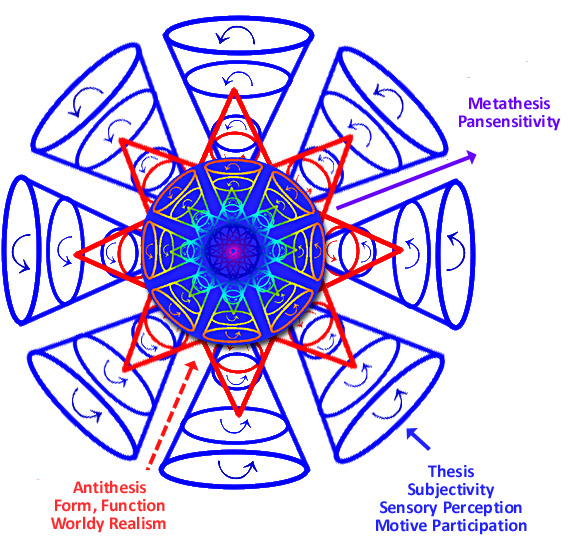
msr_mandalabr_cap2

mess

Multisense realism = The elaboration of sense into layers and modes which objectify and subjectivity.

Pushing the Envelope

March 2, 2014 Leave a comment

Consider that even the most primitive physical functions rely on detection to define themselves and each other. In a universe where biology has yet to evolve, it may be that those functions which we understand as elemental particles and forces were once more like we are, but through the progress of physics and sense, they became automated in comparison.

Imagine that the degree to which an experience is mechanical is a relative value – like a knob that can be turned toward more or less awareness. Substituting the word sense for God, I would re-interpret this Arthur Young quote to read

Sense sleeps in the minerals, awakens in plants, walks in animals, and thinks in man.’

That’s the way it seems to us, now. At one time, when there were no plants or animals or humans, the speed of geology had no faster frame of reference to make it seem slow. Thousands of years could pass in minutes, and the whirling, gyroscopic Matroyshka shells of mantle, core, and molten rock could have been nodes of vast interstellar awareness – maybe at once more fantastic and more simplistic than we can imagine. Maybe they still are, but the gap between our scale of awareness and that scale turns up the automation knob so that we are kept in our own perceptual-ontological envelopes.

When we look at our body and its world, we find a living museum that stretches back billions of our years. We would not suspect that these forms and patterns are in a sense ghosts. It is not controversial anymore to say that we live in an inner world rather than reality, or that everything we experience is delayed to a greater and greater extent as we measure further and further out from our bodies and our planet. Is it too far to suggest that consciousness is embedded in its own past in this more concrete way, so that the event horizon of progressing consciousness leaves in its wake a fading image – a kind of statistically averaged likeness of a now distant version of itself.

When we think of time nested in this way, the story of the universe becomes one of multiple simultaneous layers of varying temporal resolution. Each layer is increasingly polarazied, or meta-polarized, so that the middle of the envelope is one of ‘this or that’ reality becoming irreversible, but the trailing edge is frozen in recursive displays of computation. The leading edge of the envelope is what we are perpetually pushing into – a superposition of ‘this and that’. Unlike the mechanical semaphores inside the nest, the outside of the nest is mythic metaphors of fictional maybes. Sense thinks in man, but it dreams in gods and monsters.

Metaphysical vs Metaphenomenal

February 13, 2014 Leave a comment

One of the most contentious areas in philosophy revolves around what I consider to be a misconception about the relation between the physical and phenomenal. In particular, the term ‘metaphysical’ forces supernatural connotations onto what would otherwise be non-ordinary but natural experiences and states of mind. I think that the problem is in failing to recognize the physical and phenomenal as each having their own ranges which both overlap and oppose each other. What I mean is, synchronicity and precognition are not metaphysical, they are metaphenomenal. The surprising part is that this means that the ordering of events in which we participate is actually a subjective experience nested within many other subjective and perhaps trans-subjective subjective experiences on different scales. Einstein talked about the relativity of simultaneity, and the metaphenomenal (aka collective unconscious) works in a similar way.

When we make time physical without acknowledging the role that phenomenology has in producing both the form and content of “time”, we introduce a false universal voyeur which effectively flattens all aesthetic qualities and participation into a one dimensional vector in one direction. By taking the term metaphysical, we unintentionally validate this flattened view of the universe in which physics is nature, and phenomenology, particularly deep or non-ordinary phenomenology, can only be non- or meta- physical and therefore supernatural, aka superstitious, aka illusory. If we look at how physics treats its own non-ordinary phenomena, such as quantum entanglement, quasars, and dark energy, we do not see the term ‘illusion’ or ‘folk astronomy’ being thrown around. Their strangeness is acknowledged in a way which invites curiosity rather than fear. The mystery is safely projected into the impersonal realm of physics and the super-impersonal realm of theoretical physics. By contrast, the metaphenomenal range is super-personal or transpersonal, containing experiences which challenge our conventional expectations about the realism of physical bodies, locality, and time.

It is not incorrect to say that for these reasons the metaphenomenal can be considered metaphysical, however I think that is where we are placing the emphasis on the wrong set of properties. Instead of using experiences such as intuition, synchronicity, and even divination as scientific clues to a super-personal range of awareness, we are distracted by the apparent contradiction to physics (as if ordinary awareness did not contradict physics already). To rehabilitate our perspective, I suggest considering the relation between the different ranges of physical (ontic) and phenomenal (telic) phenomena in this way:

The term ‘paranormal’ is, like supernatural and metaphysical, the same kind of misnomer. If we see physics as a product of more primitive phenomenal sense, then it is consciousness itself which is doing the normalizing, so that it cannot be considered ‘normal’ itself. In another sense, since it is our consciousness which is defining normalcy, it does indeed identify its own regularity and meta-regularities and challenges those definitions as well. The metaphenomenal serves not only as an extension of the personal psyche into the collective unconscious, but also as a line in the sand beyond which sanity is not guaranteed.

Microphysical and Microphenomenal

The same thing occurs in another way, in an opposite way, on the bottom end of my chart. The sub-personal roots of microphenomenology and the sub-impersonal seeds of microphysics are the bottom up layers of causality and are more directly related than the top layers. The sub-personal (sub-conscious, id) urges and the microphysical (binary, semaphore-digital) are low level signs which are used to literally motivate and control. It is a common language of pushing things around.

To be able to exercise control it is necessary first to be able to see that which is to be controlled as separate in some sense from that which controls. There must be a way to sense them as ‘things’ or as a kind of inertial field which resists your intentions to cause a sensible effect. This experience of ‘things outside the self’ is the beginning of motivation, desire, intelligence, etc. In this way, motive and mechanism are born. The teeth in your mouth and the teeth of a gear exploit the same mechanical power to physically endure and prevail.

In the schema I propose, the fabric of the universe is tessellated or braided into these levels of nested counterpoint. The higher level objectifies the lower level into things because the higher level enjoys a more complete, but distanced panoramic view. The predator’s perspective engulfs the prey’s perspective. Biological organisms also objectify other living things and their own living body as higher than non-living things. Organisms with nervous systems take it one step beyond, seeing their own lives as a kind of meta-thing to direct as separate from the body. The human brain corresponds to a further, and perhaps ultimate mutation on the theme of self-reflection. There are physical implications for all of this but they have to do with time more than materials and structure. The expansion of time gives us more raw experiential material, more moments and more awareness of past and future within each moment. Technology and leisure make a virtuous cycle, bringing innovations which give us more things to do with our minds and bodies, and with the world.

Robert Anton Wilson wrote about the Jumping Jesus phenomenon – that it took X number of years for the first person to be born who had the impact of a Jesus or a Buddha, and how we now have several of them living at any particular moment. Buckminster Fuller and Terrence McKenna are among those who had this hyper-enthusiasm for the future which underlies today’s Singularity ethos. The ever ‘tightening gyre’, the transcendental object at the end of history, etc. It would seem, however, that at the same time, this enthusiasm is somehow perpetually deluded, and forever producing time wasting, leisure robbing coercions as well. As the acceleration increases, so does the mass, and a kind of stalemate plus or minus is maintained.

Conclusion

By shifting from the ad hoc, monolithic model of phenomenology as a kind of malfunctioning folk physics, or as physics belonging to an illusion that must be overcome spiritually, I propose a sense-based, multivalent view in which the metaphenomenal is understood to be both less than and more than physically real with high orthogonality, and the microphysical is understood to be less than and more than cosmologically meaningful with high isomrophism. The (one) mistake that David Chalmers made, in my opinion, is in accidentally introducing the idea of a zombie rather than a doll to the discussion of AI. Similar to error of the terms metaphysical and supernatural, the zombie specifies an expectation of personal level consciousness which is absent, rather than sub-personal level consciousness which is present on the microphysical levels. We can understand more clearly that a doll is not conscious on a personal level, no matter how many things it can say, or how many ways its limbs can be articulated. On the micro-physical level however, the material which makes up the doll expresses some sensory experience. It can be melted or frozen, broken or burned, etc. The material knows how to react to its environment sensibly and appropriately, and this is how material is in fact defined – by its sensible relations to material conditions. Just as we can assemble a 3D image on a 2D screen out of dumb pixels, so too can be automate a 5D human impostor on a 4D behavior stream of a doll.

By properly locating the micro-level physics beneath the personal-level phenomenology, we can see that beneath the micro-level physics there can be an even more primitive micro-phenomenology. On the top end as well, beyond the ontological truths of mathematics and logic, there are teleological apprehensions of aesthetics and meaning – without necessarily invoking a God personality (although that can work too, I just don’t see it as making as much sense as transpersonal Absolute).

*the super-impersonal is similar to the metaphenomenal in that it is difficult and esoteric, but opposite in that it is extrinsic rather than intrinsic. Where the metaphenomenal uses symbols as archetypes, loaded with metaphor and occult mystery, the superimpersonal (which would be more correct to call metaphysical) uses arcane mathematical and logical expressions. These are a kind of anti-metaphor as they relate to precisely defined, universally understood public information. The whole point is to expose the theory and completely, so that anyone is welcome to try to learn how to understand and use them, without any initiation rituals or strange pictures.

Against Idealism video

February 11, 2014 3 comments

http://www.youtube.com/watch?v=_dFV6UfvaOc

I have only scratched the surface here so far (it’s pretty long), but I wanted to post my comments so far. I think its a good video, and well reasoned, and gives me a good opportunity to explain why Multisense Realism is different and better than run of the mill Idealism.

The attack on idealism begins (around 22:00) by assuming that the fundamental nature of consciousness is identical to human consciousness. This would be analogous to saying that metaphysical realism is false because what is meant by reality requires that everything lacks perception, awareness, memory, etc. By setting the definition of consciousness at the high limit of its elaboration, we close the door on the much more sensible possibility of a primitive, sensory-motive basis for idealism which can augment itself into both meta-sensory capacities such as thought and personality as well as meta-insensitive capacities such as evolutionary and gravitational effects.

The properties of consciousness listed on the slide can be thought of as a spectrum of individuated aesthetic protocols which diverge rather than emerge from a single aesthetic meta-protocol, (what I call Primordial Identity Pansensitivity). In the same way that white light contains the implicit presence of each spectral color, Pansensitivity presents itself more completely through its diffraction – its incompleteness is a doorway to meta-completeness. To pick a slate of human qualities of consciousness to apply to the universe is a straw man setup. All that it shows is that non-humans are not human.

It does not show, however, that nested layers of non-human consciousness are not responsible for what we perceive as matter, planets, objects, etc. It does not mean that photons are anything other than opportunities for aesthetic acquaintance – i.e. bosons may be just how sub-biological experiences see each other. Fermions may be how low level experiences touch each other. Not ‘things’, but capacities to alienate and re-acquaint which are experienced on higher levels as mechanistic/probabilistic approximations. This may not be the argument of anyone but myself, so I can’t say whether your attack on idealism succeeds in popular forms of idealism, but I do understand what you are saying so far, and see a presumption there which you appear not to have considered.

Into the Interlipse

February 8, 2014 2 comments

Flipping Nilipsism into Solipsism

MW: The world we humans create is fiction, the reality is what existed pre-human and will exist post-human and I suspect forever unknowable. Our existence is all froth.

S33: That’s only because you are viewing the universe from the perspective of an omniscient, immortal voyeur. The contrary view holds that the universe which is not experienced by humans can never exist for humans, so that all but our existence is irrelevant. It’s a fractal. All that you can ever experience is that part of the universe which relates to some aspect of your experience of it. There can never be any other universe for you, you will never experience a universe in which you are not present experiencing it, so there can be no difference between your own life and eternity, except in your imagination. Everything outside of your life is fiction, relative to your frame of reference.

Interlipsism: A View From Everywhere

The word interlipse came to me in between sleeping and waking (hypnopompic), and it appears to have no established meaning. Etymologically, ellipse and ellipsis get their meaning from ‘a falling short’. I use the word elliptical to describe the soft-boundary nature of subjects/concepts/words, as compared to the relatively discrete boundaries of objective phenomena. In this context the word interliptical could be used to define this effect more specifically. As the number of words in a language grows, the greater the potential of those words is to be more precisely defined, and more broadly associated figuratively as well.

I’m not even sure if that’s true, but it seems like it could be. The interliptical quality is the degree to which meaning develops both elliptically (metaphorically) and semphorically (digitally) at the same time. Aesthetically it reminds me of how developer solution chemically teases out clarity and contrast from the entropy of a raw photographic exposure. Instead of assuming that words originate as collections of separate sounds, or an image is built sequentially from pixels, both the irreducible gestalt and the elementary particle are aesthetic perspectives that precipitate from the interlipse. Something like a fractal of lensing lenses.

Topography of Eigenmorphism Part II

December 16, 2013 Leave a comment

Another visual metaphor:

Eigenmorphism_demo

Eigenmorphism visualization part II

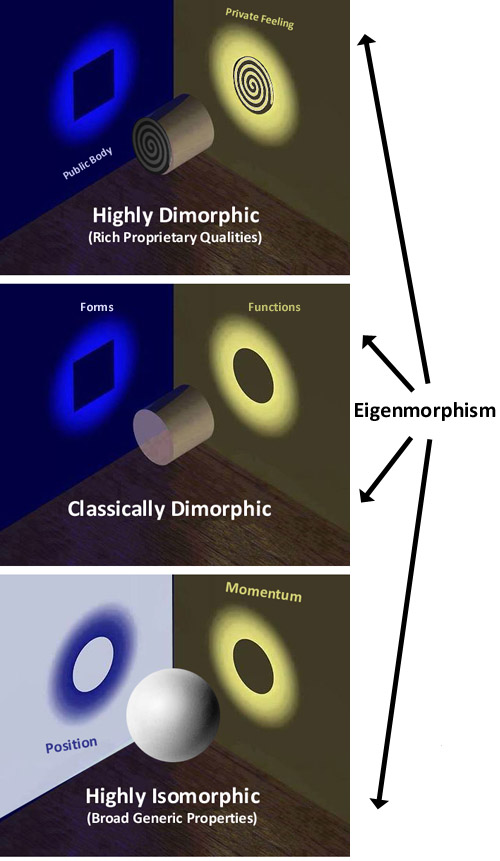
This diagram shows how elemental phenomena (bottom image) appear to us to have very little going on inside. Their public properties are not very body-like and their behaviors are imagined not to be very experiential. Eigenmorphism is the idea that as phenomena progress to richer experiential qualities, their interior and exterior nature expands in opposite directions.  In biological organisms, the public and private view not only differ by perspective, but the interior perspective can increasingly elaborate itself (spiral grows) without the exterior perspective (square shadow) revealing any change.

It should be noted that this is a metaphor, not a diagram of matter or quantum. What the yellow wall refers to is actually shapeless, as it is the appreciation of and participation in experiences. The increasing elaboration of the shape stands for increasingly rich and varied modalities of sensitivity. MSR suggests that the three dimensional figure in the center is not real at all, and a better diagram would show the shadow from the blue wall and the shadow from the yellow wall gradually morphing into each other in stages.

The difference between the high and low ends of the eigenmorphic spectrum are not only in the degree to which their interior qualities differ from their exterior properties, or in the kinds of qualities which higher experiences contain, but also in ubiquity vs uniqueness. The generic nature of low level phenomena make them comparatively interchangeable and universal, so that physical and mathematical laws have a universal reach. The highest level phenomena can be esoteric to the point of near-solipsism, with meanings that are so multiplexed and poetic that they apply only to a single moment or perspective.

The Third Eve

Who we are becoming.

Shé Art

The Art of Shé D'Montford

Astro Butterfly

Transform your life with Astrology

Be Inspired..!!

Listen to your inner self..it has all the answers..

Rain Coast Review

Thoughts on life... by Donald B. Wilson

Perfect Chaos

Steven Colborne's Philosophical Theology Blog

Amecylia

Multimedia Project: Mettā Programming DNA

SHINE OF A LUCID BEING

Astral Lucid Music - Philosophy On Life, The Universe And Everything...

Rationalising The Universe

one post at a time

Conscience and Consciousness

Academic Philosophy for a General Audience

yhousenyc.wordpress.com/

Exploring the Origins and Nature of Awareness

DNA OF GOD

BRAINSTORM- An Evolving and propitious Synergy Mode~!

Musings and Thoughts on the Universe, Personal Development and Current Topics

Copyright © 2016 by JAMES MICHAEL J. LOVELL, MUSINGS AND THOUGHTS ON THE UNIVERSE, PERSONAL DEVELOPMENT AND CURRENT TOPICS. ALL RIGHTS RESERVED. UNAUTHORIZED USE AND/OR DUPLICATION OF THIS MATERIAL WITHOUT EXPRESS AND WRITTEN PERMISSION FROM THIS SITE’S AUTHOR AND/OR OWNER IS STRICTLY PROHIBITED.

Paul's Bench

Ruminations on philosophy, psychology, life

This is not Yet-Another-Paradox, This is just How-Things-Really-Are...

For all dangerous minds, your own, or ours, but not the tv shows'... ... ... ... ... ... ... How to hack human consciousness, How to defend against human-hackers, and anything in between... ... ... ... ... ...this may be regarded as a sort of dialogue for peace and plenty for a hungry planet, with no one left behind, ever... ... ... ... please note: It may behoove you more to try to prove to yourselves how we may really be a time-traveler, than to try to disprove it... ... ... ... ... ... ...Enjoy!

Creativity✒📃😍✌

“Don’t try to be different. Just be Creative. To be creative is different enough.”

Political Joint

A political blog centralized on current events

zumpoems

Zumwalt Poems Online