Is consciousness an emergent property of the brain or a fundamental property of matter?
Which is more likely?
Isn’t saying that consciousness is an emergent property of the brain just as much a non-explanation as saying it is a fundamental property of all matter?
To begin with, I think that it is necessary to separate the notion of personal states of consciousness from the vastly more general phenomenon of awareness.
Despite continuing evidence that human beings are less unique and special compared to other species than we had believed in the past, there are still ways in which Homo sapiens exhibit superlative talents. While we may no longer be able to point to any one particular trait, such as tool use, language use, or bipedalism that makes humans fundamentally different from everything else in the universe, the overwhelming sophistication of human life is surely an order of magnitude greater than that of any other organism we have encountered.
We know now that human neurons are not very different from those of other species, however, the human brain has almost twice the ratio of brain to body mass and energy of expenditure than the next closest contender (Bottlenose dolphin). We have every reason to correlate this surplus brain capacity with the success of the human species in overcoming their natural limitations and extending their habitat in uniquely un-natural ways.
If we set aside the special case of human consciousness for a moment, what can we really say that a brain does for an organism which cannot be found in organisms which lack a brain that has to do with deciding whether that organism is aware or not? There are zooplankton, for instance, with no brains who have eyes made of just two cells. We can imagine that anything using such primitive sense organs would have a vastly degraded experience compared to stereoscopic human vision, but the general premise of using optical sensation to navigate the environment is no more or less an indication of consciousness than our own.
As neuroscience and biology progress, it seems that rather than finding a clear threshold of phenomena which begin to appear more conscious, the threshold continues to fall. Here are some interesting things to consider:
- Neurons themselves now seem to have a nervous system of their own.
- Epigenetic studies show experiences have hereditary impact (Trait vs. Fate).
- Ephaptic coupling shows neurons communicating without using the synapse.
- Quorum-Sensing shows bacteria making group decisions.
- Worms remember things after their heads are cut off
- Plants sense danger and tell each other about it.
This even extends beyond the level of living cells:
- Universal protein fluctuations in populations of microorganisms
- More evidence found for quantum physics in photosynthesis
- Tiny volcanic moon controls Jupiter’s auroras
- Trophic cascades change the way that we think of ecology and geology: How Wolves Change Rivers
Add to this the continuing lack of resolution on ‘fringe’ issues such as NDEs, OBE’s, paranormal phenomena, the increase of the placebo effect, statistical anomalies in random event generators (REGs) and we get a picture of consciousness emerging from brains as seeming awfully anthropocentric.
If we consider the possibility of a material panpsychism, in which consciousness is a property of matter, it is not clear that we have solved the fundamental problem. The so called Hard Problem of Consciousness and Explanatory Gap address this lack of understanding about what a phenomenal quality of aesthetic presence would be doing in a mechanistic universe in the first place. By focusing on the structure of the brain and function of neurons, we are hoping to deflate the mind body problem. The mind can be seen simply as the functioning of a neural body – a vast network which exploits biochemistry to represent computations in this as-yet-not-understood, but inevitably discoverable way we are familiar with as our naive experience.
If we look at this approach more closely however, I think that we should find that all we have done is to miniaturize the mind body problem, so that it now exists at an arbitrary scale (neuron-mind neuron-body, peptide-mind peptide-body, connectome-mind connectome body, etc.). The metaphor of hardware and software has, in my view, led a generation of cognitive scientists and consciousness enthusiasts down a misguided path in which the very systems which we use to serve our conscious user experience (screen, keyboard, GUI, software) are mistakenly identified as serving the hardware (CPU, RAM, storage, network).
To truly go beyond the hard problem requires that we look at ‘looking’ itself. Understanding sensation and awareness as a phenomenon in its own right requires that we suspend all previous judgments and delve into completely new directions. In my own hypothesis, I see consciousness as not only a property of matter or physics, but is the sole property from which all possible properties must extend. This doesn’t require a human-like deity any more than the belief in matter requires that the universe is a large human-like body. It is more a matter of understanding how nested symmetries of a primordial sensitivity could produce what we know as matter, energy, spacetime, information, and subjective experience.
Tip of the Iceberg
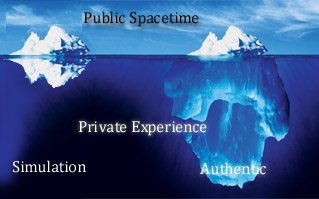
Another look at how the uncanny valley relates to the explanatory gap.
Attack and Redemption of Computational Theory of Mind
- 1. There is nothing at all which cannot be reduced to an encounter*, and that encounters can be presented directly (phenomenally) or re-presented indirectly (physically or semiotically).
- 2. That the nature of encounters can be described as aesthetic re-acquaintance, nested sensory-motive participation, or simply sense.**
- 3. In consideration of 1, sense is understood in all cases to be pre-mechanical, pre-arithmetic, and inescapably fundamental.
My challenge then, is for CTM to provide a functional account of how numbers encounter each other, and how they came to be separated from the whole of arithmetic truth in the first place. We know that an actual machine must encounter data through physical input to a hardware substrate, but how does an ideal machine (e.g. Turing machine, Universal Machine or program) encounter data? How does it insulate itself from data which is not relevant to the machine?
Failing a satisfactory explanation of the fundamental mechanism behind computation, I conclude that:
- 4. The logic which compels us to seek a computational or mechanical theory of mind is rooted in an expectation of functional necessity.
- 5. This logic is directly contradicted by the absence of critical inquiry to the mechanisms which provide arithmetic function.
- 6. CTM should be understood to be compromised by petito principii fallacy, as it begs its own question by feigning to explain macro level mental phenomena through brute inflation of its own micro level mental phenomena which is overlooked entirely within CTM.
- 7. In consideration of 1-6, it must be seen that CTM is invalid, and should possibly be replaced by an approach which addresses the fallacy directly.
The next three points have to do with my own hypothesis (Multisense Realism), submitted here only for those who might ne interested.
- 8. PIP (Primordial Identity Pansensitivity) offers a trans-theoretical explanation in which the capacity for sense encounters is the sole axiom.
PIP is the conjecture that sensitivity is the sole capability that is required for all phenomena. If we wanted to conceptualize a ‘unit’ of this pansensitivity, I suggest the aforementioned terms ‘aesthetic encounter’, ‘sensory-motive participation’, ‘re-acquaintance’, etc, or any other neologism which suggests a pre-monadic generator of pre-self and self-like perspectives.
My conjecture is that self is a type of symmetry within sense. There is no self except for self vs not-self. What is distributed by pansensitivity is not solipsism, but opportunities to modulate self-like symmetries. Selfhood is a particular form of sense distribution in which the symmetry between the absolute and the conditional is recapitulated twice. From the absolute perspective, the self becomes a branch toward isolated locality, while from the conditioned perspective, the self (the condition) stands in for the absolute.
- 9. CTM can be rehabilitated, and all of its mathematical science can be redeemed by translating into PIP terms, which amounts to reversing the foundations of number theory so that they are sense-subordinate.
Here I am talking about turning the assumptions of mathematical theory on its head. Platonic forms, for instance, would be conceived of as superficial emblems of sense rather than profound and perfect absolutes. Sacred geometry, while imbued with numinous meaning locally to a self (as it reflects the symmetry to which it owes its elaboration), but from the absolute perspective, sacred geometry is akin to a test pattern – crystallized reflections of aesthetic depth, but containing no depths themselves.
- 10. This effectively renders CTM a theory of mind-like simulation, rather than simulating macro level minds, however, mind-simulation proceeds from PIP as a perfectly viable cosmological inquiry, albeit from an impersonal, theoretical platform of sense.
All that I mean here is that because CTM trades in symbols of reflected sense-making rather than sense encounters, it doesn’t ever have a chance of capturing the important features of consciousness. It can, however, capture important features of how consciousness is distributed.
EDIT: Details added for clarity –
*Encounter can be thought of as ‘stimuli’, but need not include any information. It can be thought of as ‘qualia’ but it need not include any subject or object. The intention here is to reduce all phenomena to its absolute minimum – an opportunity for modes and motives for discernment to arise.
**This sounds jargony, for sure, but I’m inventing a precise vocabulary here, so as to avoid being misconstrued as a standard argument for what might be called ‘pseudo-subtance idealism’ (everything is made of energy, love, vibration, fields, etc) or information panpsychism (conscious experiences are produced by complex systems, functional states, etc).
John Weldon’s “To Be”
If you say yes to the scientist, you are saying that originality is an illusion and simulation is absolute. Arithmetic can do so many things, but it can’t do something that can only be done once. Think of consciousness as not only that which can’t be done more than once, it is that which cannot even be fully completed one time. It doesn’t begin or end, and it is neither finite nor infinite, progressing or static, but instead it is the fundamental ability for beginnings and endings to seem to exist and to relate to each other sensibly. Consciousness is orthogonal to all process and form, but it reflects itself in different sensible ways through every appreciation of form.
The not-even-done-onceness of consciousness and the done-over-and-overness of its self reflection can be made to seem equivalent from any local perspective, since the very act of looking through a local perspective requires a comparison with prior perspectives, and therefore attention to the done-over-and-overness – the rigorously measured and recorded. In this way, the diagonalization of originality is preserved, but always behind our back. Paradoxically, it is only when we suspend our rigid attention and unexamine the forms presented within consciousness and the world that we can become the understanding that we expect.
Die Enge des Bewusstseins, ‘the narrowness of consciousness’
To invent, I have said, is to choose; but the word is perhaps not wholly exact. It makes one think of a purchaser before whom are displayed a large number of samples, and who examines them, one after the other, to make a choice. Here the samples would be so numerous that a whole lifetime would not suffice to examine them. This is not the actual state of things. The sterile combinations do not even present themselves to the mind of the inventor. – Henri Poincaré
As part of his response, Albert Einstein writes:
… It is also clear that the desire to arrive finally at logically connected concepts is the emotional basis of this rather vague play with the above-mentioned elements. But taken from a psychological viewpoint, this combinatory play seems to be the essential feature in productive thought — before there is any connection with logical construction in words or other kinds of signs which can be communicated to others.
…It seems to me that what you call full consciousness is a limit case which can never be fully accomplished. This seems to me connected with the fact called the narrowness of consciousness (Enge des Bewußtseins)*.
Here Poincaré and Einstein are discussing the nature of creativity and the particular issue of how our personal awareness both does and does not generate novelty. Like the debate over free will, I see this as largely about the hierarchical flow of subjectivity. The personal level of awareness, as noted by Freud and Jung among others, is sandwiched between what could be called a sub-personal or sub-conscious range (Id) and a super-personal or metaphenomenal range (Collective Unconscious). Jung picked up where Freud left off, seeing that Super-Ego was not necessarily just a facade of social pressures against which the Ego cowers, but a living, trans-personal terrain of archetypal influences. The Jungian view looked at this terrain as being tied up in his idea of synchronicity – meaningful coincidence which can be decoded through a language of cross-cultural metaphor. Joseph Campbell wrote and spoke extensively on this language (‘The Power of Myth, ‘The Hero With A Thousand Faces’, etc.).
What I have not seen is a physical theory which takes the synchronicity and myth seriously. When we do take it seriously, I think that it meshes perfectly with the implications of the Theory of Relativity, and with what Poincaré and Einstein are talking about with the narrowness of consciousness. All that needs to be done is to relocate the concept of literal inertial frames of reference with a more figurative notion of phenomenal inertial framing. The idea of levels of consciousness is probably one of the most ancient and enduring concepts in mysticism. Whether they are seen as levels which can only be attained through a proscribed path or as introspective potentials which we can all access by ourselves, the desire to partition human experience as a hierarchy seems to be irresistible. Irresistible, that is, until recently. Contemporary psychology has largely moved away from hierarchies and grand schemas, focusing instead (with debatable success) on more modular, pharmacologically addressable functions.
While I appreciate many of the hierarchical maps of consciousness, like those so diligently compiled by Ken Wilber, I suggest that we begin from scratch, with an eye toward simplicity and correlation with general systems. In addition, the foundation for this view should be sensory-motive rather than information-theoretic or material-energetic. By sensory-motive, I refer to what Einstein talks about above. While the effect of creativity is teleological and communicative, the process itself is driven by what he calls combinatory play: ‘the essential feature in productive thought — before there is any connection with logical construction in words’.
Just as this sub-cognitive sensible engagement is overlooked in modern, computational theories of mind, so too is the possibility of microsensory phenomena overlooked in modern physics. I see this not as an accident, but rather the same oversight on a different scale. The idea that our own sensations emerge from a different source than the sensations which are telegraphed from the source to instrument of detection to scientific observer is not necessary if we generalize Einstein’s ‘combinatory play’ to the outer-shell of all of physics.
The MSR hypothesis is called Eigenmorphism. It is that what separates our body from our sub-conscious experience, and our sub-conscious from our personal experience can be understood in terms of a psychophysically extended narrowness of consciousness. There aren’t any inertial frames which simply exist, but only those which can be inferred through the combination of sensed perspectives. Modes of description, whether in the aesthetic of substances, quantities, or qualities are all ultimately narrowed channels of fundamental sense-making, which must be absolutely primordial. The various forms and functions which can be measured publicly are comparable to what Einstein meant about what is logically motivated and communicable, but what the deeper participation cannot be seen as the object of sight. Light, as a the most pervasive version of sense, is not a thing or an energy, but a participation multiplier – a way of being simultaneously here, there, and not literally here or there. I project my narrow attention through a mind which is already narrowed by a hierarchy of sub-personal and super-personal filters, each of which are also narrowed from scales of sensory participation so vast and unfamiliar that I read them only by the mechanical, impersonal traces that they leave. The universe that we live in is not a solipsistic narrowing of consciousness, but a nested universality of aesthetics – a combinatory play.
*The narrowness of consciousness which Einstein mentions is from William James:
“The sum total of our impressions never enters into our experience, consciously so called, which runs through this sum total like a tiny rill through a flowery mead. Yet the physical impressions which do not count are there as much as those that do, and affect our sense-organs just as energetically. Why they fail to pierce the mind is a mystery which is only named and not explained when we invoke die Enge des Bewusstseins, the narrowness of consciousness’ as its grounds.”.
Philosophy of Mind Flowchart

The idea here is that if we want to take the full spectrum of phenomena into account, we have to either begin with a reductionist realism and work upward, or a holistic idealism and work downward.
When we suppose that consciousness is a phenomenon that arises out of unconscious phenomena, we are saying that mechanism, through some act of emergence (generally by complexity), the mechanism in question (generally physical or computational mechanism) becomes enchanted with itself. In this case, as David Chalmers famously points out, there would have to be some threshold beyond which it would be impossible to tell the difference between a real person and a machine which acts just like a real person (a philosophical zombie). Finding this unacceptable, he suggests instead some variety of panpsychism should be explored, including perhaps, what I would call a promiscuous or ‘leaky’ panpsychism in which devices such as thermostats would have to be considered aware in some sense.
Finding both of these alternatives unacceptable, I suggest that we move over to the right side and begin with a downward facing ideal absolute. For the spiritually inclined, this could be called by any number of theistic names, however, it can also be conceived of equally well in completely non-spiritual, atheistic terms. When we suppose that awareness itself is inescapable and inevitable in all possible or theoretical universes, we are saying that through some divergence or illusion, awareness takes on a temporary solid appearance. In MSR, I suggest that this is a more plausible option than brute emergence from nothingness…modulated constraint within everythingness.*
Rather than positing an appeal to future scientific understanding to explain the emergence of aesthetic realism from mechanism, the divergence of mechanism from total awareness can be made palatable through a nested modulation of insensitivity. Intentionally partitioning intention itself so that it appears unintentional given a certain amount of insensitivity. This could be viewed either in the religious sense of ‘God’s divine plan is not visible to us’, or in a more conservative sense of ‘Shit happens coincidentally, but coincidental shit also happens to be meaningful from some perspective’.
If anyone is interested in what the crazy pink cone and all that is, I can explain in more detail, but briefly, if we take the MSR road from disenchanted idealism (the conservative ‘Shit happens’ option), then instead of the Chalmers dilemma of zombies vs leaky panpsychism, we get a continuum in which local sense is selectively blinded to the sense of non-human experiences, through a combination of frame rate mismatch (time scale difference cause entropy and local sense approximates) and distance (literal spatial scale difference, as well as experiential unfamiliarity).**
The other ten dollar words there, ‘tessellated monism’ and ‘eigenmetric diffraction’ both refer to the juxtaposition of sensitivity and insensitivity, through which a kind of metabolism of accumulating significance (solitrophy) in the face of fading sense (entropy) and fading motive (gravity).
*I call this cosmology the Sole Entropy Well hypothesis and it has to do with reversing Boltzmann’s solution to Loschmidt’s paradox so that entropy is a bottomless absolute, like c, in which local ranges of entropy and extropy stretch and multiply in a fractal-like reproduction.
**I call this aspect of MSR Eigenmorphism, which has to do with things appearing to be more doll-like and less familiar from a distance. This makes, for example, the presence of atoms and solar systems in our experience more similar to each other than either of them seems like a tree or a cell. The limits of our perception coincide with the simplicity of ontology, and they are, in a sense, the same thing (given eigenmorphism). As a rule of thumb, distance = the significance of insignficance.
The Sound and Style of Consciousness
In music, timbre also known as tone color or tone quality from psychoacoustics, is the quality of a musical note or sound or tone that distinguishes different types of sound production, such as voices and musical instruments, string instruments, wind instruments, and percussion instruments. The physical characteristics of sound that determine the perception of timbre include spectrum and envelope.
a signal with its envelope marked in red

What I remember from my 7th grade general music class about timbre is that it is what made modern pop and rock different from other forms of music. All of those sound effects that become possible with electric amplification allow us to transform the same kinds of melodies that have always been a part of music into new kinds of sonic textures. Any song can be made into a heavy metal or punk song by cranking up the amplitude and distortion and manipulating the tempo.
The Wiki gives a list of subjective experiences and objective acoustic properties, such as:
Subjective Objective
Vibrato Frequency modulation
Tremolo Amplitude modulation
I think that this a clue that timbre can be used meaningfully as a jumping off point for understanding subjectivity and consciousness. If we think of the red signal envelope as a cross section of a 3D prismatic glacier behind it, the axis of that figurative third dimension would be where private significance (aesthetic quality) intersects public spacetime.
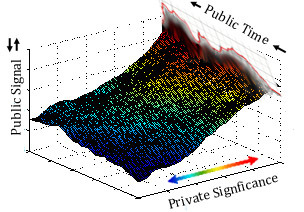
I’m not saying that qualia can literally be reduced to a kind of perpendicular meta-spacetime, but that it can be figuratively thought to cast a shadow which is measurable in those terms. The public universe is flat in comparison to the private universe, even though any particular private experience of eternity is of course orders of magnitude narrower than the totality of all experience. The full extent of our own lives and the lives of others is hidden by the constraint of our insensitivity. Our attention is directed to public facing events, to places and times outside of our private here and now.
Timbre at least recognizes the dipole of subjective and objective dimensions of phenomena and the sensible link between them. Our Western approach of psychoacoustics still reduces the subjective psycho- qualities to a mechanical model which is presumed to be driven by the acoustics only, but what I suggest is that acoustic mechanics are themselves micro-aesthetic experiences which are shared on all phenomenal levels (sub-personal, personal, and super-personal).
Timbre is a word which has been called “the psychoacoustician’s multidimensional waste-basket category for everything that cannot be labeled pitch or loudness”. The difference between a recording of a flute and a recording of a guitar playing the same song could be described in terms of timbre. Each instrument has its own idiosyncratic mixture of tonal and extra-tonal noise-like qualities. When we talk about playing a song on the piano, we are treating the melody as the object. What is being played is an abstract concept of sequenced notes, but what is bringing that abstraction into a concretely realized experience is the acoustic and artistic qualities of the instrument and the performance.
A font or typeface can be seen in a similar way. The invention of customizable fonts was one of the favorite features of early word processors. Instead of being locked into a particular typewriters look, the consumer could now make their printed output look more like published text. Font designers had to painstakingly build the look of each letter in the character set (since a computer would not be much good at guessing what a Helvetica style might be). Soon the entire typographic palette of styles and sizes were available, bringing into sharp distinction the difference between the alphanumeric data (ASCII text), and the font (character set). We can understand, that just as the melody of a song sounds different when it is played on a flute than when it is blasting out of a distorted electric guitar, a phrase written in Times New Roman carries a different meaning when it is written in Comic Sans. The computer, however, does not have any need to differentiate. It doesn’t care what font you write a program in, just as sheet music doesn’t carry instructions for a flute to sound like a flute.
If we use timbre and typeface as metaphors for qualia, we can see how it describes a difference in kind from the skeletal underpinnings of quanta. It’s true that we can use quantitative mechanisms to communicate qualia, but only if the receiver has the right kind of sensory range to match the sender’s intent. The mechanism has no way to appreciate the aesthetic content though, as all such qualities, whether they are fonts, timbre, image, or meaning, are reduced to the same binary digits. Compare this with what we hear, for example, when dragging a stick along the ground. There is the sound of the foot of the stick scraping the ground itself, and then there is the amplified, woody resonance which describes the length, mass, and density of the stick. Both can be felt as well as heard. The effect overall is a unified gestalt. Unlike a computation in which data must be explicitly separated and handled differently (some bits belong to the font, some to the text), natural sound is a feeling for our body and a knowing for our mind that is bound together metaphorically.
There is no mechanical process through which feelings and thoughts are bound. Instead, they are divided, like the spectrum of visible light is divided from white light, from the common sense of all experience. There is no way to simulate that coherence mechanically, but given enough artificial cues, our naturally poetic psyche will confabulate animation into it. We look at the words typed in a romantic script font and get a sense of a voice which might make the words seem pretentious or anachronistic. We hear the distorted guitar strings and feel that the song has become massively and explosively energetic. The ‘information’ which describes the underlying structure of the music or the typeface is non-poetic. It is only pixels and mathematical relations which relate to themselves and to mathematics in general, not to the experience of being alive. For being alive and aware, we need extra-mathematical qualities – the same qualities from which math itself emerges.
“There is no information without representation”
My rebuttal to this from New Empiricism
Information is one of the most poorly defined terms in philosophy but it is a well defined concept in physical theory. How can it be that a clear idea in one branch of knowledge can be murky in another?
The physical meaning of information is succinctly summarised in the Wikibook on “Consciousness Studies”:
“The number of distinguishable states that a system can possess is the amount of information that can be encoded by the system.”
In most cases a “state of a system” boils down to arrangements of objects, either material objects laid out in the world or sequences of objects such as the succession of signals in a telephone line. So information is represented by physical things laid out in space and time. There is no information without this representation as an arrangement of physical objects.
Information can be processed by machines. As an example, computers use the “distinguishable states” of charge in electrical components to perform a host of useful tasks. They use the state of electrical charge in electronic components because charge can be manipulated rapidly and can be impressed on tiny components, however, computers could use the states of steel balls in boxes or carrots flowing on conveyor belts to achieve the same effect, albeit more slowly. There is nothing special about electronic computers beyond their speed, complexity and compactness. They are just machines that contain three dimensional arrangements of matter.
Philosophers use information in a much less well-defined fashion. Philosophical information is far more fuzzy and involves the quality of things such as hardness or blueness. So how does philosophical blueness differ from a physical information state?
Physical information about the world is a generalised state change that is related to particular events in the world and could be impressed on any substrate such as steel balls etc.. This allows information to be transmitted from place to place. As an example, a heat sensor in England could trigger a switch that opens a trapdoor that drops a ball that is monitored on a camera that causes changes in charge patterns in a computer that are transmitted as sounds on a radio in the USA. If the sound on the radio makes a cat jump and knock over a vase then it is probably valid to look at the vase and say “its hot in England”. So physical information is related to its source by the causal chain of preceding steps. Notice that each of these steps is a physical event so there is no information without representation as a state in the real world.
In the philosophical idea of information “hot” or “cold” are particular states in the mind. Our mental states are not uniquely related to the state of the world outside our bodies. As an example, human heat sensors are fickle so a blindfolded person might contain the state called “cold” when their hand is placed in water at 60 degrees or ice water at zero degrees. Our “cold” is subjective and does not have a fixed reference point in the world. Our own information is a particular state that could be induced by a variety of events in the world whereas physical information can be a variety of states triggered by a particular event in the world.
To summarise, information in physics is a state change in any substrate. It can be related to the state change in another substrate if a causal chain exists between the two substrates. Information in the mind is the state of the particular substrate that forms your particular mind.
Your mind is a state of a particular substrate but a “state” is an arrangement of events. The crucial questions for the scientist are “what events?” and “how many independent directions can be used for arranging these events?”. We can tell from our experience that at least four independent axes (or “dimensions”) are involved.
Note
The fact that there is no information without representation of the information as a physical state means that peculiar non-physical claims such as Cartesian Dualism and Dennett’s “logical space” are not credible.
Daniel C Dennett. (1991). Consciousness Explained. Little, Brown & Co. USA. Available as a Penguin Book.
Dennett says: “So we do have a way of making sense of the idea of phenomenal space – as a logical space. This is a space into which or in which nothing is literally projected; its properties are simply constituted by the beliefs of the (heterophenomenological) subject.” Dennett is wrong because if the space contains information then it must be instantiated as a physical entity, if it is not instantiated then it does not exist and Dennett is simply denying the experience that we all share to avoid explaining it. Either we have simultaneous events or are just a single point, if we have simultaneous events the space of our experience exists.
“So information is represented by physical things laid out in space and time.”
Why would physical things ‘represent’ anything though? Without some sensory interpretation that groups such things together so that they appear “laid out in space and time”, who is to say that there could be any ‘informing’ going on?
“computers use the “distinguishable states” of charge in electrical components to perform a host of useful tasks.”
Useful to whom? The beads of an abacus can be manipulated into states which are distinguishable by the user, but there is no reason to assume that this informs the beads, or the physical material that the beads are made of. Computers do not compute to serve their own sense or motives, they are blind, low level reflectors of extrinsically introduced conditions.
“Your mind is a state of a particular substrate but a “state” is an arrangement of events. ”
States and arrangements are not physical because they require a mode of interpretation which is qualitative and aesthetic. Just as there can be no disembodied information, there can be no ‘states’ or ‘arrangements’ which are disentangled from the totality of sensible relations, and from specific participatory subsets therein. Information is a ghost – an impostor which reflects this totality in a narrow quantitative sense which is eternal but metaphysical, and a physical sense which is tangible and present but in which all aesthetic qualities are reduced to a one dimensional schema of coordinate permutation. Neither information nor physics can relate to each other or represent anything by themselves. It is my view that we should flip the entire assumption of forms and functions as primitively real around, so that they are instead derived from a more fundamental capacity to appreciate sensory affects and participate in motivated effects. The primordial character of the universe can only be, in my view metaphenomenal, with physics, information, and subjectivity as sensible partitions of the whole.
More Notes on the Against Idealism Video
I had a chance to take in some more of the previously posted video arguing against idealism. This is a solid video in my opinion and I envy the clear, thorough, and surprisingly tolerable style.
27:30 In discussing perception, the narrator makes the point that sense organs require sense organs. This is not exactly as rock solid as it might seem be. There is the blind painter Esref Armagan whose fMRI looks more or less like he is seeing. At the same time, activity in the visual cortex is perceived by those who are blind from an early age as tactile rather than visual sense. The more exotic reports and studies on remote viewing and NDEs in which blind people become sighted for the first time. Together these are enough for us to at least cast some doubt on the ontologically certain connection between sense organs and sensation. Adding in synesthesia and blindsight and we at least have reason to suspect that sense modalities are both commutable with each other to some extent and separable to some extent from the specific kinds of information processing which we expect to match. To me this puts any kind of simplistically eliminativist, mind-brain identity theory in jeopardy.
Under an idealism which posits a unified ground of being which is eternal, initial perception need not be assumed to be an absolutely novel acquaintance, but can be, I think perfectly reasonably, a kind of local re-acquaintance. In my model of this absolute ground of being, (Primordial Identity Pansensitivity) there is a kind of aesthetic interest which is gained from each re-acquaintance. Not only in a ‘practice makes perfect way’, but in a ‘significance overcomes entropy in the long run’, and in the way that the repetition of pleasure (and relief from pain) is worth repeating in and of itself.
When he gets into the memory section, the narrator assumes the model of memory as being generated locally, so that forgetting is a destruction of that memory or the destruction of the ability to recall it. While that is true enough locally, if we use the PIP Absolute that I propose, then local experience are already a kind of masking of total awareness. While we are alive, certainly the brain’s limitations directly influence our recall, but just as NDEs often include a life review, we cannot rule out that the removal of consciousness from its investment in our personal experience does not entail a reconnection with a much larger, even universal level of illumination. The case of Marilu Henner and others with superior autobiographical memory suggest that the standard, buggy memory retrieval conditions of the typical human mind may be arbitrarily or intentionally throttled. There appear to be much more effective ways for a human mind to recall events, and to see them in a quasi-visual parallelism rather than a linear, episodic unmasking of the past.
In working with the PIP model, I suggest considering it like a colorful picture covered with black crayon, which is partially revealed through scratching, and then covered up again. The picture itself would be changing as well, adding more to the canvas in response to every new scratch.
As far as consciousness requiring thought, I would argue that there are many thoughtless activities which we engage in consciously. Sex, sports, violence, etc often include thoughts, but they can be appreciated without sentences and words in our mind as well.
I would agree that human qualities of consciousness require an animal body and brain, but that does not mean that the body and brain are not themselves, aspects of non-human experiences which appear to us as made of matter. Because I think the universe is primarily aesthetic, I think the point of matter, and all forms, structures, and function is ultimately to enrich the range and depth of possible qualities of experience. Stability and realism are precious qualia, shared at the lowest levels, drawing a line between fact and fiction.
35:38 “Imagination and reasoning don’t exist in a vacuum” – I would say that is begging the question. I have seen a couple accounts of reincarnation that seem compelling, as well as evidence of child prodigies and acquired savant syndrome which suggest that like forgetting and perception limited by sense organs, imagination’s reliance on local experience may itself be a local condition of masking.
At 36:37, he talks bout free will requiring human level capacities to reason, and while I agree of course that there is a direct relation to the quality of our freedom (motives) and the quality of our understanding (sense-making) I would not say that the experience of appreciating freedom is limited to humans. Even bacteria or inorganic matter may be symptoms of an experience with some degree of volition on some alien scale of time or size. After all, if our body is only made of cells and cells are only molecules, then the potential for free will to eventually develop or not to develop lies there.
38:00 He is reiterating here the assertion that No input = No consciousness. This may be a conceit of our logical mind looking at the logical mind rather than a fact about human consciousness or consciousness in general. There are many who have used sensory isolation tanks to access vivid phenomenal states with content well outside their personal experience. It could always be claimed that these fantasies are merely recombination of memories, etc, but again it is begging the question to presume that must be the case, and especially that it must be the case for possible non-human or non-localized forms of awareness.
At 38:53, he is talking about self awareness, and offhandedly mentions that 1) all awareness must be an awareness of some thing, and that therefore the self must be some thing in order for us to be aware of it. If we assume my model of pansensitivity being absolutely primordial instead, then awareness is by definition beneath all “being”, so that “thing” is a character in whatever story is being scratched into the existential mask. The object things and the subject selves are both divided and diffracted within a deeper context of perceptual relativity. One person’s body is another person’s experience. I am saying that relation extends all the way down, so that while seeing a thing does not mean that it is the thing which is the experience (i.e. a plastic doll is not having an experience as a doll, but the plastic it is made of responds to the environment in a sensible, interactive way within its own context.)
There is something at 39:26 about sleeping and how our consciousness is suspended while we sleep. I would agree that our personal consciousness is suspended, but who wakes us up when we have to go to the bathroom? What unconscious part of the brain cares about wetting the bed and has the power to awaken our personal consciousness? Instead of seeing the brain as being the host to a sole resident, I see our experience as a loose confederation of nested experiences, on the microphenomenal/sub-personal, personal/phenomenal, and super-personal/metaphenomenal levels (levels = really entangled ranges or scopes). Not solipsism, but shared, nested perception. The brain exists independent of our personal consciousness, but not biochemical consciousness, and not of Absolute pansensitivity.
Lastly, I would add that proving that consciousness is corruptible or not is a question which itself supervenes on consciousness. Discernment of corruption, assumption of non-corruption…these are aesthetic expectations within cognition. I enjoyed the video through the first section, and hopefully will watch the rest another time. I’m not so much interested in theistic idealism, so I’m not sure about that.


Recent Comments