Nested Pansensitivity Interpretation

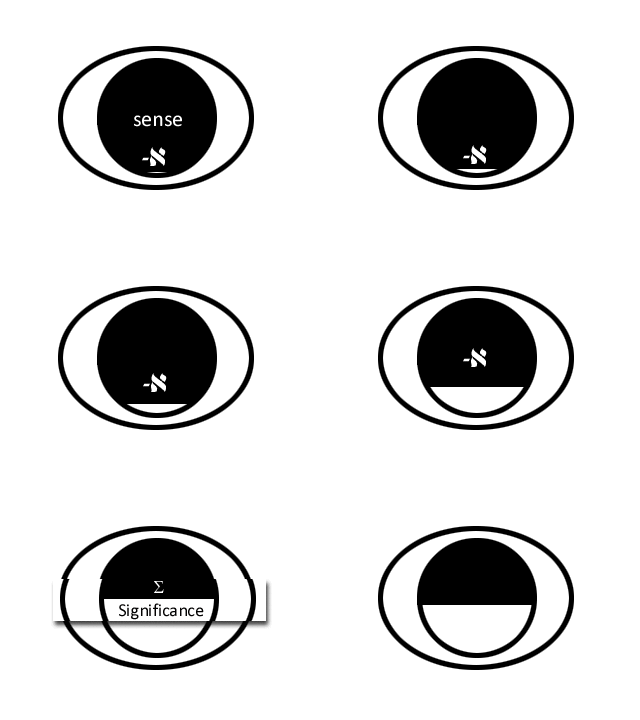
Here is an early sketch of the basic concepts of the sense-based physics in Multisense Realism (MSR). The aspects of MSR that deal with elemental conditions now fall under the heading “Nested Pansensitivity Interpretation (NPI)”. This is intended to pre-figure quantum theory, and is also referred to as quorum mechanics or post-particle physics. It is a general systems concept, so that it can apply to events on any scale, not just microphysical. The simple gifs are intended only as a metaphor – not as literal physical particles or functions. The rising bar of sense could refer to light, sound, emotion, a story unfolding, etc. It’s about the meta-ontology through which metaphysical expectations such as cycles and events arise.
In the top gif, the relation of sense, motive, effort, and effect is shown. Sense, being the primordial resource, is represented by this oscillation of light and dark, but it should be noted that this refers to the appreciation of feeling or sensing, not a literal mechanism which oscillates. Primordial pansensitivity must pre-figure time, cycles, identification of light and dark, etc. All of those tropes of sense (symmetry, opposites, etc) are types of significance (as shown in the second gif).
In the top gif, the center circle is nested within a concentric ellipse to denote one of what I suspect are the most primitive types of significance – the distinction between interiority and exteriority. As sense builds to a peak, it can become focused as a motive. We have countless motives within and at the fringes of our awareness as human beings, but what is being shown here is a conjecture about the nature of any part of the universe, even in the complete absence of human beings, biological life, and physical matter. I use the Omega symbol (Ω) for Motive because a) it’s cool, and b) it references exteriority and teleology obliquely, being that it is the last letter of the Greek alphabet. Motive is the part of sense which is targeted for action. The symbol itself obliquely references exteriority as well, appearing as a breached circle or as a white bulb emerging. Using the minus Aleph symbol (-ℵ) has been my convention because of it’s connection to ‘before the first’, and ‘before the expectation of infinite cardinality’. Counting requires logic, which requires multiple nested cycles of sense, motive, effort, effect, and significance to be abstracted.
Quora Question on Entropy
Help me understand this. If entropy is about signal transmission, and is measured by “how much information is missing,” it implies a transmitter and receiver – in other words, a relationship. Entropy is an appealing notion because at first glance the receiver of the information cannot suddenly know more than what is transmitted. But the amount of information the receiver can receive seems to be highly relative and transformable.This is if I understand correctly that entropy is not a measurement of a system’s physical properties, but of how much information is missing when that system is observed. For sure, a system will emit is information, and there will be a less than 100% reception of that signal for any system observing it. That number cannot be 101%…. But there are two sides to a relationship, and a system’s entropy is not related to some total “information” it “contains”… So there are simple workarounds to that 100% threshold.
For example, if I look at a blade of grass that I hold in my hand, I can only receive so much information about it, and I cannot get more information than what it is transmitting to me… Unless I then look at it under a microscope and now the information loss (entropy) has decreased. If entropy were a law of the universe, my act of changing my receptor would be “impossible.”
It seems to me that labeling entropy as an unbreakable law is a naive notion, and instead I see it as a useful property of observation. Does entropy deserve the status of “law of the universe”?
The subject of entropy is, appropriately highly entropic. There are a lot of different ways that the word is used, some more figuratively than others. Thermodynamic entropy is not the same as information entropy, in the sense that if we make an MPEG compressed video of a glass of ice melting into room temperature water, the first half of the movie would take more resources to compress than the last half, given that the last half would feature only a glass of still water. As the thermodynamic entropy of the actual ice increases, the information entropy of the content of the video decreases. The sensitivity of the video camera is limited, so it can’t detect the microstates of the water molecules.
I think this speaks to the question of perception, and how our designation of what constitutes a ‘system’ is more arbitrary than it may seem. All of our instruments and all of our sensing and sense-making capabilities are potentially as limited as the video camera. Our attention is squeezed into an anthropocentric range, so that our window on ourselves and the universe does not allow us to discern ultimately what is ‘a law of the universe, or simply an assumption based on our perceptions’. Everything that we can understand about the universe is furnished to us only by our perceptions, intuitions, and understanding.
Our perception leads us to expect a universe of laws and realities beyond itself, but these too are either ultimately subjective conditions, or else subjectivity itself must include the possibility of transcending itself. The difference between what we presume to be our private perceptions and what we presume to be something more is…. entropy. There is no way to obtain 100% of the information about anything. Even given omniscient access to the entire history of the universe, the nature of the universe may be intrinsically open ended within any given inertial frame.
What I am suggesting is that just as entropy is the gap between what we experience and what we think could be experienced (‘objectively’), what we consider information may only appear to be finite because of the gap between our native perceptual frame of reference and the target frame of reference. Rather than being a true description of what a phenomenon is, ‘information’ may be as fictional in its amputation of subjective qualities as perception is in its failure to pick up on physical properties. The definition of entropy itself can be thought of as gradually reversing or flipping in proportion to the distance (literal and figurative) between two perceptual frames. Take these words for example. If you read English, then your absorption of their meaning is rather loose and general. You get the idea of what I am saying, and even sort of ‘hear’ an inner narrator voice that stands in for me. It’s all rather fuzzy, but it works really well. Entropy is actually what allows you to get the gist of what I am saying or even what I am not saying (reading between the lines).
By comparison, someone who cannot read English at all may have a much clearer view of what these characters ‘actually’ look like (without as much fuzzy interpretive conditioning). In the same way, some people find it easier to draw realistically if they are copying an image upside down. Entropy and significance, subjectivity and objectivity are not functional properties, they are aesthetic ranges. The universe as a whole can, in the same way, be considered primarily an aesthetic phenomenon as a whole, in which any part can reduce another to a functional stereotype using variations on the theme of distance or insensitivity.

What is Time?
How would you define it?
I propose a new way of describing time, which I find clearer and more explanatory than others.
Time is an abstraction which refers to a general property of experiences which are remembered or recorded as having occurred in a either an irreversible linear sequence, or a repeating sequence (cycle). In my view, time is inherently phenomenal (private, experiential) rather than physical (public, structural), not just because of time dilation under Relativity, but for the more axiomatic reason that time requires memory. Without memory, there can logically be only one eternal moment. It could be repeating forever or be following a pattern or have no pattern and nothing could tell the difference. Time…is experience, or a quality of experience through which private memory can map to public structure. I suggest that time can be understood as taking on three different modal scopes:
I. Micro-phenomenal: This is clock time. Physics. Looking at the development of time keeping, we can see that early devices exploited natural processes which were either continuous and invariant, such as the flow of water or sand into a container, or which cycled reliably, such as a shadow on a sundial. Mechanical clocks offered a marriage of the two, whereby an underlying linear or oscillating effect such as an unwinding spring’s tension or a pendulum’s swing would advance the teeth of a system of gears, one by one.
Each tick/tock is an precisely measured event which is, as much as possible, uniform and generic. As technology has improved, we have refined the clock to a pinnacle of pure abstraction. Both the indivisible and divisible power of nature has been abstracted electronically. A perpetual electrical current drives generic switches to compute a digitally coded readout. Satellite networks deliver synchronized atomic time. Each microsecond like the last, and even though global adjustments to clock or calendar can be made arbitrarily by central authorities, we feel that this kind of time is the ‘real time’.
II. Phenomenal Time: This is natural time. Idioms like ‘time flies when you’re having fun’ or ‘it was the longest night of my life’ reflect that our ordinary sense of time also dilates and contracts through emotional states. Significant events and experiences seem to stand out in our autobiographical memory as not only more timely, but more timeless as well. We claim them, intentionally or unintentionally, as our own. This kind of time is narrative. “I woke up, I ate breakfast, I went to the store”, etc.. There is a story which has a shape – beginnings, middles and ends. It is not just generic oscillation or monotonous duration or arrow of increasing entropy, but a proprietary sequence of participation. This is the kind of time that we might say ‘seems like’ it is real.
If you think of how a story works, the more of the story is told, the more the information entropy decreases. By the middle of the story, we know the characters, the setting, the plot, etc. The number of possible ways the story can continue is relatively limited (even if it is still potentially unlimited in an absolute sense). The significance, however, of the remaining bit of the story is increasingly augmented. If the story is good, you want to hear the end of it, even if you are pretty sure that you know how it will turn out.
After the story ends, it would seem that there is no entropy left. The story has been told in its entirety. In reality, however, the meta-story has just begun. The memory of it survives, creating new opportunities to be applied figuratively in one’s life, as well as sharing it socially and seeing it retold, dramatized, and celebrated in culture as myth.
III. Metaphenomenal Time: Carl Jung famously wrote about the Collective Unconscious, and synchronicity. Experiences which some consider delusional or paranormal. Meaningful coincidences, prophetic dreams, a symbolic language of recurring characters and sagas called archetypes. This is eternal time. Time wound around itself in such a way that some essential, iconic reduction of all that has happened or might happen is in some sense ‘always still here’ and in another sense ‘never really anywhere’.
This is not mystical babbling to me, it is literally the physical reality of what the universe is and what (or who) it does. We have no trouble thinking of eternity in the Platonic sense, as ideal geometric forms or mathematical relations, but because we ourselves are immersed in human phenomena we do not see ourselves as being composed of similarly eternal recurrences.
Because there is no hard line between I, II, and III, all time is actually nested within all three contexts. This can help explain how intuition could work to allow people to sometimes pick up on feelings from a larger scope of time. Events that have great significance especially could theoretically cast a shadow from the III range to the II, so that from the II perspective, it is precognitive.
Time for Nested Causality
What do you about the simultaneity of cause and effect?
“The greater part of operating causes in nature are simultaneous with their effects, and the succession in time of the latter is produced only because the cause cannot achieve the total of its effect in one moment. But at the moment when the effect first arises, it is always simultaneous with the causality of its cause, because, if the cause had but a moment before ceased to be, the effect could not have arisen…. The time between the causality of the cause and its immediate effect may entirely vanish, and the cause and effect be thus simultaneous, but the relation of the one to the other remains always determinable according to time.” (Kant, 1787, The Critique of Pure Reason)

As the crickets’ soft autumn hum
is to us
so are we to the trees
as are they
to the rocks and the hills.– Gary Snyder
Animation

Animation doesn’t make sense as a property which emerges from a computation, it is inferred through an expectation which is aesthetic rather than functional. The information content is the same whether there are rapid updates of static frames or whether there is an animated flow, yet our sense of realism is hinges on the sense of continuous motion.
It makes sense to me that when sense is interrupted by another level of sense, the result is a representation which as an artificially static quality. The conversion from a waving over time to a shape of a wave in space is a destructive compression. The wave shape can be strung together with variations of itself, but that doesn’t automatically imply an narrative experience, only a collection of ordered shapes. If computation is the animation of logic, then logic is at once the dis-animation of sense and the automation of sense.
The genuine dynamism of sense is derived not from position and momentum, but from the transformation of effort into satisfaction. Each micro movement we make subconsciously satisfies countless agendas on every scale – neurological, physiological, psychological, intuitive….thousands of sub-personal negotiations being worked out in real time right under our noses. Scratch an itch, shift position. Paying attention to these things can make us nervous and self-conscious. By bringing our personal awareness into the sub-personal, we slip into recursion and undermine our self-confidence – our power to control our effort and satisfy our personal level agendas.
Curiously, when simple figures are animated into cartoons (the word cartoon comes from the canvas or cards that artists would use to draw them on), the aesthetic of realism is charged with what could be called ‘levity’. Watching a cat chase a mouse in real life might elicit anxiety or agitation, but as a cartoon, the figures of mice and cats are recontextualized as delightful or hilarious. The idea that this is an emergent property of computation alone is technically possible, but only if we have already given computation the benefit of the doubt of producing all of these functionally superfluous aesthetic qualities. It seems to work better the other way. In animation, we see that which is closer to what we are made of – we see imagination ‘brought to life’.
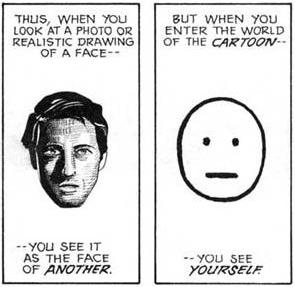
From Scott McCloud’s excellent Understanding Comics, he points out the cartoonists mastery of the palette of subjectivity and objectivity. The more realistic detail is added, the more information there is – the more that has been calculated and measured, and the more that it reflects the power of reality to arrest consciousness. The unrealistic face promotes an informal state of mind, where the vacuum of information does not stand empty as it would in RAM, but is instead filled in with self-identification.
Othello
“Othello” is a code that exists in a variety of forms, including ink on paper and binary digits on electronic storage. When this code is processed by human minds, it evokes some specific sensations. For instance, it causes our mirror neurons (and other brain modules) to run simulations of characters and situations.
The sensations “Othello” evokes in two different brains will usually be similar enough that the owners of those brains will be able to have a meaningful discussion about the play.
What I propose is that you turn your description of Othello as a code inside out. The code idea is a good one, and one that makes a lot of sense, but I have found that it makes more sense to view it this way:
“Othello” is many different but related phenomena:
0) Elementary level
- +0) a human experience that can be accessed through particular states of conscious and subconscious attention (proto-sensory)
- -0) a symbolic code that can be modulated and demodulated through a variety of communication channels (logical-quantitative or pseudo-sensory)
1) Sub-Personal level
- +1) a series of audio-phonetic and psycho-acoustic sensations which are fragments of aesthetically richer experiences. (sensory-qualitative*)
- -1) a series of electro-magnetic and neuro-chemical state changes which through which a computational isomorphism arises between syntactic structures and functional semantics. (microphysical)
2) Personal Level
- +2) a production of subjective feelings and thoughts in which one is theatrically immersed. This does not occur because of 1), but rather because of the essential psychological unity of the human experience that is being tapped into (+3) at a personal and social level of understanding (+2).
- -2) an enactment or rendition of a tragedy by William Shakespeare, believed to have been written in approximately 1603, and based on the Italian short story Un Capitano Moro (“A Moorish Captain”)
3) Super-personal Level
- +3 ) an artistically customized sampling of mytho-poetic inspirations, in which timeless human themes are clothed in specific anthropological, sociological, and psychological metaphors (metaphoric).
- -3 ) Part of a body of work which arose through the English Renaissance Period or Elizabethan Era reflecting a resurgence of interest in the humanities. It serves as an archeological artifact to add to our knowledge about everything from European history to political science, art, language, racial relations etc. (I call this meta-theoretic to contrast with the metaphoric…intellectual rather than aesthetic)
∞) Absolute Level
- +∞) A harmonic** integration of all of the above, so that each level makes sense in its own context and in conjunction with others. To arbitrarily choose one level of description would be a destructive compression if taken literally. (Telic)
- +∞) An impressive, though ultimately inevitable product of mathematical and physical laws plus statistically random mutations. (Ontic)
*I call this ‘semaphoric’ – meaning simple, repetitive meanings as would be produced by signal flags or digital codes. Intended to evoke a contrast to metaphoric, which are numerous complex figurative meanings extracted from a single communication. The personal, ‘phoric’ level would be between the semaphoric and metaphoric.
**or what I call ‘holotrophic’ – a productive extension of tendencies toward wholeness.
If the universe was going to be destroyed, and we had to recreate it based on some general description, I would say that my list of five, dual aspect levels is the minimum reduction that would be useful.
The idea that it can all be reduced to codes and simulations I consider to be a folly of the turn of this century in which low level functions are confused with generators of high level phenomena rather than the other way around.
To sum up and add cool symbols:
0) Elementary
-ℵ Sense, Essential Figurative Unity, +0
ω Information, Existential Logical Units, -0
1) Sub-Personal
æ Affect-Effect, Sensory-Motive Intention, Semaphoric Qualia +1
E Energy, Unintentional Physical Function, Dynamic Analogues -1
2) Personal
Æ Aesthetic Experience, direct, ‘-phoric’ +2
M Material Structure, indirect,’-morphic’ -2
3) Super-Personal
Ψ Psyche, Super-Personal, Meta-phoric, mytho-poetic +3
Φ Noús, Super-Impersonal, Meta-theoretic, algebraic-geometric -3
∞) Absolute (ॐ)
ש Telic, Metaphenomenal, proprietary preferences +∞
Δ Ontic, Automatic, generic axioms -∞
Syzygy Integrals and Other Neoquantisms
 Syzygy Integral
 Syzygy Integral with labels
When applying the syzygy integral to a sense modality such as vision, the Δæ would refer to the difference in the microphenomenal qualities, such as pixel hue, saturation, value, or contrast/edge detection, etc.. the entire palette of what I would call entopic or generic visual encounters. As shown in optical illusions, these elemental graphic features depend on their surrounding context, and two pixels or shaded regions which are measured to be optically identical can be perceived quite differently.

For this reason and others, I suggest that the fundamental nature of all phenomena is only definable in terms of specific properties, but of a pseudo-specific quorum of detectable differences. It looks like a lighter grey on the bottom because of the adjacent contrasts, and it is my conjecture that this kind of pseudo-specificity is at the heart of all measurements, particularly those which we have used to define subatomic particles.
On the top of the integral, the ∇Æ would refer to an entirely different, top-down mode of visual perception. Instead of a delta (Δ) to stand for a the difference of generic micro-phenomenal qualia, the nabla symbol (∇) is used to stand for a divergence from a larger perceptual context. This relates to the binding problem, i.e., when we see two dogs walk behind the same fence, we do not perceive them as becoming the same dog – the narrative continuity does for our overall understanding what the ‘illusory’ plasticity does on a microphenomenal level. To see the ) as a smile in the emoticon : – ) requires both a low level fudging of pixels into a curve, as well as the ability for our expectation of a face to be projected from the top down. The emoticon is a minimalist example, but a better example would be something like this:

Terms like pareidolia, apophenia, simulacra, and eidetic hallucination all have in common this potential to misread a more proprietary, macrophenomenal text on top of a relatively generic, microphenomenal context.
What the syzygy integral is supposed to model is that any given sense modality is a special kind of integration between top-down or holotrophic orientation and bottom up, entropic orientation. In the case of visual sense, the top-down images are encountered like those in an Rorschach inkblot, as endless wells of imaginative psychosexual association. The personal range of the psyche is here encountering influences from the super-personal range of the overall presence of this moment in relation to their lives, and their lives in relation to eternity.
The bottom-up ‘entopic’ confabulation (entopic hallucinations are those which are geometric designs, etc as opposed to eidetic hallucinations which are images such as specific faces) is where the personal psyche encounters the sub-personal influence of neurological, biological, and chemical events as it impinges on them visually. An entopic hallucination presumably maps much more directly to neurochemical patterns in the visual cortex, whereas the eidetic, storytelling hallucinations would be much more obscure and proprietary. A hallucination of Darth Vader or Dick Cheney might be hard to tell apart from looking at an fMRI, but it should not be so difficult to get a fix on zig zag patterns vs concentric circles, etc.
The syzygy integral of vision then would be this continuum between the sub-phenomenal adhesive that holds the graphic canvas together and the cohesive that renders the meta-phenomenal meanings and figures phenomenally visible. It’s not an ordinary integral, since it has an encircled triple bar in the center, which denotes a participatory intent (motive effect), and an aesthetic contour (sense affect). The term syzygy, an old favorite of mine (its a real word), refers to a union of opposites, either figuratively as in yin-yang, or literally as in an solar eclipse where the Moon is opposite to the Sun behind the Earth.
In the syzygy integral for vision, the vast sweep of possible interpretations from the meta to the micro level is interrupted by the inflection point of the moment as it is localized from eternity (the absolute). That which is seen had been both filtered from above and built up from below, but the visual encounter is defined even in opposition to that. The seeing is not the seen. All visual forms are opposed to an equally rich continuum of possible ways to appreciate those forms and images. The syzygy integral is not just a map of what there is ‘there and then’ but the entire domain of what each and every there and then still means ‘here and now’.
As the syzygy integral can be used to describe vision (vision = the participatory integration of graphic differences and imaginative likeness) or sound (sound = the participatory integration of phonic differences and psychoacoustic likeness), so too should it be able to describe the character of all phenomena. The underlying formula (Grand syzygy ingegral) uses the * asterisk and # pound to denote the limit of infinite figurative unity and the limit of literal, finite granularity respectively. In this case, the encircled triple bar refers to the Primoridal Identity Pansensitivity, from which all other syzygies are diffracted.
 Grand Syzygy Integral
The syzygy integral without the contour circle I am calling the information integral.
 Information Integral
Unlike the syzygy integral, which defines every piece of information as an aesthetic encounter or re-acquaintance, the information integral refers only to the skeletal functionality of sense. Locally we may experience novel encounters or acquaintances, but some would argue that all experiences can only be re-acquaintances from the absolute perspective. I think that it may make the most sense to think of even that either-or condition as just another superimposed quality of the absolute. Awareness is infinitely novel, infinitely repeating, and paradoxically non-paradoxical. It is only the disorientation of locality which provides orientation.
The information integral strips away all of the mystical trappings – the supertext and subtext contours, and refers instead to the conventional concepts of information theory. Here, the triple bar is still a participant and intentional arbiter of interpretation between signal and noise, but without the aesthetic complication. This is the standard view of information processing as a functional exercise, only with the additional acknowledgement of a core superposition of telic intention and ontic unintention, absolute improbability and immaculate reliability.
Alien Hand/Limb Syndrome
“The alien hand syndrome, as originally defined, was used to describe cases involving anterior corpus callosal lesions producing involuntary movement and a concomitant inability to distinguish the affected hand from an examiner’s hand when these were placed in the patient’s unaffected hand. In recent years, acceptable usage of the term has broadened considerably, and has been defined as involuntary movement occurring in the context of feelings of estrangement from or personification of the affected limb or its movements. Three varieties of alien hand syndrome have been reported, involving lesions of the corpus callosum alone, the corpus callosum plus dominant medial frontal cortex, and posterior cortical/subcortical areas. A patient with posterior alien hand syndrome of vascular aetiology is reported and the findings are discussed in the light of a conceptualisation of posterior alien hand syndrome as a disorder which may be less associated with specific focal neuropathology than are its callosal and callosal-frontal counterparts.” – http://jnnp.bmj.com/content/68/1/83.full
This kind of alienation from the function of a limb would seem to contradict functionalism. If functionalism identifies consciousness with function, then it would seem problematic that a functioning limb could be seen as estranged from the personal awareness, is it is really no different from a zombie in which the substitution level is set at the body level. There is no damage to the arm, no difference between one arm and another, and yet, its is felt to be outside of one’s control and its sensations are felt not to be your sensations.
This would be precisely the kind of estrangement that I would expect to encounter during a gradual replacement of the brain with any inorganic substitute. At the level at which food becomes non-food, so too would the brain become non-brain, and any animation of the nervous system would fail to be incorporated into personal awareness. The living brain could still learn to use the prosthetic, and ultimately imbue it with its own articulation and familiarity to a surprising extent, but it is a one way street and the prosthetic has no capacity to find the personal awareness and merge with it.


Recent Comments