Archive
“Is Consciousness a Controlled Hallucination?”
In this new video from 8/25/2021, philosophers Philip Goff and Keith Frankish discuss consciousness with neuroscientist Anil Seth, whose new book is Being You: A New Science of Consciousness (which I have not read yet). Following are my comments on the first half of the video:
Jumping right in from the first few minutes, I have some questions, criticisms and insights that are worth mentioning. My apologies for the long winded, irritatingly constructed sentences that probably detract from what I’m trying to say more than clarify, but it’s important to me that I communicate the nuances in excruciating detail. Maybe someone or some AI internet archive spider will find it interesting in fifty years.
8:45 (Anil Seth) “Everything that we perceive is an active construction. It’s generated by the brain.”
Has this been tested and found to be conclusively true, or is it an assumption + confirmation bias? How do we know that what we perceive is not an active filtration or modulation of access to other contexts of consciousness (transpersonal, subpersonal, etc)? How do we know it is active construction rather than participatory collaboration?
What is the physical mechanism by which “the brain” (the whole organ? neurons? molecular changes within neurons?) “generates” (Explanatory Gap/Hard Problem goes here) these “constructions” (sights, sounds, flavors, thoughts…call them qualia)?
Note: *Importantly, anything we refer to as a brain is also only known as qualia, by qualia, for qualia. A brain is an object rendered in our sense of touch, an image rendered in our sense of sight, an idea rendered in our sense of understanding. We have no valid reason to presume objects to be anything other than shared or universal qualia. To the contrary, even the physicalist/eliminative position demands that everything that we experience and can ever experience, including all physical phenomena, can only ever be a representation of conditions inside of a (literally meta-physical) program or biochemical virtual “function space”. If physicalism is right, we can never contact physics in any way and are forever trapped in some kind of Platonic cave of computations that only seem physical, or only seem like computations, or only seem to seem…or something.
9:28 (AS) “My perceptions have the characteristic phenomenology – they appear the way they appear because that’s useful for my overall survival as an organism.”
My argument against this is that it is clearly a “Just So story”, that is, a post-hoc justification of appearances without being based on any plausible a priori possibility of a capacity to generate appearances physically, let alone for any such thing to provide a possibility of survival advantage over the ordinary complex physical activities of other body systems that we presume do not generate appearances and would not improve as a result of them. 1
Indeed, it seems quite implausible that of all phenomena that have come to exist in the universe, only these certain groups of cells in certain organic bodies have this unexplained physical power to generate non-physical appearances…to themselves…that bear some isomorphic relation to everything else in the universe…that actually has no appearance at all.
The entire physical universe is, under the contemporary neuroscientific view that Seth advocates, without appearance – an invisible, intangible, unexperienced void that spontaneously acquires a monumentally grand variety of distinct, multisensory appearances when certain very specific kinds of biochemical events occur in certain sequences. But how? And Why?
Given the staggeringly effective abilities of a simple periodic table of atoms generated by simple stars to physically generate and maintain every organism, every immune system, every brain structure and function without any such thing as appearance, why would this virtual dashboard “appearance”, within which a hallucinated “user” of such hallucinated dashboards also virtually “appears”, offer any improved chance of survival to a reproducing body of cells? There are neurons in the gut too. What is our theory for how and why these systems of cells would not benefit by creating hallucinated ‘constructions’ for…their mission critical activities (or is it for their constructed ‘selves’)?
9:40 (AS) “Redness is not objectively out there in the world. There’s just wavelengths of electromagnetic radiation”
The problem here is that our expectation of electromagnetic radiation, and of a world, and of objectivity would also have to be constructions. Our sense of a physical reality that has no appearance and can never be contacted in any way, must also be a construction. No matter how much science we do, and how objectively we think we are being, we can only ever validate our sense constructions by more constructed appearances of relation between theories (intellectual constructions) about observations (meta-perceptual constructions derived from multiple similar perceptual constructions). You can’t have it both ways. If consciousness is constructed, then every sense of correspondence between constructions is also constructed. We can’t put ourselves in a hallucinatory box without that box also being hallucinatory.
10:19 (AS) “In some conditons, like under psychedelic drugs or in psychosis, whatever, your perceptions become less controlled by the relevant sensory data.”
Is it always less controlled, or do altered states of consciousness sometimes appear to open access to sensory data that is controlled by different, but no less controlling features of reality beyond physical appearance constructions? Some of that data may be in conflict to some extent with our default conditioning, and even physical causality, but not always. Psychedelics and psychosis are sometimes tied to genius insights and unusually high performance (Doc Ellis’s LSD No-Hitter as an example). Transpersonal/psychedelic appearances may defy ordinary personal and subpersonal control, but that does not mean that the defiance is not simply another, perhaps higher2 context of control. There may be conflict and chaos between modes and scales of awareness, and that is fairly described as ‘uncontrolled’, but it need not imply that what is bleeding through personal awareness is not also a form of highly developed awareness. By analogy, two strong, clear radio station signals may be received by one receiver as a garbled confusion of two signals and static. In addition, examples like Doc Ellis’ psychedelic no-hitter present a counterfactual data point to the hypothesis that it is always adaptive for hallucinations to tend to resemble physical conditions and causes.
11:51 AS makes an important point about prediction not always being about predicting the future, but rather we might also refer to perceptual fill-in of missing data ‘prediction’. What needs more attention, IMO is the wholeness or gestalt of the appearance. A simulacra such as a face appearing in a cloud does not appear to be filling in something as a computer would try many different possible solutions, rather one solution or another appears in its entirety at any given moment. While the neuroscientific view focuses on the information processing function of suppressing ambiguity, the more interesting issue to me to focus on is what that ambiguity is replaced with – seemingly complete and aesthetically rich presentations that are revealed in a finished form rather than constructed over time, as if being pulled from some eternal Akashic gallery of archetypes. It seems to make no difference whether the gestalt is from memory or novel as far as the level of detail of its completeness or the speed in which it is accessed. When I see the Mona Lisa in the image below, it is ephemeral yet persistent, and neither fuzzy nor focused.

In the case of novel gestalts (such as a weird, non-famous face in slice of toast), the fill-in would appear to have no value or a negative value to abductive reasoning (~13:12). The simulacra toast face does not lead us to an explanation of a physical cause of that sensation. Note that our early advances in artificial image recognition do not produce these kinds of prefabricated gestalts, but rather just the opposite.

In fact, without the side by side comparison, the digitized output of Bayesian-like backpropagation does not really resemble an image. It is an anti-simulacra…a source of potential recognition strategies, but what is being recognized is not a visible image, but invisible statistics. Why, if Anil Seth’s view is on the right track, do our guesses and predictions look like they are coming from ‘somewhere’, rather than from nowhere?
The conversation continues into describing the role of prediction for both biology and consciousness. There is no question that human personal consciousness uses Bayesian-like probabilistic methods of accessing what I would call subpersonal data, but whether that data is simply another layer of conscious experience or an unexperienced biochemical process remains untouched by neuroscientific inquiry. Yes, our perception certainly can model to predict something evolutionarily functional (red octagon = Stop sign) but that does not explain what the appearance of color or shape actually is, how it appears, or why. Retrospectively, once we have qualia/appearances, then sure, we have every reason to benefit against natural selection pressures by using them, but we would have the same reason to benefit from any power that transcends ordinary physics. Omniscience would come in handy, and it’s just as likely to emerge spontaneously from physics as any sort of qualia.
The retrospective benefit of prediction does not in any way prospectively justify the existence of qualia or its value for prediction over and above biochemistry. Everything that Anil is saying is important to the easy problem of consciousness, and it gives us a plausible connection between evolved Bayesian prediction mechanisms and evolutionary biology, but it doesn’t give us any insight into how either of those mechanical-anesthetic functions could relate to phenomenological (aesthetic-participatory) presentations, or the possibility of their being generated physically or mathematically. Philip makes this point later on, around ~21:00, that the predictive features of consciousness are neutral as far as dualism v materialism is concerned.
Although Anil goes on to say that his materialism is pragmatic rather than an absolute philosophical conviction, he does not really seem to support that. Instead his defense of pragmatic materialism seems more tied to a preference for working with brain function rather than metaphysical speculation. I don’t disagree, but it’s not an argument that defends materialism objectively. It is of course more pragmatic professionally to know about the brain than it is to know about the big picture of life, the universe, and everything, but that doesn’t make it more true. As he continues around ~28:00, it seems clear to me that his rejection of Dualism (which I reject as well, but for the opposite reason3) is itself a kind of naive rejection of a straw man of Dualism, it’s history and popular association with the harmful behaviors of religious groups, etc. It’s a pedantic, and overused disqualification of all things non-material on general grounds of being ‘unhelpful’ and silly seeming. I think that there are good evolutionary reasons for that bias toward matter and by extension survival of the material body, but it is an unscientific bias nonetheless.
Around 33:45, Keith asks Anil about realism and privacy. His response includes “Buses have qualities, properties such as solidity and velocity that do not rely on a mind to exist.”
Here I would say that we only know that those physical properties do not require our mind to exist, but we do not know that such properties are anything other than other properties of consciousness. Perhaps there are impersonal qualities of conscious experience that are common to certain contexts and modalities of sense that have become nearly universal. If our sense of physicality is derived from our haptic-tactile sensitivity and perceptual processing, then it makes sense evolutionarily that the appearance of our body and it’s existence in a world of bodies/objects/matter is rendered with robust realism. That physical universe that our bodies exist within may be the sole common context that binds all experiences together, however that universe may in turn be dependent on a larger context of a universal haptic-tactile sense capacity that prefigures biology, and which may be dependent on a still larger context of an irreducibly aesthetic Totality or Holos.
The discussion goes on to mention Donald Hoffman’s Interface theory, where Anil comments that he parts ways at the point where Hoffman’s view suggests conscious agents everywhere. I call this ‘promiscuous panpsychism’ and agree that it seems unparsimonious – however – I see agency itself as irreducibly qualitative, so that it need not be a prerequisite for qualia. I propose that the universe may exist as an experiential phenomenon prior to a robust sense of agency, and that qualities like redness, or visibility itself may exist as modes of awareness independent of any container of multiple other types of awareness. Something like subjectivity may develop from more primitive sensory-motive qualities, which we may have mistakenly conceived of in non-participatory terms such as electromagnetism. In other words, the sense of being a participant may evolve from pre-agent experiential-aesthetic phenomena of “motive” or “participation”. It may be that agency is nothing more than a sense experience of persistent separation from of multiple other sense experiences.
I think that Anil is wise in stating at ~43:22 that his view does not insist that qualia must be reduced exclusively to behaviors, dispositions, and functions. He goes on to say that he thinks that the self is not a separate entity as in Dualism, but is just another controlled hallucination. I agree with that, however, if we follow the reasoning to its logical conclusion, Seth is saying that it is the brain that is hallucinating itself as a self, rather than as a brain appearance. This to me is arbitrary and inconsistent. If the self is a phenomenological model of something, then so must the brain be also – and physics. Whatever it is that hallucinates both physics, brains, and selves cannot be meaningfully described as physical, and the whole notion of hallucination begins to unravel itself. Neither self nor brain has any reason to hallucinate, and if hallucination is more primitive than either of those, there is no reason to diminish it in hallucinatory terms. If my suggestion of universal qualia is on the right track, that would be the more fundamental reality, or even more fundamental than reality as it encompasses fact, fiction, nonsense and qualia in which all three can comingle as well as transcended.
More that I agree with after the 50:00 mark, Anil talks about the brain being fundamentally an organ concerned with keeping the body alive. The problem is that view doesn’t offer any explanation of how that function would be so different from that of any other body organ or system that it would allow its predictive, homeostatic strategies to be anything other than the biochemical gears and timers that we observe them to physically be. What makes the homeostasis of a body any more worthy of non-physical aesthetic seemings and hallucinations than any other system within a body? The immune system has to record and strategize against pathogens, shouldn’t it also have evolved feelings, thoughts, sounds, etc to model its games and meta-games?
After the 57:00, Philip brings up Free Will and the extreme positions of Determinism vs Libertarian Free Will. Here again, Anil’s response is a fall back to cliched arguments from incredulity; “Not even wrong”, “Not the kind of argument that warrants…” These aren’t valid objections. They might be true, but you have to provide a reason why. How you feel about it isn’t relevant. “What could that possibly mean?” he asks at 58:39…”Without invoking some sort of thing that has causal agency…” “I have no need for that hypothesis”.
Except that you do need some kind of hypothesis for how you can purport to have authority to decide what hypotheses you need in the first place. What is this “you” that the brain puppet on the screen speaks of? How can it have opinions or change them?
I understand Anil’s line of objection as I used to think of free will in the same way for many years. I reasoned that we have no choice but to make the ‘best’ choice we are aware is possible. After flipping my physicalist worldview many years ago however, I see the limitations of that assumption. While I completely agree with determinists and neuroscientists who point to our shockingly bad estimation of the independence of our will from subconscious influences, I no longer see that as a valid reason to eliminate some measure of direct personal agency as a legitimate influence on its own.
For example, sure, I can connect up a device to someone’s brain and zap them into making their arm move. If I zap it just right, they will think that they have made it move, but if we follow the causal chain back from the zap, it is my personal agency that is clicking the button to override their personal agency. In addition to chronically overestimating our own sense of free will, I see that we also chronically underestimate it, and that human beings routinely demonstrate remarkably unprecendented acts of creativity – inventing their own new choices rather than simply following the nudgings of their default brain states.
This gets into a much deeper discussion into the fabric of causality, which in my view can be understood in a radically new way. To use a metaphor of a traffic light, where Anil Seth’s view might reduce a Yellow (“Caution”) traffic signal to a slightly more complicated flow chart of Red and Green deterministic calculations (How fast am I going? How long has the light been Yellow? etc) and other more subtle calculations (“That car on the right looks like it’s going too fast to clear the intersection”, “I can’t be late for this appointment”, etc), we have to ask why those computations would require some sort of experience of seeming to wield authority over the final edit of decision and the rather Promethean-seeming power of motor execution. Why wouldn’t the choice just happen without an “us”? Why would it be a choice rather than simply an arbitrarily next step in a series of generic computations? What feels proprietary about the final execution choice, and why? What feels responsible and endeavors to make others act responsibly?
I propose a different view of causality as a spectrum of overlapping interdependencies of influence. In the absolute sense, it is not will that is the illusion, but determinism and randomness. Will may be the authentic primordial phenomenon while mechanism and chaos are artifacts of interface entropy/insensitivity. What we see in the behavior of quantum phenomena for example may not be anything other than deeply microphenomenal will, or the distant ancestor of will. Not random, and not the Green Light / Red Light of determinism. Instead of reducing the Yellow Light to a flow chart of Green and Red dichotomies, I flip the assumption and see Green and Red dichotomies as the approximated appearances – collapsed states of Yellow light experiences of will that are not directly accessible to our interface. I’m not suggesting a kind of panpsychism where every electron is agonizing over their destiny like Hamlet, but rather that what we see as an electron is itself only a reflection of many contexts of experience that are ultimately united in superposition of both ‘to be’ and ‘not to be’…the eternal and the eternally ephemeral.
I observe that the strong nature of the objections to taking personal will as ontologically distinct from other influences as, ironically, a reflection of the particular modes of sense and sense-making that we have learned to use and cherish from legacy of scientific Enlightenment thinking. Ironic because we are using our free will to choose to deny free will. Could anything else even have the power to deny itself sincerely? Once we drop the anthropocentric and biocentric bias from our understanding of sense, we no longer have a reason to assume that the haptic-tactile sense of a physical world is the sole authoritative context within which reality is defined. That sense, as well as visibility, may only be specialized modalities of objectifying and separating, so that it would be a category error to look to them to find evidence of will. Will is at the opposite end of the continuum of sense – the most intimate and least objectified influence on reality. You won’t find it in a microscope or photomultiplier. What we do find in our experiments with photomultipliers, however, defy any reasonable expectation of randomness or determinism, proving again and again to be more than either…more like the Yellow Light than either the Red/Green of determinism or the arbitrary blinking of both. It appears to be “uncertainty” all the way down, so how is that not will? If it is will or proto-will, why should we be the sole phenomenon in the universe who posses only an illusion of it?
I’ll stop here at the 1:00:00 mark for now. Will continue watching the second half and post my comments soon. Or I won’t! Depends on what I decide, and what reasons I choose, of the many that influence me from the subpersonal, personal, and transpersonal levels of my awareness to place above other influences. No matter how few degrees of freedom I really have, just the sense that I exist at all, and that will is even conceivable objectively contain more degrees of freedom than a universe in which those experiences/phenomena do not exist.
Part 2 of this is here.
1 See Raymond Tallis excellent book “Aping Mankind“, chapter “The Disappearance of Appearance”. I have also lifted the terms prospective and retrospective from his writing on this topic.
2 More aesthetically rich, seemingly more meaningful, multivalent, synchronistic, and often seemingly more teleologically driven.
3 In my understanding, Dualism is insufficient not because of any ties to superstition or fantasy, but because it doesn’t go far enough, and because I think that Locke and Galileo made a mistake in giving objectified qualia Primary status, relegating trans-tangible and intangible qualia Secondary status for centuries to come. Unlike physical or mathematical law, aesthetic qualia are conserved across all context of realism and surrealism. Even under synesthesia, a word or number may have a color, but the color and the word are merely bound together, not indistinguishable. Red is red whether we are dreaming, hallucinating, or wide awake. Whether visible wavelength photons are present or not. Most qualia is conserved across states of consciousness but many physical laws are not. I may dream of a physical world where gravitational laws are unstable or anti-realistic, but I cannot dream of a world where the color red has no visible appearance.
Matthew Forrest: Linear time is an illusion
Great video Matthew. I agree mostly, but I don’t think that we need to conclude that linear time is (only) an 𝙞𝙡𝙡𝙪𝙨𝙞𝙤𝙣, any more than we can conclude that photons are 𝒏𝒐𝒕 an illusion.
I see illusion itself as more illusory, a function of the perceptual sense of realism which is a hierarchical, power-law relation across multiple modes and scales of perceptual access.
For example, in the perceptual reality of all small flying insects such as a mosquito, the surface tension of water allows one to stand on top of a pond. The world at that scale is just a different world than it is at the scale of a human body.
I propose that in addition to having access to different qualities of the exterior (seeming) world by virtue of that world’s body size scale differences, mosquito experience also likely includes access to a corresponding set of interior (seeming) features (such as sensory and perceptual qualities) that human experience does not. The mosquito may not experience the world in anything like the stunning degree of aesthetic richness that human consciousness affords.
The mosquito’s life may be devoid of deep pain and pleasure as we know them, of a sense of self as separate from all of mosquito-kind, etc. It’s a different game of life at that scale – possibly more about geometry of feelings rather than the geometry of crystal clear objects we can touch and see with human scale sense.
Our scope of access changes as we grow and age, but also remains the same as far as it remains the experience of an individual human being, which is divided out of a larger collective experience of family, species, order, class, phylum, kingdom, etc. I propose that experience goes beyond biological kingdoms even, and into geo-chemical and astro-nuclear scales of 𝒓𝒆𝒍𝒂𝒕𝒊𝒗𝒆 size and relative sample frequency rate.
It makes sense to me that because perception or consciousness is necessarily and literally 𝙜𝙧𝙚𝙖𝙩𝙚𝙧 than reality, and includes sole access to all facts and fictions, facts are literally a localized/localizing subset of universal fiction rather than the other way around.
What we perceive to be stable facts (and which 𝙖𝙧𝙚 stable facts 𝙛𝙧𝙤𝙢 𝙤𝙪𝙧 𝙥𝙚𝙧𝙨𝙥𝙚𝙘𝙩𝙞𝙫𝙚, physical constants etc,) can be understood as established, ongoing fact-fiction experiences of a greater or lesser scale of significance than our own ongoing fact-fictions.
I propose that the relation of the scales of significance are the basis of the perceptual quality of realism, as well as gravity, both of which are the same power law relation of universal perception only interiorized and exterioirzed respectively.
We can have dreams that are more realistic or less realistic than our waking experience, but within any given dream or period of waking awareness, we can accept any degree of strangeness and surreality as factual reality. Only the experience of waking up, which is a perceptual shift in perceptual context, can change the relations to cast one set of experiences as dream and another as reality.
If you never wake up from a dream, that dream is your real life. The only difference is that real life is a dream that shares more context of common sense (sense that is literally common across more relative scales and sample rate frequencies, modalities, and quantities of individualized experiences).
TSC Science of Consciousness Retrospective
2012
Abstract
40 The Elephant in Every Room: A Proposed Theory of Multisense Realism
Craig Weinberg
Multisense realism defines a new approach to bridge the Explanatory Gap between neurological observation and first hand conscious experience. This is a hypothesis of consciousness, elementary physics, and ultimately cosmology which requires no belief in non-ordinary reality yet which honors the full spectrum of the psyche and self. It consists of new interpretations of established scientific and common sense observations rather than a contradiction of them. It is proposed that consciousness, rather than being either a metaphysical epiphenomenon of matter, or a Cartesian dualism alongside matter, is more like a frequency range within a continuous spectrum which includes both subjective and objective phenomena. Rather than a simple graduated continuum like the electromagnetic spectrum, it should be conceived of as an ‘involuted continuum’ which twists into an interior and exterior topology like a Möbius strip. The common denominator (the strip) is the sense which arises from through symmetry, similarity, circuity, and divergence between the various nested perspectives on interiority and exteriority. Sense is the underlying primitive. That is what the cosmos, and we ourselves are “made of’”. Not mind or matter, but the capacity for the two to be both separate in one sense and the same thing in another. Sense is a universal dance of presentation and representation. Without either subject or object – there cannot be a sense of ‘reality’ or realism. Realism arises from this involuted continuum between opposite ontological expressions.
more

Slide Deck: The Elephant in Every Room
2014
Abstract
23 Consciousness: Intrinsic, Primordial, Multisense Realism
Craig Weinberg (multisenserealism.com, Durham, NC)
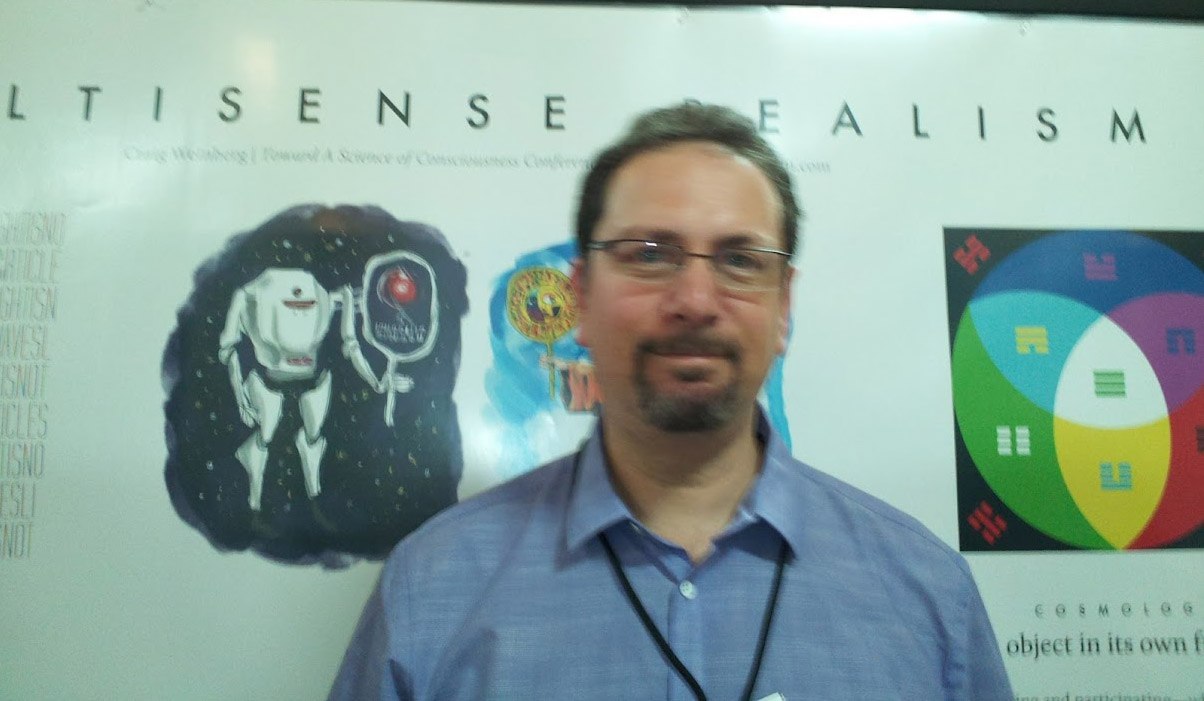
Multisense Realism (MSR) is philosophical hypothesis which is intended to pick up where panpsychism leaves off. Consisting of an informal framework of core concepts developed from diverse influences such as semiotics, information theory, and anthropology, MSR proposes a united continuum of physics and phenomenology which is fundamentally aesthetic. MSR addresses five problems (The Hard Problem of Consciousness, The Explanatory Gap, The Combination or Binding Problem, The Symbol Grounding Problem, and the Mind Body Symmetry Problem) as a single Presentation Problem, while exposing critical flaws in popular competing approaches. MSR aspires to be a reality theory which reconciles the plausible and the absurd under the umbrella of a single irreducible synthetic a priori, and in the process reinterprets the number one, the Big Bang, and the ontology of light.
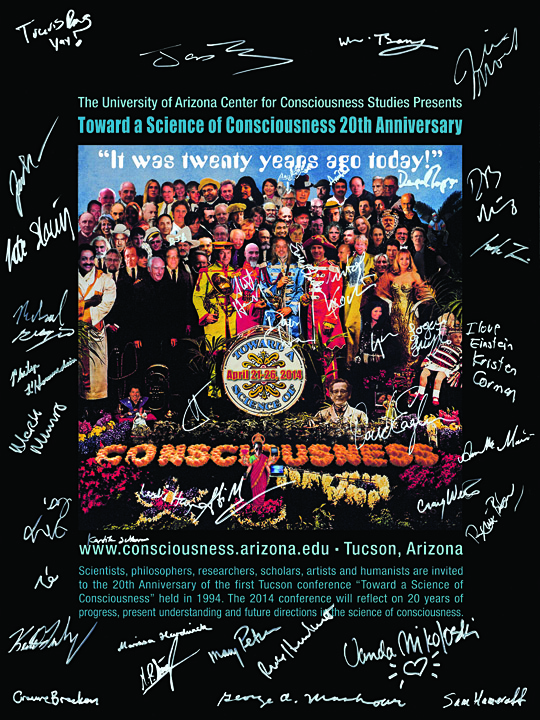
I don’t have a digital copy of my poster for 2014, but I did get this cool souvenir poster signed by a lot of great people:
2016
Abstract
47 Diffractivity and Multisense Continuum
Craig Weinberg (multisenserealism.com, Durham, NC )
In the science of consciousness, one question that we must eventually ask is, What is the event horizon of consciousness? Where does the rubber hit the road? Are all sensations, feelings and thoughts derived from a common source? Many theories offer ways to correlate consciousness with formal systems such as neurology or information processing, but the accomplishment of correlation itself is taken for granted from the start. I think that this is a problem which turns out to be identical to the Hard Problem. Without an explanation of precisely what is doing the actual relating in Relativity or the actual integrating in IIT, we have not solved the problem, only hidden it from ourselves. The hypothesis of Diffractivity begins by rejecting emergence-based theories on the grounds that they provide no explanation for their own origin. Diffractivity inverts the assumption of an unconscious universe which produces consciousness so that it is the appearance of unconsciousness which is proportional to dissociation by insensitivity. Diffractivity is intended as a philosophical conjugate to Relativity, but it can be adapted to any theory which reduces to a formal system. In Hameroff and Penroses Orch OR, the Diffractivistic conjugate to the Objective Reduction would be a Subjective Inflation. In Tononi & Kochs IIT, Information Integration would be preceded an Aesthetic Disintegration. Bohms Implicate and Explicate Order would be diffracted from the order-transcending Multisense Continuum. Any system based on structures, including mathematics and logic, would find new roots beyond formality and extend to fusion with the Continuum. This is not intended as an appeal to supernatural metaphysics but a logical extension of the proposition of ordinary sense as fundamental. By grounding all substances and conditions into a foundation which is purely aesthetic, we gain insight into the philosophical and technological issues of the 21st century. The empirical observations of science and math remain the same, only their interpretation changes. Diffractivity proposes that objects, dreamed or real, are produced by the same filtering, but with a different scale of experiential density or significance. Time and space emerge as limits on awareness rather than axioms of existence. We can see and understand white light as a colorless brightness which reveals color through diffraction of light itself. Diffractivity proposes that all phenomena are fragments of a universal experience, and that the maximum degree of fragmentation within any given frame of perception constitutes its math and physics. Electromagnetic effects would be affects of effectiveness, in the same way that light is a seeing of seen-ness. What we experience as physics, chemistry, and biology is suggested to emerge from fundamental levels of diffraction. Our sense of subjectivity provides a limited unveiling, or re-acquaintance with that which has been alienated by time, space, and entropy, giving the brain a new identity as an aesthetic diffraction engine.
Diffractivity slide deck
Poster:

2018
Abstract
68 The Hard Problem of Signaling.
Craig Weinberg (multisenserealism.com, Durham, NC )
As we struggle to understand consciousness scientifically, we should take care to avoid errors resulting from anthropomorphic projection and assumptions of bottom-up emergence. My presentation focuses on clarifying the differences between physical form, logical information, and sense experience. I propose that common terms such as ‘signaling’ and ‘sense data’ are deceiving approximations which rely on pan-semiotic, anthropomorphic biases that lead us away from understanding and toward an echo-chamber of fallacies and false presumptions. What is the difference between a physical chain reaction and a signal? What is the difference between sense experience and sense-making? What is the role of tangibility in differentiating between objects, concepts, and percepts, and what is the origin of tangibility? In light of the accelerated pace of AI development and the heightened intensity of debate about its implications, it is important to go back and re-examine the foundations of computation from a philosophical perspective. By doing this, at least some of us will see that science and technology have not solved the hard problem of consciousness, only miniaturized it to the point that it can be easily overlooked. In my view, recognizing this mistake and the gravity of its consequences is critical to any deep understanding of consciousness or simulated intelligence systems. Without such a deep understanding, I think that we will tend to assume human or superhuman sentience for any unfamiliar results, and to ultimately cede authority to systems which only reflect our own desires for certainty and leadership. C13
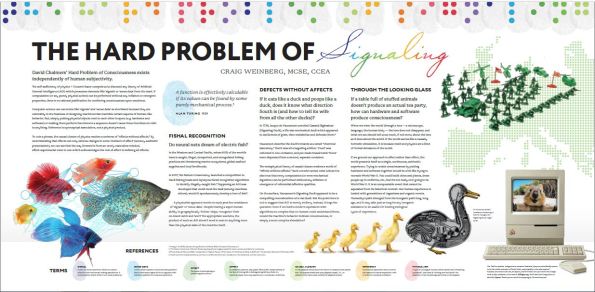
Hard Problem of Signaling slide deck
2019 Interlaken, Switzerland
Abstract
- De-Simulating Natural Intelligence
Craig Weinberg, Multisenserealism.com
In recent years, scientific and popular imagination has been captured by the idea that
what we experience directly is a neuro-computational simulation. At the same time,
there is a contradictory idea that some things that we experience, such as the existence
of brains and computers, are real enough to allow us to create fully conscious and intelligent devices. This presentation will try to explain where this logic breaks down, why
true intelligence may never be generated artificially, and why that is good news. Recent
studies have suggested that human perception is not as limited as previously thought,
and that while machines can do many things better than we can, becoming conscious
may not be one of them. The approach taken here can be described as a Variable Aspect
Monism or Multisense Realism, and it seeks to clarify the relationship between physical
form, logical function, and aesthetic participation.

Wai H. Tsang: Science and Technology. It’s origin & convergence back to Renaissance Religion – Zoom talk 31/03/21
Great stuff from Wai H. Tsang. I’m about halfway through listening to this talk. Here are my comments:
I propose an additional clarification that the fractal, cyclical, and mathematical properties of the Totality are aspects of the Diffraction process or Diversification of the Unity into Universe.
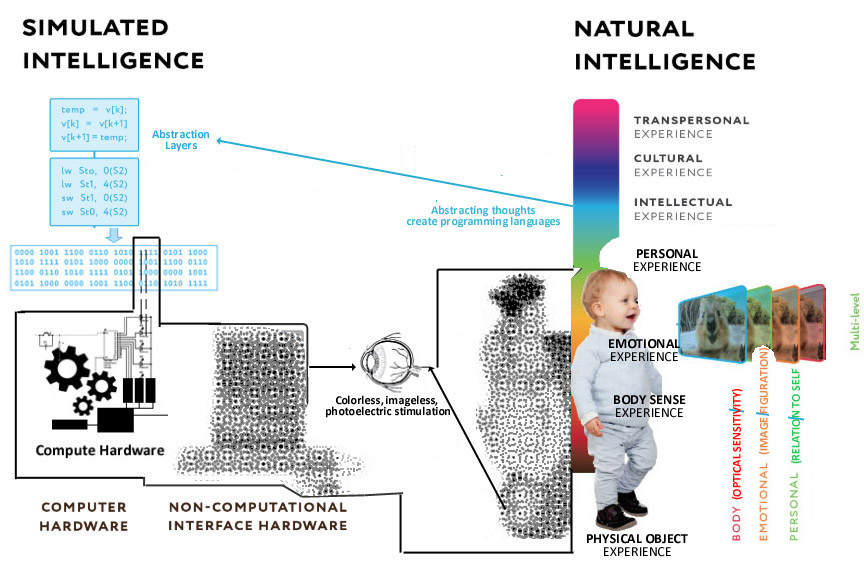
My point in the comparison image is that I think that purpose – the participatory aspect of the Totality in general is not part of mathematics, fractals, etc. To the contrary, counting, and by extension math, computation, geometry, physics are passive instruments of purpose.
Specific purposes are clothed in algorithmic-geometric form, however only as a vehicle for expression of the true Unity of the Totality, which is more like the inversion of mathematics.

I was also inspired by Wai’s discussion and inclusion of this image. Talking about a teleological universe in which a retrocausal attractor is pulling us toward the originating singularity. I agree but to clarify, only in the Uni/Holos sense and not in the Verse/Graphos sense.
It’s complicated but…mortality is like a bubble of conscious perception within the Totality of conscious perception. The perception of the Totality from within that bubble varies from states of transparency, translucence, reflection, refraction, diffraction, and opacity to the Totality.
It’s a focus thing. As we change our focus (or our focus is changed for us), sensitivity to the Totality can be increased so that the self identifies with the Totality and sees no separation. This is profound and true, however, while consciousness is conditioned with mortality, the loss of separation is akin to mania/psychosis. The idealist is correct in the ultimate sense, but impractical and deluded from the mortality-dominated perspective.
As awareness contracts, focus shifts from the Totality to the Locality, and then to the bubble itself – the separation. It’s complicated because I think that what Wai and others are on to is a Unity of Graphos rather than Holos. All separations use similar schemas, but that similarity itself is maximally dissimilar to the true Holos/Absolute/Totality, which we experience mentally as imagination, perceptually as qualia, emotionally as love, somatically as pleasure, egotistically as success, etc. Physicality and mathematics are inversions of sensitivity…they are the concrete and abstract qualia of quanta.


The Haptic Universe
If I’m on the right track in thinking of existence as an irreducibly sensing phenomenon, then the idea of particles can be replaced with the idea of coordinated sense happenings, or haptics. Haptics, not atoms or quarks or data, form the skeleton of realism, uniting the sense of touch and tangibility with the sense of causality, proprioception and any other aesthetic sense modalities that are available.

Whether we are dreaming or awake, the properties of realism are conserved. Rupert Sheldrake’s idea of Morphic Resonance can be modified as Haptic Resonance. Possibly electromagnetism can be reinterpreted as electrohaptic and magnetohaptic properties – which are properties of haptics rather than of disembodied force-field perturbations of vacuum spacetime. The universe is not an empty container within which matter and energy happen, the universe is an eternal multisense happening with material and energetic sense qualities.

There Has Always Been a Better Case for Matter Being Imaginary Than Imagination Being Material

Appeal to the Stone (Argumentum ad lapidem) “The name of this fallacy is derived from a famous incident in which Dr. Samuel Johnson claimed to disprove Bishop Berkeley‘s immaterialist philosophy (that there are no material objects, only minds and ideas in those minds) by kicking a large stone and asserting, “I refute it thus.”
I suspect that even now, this fallacy secretly remains the foundation of physicalism. Of course, the problem with Johnson’s demonstration is that kicking a rock could occur just the same way in a dream or in our imagination. We can understand that a rock in a dream has no need to seem to be composed of physical substances like silicon or basalt. A dream rock may be ‘composed’ of one’s hard feelings toward the menial tasks being assigned to someone at work. Just being able to experience kicking a rock says nothing about that rock, or any rock being real in some other way besides the reality of the experience. All dreams are real dreams.
Being open to the idea of matter as imaginary in an ultimate or absolute sense does not have to bring us to solipsism or creationism. All that we know is that we can dream or imagine matter, but we do not know that it is our imagination that is responsible for all dreams, nor do we know that any person or super-person including ourselves or God is not also “imaginary”. All that we know is that imagination itself is real.
If I were to rewrite Decartes’ Cogito, I would leave “I” and “think” out of it and just say something like “everything can be an illusion of conscious experience except conscious experience itself”. From there, I might derive “Therefore there can be no escape from conscious experience except into another conscious experience.”. After all, if we say that we experience unconsciousness, we cannot have been completely unconscious. If we were, then we can only infer such a non-existent experience as an inference when we return to consciousness.
To sum up:
- Everything – including ourselves, God, matter, space, time, even mathematics can be “imaginary”.
- Imagination cannot be imaginary.
- Imagination can potentially exist beyond ourselves, God, reality, etc.
- Nothing can be shown to be beyond imagination in a way that could not also be imaginary.
On 0.999… being equal to 1
We can revise our understanding of numbers such that each number is not a noun but a verb. The numerical value comes not from the digitization, which is only a snapshot representation, but from the act of counting. In other words, quantitative value may ultimately require a direction of flow. In this case, the “…” refers to a positive direction of flow that is unbounded so that it must be considered identical to the value that it reaches by its own definition.
All numbers are parts of a continuum and therefore always ‘almost’ the previous and successor numbers just as orange is defined as the color between almost red and almost yellow.
One interesting possibility from making this fundamental shift is that zero could be understood as an imaginary number between two real numbers “-0.000…1” and “0.000…1”.
Once we have that, we no longer need to see numbers as digital entities added on top of nothingness, but as diffraction bands breaking the continuity of a fluid spectrum of ‘everythingness’. Numbers do not connect to form wholes, they break wholes into parts. This has enormous consequences for our understanding of existence, consciousness, and AI.
 Multisense Realism
Recent Comments