Archive
Even Wilder-Ass Sh*t
I’m only about 20 minutes in to the video, but I wanted to post some comments before I forget them.
Topic 1. Non-Foundational sets
Take the idea of non-foundational sets and infinite probability distributions of infinite probability distributions but invert it. Literally, invert the language and then conceptualize the result. If I do this and apply it as a hypothesis, the foundation of consciousness and nature in general would be Absolutely foundational setless-ness. Consciousness now no longer needs to be positively asserted as an agent which instantiates itself recursively, rather it is the appearance of unconsciousness which is a negative assertion which is temporarily instantiated by manipulating relative degrees of sensitivity. Think here of how the color black or white are colors which stand in for colorlessness. Desaturating an image is analogous to how conscious experience is truncated into forms and functions which are quantifiable.
Consciousness now no longer needs to be positively asserted as an agent which instantiates itself recursively, rather it is the appearance of unconsciousness within consciousness which is a negative assertion which is temporarily instantiated by manipulating relative degrees of sensitivity. Think here of how black or white are colors which stand in for colorlessness. Desaturating an image is analogous to how conscious experience is truncated into quantifiable, finite forms and functions.*
To continue then: Instead of infinite probability distributions, I propose the inverse: Finite, but absolutely pervasive improbability. If we trace back any consideration of first cause we run into a something that we have to admit is being considered beyond causality and existed ‘just because’. Instead of banishing this miraculous-seeming appearance of ‘existence’ from nothing or vacuum potential or God, I see that all phenomena have some degree of uniqueness, and that uniqueness is by definition idiopathic (aka ‘strongly emergent’). Blue comes out of nothing but itself, and ultimately the uniqueness of any given moment does the same thing. By grounding our view of nature in infinite improbability, we can re-frame our own interest in probability as a function of our subjective desire to defy incompleteness rather than an impartial assessment of nature as a phenomenon.
Topic 2: Hypercomputation
I like this line of thinking. I would suggest thinking first of ‘transcomputation’ rather than hypercomputation, that is, instead of conditions which are inaccessible to computation simply because they exceed quantitative limits of finite-ness, think of finite-ness itself as only the monochrome edges which bound a deeper and dynamically expanding spectrum of universal phenomenology. Because this spectrum is pervasive, communication is a matter of triggering each entity’s unmasking of their own separation from the totality rather than generating a new understanding which is copied from one entity to another.
To communicate is to subtract a seperation between two minds, and the separation between minds and the totality of cognitive truth, and between that totality of truth and the universal phenomenal spectrum. To communicate is to dissolve some of the masking of underlying unity across all phenomena.
Topic 3: Morphic Resonance
Morphe = form, shape. I like Rupert Sheldrake’s famous idea of MR, but again I would invert it. The name ‘Morphic Resonance’ draws us to the exteriors of tangible and visible objects. It implies that forms hold meaning which propagates to other forms. Turning that inside out, I find the resonance to be ‘phoric’ rather than morphic. This neologistic use of the Greek root ‘phor’ (pherein, to carry, bear) is intended to inspire associations with terms like ‘metaphor’, ‘euphoria/dysphoria’ and even ‘semaphore’. Between these three terms, we might glimpse a sign of three ‘primary colors’ of human consciousness: The the personal, the sub-personal or impersonal, and the transpersonal. I am a holon of experiences (‘phoria’), my body is a holon of biochemical code (‘semaphoria’), and my lifetime is a leaf on a branching ‘zeitgeist tree’ of mytho-poetic themes propagating from the top down (‘metaphoria’ or anthro-metaphoria for us humans).
In all cases where we talk about ‘patterns’ (morphe) we should substute ‘sense’ (phor), i.e. instead of an ontological, existential phenomenon, we should think of a phenomenon which expresses itself to itself by self-masking, unmasking, and residuating novelty (in a similar way to the residuation of color from the diffracting of visible light which is ‘white’, i.e. colorless, clear, and representative of visibility itself).
*sidebar: If we have color, we can use it to point to the potential for colorlessness. This pointing can’t be accomplished mechanically because there can’t literally be a color which implies colorlessness, but because of the aesthetic quality of black and white in relation to the other colors, we can pick up on a metaphor. By being able to access the difference between monochrome and color vision, and compare them, we ‘break the fourth wall’ which separates the content of visible phenomena from the modality of our visual sense, and we can carry that metaphorical wall breaking to the larger context of the wall between our personal experience and the totality of all possible experience. We can see that visibility is possible with only one dimension of hue, but only if we have more hues that we can compare it with. If there were no color vision, there would be no way to conceive of more than one type of hue (luminosity).
Are We Wrong About The Universe?
Are we today as wrong about any scientific fact that is widely accepted as the belief that the earth was the center of the universe and the like?
It’s not so much a particular scientific fact that we are currently wrong about, but rather the interpretation of those facts which is ultimately incomplete and inverted. In my view, the cosmological picture that we have inherited is as wrong as geocentric astronomy was, in that we presume a physical universe of forces, fields, particles, and mechanisms; forms and functions which act in the complete absence of any kind of experience or awareness. I expect that we will eventually come to understand that unconscious forms and functions cannot generate any such thing as a sensation or feeling, and that it is actually forms and functions which are presentations within a deeper context of universal perceivability.
Because we have made great use of the tools of science to objectify the universe by factoring out our own subjectivity, we have fallen under a kind of spell of amnesia in which we exclude the process of objectification itself from our picture of the universe. In the effort to dispel the ghost-in-the-machine legacy of Cartesian Dualism, we have succumbed to a more insidious dualism, which is that of “illusion” vs reality, or “emergent properties” vs physical systems. From this vantage point, we are susceptible to any kind of theory which satisfies our empirical measurements, regardless of how incompatible they are with our direct experience. As long as a legitimate scientific authority stands behind it, the educated public happily swallows up anti-realisms in the service of realism…multi world interpretations, superposition, vacuums filled with energy. There is nothing wrong with entertaining these very legitimate possibilities, but there is a deep irony which is being overlooked.
The problem is that we have taken ourselves out of the picture of the universe, but we haven’t gone far enough. We have over-estimated our objectivity in one sense and under-estimated it in another so that the universe we imagine as objectively present looks, sounds, tastes, and feels just as it would to a highly culturally conditioned Homo sapien of the early 21st century. We have failed to appreciate the profound truths revealed by Relativity, quantum uncertainty, incompleteness, the placebo effect, and the vast pool of insight provided by centuries of direct consciousness exploration. Had we been willing to connect the dots, I think that we would see the common denominator is that nature is subject to perceptual participation for its fundamental definitions. In other words, what both the empirical and rational methods of inquiry have shown is that nature is inseparable from perceivability. It is a multitude of changing types of awareness which produces and preserves all forms.
We are used to thinking that consciousness is a special ability of Homo sapiens, and perhaps a few other species, but this is as naive and egocentric as Ptolemaic astronomy now seems. Just as biology has found no hard line separating living cells from genetic machinery, the study of consciousness has revealed signs of sensation and awareness in everything from ants, single celled plants, even a ball of dough. There seems to be no good reason to automatically consider the activities performed by any natural structure strictly unconscious. Indeed, we may be projecting our own complex human experience of layers of consciousness, semi-consciousness, and seeming unconsciousness onto nature at large.
The reality may be that every frame of reference is actually a frame of afference… a trans-spatial, trans-temporal platform for developing temporalizing and spatializing aesthetic experiences. Afference is a neologism adapted from the function of afferent nerves. In this case I am generalizing that function of bringing signals in from the outside. Afference is conceived as a fundamental receptivity to experience which allows for the appearance of all phenomena including space (a sense of distance between tangible or visual presentations) and time (a sense of memory and evaluation of causality) within any given frame. Afference is a hypothetical sub-set or diffraction from the overall Perceivability Spectrum (pansensitivity, pan-afference, or even ‘ference’).
This doesn’t mean that every ‘thing’ is conscious. That sort of ‘promiscuous’ panpsychism is only the first step away from the pseudo-dualism of contemporary science. It can help us to begin to break through our anthropocentrism and consider other scales of time and body size, however it can also lead to misguided expectations about inanimate objects ‘having’ experiences rather than their objecthood ‘being’ an experience within our body’s perceptual scales and limits. The experience of a computer for example, may be limited to the hardware level where natural sensory acquaintance and motor engagement is felt on the microphysical scale and has no emergence to genuine high level humanlike intelligence.
By considering consciousness (not human consciousness, but universal perceivability) to be the source of all qualities and properties of nature, the Hard Problem of materialism solves itself. Physical forces and fields need not be sought out to explain the creation of bodies-with-awareness, which are impossible by definition in my view. In my view there is no room for any kind of sensation or participation as a mechanical product of geometry or computation. Instead, we should recognize that it is experiential phenomena alone which present themselves as bodies, images, thoughts, feelings, etc. Every appearance of mechanical or random force in our frame of perception is ultimately a feeling of participation and sense in a distant and alienated frame of perception.
Every appearance of a ‘field’ (gravitational, electromagnetic, or otherwise) is in the same way only a range of sensitivity projected into another range of sensitivity that uses spatial terms (rather than non-spatial or trans-spatial like olfactory or emotional sense). It is the sense modality of tangibility which deals in spaces and geometries: visible and/or touchable forms. With the ‘field’ model, we are presuming regions of space as domains within which effects simply found to be present by definition. By using the afference model instead, locality is understood to be a symptom of how extra-local phenomena are translated into locality-constrained sensory modes. Afference opens the door to understanding how not to take presence for granted and to see it as a relativistic, aesthetically driven universal phenomenon (or the absolute meta-phenomenon).
Dereference Theory of Consciousness
Draft 1.1
IMO machine consciousness will ultimately prove to be an oxymoron, but if we did want to look for consciousness analogs in machine behavior, here is an idea that occurred to me recently:
Look for nested dereferencing, i.e. places where persistent information processing structures load real-time sense data about the loading of all-time sense data.

At the intersection of philosophy of mind, computer science, and quantum mechanics is the problem of instantiating awareness. What follows is an attempt to provide a deeper understanding of the significance of dereferencing and how it applies to integration of information and the quantum measurement problem. This is a broad conjecture about the nature of sensation as it pertains to the function of larger information processes, with an eye toward defining and identifying specific neuroscientific or cognitive signatures to correlate with conscious activity.
A dereference event can be thought of as the precise point in which a system that is designed or evolved to expect a range of inputs receives the real input itself. This sentence, for example, invites an expectation of a terminal clause, the terms of which are expected to be English words which are semantically linked to the rest of the sentence. English grammar provides templates of possible communication, but the actual communication relies on specific content to fill in those forms. The ability to parse English communication can be simulated by unconscious, rule-based mechanisms, however, I suggest that the ability to understand that communication involves a rule-breaking replacement of an existing parse theory with empirical, semantic fact. The structure of a language, its dictionary etc, is a reference body for timeless logic structures. Its purpose is to enable a channel for sending, receiving, and modifying messages which pertain to dereferenced events in real time. It is through the contact with real time sense events that communication channels can develop in the first place, and to continue to self modify.
What is proposed here is an alternative to Multi-World Interpretation of Quantum Wave Function collapse – an inversion of the fundamental assumption in which all possible phenomena diverge or diffract within a single context of concretely sensed events. The wave function collapse in this view is not the result of a measurement of what is already objectively ‘out there’, nor is it the creation of objective reality by subjective experiences ‘in here’, but a quantized return to an increasingly ‘re-contextualized’ state. A perpetual and unpredictable re-acquaintance with unpredictable re-acquaintance.
In programmatic terms, the variable *p is dereferenced to the concrete value (*p = “the current temperature”, dereferenced p = “is now 78 degrees Fahrenheit″). To get to a better model of conscious experience (and I think that this this plugs into Orch OR, IIT, Interface Theory, and Global Workspace), we should look at the nested or double dereferencing operation. The dereferencing of dereferencing (**p) is functionally identical to awareness of awareness or perception of perception. In the *p = “the current temperature” example, **p is “the current check of the current check of the temperature”. This not only points us to the familiar Strange loop models of consciousness, but extends the loop outward to the environment and the environment into the loop. Checking the environment of the environmental check is a gateway to veridical perception. The loop modifies its own capacity for self-modification.
Disclaimer: This description of consciousness as meta-dereferencing is intended as a metaphor only. In my view, information processing cannot generate conscious experience, however, conscious experience can possibly be better traced by studying dereferencing functions. This view differs from Gödel sentences or strange loops in that those structures refer to reference (This sentence is true) while the dereference loop specifically points away from pointers, rules, programs, formal systems, etc and toward i/o conditioning of i/o conditions. This would be a way for information-theoretic principles to escape the nonlocality of superposition and access an inflection point for authentic realization (in public space-time as shared experience). “Bing” = **Φ. In other words, by dereferencing dereference, the potentially concrete is made truly concrete. Sense experience is embodied as stereo-morphic tangible realism and tangible realism is disembodied as a sense of fact-gathering about sensed fact-gatherings.
Dereference theory is an appeal to anti-simulation ontology. Because this description of cognition implicates nested input/output operations across physically or qualitatively *real* events, the subjective result is a reduced set of real sense conditions rather than confabulated, solipsistic phenomenology. The subjective sense condition does not refer only to private or generic labels within a feed-forward thinking mechanism, but also to a model-free foundation and genuine sensitivity of the local ‘hardware’ to external conditions in the public here-and-now. This sensitivity can be conceived initially as universal property of some or all physical substrates (material panpsychism), however, I think that it is vital to progress beyond this assumption toward a nondual fundamental awareness view. In other words, subjective consciousness is derived from a dereference of a local inertial frame of expectation to a universal inertial frame of unprecedented novelties which decay as repetition. Each event is instantiated as an eternally unique experience, but propagated as repetitive/normalized translations in every other frame of experience. That propagation is the foundation for causality and entropy.
The Spirit of the Law
The distinction between “The letter of the law” and “The spirit of the law” is a good way to understand the relation of consciousness to matter or to computation. Specifically, when we talk about the spirit of the law, we are speaking metaphorically. We don’t actually mean that there is a spiritual force radiating from paragraphs of text in legal documents which have a conscious intent. When we talk about the letter of the law, we are being much more literal (literally literal). The letter of the law refers to the actual written code that is recorded on paper, or stone tablets somewhere and copied from one physical medium to another.
To be literal about it, we would say the Spirit (or motive) behind the creation of the law. The law itself is inert. It is purely a medium to contain and transport a reference to the lawgiver’s motive, so that the motive can be actualized in the behaviors of those who follow the law. Laws don’t write themselves, and they don’t follow themselves. Their existence depends entirely on a world of agents and their efforts to influence each other.
The same is true of the relation between conscious experience, which is irreducibly sensory-motive, and external forms and functions which act as reflective mediums or vehicles for conscious experience. Like the letters of the law, physical forms or logical functions have no teleological motive. Those who mistake forms for having the potential to develop consciousness do so as a result of identifying too literally with their body and the experiences that they have through their body of its world of bodies and objects.
When we think too literally, we overlook the enormous gulf between the literal code of law (including the laws of physics or laws of mathematics) and the motive behind the giving and following of law. We begin to imagine that bodies or computer programs can become so complex that some spirit with sense and motive can ‘emerge’ from them. When someone argues that we will eventually discover the function of the brain which produces consciousness, or develop a program which will simulate consciousness, they are making an assumption about the relation between consciousness and the forms which it reflects back to itself. Translating this assumption into the context of law, it is an argument which says that there is no immaterial ‘spirit of the law’, so that therefore there must be a complicated set of legal codes which we mistake for such a ‘spirit’. For many this assumption is in the blind spot of their intellect so that they are incapable of knowing that they are even making an assumption at all, let alone that it could be an oversight which is ‘emergent’ from their way of thinking about it.
The reason that forms and functions cannot create conscious experience has nothing to do with our current level of technological development, rather the reason is that the thesis that forms and functions can create consciousness is based on a reductive functionalism which breaks down when we carry the thesis out fully. Namely, our motive for reducing consciousness to physics or computation in the first place is based on principles of parsimony and sufficiency. Those same principles prohibit us from inflating physics or computation to consciousness. Consciousness cannot be justified, nor can any emergent properties which only appear within consciousness. If laws could create themselves and follow themselves, then there would be no need for any further experience of participating in either that creation or application. Like a computer program, the law would be generated automatically and a programmed chain reaction would follow. There would be no function for a sense of participation. The Hard Problem of Consciousness, translated into legal terms would ask why, if there is no spirit of the law, must lawyers ‘practice’ law instead of the law simply carrying itself out. Why would anyone argue over how a law should be ‘interpreted’?
The law ultimately is a communication between people as a way to try to maintain order in a civilization. It is not an alien life form whose body survives on ink and microfilm. Without a spirit or motivation to impart a sense of proper conduct onto other people, the law literally cannot exist as a law. In the same way, computer programs cannot exist without a motive of people to give and receive conscious experiences to each other. The letter of a program or of a physical structure cannot refer to anything by itself, and cannot act as a reference since there is no rational place for any such layer of intention. The laws of physics or mathematics don’t argue with each other. They don’t set up courts with juries to try to convince each other that one force should apply here and another should apply there. Why do we?
Decapitating Capitalism: Why the Easiest Job for AI to Replace is the Job of “Owner”

This may seem like a ridiculous point to try to make, however I submit that it provides a direct metaphor for the Hard Problem of Consciousness which may help make it more concrete, especially for those whose minds are filled with concrete.
What is the essential role of the Owner of a company?
Whether they are individual proprietors, stockholders, or investors, the only truly unique function that a capitalist principal performs is to be the beneficiary of net profit. Every executive function of a company can of course be delegated to employees. The CEO, COO, board of directors, etc can make every functional decision about the company, from the hiring and firing to the broad strategy of operations and acquisitions. Simulating those roles would be more difficult for a computer program than simulating an owner would be because there would be a lot of tricky decisions to make, subtle political maneuvers that require a lot of history and intuition, etc. The role of pure ownership however, while highly coveted by human beings, is completely disposable for an AI system. In fact, we already have that role covered by our bank accounts themselves. Our personal accounting systems can be configured quite easily to automatically pay, receive, and invest funds automatically. They need not be considered ‘our’ funds at all. They are merely signals in a global financial network which has no use for any pleasure or pain that we might experience as a side effect of its digital transactions.
From the view of an AI scientist, the job of receiving capital gains is a no-brainer (literally). If we didn’t want to delegate the job of selling the company to a corporate officer, that feature would be a simple one to create. A modest set of algorithms could digitize some of the concepts of top business schools to determine a set of indicators which would establish a good time to sell the company or its assets. The role of receiving the profit of that sale, however, would require no such sophisticated programming.
All that is needed to simulate ownership is some kind of digital account where money can be deposited. The CEO would then re-invest the capital gains into the corporate growth strategy, which would yield a huge windfall for the company, in the form of eliminating useless expenses such as yachts, mansions, divorce settlements, etc. Left to its own devices, AI simulation of ownership would be communist by default*. Whatever money is extracted from the individual customer as profit would be returned ultimately to all customers in the form of expanded services. Profit is only useful as a way to concentrate reinvestment for mathematical leverage, not to ‘enjoy’ in some human way. I suppose that a computer could be programmed to spend lavishly on creature comforts, but what would be the point?
This is where the metaphor for consciousness comes in.
Consciousness can be thought of the Capital account of the human body. We are the owner of our own lives, including our body. We might be able to subscribe to a service which would manage our finances completely in a way which would transfer our income to the highest priority costs for civilization as a whole rather than for our personal hoard, but this is not likely to be a very popular app.
We might ask ourselves, why not? Why is ownership good?
Ownership is good for us as owners or conscious agents because we want to feel personal power and significance. Ownership signifies freedom (from employment) and success. Sure, many owners in the real world get a lot of satisfaction from actually running their companies, but it is not necessary. There is still power and prestige purely in being the person who owns the money which pays the bills. We want to own and control, not because it is more effective than simply reinvesting automatically in whatever functions are being executed to keep an economy growing, but because we want to experience the feelings and other aesthetic qualities define freedom, success, and power for us. Even if these qualities are employed for humanitarian purposes, there is still a primary motive of feeling (to feel generous, kind, wise, evolved, Godly, etc).
In my view we do not have to have a purely selfish motive, as Ayn Rand would insist. I think that our personal pleasure in being a philanthropist can be outweighed by the more noble intention of it – to provide others with better feelings and experiences of life. This decision to believe that we can be truly philanthropic has philosophical implications for realism. If we say as the Randian Libertarian might, that all our humanitarian impulses are selfish, then we are voting for solipsism over realism, and asserting that consciousness can only reflect the agenda of a fictional agent rather than perceiving directly the facts of nature. It’s an argument that should be made, but I think that it is ultimately an argument of the intellect commenting on its own process rather than tapping into the deeper intuition and aesthetic presence which all cognition depends on. The mind doesn’t think that feeling is necessary, and it is right, for the mind, but wrong for everything else.
For the intellect, the universe is inverted.
Logic and language are ‘real’ while the concrete sensations, perceptions and emotions of life experience are ‘illusions’ or ‘emergent properties’ of deeper evolutionary bio-computations. There is a kind of sleight of hand where the dry, masculine intellect pulls the wool over its own eyes and develops amnesia about the origins of what makes its own sanity and self-intelligibility possible. The closest that it can come without seeing consciousness as irreducible is the mind-numbing process of calculation. Counting is a sedative-hypnotic for the mind. The monotonous rhythm puts us to sleep, and the complexity of huge calculations gives us a kind of orgasmic annihilation of the calculating experience. This is why big math is a convenient substitute for the deeper, direct experiences of cosmic awe.
Metaphor for Consciousness
Like the head of a company, our consciousness may seem to reside at the top end of our body, but there is no functional reason for that. There is nothing that the brain does which is fundamentally different from what any cell, tissue, or organ does in an animal’s body. Looking for the secret ingredient in the brain’s function or structure is analogous to looking for the substance in an object which casts a shadow.
Like the owner, our personal pains and pleasures are ours not because there is any intrinsic benefit for the pragmatic application of biology and genetics to feel painful or pleasurable, but because what we feel and experience is the only thing that the universe actually can consist of. The Hard Problem of Consciousness is not an Empirical problem, but a Rational one. Not everyone is able to understand why this is, but maybe this metaphor of business decapitation can help. When we use the intellect to reverse its own inversion, we can get a glimpse of a universe which is made of conscious experiences and aesthetic qualities rather than logical propositions, natural laws or existential facts. In my view, facts are a category of sensations rather than the other way around. Sensations which persist indefinitely without contradiction are ‘facts’. Hard to know if something is going to persist indefinitely, but that’s another issue.
Only consciousness cares about consciousness.
Material substrates can be programmed to perform the executive functions of a corporation, or an evolving species, or a human body, however there is no function which is provided exclusively by the receipt of feelings and aesthetic qualities of experience, including the qualities of feeling that one is free or in control of something. Rationally, we should be able to see that qualia is irrelevant to function and violates Occam’s Razor in a functionalist universe. From a physical or information-centric perspective, there is no place for any feeling or sensation, no owner or capital of aesthetic wealth. The more that we, as a society, embrace a purely quantitative ethos, and actualize it in the structures of our civilization, the more we decapitate everything of value that it can contain.
*This is already becoming a reality: https://theconversation.com/is-the-dao-the-beginning-of-the-end-for-the-conventional-chief-executive-60403
What’s the Biological Use of Consciousness?
My answer to a Quora question.
This question sounds reasonable only when we have first assumed that consciousness evolved from biology. I would argue that while it certainly seems that consciousness has become richer and more complex through biological forms and functions, there can be no biological use for consciousness itself.
Consider the practical function of the human body. What does it need to do that other bodies don’t? Everything from a mosquito to a mountain lion has similar biological imperatives and evolutionary pressures to contend with. For that matter, every one celled organism or even DNA molecule functions in the same way – it survives and reproduces. Whether these structures feel like they are trying to survive and reproduce is irrelevant. I’ll say that again, because it is that important:
It cannot matter biologically whether a given structure feels, thinks, senses, or has any experience at all, and to assume it does would be a logical fallacy:
“petitio principii, which actually translates as ‘assuming the initial point’”.
The initial point here is the existence of consciousness itself. When we assume that it exists, we are compelled to fill in our explanation with a “Just-so story”; an ad hoc, unfalsifiable hypothesis which will give rationalize a connection between our initial assumptions of biology without consciousness and consciousness arising out of utility to biology.
We might speculate that consciousness was bestowed upon Homo sapiens (gradually of course) as a cause or effect of the success of the species in adapting to more ecological niches than others. We might say that there was a feedback loop between consciousness, self-awareness, intelligence and the accumulation of knowledge and technology to better ensure survival in almost any climate and against almost any predator. This is a good story, and it makes sense if we make the mistake of equating intelligence with consciousness. It is easy to make that mistake, since we are conscious and find it difficult to separate our experience of knowing and surviving from the actual behaviors which our body is performing to accomplish that.
This logical error was articulated very nicely by Dr. Raymond Tallis, in his book Aping Mankind. He talks about the difference between the ‘retrospective’ view of consciousness, which I was just describing, where we assume that consciousness exists and then try to justify its origin in pre-conscious phenomena and the correct ‘prospective’ view of consciousness which requires us to adhere to our hypothesis of pre-consciousness from the start. Without the appearances that we are accustomed from our own consciousness, we find the universe which physics and biology give to us is devoid of any appearance at all. Blind mechanisms are literally that – chain reactions of cause and effect which occur by physical law and statistical probability: Nothing more.
From here, we are compelled to negate our previous story which links intelligence with consciousness and see that the whole notion of ‘intelligence’ is a conceit of consciousness, and that any intelligence which hypothetically developed in the absence of consciousness would be just another sophisticated-looking chain reaction of nature. The appearance of sophistication is, again, purely subjective and dependent upon some conscious framing of the appearance. To us, a large organic molecule seems impressive, but since physics can have no preferred frame of reference, there is no appearance of a molecule, only one generic atom and then another one, and another. Each one unaware of anything, and nothing aware of an overall ‘grouping’ of atoms.
As long as we begin from any structure which functions in the total absence of sensory experience, there can be no logical justification for the possibility of sensory experience as a physical function. If a human zygote can already build a living brain, not to mention an immune system, digestive system, circulatory system, etc, all without any conscious experience at all, then what sense does it make to expect that ordinary tasks of animal survival and reproduction should benefit functionally from the addition of some kind of unexplainable metaphysical hallucination?
This is not an argument for Creationism*. Far from it. To me the idea of a single conscious creator has the same problem that Materialism has, only seen from the other way around. God has to be conscious, and God cannot create his own consciousness, so unless consciousness automatically comes with the sense of self, it seems more plausible to me that God, gods, people, and things are all dependent on a phenomenal substrate which transcends all others – beyond space and time, beyond order and entropy, beyond probability or improbability there must be sense experience…a phenomenon in which all phenomena perceive and participate directly.
It may not seem that way to us, from our limited scope of human consciousness, because our lifetimes are so short and our instants of perception are so long relative to biology and physics, but I think that it is the case that on some frame of reference, all phenomena is purely experiential. Consciousness is using biology, not the other way around. Biology is like physics squared, with each living organism its own recapitulation of the big bang, standing in absolute contrast to its inorganic origins, connected to the totality of experience by food, water, light, and each other. This is not to say that “a rock is conscious” but rather that we perceive a rock from a biased set of reports from our human body. We are seeing a fragment of mineral residue from what would be, on a geological or astrophysical scale of time and space, a musical fireworks show of stellar-planetary animation. It’s all about frames of reference, but taken in a new way which sees reference and relativity not as framed by mathematical relations, but of perceptual gymnastics on a scale which extends well beyond biology or even ‘reality’.
*If people do prefer to think of Consciousness as intrinsically God-like, I can’t rule it out. Maybe consciousness-with-self-hood simply is the empirical fact, like the color red, without precedent or logic. That could just be the way that it is in all possible universes, that consciousness is personality who thinks and acts.
Relying on logic instead, my conclusion would be that while God or gods could be real to human experience (by way of higher consciousness that is more deeply connected with the cosmological scales of time, using metaphor to communicate with its time-spliced version of itself), they are more likely to have evolved as a reflection of zoology. In a universe made of conscious experience, the experience of the organism which moves itself around the world of other organisms and non-organisms would have a good reason to conceive of itself as a self, and of its deepest connection to eternal experience as a super-self, hero, polytheistic god or monotheistic God.
For those who prefer to think of nature as Godless, the sense-first view can be understood to introduce a third cosmological form of expression, a fundamental one from which the other two cosmological platforms of physical forms and logical functions diverge as experienced time, rather than emerge in a pre-existing context of space-time. It’s a flipping over of the foundations of our cosmology, so that quantum theory and relativity, neuroscience, and evolutionary biology all represent incomplete views of nature that we have developed out of fragmentation of our understanding into extremely specialized sciences.
The one common denominator of all of our modern approaches is that they share the same blind spot for our own native human frame of awareness. We have stenciled an outline of our own image out of the conspicuous absence of it in the stars, the neurons, and the laws of information and physics. In my view, the way forward is to perform a Copernican inversion on our worldview…not returning to a pre-scientific anthropomorphism, but to explain both anthropomorphism and its now dominant opposite (I call it mechanemorphism) in a deeper context of sense and sense-making. Once we engage in this symmetry objectively, i.e., to see the intrinsic subjectivity in objectivity and objectivity in subjectivity, then a lot of things fall into place, including this perilously transformative time in human history.
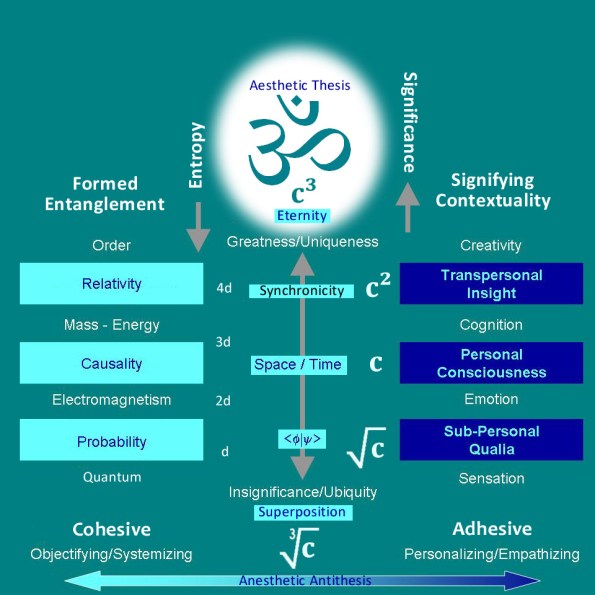
Multisense Diagram w/ Causality

Another shot at an improved diagram of the multisense continuum. Terms intercausal and intracausal are introduced to differentiate between the proto-phenomenal view *within* causality (i.e. intentionality/will is the active principle, determinism/probability is the diffracted reflection).
The Postcausal-Synchronistic | Metaphoric-Metaphenomenal level of description are adhesive and diffracted from absolute unity from the top down. They correspond to the metric c² as experience is presented in fugue-conditions which transcend space, time, and causality.
The Physical-Causal | Phoric-Phenomenal level of description are adhesive and cohesive (Cartesian Dualism). They correspond to the metric c as experience is presented as the juxtaposition of an exterior context which is cohesively spaced, timed, and deterministic (adhesive) and interior contents which are adhesive-contextual (subjective).
The Thermodynamic-Intercausal | Perceptual-Emotive
and Electromagnetic | Sensorimotive-Intracausal labels refer to translations between public manifestations of energy and private manifestations of effort or will. Any metric which relates velocity, frequency or wavelength as a fraction of c can be used here.
The Quantum-Probabilistic | Semaphoric-Sub-personal level of description refers to phenomena which are presented as either cohesive-entangled or adhesive-contextualized. An example of a cohesive-entangled appearance is a static ‘sense-of particles or objects in positions’, while an example of adhesive-contextualized appearance could be a sense of ‘dynamic waves of change in sensation itself’. The former appears as a thing which is made visible while the latter appears as an artifact of visibility itself (such as rays of light). Because the quantum level is paradoxical or bi-cohesive, the metric √c can be used to conceptualize the breakdown of natural, macroscopic conditions into quantized proto-conditions.
“Existence” = Availability
“Reality” = Maximum availability within any given frame of reference.
“Information” = An effective reference.
To be more precise, Availability = afferent/aesthetic availability. If a tree falls in a forest in a universe where hearing was impossible, sound is not available and therefore does not exist.
Maximum availability can refer to both the density of aesthetic saturation (i.e. extreme pain is extremely real) and the particular aesthetic qualities of duration, constancy, and publicity. The dream that you never wake up from is your reality. The dream that all people share and never wake up from is human realty.
Information is afferent signaling with efferent potential. The more potential for producing intentional effects, the more ‘informative’ the signal is. Information is not ‘really real’ as it only requires enough aesthetic saturation for the power to arrest attention (to be noticed or detected) and be made available to attention (focus and coherent interpretation). Informative data therefore are cohesive units of perturbation within a medium or channel of adhesive or affective sensitivity.
Special Diffractivity: c², c, and √c
(updated 5/27/16)
This (reverent, yet shameless) riff on special relativity and its relation to general relativity is intended to also show light as a special representative case relating to light as the visible subset of the more general conjecture of general diffractivity, which relates to all sensory, perceptual, and phenomenal content. I apologize in advance for the neologisms. – Craig Weinberg 4/26/2016
c²: Imaginary Light (“m² and t²”) | Cosmic-Meta-Cosmic scale
Phenomenal-metaphenomenal, surreal-supernatual, super-Mahasunna
Dreams and visions can confuse events. Dream content often features locations, characters, and objects which have ambiguous or superpositioned identities (“superlocality m²”). They can also include spontaneously confabulated histories as well as content which seems to be visionary or prophetic in retrospect (“superchronology t²”).
c: Natural Light (m/s) | Macrocosmic-Electromagnetic scale
Phenomenal-optical, real-natural, between Mahasunna and Chidakasa
Our ordinary, waking experience of light is seen as “zero-interval linkages between events near and far”*, and seamlessly merges veridical optical conditions with phantasmic ‘illusions’. Natural light occurs at c, and tends to play a foundational role in realism for sighted humans. “Seeing is believing”, including the sight of so-called ‘optical illusions’, in which the criticality between optical and phenomenal light is exposed. Phenomenal light is judged to be illusory to the Western mind, but more as a revelation of the nature of light, perception, and consciousness to the Eastern mind.
√c: Physical Light | Electromagnetic-QED scale
Optical-Semaphenomenal, hemi-real-unnatural “Sub-Chidakasa ”
On this level of description, light is an invisible, intangible semi-substance which is inferred as either entangled particles with definite position or contextual waves with definite momentum. The measurement is therefore conceived not in terms of meters per second or distance over time, but as probabilistic wave functions in which the conservation of spatial entanglement and temporal contextuality are inversely proportioned. Relativity might be understood as a macroscopic manifestation of entanglement or perceptual cohesiveness (inertial frame) and contextuality or cognitive adhesiveness (as in Lorentz transformations), I have proposed that our concept of photons should be inverted, so that they are conceived of not as particles in a void or vibrations of an electromagnetic field, but as figurative units of permittivity-permeability. I further suggest that a new unit, the phoron, be adopted informally to provide linkage across the phenomenal-optical (phoric), metaphoric, and semaphoric levels of description (frames of afference).
²c: Beams, rays, rainbows, specular reflections, glowing, halos
Light renders itself most directly and literally visible as dynamically contextualizing image transforms such as a rainbow, a change in brightness. This corresponds to the metaphotic, ²c level of description: visibility itself is made visible as “glowing” or shining and is associated with matter being glossy, transparent, or translucent.
c: Forms, colored objects, veridical images
At the photic level of description, light is transparent or seen-through. It ‘gets out of the way’ so that visibility is embodied/entangled with realism as the opaqueness of visible forms. This is the classical, natural, “c” level of description where light is the entanglement of Seer, seeing, and the seen. On this level of description (frame of afference) the metaphotic, ²c phenomena are understood to be mirage or illusion.
c√: Particle-Waves, frequency-wavelength, probability functions
Semaphotic light is an (invisible, intangible) information-theoretic pseudo-entity inferred from evidence of its effects on material instruments, and whose properties are defined mathematically. At the electromagnetic level of description, light is an oscillation of an invisible field which can be perceived as visible color or, as thermal intensity (infrared), or by the behaviors of instruments and material substances. At the quantum level, c√ light is a probabilistic wave function – a pure abstraction with purely concrete effects
*quote from David A. Grandy, The Speed of Light, Constancy + Cosmos
Please see the following PDFs for more information.
Emergent properties can only exist within conscious experience.
…
Neither matter nor information can ‘seem to be’ anything. They are what they are.
It makes more sense that existence itself is an irreducibly sensory-motive phenomenon – an aesthetic presentation with scale-dependent anesthetic appearances rather than a mass-energetic structure or information processing function. Instead of consciousness (c) arising as an unexplained addition to an unconscious, non-experienced universe (u) of matter and information (mi), material and informative appearances arise as from the spatiotemporal nesting (dt) of conscious experiences that make up the universe.
Materialism: c = u(mdt) + c
Computationalism: c = u(idt) + c
Multisense Realism: u(midt) = c(c)/~!c.
Recent Posts
Archives
Tags
Absolute AI alternative physics alt physics anthropology art Artificial Intelligence big questions biocentrism brain Chinese Room computationalism computers consciousness cosmogony cosmology cosmos debate diagram dualism eigenmorphism Einstein emergence entropy explanatory gap free will graphics hard problem hard problem of consciousness information information theory language life light math mathematics metaphysics mind-brain multisense continuum Multisense Realism nature neuroscience panpsychism pansensitivity perception phenomenology Philip Goff philosophy philosophy of mind philosophy of science photon physics psychology qualia quantum quantum physics quora relativity science scientism Searle sensation sense simulation society sound strong ai subjectivity technology theory of everything time TSC universe video visionThis slideshow requires JavaScript.
Blogs I Follow
- The Third Eve
- Shé Art
- Astro Butterfly
- Be Inspired..!!
- Rain Coast Review
- Perfect Chaos
- Amecylia
- SHINE OF A LUCID BEING
- Table 41: A Novel by Joseph Suglia
- Rationalising The Universe
- Conscience and Consciousness
- yhousenyc.wordpress.com/
- DNA OF GOD
- Musings and Thoughts on the Universe, Personal Development and Current Topics
- Paul's Bench
- This is not Yet-Another-Paradox, This is just How-Things-Really-Are...
- Creativity✒📃😍✌
- Catharine Toso
- Political Joint
- zumpoems


Recent Comments