Archive
Multisense Diagram w/ Causality

Another shot at an improved diagram of the multisense continuum. Terms intercausal and intracausal are introduced to differentiate between the proto-phenomenal view *within* causality (i.e. intentionality/will is the active principle, determinism/probability is the diffracted reflection).
The Postcausal-Synchronistic | Metaphoric-Metaphenomenal level of description are adhesive and diffracted from absolute unity from the top down. They correspond to the metric c² as experience is presented in fugue-conditions which transcend space, time, and causality.
The Physical-Causal | Phoric-Phenomenal level of description are adhesive and cohesive (Cartesian Dualism). They correspond to the metric c as experience is presented as the juxtaposition of an exterior context which is cohesively spaced, timed, and deterministic (adhesive) and interior contents which are adhesive-contextual (subjective).
The Thermodynamic-Intercausal | Perceptual-Emotive
and Electromagnetic | Sensorimotive-Intracausal labels refer to translations between public manifestations of energy and private manifestations of effort or will. Any metric which relates velocity, frequency or wavelength as a fraction of c can be used here.
The Quantum-Probabilistic | Semaphoric-Sub-personal level of description refers to phenomena which are presented as either cohesive-entangled or adhesive-contextualized. An example of a cohesive-entangled appearance is a static ‘sense-of particles or objects in positions’, while an example of adhesive-contextualized appearance could be a sense of ‘dynamic waves of change in sensation itself’. The former appears as a thing which is made visible while the latter appears as an artifact of visibility itself (such as rays of light). Because the quantum level is paradoxical or bi-cohesive, the metric √c can be used to conceptualize the breakdown of natural, macroscopic conditions into quantized proto-conditions.
Continuum of Sense
I have been writing for a long time now about what I call the Multisense Continuum, or the ACME-OMMM duality. In the course of developing this hypothesis, I have learned about other such efforts, detailed below, including a recent paper:
Rigidity-chaos semantic continuum
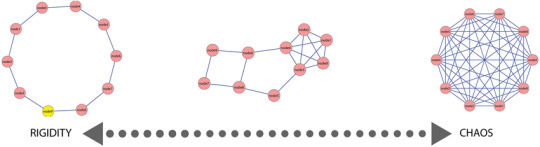
Drawing on network models, this is a promising approach, however the irony was apparent to me in the choice of terms. To see the opposite of psychological rigidity as chaos may be trivially true, however, it may also be that the chaos is a projection of the rigid, systemizing approach.
The model that I propose sees chaos as only one aspect, and not the most important aspect of the opposite of rigidity. This continuum is so universal, that I think it extends beyond ‘reality’ to embrace all of nature.
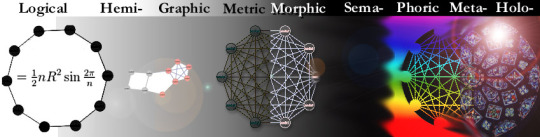
Here are some other variations:
Tough-Minded vs. Tender-Minded (William James)
interpreted the European divide between empiricists/positivists on the
one hand and German idealists/rationalist on the other hand in a
psychological way. He talked of the “tender-minded” and the
“tough-minded.” The tender-minded are the German idealists and
rationalists. (this linked source is gone, see new link for James’ original work)
The Divided Brain (Iain McGilchrist)
Psychiatrist Iain McGilchrist describes the real differences between the
left and right halves of the human brain. It’s not simply “emotion on
the right, reason on the left,” but something far more complex and
interesting.
Autistic-Psychotic Spectrum (PDF)
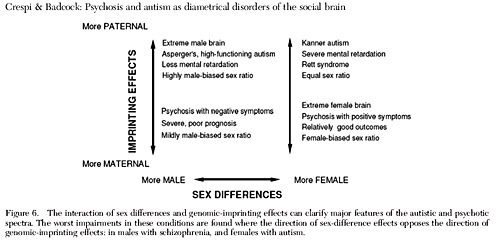
‘Thin-boundares” and “Thick-boundaries”
Significantly thinner boundaries compared to control groups have been
found in art students (Beal, 1989, Hartmann, 1991), music students, and
mixed groups of creative persons (Beal, 1989), frequent dream recallers
(Hartmann, 1991, Hartmann Elkin, & Garg 1991), adults with
nightmares (Hartmann, 1991, Levin, Galin, & Zywiak 1991; Galvin,
1993), adolescents with nightmares (Cowen and Levin, 1995), “lucid
dreamers” (Galvin, 1993), male as well as female fashion models (Ryan
2000), persons with unusual mystical experiences (Krippner,,
Wickramasekera, Wickramasekera, & Winstead, 1998), and persons with a
diagnosis of Borderline Personality Disorder, Schizoid Personality
Disorder or Schizotypal Personality Disorder (Hartmann, 1991).
Interestingly, although art students have much thinner boundaries than
average, this is not true of established artists, who have boundary
scores in the normal range (Beal, 1989).Groups that score significantly “thicker” than average
on the BQ include naval officers, salespersons, lawyers, patients with a
diagnosis of Obsessive-compulsive Personality Disorder, persons
suffering from “Alexythymia” (Hartmann, 1991), and patients (from two
different sleep disorders centers) with a diagnosis of Sleep Apnea
(Hartmann, 1992).
Empathizing-Systemizing Continuum
Empathizing and systemizing traits were independent in women, but
largely dependent in men. In men, level of systemizing skill required by
field of study was directly related to social interactive and
mindreading deficits; men’s social impairments correlated with prolonged
go/no-go response times, and men tended to apply systemizing strategies
to solve problems of empathizing or global processing: rapid perceptual
disembedding predicted heightened sensitivity to facial emotion. In
women, level of systemizing in field was related to male-typical digit
ratios and autistic superiorities in detail orientation, but not to
autistic social and communicative impairments; and perceptual
disembedding was related to social interactive skills but independent of
facial emotion and visual motion perception.
…and my own bloggings:
Zooming in on Reductionism and Extremely Gendered Brains
Ironically, but unsurprisingly, the idea of the continuum of sense itself may only be coherent when approached from the ‘East side’ of the spectrum. This has to do with what is known as Theory of Mind.
Does Neuroscience Crush Dualism?
Is dualism no more than philosophical debris given the advances in neuroscience?
Dualism perhaps, but so too are Physicalism and Positivism obsolete philosophies given advances in neuroscience, physics, and psychology. Idealism, Panpsychism, and Non-Dualism are, in my view, still far ahead of neuroscience and cognitive science as far as being on the right track philosophically.It is very common for people who have a Physicalist view to confuse Non-Physicalist views with Dualism, Solipsism, Anthropocentrism, Theism and Naive Realism. In some cases there is cause for this confusion, but it is more common in my experience that it is a psychological projection or Straw Man argument against the view which is diametrically opposed to their own.There is a psychological dimension to this which is important. Jung’s identification of the Shadow projection, “the thing a person has no wish to be” provides a model for how hostility and prejudice can arise, even in the most scientific mind. Other very useful concepts include the Empathizing-Systemizing Continuum or Psychotic-Autistic Spectrum.
In short, the mind which is extremely Systemizing by default tends to suppress its potentials for Empathizing, resulting in a rigid, combative cynicism against anything which is perceive as anti-scientific (really Anti-Systemizing). Extremely Empathizing minds have identical response to what they perceive as Anti-Empathizing so that neither side can actually listen to the other’s perspective and both parties argue past each other. I call these reactionary and radical extremes OMMM and ACME respectively (Only Material Mechanisms Matter and Anything Can Mean Everything) War of the Worldviews.

Even neuroscience itself can be used to understand the limits of the current Neuroscientific approach. Brain lateralization, though held in disfavor after being overly hyped for several years, still has profound neuroscientific value (as explained in the video The divided brain). Animals with brains seem to split their consciousness between narrow, logical focus on the most immediate details of perception and broad environmental sensitivity.William James talked about ‘Tough-Minded’ vs ‘Tender-Minded’ philosophies.
[…]he interpreted the European divide between empiricists/positivists on the one hand and German idealists/rationalist on the other hand in a psychological way. He talked of the “tender-minded” and the “tough-minded.” The tender-minded are the German idealists and rationalists. Tough-Minded vs. Tender-Minded: William James’ Pragmatism and the Empiricist-Rationalist Divide
More recently Ernest Hartmann expanded it to a more general notion of ‘thin-boundares” and “thick-boundaries” in his book Boundaries: A New Way to Look at the World.
In my own understanding, I reconcile both ends of the spectrum to try to understand the underlying unity, which I identify as ordinary ‘Sense’. The qualities of thick/tough and thin/tender are seen as a consequence of direct Sensing and indirect Sense-Making modes of Sense which have evolved, and continue to evolve novelty and self-enrichment on many levels simultaneously.
This turns out to be along the lines of what many schools of Western Mysticism and Eastern Philosophy have taught, except where they used Spiritual terms, my approach draws on semiotics and general systems theory. What many traditions identify as God or Spirit, I see as an Aesthetic Foundation or Pansensitivity which accounts for both Theistic and Atheistic appearances without collapsing into relativism. Sense is Absolute, and Relative-but-not-Absolutely Relative.For those Systemizing readers whose blood pressure is already climbing at reading this, you might want to stop while you’re ahead, before I add more fuel to the fire. Warning, silly sounding neologisms ahead…
Materialist Monism is actually Crypto-Cartesianism.
In other words, the conventional scientific worldview treats consciousness as an ’emergent property’ or ‘information processing’ without grounding those terms in physics itself. Since Physicalism and Functionalism reduce nature to unconscious, automatic interaction of forces and probabilities, all appeals to emergence or integration are really metaphysical appeals to panpsychism. The OMMM answer to Dualism, Solipsism, Anthropocentrism, Theism and Naive Realism are the diametrically pathological exaggerations: Nihilism, Nilipsism, Mechanemorphism, Anti-Theism, and Anti-Realist Sophism.
In the perpetual argument between the two extremes, the Superstitious Charlatan archetype is projected by its antagonist, the Substitutious Inquisitor. For every ACME appeal to God or Spirit, the OMMM counter-appeals to a mechanical substitute. Nothing can be considered ‘special’ except the negation of the ‘special’ through compulsive debunking. Words like ‘merely’, and ‘simply’ are thrown around liberally, as are epithets of ‘nonsense’, ‘rubbish’, ‘postmodernism’, and ‘word-salad’. Feelings and thoughts are merely electrochemical patterns in a brain. For everything imaginative or mysterious there is condescension and venomous hostility. For everything personal or subjective there is an impersonal object to substitute.
The final irony of course is that in seeking to nullify the personal self*, the denier of human specialness paints a mental picture of a universe of radical anthropocentrism. In this universe where all phenomena, even evanescent neutrinos and dark matter are absolutely real, there is only one phenomenon, one delusion conjured** by the brain function of Homo sapiens, which is absolutely unreal, and which contains all of the direct experience of Reality we can ever have. Instead of perception, we have deception† and instead of a phenomenal, sensible universe, we have a dualism consisting of two nihilverses – one devoid of life and consciousness, the other devoid of reality and truth.
*or Science forbid, “Soul”!
**Emergently, and Naturally of course
†with one ‘scientific’ exception
Nesting Spinor

“A spinor visualized as a vector pointing along the Möbius band, exhibiting a sign inversion when the circle (the “physical system”) is rotated through a full turn of 360°” – Wiki
Here is an adaptation of a spinor topology to show the relations within aesthetic phenomena that give rise to realism. Note the adjacent red and blue arrows in opposite directions make an ideal place for the sensory-motive locus, where input/output is experienced directly. The opposite side of the band is the ‘object’ side, where inertia and determinism present a united front against the subjective perspective.
If we set consciousness aside for a moment, this view of the spinor can be used to conceptualize electromagnetism as the source of spacetime rather than an effect occurring within spacetime:

The conventional understanding frequency and wavelength are here inverted, so that we are thinking about them from the inside rather than as objects of study. A wave is an outsider’s view of an occurrence which is only metaphorically wave-like: a surge of changing phenomenal quality.
Dreams, Reality, and the True North of Consciousness
For the materialist, dreams are nonsense. While the body rests, the brain performs housekeeping tasks which have the side effect of giving us hallucinations, and that’s it. If we want to know about consciousness, the materialist will say, we should study biology and evolution, not dreams.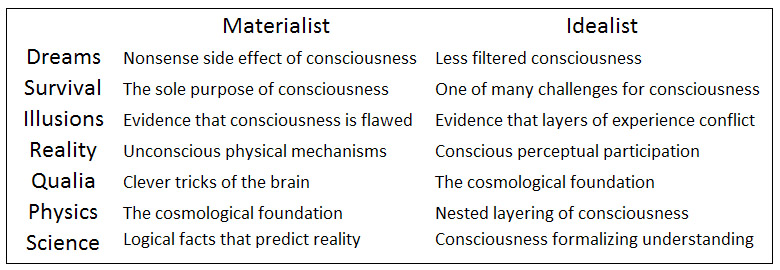
The materialist’s view of consciousness is that is a marvelously complex way for an animal’s body to adapt its behavior and control its environment. Consciousness is about what we do to the world and what it does to us. Things like optical illusions and the placebo effect tell us that the brain’s mental products are flawed since they fail to render reality as it is, but often wished or feared to be. To understand anything about nature as it really is, we can only use empirical, formal, consensus-building methods to tease out golden flecks of truth from the raw ore of our personal guesses and opinions.
For the idealist* consciousness need not inhere to a context of physical survival. Consciousness is not only about what we’re trying to do in the world, but is instead the very fabric of all possible worlds. I personally suspect that this means that consciousness of all sorts is not only pervasive in the universe, but that the universe is actually nothing but the collection of all conscious experiences. If there is anything beyond all forms of conscious experience, it is by definition, indistinguishable from nothing at all (since awareness of some kind is required to make and appreciate distinctions).
In this view, consciousness is not only about the survival of certain special animals, but is the necessary feature of nature to present itself and to participate in that presentation. Just as we do not expect a dead body to have experiences, neither should we expect physics to be able to define itself or function in the absence of all experience.
In idealism, dreams present at least the possibility of a purer sample of human awareness than waking consciousness. Because the psyche is free from contamination of the outside world, dreams would be a kind of control for our thought experiments about consciousness. For the idealist, dreaming should be the true North of consciousness. As Freud and then Jung found, dreams are overflowing with deep symbols and information which transcend personal experience.
In practice, dreams may have contamination of their own, and materialists may be appalled at the idea of treating consciousness most useless and bizarre extremities as the foundation for understanding, but the idealist understands that facts are facts, and the fact is that when we close our eyes and relax, consciousness reveals itself as a spontaneous world-maker, and that is an important fact to begin with. When we withdraw from the physical world, the psyche does not just disappear, it also creates new worlds, and it seems to create them on the fly, instantaneously, without optical illusions or placebo effects.
From here, in the dreamworld, we can see that color need not be wavelengths, and images need not be representations of something physical in the world. In the context of the dream, idealism is the physical reality. Qualia is matter. Any argument about this is a misunderstanding about what the word qualia means (which is common for materialists who may not be able to conceive of images and sounds independently of neurology and physics). If you never wake up from the dream, you will never encounter any part of your own brain or body as it exists in physical reality.
Once we accept that, as Bernardo Kastrup has said, “Materialism is baloney.”, we can move on to the deeper questions of what the universe of qualia is really all about, and whether our own place in it as humans is central or not. This is actually the more interesting level of metaphysics than the perennial argument at the gate between materialists and idealists. I’m using the terms subjective idealist and transcendental idealist here, but there may already be philosophical terms that are used academically.

As a transcendental idealist (aka multisense realist), I’m pretty much on my own. The materialists hate my view because they see it as vile woo, and the traditional idealists think I’m confused because I don’t accept the primacy of subjectivity in generating qualia as a necessary truth (although it may be an empirical fact). The picture that I’m looking at is a scientific one, but larger than science. It is a quasi-theistic or ambi-theistic one, but larger than theism. I do not see this as strictly philosophy, but a potentially actionable view of nature, complete with applications for the future of technology and for the rehabilitation of (what remains of) society.
*and here I’m presenting my own view as the example, not necessarily the most common views…likewise, the materialism column applies to non-material reductionism like computational mind theories.

Hyper-Mentalism and Supernatural Belief
This article from Psychology Today, Hyper-Mentalism, Hyper-Empathizing, and Supernatural Belief, talks about the diametric model’s explanation of the psychotic end of the autistic-psychotic spectrum.
“To use an analogy, the diametric model implies that we live in parallel mentalistic and mechanistic universes, with mental causality ruling the first and physical causality the second. Religious, superstitious, and magical thinking clearly represent an encroachment of the mental world on the real one in the form of belief in divine creation, miracles, the power of prayers and spells, and so on. Indeed, as I pointed out in an earlier post, you could see traditional religion and superstition as the result of a primeval mentalistic inflation which hyper-mentalized the real world, in part because mechanistic understanding of it in the form of modern science, medicine, and technology had not had time to develop. Furthermore, you could also see this as the paradigmatic historical case of a “combination of strong mentalizing coupled with poor understanding of the physical world.”
In my view, this is very close to the hypothesis that has been developed under the Multisense Continuum or ACME/OMMM model.

The diametric model deserves more attention, in my view, however I think that the assumptions behind the model are themselves biased toward the systemizing/mechanistic end of the spectrum. Note the language in the quote above: “Religious, superstitious, and magical thinking clearly represent an encroachment of the mental world on the real one“. Highly subjective states are identified as being intrinsically unreal rather than being an extension of nature and reality. The end of that quote shows another good example of the mechanistic worldview, associating superstition with “poor understanding of the physical world.” I would not deny that there are many people who do suffer from a poor understanding of the physical world and compensate for that to some extent with magical thinking, however, that correlation does not always hold true. Many people, such as myself, embrace the physical world and have an excellent understanding of it, yet see that behind and beyond mechanistic appearances are also more subtle natural phenomena. It is not that the psychotic is poorly equipped for reality, it is more like reality poorly equipped to contain psychotic hyper-sensitivities. This is not to say that paranoid schizophrenics are right about the content of their delusions, only that the form of paranoid delusions reflect (in a distorted way) the transpersonal territory of the psyche.
In the short article linked above, the author makes the distinction between his diametric model and “Simon Baron-Cohen’s rival scheme, which has systemizing versus empathizing instead of the diametric model’s mechanistic versus mentalistic cognitive dualism”. Here again, the distinction between empathizing and mentalistic is itself a mechanizing/systemizing distinction. Both the diametric model and empathizing-systemizing model label the ‘feminine’ side in terms of a personal function. The former sees empathy as a cognitive skill, while the latter seems to suggest that it is overdeveloped empathy which interferes with the correct application of cognitive skills. In both cases, the bias of contemporary academic science shows through: Extraordinary awareness which conflicts with consensus reality is a defect.
This bias is not surprising, nor is it even a negative if we are trying to get a handle on human psychology for purposes of treatment. The problem that I see, is that it closes the door on the deeper dimensions of psyche and fails to take seriously the implications of consciousness transcending classical physics. Once we do take a scientifically objective look at these implications, I think that we wind up with a theory of order and participation in the universe which is not limited to human psychology but extends beyond physics, information science, philosophy, and religion: A new scientific cosmology based on sense phenomena.


Recent Comments