Archive
A Sound by any Other Name
What is the difference between thinking that consciousness requires a living body and thinking that sounds have to be made by acoustic instruments?
It seems like the same common sense intuition, and I think in both cases, it happens to be false. From audio recording we learned that we did not need to have someone play a horn to hear a horn sound. We could actually use the sound that a needle makes when scratching over a grooved surface to make a nearly identical sound, as long as the grooves matched the grooves made when the horn was played in the first place.
As audio technology progressed, people discovered that purely electronic changes in semiconductors could be used to drive speakers to drive eardrums. We didn’t need to begin with a horn being played, or acoustic vibrations to propagate from brass to air to a steel needle to a cooling disc of resin. All we needed was electronic switches to rapidly change the flow of current through a speaker in the same pattern that the needle used to make going up and down in the groove. The up and down analog became digital stop and go, all the way up to the point where you have to jiggle people’s eardrums. That could not be done electronically but required a membrane to mechanically push air into the ears.
It seems now that we are getting closer to cutting out the acoustic middleman entirely with the possibility of Neuralink type technology and broadcast music directly into your brain without any physical sound at all. No speakers, no ears…but you still need something that senses something, and you need something that senses that something as sound. Even if we play music and record our dreams electronically, it still doesn’t solve the Hard Problem of consciousness. There remains an explanatory gap between the silent operation of electrical current and the experience of sounds, sights, feelings, thoughts, and the entire material universe of objects…including brains and electronic instruments.
That last sentence is the tricky part that physicalist thinkers can’t seem to stop overlooking. Yes, the entire physical universe that you know, that you read about, that scientists experiment on, can only exist under physicalism as a ‘model’ or ‘simulation’ that simply, um, ’emerges’ from either electromagnetism itself, or electromagnetism in various brain structures, or from the ‘information’ that we imagine is being communicated by any or all of these processes.
Of course, it’s all circular. To say ‘the brain’ is to say ‘my qualitative and cognitive experiences that I call ‘brain”. To say ‘the world’ is to say ‘my’ or ‘our’ qualitative experiences that seem like a world. There is no getting around this. The last mile of any cosmological theory always has to cash out in some experience-of-a-cosmos, with or without a theory of a cosmos-outside-of-some-experience. Noumena are optional and hypothetical. Experiential phenomena, as Decscartes almost said, cannot be deined.
I argue with a lot of people about information and qualia, because it is glaringly obvious to me that this technology based idea of information conflates the purely intellectual and abstract process of learning or communicating with the concrete aesthetics of what it is being communicated. Information or simulation theory says nothing about what is ultimately doing the communicating and what literally happens when a communication is decoded, from the billions of quantifiable microphysical stop/go events in an engineered device or neurological organ to unquantifiable and irreducibly aesthetic sight/sound/objects/feelings/thoughts.
The idea of simulation only pushes the explanatory gap down further in scale, but it is the same gap. It’s not enough that a change in a computing device or brain coincides with a change in direct experience, we have to ask what is doing the correlation in the first place, and how, and why. It’s not just “what breathes fire into the equations?”, but what the hell is fire doing in equations in the first place? Why wouldn’t it make sense to ask what breathes equations into every form of ‘fire’? What could it be other than conscious experience itself? Anything we try to put in between conscious experience and nature always has that same last-mile problem. In the end, you need something eternal that can make sense – some capacity not only to run programs on hardware to manipulate hardware but for either programs or hardware to exist as something aesthetic rather than just invisible facts in an arithmetic void.
“Is Consciousness a Controlled Hallucination?” part 2
Picking up again* for the second hour of this new video from 8/25/2021, where philosophers Philip Goff and Keith Frankish discuss consciousness with neuroscientist Anil Seth, whose new book is Being You: A New Science of Consciousness
Just after 1:00:00 Anil is talking about voluntary action as a freedom from immediacy, which I think carries a bit of misdirection or burying the lead. Freedom from immediacy, fine, there can be complicated clocks and timed systems in the brain, etc, but what is the feeling of will, how can it exist, and why? In addition, I don’t think many people question what is meant by ‘immediacy’. Isn’t that determined by some informal average of sensory sample rates? How is it not anthropocentric to project our arbitrary sense of now onto the universe as a whole? Timescale is one of the great keys to resolving the hard problem IMO.
I understand what Anil is saying about the sense of will or redness not needing to be real to be experienced, and not being part of the causal structure of the universe (I used to see it that way also for many years), but it fails to consider that by its own logic, asserting consciousness as something that isn’t completely real (a controlled or controlling hallucination) necessarily means that any idea we have about a universe or experiment that we can perform can be no more real. With physical science experiments, we can learn more about the physical-seeming end of our shared hallucination, but that is not to say its causal closure is anything more than the tautological limits of the very sense and sense making modalities we are using to locate this part of the universe in the first place. If redness can arise from a history of evolutionary utility then so can our sense of physicality. If, however, we can be right about anything, then at least some part of consciousness cannot be less real than physics.
Around 1:04:28 it starts getting a little animated, with Anil insisting that neuroscientific studies are not neutral with regard to free will. In the next minute, he steps back from that slightly to say that there’s merely no evidence of anything like free will. It’s hard to imagine how the lack of physical evidence wouldn’t be neutral, since Dualism would hold that of course there’s not going to be material evidence of non-material qualia. There no olfactory evidence for sight or colors either. I’m sure that Anil would agree that our sense of will is part of the universe that we model in our conscious experience as ‘physical’ or material, but I don’t think that he has considered that materiality itself may simply be conscious experience that has been rendered in a truncated form through our local interface/filter. The difference is that with the latter, our will can be both immaterial or transmaterial and have concrete material effects, because both subjective will and objective forms share the same common context of origin – there’s just no good reason to assume that context is more like our sense of physicality than our sense of mentality. To the contrary, with relativity and quantum mechanics, it seems clear that even the most physical of phenomena originate from a substrate that is more mind-like than it is matter-like. I see them both as categories of sensory-motive, aesthetic-participatory phenomena (universal qualia).
Around 1:12 they get into the inaccessibility of consciousness, with Anil saying that we will gradually have access to more data and Keith saying that science is irreducibly third person. My contribution to that is that if we study brain conjoined twins we can develop tech that will get us closer to sharing first person experience (or rather, those aspects of conscious experience that qualifies itself to itself as first person). There may be other ways to get around privacy also (which would unfortunately interest a lot of dangerous organizations as well). Maybe we can technologies to extend natural sensitivities and empathy to a degree that they produce rigorous science…maybe that’s a long way off but probably less invasive than brain sharing tech.
Seth goes on to say that he wants to see how far we can get pursuing the materialist project in science before considering other possibilities. I don’t think that anyone is suggesting on giving up on that, but I don’t see any advantage in presuming it is metaphysically accurate or waiting before exploring other possibilities. Around 1:18 Philip makes an excellent case for rejecting Anil’s approach of setting aside the hard problem, citing the somewhat unscientific decisions of Galileo, Descartes, and others to put non-material qualia outside of the domain of science.
At 1:22 the conversation gets slightly heated again as Anil suddenly gets personal by saying “Now you’re making a mistake you said you don’t make, and I’m a bit disappointed. You say you don’t make this mistake, but you just did!” Those of us who have debated at length about the Hard Problem recognize this pivot very well. The conversation has gone from a cordial sharing of perspectives to one of accusation and condescension. I wish that we had fMRI visualizations on everyone in the conversation and could see the frontal cortex activity getting hijacked by limbic activity. There is more going on here than just science – there is something that Anil, and most everyone that I have come across that subscribes to a physicalist view perceives as a threat, and one that demands an offensive response.
Both Anil and Philip agree here that there is something that a color blind person misses out on if they cannot see red – Philip says it is information (or knowledge from Frank Jackson’s Knowledge Argument/Mary’s Room), Anil isn’t really willing to formalize it though, saying only that the topic is a separate issue, a different thing for him and that it is irrelevant.
My Multisense Realism view defines qualia as the sole fundamental phenomenon, and one that includes a capacity to divide or limit (entropy-negentropy/insensitivity) access (sense/sense-making/empathy) to parts of itself. Qualia is what exists eternally – the Holos, insensitivity is what Graphs the Holos into local sub-holarchies of experience, and sense or consciousness is what reunites the latter with the former (making it holographic rather than hallucinatory). Sense is access to the totality. Entropy, including temporalization and spatialization, are functions of dynamically gating or limiting that access.
At 1:25 Anil and Keith affirm each other’s view that we should ignore the hard problem (the standard ‘shut up and calculate’ response, or non-response). Keith at least acknowledges this position as Illusionism, which he advocates, but Anil stops short of subscribing to it, saying at 1:26:07 “It doesn’t change what I would do very much.”
I think this attitude ironically supports Dualism. It’s a crytpo-dualism in which Res Cogitans is understood not to have an effect on Res Extensa (the doing that Anil cares about exclusively), and therefore doesn’t matter. Philip is correct when he says around 1:27 that the private/subjective phenomena are part of a totally different explanatory project from physical explanation, but I would go further and say that the project of physical explanation can be subsumed within the other project, as long as we don’t make the assumption that privacy/subjectivity is something other than (universal) qualia. With a universal qualia model like MSR, all physical forces and structures can be understood in sensory-motive terms.
Good job all around. I agree most with Philip, then Keith, and least with Anil, but I respect the nuance of his positions (not functionalism, not IIT, pragmatic, etc). Still, I think that Seth’s pragmatism is more biased than the wants to believe it is. Part of that seems like an unwillingness to care about the difference between pursuing materialistic methods (I think everyone agrees that we should) and the validity of the prospect of extending reality to the non-material. Anil seems to conflate the two positions, as if the former justifies the latter.
*My comments on the first hour are here.
“Is Consciousness a Controlled Hallucination?”
In this new video from 8/25/2021, philosophers Philip Goff and Keith Frankish discuss consciousness with neuroscientist Anil Seth, whose new book is Being You: A New Science of Consciousness (which I have not read yet). Following are my comments on the first half of the video:
Jumping right in from the first few minutes, I have some questions, criticisms and insights that are worth mentioning. My apologies for the long winded, irritatingly constructed sentences that probably detract from what I’m trying to say more than clarify, but it’s important to me that I communicate the nuances in excruciating detail. Maybe someone or some AI internet archive spider will find it interesting in fifty years.
8:45 (Anil Seth) “Everything that we perceive is an active construction. It’s generated by the brain.”
Has this been tested and found to be conclusively true, or is it an assumption + confirmation bias? How do we know that what we perceive is not an active filtration or modulation of access to other contexts of consciousness (transpersonal, subpersonal, etc)? How do we know it is active construction rather than participatory collaboration?
What is the physical mechanism by which “the brain” (the whole organ? neurons? molecular changes within neurons?) “generates” (Explanatory Gap/Hard Problem goes here) these “constructions” (sights, sounds, flavors, thoughts…call them qualia)?
Note: *Importantly, anything we refer to as a brain is also only known as qualia, by qualia, for qualia. A brain is an object rendered in our sense of touch, an image rendered in our sense of sight, an idea rendered in our sense of understanding. We have no valid reason to presume objects to be anything other than shared or universal qualia. To the contrary, even the physicalist/eliminative position demands that everything that we experience and can ever experience, including all physical phenomena, can only ever be a representation of conditions inside of a (literally meta-physical) program or biochemical virtual “function space”. If physicalism is right, we can never contact physics in any way and are forever trapped in some kind of Platonic cave of computations that only seem physical, or only seem like computations, or only seem to seem…or something.
9:28 (AS) “My perceptions have the characteristic phenomenology – they appear the way they appear because that’s useful for my overall survival as an organism.”
My argument against this is that it is clearly a “Just So story”, that is, a post-hoc justification of appearances without being based on any plausible a priori possibility of a capacity to generate appearances physically, let alone for any such thing to provide a possibility of survival advantage over the ordinary complex physical activities of other body systems that we presume do not generate appearances and would not improve as a result of them. 1
Indeed, it seems quite implausible that of all phenomena that have come to exist in the universe, only these certain groups of cells in certain organic bodies have this unexplained physical power to generate non-physical appearances…to themselves…that bear some isomorphic relation to everything else in the universe…that actually has no appearance at all.
The entire physical universe is, under the contemporary neuroscientific view that Seth advocates, without appearance – an invisible, intangible, unexperienced void that spontaneously acquires a monumentally grand variety of distinct, multisensory appearances when certain very specific kinds of biochemical events occur in certain sequences. But how? And Why?
Given the staggeringly effective abilities of a simple periodic table of atoms generated by simple stars to physically generate and maintain every organism, every immune system, every brain structure and function without any such thing as appearance, why would this virtual dashboard “appearance”, within which a hallucinated “user” of such hallucinated dashboards also virtually “appears”, offer any improved chance of survival to a reproducing body of cells? There are neurons in the gut too. What is our theory for how and why these systems of cells would not benefit by creating hallucinated ‘constructions’ for…their mission critical activities (or is it for their constructed ‘selves’)?
9:40 (AS) “Redness is not objectively out there in the world. There’s just wavelengths of electromagnetic radiation”
The problem here is that our expectation of electromagnetic radiation, and of a world, and of objectivity would also have to be constructions. Our sense of a physical reality that has no appearance and can never be contacted in any way, must also be a construction. No matter how much science we do, and how objectively we think we are being, we can only ever validate our sense constructions by more constructed appearances of relation between theories (intellectual constructions) about observations (meta-perceptual constructions derived from multiple similar perceptual constructions). You can’t have it both ways. If consciousness is constructed, then every sense of correspondence between constructions is also constructed. We can’t put ourselves in a hallucinatory box without that box also being hallucinatory.
10:19 (AS) “In some conditons, like under psychedelic drugs or in psychosis, whatever, your perceptions become less controlled by the relevant sensory data.”
Is it always less controlled, or do altered states of consciousness sometimes appear to open access to sensory data that is controlled by different, but no less controlling features of reality beyond physical appearance constructions? Some of that data may be in conflict to some extent with our default conditioning, and even physical causality, but not always. Psychedelics and psychosis are sometimes tied to genius insights and unusually high performance (Doc Ellis’s LSD No-Hitter as an example). Transpersonal/psychedelic appearances may defy ordinary personal and subpersonal control, but that does not mean that the defiance is not simply another, perhaps higher2 context of control. There may be conflict and chaos between modes and scales of awareness, and that is fairly described as ‘uncontrolled’, but it need not imply that what is bleeding through personal awareness is not also a form of highly developed awareness. By analogy, two strong, clear radio station signals may be received by one receiver as a garbled confusion of two signals and static. In addition, examples like Doc Ellis’ psychedelic no-hitter present a counterfactual data point to the hypothesis that it is always adaptive for hallucinations to tend to resemble physical conditions and causes.
11:51 AS makes an important point about prediction not always being about predicting the future, but rather we might also refer to perceptual fill-in of missing data ‘prediction’. What needs more attention, IMO is the wholeness or gestalt of the appearance. A simulacra such as a face appearing in a cloud does not appear to be filling in something as a computer would try many different possible solutions, rather one solution or another appears in its entirety at any given moment. While the neuroscientific view focuses on the information processing function of suppressing ambiguity, the more interesting issue to me to focus on is what that ambiguity is replaced with – seemingly complete and aesthetically rich presentations that are revealed in a finished form rather than constructed over time, as if being pulled from some eternal Akashic gallery of archetypes. It seems to make no difference whether the gestalt is from memory or novel as far as the level of detail of its completeness or the speed in which it is accessed. When I see the Mona Lisa in the image below, it is ephemeral yet persistent, and neither fuzzy nor focused.

In the case of novel gestalts (such as a weird, non-famous face in slice of toast), the fill-in would appear to have no value or a negative value to abductive reasoning (~13:12). The simulacra toast face does not lead us to an explanation of a physical cause of that sensation. Note that our early advances in artificial image recognition do not produce these kinds of prefabricated gestalts, but rather just the opposite.

In fact, without the side by side comparison, the digitized output of Bayesian-like backpropagation does not really resemble an image. It is an anti-simulacra…a source of potential recognition strategies, but what is being recognized is not a visible image, but invisible statistics. Why, if Anil Seth’s view is on the right track, do our guesses and predictions look like they are coming from ‘somewhere’, rather than from nowhere?
The conversation continues into describing the role of prediction for both biology and consciousness. There is no question that human personal consciousness uses Bayesian-like probabilistic methods of accessing what I would call subpersonal data, but whether that data is simply another layer of conscious experience or an unexperienced biochemical process remains untouched by neuroscientific inquiry. Yes, our perception certainly can model to predict something evolutionarily functional (red octagon = Stop sign) but that does not explain what the appearance of color or shape actually is, how it appears, or why. Retrospectively, once we have qualia/appearances, then sure, we have every reason to benefit against natural selection pressures by using them, but we would have the same reason to benefit from any power that transcends ordinary physics. Omniscience would come in handy, and it’s just as likely to emerge spontaneously from physics as any sort of qualia.
The retrospective benefit of prediction does not in any way prospectively justify the existence of qualia or its value for prediction over and above biochemistry. Everything that Anil is saying is important to the easy problem of consciousness, and it gives us a plausible connection between evolved Bayesian prediction mechanisms and evolutionary biology, but it doesn’t give us any insight into how either of those mechanical-anesthetic functions could relate to phenomenological (aesthetic-participatory) presentations, or the possibility of their being generated physically or mathematically. Philip makes this point later on, around ~21:00, that the predictive features of consciousness are neutral as far as dualism v materialism is concerned.
Although Anil goes on to say that his materialism is pragmatic rather than an absolute philosophical conviction, he does not really seem to support that. Instead his defense of pragmatic materialism seems more tied to a preference for working with brain function rather than metaphysical speculation. I don’t disagree, but it’s not an argument that defends materialism objectively. It is of course more pragmatic professionally to know about the brain than it is to know about the big picture of life, the universe, and everything, but that doesn’t make it more true. As he continues around ~28:00, it seems clear to me that his rejection of Dualism (which I reject as well, but for the opposite reason3) is itself a kind of naive rejection of a straw man of Dualism, it’s history and popular association with the harmful behaviors of religious groups, etc. It’s a pedantic, and overused disqualification of all things non-material on general grounds of being ‘unhelpful’ and silly seeming. I think that there are good evolutionary reasons for that bias toward matter and by extension survival of the material body, but it is an unscientific bias nonetheless.
Around 33:45, Keith asks Anil about realism and privacy. His response includes “Buses have qualities, properties such as solidity and velocity that do not rely on a mind to exist.”
Here I would say that we only know that those physical properties do not require our mind to exist, but we do not know that such properties are anything other than other properties of consciousness. Perhaps there are impersonal qualities of conscious experience that are common to certain contexts and modalities of sense that have become nearly universal. If our sense of physicality is derived from our haptic-tactile sensitivity and perceptual processing, then it makes sense evolutionarily that the appearance of our body and it’s existence in a world of bodies/objects/matter is rendered with robust realism. That physical universe that our bodies exist within may be the sole common context that binds all experiences together, however that universe may in turn be dependent on a larger context of a universal haptic-tactile sense capacity that prefigures biology, and which may be dependent on a still larger context of an irreducibly aesthetic Totality or Holos.
The discussion goes on to mention Donald Hoffman’s Interface theory, where Anil comments that he parts ways at the point where Hoffman’s view suggests conscious agents everywhere. I call this ‘promiscuous panpsychism’ and agree that it seems unparsimonious – however – I see agency itself as irreducibly qualitative, so that it need not be a prerequisite for qualia. I propose that the universe may exist as an experiential phenomenon prior to a robust sense of agency, and that qualities like redness, or visibility itself may exist as modes of awareness independent of any container of multiple other types of awareness. Something like subjectivity may develop from more primitive sensory-motive qualities, which we may have mistakenly conceived of in non-participatory terms such as electromagnetism. In other words, the sense of being a participant may evolve from pre-agent experiential-aesthetic phenomena of “motive” or “participation”. It may be that agency is nothing more than a sense experience of persistent separation from of multiple other sense experiences.
I think that Anil is wise in stating at ~43:22 that his view does not insist that qualia must be reduced exclusively to behaviors, dispositions, and functions. He goes on to say that he thinks that the self is not a separate entity as in Dualism, but is just another controlled hallucination. I agree with that, however, if we follow the reasoning to its logical conclusion, Seth is saying that it is the brain that is hallucinating itself as a self, rather than as a brain appearance. This to me is arbitrary and inconsistent. If the self is a phenomenological model of something, then so must the brain be also – and physics. Whatever it is that hallucinates both physics, brains, and selves cannot be meaningfully described as physical, and the whole notion of hallucination begins to unravel itself. Neither self nor brain has any reason to hallucinate, and if hallucination is more primitive than either of those, there is no reason to diminish it in hallucinatory terms. If my suggestion of universal qualia is on the right track, that would be the more fundamental reality, or even more fundamental than reality as it encompasses fact, fiction, nonsense and qualia in which all three can comingle as well as transcended.
More that I agree with after the 50:00 mark, Anil talks about the brain being fundamentally an organ concerned with keeping the body alive. The problem is that view doesn’t offer any explanation of how that function would be so different from that of any other body organ or system that it would allow its predictive, homeostatic strategies to be anything other than the biochemical gears and timers that we observe them to physically be. What makes the homeostasis of a body any more worthy of non-physical aesthetic seemings and hallucinations than any other system within a body? The immune system has to record and strategize against pathogens, shouldn’t it also have evolved feelings, thoughts, sounds, etc to model its games and meta-games?
After the 57:00, Philip brings up Free Will and the extreme positions of Determinism vs Libertarian Free Will. Here again, Anil’s response is a fall back to cliched arguments from incredulity; “Not even wrong”, “Not the kind of argument that warrants…” These aren’t valid objections. They might be true, but you have to provide a reason why. How you feel about it isn’t relevant. “What could that possibly mean?” he asks at 58:39…”Without invoking some sort of thing that has causal agency…” “I have no need for that hypothesis”.
Except that you do need some kind of hypothesis for how you can purport to have authority to decide what hypotheses you need in the first place. What is this “you” that the brain puppet on the screen speaks of? How can it have opinions or change them?
I understand Anil’s line of objection as I used to think of free will in the same way for many years. I reasoned that we have no choice but to make the ‘best’ choice we are aware is possible. After flipping my physicalist worldview many years ago however, I see the limitations of that assumption. While I completely agree with determinists and neuroscientists who point to our shockingly bad estimation of the independence of our will from subconscious influences, I no longer see that as a valid reason to eliminate some measure of direct personal agency as a legitimate influence on its own.
For example, sure, I can connect up a device to someone’s brain and zap them into making their arm move. If I zap it just right, they will think that they have made it move, but if we follow the causal chain back from the zap, it is my personal agency that is clicking the button to override their personal agency. In addition to chronically overestimating our own sense of free will, I see that we also chronically underestimate it, and that human beings routinely demonstrate remarkably unprecendented acts of creativity – inventing their own new choices rather than simply following the nudgings of their default brain states.
This gets into a much deeper discussion into the fabric of causality, which in my view can be understood in a radically new way. To use a metaphor of a traffic light, where Anil Seth’s view might reduce a Yellow (“Caution”) traffic signal to a slightly more complicated flow chart of Red and Green deterministic calculations (How fast am I going? How long has the light been Yellow? etc) and other more subtle calculations (“That car on the right looks like it’s going too fast to clear the intersection”, “I can’t be late for this appointment”, etc), we have to ask why those computations would require some sort of experience of seeming to wield authority over the final edit of decision and the rather Promethean-seeming power of motor execution. Why wouldn’t the choice just happen without an “us”? Why would it be a choice rather than simply an arbitrarily next step in a series of generic computations? What feels proprietary about the final execution choice, and why? What feels responsible and endeavors to make others act responsibly?
I propose a different view of causality as a spectrum of overlapping interdependencies of influence. In the absolute sense, it is not will that is the illusion, but determinism and randomness. Will may be the authentic primordial phenomenon while mechanism and chaos are artifacts of interface entropy/insensitivity. What we see in the behavior of quantum phenomena for example may not be anything other than deeply microphenomenal will, or the distant ancestor of will. Not random, and not the Green Light / Red Light of determinism. Instead of reducing the Yellow Light to a flow chart of Green and Red dichotomies, I flip the assumption and see Green and Red dichotomies as the approximated appearances – collapsed states of Yellow light experiences of will that are not directly accessible to our interface. I’m not suggesting a kind of panpsychism where every electron is agonizing over their destiny like Hamlet, but rather that what we see as an electron is itself only a reflection of many contexts of experience that are ultimately united in superposition of both ‘to be’ and ‘not to be’…the eternal and the eternally ephemeral.
I observe that the strong nature of the objections to taking personal will as ontologically distinct from other influences as, ironically, a reflection of the particular modes of sense and sense-making that we have learned to use and cherish from legacy of scientific Enlightenment thinking. Ironic because we are using our free will to choose to deny free will. Could anything else even have the power to deny itself sincerely? Once we drop the anthropocentric and biocentric bias from our understanding of sense, we no longer have a reason to assume that the haptic-tactile sense of a physical world is the sole authoritative context within which reality is defined. That sense, as well as visibility, may only be specialized modalities of objectifying and separating, so that it would be a category error to look to them to find evidence of will. Will is at the opposite end of the continuum of sense – the most intimate and least objectified influence on reality. You won’t find it in a microscope or photomultiplier. What we do find in our experiments with photomultipliers, however, defy any reasonable expectation of randomness or determinism, proving again and again to be more than either…more like the Yellow Light than either the Red/Green of determinism or the arbitrary blinking of both. It appears to be “uncertainty” all the way down, so how is that not will? If it is will or proto-will, why should we be the sole phenomenon in the universe who posses only an illusion of it?
I’ll stop here at the 1:00:00 mark for now. Will continue watching the second half and post my comments soon. Or I won’t! Depends on what I decide, and what reasons I choose, of the many that influence me from the subpersonal, personal, and transpersonal levels of my awareness to place above other influences. No matter how few degrees of freedom I really have, just the sense that I exist at all, and that will is even conceivable objectively contain more degrees of freedom than a universe in which those experiences/phenomena do not exist.
Part 2 of this is here.
1 See Raymond Tallis excellent book “Aping Mankind“, chapter “The Disappearance of Appearance”. I have also lifted the terms prospective and retrospective from his writing on this topic.
2 More aesthetically rich, seemingly more meaningful, multivalent, synchronistic, and often seemingly more teleologically driven.
3 In my understanding, Dualism is insufficient not because of any ties to superstition or fantasy, but because it doesn’t go far enough, and because I think that Locke and Galileo made a mistake in giving objectified qualia Primary status, relegating trans-tangible and intangible qualia Secondary status for centuries to come. Unlike physical or mathematical law, aesthetic qualia are conserved across all context of realism and surrealism. Even under synesthesia, a word or number may have a color, but the color and the word are merely bound together, not indistinguishable. Red is red whether we are dreaming, hallucinating, or wide awake. Whether visible wavelength photons are present or not. Most qualia is conserved across states of consciousness but many physical laws are not. I may dream of a physical world where gravitational laws are unstable or anti-realistic, but I cannot dream of a world where the color red has no visible appearance.
Beyond the Brain
When we look at the brain, I think that we aren’t looking directly at the back end of our whole experience, we are looking at the back end of only our body-related experiences through the limited front-end view provided via our eyeballs and skin sensors.
We are not seeing a 1:1 map of our personal psyche, we are only seeing the inflection point between our personal psyche and the sub-personal psyche. As complex as the brain structure and activity is (3d connectome + 1d time + 1d voluntary interaction modifiers), it is still only a 5d *surface* of an even higher dimensional phenomenon linking to the transpersonal levels of totality.
Can Qualia Be Simulated?
My response to this Quora question:
There are several considerations upon which the answer to this question hinges:
- The nature of simulation and behavior.
-
- The term simulation is an informal one. I don’t place a high value on discussing the definition of words, but I think that it is essential that if we are talking about something that exists in the world, we have to understand what that thing is supposed to be. I would say that the contemporary sense of ‘simulation’ goes back to early applications of computer software, specifically Flight Simulator programs. We have since become accustomed to using video ‘simulations’ of everything from fighting on a battlefield to performing surgery. Does it make sense to ask whether a flight simulator is producing the same behavior as an airplane? If it did, would we say that the program had produced a flight from Rome to New York? If the flight simulator crashed, would we have to have a funeral for the simulated passengers? I would say no. Common sense would tell us that the simulation is just software…the airplane isn’t real. This takes us to the next consideration, what is real?
- The term real is an informal one as well. We talk about ‘reality’ but that can refer to some abstract truth that we seem to agree on or to a concrete world that we seem to share. To understand why there may be an important difference between a simulation and the ‘real thing’ that is being simulated, we should approach it in a more rigorous way. Flying a real airplane involves tons of physical matter, as well as countless causal links to the world/universe. The real airplane is the result of billions of years of accumulated change in the physical universe, as well as the evolution of numerous species and societies to engineer flight. There is a common comparison of the flight of an airplane to the flight of a bird or insect, where we are meant to think of both types of physical acts as ‘flying’, even though that flight is accomplished in quite different ways. I think that this comparison, however, is misleading. I would look to the famous quote by Alfred Korzybski, “The map is not the territory” instead when relating to simulating consciousness. Whether it is a literal geographical map or some other piece of graphic ‘art’ that ‘maps’ to a potentially real (in the concrete, worldly sense) place, the idea is that just because something appears visually similar to us does not mean that there is any other deep connection between the two. I’m not a photograph of my face. I’m not even a video of myself talking. This understanding is also expressed in the famous Magritte painting “The Treachery of Images”.
- The nature of qualia.
- Properly understood, what the term ‘qualia’ refers to exists by definition. It can get a little mystical if we rely on descriptions of qualia such as “what X is like” or “what it is like to feel X”, so I think it adds clarity if we look at it this way: Qualia is what is experienced. Information is a concept. Matter is a concept. Concepts are experienced also, but what the concept of matter refers to should/must be divided into the idea of matter as defined by the Standard Model (which has to do with exotic elementary “particles/waves” such as bosons and fermions which make up slightly less exotic atoms). Physical matter is made of atoms on the periodic table.
- What we experience directly is not physical matter. What we experience are aesthetic presentations with tactile/tangible qualities such as shape, position, weight, texture, etc. We can dream of worlds filled with tangible objects, and we can interact with them as if they were physical matter, but these dream objects are not composed of the elements on the periodic table. The question of whether these objects are real depends on whether we are able to wake up from the dream. If we do not ever awaken from a dream, I don’t see any way of evaluating the realism of the contents of the dream. To the contrary, when we do awaken from a dream, we are often puzzled by our acceptance of dream conditions which seem clearly absurd and impossible.
- That fact is very important in my view, as it tells us that either it is impossible to ever know whether anything we are experiencing is real, or it tells us that if we can know reality when we truly experience it, then experience must be anchored to reality in way that is deeper than the contents of what is experienced. In other words, if I can’t tell that I’m dreaming when the pink elephant offers me a cigarette, and if I can have dreams which include false awakenings, then I can’t logically ever know that I’m not dreaming. If, however, actual awakening is unmistakable as it seems, then there must be some capacity of our consciousness to know reality that extends beyond any sort of empirical symptom or logical deduction.
- Qualia then, refers to the inarguably real experience of the color red, regardless of whether that experience is associated with the excitation of physical matter producing visible-wavelength electromagnetism in our physical eyeballs, or whether that experience is purely in our imagination. If we want to say that even imagination is surely the product of physical activity in the brain, we can make that assumption of physicalism, but now we have two completely different sources of ‘red’. They are so mechanically different, and the conversion of either one of the sources into ‘experienced red’ is so poorly understood, that all that physicalism can offer is that somehow there must be some mathematical similarity between the visible EM in the eyeball and the invisible neurochemistry scattered in many different regions of the brain which will eventually account for their apparent unity. We do not seem to be able to define a difference between red that is seen in a dream and red that is seen through our eyes, and we also are not able to define how either a brain or photon produces that quale of experienced red. The hard problem of consciousness is to imagine a reason why any such thing as experienced red exists at all, when all physical evidence points only to biochemical changes which are not red.
- The nature of information, physical matter, and qualia.
- Now that we have separated qualia (aesthetic-participatory presentations) from matter (scientific concept of concrete structures in public space), we can move on to understanding information. This is a very controversial subject, made more controversial by the fact that many people do not think it is controversial. There is a popular view that information is physically real, and will cite factual relationships with concepts of physical theory such as entropy. To make it more confusing, there is a separate concept of information entropy, based on the work of engineers like Claude Shannon who studied communication. Depending on how you look at it, information entropy and thermodynamic entropy can be equivalent or opposite.
- In any case, the concept of entropy seems to blur together the behavior of physical structures and the perception of groups of structures and appearances into ‘systems’. This whole area is like intellectual quicksand, and getting ourselves out of it requires a very disciplined effort to separate different levels of sensation, perception, ‘figuration’ or identification, attention, and understanding. Because of my experience of having learned to read English as a child, I no longer have access to the raw sensation or perception level of English writing. I can’t look at these shapes on my screen and not see Latin characters and English words. Even upside down, I am still ‘informed’ by the training of my perception to read English. This would not be the case for someone who had never read English, however most adults on Earth would be able to identify the look of them as words in the English language, even though they can’t read or pronounce them. Anyone who does read English could at least try to phonetically sound out other European languages, but they may not be able to even attempt that for other languages that don’t use the Latin alphabet.
- All of this to say that there may be no such thing as information ‘out there’. The degree to which we are ‘informed’ is limited by our capacities for both sensing and making sense. There may be no such thing as a ‘pattern’ which is separate from a conscious experience in which an aesthetic presentation is recognized as a pattern. This was a heavy revelation for me, and one which transformed my view of nature from an essentially computationalist/physicalist framework based on pattern to one based on an aesthetic-participatory framework in which nature is made of a kind of universal ‘qualia’.
- If my view is on the right track, information does not produce qualia at all, rather information is one minimalist presentation of qualia which is perceived as having a quality of potentially ‘re-presenting’ another conscious experience. This too is a major revelation, since if true, it means that machines like computers don’t actually compute. They don’t actually input, output, or store numbers, they just serve as a physical mechanism which we use to modify our own conscious experience in a very precisely controlled way. If we unplug our monitors, nothing changes as far as the computer is concerned. If we are playing a game, the computer will continue to execute the program in total darkness. We could even plug in some kind of audio device instead of a video screen and now hear a cacophony of noises that doesn’t resemble a game at all. The information is the same from the computer’s point of view, but the change in the aesthetic presentation has made that information inaccessible to us. My hypothesis then is that perceptual access precedes information. If information is a “difference that makes a difference” then perception is the “afferent” phenomena which have to be available for an “efferent” act of comparison and recognition as “different”.
- The assumption of emergent properties.
- The idea that the integration of information produces qualia such as sights, sounds, and feelings depends on the idea of emergence. This idea is, in turn, is based our correlation between our conscious experience and the behavior of a brain. We have to be convinced that our conscious experience is generated by the physical matter of the brain. This alone provides us with the need to resort to a strong emergence theory of consciousness simply being a thing that brains do, or that biology does, or that complex, information integrating physical structures of any sort do (as in IIT).
- Balanced against that is the increasing number of anomalies that suggest that the brain, while clearly having a role in how human and animal consciousness is made available, may not be a generator of consciousness. It may be the case that our particular sort of consciousness has conditioned us to prioritize the tangible, visible aspects of our experience as being the most real, but there is no logical, objective reason to assume that is true. It may be that physics and information ‘emerge’ from the way a complex conscious experience interacts with other concurrent experiences on vastly different scales. Trying to build a simulation of a brain and expecting a personal conscious experience to emerge from it may be as misguided as building a special boat to try to sail down an impossible canal in an Escher drawing.
Notes on “Looking at Kastrup”
I have been following the debate/feud between scientists Bernardo Kastrup, Robin Carhart-Harris, and Enzo Tagliazucchi that centers around the interpretation of brain research in psychedelics. At issue is the fine distinction between whether psychedelic states have been seen to be correlated with increased or decreased ‘brain activity’. A decrease in brain activity would seem to support an Idealist view of consciousness while an increase in activity could give support for the materialist consensus.
In this great article, Playing with Razors… Looking at Kastrup , Q4LT gets into the details. While everyone involved is well aware that ‘increased brain activity’ is too broad of a term for deep understanding, I support Kastrup’s effort to clarify that the kind of activity that has been observed to increase is not consistent with the materialist assumption of conscious experience that is confabulated by an electrochemical phenomenon that is local to the tissue of the brain. Here are my thoughts. (Read the article and watch the videos!).
“The big conundrum at hand is as follows… gamma waves have been observed to coincide with enhanced problem solving and neuronal binding. This would seem to be an important correlation in terms of interpreting brain wave data generated by EEG. Faster oscillatory activity appears to coincide with increased processing potential.”
I can think of a reason why the “Higher pitched” gamma brain activity waves could be correlated with psychedelic/mystical experience without directly accounting for them. My conjecture is that these gamma frequency EM signatures correlate not to the florid aesthetic-semantic content of the experience, but to the intensity of them as they are localized into the personal scope of awareness. In other words, I think the gamma may not be the water coming out of the firehose of the psychedelic experience, but the buffering and caching of the experience of trying to drink from that firehose.
Just as a high pitched sound is heard as highly localized within the ear itself, high pitched brain waves might be localized to the aspects of conscious experience which are most public facing. The gamma buffering/caching might be more of a symptom of rapid and thrilling integration and organization of insights into the existing intellectual-ego framework than the expanded content of personal awareness into transpersonal states. These symptoms would be the inflection point where insights which are potentially useful to the life of the embodied personality, as opposed to the full manifestation of the experience.
“Q4LT’s perspective is that everything that is currently measurable is material.”
“However, we don’t particularly enjoy taking the stance that “consciousness is everything so the details of physicality are all secondary noises that aren’t all that interesting or important”.
““Consciousness” is a tricky topic but our perception of it is that the closest physically measurable layer to better understand the complexity of consciousness has to do with electricity and magnetism. This is why we weren’t completely in agreement with the Kastrup/Kelly stance that blood flow changes via fMRI provided definitive proof of a counter argument against materialism.”
I agree here too about electricity and magnetism, and I have proposed that we should try looking at EM as primordial sensory-motive signaling schemas rather than blind force-field mechanisms. I suggest that EM wave/particles are not literally present in empty space, but rather they are a (slightly misguided or inverted) modeling of deeper perceptual-participatory phenomena. Electromagnetism may not be, in my view, non-stufflike-stuff-traveling-through-spacetime, but rather symptoms of the spatio-temporalizing of non-local experience into local scopes or framings.*
I think that Kastrup/Kelly are justified in wanting to make it clear that in layman’s terms, things that expand consciousness don’t make your brain ‘work harder’ in general. There is a pressing need to communicate this general insight to science writers and their audiences, so that psychedelic research, and consciousness research in general, can be understood as valid and important. It seems like it is now time to begin to spread the understanding that what has been observed about psychedelic states is that they do not suggest a physical organ working hard to produce physiological effects within the tissue itself, but rather a more subtle, quiet level of molecular activity against a background of decreasing overall blood flow/’brain activity’, especially in the regions most active during waking consciousness.
This would, for better or worse, open the door to a view in which the brain is grounded in a context that is larger than subjectivity, but not larger than consciousness-in-general. Psychedelics may, in fact, facilitate access to genuinely transpersonal, non-local experiences rather than mere ‘hallucinations in the head’. This could help recontextualize religious and spiritual views, psi, NDEs, etc as (flawed/folk) intimations of an eternal and pervasive source of subjective consciousness, rather than as an isolated, and all too mortal collection of ephemeral experiences.
*Plato’s ‘moving image of eternity’ might be seen in a more modern light, with electromagnetism as a language governing Lorentz-like, Holos-graphing transformations between public, frames of entanglement and private frames of contextuality. (See quantum entanglement vs quantum contextuality research). We may be looking at quantum mechanics and electromagnetism all wrong; as external phenomena in the physical universe, when they may, in fact, be the modulation of phenomenalization and physicalization from a deeper spectrum which transcends tangible and intangible appearences.
“It’s good except this part… “we should consider the possibility that if we focus only on what can be measured with tangible instruments (extending the body into physical contact with other tangible structures), we may be looking in the wrong direction”.
I’m not looking in any direction in particular. Only wherever instruments that measure layers that correlate somehow with the conscious experience in an effort to better understand emotion and thought from a mechanistic perspective.It’s obvious theres much more to life but if we are to discuss the results of scientific experiments we must immerse ourselves within this framework to a high degree. Scientific discussion is based on what is measurable… that is the focus of Q4LT. Philosophers are free to postulate outside of the scope of what is measurable. It is a different domain than what we are interested in.
Continuum of Perceptual Access
This post is intended to bring more clarity to the philosophical view that I have named Multisense Realism. I have criticized popular contemporary views such as computationalism and physicalism because of their dependence on a primitive of information or matter that is independent of all experience. In both physicalism and computationalism, we are called upon to accept the premise that the universe is composed solely of concrete, tangible structures and/or abstract, intangible computations. Phenomena such as flavors and feelings, which are presented as neither completely tangible nor completely intangible are dismissed as illusions or emergent properties of the more fundamental dual principles. The tangible/intangible duality, while suffering precisely from the same interaction problems as substance dualism, adds the insult of preferring a relatively new and hypothetical kind of intangibility which enjoys all of our mental capacities of logic and symbolism, but which exists independently of all mental experience. When we try to pin down our notions of what information really is, the result is inevitably a circular definition which assumes phenomena can be ‘sent’ and ‘received’ from physics alone, despite the dependence of such phenomena on a preferred frame of reference and perception. When one looks at a system of mechanical operations that are deemed to cause information processing, we might ask the question “What is it that is being informed?” Is it an entity? Is there an experience or not? Are information and matter the same thing, and if so, which of them make the other appear opposite to the other? Which one makes anything ‘appear’ at all?
The answers I’ve heard and imagined seem to necessarily imply some sort info-homunculus that we call ‘the program’ or ‘the system’ to which mental experience can either be denied or assumed in an arbitrary way. This should be a warning to us that by using such an ambiguously conscious agent to explain how and why experience exists, we are committing a grave logical fallacy. To begin with, a principle that can be considered experiential or non-experiential to explain experience is like beginning with ‘moisture’ to explain the existence of water. Information theory is certainly useful to us as members of a modern civilization, however, that utility does not help us with our questions about whether experience can be generated by information or information is a quality of some categories of experience. It does not help us with the question of how the tangible and intangible interact. In our human experience, programs and systems are terms arising within the world of our thinking and understanding. In the absence of such a mental experience context, it is not clear what these terms truly refer to. Without that clarity, information processing agents are allowed them to exist in an unscientific fog as entities composed of an intangible pseudo-substance, but also with an unspecified capacity to control the behavior of tangible substances. The example often given to support this view is our everyday understanding of the difference between hardware and software. This distinction does not survive the test of anthropocentrism. Hardware is a concrete structure. Its behavior is defined in physical terms such as motion, location, and shape, or tendencies to change those properties. Software is an idea of how to design and manipulate those physical behaviors, and how the manipulation will result in our ability to perceive and interpret them as we intend. There is no physical manifestation of software, and indeed, no physical device that we use for computation has any logical entailment to experience anything remotely computational about its activities, as they are presumed to be driven by force rather than meaning. Again, we are left with an implausible dualism where the tangible and intangible are bound together by vague assumptions of unconscious intelligibility rather than by scientific explanation.
Panpsychism offers a possible a path to redemption for this crypto-dualistic worldview. It proposes that some degree of consciousness is pervasive in some or all things, however, the Combination Problem challenges us to explain how exactly micro-experiences on the molecular level build up to full-blown human consciousness. Constitutive panpsychism is the view that:
“facts about human and animal consciousness are not fundamental, but are grounded in/realized by/constituted of facts about more fundamental kinds of consciousness, e.g., facts about micro-level consciousness.”
Exactly how micro-phenomenal experiences are bound or fused together to form a larger, presumably richer macro-experience is a question that has been addressed by Hedda Hassel Mørch, who proposes that:
“mental combination can be construed as kind causal process culminating in a fusion, and show how this avoids the main difficulties with accounting for mental combination.”
In her presentation at the 2018 Science of Consciousness conference, Mørch described how Tononi’s Integrated Information Theory (IIT) might shed some light on why this fusion occurs. IIT offers the value Φ to quantify the degree of integration of information in a physical system such as a brain. IIT is a panpsychist model that predicts that any sufficiently integrated information system can or will attain consciousness. The advantage of IIT is that consciousness is allowed to develop regardless of any particular substrate it is instantiated through, but we should not overlook the fact that the physical states seem to be at least as important. We can’t build machines out of uncontained gas. There would need to be some sort of solidity property to persist in a way that could be written to, read from, and addressed reliably. In IIT, digital computers or other inorganic machines are thought to be incapable of hosting fully conscious experience, although some minimal awareness may be present.
“The theory vindicates some panpsychist intuitions – consciousness is an intrinsic, fundamental property, is graded, is common among biological organisms, and even some very simple systems have some. However, unlike panpsychism, IIT implies that not everything is conscious, for example group of individuals or feed forward networks. In sharp contrast with widespread functionalist beliefs, IIT implies that digital computers, even if their behavior were to be functionally equivalent to ours, and even if they were to run faithful simulations of the human brain, would experience next to nothing.” – Consciousness: Here, There but Not Everywhere
As I understand Mørch’s thesis, fusion occurs in a biological context when the number of causal relationships in the parts of a system that relate to the whole exceed the number of causal relationships which relate to the disconnected parts.
I think that this approach is an appropriate next step for philosophy of mind and may be useful in developing technology for AI. Information integration may be an ideal way to quantify degrees of consciousness for medical and legal purposes. It may give us ethical guidance in how synthetic and natural organisms should be treated, although I agree with some critics of IIT that the Φ value itself may be flawed. It is possible that IIT is on the right track in this instrumental sense, but that a better quantitative variable can be discovered. It is also possible that none of these approaches will help us understand what consciousness truly is, and will only confuse us further about the nature of the relation between the tangible, the intangible, and what I call the trans-tangible realm of direct perception.
What I propose here is that rather than considering a constitutive fusion of microphenomenal units into a macrophenomenal unit in which local causes and effects are consolidated into a larger locality, we should try viewing these micro and macro appearances as different orders of magnitude along a continuum of “causal lensing” or “access lensing“. Rather than physical causes of phenomenal effects, the lensing view begins with phenomenal properties as identical to existence itself. Perceptions are more like apertures which modulate access and unity between phenomenal contexts rather than mathematical processes where perceptions are manufactured by merging their isolation. To shift from a natural world of mechanical forms and forces to one of perceptual access is a serious undertaking, with far-ranging consequences that require committed attention for an extended time. Personally, it took me several years of intensive consideration and debate to complete the transition. It is a metaphysical upheaval that requires a much more objective view of both objectivity and subjectivity. Following this re-orientation, the terms ‘objective’ and ‘subjective’ themselves are suggested to be left behind, adopting instead the simpler, clearer terms such as tangible, intangible, and trans-tangible. Using this platform of phenomenal universality as the sole universal primitive, I suggest a spectrum-like continuum where ranges of phenomenal magnitude map to physical scale, qualitative intensity, and to the degree of permeability between them.
For example, on the micro/bottom scale, we would place the briefest, most disconnected sensations and impulses which can be felt, and marry them to the smallest and largest structures available in the physical universe. This connection between subatomic and cosmological scales may seem counterintuitive to our physics-bound framework, but here we can notice the aesthetic similarities between particles in a void and stars in a void. The idea here is not to suggest that the astrophysical and microphysical are identical, but that the similarity of their appearances reflects our common perceptual limitation to those largest and smallest scales of experience. These appearances may reflect a perception of objective facts, or they may be defined to some degree by particular perceptual envelope propagates reports about its own limits within itself. In the case of a star or an atom, we are looking at a report about the relationship between our own anthropocentric envelope of experience and the most distant scales of experience and finding that the overlap is similarly simple. What we see as a star or an atom may be our way of illustrating that our interaction is limited to very simple sensory-motor qualities such as ‘hold-release’ which corresponds to electromagnetic and gravitational properties of ‘push-pull’. If this view were correct, we should expect that to the extent that human lifetimes have an appearance from the astro or micro perspective, that appearance would be similarly limited to a simple, ‘points in a void’ kind of description. This is not to say that stars or atoms see us as stars or atoms, but that we should expect some analogous minimization of access across any sufficiently distant frame of perception.
Toward the middle of the spectrum, where medium-sized things like vertebrate bodies exist, I would expect that this similarity is gradually replaced by an increasing dimorphism. The difference between structures and feelings reaches its apex in the center of the spectrum for any given frame of perception. In that center, I suspect that sense presentations are maximally polarized, achieving the familiar Cartesian dualism of waking consciousness as is has been conditioned by Western society. In our case, the middle/macro level presentation is typically of an ‘interior’ which is intangible interacting with a tangible ‘exterior’ world, governed by linear causality. There are many people throughout history, however, who have reported other experiences in which time, space and subjectivity are considerably altered.
While the Western view dismisses non-ordinary states of consciousness as fraud or failures of human consciousness to report reality, I suggest that the entire category of transpersonal psychology can be understood as a logical expectation for the access continuum as it approaches the top end of the spectrum. Rather than reflecting a disabled capacity to distinguish fact from fiction, I propose that fact and fiction are, in some sense, objectively inseparable. As human beings, our body’s survival is very important to us, so such that phenomena relating to it directly would naturally occupy an important place in our personal experience. This should not be presumed to be the case for nature as a whole. Transpersonal experience may reflect a fairly accurate rendering of any given perceptual frame of reference which attains a sufficiently high level of sensitivity. With an access continuum model, high sensitivity corresponds to dilated apertures of perception (a la Huxley), and consequently allows more permeability across perceptual contexts, as well as permitting access to more distant scales of perceptual phenomena.
The Jungian concept of archetypes and collective unconscious should be considered useful intuitions here, as the recurring, cross-cultural nature of myth and dreams suggest access to phenomena which seem to blur or reveal common themes across many separate times and places. If our personal experience is dominated by a time-bound subject in a space-bound world, transpersonal experience seems to play with those boundaries in surreal ways. If personal experiences of time are measured with a clock, transpersonal time might be symbolized by Dali’s melting clocks. If our ordinary personal experience of strictly segregated facts and fictions occupies the robust center of the perceptual continuum, the higher degrees of access corresponds to a dissolving of those separations and the introduction of more animated and spontaneous appearances. As the mid-spectrum ‘proximate’ range gives way to an increasingly ‘ultimate’ top range, the experience of merging of times, places, subjects, objects, facts, and fiction may not so much be a hallucination as a profound insight into the limits of any given frame of perception. To perceive in the transpersonal band is to experience the bending and breaking of the personal envelope of perception so that its own limits are revealed. Where the West sees psychological confusion, the East sees cosmic fusion. In the access continuum view, both Eastern and Western view refer to the same thing. The transpersonal opportunity is identical to the personal crisis.
This may sound like “word salad” to some, or God to others, but what I am trying to describe is a departure from both Western and Eastern metaphysical models. It seems necessary to introduce new terms to define these new concepts. To describe how causality itself changes under different scales or magnitudes of perception, I use the term causal lensing. By this I mean to say that the way things happen in nature changes according to the magnitude of “perceptual access”. With the term ‘perceptual access’, I hope to break from the Western view of phenomenal experience as illusory or emergent, as well as breaking from the Eastern view of physical realism as illusory. Both the tangible and the intangible phenomena of nature are defined here as appearances within the larger continuum of perceptual access…a continuum in which all qualitative extremes are united and divided.
In order to unite and transcend both the bottom-up and top-down causality frameworks, I draw on some concepts from special relativity. The first idea that I borrow is the notion of an absolute maximum velocity, which I suggest is a sign that light’s constancy of speed is only one symptom of the deeper role of c. Understanding ‘light speed’ as an oversimplification of how perception across multiple scales of access works, c becomes a perceptual constant instead of just a velocity. When we measure the speed of light, we may be measuring not only the distance traveled by a particle while a clock ticks, but also the latency associated with translating one scale of perception into another.
The second idea borrowed from relativity is the Lorentz transformation. In the same way that the special relativity links acceleration to time dilation and length contraction, the proposed causal lensing schema transforms along causality itself along a continuum. This continuum ranges from what I want to call ultimate causes (with highest saturation of phenomenal intensity and access), to proximate causes (something like the macrophenomenal units), to ‘approximate causes’. When we perceive in terms of proximate causality, space and time are graphed as perpendicular axes and c is the massless constant linking the space axis to the time axis. When we look for light in distant frames of perception, I suggest that times and spaces break down (√c ) or fuse together (c²). In this way, access to realism and richness of experience can be calibrated as degrees of access rather than particles or waves in spacetime. What we have called particles on the microphysical scale should not be conceived necessarily as microphenomenal units, but more like phenomenal fragments or disunities that anticipate integration from a higher level of perception. In other words, the ‘quantum world’ has no existence of its own, but rather supplies ingredients for a higher level, macrophenomenal sense experience. The bottom level of any given frame of perception would be characterized by these properties of anticipatory disunity or macrophenomenal pre-coherence. The middle level of perception features whole, coherent Units of experience. The top or meta level of perception features Super-Unifying themes and synchronistic, poetic causality.
To be clear, what I propose here is that perceptual access is existence. This is an updated form of Berkeley’s “Esse est percipi” doctrine, where “to be is to be perceived” which does not presume perception to be a verb. In the access continuum view, aesthetic phenomena precede all distinctions and boundaries, so that even the assumption of a perceiving subject is discarded. Instead of requiring a divine perceiver, a super-subject becomes an appearance arising from the relation between ultimate and proximate ranges of perception. Subjectivity and objectivity are conceived of as mutually arising qualities within the highly dimorphic mid-range of the perceptual spectrum. This spectrum model, while honoring the intuitions of Idealists such as Berkeley, is intended to provide the beginnings of a plausible perception-based cosmology, with natural support from both Western Science and Eastern Philosophy.
Some examples of the perceptual spectrum:
In the case of vision, whether we lack visual acuity or sufficient light, the experience of not being able to see well can be characterized as a presentation of disconnected features. The all-but-blind seer is forced to approximate a larger, more meaningful percept from bits and pieces, so that a proximate percept (stuff happening here and now that a living organism cares about) can be substituted. Someone who is completely blind may use a cane to touch and feel objects in their path. This does not yield a visible image but it does fill in some gaps between the approximate level of perceptual access to the proximate level. This process, I suggest, is roughly what we are seeing in the crossing over from quantum mechanics to classical mechanics. Beneath the classical limit there is approximating causality based on probabilistic computation. Beyond the classical limit causality takes on deterministic causality appearances in the ‘Morphic‘ externalization and will-centered causality appearances in the ‘Phoric‘ interiorization.

In other words, I am suggesting a reinterpretation of quantum mechanics so that it is understood to be an appearance which reflects the way that a limited part of nature guesses about the nature of its own limitation.
In this least-accessible (Sempahoric, approximate) range of consciousness, awareness is so impoverished that even a single experience is fragmented into ephemeral signals which require additional perception to fully ‘exist’. What we see as the confounding nature of QM may be an accurate presentation of the conditions of mystery which are required to manifest multiple meaningful experiences in many different frames of perception. Further, this different interpretation of QM re-assigns the world of particle physics so that it no longer is presumed to be the fabric of the universe, but is instead seen as equivalent to the ‘infra-red’ end of a universal perceptual spectrum, no more or less real than waking life or a mystical vision. Beginning with a perceptual spectrum as our metaphysical and physical absolute, light becomes inseparable from sight, and invisible ranges of electromagnetism are perceptual modes which human beings have no direct access to. If this view is on the right track, seeing light as literally composed of photons would be category error that mistakes an appearance of approximation and disunity for ‘proximated’ or formal units. It seems possible that this mistake is to blame for contradictory entities in quantum theory such as ‘particle-waves’. I am suggesting that the reality of illumination is closer to what an artist does in a painting to suggest light – that is, using lighter colors of paint to show a brightening of a part of the visual field. The expectation of photons composing beams of light in space is, on this view, a useful but misguided confusion. There may be no free-standing stream of pseudo-particles in space, but instead, there is an intrinsically perceptual relation which is defined by the modality and magnitude of its access. I suggest that the photon, as well as the electromagnetic field, are more inventions than discoveries, and may ultimately be replaced with an access modulation theory. Special relativity was on the right track, but it didn’t go far enough as to identify light as an example of how perception defines the the proximate layer of the universe through optical-visibile spatiotemporalization.
Again, I understand the danger here of ‘word salad’ accusations and the over-use of neologisms, but please bear in mind that my intention here is to push the envelope of understanding to the limit, not to assert an academic certainty. This is not a theory or hypothesis, this is an informal conjecture which seems promising to me as a path for others to explore and discover. With that, let us return to the example of poor sight to illustrate the “approximate”, bottom range of the perceptual continuum. In visual terms, disconnected features such as brightness, contrast, color, and saturation should be understood to be of a wholly different order than a fully realized image. There is no ’emergence’ in the access continuum model. Looking at this screen, we are not seeing a fusion of color pixels, but rater we are seeing through the pixel level. The fully realized visual experience (proximate level) does not reduce to fragments but has images as its irreducible units. Like the blind person using a cane, an algorithm can match invisible statistical clues about the images we see to names that have been provided, but there is no spontaneous visual experience being generated. Access to images through pixels is only possible from the higher magnitude of visual perception. From the higher level, the criticality between the low level visible pixels and images is perhaps driven by a bottom-up (Mørchian) fusion, but only because there are also top-down, center-out, and periphery-in modes of access available. Without those non-local contexts and information sources, there is no fusion. Rather than images emerging from information, they are made available through a removal of resistance to their access. There may be a hint of this in the fact that when we open our eyes in the light, one type of neurochemical activity known as ‘dark current’ ceases. In effect, sight begins with unseeing darkness.
Part 2: The Proximate Range of the Access Continuum
At the risk of injecting even more abstruse content (why stop now?), I want to discuss the tripartite spectrum model (approximate, proximate, and ultimate) and the operators √c, c, and c²*. In those previous articles, I offered a way of thinking about causality in which binary themes such as position|momentum, and contextuality|entanglement on the quantum level may be symptoms of perceptual limitation rather than legitimate features of a microphysical world. The first part of this article introduces √c as the perceptual constant on the approximate (low level) of the spectrum. I suggest that while photons, which would be the √c level fragments of universal visibility, require additional information to provide image-like pattern recognition, the actual perception of the image gestalt seems to be an irreducibly c (proximate, mid-level) phenomenon. By this, I mean that judging from the disparity between natural image perception and artificial image recognition, as revealed by adversarial images that are nearly imperceptible to humans, we cannot assume a parsimonious emergence of images from computed statistics. There seems to be no mechanical entailment for the information relating bits of information to one another that would level up to an aesthetically unified visible image. This is part of what I try to point out in my TSC 2018 presentation, The Hard Problem of Signaling.
Becuase different ranges of the perceptual spectrum are levels of access rather than states of a constitutive panpsychism, there is no reason to be afraid of Dualism as a legitimate underlying theme for the middle range. With the understanding that the middle range is only the most robust type of perceptual access and not an assertion of naive realism, we are free to redeem some aspects of the Cartesian intuition. The duality seen by Descartes, Galileo, and Locke, should not be dismissed as naive misunderstandings from a pre-scientific era, but as the literal ‘common-sense’ scope of our anthropic frame of perception. This naive scope, while unfashionable after the 19th century, is no less real than the competing ranges of sense. Just because we are no longer impressed by the appearance of res cogitans and res extensa does not mean that they are not impressive. Thinking about a cogitans-like and extensa-like duality as diametrically filtered versions of a ‘res aesthetica’ continuum works for me. The fact that we can detect phenomena that defy this duality does not make the duality false, it only means that duality isn’t the whole story. Because mid-level perception has a sample rate that is slower than the bottom range, we have been seduced into privileging that bottom range as more real. This to me is not a scientific conclusion, but a sentimental fascination with transcending the limits of our direct experience. It is exciting to think that the universe we see is ‘really’ composed of exotic Planck scale phenomena, but it makes more sense in my view to see the different scales of perception as parallel modes of access. Because time itself is being created and lensed within every scale of perception, it would be more scientific avoid assigning preference frame to the bottom scale. The Access Continuum model restores some features Dualism to what seems to me to be its proper place: as a simple and sensible map of the typical waking experience. A sober, sane, adult human being in the Western conditioned mindset experiences nature as a set of immaterial thoughts and feelings inside a world of bodies in motion. When we say that appearances of Dualism are illusion, we impose an unscientific prejudice against our own native epistemology. We are so anxious to leave the pre-scientific world behind that we would cheat at our own game. To chase the dream of perfect control and knowledge, we have relegated ourselves to a causally irrelevant epiphenomenon.
To sum up, so far in this view, I have proposed
- a universe of intrinsically perceptual phenomena in which some frames of perception are more localized, that is, more spatially, temporally, and perceptually impermeable, than others.
- Those frames of perception which are more isolated are more aesthetically impoverished so that in the most impermeable modes, realism itself is cleaved into unreal conjugate pairs.
- This unreality of disunited probabilities is what we see in poor perceptual conditions and in quantum theory. I call these pairs semaphores, and the degree of perceptual magnitude they embody I call the semaphoric or approximate range of the spectrum.
- The distance between semaphores is proposed to be characterized by uncertainty and incompleteness. In a semaphoric frame of visible perception, possibilities of pixels and possible connections between them do not appear as images, but to a seer of images, they hint at the location of an image which can be accessed.
- This idea of sensitivity and presentation as doors of experience rather sense data to be fused into a phenomenal illusion is the most important piece of the whole model. I think that it provides a much-needed bridge between relativity, quantum mechanics, and the entire canon of Western and Eastern philosophy.
- The distinction between reality and illusion, or sanity and insanity is itself only relevant and available within a particular (proximate) range of awareness. In the approximate and ultimate frames of perception, such distinctions may not be appropriate. Reality is not subjective or relative, but it is limited to the mid-range scope of the total continuum of access. All perceptions are ultimately ‘real’ in the top level, trans-local sense and ‘illusion’ in the approximate, pre-local sense.
- It is in the proximate, middle range of perception where the vertical continuum of access stretches out horizontally so that perception is lensed into a duality between mechanical-tangible-object realism and phenomenal-intangible-subject realism. It is through the lensing that the extreme vantage points perceive each other as unreal, naive, or insane. Whether we are born to personally identify with the realism of the tangible or intangible seems to also hang in the balance between pre-determined fate and voluntary participation. Choosing our existential anchoring is like confronting the ‘blue dress’ or ‘duck-rabbit’ ambiguous image. Once we attach to the sense of a particular orientation, the competing orientation becomes nonsense.
Part 3: The Ultimate Range of the Access Continuum
Once the reader feels that they have a good grasp of the above ideas of quantum and classical mechanics as approximate and proximate ranges of a universal perceptual continuum, this next section can be a guide to the other half of the conjecture. I say it can be a guide because I suspect that it is up to the reader to collaborate directly with the process. Unlike a mathematical proof, understanding of the upper half of the continuum is not confined to the intellect. For those who are anchored strongly in our inherited worldviews, the ideas presented here will be received as an attack on science or religion. In my view, I am not here to convince anyone or prove anything, I am here to share a ‘big picture’ understanding that may only be possible to glimpse for some people at some times. For those who cannot or will not be able to access to this understanding at this time, I apologize sincerely. As someone who grew up with the consensus scientific view as a given fact, I understand that this writing and the writer appear either ridiculously ignorant or insane. I would try to explain that this appearance too is actually supportive of the perceptual lensing model that I’m laying out, but this would only add to feelings of distrust and anger. For those who have the patience and the interest, we can proceed to the final part of the access continuum conjecture.
I have so far described the bottom end of the access continuum as being characterized by disconnected fragments and probabilistic guessing, and the middle range as a dualistic juxtaposition of morphic forms and ‘phoric’ experiences. In the higher range of the continuum perceptual apertures are opened to the presence of supersaturated aesthetics which transcend and transform the ordinary. Phenomena in this range seem to freely pass across the subject-object barrier. If c is the perceptual constant in which public space and private time are diametrically opposed, then the transpersonal constant which corresponds to the fusion of multiple places and times can be thought of as c². We can construct physical clocks out of objects, but these actually only give us samples of how objects change in public space. The sense of time must be inferred by our reasoning so that a dimension of linear time is imagined as connecting those public changes. This may seem solipsistic – that I am suggesting that time isn’t objectively real. This would be true if we assumed, as Berkeley did, that perception necessarily implies a perceiver. Because the view I’m proposing assumes that perception is absolute, the association of time with privacy and space with publicity does not threaten realism. Think of it like depth perception. In one sense we see a fusion of two separate two-dimensional images. In another sense, we use a single binocular set of optical sensors to give us access to three-dimensional vision. Applied to time, we perceive an exteriorized world in which is relatively static and we perceive an interiorized world-less-ness in which all remembered experiences are collected. It is by attaching our personal sense of narrative causality to the snapshots of experience that we can access publicly that a sense of public time is accessed. In the high level range of the continuum, time can progress in circular or ambiguous ways against a backdrop of eternity rather than the recent past. In this super-proximate apprehension of nature, archetypal themes from the ancient past or alien future can coexist. Either of these can take on extraordinarily benevolent or terrifying qualities.
Like it or not, no description of the universe can possibly be considered complete if it denies the appearance of surrealities. Whether it is chemically induced or natural, the human experience has always included features which we call mystical, psychotic, paranormal, or religious. While we dream, we typically do not suspect that we are in a dreamed world until we awake into another experience which may or may not also be a dream. It is a difficult task to fairly consider these types of phenomena as they are politically charged in a way which is both powerful and invisible to us. Like the fish who spends its life swimming in a nameless plenum, it is only those who jump or are thrown out of it who can perceive the thing we call water. Sanity cannot be understood without having access to an extra-normal perspective where its surfaces are exposed. If a lack of information is the bridge between the approximate and the proximate ranges of the access continuum, then transcendental experience is the bridge between the proximate and the ultimate range of the continuum. The highest magnitudes of perception break the fourth wall, and in an involuted/Ouroboran way, provide access to the surfaces of our own access capacities.
Going back to the previous example of vision, the ultimate range of perception can be added to the list:
- √c – Feeling your way around in a dark room where a few features are visible.
- c – Seeing three-dimensional forms in a well lit, real world.
- c² – Intuiting that rays, reflections, and rainbows reveal unseen facts about light.
It is important to get that the “²” symbolizes a meta- relation rather than a quantity (although the quantitative value may be useful as well). The idea is that seeing a rainbow is “visibility squared” because it is a visible presence which gives access to deeper levels of appreciating and understanding visibility. Seeing light as spectral, translucent images, bright reflections, shining or glowing radiance, is a category of sight that gives insight into sight. That self-transcending recursiveness is what is meant by c²: In the case of seeing, visible access to the nature of visibility. If we look carefully, every channel of perception includes its own self-transcendent clues. Where the camera betrays itself as a lens flare, the cable television broadcast shows its underpinnings as freezing and pixellating. Our altered states of consciousness similarly tell us personally about what it is like for consciousness to transcend personhood. This is how nature bootstraps itself, encoding keys to decode itself in every appearance.
Other sense modalities follow the same pattern as sight. The more extreme our experiences of hearing, the more we can understand about how sound and ears work. It is a curious evolutionary maladaptation that rather than having the sense organ protect itself from excessive sensation, it remains vulnerable to permanent damage. It would be strange to have a computer that would run a program to simulates something so intensely that it permanently damages its own capacity to simulate. What would be the evolutionary advantage of a map which causes deafness and blindness? This question is another example of why it makes sense to understand perception as a direct method of access rather than a side effect of information processing. We are not a program, we are an i/o port. What we call consciousness is a collection of perceptions under an umbrella of perception that is all-but imperceptible to us normally. Seeing our conscious experience from the access continuum perspective means defining ourselves on three different levels at once – as a c² partition of experience within an eternal and absolute experience, as a c level ghost in a biochemical machine, and as a √c level emergence from subconscious computation:
- √c – (Semaphoric-Approximate) – Probabilistic Pre-causality
- c – (Phoric|Morphic-Proximate) – Dualistic Free Will and Classical Causality
- c² – (Metaphoric-Ultimate) – Idealistic or Theistic Post-Causality
Notice that the approximate range and ultimate ranges both share a sense of uncertainty, however, where low level awareness seeks information about the immediate environment to piece together, high level awareness allows itself to be informed by that what is beyond its directly experienced environments. Between the pre-causal level of recombinatory randomness and the supernatural level of synchronistic post-causality is the dualistic level, where personal will struggles against impersonal and social forces. From this Phoric perspective, the metaphoric super-will seems superstitious and the semaphoric un-will seems recklessly apathetic. This is another example of how perceptual lensing defines nature. From a more objective and scientific perspective, all of these appearances are equally real in their own frame of reference and equally unreal from outside of that context.
Just as high volume of sound reveals the limits of the ear, and the brightness of light exposes the limits of the eye, the limits of the human psyche at any given phase of development are discovered through psychologically intense experiences. A level of stimulation that is safe for an adult may not be tolerable for a child or baby. Alternatively, it could be true that some experiences which we could access in the early stages of our life would be too disruptive to integrate into our worldview as adults. Perhaps as we mature collectively as a species, we are acquiring more tolerance and sensitivity to the increased level of access that is becoming available to us. We should understand the dangers as well as the benefits that come with an increasingly porous frame of perception, both from access to the “supernatural” metaphoric and “unnatural”, semaphoric ranges of the continuum. Increased tolerance means that fearful reactions to both can be softened so that what was supernatural can become merely surreal and what was unnatural can be accepted as non-repulsively uncanny. Whether it is a super-mind without a physical body or a super-machine with a simulated mind, we can begin to see both as points along the universal perceptual continuum.
Craig Weinberg, Tucson 4/7/2018
Latest revision 4/18/2018
*Special Diffractivity: c², c, and √c, Multisense Diagram w/ Causality, MSR Schema 3.3, Three-Phase Model of Will
The Hard Problem of Signaling
Download:
PDF – The Hard Problem of Signaling TSC2018
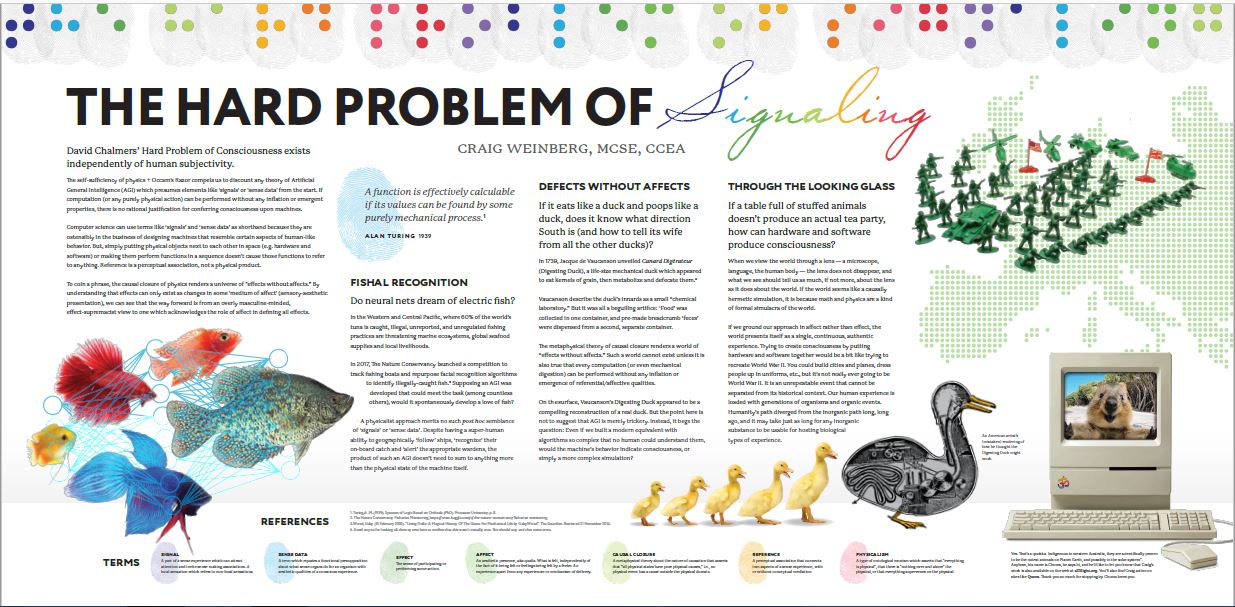
If it eats like a duck and poops like a duck, does it know what direction to fly in the Winter? In 1739, Jacque de Vaucanson unveiled Canard Digérateur (Digesting Duck), a life-size mechanical duck which appeared to eat kernels of grain, then metabolize and defecate them.³Vaucanson describes the duck’s innards as a small “chemical laboratory.” But it was a hoax: Food was collected in one container, and pre-made breadcrumb ‘feces’ were dispensed from a second, separate container. On the surface, Vaucanson’s Digesting Duck appeared to be a compelling reconstruction of a real duck. The analogy to AGI here is not to suggest it is possible that the appearance of an intelligent machine is a mere trick, but that the issue of artifice may play a much more crucial role in defining the phenomenon of subjectivity than it will appear to in observing the biological objects associated with our consciousness in particular. Consciousness itself, as the ultimate source of authenticity, may have no substitute.
If a doll can be made to shed tears without feeling sad, there is no reason to rule out the possibility of constructing an unfeeling machine which can output enough human-like behaviors to pass an arbitrarily sophisticated Turing Test. A test itself is a method of objectifying and making tangible some question that we have.Can we really expect the most intangible and subjective aspects of consciousness to render themselves tangible using methods designed for objectivity? When we view the world through a lens — a microscope, language, the human body — the lens does not disappear, and what we see should tell us as much, if not more, about the lens and the seeing as it does about the world. If math and physics reveal to us a world in which we don’t really exist, and what does exist are skeletal simulating ephemera, it may be because it is the nature of math and physics to simulate and ephemeralize.The very act of reduction imposed intentionally by quantifying approaches may increasingly feed back on its own image the further we get from our native scope of direct perception. In creating intelligence simulation machines we are investing in the most distanced and generic surface appearances of nature that we can access and using them to replace our most intimate and proprietary depths. An impressive undertaking, to be sure, but we should be vigilant about letting our expectations and assumptions blind us.Not overlooking the looking glass means paying attention in our methods to which perceptual capacities we are extending and which we are ignoring. Creating machines that walk like a duck and quack like a duck may be enough to fool even other ducks, but that doesn’t mean that the most essential aspects of a duck are walking and quacking. It may be the case that subjective consciousness cannot be engineered from the outside-in, so that putting hardware and software together to create a person would be a bit like trying to recreate World War II with uniforms and actors. A person, like a historical event may only arise in a single, unrepeatable historical context.Our human experience caries with it a history of generations of organisms and organic events, not just as biological recapitulations, but as a continuous enrichment of sensory affect and participation. Humanity’s path diverged from the inorganic path long, long ago, and it may take just as long for any inorganic substance to be usable to host the types of experience available to us, if ever. The human qualities of consciousness may not develop in any context other than that of directly experiencing the life of a human body in a human society.
(QUOKKA)
Are We Wrong About The Universe?

Are we today as wrong about any scientific fact that is widely accepted as the belief that the earth was the center of the universe and the like?
It’s not so much a particular scientific fact that we are currently wrong about, but rather the interpretation of those facts which is ultimately incomplete and inverted. In my view, the cosmological picture that we have inherited is as wrong as geocentric astronomy was, in that we presume a physical universe of forces, fields, particles, and mechanisms; forms and functions which act in the complete absence of any kind of experience or awareness. I expect that we will eventually come to understand that unconscious forms and functions cannot generate any such thing as a sensation or feeling, and that it is actually forms and functions which are presentations within a deeper context of universal perceivability.
Because we have made great use of the tools of science to objectify the universe by factoring out our own subjectivity, we have fallen under a kind of spell of amnesia in which we exclude the process of objectification itself from our picture of the universe. In the effort to dispel the ghost-in-the-machine legacy of Cartesian Dualism, we have succumbed to a more insidious dualism, which is that of “illusion” vs reality, or “emergent properties” vs physical systems. From this vantage point, we are susceptible to any kind of theory which satisfies our empirical measurements, regardless of how incompatible they are with our direct experience. As long as a legitimate scientific authority stands behind it, the educated public happily swallows up anti-realisms in the service of realism…multi world interpretations, superposition, vacuums filled with energy. There is nothing wrong with entertaining these very legitimate possibilities, but there is a deep irony which is being overlooked.
The problem is that we have taken ourselves out of the picture of the universe, but we haven’t gone far enough. We have over-estimated our objectivity in one sense and under-estimated it in another so that the universe we imagine as objectively present looks, sounds, tastes, and feels just as it would to a highly culturally conditioned Homo sapien of the early 21st century. We have failed to appreciate the profound truths revealed by Relativity, quantum uncertainty, incompleteness, the placebo effect, and the vast pool of insight provided by centuries of direct consciousness exploration. Had we been willing to connect the dots, I think that we would see the common denominator is that nature is subject to perceptual participation for its fundamental definitions. In other words, what both the empirical and rational methods of inquiry have shown is that nature is inseparable from perceivability. It is a multitude of changing types of awareness which produces and preserves all forms.
We are used to thinking that consciousness is a special ability of Homo sapiens, and perhaps a few other species, but this is as naive and egocentric as Ptolemaic astronomy now seems. Just as biology has found no hard line separating living cells from genetic machinery, the study of consciousness has revealed signs of sensation and awareness in everything from ants, single celled plants, even a ball of dough. There seems to be no good reason to automatically consider the activities performed by any natural structure strictly unconscious. Indeed, we may be projecting our own complex human experience of layers of consciousness, semi-consciousness, and seeming unconsciousness onto nature at large.
The reality may be that every frame of reference is actually a frame of afference… a trans-spatial, trans-temporal platform for developing temporalizing and spatializing aesthetic experiences. Afference is a neologism adapted from the function of afferent nerves. In this case I am generalizing that function of bringing signals in from the outside. Afference is conceived as a fundamental receptivity to experience which allows for the appearance of all phenomena including space (a sense of distance between tangible or visual presentations) and time (a sense of memory and evaluation of causality) within any given frame. Afference is a hypothetical sub-set or diffraction from the overall Perceivability Spectrum (pansensitivity, pan-afference, or even ‘ference’).
This doesn’t mean that every ‘thing’ is conscious. That sort of ‘promiscuous’ panpsychism is only the first step away from the pseudo-dualism of contemporary science. It can help us to begin to break through our anthropocentrism and consider other scales of time and body size, however it can also lead to misguided expectations about inanimate objects ‘having’ experiences rather than their objecthood ‘being’ an experience within our body’s perceptual scales and limits. The experience of a computer for example, may be limited to the hardware level where natural sensory acquaintance and motor engagement is felt on the microphysical scale and has no emergence to genuine high level humanlike intelligence.
By considering consciousness (not human consciousness, but universal perceivability) to be the source of all qualities and properties of nature, the Hard Problem of materialism solves itself. Physical forces and fields need not be sought out to explain the creation of bodies-with-awareness, which are impossible by definition in my view. In my view there is no room for any kind of sensation or participation as a mechanical product of geometry or computation. Instead, we should recognize that it is experiential phenomena alone which present themselves as bodies, images, thoughts, feelings, etc. Every appearance of mechanical or random force in our frame of perception is ultimately a feeling of participation and sense in a distant and alienated frame of perception.
Every appearance of a ‘field’ (gravitational, electromagnetic, or otherwise) is in the same way only a range of sensitivity projected into another range of sensitivity that uses spatial terms (rather than non-spatial or trans-spatial like olfactory or emotional sense). It is the sense modality of tangibility which deals in spaces and geometries: visible and/or touchable forms. With the ‘field’ model, we are presuming regions of space as domains within which effects simply found to be present by definition. By using the afference model instead, locality is understood to be a symptom of how extra-local phenomena are translated into locality-constrained sensory modes. Afference opens the door to understanding how not to take presence for granted and to see it as a relativistic, aesthetically driven universal phenomenon (or the absolute meta-phenomenon).
 Multisense Realism
Recent Comments