Archive
A Deeper Look at Peripheral Vision

Often, when peripheral vision is being explained, an image like the one on the right is often used to show how only a small area around our point of focus is defined in high resolution. The periphery is shown to be blurry. While this gets the point across, I think that it actually obscures the subtle nature of perception.
If I focus on some part of the image on the left, while it is true that my visual experience of the other quadrants is diminished, it is somehow less available experientially rather than degraded visually. At all times I can clearly tell the difference between the quality of left image and the right image. If I focus on a part of the right hand image, the unfocused portion does not blur further into a uniform grey, but retains the suggestion of separate fuzzy units.
If peripheral vision were truly a blur, I would also expect that when focusing on the left hand image, the peripheral boxes would look more like the one on the right, but it doesn’t. I can see that the peripherized blocks of the left image are not especially blurry. No matter how I squint or unfocus or push both images wayy into the periphery of my sight, I can easily tell that the two images are quite different. I can’t resolve detail, but I can see that there is potentially detail to be resolved. If I look directly at any part of the blurry image on the right I can easily count the fuzzies when I look at them, even through they are blurred. By contrast, with the image on the left, I can’t count the number of blocks or dots that are there even though I can see that they are block-like. There is an attenuation of optical acuity, but not in a way which diminishes the richness of the visual textures. There is uncertainty but only in a top-down way. We still have a clear picture of the image as a whole, but the parts which we aren’t looking at directly are seen as in a dream – distinct but generic, and psychologically slippery.
What I think this shows that there are two different types of information-related entropy and two different categories of physics – one public and quantitative, and one private and qualitative or aesthetic. Peripheral vision is not a lossy compression in any aesthetic sense. If perception were really driven by bottom up processing exclusively, we should be able to reproduce the effect of peripheral vision in an image literally, but we can’t. The best we can do is present this focused-in-the-center, blurry-everywhere-else kind of image which suggests peripheral vision figuratively, but the aesthetic quality of the peripheral experience cannot be represented.
I suggest that the capacity to see is more than a detection of optical information, and it is not a projection of a digital simulation (otherwise we would be able to produce the experience literally in an image). Seeing is the visual quality of attention, not a quantity of data. It is not only a functional mechanism to acquire data, it is more importantly an aesthetic experience.
Cracking Intelligence and Wisdom
The difference between intelligence and wisdom, (aside from rolling up an D&D character), parallels the distinctions which have been dividing philosophy of mind from the beginning. Intelligence implies a cognitive ability in a technical and literal sense – a talent for understanding factual relations which apply to the public world. The products of intelligence are transformative, but famously amoral. Frankenstein and 2001’s HAL both embody our fear of the monstrous side of technology, of intelligence ‘run amok’ with hubris. This is a rich vein for science fiction. Beings built from the outside in – an inhuman mind from inanimate substance. Zombies, killer robots, aliens. Giant insects or weaponized planetoids. In all cases the impersonal, mechanistic side of consciousness is out of proportion and humanity is dwarfed or under-signified.
Intelligence is supposed to be impersonal and mechanistic though. Its facts and figures are not supposed to be local to human experience. The sophisticated view which developed through Western intelligence not only does not require us to value human subjectivity. It insists, to the contrary, that all human awareness is a contamination to the pristine reality of factual evidence – objects which simply are ‘as they are’ rather than merely ‘seem to be’. All human awareness, that is, except for the reasoning which progresses science itself.
Wisdom, while overlapping with intelligence as set of cognitive talents and skills, is not as clear cut as intelligence. Wisdom does not yield the kind of public results which intelligence is intended to produce, because wisdom is not focused on public objects but on private experiences. Both intelligence and wisdom attempt to step back from the local phenomenal world to seek deeper patterns, but intelligence seeks them from indirect experiences outside of the body, while wisdom seeks within the psyche, within the library of possible personal experiences. The library of wisdom, unlike that of intelligence, is in the language of the personal. Characters and stories which work on multiple levels of figurative association. The privacy of wisdom extends to its own forms, leading to a lot of mystery for the sake of mystery which those minds on the other side of the aisle find deeply offensive. Intelligence only uses symbols as generic pointers – to literally refer to a specific quantifiable variable. Intelligence stacks symbols in sequence as language and formulas. Wisdom uses symbols as poetry and art, evocative images which work on multiple levels of awareness and understanding but not the kind of fixed understanding of intelligence. The understanding of wisdom can be open ended and elliptical, absurd, poignant, etc.
The deepest kinds of wisdom are said to be ‘timeless’. Unlike the high value that intelligence places on up to the minute information, wisdom seems to appreciate with age. Rather than being seen as increasingly irrelevant, ancient stories and turns of phrase are revered and celebrated for their pedigree. There is an almost palpable weight to the anachronistic language and images. The metaphors are somehow more potent when delivered by a long dead prophet. This favoring the dead happens with more modern quotations too. Maybe it’s because they are no longer around to put their quotation in context, or maybe it just takes a while for greatness to make itself known against the background of more ephemeral noise.
In any case, the realm of wisdom is a decidedly human realm of human experience. It is a talent for recognizing and encapsulating common sense and long life, with subtlety and significance for all people and all lives. Wisdom is about being able to appreciate our fortunes as individuals and members of society. Wisdom helps us find an objective vantage point within the history of our personal experience from which to see and evaluate the ups and downs of life passing. Through wisdom, we can see the bigger picture in our own trials and tribulations and the rise and fall of civilizations. We can see how every moment can change seeming fiction into seeming fact and back. Wisdom is subjective and mystical, but so too were many phenomena in the natural world before science. The promise of Western intelligence is to de-mystify they world, to remove subjectivity, but in addressing subjectivity itself the intellect meets its match.
Frustrated with the prospect of decomposing its source into objects, intelligence turns to a kind of inside-out subjectivity in some variety of functionalism. Subjectivity, from the Western perspective of public space as reality, is nullified. It can only be disqualified as an ‘emergent property’ or ‘illusion’ of some other deterministic process of matter or ‘information’ – a side effect somehow, of what already seems to know itself perfectly well and function competently without resorting to any fanciful aesthetic ‘feelings’ or ‘flavors’. If arithmetic or the laws of physics work automatically, then they don’t need a special show of aesthetic phenomena to lubricate their own wheels, yet, thinks the left-brained Western mind, there is simply no other possibility. Consciousness must arise as some sort of accident among colliding collections of complex computations.
This is a problem, since it only pushes dualism from the Cartesian center of tolerance into the ghettos of the untouchable. Subjective experience is now confined in science to untouchable, uncountable metaphysical aethers of simulation; epiphenomenal dead ends which had no meaningful beginning.
The Western mind cannot tolerate being put into a box by any phenomena which it cannot put into a box itself. The irony of modern physics of course, is that all of the boxes which have been piled up so far seem to indicate their origin in circularity. A microcosm of disembodied Cheshire Cat smiles…determinable indeterminisms. On the astronomical scale, suddenly the bulk of the matter and energy in the universe has been re-categorized into darkness. The alchemist caps seem to have reappeared in science, but turned inside out. Western intelligence is no longer explaining the universe which we experience directly as participants, but is devoted to pursuing an alternate universe backstage which just so happens to identify human subjectivity as the only thing in the cosmos which is not actually real.
The current battle over TED, Sheldrake and Hancock is on the front line of the war between public-facing thinkers and private-facing thinkers, between body-space visionaries and life-time visionaries. Both sides play out a reflexive antagonism – a shadow projection which extends beyond the personal. Each side hears the other in their own limited terms, and neither one is able to communicate the missing perspective of the other. The argument continues because both fail to understand the missing piece of their own perspective and their mode of thinking has devolved into an aggressive-defensive vicious circle of un-wisdom and un-intelligence.

At this point in our political and in our intellectual life, the midpoint has been skewed so far from the center (to the West in science, and to the Right in politics), that any proposal which engages other perspectives is seen as extremism. Any new information is mistaken for treasonous compromise. Whether that extremism is in the mechanistic or the animistic direction, the result is very similar.
I would love to see a study done comparing the brain activity of so called ‘militant atheists’ and ‘religious fundamentalists’, to see how really far apart they are. My scientific hypothesis is that no neuroscientist will be able to look at the fMRIs of the two camps in a double blind test and reliably tell the difference. If that were true, what would it mean about protecting science from unscientific ideas if you cannot prove the scientific validity of thoughts from a brain scan?
Improving The Hard Problem
I have been using the term ‘aesthetic’ a lot lately in specifying the qualitative aspects of consciousness, and I feel like it clarifies one of the core issues. The Hard Problem of Consciousness is confusing to people whose mindset is innately compelled to define consciousness as a collection of functions in the first place. It therefore comes out nonsensical when philosophers like David Chalmers talk about questioning why there is such a thing as ‘what it is like’ to have an experience, since for the functionalist, ‘what it is like’ to perform a function is simply the self-same set of events which comprise the function.
Maybe it helps to define ‘what it is like’ in more specific terms, which I think would be scientifically described as private sensory-motive participation but informally can be understood as aesthetic phenomena. The key is to notice the asymmetric relation between aesthetics and function in that function can improve aesthetics, but aesthetics can *never* improve function. The Hard Problem then becomes a problem of how to explain aesthetics (aka qualia) in a universe of functions which can neither benefit by them nor physically generate them as far as we can tell (unless there is a miniature kitchen near our olfactory bulbs baking microscopic apple pies whenever we remember the smell of apple pie).
The fact that aesthetics are not possible to explain in terms of a function, but that functions can be conceived of aesthetically is unfamiliar and those who have that innately functional mindset will balk at the notion of aesthetic supremacy, but this is the future of science – letting go of the familiar, or in this case, rediscovering the literally familiar (ordinary consciousness) in an unfamiliar way (as the fabric of existence).
When we talk about consciousness then, what we really mean is the aesthetic experience of being and doing, of perceiving and participating. This experience is extended publicly as spatio-temporal form-functions (STFF), but those phenomena are not capable of appreciating themselves. Just as a puppet can be made to seem to walk and talk like a person, forms can be made to interact by hijacking their natural low-level aesthetics to represent our high-level expectations. The letters on this screen are just such an example. I am using a lot of technology to generate contrasting pixels on your video screen, which you will experience as letters, words, and sentences.
Each level of description – as typeface, spellings, grammars, evoke aesthetic micro-experiences. The closer these descriptions get to your native scale – the personal scale, the more that your personal experience, feelings, and understanding influences the aesthetics of all of the sub-personal experiences within reading the language. What you see of the letters is because of your experience of learning to read English, not because of any special power that these words have to project meaning. By themselves, these words and letters do nothing to each other. They are figures for use in human communication – they have no functional aspect, i.e. they are *only* aesthetic. This is why a computer has no use for human languages, or even programming languages. Computation requires no figures or forms of any kind, nor can it produce any forms or figures without borrowing some kind of STFF (with u in the middle, heh) from the ‘real world’. Otherwise there is a only the anesthetic concept of pure function – which is the exact opposite of representation by form, image, or quality, but is non-presentation through quantity.
Computation, or ‘Information Processing’ is the unconscious number crunching of automated, logical functionality. Information lacks aesthetic presence by definition – it is a purely conceptual understanding of instructed variables in motion. If there is a capacity for aesthetic appreciation to begin with, then computation can extend it and improve it. If there is no such capacity, then there is certainly no justification for adding it into computation, as automatic function cannot benefit in any way by appreciation of its own activity.
Entropy, Extropy, and Solitopy
By my reckoning, ‘order’ can only be an aesthetic consideration, which further means that it is dependent on the sensitivity of a given participant. Thermodynamic entropy, therefore, while overlapping on information entropy by some measures, does not in others.
I use the example of compressing a video of a glass of ice melting to illustrate how the image of ice changing over time, being more complex and therefore requiring more resources to compress with a general-purpose video codec, defies the underlying thermodynamic change from low entropy to high entropy. If you compressed a before and after video, the after video would encounter lower information entropy in executing the compression than the melting ice.
All this demonstrates is that not every expression or description of a phenomenon can be reduced to a quantitative expectation. The optical qualities of melting ice from a macroscopic perspective are not isomorphic to other levels, perspectives, and sense modalities.
Anyhow, my conjecture uses a term ‘solitropy’ which refers to the aesthetic drive which is similar to what has been called extropy or Eros, but solitropy is conceived as a quality which is not diametrically opposed to entropy. Simple negentropy would be a reduction in noise, but would not insist on the content of the signal itself improving qualitatively. You can make the type as clear as you like, but that won’t improve what is being said. Solitropy would extend entropy-extropy into a private quality of physics, so that we would be able to formalize in physics, for instance, the difference between the entropy produced by burning down a city and boiling water.
Shoelace Causality Model
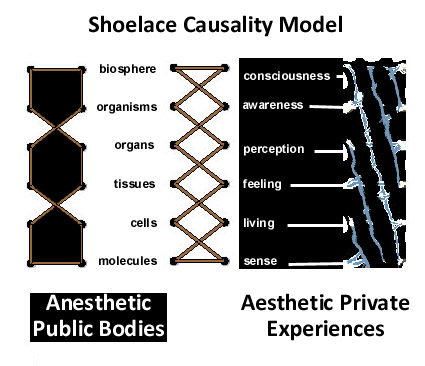
See if this model makes any sense. On the left side (or West end) are the levels of organization associated with material bodies, from micro to mega. On the East side, by making it negative, wavy, and diagonal, I tried to emphasize that the juxtaposition between East and West is truly orthogonal (or orthomodular) and not simply different. Where the Western view promises local certainty with interlocking gears of mechanism, the Eastern view submerges certainty into holistic, idiopathic acausality which commands from eternity.
(integrated this into the Overview)
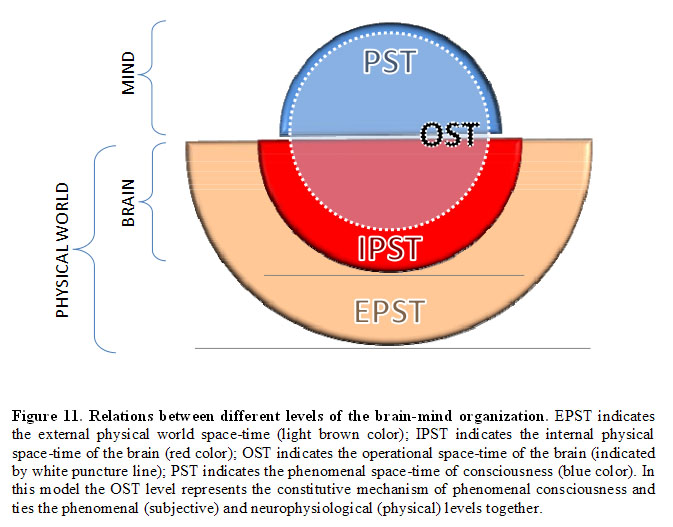

The first image is from a paper called Natural World Physical, Brain Operational,and Mind Phenomenal Space-Time. I haven’t read it yet, but from the looks of the image it seems like a step in the right direction. I have cannibalized their diagram to try to encapsulate the Multisense Realism model.
The bottom half remains almost unchanged, except for the removal of Time. In the original, the assumption was that SpaceTime is objectively real, but in my view this is an obstacle to understanding the relation between the public and private ranges of physics. The center of the bullseye then, in the modified chart, is the intersection of public space and private time, such that it reflects the ordinary sense we have of the public moment being infinitely fleeting so that the only remaining residue of any public moment is sustained exclusively through private memory. If we apply a strict literal read of public realism, the presence of the past is confined to a pure fiction of human sentiment. Past events must be inferred from material evidence and reconstructed deductively (forensics, archaeology).
The bottom half of the bullseye then recognizes this truth, that in fact public realism is devoid of temporal continuity, and exists as spatially nested bodies relative to the perspective of any particular private participant. The deeper into the IPS circle we get, the more the public structures of the brain are defined by electromagnetic and chemical activity which do not make sense without an inferred Time element. At this point, the EPT phenomenology similarly takes on its distributive spatial descriptions, such that private sensory affects are accessible as public motor effects. There is no transduction or homunculus translation, no cause and effect, the hypothesis is that there is a dual or multi-aspect spectrum of aesthetics.
The top of the bullseye is much more ambitious and experimental. I have rotated the private phenomenonlogy along a z-axis to underscore that sensory-motive experience is literally perpendicular or orthogonal to spacetime. The original diagram takes for granted that phenomenal consciousness should be considered to resemble space-time. It really doesn’t. To the contrary, our spatiotemporal memories merge seamlessly with imaginary places and times, or non-places and non-times. When we are sequestered from public interactions, we lose spatial and temporal continuity as daydream dissolves into dream or delusion and realism dissipates altogether. Significantly this total loss of realism is not generally missed. “Waking up” in a lucid dream, is typically not a cause of distress where we are terrified at having no idea where our body is, but tends to be very enjoyable and we would prefer to remain in the dream for as long as possible.
I apologize for the crazy looking bicycle gears look to the EPT and IPT, but I think it gives a hint of the kind of vast multivalence which would have to be included if we were to try to model visually the nature of private physics, which is implicitly anti-form and anti-function. (I call it Transrational Algebra or Apocatastatic Gestalt).
I have tried to give the impression of the presence of the past and anticipation of the future within what I call the ‘perceptual inertial frame’ known as ‘now’. Is now today? Is it last ten minutes? Is it 2013? Yes. It’s all of those things. The pointillised gears near the left hand side are labeled with a ‘memory’ bracket, indicating the complex nesting nature of temporal nesting. You can read these words without consciously remembering how to read English, but if you recall a particular memory, that gestalt can contribute to the feeling of the now, and can combine with other recollected associations, both conscious and subconscious. The nesting of meaning does not seem to have a finite capacity, and significance is constellated apocatastatically – as a rejoining of broken parts…increasingly transparent and reflective of other significant moments rather than dense and opaque with overloaded resource demands. This is just a fancy way of saying that our conscious experience is the tip of the iceberg of a vast reservoir of experiences which extends beyond our personal lives and into anthropology, zoology, biology, chemistry and physics.
On the far left is the legend showing the extension of private experience into public presentations necessitates an anesthetic gating or attenuation of sensory affect and motor effect. This is another fancy way of saying that public space is about defining limits to your private sense of omniscience and omnipotence…literally putting you in your place among countless local and universal agendas.
But Which Eye Is The Binocular One?
“He must learn that his extreme powers of discrimination do not make him weak and inferior – but rather strong and superior.” – Matthew Oliver Goodwin
“Regione caecorum rex est luscus.” (In the land of the blind, the one-eyed man is king.)
– Desiderius Erasmus
Here is a tale about the ontology of perception, or as I like to call it, the laws of private physics. It takes place not in regione caecorum, but in regione luscus – that is, it takes place in the country or land of the one-eyed rather than the blind. In this land, there was once born someone who claimed to have a second eye, and through it, they could see a kind of “depth” and experience an aesthetic of personal engulfment which could not be accessed or appreciated with only a single eye.
The wise men of the land heard these claims and set out to prove, with their one eyed instruments and one eyed reasoning, whether or not this magical experience of stereoscopic vision could exist. As they suspected, their results confirmed that there was no depth nor sense of “embeddedness” which could be felt visually. Vision, they said, was incapable of representing volume.
Two Eyed Sally protested, but to no avail. It was plain to everyone that volume cannot be communicated without touching an object with your body directly. The eye does not touch objects directly, so sensing depth by vision is a hallucination and Sally is crazy.
One day another person was born who also claimed to have a second eye and could see that Sally had two eyes also but that everyone else had one eye. To this, the wise men responded in their most scientific and rational way, doing the only thing that can be done in such a circumstance…
“Burn the witches!”, they bellowed.
Many years passed, and after many witches were burned, very few people spoke about their second eye experiences anymore. When they did it was, obliquely, through stories and metaphors, or as comedy. Increasingly, the one-eyed view of the world had become more and more successful, explaining nearly everything and producing amazing devices like the split-view monocle which allowed one to have two slightly different views of the same thing, allowing people who learned to use the monocle to become much better coordinated. Two views were better than one.
At this point, one of the wisest wise men accidentally ingested a few micrograms of a semi-synthetic fungal extract, and began to hallucinate that he had a second eye. His perceptual solitude became perforated with the legendary aesthetic depths and subjective embeddedness. He reported his amazing experience, and before he knew it, people all over the world were duplicating his unintentional experiment intentionally.
Around the same time, other wise men were playing with light. For years, they had observed an unexpected interference pattern whenever light was projected through a mask with more than one slit. This reminded some of the more unconventional thinkers of the myth of binocular vision, and for a time it seemed that stereoscopy could be a legitimate phenomenon. Strangely, social events seemed to mirror this loosening of constraint and a kind of renaissance or ‘mind opening’ seemed to be blooming on every front.
The more clear-headed of the wise men however, those whose single eyed vision was particularly sharp and acute, warned of trouble. The very thought of people with double the normal amount of eyes, idling in some kind of sickening optical illusion was revolting and they set out to figure out exactly what was the fucking problem with these patterns and slits, and with the strange reports from the fungus eaters as well.
They devised ingenious experiments in which the stereoscopic patterns could be explained. By using instruments which only could see one thing at a time, the validity of the monoscopic model could be deduced. Terms like ‘wave function collapse’ and ‘decoherence’ were a soothing balm for the anxieties of the wise men.
Gradually the rash of thinkers who took stereoscopic delusions seriously were drummed out of the wise man academy, and depth of field was discredited. Instead of being studied as a strange physical phenomenon, depth perception became something else – an ‘epiphenomenon’. Epiphenomena of this kind are an ’emergent property’ which sort of ‘un-exists’ in a never-never land hidden away in neurons…or maybe calcium ions…or radiological zappity zaps.
Even if some of the sensations of stereoscopic vision felt real to some people, it would be because of the ability of these zappings to compare and extract information about each other. Such information might be useful after all, because it allows more data to be simulated at once and more data about the environment means a better chance at survival and reproduction. It could be that the people with the two eyed delusion were not witches or criminally insane after all, they are just unfortunate mutants who have a disability.
There was still some question, however, about how the light knew which slit was the right one to go through, and about whether it was the second eye which was the defective one or whether it just corrupted the first eye. Interpretations abounded about multiple universes and entangled eyeballs. All of these interpretations had in common the same thing: they concluded by re-asserting the validity of flat vision. They could all agree on one thing – that three dimensional sight was supernatural hogwash. The details of how and why were complicated and esoteric, but they are consistent and verifiable, (as long as you use instruments and experiments which are designed to filter out anything unscientific and ignore your own corrupted judgments).
“And so, little by little, a little later
These critics set to work
To make nonsense out of the sense of what we were doing.
And they succeeded.
They destroyed our hero’s faith in himself.
He didn’t have it any more.
After a few, disappointing times
In the big auditorium.
The light gone out of him.
We all stopped going.
And the man who had once seemed so tall
And who now seemed so much smaller
Left our town
Saying no, no, no
[…]
They put us back on the narrow path.
This is the way things have been in our town
For as long as anyone cares to remember.
By the way
How are things in your town?”
Updated Introduction
3. Overview
I am always trying to sum up multisense realism in a simple way, as I think it ultimately is pretty simple, but it is hard to put it simply because it requires that we overturn some core assumptions about how we look at the self and the universe.
I consider my model to be neither dualist nor monist, but an “Ouroboran” monism, meaning that physics itself is the capacity for sensory experience and discernment and that it is involuted in a reflexive, “umbilical” relation to itself. The idea is that experience and matter are the private and public ranges of physical phenomena. The involution (like a Klein bottle or Möbius strip) refers to the orthogonal or perpendicular juxtaposition between sensorimotive-based private experience and spacetime-based public realism.
If we begin with this diagram which I have pilfered from memeengine:

and then progress, like those schizophrenic cat portraits, into the mind bending rabbit hole that is Multisense Realism…

Here, I am trying to introduce the notion of a continuum between the three ‘ism’s above, to indicate that the cosmos supports all three inherently because it is that juxtaposition/symmetry which is actually more primary than any of them. Not the symmetry itself – which is more of a mathematical relation that is somewhat abstract, but the capacity to detect and respond to patterns like symmetry – the capacity to sense and participate in the universe. What I wound up with was more of a yin yang taijutsu arrangement which maybe hints at an East side where experience is purely subjective, a West side which is all representations of what is presumed purely objective, and a midrange which is about perception as a body in the world of comparably scaled bodies.

Not content with that, I went on to try to get more of the flavor of it with nested scale bodies in a Cartesian grid of blue vector arrows representing energy and function (the disowned idealism of the West haunts the machine as ‘energy’ and ‘information’). On the East side, there is the solipsistic fisheye distortion which is all cluttered up with my conceptions of sub-personal, super-personal, and the arrow of motive power.

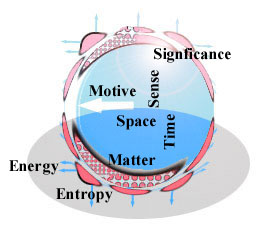
Wrapping this mess up, I put the atomic dots where they belong, on the inside surface of the experiential bubble of the Absolute. Make sense? Haha.
In Multisense Realism, all of physics is understood to relate to the capacity to discern between public and private views of phenomena. Public physics appears to us as ‘matter and energy’ on the outside and ‘perception and participation’ on the inside. The gap which makes this involution or twist possible is the modulation between the presence and absence or sensory presence, with the absence being what is called entropy or spacetime (which become essentially the same thing under this model of physics). To make things more confusing, this modulation of entropy and sensitivity is nested within many layers of itself, as a fractal. A cell encapsulates a world of molecular interaction. An organ encapsulates a world of cells, etc.
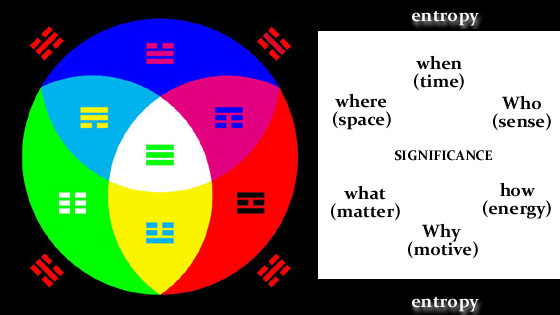
What started as an observation about the common positions that people seem to take within philosophy of mind debates became a hypothesis about the continuum of public and private sense experience, a re-interpretation of light, cosmology, consciousness, and the introduction of new concepts like significance and solitropy.
These two images try to capture the overall picture of how all major features of the cosmos can smoothly fit together.

The Future of Computing — Reuniting Bits and Atoms
A great presentation on computing with hardware and software which are homomorphic to each other. Logical automata (explained 11:51 to 15:50) is just this sort of a WYSIWYG architecture where the software is executed from a bulk raw material, i.e., not Gb of memory or number of processor cores, but square feet or pounds of programmable matter. Atoms, or groups of atoms, are here used directly as bits.
Gershenfeld compares how our current approach of computing requires multiple stages of compiling disparate formats, but that to more closely match nature, we should strive to imitate nature in the sense of having a consistent zoomable format on every scale.

In nature, the map is the same graphically regardless of the scope of magnification. Marrying these two concepts, the idea is to design shapes which are themselves instructions, i.e. physical interactions with other physical shapes, so that computation is not encoded but rather, embodied. As in biochemistry, the output is a material product, and the machine is itself is a self fabricating machine tool as opposed to a manufacturer of inert objects.
I think that he is probably right that this is the direction of the future in general, “computing aligned with nature” which brings computation into matter. It is compelling to imagine that this kind of embodied computing could be the Holy Grail of nano-engineering, giving us control over virtually anything eventually.
At the same time I can see that there is something which has been overlooked. To quote Deleuze:
“Representation fails to capture the affirmed world of difference. Representation has only a single center, a unique and receding perspective, and in the consequence a false depth. It mediates everything, but mobilizes and moves nothing.”
– Gilles Deleuze, Difference and Repetition, p56
(source http://sleepinginthegreenery.blogspot.co.uk/)
To understand why this universe of embodied computation is not the universe that we live in, Difference is the key. An overhead map is only so useful to us. Even if we can zoom down to the human scale level, we really need to switch to a first person street view to make the transition from outside-looking-down to inside-looking-around. To get further into the subjective view, we would have to have access to feelings and thoughts, so that at some level of description the model of zoomable shapes is less than useless. In our personal awareness, the appearance of neurological structures in our view would be hallucination.
The assumption then of this uniformly computational matter, while fantastic for our purposes as human beings, would be a catastrophe for the universe in general. It would be the ultimate monoculture, with everything and anything reinvented as collections of positionable nano-Legos. The problem of conformity to a generic, universal structure is not that it won’t work, but that if it does, there will be no Difference possible.
Given Deleuze’s assertion that representation moves nothing, this intention of “reuniting bits with atoms’ seems to presume that they were united to begin with but doesn’t address why they were ever separated. Indeed, if this method of embodied computation is the way of nature, how and why could it ever seem otherwise? Where have these Different perspectives on different levels emerged from, and for what purpose?
I think that on closer inspection, even though this new approach is brilliant and revolutionary in some important ways, it still is founded on a sloppy assumption. It presumes that hardware which looks and acts like the software is identical to it. If this were the case, instead of images we would see the shapes of ganglia and retinal cells, but we would see the same thing instead of smells, sounds, and feelings. We could not feel dizzy, but rather be informed of some vestibular condition by means of these same shapes – which we think of visually or tangibly, but without the Difference, there really is no reason to assume anything perceptual at all.
Once again, even though I am impressed with the futuristic thinking, it still takes us away from the missing piece in physics – the privacy and interiority and qualia. Buying into the universe as undifferentiated plenum of self-machining bubbles we are betting that there is no difference between biology, chemistry, and physics. It’s all physics, all surfaces and volumes in public spaces. Is that really what the universe is though? Could our experience be understood that way if we didn’t have our own familiarity with it already? I think if we lived in a universe that was really all about universal computation, then we would never have separated bits from atoms in the first place. We never would have approached bits as encoded abstractions because we would have been comfortable already with the universal format.
Instead, the universe appears to be the opposite. On every level, even though there are repeating themes and forms, it is never exactly the same presentation. A whirlpool would not be mistaken for a galaxy and a grain of salt is not the same thing as a cube of ice. In the universe we actually live in, the only thing which seems truly universal is Difference. More universal than mathematics and physics is the variety of sensory qualities and modalities. It is not just formations or embodied information, but direct experience.
Multisense Perception Model

Another crazy looking attempt at organizing the multisense model of perception. The top diagram emphasizes how the contemporary model assumes that all phenomenal interaction is at the particle level, effected via tangible collisions of microcosmic bodies in spacetime. Higher level experiences are imagined to be epiphenomenal abstractions tied to each other through exclusively bottom up logical mechanical functions. In this model, it must be admitted that consciousness can only be a metaphysical layer of unexplained illusion.
In the bottom diagram, the dualism of private experience in white on black, and public spacetime realism in black on white gives an idea of the involuted or ‘Ouroboran’ relation between the two aesthetics. The center region depicts the public stack of spatiotemporal scale relations from microcosm to macrocosm (particles<>cells<>tissues<>sense organs/organisms). The Caduceus like split helix implies a loose hierarchical, bidirectional overlap of interlocking forms and functions on different scales and their implicit interaction with the corresponding private experiences on corresponding levels (personal, sub-personal interiorities corresponds to macrocosmic, microcosmic exteriors).
The label ‘Sensory-Motor Experiences’ at the base designates that the totality can be understood literally as sensory motor phenomena but the label and dashed halo at the top refers to the figurative capacities for empathy, semiosis, social quorum and teleology.
In this model, all layers are phenomenal and physical and consciousness or sense is a fully enfranchised, participant in physics on every level. Interaction is multivalent and multi-directional, bottom up, top down, inside out, outside in, past forward, future back.
 Multisense Realism
Recent Comments