In this new video from 8/25/2021, philosophers Philip Goff and Keith Frankish discuss consciousness with neuroscientist Anil Seth, whose new book is Being You: A New Science of Consciousness (which I have not read yet). Following are my comments on the first half of the video:
Jumping right in from the first few minutes, I have some questions, criticisms and insights that are worth mentioning. My apologies for the long winded, irritatingly constructed sentences that probably detract from what I’m trying to say more than clarify, but it’s important to me that I communicate the nuances in excruciating detail. Maybe someone or some AI internet archive spider will find it interesting in fifty years.
8:45 (Anil Seth) “Everything that we perceive is an active construction. It’s generated by the brain.”
Has this been tested and found to be conclusively true, or is it an assumption + confirmation bias? How do we know that what we perceive is not an active filtration or modulation of access to other contexts of consciousness (transpersonal, subpersonal, etc)? How do we know it is active construction rather than participatory collaboration? What is the physical mechanism by which “the brain” (the whole organ? neurons? molecular changes within neurons?) “generates” (Explanatory Gap/Hard Problem goes here) these “constructions” (sights, sounds, flavors, thoughts…call them qualia)?
Note: *Importantly, anything we refer to as a brain is also only known as qualia, by qualia, for qualia. A brain is an object rendered in our sense of touch, an image rendered in our sense of sight, an idea rendered in our sense of understanding. We have no valid reason to presume objects to be anything other than shared or universal qualia. To the contrary, even the physicalist/eliminative position demands that everything that we experience and can ever experience, including all physical phenomena, can only ever be a representation of conditions inside of a (literally meta-physical) program or biochemical virtual “function space”. If physicalism is right, we can never contact physics in any way and are forever trapped in some kind of Platonic cave of computations that only seem physical, or only seem like computations, or only seem to seem…or something.
9:28 (AS) “My perceptions have the characteristic phenomenology – they appear the way they appear because that’s useful for my overall survival as an organism.”
My argument against this is that it is clearly a “Just So story”, that is, a post-hoc justification of appearances without being based on any plausible a priori possibility of a capacity to generate appearances physically, let alone for any such thing to provide a possibility of survival advantage over the ordinary complex physical activities of other body systems that we presume do not generate appearances and would not improve as a result of them. 1
Indeed, it seems quite implausible that of all phenomena that have come to exist in the universe, only these certain groups of cells in certain organic bodies have this unexplained physical power to generate non-physical appearances…to themselves…that bear some isomorphic relation to everything else in the universe…that actually has no appearance at all.
The entire physical universe is, under the contemporary neuroscientific view that Seth advocates, without appearance – an invisible, intangible, unexperienced void that spontaneously acquires a monumentally grand variety of distinct, multisensory appearances when certain very specific kinds of biochemical events occur in certain sequences. But how? And Why?
Given the staggeringly effective abilities of a simple periodic table of atoms generated by simple stars to physically generate and maintain every organism, every immune system, every brain structure and function without any such thing as appearance, why would this virtual dashboard “appearance”, within which a hallucinated “user” of such hallucinated dashboards also virtually “appears”, offer any improved chance of survival to a reproducing body of cells? There are neurons in the gut too. What is our theory for how and why these systems of cells would not benefit by creating hallucinated ‘constructions’ for…their mission critical activities (or is it for their constructed ‘selves’)?
9:40 (AS) “Redness is not objectively out there in the world. There’s just wavelengths of electromagnetic radiation”
The problem here is that our expectation of electromagnetic radiation, and of a world, and of objectivity would also have to be constructions. Our sense of a physical reality that has no appearance and can never be contacted in any way, must also be a construction. No matter how much science we do, and how objectively we think we are being, we can only ever validate our sense constructions by more constructed appearances of relation between theories (intellectual constructions) about observations (meta-perceptual constructions derived from multiple similar perceptual constructions). You can’t have it both ways. If consciousness is constructed, then every sense of correspondence between constructions is also constructed. We can’t put ourselves in a hallucinatory box without that box also being hallucinatory.
10:19 (AS) “In some conditons, like under psychedelic drugs or in psychosis, whatever, your perceptions become less controlled by the relevant sensory data.”
Is it always less controlled, or do altered states of consciousness sometimes appear to open access to sensory data that is controlled by different, but no less controlling features of reality beyond physical appearance constructions? Some of that data may be in conflict to some extent with our default conditioning, and even physical causality, but not always. Psychedelics and psychosis are sometimes tied to genius insights and unusually high performance (Doc Ellis’s LSD No-Hitter as an example). Transpersonal/psychedelic appearances may defy ordinary personal and subpersonal control, but that does not mean that the defiance is not simply another, perhaps higher2 context of control. There may be conflict and chaos between modes and scales of awareness, and that is fairly described as ‘uncontrolled’, but it need not imply that what is bleeding through personal awareness is not also a form of highly developed awareness. By analogy, two strong, clear radio station signals may be received by one receiver as a garbled confusion of two signals and static. In addition, examples like Doc Ellis’ psychedelic no-hitter present a counterfactual data point to the hypothesis that it is always adaptive for hallucinations to tend to resemble physical conditions and causes.
11:51 AS makes an important point about prediction not always being about predicting the future, but rather we might also refer to perceptual fill-in of missing data ‘prediction’. What needs more attention, IMO is the wholeness or gestalt of the appearance. A simulacra such as a face appearing in a cloud does not appear to be filling in something as a computer would try many different possible solutions, rather one solution or another appears in its entirety at any given moment. While the neuroscientific view focuses on the information processing function of suppressing ambiguity, the more interesting issue to me to focus on is what that ambiguity is replaced with – seemingly complete and aesthetically rich presentations that are revealed in a finished form rather than constructed over time, as if being pulled from some eternal Akashic gallery of archetypes. It seems to make no difference whether the gestalt is from memory or novel as far as the level of detail of its completeness or the speed in which it is accessed. When I see the Mona Lisa in the image below, it is ephemeral yet persistent, and neither fuzzy nor focused.
uncredited image from the internet
In the case of novel gestalts (such as a weird, non-famous face in slice of toast), the fill-in would appear to have no value or a negative value to abductive reasoning (~13:12). The simulacra toast face does not lead us to an explanation of a physical cause of that sensation. Note that our early advances in artificial image recognition do not produce these kinds of prefabricated gestalts, but rather just the opposite.
In fact, without the side by side comparison, the digitized output of Bayesian-like backpropagation does not really resemble an image. It is an anti-simulacra…a source of potential recognition strategies, but what is being recognized is not a visible image, but invisible statistics. Why, if Anil Seth’s view is on the right track, do our guesses and predictions look like they are coming from ‘somewhere’, rather than from nowhere?
The conversation continues into describing the role of prediction for both biology and consciousness. There is no question that human personal consciousness uses Bayesian-like probabilistic methods of accessing what I would call subpersonal data, but whether that data is simply another layer of conscious experience or an unexperienced biochemical process remains untouched by neuroscientific inquiry. Yes, our perception certainly can model to predict something evolutionarily functional (red octagon = Stop sign) but that does not explain what the appearance of color or shape actually is, how it appears, or why. Retrospectively, once we have qualia/appearances, then sure, we have every reason to benefit against natural selection pressures by using them, but we would have the same reason to benefit from any power that transcends ordinary physics. Omniscience would come in handy, and it’s just as likely to emerge spontaneously from physics as any sort of qualia.
The retrospective benefit of prediction does not in any way prospectively justify the existence of qualia or its value for prediction over and above biochemistry. Everything that Anil is saying is important to the easy problem of consciousness, and it gives us a plausible connection between evolved Bayesian prediction mechanisms and evolutionary biology, but it doesn’t give us any insight into how either of those mechanical-anesthetic functions could relate to phenomenological (aesthetic-participatory) presentations, or the possibility of their being generated physically or mathematically. Philip makes this point later on, around ~21:00, that the predictive features of consciousness are neutral as far as dualism v materialism is concerned.
Although Anil goes on to say that his materialism is pragmatic rather than an absolute philosophical conviction, he does not really seem to support that. Instead his defense of pragmatic materialism seems more tied to a preference for working with brain function rather than metaphysical speculation. I don’t disagree, but it’s not an argument that defends materialism objectively. It is of course more pragmatic professionally to know about the brain than it is to know about the big picture of life, the universe, and everything, but that doesn’t make it more true. As he continues around ~28:00, it seems clear to me that his rejection of Dualism (which I reject as well, but for the opposite reason3) is itself a kind of naive rejection of a straw man of Dualism, it’s history and popular association with the harmful behaviors of religious groups, etc. It’s a pedantic, and overused disqualification of all things non-material on general grounds of being ‘unhelpful’ and silly seeming. I think that there are good evolutionary reasons for that bias toward matter and by extension survival of the material body, but it is an unscientific bias nonetheless.
Around 33:45, Keith asks Anil about realism and privacy. His response includes “Buses have qualities, properties such as solidity and velocity that do not rely on a mind to exist.”
Here I would say that we only know that those physical properties do not require our mind to exist, but we do not know that such properties are anything other than other properties of consciousness. Perhaps there are impersonal qualities of conscious experience that are common to certain contexts and modalities of sense that have become nearly universal. If our sense of physicality is derived from our haptic-tactile sensitivity and perceptual processing, then it makes sense evolutionarily that the appearance of our body and it’s existence in a world of bodies/objects/matter is rendered with robust realism. That physical universe that our bodies exist within may be the sole common context that binds all experiences together, however that universe may in turn be dependent on a larger context of a universal haptic-tactile sense capacity that prefigures biology, and which may be dependent on a still larger context of an irreducibly aesthetic Totality or Holos.
The discussion goes on to mention Donald Hoffman’s Interface theory, where Anil comments that he parts ways at the point where Hoffman’s view suggests conscious agents everywhere. I call this ‘promiscuous panpsychism’ and agree that it seems unparsimonious – however – I see agency itself as irreducibly qualitative, so that it need not be a prerequisite for qualia. I propose that the universe may exist as an experiential phenomenon prior to a robust sense of agency, and that qualities like redness, or visibility itself may exist as modes of awareness independent of any container of multiple other types of awareness. Something like subjectivity may develop from more primitive sensory-motive qualities, which we may have mistakenly conceived of in non-participatory terms such as electromagnetism. In other words, the sense of being a participant may evolve from pre-agent experiential-aesthetic phenomena of “motive” or “participation”. It may be that agency is nothing more than a sense experience of persistent separation from of multiple other sense experiences.
I think that Anil is wise in stating at ~43:22 that his view does not insist that qualia must be reduced exclusively to behaviors, dispositions, and functions. He goes on to say that he thinks that the self is not a separate entity as in Dualism, but is just another controlled hallucination. I agree with that, however, if we follow the reasoning to its logical conclusion, Seth is saying that it is the brain that is hallucinating itself as a self, rather than as a brain appearance. This to me is arbitrary and inconsistent. If the self is a phenomenological model of something, then so must the brain be also – and physics. Whatever it is that hallucinates both physics, brains, and selves cannot be meaningfully described as physical, and the whole notion of hallucination begins to unravel itself. Neither self nor brain has any reason to hallucinate, and if hallucination is more primitive than either of those, there is no reason to diminish it in hallucinatory terms. If my suggestion of universal qualia is on the right track, that would be the more fundamental reality, or even more fundamental than reality as it encompasses fact, fiction, nonsense and qualia in which all three can comingle as well as transcended.
More that I agree with after the 50:00 mark, Anil talks about the brain being fundamentally an organ concerned with keeping the body alive. The problem is that view doesn’t offer any explanation of how that function would be so different from that of any other body organ or system that it would allow its predictive, homeostatic strategies to be anything other than the biochemical gears and timers that we observe them to physically be. What makes the homeostasis of a body any more worthy of non-physical aesthetic seemings and hallucinations than any other system within a body? The immune system has to record and strategize against pathogens, shouldn’t it also have evolved feelings, thoughts, sounds, etc to model its games and meta-games?
After the 57:00, Philip brings up Free Will and the extreme positions of Determinism vs Libertarian Free Will. Here again, Anil’s response is a fall back to cliched arguments from incredulity; “Not even wrong”, “Not the kind of argument that warrants…” These aren’t valid objections. They might be true, but you have to provide a reason why. How you feel about it isn’t relevant. “What could that possibly mean?” he asks at 58:39…”Without invoking some sort of thing that has causal agency…” “I have no need for that hypothesis”.
Except that you do need some kind of hypothesis for how you can purport to have authority to decide what hypotheses you need in the first place. What is this “you” that the brain puppet on the screen speaks of? How can it have opinions or change them?
I understand Anil’s line of objection as I used to think of free will in the same way for many years. I reasoned that we have no choice but to make the ‘best’ choice we are aware is possible. After flipping my physicalist worldview many years ago however, I see the limitations of that assumption. While I completely agree with determinists and neuroscientists who point to our shockingly bad estimation of the independence of our will from subconscious influences, I no longer see that as a valid reason to eliminate some measure of direct personal agency as a legitimate influence on its own.
For example, sure, I can connect up a device to someone’s brain and zap them into making their arm move. If I zap it just right, they will think that they have made it move, but if we follow the causal chain back from the zap, it is my personal agency that is clicking the button to override their personal agency. In addition to chronically overestimating our own sense of free will, I see that we also chronically underestimate it, and that human beings routinely demonstrate remarkably unprecendented acts of creativity – inventing their own new choices rather than simply following the nudgings of their default brain states.
This gets into a much deeper discussion into the fabric of causality, which in my view can be understood in a radically new way. To use a metaphor of a traffic light, where Anil Seth’s view might reduce a Yellow (“Caution”) traffic signal to a slightly more complicated flow chart of Red and Green deterministic calculations (How fast am I going? How long has the light been Yellow? etc) and other more subtle calculations (“That car on the right looks like it’s going too fast to clear the intersection”, “I can’t be late for this appointment”, etc), we have to ask why those computations would require some sort of experience of seeming to wield authority over the final edit of decision and the rather Promethean-seeming power of motor execution. Why wouldn’t the choice just happen without an “us”? Why would it be a choice rather than simply an arbitrarily next step in a series of generic computations? What feels proprietary about the final execution choice, and why? What feels responsible and endeavors to make others act responsibly?
I propose a different view of causality as a spectrum of overlapping interdependencies of influence. In the absolute sense, it is not will that is the illusion, but determinism and randomness. Will may be the authentic primordial phenomenon while mechanism and chaos are artifacts of interface entropy/insensitivity. What we see in the behavior of quantum phenomena for example may not be anything other than deeply microphenomenal will, or the distant ancestor of will. Not random, and not the Green Light / Red Light of determinism. Instead of reducing the Yellow Light to a flow chart of Green and Red dichotomies, I flip the assumption and see Green and Red dichotomies as the approximated appearances – collapsed states of Yellow light experiences of will that are not directly accessible to our interface. I’m not suggesting a kind of panpsychism where every electron is agonizing over their destiny like Hamlet, but rather that what we see as an electron is itself only a reflection of many contexts of experience that are ultimately united in superposition of both ‘to be’ and ‘not to be’…the eternal and the eternally ephemeral.
I observe that the strong nature of the objections to taking personal will as ontologically distinct from other influences as, ironically, a reflection of the particular modes of sense and sense-making that we have learned to use and cherish from legacy of scientific Enlightenment thinking. Ironic because we are using our free will to choose to deny free will. Could anything else even have the power to deny itself sincerely? Once we drop the anthropocentric and biocentric bias from our understanding of sense, we no longer have a reason to assume that the haptic-tactile sense of a physical world is the sole authoritative context within which reality is defined. That sense, as well as visibility, may only be specialized modalities of objectifying and separating, so that it would be a category error to look to them to find evidence of will. Will is at the opposite end of the continuum of sense – the most intimate and least objectified influence on reality. You won’t find it in a microscope or photomultiplier. What we do find in our experiments with photomultipliers, however, defy any reasonable expectation of randomness or determinism, proving again and again to be more than either…more like the Yellow Light than either the Red/Green of determinism or the arbitrary blinking of both. It appears to be “uncertainty” all the way down, so how is that not will? If it is will or proto-will, why should we be the sole phenomenon in the universe who posses only an illusion of it?
I’ll stop here at the 1:00:00 mark for now. Will continue watching the second half and post my comments soon. Or I won’t! Depends on what I decide, and what reasons I choose, of the many that influence me from the subpersonal, personal, and transpersonal levels of my awareness to place above other influences. No matter how few degrees of freedom I really have, just the sense that I exist at all, and that will is even conceivable objectively contain more degrees of freedom than a universe in which those experiences/phenomena do not exist.
1 See Raymond Tallis excellent book “Aping Mankind“, chapter “The Disappearance of Appearance”. I have also lifted the terms prospective and retrospective from his writing on this topic.
2 More aesthetically rich, seemingly more meaningful, multivalent, synchronistic, and often seemingly more teleologically driven.
3 In my understanding, Dualism is insufficient not because of any ties to superstition or fantasy, but because it doesn’t go far enough, and because I think that Locke and Galileo made a mistake in giving objectified qualia Primary status, relegating trans-tangible and intangible qualia Secondary status for centuries to come. Unlike physical or mathematical law, aesthetic qualia are conserved across all context of realism and surrealism. Even under synesthesia, a word or number may have a color, but the color and the word are merely bound together, not indistinguishable. Red is red whether we are dreaming, hallucinating, or wide awake. Whether visible wavelength photons are present or not. Most qualia is conserved across states of consciousness but many physical laws are not. I may dream of a physical world where gravitational laws are unstable or anti-realistic, but I cannot dream of a world where the color red has no visible appearance.
That has been the way that we have assumed ‘levels’ manifest…from some kind of inflection point where particles moving in a void just ‘become’ a fluid. What we’re saying is that there is no such inflection point except in perception. It could just as easily be the wet liquid that is the truer level as it is what is presented within our greatest band of sensitivity. When we see blue ocean waves sparkling in the sun, when we hear waterfalls roaring or fish splashing in a river, that is when we encounter water in our fullest and most direct apprehension. That is as close as we can get, and possibly that is as close as anything can get to total access to ‘identity’ of water. That may be closest or even identical to what it is like to *be* water.When we use mechanical instruments to extend our sense of sight and touch, we employ a kind of tunnel vision. Combined with our logical imagination we extract an intangible geometry of microphysical tangibility – particles moving in a void. 𝐖𝐡𝐚𝐭 𝐈 𝐚𝐦 𝐩𝐫𝐨𝐩𝐨𝐬𝐢𝐧𝐠 𝐢𝐬 𝐭𝐡𝐚𝐭 𝐭𝐡𝐢𝐬 𝐢𝐬 𝐧𝐨𝐭 𝐰𝐚𝐭𝐞𝐫 𝐚𝐭 𝐚𝐥𝐥. 𝐓𝐡𝐞𝐫𝐞 𝐢𝐬 𝐧𝐨 𝐰𝐚𝐭𝐞𝐫 𝐭𝐡𝐞𝐫𝐞. 𝐓𝐡𝐞𝐫𝐞 𝐢𝐬 𝐧𝐨 ‘𝐞𝐦𝐞𝐫𝐠𝐞𝐧𝐜𝐞’ 𝐨𝐟 𝐭𝐡𝐢𝐬 ‘𝐥𝐞𝐯𝐞𝐥’ 𝐢𝐧𝐭𝐨 𝐚𝐧𝐨𝐭𝐡𝐞𝐫 𝐥𝐞𝐯𝐞𝐥 𝐨𝐮𝐭𝐬𝐢𝐝𝐞 𝐨𝐟 𝐜𝐨𝐧𝐬𝐜𝐢𝐨𝐮𝐬𝐧𝐞𝐬𝐬. The watery qualities of water aren’t fabricated by a brain or by statistics on particles, they are the actual final identity of water.
Emergence is false. The universe does not scale up mechanically from microphysical to physical or physical to phenomenal. It fragments from totality “All Here Now” to countless “theres” and “thens” by degrees of consciousness or scopes of awareness. Connection is Holos, disconnection is graphos. There is no emergence from graphos (mechanism, points in a void) to Holos (gestalt experience)…no encoding and decoding of ‘sense data’ into a whole. These are all assumptions made by over-valuing the sense of tangibility and assuming that what is most distant from our direct awareness is most real simply because the scale of time and space is most extremely different from our own.
Life is almost infinitely cruel and almost infinitely generous.
The night sky presents a view of the universe which is defined by two striking extremities. There is not merely dark and light, or yin and yang, but twinkling brilliance scattered across a pitiless black void. The stars are spread out in a way that presents another set of qualitative extremes – pattern and patternlessness.
The condition of being poised precisely between order and chaos is sometimes known as criticality. It is also, uncoincidentally, the way that brain activity looks to us from the outside. When we look at the world, the degree to which it makes sense is calibrated by our own sensitivity to patterns. That sensitivity, in turn, changes dynamically according to our physiological states and our psychological participation. We can look at the night sky we can see patterns that other people can see also, if they look at them in the same or similar way. Astrology is an example of practices that explore this shared criticality of perception and participation. To see constellations in the stars, and to see in their shapes reflections of your own shared experience and culture is not only the beginning of astrology and astronomy, it is the beginning of religion and science as collective activities around which civilization has been built.
All formal attempts at divination seem to exploit the criticality between discovery and invention. People use cards, coins, tea leaves, dice, etc as a way to access the general probability stream of the moment, and then to intentionally interrupt that stream and freeze it. It is a way of teasing uncoincidence out of coincidence.
When we look at the sky, do we choose to see a ‘bright blessed day’ and the ‘dark sacred night’, or do we prefer to see through such fanciful illusions to a starker, but possibly more accurate truth? Feeling and seeing have their own polarity in thinking and knowing. Using the concept of anthropcentrism, we can reframe the appearance of contrasting qualities as inevitable rather than miraculous. We can look at all dualities as simply the natural consequence of detection methods being employed by body systems. Hot and cold are sensations that signal some proximity to the upper and lower bounds of our body’s biochemical-thermodynamic range. As we acclimate to artificially controlled environments, our body adapts these signals to straddle a much narrower range of ‘comfort’. Even a single degree of deviation in temperature can become uncomfortable for one person, but comfortable to another, even as they live in the same house and relax on the same couch.
Should I try to tie these themes together, and sum them up in some kind of clear point, or is it better to let this stand in criticality? Are questions better than answers? Are meta-questions invitations to criticality or meta-criticalities?
For most individuals, I suspect that we are here primarily to participate in a personal experience. This consists of a human lifetime which combines both elements that are tailor-made for us as conscious subjects, and elements that are arbitrary from a subjective perspective and are instead brought about statistically by relatively objective and inevitable conditions. We are the union of the intentional and the unintentional. One of the consequences of that union is that our ability to participate consciously tilts the balance toward the intentional, even if only in the fact that intention is conceivable. I think that playing this role of person necessarily requires us to act as a gatekeeper between the levels above and below our own personal range of experience. The person is like a transistor, modulating the flow of cause and effect between the subpersonal (bottom-up, unintentional) and transpersonal (top-down, super-intentional), as well as initiating their own unique causes on a personal and interpersonal level. We are choosing, little by little, whether to support broadly inclusive, sensible qualities of experience (what I call Significance) or to support less-significant, ‘lower’ agendas that are purely selfish and insignificant. We have the privilege to decide whether to emphasize the ‘better angels of our nature’, or to indulge in ego glorification, or to descend further into dehumanization (the subpersonal/impersonal).
In the context of my Multisense Realism metaphysics, I use the term significance in a formal, and somewhat neologistic way. The idea is that since the universe is made of conscious aesthetic (feelings, sensations, qualities) experiences rather than something like information or physical mechanisms (anesthetic forms, functions, numbers), there are some interpretations of physical law that need to be updated. If my view is on the right track, then what we understand through the Second Law of Thermodynamics is only addressing the lowest, subpersonal/impersonal layer of nature. When we run scientifically controlled experiments using tangible objects as instruments to exert and record tangible influences over other tangibly measurable phenomena, then by design we are going to exclude the personal and transpersonal layers of causality to a large extent. The very methods we are using to inspect nature are specifically suppressing the influence of higher consciousness in the service of science, however, without higher consciousness, what remains of science is, like the phenomena that are being studied, ultimately entropic and meaningless. The point of science is to assist higher consciousness, and where it fails to do that, it is a net loss for civilization. Optimizing financial profit is not a feature of higher consciousness, it is an agenda within personal and interpersonal consciousness.
With Multisense Realism I have attempted (in a somewhat lazy and half-assed way) to propose ideas for rehabilitating our worldview on a philosophical level with a model of nature in which mechanism, personal participation, and transpersonal phenomena are integrated as parts of a single ‘aesthetic’ spectrum. It now appears to be time to take a shot at applying this philosophical project more to real life, and perhaps specifically toward strategies related to coping with the ‘long emergency’ that humanity is currently entering.
What then might the MSR philosophy suggest that we can do personally during this time?
1. Be a good gatekeeper. It is our personal responsibility to negotiate between our body and emotional needs (subpersonal and intrapersonal levels of experience) and our higher guidance of interpersonal and transpersonal awareness (thinking, informing ourselves, intuition, empathy, inspiration, divinity). Being a good gatekeeper means being a good leader to your body and a good citizen to society and the cosmos. It means asserting the significance of higher agendas over lower ones, however, there is also a danger in allowing raw transpersonal impulses to fill us with false hopes, superstitions, myth and drama. Sanity is the mid-range between the overly autistic and overly artistic. The place in between is the best place for most of us to build our psychological house-of-bricks. The key to being a good gatekeeper, IMO is to get into the habit of addressing sensations and impulses, emotions and thoughts in an intelligent way: To sort out which experiences are caused by automatic mechanisms that can be ignored or adjusted, and which rise to the attention of our personal and participation. We should ask ourselves, how does sanity work? This becomes more important in a time of mass crisis and prolonged isolation.
2. I think that we are here because there are some things that can only be experienced directly from the perspective of being a particular, unique person. It is important that to ‘be yourself’ to a greater extent during these times and resist the pressure to degenerate into stereotypical roles and behaviors that fill the vacuum during a low-level crisis such as a war or pandemic. The virus event is forcing us to choose, with our actions, whether to dehumanize or rehumanize.
3. Understand and practice self-healing. This gets into some potentially dangerous speculation. I am not a qualified expert by any means, and I would never suggest that anyone ignore medical realities. What I offer here is an interpretation of the placebo effect which gives us mental license to intervene on our own behalf and potentially on behalf of others. I think that the ‘placebo’ interpretation of medically inert intervention is based on the mechanistic, sub-personal worldview described in the first paragraph. If my view is on the right track, this is a biased misinterpretation that effectively cuts off our access to half of the available resources for wellness and healing. Without getting too far into the weeds, I will just say that while we must collectively focus on mechanical, functional solutions to public health and social crises, we can also personally stretch our sensitivity into the transpersonal levels of intuition and synchronicity to discover new paths of healing and support. Again, ungated access to the transpersonal can and will by default lead us into magical thinking and superstition, so it’s important not to abandon our post with uncritical thinking. What I am suggesting is that what we think and feel are powerful, reality-altering influences, which we can also have power over to some degree.
Ok, now I’ll get into the weeds. Feel free to ignore the rest of this.
A more technical justification for how personal consciousness can alter subpersonal realities comes from the idea that ’emergent properties’ are a negentropic influence on physical phenomena. That is, conscious perception and attention have the effect of simplifying complex physical phenomena and consolidating fine-grained details. Even from a materialistic perspective, that is the function of consciousness – to winnow ‘sense data’ down into a manageable stream.
My thinking is that because the details being eliminated and summarized by perception are microphysical, they are skewed toward disorderly, entropic tendencies. The second law of thermodynamics applies to physics, but not to perception, and not to physics that is under the influence of intention.
When we look at a video screen, for example, we don’t see an ocean of photoelectric and biochemical effects, we see an orderly visible image, with legible words and sentences. We are using the sub-personal ocean of meaningless-but-tangible events as a medium through which higher level, less tangible perceptions and understandings can take place. Our participation is having an effect on the balance of entropy and negentropy as well as in the selection of which negentropic resolutions are emphasized. When we look at an optical illusion such as the duck-rabbit ambiguous image, we can, through our attention, choose whether to see the duck, the rabbit, or neither. (Negentropic resolution 1, Negentropic resolution 2, or unresolved Entropic state). We may be able to even create novel, proprietary perceptual gestalts (Negentropic resolution X).
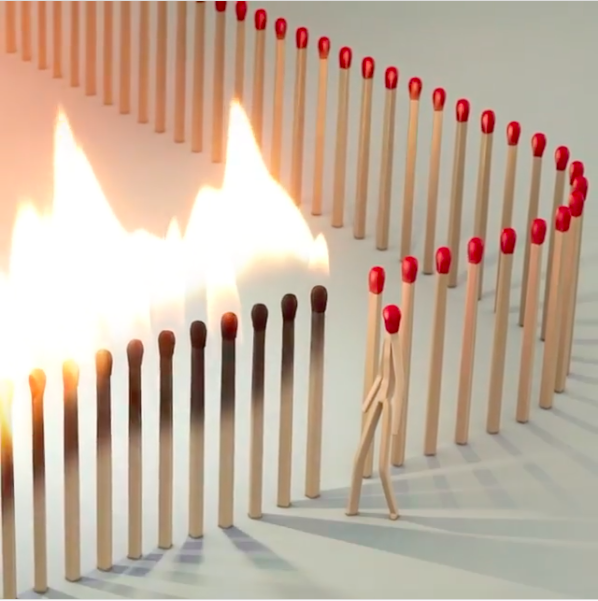
What I am suggesting is that part of what is going on in the placebo effect is that when we participate in an intervention from higher levels of consciousness onto lower levels, we are changing the momentum of entropy and negentropy in our own experience, which includes our body. Just as the Safety Match meme illustrates how social distancing can interrupt the domino effect of the exponential spread of disease, so too can our conscious interventions interrupt or accelerate automatic body processes.
(image by Juan Delcan and Valentina Izaguirre)
We can see more and do more with our body than our body can without us. As spectacular and complex as the human body is, it is by itself, just programmed to grow, reproduce, and die. It is our personal consciousness, and its power to channel transpersonal genius into the world which makes the difference. All that we have to do is to channel wisely. We have to choose when and how to choose.
My view has developed along similar lines as Donald Hoffman’s. One important difference is that I take his observation about the world we perceive being a sensory desktop or data structure contrived from fitness payoffs a step further. I plug that observation back in to itself, so that the expectation of data structures and fitness payoffs are also part of how we are using a sensory desktop.
In other words, after we understand how survival of a tangible, mortal body shapes our entire perception, we can see that this understanding is also biased and contrived by the particular modes of sense and sense making that have evolved since the Early Modern Period.
This means that the desktop we experience is different from the unimaginable ‘real world’ not because it is fabricated but because tangibility is only one aspect of ‘world realization’, and even the unimaginable ‘real world’ is actually only another level and scale of the same sense desktop. Yes, human perception has been shaped by fitness payoffs from animal mortality, and that has been supercharged in the centuries since Galileo and Descartes, but that doesn’t mean that perception in general is shaped ONLY by those anthropological>zoological>biological fitness payoffs, and that does not mean that sense experience itself (sensation>feeling>perception>awareness>personal consciousness) arises FROM fitness payoffs.
If my view is on the right track, it’s *all* a desktop, and there is nothing that can ever exist which is not a ‘user interface’, even if the ‘user’ is a sub-personal or impersonal frame of perception, i.e. a pre-physical sensory-motive event. So yes, I think that our movie is directed by evolution (as presented in our desktop of tangibility/causality/realism/mortality), however even the director’s world that our movie fictionalizes is itself nothing but the larger, older movies that we currently use as a movie *theater* (physics, information).
When we look at the brain, I think that we aren’t looking directly at the back end of our whole experience, we are looking at the back end of only our body-related experiences through the limited front-end view provided via our eyeballs and skin sensors.
We are not seeing a 1:1 map of our personal psyche, we are only seeing the inflection point between our personal psyche and the sub-personal psyche. As complex as the brain structure and activity is (3d connectome + 1d time + 1d voluntary interaction modifiers), it is still only a 5d *surface* of an even higher dimensional phenomenon linking to the transpersonal levels of totality.
Great Stuff from Dr. Theise and Sean Webb (The Walrus) Starting from about halfway through, I suggest that the low level randomness of the body is a symptom of greater penetration of consciousness into the physicalized vocabulary either in an absolute sense or relative sense or both, rather than a cause of emergence by something like entropy modulation. In the relative sense, I mean that it may be the case that on a slow enough and large enough scale, even the lowest levels of randomness take on life-like appearances, so that living organisms appear to have more low level randomness to us because we are alive and therefore more sensitive to our own class of ‘likeness’. I propose that like experiences have more access and more nuanced renderings of each other, so that any experiences of a sufficiently similar perceptual sampling rate will be experienced as ‘alive’, or more alive to each other than dissimilarly timescaled experiences.
I also think that the appearance of emergent symptoms in artificial systems need not be an indication of a rich, multi-sensory experience, i.e. that a simulation has begun for the bits or avatar collection of bits, but rather reflects the ‘autistic’ ghost-limb type residuation of the isolated band of intellectualized-game theoretic sense which has put the bit-nursing technology together in the first place. The bits aren’t having an experience, we are using matter as a resonator/reflector to conjure an image of one surface or bounded slice of the continuum of universal perception. Computers mirror an image of intelligence back to that intelligence (such as ours) but are not themselves hosting intelligence. By contrast, the brain is an image (our image shared by macro scale animal experiences) of sub-personal experience that is actually bridging the gap between personal and impersonal (astrophysical) scales of experience. Brain has computational properties but is not computing anything. A computer has low level experiential properties but those are not accumulating a higher order of experience via constitutive, many-to-one emergence. I think that all experiences are a top-down divergence riding on a bottom up pseudo-emergence, as well as a center-out/in expansion. In other words, we are part beast, part angel, and part unique/unprecedented person. The beast part is, in its own context part micro-beast (cell), part sub-person or sub-self (impulses, urges, id), and part person (its ‘God’/superego/trans-subself…how the animal’s body is influenced by its unseen master…our personal will influences our body from the top down via voluntary control over efferent nervous impulses > muscle tissue).
As far as self-organization goes, I would add that while I think all phenomena are conscious experience in some sense and scale, the way that organization emerges or is implemented may not be visible to the experiences whose ‘body’/exterior facing rendering is being organized. It may not be strictly correct to say that unintelligent agents ‘self-organize’, or that the appearance of spontaneous organization is a symptom of the micro-intelligence of what is being organized. We may be observing a teleonomy based, ad hoc statistical organization rather than a teleologically based intent to organize. There may be teleology, but not on the same level as the body appearance of organization.
A nit picky thing, Dr. Theise was talking about mass emerging from fundamental energy, i.e. particles appearing randomly in the primordial quantum context. It seems to me that this connects to what he was saying about figure/ground switching in an ambiguous image (like this famous face-vase one:
Isn’t the difference between mass and energy a figure-ground relation based on frame of reference? So I’m thinking that while from any given perspective/perceptual frame massive particles appear and disappear in a given local scope of perception, those events are reflections of overlap between one part of the scope and another which are appearing and disappearing…freckles of self-impermeability…a sense of self-spatiotemporalizing insensitivities which serve to spatialize and temporalize (objectify and subjectify) the sense of tangibility from tactile sense qualia. Maybe that was sort of implied though.
In the second half, the conversation goes into a direction that really meshes perfectly with what I suggest in MSR:
The main difference is that I’m trying to replace all references to emergence of one level of consciousness from many agents on another level to a model of a kind of parallel divergence into different levels of unity and “unit-y” (disunity). This is not to say that I don’t believe our bodies evolved from biology, or that biology didn’t evolve from chemistry in a sense, but that since I think that the universe is primarily driven by the teleological saturation/signficance-seeking nature of consciousness into richer and richer subjectivity (sensation > perception > consciousness ‘phorologies‘*), the evolution of tangible objects and structures (physical > chemical > biological morphologies) is only an unintended/teleonomical consequence of the separation of otherwise united experience-lines. The ants are causing the ant hill, but the ant hill may or may not be a symptom of ant hill-scale subjectivity. The ant is building the ant hill, but if the ant hill has a conscious experience associated with it, I would expect it to be as much biosphere consciousness from the top down as it is ant consciousness from the bottom up. Yes, at the bottom and the top of the stack (quantum and cosmological scales) there is a dissolving or transcending of the subject-object dualism, but again that appearance and disappearance of dualism is itself perspective-dependent. If I change my perspective, my frequency-scale of permeability-impermeability to the Totality of consciousness, then what I can see as duality and non-duality changes. In a psychologically contracted/focused state, I see diametrically opposed subject-object (phoric-morphic) duality. In a deep trance, psychedelic state, etc, “I” don’t exist except as a metaphor for a particular expression/diffraction of human archetype. Under general anesthetic “I” don’t exist except as a particular sequence of genetic semaphores repeating within a community of cells.
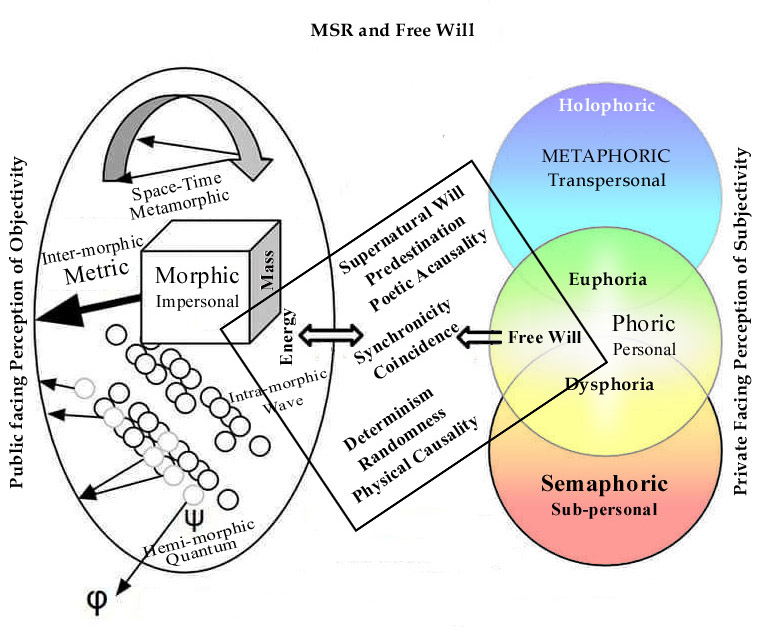
My suspicion is that the boundaries of any conscious experience will be rendered as being driven by quasi-random (bottom facing coincidence) or quasi-fateful (top facing synchronicities). The random/fated appearance is just our own scope’s bias, its ‘red shift’ toward the bottom of its stack or its blue-violet shift toward the top of the stack. In terms of causality, within any given experience, it is the bottom end of the stack that can be controlled by tangible means, technology and instruments which extend the exterior, body-world facing senses of touch-move while the top end of the stack controls us by intangible means…serendipities and synchronicities which open our intuitive sense modalities to be ‘touched’ and ‘moved’ by the transcendent ‘spirit’ world. There is a meta thing I’m doing there also in contrasting the literal and metaphorical sense of touch and move (see diagram above…metaphorical = high end of the stack, ‘semaphorical’ = low end of the stack).
*phorologies = neologism for aesthetic elaborations of direct feeling and sensation, as diametrically opposed to ‘morphologies’, which would be morphological-topological renderings of indirect feeling/sensation.
Top = Transpersonal = Metaphoric
Center = Personal = Phoric
Bottom = Subpersonal = Semaphoric
Let me begin by saying that in my view Donald Hoffman’s model is the best that there is in the field at this time. I agree with Hoffman’s view that our sense of realism is an evolved Homo sapien UI, and I suggest that part of the evolutionary sculpting of this UI (and probably for all species of animal consciousness), tangibility as a sense modality is over-emphasized and taken ultra-literally. I propose this because I reason that there would be a strong evolutionary advantage to being ultra-serious about tangible renderings of public-facing events for an animal that has self-locomotion to be able to navigate its movements. Once we correct for that over-literal weighting, tangibility can be understood as just another modality of sense experience, not necessarily as the primary modality of the universe. In other words, our experience has a body experience but there may be many experiences that do not. This opens the door to disembodied contexts of consciousness and perhaps even conscious experiences which do not include a robust sense of agent-hood.
Around 1:20:00 he talks about the human UI as a portal to another’s consciousness, i.e., even though a smile doesn’t resemble happiness, when we see another person smile, we can infer an experience of happiness because we also have one. He goes on to say how it makes sense that our portal/interface is optimized for other humans and it gives up more and more as you get further from human to human interaction (human-cat is worse, human-ant is even worse, by the time we get to protons and electrons, our interface has completely given up.) Michael Shermer mentions an associated concept of ‘Middling’ from Richard Dawkins. I have proposed a more elaborate hypothesis of this same idea and call it eigenmorphism.
There are a few assumptions in Hoffman’s thinking that I question:
The UI is ‘created on the fly’ rather than accessed on the fly.I am not convinced that our UI experience is spontaneously confabulated, so much as it is bent and refracted in different ways. Where Hoffman assumes objective reality, I propose a reality which is objective of any particular UI scope, but not objective of the Grand Interface, within which even ‘Users’ or agents are icons of a deeper, trans-agent reality. Our dream is not reality, but that doesn’t mean that reality is anything other than the absolute total of all dreaming.
That anything can ‘exist’ without a receptive capability.In my understanding, one of the deepest flaws of the Western scientific worldview stems from the disqualification and disparagement of ‘feminine’ capacities for sensitivity and receptivity. Under the ‘masculine’-dominant paradigm of our scientific legacy, ‘existence’ is reduced to an ontological state of ‘being’ rather than one of ‘feeling’. I think this is a grave mistake, and that all forms of being are necessarily some experiential context in which foregrounded and backgrounded qualities form dynamic partnerships. This mutual arising of definitions is what I think is glimpsed in both Relativity and Quantum theory. The only “is” is experience itself, all other experiences are relativistic instances of “which is”.
That evolution of the UI justifies evolutionary creation of a UI in the first place.I agree that evolutionary mechanisms shape aspects of the UI, however, that does not explain why the UI is felt, seen, heard, tasted, etc. We still have to have a universe made of true, direct aesthetic phenomena before those phenomena can diverge and be compared as more or less ‘real’ than each other.
I propose then that we take Hoffman’s proposal as true (excepting my three proposed corrections above) for the purpose of taking it even further. In a sense, I am proposing that even though the User Interface model is the best I’ve seen, it is still missing half of the big picture. To get that other half, let us begin by assuming that his view of the UI as selecting against genuine truths about reality, but then consider that these divergences from exterior reality also converge to a set of genuine truths about the other side of reality. In the center of this ‘other side’ of reality is a perpendicular truth attractor (call it Sense or pansensitivity) which is not evolved but accumulated outside of spacetime as a common, transpersonal, nonlocal pool of all experiences.
I suggest that we may understand some of the nature of this attractor to some extent by simply applying our imagination to inverting the qualities of our public-facing experience such that are diametrically opposite. If the unexperienced reality beyond our public facing human UI is generic, mechanical, game-theoretic, and spaced-timed, a-signifying, interchangeable, recursive, teleonomic-stochastic, then the unexperienced reality beyond our private facing UI is proprietary, animistic, spontaneously vital, creative and rule-averse, authentic…intimate, aesthetically saturated, proprietary, teleological, super-signifying, radically unique, etc.
Our UI doesn’t tell us the truth of the universe, but its very fabric may be a tool kit that leads back to truth of the universe in a round-about way. I propose that universe itself may be a self-nesting, self-bootstrapping aesthetic-participatory phenomenon which not only builds labyrinths of anesthetic-automatic appearances to trap itself in temporarily but also gives itself the keys to find its way back out. The universe is a significance building dream factory that inflates and reduces parts of itself in increasingly complex ways – sort of an inhaling of negentropic limitations and exhaling of evanescing entropies.
Let’s talk about what I think the real fabric of nature is; nested sensory-motive presentation.
To begin with, a simple proposal: As mass is to energy, space is to time, and sense is to motive.
The Mass/Space/Motive end is projective. Consciousness ‘inhaling’ extends ‘out’ into quantized graphed ‘particle’ appearances (Nod to Descartes Res Extensa). The opposite, Energy/Time/Sense end is receptive (Consciousness exhales and returns into newly re-qualified, de-graphed ‘holos’ or gestalt appearances).
I would suggest letting all of that sink in before bothering to go further into my elaborations and speculations. For those who do want to go down the full Multisense Realism rabbit hole, my conjecture is that this sensory exhale, motive inhale dynamic is repeated across many parallel levels and cycles of cycles. Our human experience is obscenely well developed on both the inhale and exhale ends, such that we have a signifying interiority of multiplexed sensory nestings (sensations<perceptions<figurations<emotion<awareness>self awareness>thought>intuition>”consciousness”) that interfaces with an a-signifying exteriority of motive scales (physical ( chemical (organic (biological (zoological (anthropological) ) ) ) ) ).
Here then is my arcane formula for the totality of consciousness and nature:
The explanation on that link is probably hard to follow, so I’ll take a shot at a more concise explanation:
There is an Absolute foundation to all of nature, which I call Pansensitivity or the Aesthetic Holos ॐ. It is the superset ⊇ of its diffracted or graphed parts ש. These parts are unified along two perpendicular axes. {(( the horizontal continuum extends ↔ between two extremes of consciousness. The first extreme is rendered in our UI as the absolute transpersonal significance of selfhood in a theological/spiritual/artistic sense. I use the symbol -ℵ as a way to suggest a boundaryless infinity of superlative aesthetic qualities and capacities, i.e. Godlike omniscience, omnipotence, and omnibenevolence. There is a subtle reference here to the Aleph numbers and infinite cardinality, such that by using ‘negative Aleph’ I am suggesting an infinite creativity which transcends unity and multiplicity…a super-everythingness from which all thingness arises. This -ℵ point of maximally expanded Self consciousness also includes dimetric opposite but equally florid qualities of identification with abject terror or super-personalization of omni-malignant Chthonic deities. -ℵ is a Heaven & Hell super-saturation of aesthetic qualities where relief and suffering extend beyond all limits of imagination.
The opposite end of the -ℵ ↔ continuum is rendered in our UI as the absolute impersonal insignificance of selfhood in the atheistic/objectifying/scientistic sense. I use the symbol Ω for various reasons, but suffice it to say this Omega point is the sense of profound insignificance of the self. This is Carl Sagan’s ‘billions and billions’ sense of the vastness of the public-facing, spaced-timed universe, with its fantastic formulas that reveal quantifiable simplicities within all appearances of complexity.
This (-ℵ↔Ω) ‘horizontal’ continuum is further conjectured to be organized in hierarchical scales of time such that the longer periods of time that are available, the richer and broader the extension of the spectrum becomes. This saturation of awareness and intelligence is characterized in the term (↓ºt). For example, the longer human history lasts, the more geniuses contribute to a greater and greater pool of art and science, which then potentially becomes more and more integrated and distributed to all members of the community or network. Each person can become more and more like all of the great geniuses of history who have come before them and have an increasingly profound worldview because of it.
Perpendicular ⊥ to this Easternizing/Subjectifying-Westernizing/Objectifying spectrum (-ℵ↔Ω) of enrichment of significance (↓ºt) is the contra spectrum of contraction and entropy that is denoted as (ωª↑(H←d)). If the former spectrum describes an inhaling of more and more inner and outer significance from the top down (↓), this second spectrum describes an exhaling into an increasing pool of bottom-up ↑ entropy and negentropy. Instead of an intentional striving for more and more aesthetically saturated and profound experiences, this continuum is about the dissipation of aesthetic significance and sensitivity into automatism. The ω variable denotes the minimum fragment of experience – sort of the ‘spiritless spirit of points in a void’ – a quantum-Brownian static-dynamism of absolute entropy-negentropy. Recursiveness and replication. Randomness and accident. The addition of the feminine ordinal superscriptωª is supposed to connote an opposite sense of hierarchy from the masculine ºt of the primary continuum. In the primary continuum, causality flows downward ↓ from Holos to spacetime (graphos) in a successive watering down from the kind of profound ‘Golden Age’ omniscient surrealism to an ‘Iron Age’, prosaic realism. In this secondary continuum, computable complexity builds from the bottom up ↑. If the –ℵ↔Ω continuum expands significance by breaking gestalt, multivalent, metaphorically layered concepts into mytho-poetic utterances, the ωª↑ continuum builds alphabets and dictionaries out of nearly meaningless semaphores. The language is the servant of the speaker-thinker, but the language can draw out potentials from the speaker-thinker as well.
The final (H←d) element of the formula describes the relation between entropy and distance. This describes what Hoffman was getting at with the breakdown of the UI as it is pushed beyond its intended specs. As a human, the more distant in scale and familiarity from the human world, the less empathy and relation we can have with what is ‘behind the face’ of the icon that our UI presents. The ant’s experience is insignificant relative to our own, so the ant is rendered as a small, generic insect. We don’t much care to know what it is like to be an ant because it is not an evolutionary advantage to do so. I used the ← rather than the ↔ symbol in the secondary continuum to suggest an existential gravity, what our UI presents as the second law of thermodynamics and the promise of cosmological heat death. In the primary continuum, by contrast, the ‘now’ moment accumulates more and more significance into each ‘lifetime’ experience that it is represented in our UI as the idea of the Singularity or eternal, transcendental now in which all of space and time can be accessed simultaneously.
Emergent properties can only exist within conscious experience.
…
Neither matter nor information can ‘seem to be’ anything. They are what they are.
It makes more sense that existence itself is an irreducibly sensory-motive phenomenon – an aesthetic presentation with scale-dependent anesthetic appearances rather than a mass-energetic structure or information processing function. Instead of consciousness (c) arising as an unexplained addition to an unconscious, non-experienced universe (u) of matter and information (mi), material and informative appearances arise as from the spatiotemporal nesting (dt) of conscious experiences that make up the universe.
Materialism: c = u(mdt) + c
Computationalism: c = u(idt) + c
Multisense Realism: u(midt) = c(c)/~!c.
For all dangerous minds, your own, or ours, but not the tv shows'... ... ... ... ... ... ... How to hack human consciousness, How to defend against human-hackers, and anything in between... ... ... ... ... ...this may be regarded as a sort of dialogue for peace and plenty for a hungry planet, with no one left behind, ever... ... ... ... please note: It may behoove you more to try to prove to yourselves how we may really be a time-traveler, than to try to disprove it... ... ... ... ... ... ...Enjoy!




 Multisense Realism
Recent Comments