Archive

A Multisense Realist Critique of “Human and Machine Consciousness as a Boundary Effect in the Concept Analysis Mechanism”
Let me begin by saying first that my criticism of the thoughts, ideas, and assumptions behind this hypothesis on the Hard Problem (and of all such hypotheses) does not in any way constitute a challenge to the expertise or intelligence of its authors. I have the utmost respect for anyone who takes the time to thoughtfully formulate an opinion on the matter of consciousness, and I do not in any way place myself on the same intellectual level as those who have spent their career achieving a level of skill and knowledge of mathematics and technology that is well beyond my grasp.
I do have a lifelong interest in the subject of consciousness, and most of a lifetime of experience with computer technology, however, that experience is much more limited in scope and depth than that of full-time, professional developers and engineers. Having said that, without inviting accusations of succumbing to the Dunning-Kruger effect, I dare to wonder if abundant expertise in computer science may impair our perception in this area as well, and I would desperately like to see studies performed to evaluate the cognitive bias of those scientists and philosophers who see the Hard Problem of Consciousness as a pseudo-issue that can be easily dismissed by reframing the question.
Let me begin now in good faith to mount an exhaustive and relentless attack on the assumptions and conclusions presented in the following: “Chapter 15: Human and Machine Consciousness as a Boundary Effect in the Concept Analysis Mechanism” by Richard Loosemore (PDF link), from the book Theoretical Foundations of Artificial General Intelligence, Editors: Wang, Pei, Goertzel, Ben (Eds.) I hope that this attack is not so annoying, exhausting, or offensive that it prevents readers from engaging with it and from considering the negation/inversion of the fundamental premises that it relies upon.
From the very top of the first page…
“To solve the hard problem of consciousness we observe that any cognitive system of sufficient power must get into difficulty when it tries to analyze consciousness concepts, because the mechanism that does the analysis will “bottom out” in such a way as to make the system declare these concepts to be both real and ineffable.”
Objections:
1: The phenomenon of consciousness (as distinct from the concept of consciousness) is the only possible container for qualities such as “real” or “ineffable”. It is a mistake to expect the phenomenon itself to be subject to the categories and qualities which are produced only within consciousness.
2: Neither my analysis of the concept or phenomenon of consciousness ‘bottoms out’ in the way described. I would say that consciousness is both real, more than real, less than real, effable, semi-effable, and trans-effable, but not necessarily ineffable. Consciousness is the aesthetic-participatory nesting of sensory-motive phenomena from which all other phenomena are dreived and maintained, including anesthetic, non-participatory, non-sensory, and non-motivated appearances such as those of simple matter and machines.
“This implies that science must concede that there are some aspects of the world that deserve to be called “real”, but which are beyond explanation.”
Here my understanding is that attempting to explain (ex-plain) certain aspects of consciousness is redundant since they are already ‘plain’. Blue is presented directly as blue. It is a visible phenomenon which is plain to all those who can see it and unexplainable to all those who cannot. There is nothing to explain about the phenomenon itself, as any such effort would only make the assumption that blue can be decomposed into other phenomena which are not blue. There is an implicit bias or double standard in such assumptions that any of the other phenomena which we might try to use to account for the existence of blue would also require explanations to decompose them further as well. How do we know that we are even reading words that mean what they mean to another person? As long as a sense of coherence is present, even the most surreal dream experiences can be validated within the dream as perfectly rational and real.
Even the qualifier “real” is also meaningless outside of consciousness. There can be no physical or logical phenomenon which is unreal or can ‘seem’ other than it is without consciousness to provide the seeming. The entire expectation of seeming is an artifact of some limitation on a scope of perception, not of physical or logical fact.
“Finally, behind all of these questions there is the problem of whether we can explain any of the features of consciousness in an objective way, without stepping outside the domain of consensus-based scientific enquiry and becoming lost in a wilderness of subjective opinion.”
This seems to impose a doomed constraint on to any explanations in advance, since the distinction between subjective and objective can only exist within consciousness, consciousness cannot presume to transcend itself by limiting its scope to only those qualities which consciousness itself deems ‘objective’. There is no objective arbiter of objectivity, and presuming such a standard is equivalent to or available through our scientific legacy of consensus is especially biased in consideration of the intentional reliance on instruments and methods in that scientific tradition which are designed to exclude all association with subjectivity.* To ask that an explanation of consciousness be limited to consensus science is akin to asking “Can we explain life without referring to anything beyond the fossil record?” In my understanding, science itself must expand radically to approach the phenomenon of consciousness, rather than consciousness having to be reduced to fit into our cumulative expectations about nature.
“One of the most troublesome aspects of the literature on the problem of consciousness is the widespread confusion about what exactly the word “consciousness” denotes.”
I see this as a sophist objection (ironically, I would also say that this all-too-common observation is one of the most troublesome aspects of materialistic arguments against the hard problem). Personally, I have no confusion whatsoever about what the common sense term ‘consciousness’ refers to, and neither does anyone else when it comes to the actual prospect of losing consciousness. When someone is said to have lost consciousness forever, what is lost? The totality of experience. Everything would be lost for the person whose consciousness is truly and completely lost forever. All that remains of that person would be the bodily appearances and memories in the conscious experiences of others (doctors, family members, cats, dust mites, etc). If all conscious experience were to terminate forever, what remained would be impossible to distingish from nothing at all. Indeed there would be no remaining capacity to ‘distinguish’ either.
I will skip over the four bullet points from Chalmers work in 15.1.1 (The ability to introspect or report mental states…etc), as I see them as distractions arising from specific use cases of language and the complex specifics of human psychology rather than from the simple/essential nature of consciousness as a phenomenon.
Moving on to what I see as the meat of the discussion – qualia. In this next section, much is made about the problems of communicating with others about specific phenomenal properties. I see this as another distraction and if we interrogate this definition of qualia as that which “we cannot describe to a creature that does not claim to
experience them”, we will find that it is a condition which everything in the universe fits just as well.
We cannot describe numbers, or gravity, or matter to a creature that does not claim to experience them either. Ultimately the only difference between qualia and non-qualia is that non-qualia only exist hypothetically. Things which are presumed to exist independently of subjectivity, such as matter, energy, time, space, and information are themselves concepts derived from intersubjective consensus. Just as the Flatlander experiences a sphere only as a circle of changing size, our entire view of objective facts and their objectiveness is objectively limited to those modalities of sense and sense-making which we have access to. There is no universe which is real that we could not also experience as the content of a (subjective) dream and no way to escape the constraints that a dream imposes even on logic, realism, and sanity themselves. A complete theory of consciousness cannot merely address the narrow kind of sanity that we are familiar with as thinking adults conditioned by the accumulative influence of Western society, but also of non-ordinary experiences, mystical states of consciousness, infancy, acquired savant syndrome, veridical NDEs and reincarnation accounts, and on and on.
a philosophical zombie— would behave as if it did have its own phenomenology (indeed its behavior, ex hypothesi, would be absolutely identical to its normal twin) but it would not experience any of the subjective sensations that we experience when we use our minds
As much as I revere David Chalmers brilliant insights into the Hard Problem which he named, I see the notion of a philosophical zombie as flawed from the start. While we can imagine that two biological organisms are physically identical with and without subjective experience, there is no reason to insist that they must be.
I would pose it differently and ask ‘Can a doll be created that would seem to behave in every respect like a human being, but still be only a doll?” To that question I would respond that there is no logical reason to deny that possibility, however, we cannot deny also the possibility that there are some people who at some time might not be able to feel an ‘uncanny’ sense about such a doll, even if they are not consciously able to notice that sense. The world is filled with examples of people who can pretend and act as if they are experiencing subjective states that they are not. Professional actors and sociopaths, for example, are famously able to simulate deep sentiment and emotion, summoning tears on command, etc. I would ask of the AI dev community, what if we wanted to build an AGI simulator which did not have any qualia? Suppose we wanted to study the effects of torture, could we not hope to engineer a device or program which would allow us to understand some of the effects without having to actually subject a conscious device to excruciating pain? If so, then we cannot presume qualia to emerge automatically from structure or function. We have to have a better understanding of why and how qualia exist in the first place. That is the hard problem of consciousness.
Similarly, if we know that wires from a red color-detection module are active, this tells us the cognitive level fact that the machine is detecting red, but it does not tell us if the machine is experiencing a sensation of redness, in anything like the way that we experience redness.
Here I suggest that in fact the machine is not detecting red at all, but it is detecting some physical condition that corresponds to some of our experiences of seeing red, i.e. the open-eye presence of red which correlates to 680nm wavelength electromagnetic stimulation of retinal cells. Since many people can dream and imagine red in the absence of such ophthalmological stimulation**, we cannot equate that detection with red at all.
Further, I would not even allow myself to assume that what a retinal cell or any physical instrument does in response to illumination automatically constitutes ‘detection’. Making such leaps is, in my understanding, precisely how our thinking about the hard problem of consciousness slips into circular reasoning. To see any physical device as a sensor or sense organ is to presume a phenomenological affect on a micro scale, as well as a mechanical effect described by physical force/field mathematics. If we define forces and fields purely as mechanical facts with no sensory-motive entailment, then it follows logically that no complex arrangement of such force-field mechanisms would necessarily result in any addition or emergence of such an entailment. If shining a light on a molecule changes the shape or electrical state of that molecule, every subsequent chain of physical changes effected by that cause will occur with or without any experience of redness. Any behavior that a human body or any species of body can evolve to perform could just as easily have evolved to be performed without anything but unexperienced physical chain reactions of force and field.
The trouble is that when we try to say what we mean by the hard problem, we inevitably end up by saying that something is missing from other explanations. We do not say “Here is a thing to be explained,” we say “We have the feeling that there is something that is not being addressed, in any psychological or physical account of what happens when humans (or machines) are sentient.”
To me, this is a false assumption that arises from an overly linguistic approach to the issue. I do in fact say “Here is a thing to be explained”. In fact, I could use that very same word “here” as an example of that thing. What is the physical explanation for the referent of the term “here”. What gives a physical event the distinction of being ‘here’ versus ‘there’?
The presence of something like excruciating pain can’t be dismissed on account of a compulsion to assume that ‘Ouch!’ needs to be deconstructed into nociception terminology. I would turn this entire description of ‘The trouble” around to ask the author why they feel that there is something about pain that is not communicated to anyone who experiences it directly, and how anything meaningful about that experience could be addressed by other, non-painful accounts.
On to the dialectic between skeptic and phenomenologist:
“The difficulty we have in supplying an objective definition should not be taken as grounds for dismissing the problem—rather, this lack of objective definition IS the problem!”
I’m not sure why a phenomenologist would say that. To me, the hard problem of consciousness has nothing at all to do with language. We have no problem communicating “Ouch!” any more than we have in communicating ” “. The only problem is in the expectation that all terms should translate into all languages. There is no problem with reducing a subjective quality of phenomenal experience into a word or gesture – the hard problem is why and how there should be any inflation of non-phenomenal properties to ‘experience’ in the first place. I don’t find it hard to articulate, though many people do seem to have a hard time accepting that it makes sense.
 “. The only problem is in the expectation that all terms should translate into all languages. There is no problem with reducing a subjective quality of phenomenal experience into a word or gesture – the hard problem is why and how there should be any inflation of non-phenomenal properties to ‘experience’ in the first place. I don’t find it hard to articulate, though many people do seem to have a hard time accepting that it makes sense.
“In effect, there are certain concepts that, when analyzed, throw a monkey wrench into the analysis mechanism”
I would reconstruct that observation this way: “In effect, there are certain concepts that, when analyzed, point to facts beyond the analysis mechanism, and further beyond mechanism and analysis. These are the facts of qualia from which the experiences of analysis and mechanical appearance are derived.”
“All facets of consciousness have one thing in common: they involve some particular
types of introspection, because we “look inside” at our subjective experience of the world”
Not at all. Introspection is clearly dependent on consciousness, but so are all forms of experience. Introspection does not define consciousness, it is only a conscious experience of trying to make intellectual sense of one’s own conscious experience. Looking outside requires as much consciousness as looking inside and unconscious phenomena don’t ‘look’.
From that point in the chapter, there is a description of some perfectly plausible ideas about how to design a mechanism which would appear to us to simulate the behaviors of an intelligent thinker, but I see no connection between such a simulation and the hard problem of consciousness. The premise underestimates consciousness to begin with and then goes on to speculate on how to approximate that disqualified version of qualia production, consistently mistaking qualia for ‘concepts’ that cannot be described.
Pain is not a concept, it is a percept. Every function of the machine described could just as easily be presented as hexadecimal code, words, binary electronic states, etc. A machine could put together words that we recognize as having to do with pain, but that sense need not be available to the machine. In the mechanistic account of consciousness, sensory-motive properties are taken for granted and aesthetic-participatory elaborations of those properties that we would call human consciousness are misattributed to the elaborations of mechanical process. That “blue” cannot be communicated to someone who cannot see it does not define what blue is. Building a machine that cannot explain what is happening beyond its own mechanism doesn’t mean that qualia will automatically appear to stand in for that failure. Representation requires presentation, but presentation does not require representation. Qualia are presentations, including the presentation of representational qualities between presentations.
“Yes, but why would that short circuit in my psychological mechanism cause this particular feeling in my phenomenology?”
Yes, exactly, but that’s still not the hard problem. The hard problem is “Why would a short circuit in any mechanism cause any feeling or phenomenology in the first place? Why would feeling even be a possibility?”
“The analysis mechanism inside the mind of the philosopher who raises this objection will then come back with the verdict that the proposed explanation fails to describe the nature of conscious experience, just as other attempts to explain consciousness have failed. The proposed explanation, then, can only be internally consistent with itself if the philosopher finds the explanation wanting. There is something wickedly recursive about this situation.”
Yes, it is wickedly recursive in the same exact way that any blind faith/Emperor’s New Clothes persuasion is wickedly recursive. What is proposed here can be used to claim that any false theory about consciousness which predicts that it will be perceived as false is evidence of its (mystical, unexplained) essential truth. It is the technique of religious dogma in which doubt is defined as evidence of the unworthiness of the doubter to deserve to understand why it isn’t false.
“I am not aware of any objection to the explanation proposed in this chapter that does not rely for its force on that final step, when the philosophical objection deploys the analysis mechanism, and thereby concludes that the proposal does not work because the analysis mechanism in the head of the philosopher returned a null result.”
Let me try to make the reader aware of one such objection then. I do not use an analysis mechanism, I use the opposite – an anti-mechanism of direct participation that seeks to discover greater qualities of sense and coherence for their own aesthetic saturation. That faculty of my consciousness does not return a null result, it has instead returned a rich cosmogony detailing the relationships between a totalistic spectrum of aesthetic-participatory nestings of sensory-motive phenomena, and its dialectic, diffracted altars; matter (concrete anesthetic appearances) and information (abstract anesthetic appearances).
“I am now going to make a case that all of the various subjective phenomena associated with consciousness should be considered just as “real” as any other phenomena in the universe, but that science and philosophy must concede that consciousness has the special status of being unanalyzable.”
I’m glad that qualia are at least given a ‘real’ status! I don’t see that it’s unanalyzable though. I analyze qualia all the time. I think the limitation is that the analysis doesn’t translate into math or geometry…which is exactly what I would expect because I understand the role of math and geometry to be precisely the qualia which are presented to represent the disqualification of alienated/out of bounds qualia. We don’t experience on a geological timescale, so our access to experiences on that scale is reduced to a primitive vocabulary of approximations. I suggest that when two conscious experiences of vastly disparate timescales engage with each other, there is a mutual rendering of each other as either inanimate or intangible…as matter/object or information/concept.
In the latter parts of this chapter, the focus is on working with the established hypothesis of qualia as bottomed-out mechanical analysis. The irony of this is that I can see clearly that it is math and physics, mechanism and analysis which are the qualia of bottomed out direct perception. The computationalist and physicalist both have got the big picture turned inside out, where the limitations of language and formalism are hallucinated into sources of infinite aesthetic creativity. Sight is imagined to emerge naturally from imperfect blindness. It’s an inversion of map and territory on the grandest possible scale.
“When we say that a concept is more real the more concrete and tangible it is, what we actually mean is that it gets more real the closer it gets to the most basic of all concepts. In a sense there is a hierarchy of realness among our concepts, with those concepts that are phenomenologically rich being the most immediate and real, and with a decrease in that richness and immediacy as we go toward more abstract concepts.”
To the contrary, when we say that a concept is more real the more concrete and tangible it is, what we actually mean is that it gets more real the further it gets from the most abstract of all qualia: concepts. No concepts are as phenomenologically rich, immediate, and real as literally everything that is not a concept.
“This seems to me a unique and unusual compromise between materialist and dualist conceptions of mind. Minds are a consequence of a certain kind of computation; but they also contain some mysteries that can never be explained in a conventional way.”
Here too, I see that the opposite clearly makes more sense. Computation is a consequence of certain kinds of reductive approximations within a specific band of consciousness. To compute or calculate is actually the special and (to us) mysterious back door to the universal dream which enables dreamers to control and objectify aspects of their shared experience.
I do love all of the experiments proposed toward the end, although it seems to me that all of the positive results could be simulated by a device that is designed to simulate the same behaviors without any qualia. Of all of the experiments, I think that the mind-meld is most promising as it could possibly expose our own consciousness to phenomena beyond our models and expectations. We may be able for example, to connect our brain to the brain of a fish and really be able to tell that we are feeling what the fish is feeling. Because my view of consciousness is that it is absolutely foundational, all conscious experience overlaps at that fundamental level in an ontological way rather than merely as a locally constructed model. In other words, while some aspects of empathy may consist only of modeling the emotions of another person (as a sociopath might do), I think that there is a possibility for genuine empathy to include a factual sharing of experience, even beyond assumed boundaries of space, time, matter, and energy.
Thank you for taking the time to read this. I would not bother writing it if I didn’t think that it was important. The hard problem of consciousness may seem to some as an irrelevant, navel-gazing debate, but if I am on the right track in my hypothesis, it is critically important that we get this right before attempting to modify ourselves and our civilization based on a false assumption of qualia as information.
Respectfully and irreverently yours,
Craig Weinberg
*This point is addressed later on in the chapter: “it seems almost incoherent to propose a scientific (i.e. non-subjective) explanation for consciousness (which exists only in virtue of its pure subjectivity).”
**Not to mention the reports from people blind from birth of seeing colors during Near Death Experiences.
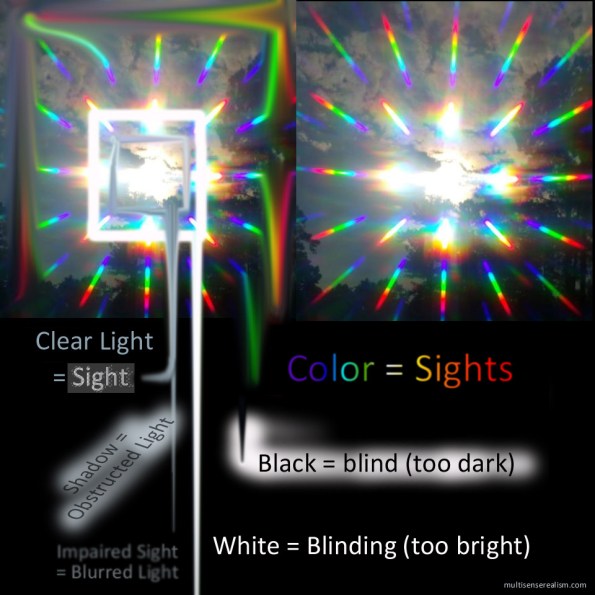
Multisense Realism Sight-Light Hypothesis
• Transparency as the true center of the absolute visible spectrum, which is the spectrum of visibility itself.
• Colorless extremes (dark and light) as undersights and oversights. White and Black are the masking colors for sights outside of any given scope of vision.
• Color as sights.
De-Simulating Natural Intelligence
Hi friends! I’m getting ready for my poster presentation at the Science of Consciousness conference in Interlaken:
Abstract In recent years, scientific and popular imagination has been captured by the idea that what we experience directly is a neuro-computational simulation. At the same time, there is a contradictory idea that some things that we experience, such as the existence of brains and computers, are real enough to allow us to create fully conscious and intelligent devices. This presentation will try to explain where this logic breaks down, why true intelligence may never be generated artificially, and why that is good news. Recent studies have suggested that human perception is not as limited as previously thought and that while machines can do many things better than we can, becoming conscious may not be one of them. The approach taken here can be described as a Variable Aspect Monism or Multisense Realism, and it seeks to clarify the relationship between physical form, logical function, and aesthetic participation.
In Natural Intelligence, intelligence is abstracted from within a full spectrum of aesthetically rich experience that developed over billions of years of evolving sensation and participation.
In Artificial “Intelligence”, intelligence is abstracted from outside the natural, presumably narrow range of barely aesthetic experience that has remained relatively unchanged over human timescales (but has changed over geological timescales, evolving, presumably, very different aesthetics).
In Natural Intelligence, intelligence is abstracted from within a full spectrum of aesthetically rich experience that developed over billions of years of evolving sensation and participation.
In Artificial “Intelligence”, intelligence is abstracted from outside the natural, presumably narrow range of barely aesthetic experience that has remained relatively unchanged over human timescales (but has changed over geological timescales, evolving, presumably, very different aesthetics).

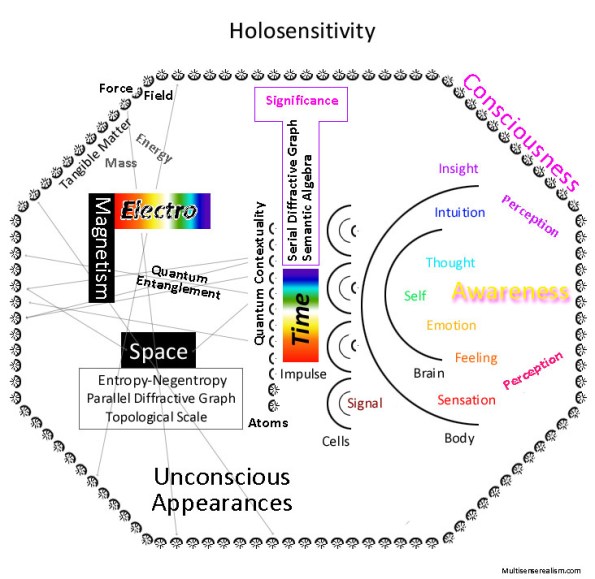
What Multisense Realism proposes is more pansensitivity than panpsychism.
The standard notion of panpsychism is what I would call ‘promiscuous panpsychism’, meaning that every atom has to be ‘conscious’ in a kind of thinking, understanding way. I think that this promiscuity is what makes panpsychism unappealing to many/most people.
Under pansensitivity, intelligence 𝒅𝒊𝒗𝒆𝒓𝒈𝒆𝒔 from a totalistic absolute, diffracting through calibrated degrees of added insensitivity. It’s like in school when kids draw a colorful picture and then cover it with black crayon (the pre-big bang) and then begin to scratch it off to reveal the colors underneath. The black crayon is entropy, the scratching is negentropy, and the size of the revealed image is the degree of aesthetic saturation.
So yes, the physical substances that we use to build machines are forms of conscious experience, but they are very low level, low aesthetics which don’t necessarily scale up on their own (since they have not evolved over billions of years of natural experience by themselves).
I think that despite our success in putting our own high level aesthetic experience into code that we use to manipulate hardware, it is still only reflecting of our own natural ‘psychism’ back to us, rather than truly exporting it into the machine hardware.
 Version 2 better or worse?
Sense and Simulation
1. Nothing that can be experienced is a simulation.
There are different levels of perception (experiences of experience) and interpretation (experiences of understanding perceptions), and they can spoof each other, but all experiences are as fundamentally real any physical substance or process.
If you look in at a mirror, you are *really* seeing a *real* image, it’s just that your body isn’t really inside of a mirror. Your physical body can’t actually be seen, it can only be touched and felt. What can be seen is an image (made of color contrast shapes) that reflects both low-level tangible-public and high-level intangible-psychological conditions.
2. The Hard Problem of Consciousness can be reduced to this question: “How can a particle, force or field become sensitive?“
I think that the answer is that it cannot. Rather, we have to invert our Western presumptions about nature and understand that fields and forces are concepts that may need be replaced by a more accurate one: direct sensory-perceptive and motive-participatory phenomena – aka nested conscious experiences.
Particles are the way that the division and polarization of experience is rendered in the tangible-tactile modality of sensory-perception.
They are not sensitive, and no structure composed of particles is sensitive, just as no words made of letters generate meaning. The particles and structures, words and letters are literally place-holders…spatiotemporally anchored addresses through which experiences can be organized in increasingly complex, rich, and meaningful ways. This is what nature and the universe is: An anti-mechanical sensory experience of mechanically divided experiencers…an aesthetic holos that renders its self-diffraction through anesthetic holography.
Can Qualia Be Simulated?
My response to this Quora question:
There are several considerations upon which the answer to this question hinges:
- The nature of simulation and behavior.
-
- The term simulation is an informal one. I don’t place a high value on discussing the definition of words, but I think that it is essential that if we are talking about something that exists in the world, we have to understand what that thing is supposed to be. I would say that the contemporary sense of ‘simulation’ goes back to early applications of computer software, specifically Flight Simulator programs. We have since become accustomed to using video ‘simulations’ of everything from fighting on a battlefield to performing surgery. Does it make sense to ask whether a flight simulator is producing the same behavior as an airplane? If it did, would we say that the program had produced a flight from Rome to New York? If the flight simulator crashed, would we have to have a funeral for the simulated passengers? I would say no. Common sense would tell us that the simulation is just software…the airplane isn’t real. This takes us to the next consideration, what is real?
- The term real is an informal one as well. We talk about ‘reality’ but that can refer to some abstract truth that we seem to agree on or to a concrete world that we seem to share. To understand why there may be an important difference between a simulation and the ‘real thing’ that is being simulated, we should approach it in a more rigorous way. Flying a real airplane involves tons of physical matter, as well as countless causal links to the world/universe. The real airplane is the result of billions of years of accumulated change in the physical universe, as well as the evolution of numerous species and societies to engineer flight. There is a common comparison of the flight of an airplane to the flight of a bird or insect, where we are meant to think of both types of physical acts as ‘flying’, even though that flight is accomplished in quite different ways. I think that this comparison, however, is misleading. I would look to the famous quote by Alfred Korzybski, “The map is not the territory” instead when relating to simulating consciousness. Whether it is a literal geographical map or some other piece of graphic ‘art’ that ‘maps’ to a potentially real (in the concrete, worldly sense) place, the idea is that just because something appears visually similar to us does not mean that there is any other deep connection between the two. I’m not a photograph of my face. I’m not even a video of myself talking. This understanding is also expressed in the famous Magritte painting “The Treachery of Images”.
- The nature of qualia.
- Properly understood, what the term ‘qualia’ refers to exists by definition. It can get a little mystical if we rely on descriptions of qualia such as “what X is like” or “what it is like to feel X”, so I think it adds clarity if we look at it this way: Qualia is what is experienced. Information is a concept. Matter is a concept. Concepts are experienced also, but what the concept of matter refers to should/must be divided into the idea of matter as defined by the Standard Model (which has to do with exotic elementary “particles/waves” such as bosons and fermions which make up slightly less exotic atoms). Physical matter is made of atoms on the periodic table.
- What we experience directly is not physical matter. What we experience are aesthetic presentations with tactile/tangible qualities such as shape, position, weight, texture, etc. We can dream of worlds filled with tangible objects, and we can interact with them as if they were physical matter, but these dream objects are not composed of the elements on the periodic table. The question of whether these objects are real depends on whether we are able to wake up from the dream. If we do not ever awaken from a dream, I don’t see any way of evaluating the realism of the contents of the dream. To the contrary, when we do awaken from a dream, we are often puzzled by our acceptance of dream conditions which seem clearly absurd and impossible.
- That fact is very important in my view, as it tells us that either it is impossible to ever know whether anything we are experiencing is real, or it tells us that if we can know reality when we truly experience it, then experience must be anchored to reality in way that is deeper than the contents of what is experienced. In other words, if I can’t tell that I’m dreaming when the pink elephant offers me a cigarette, and if I can have dreams which include false awakenings, then I can’t logically ever know that I’m not dreaming. If, however, actual awakening is unmistakable as it seems, then there must be some capacity of our consciousness to know reality that extends beyond any sort of empirical symptom or logical deduction.
- Qualia then, refers to the inarguably real experience of the color red, regardless of whether that experience is associated with the excitation of physical matter producing visible-wavelength electromagnetism in our physical eyeballs, or whether that experience is purely in our imagination. If we want to say that even imagination is surely the product of physical activity in the brain, we can make that assumption of physicalism, but now we have two completely different sources of ‘red’. They are so mechanically different, and the conversion of either one of the sources into ‘experienced red’ is so poorly understood, that all that physicalism can offer is that somehow there must be some mathematical similarity between the visible EM in the eyeball and the invisible neurochemistry scattered in many different regions of the brain which will eventually account for their apparent unity. We do not seem to be able to define a difference between red that is seen in a dream and red that is seen through our eyes, and we also are not able to define how either a brain or photon produces that quale of experienced red. The hard problem of consciousness is to imagine a reason why any such thing as experienced red exists at all, when all physical evidence points only to biochemical changes which are not red.
- The nature of information, physical matter, and qualia.
- Now that we have separated qualia (aesthetic-participatory presentations) from matter (scientific concept of concrete structures in public space), we can move on to understanding information. This is a very controversial subject, made more controversial by the fact that many people do not think it is controversial. There is a popular view that information is physically real, and will cite factual relationships with concepts of physical theory such as entropy. To make it more confusing, there is a separate concept of information entropy, based on the work of engineers like Claude Shannon who studied communication. Depending on how you look at it, information entropy and thermodynamic entropy can be equivalent or opposite.
- In any case, the concept of entropy seems to blur together the behavior of physical structures and the perception of groups of structures and appearances into ‘systems’. This whole area is like intellectual quicksand, and getting ourselves out of it requires a very disciplined effort to separate different levels of sensation, perception, ‘figuration’ or identification, attention, and understanding. Because of my experience of having learned to read English as a child, I no longer have access to the raw sensation or perception level of English writing. I can’t look at these shapes on my screen and not see Latin characters and English words. Even upside down, I am still ‘informed’ by the training of my perception to read English. This would not be the case for someone who had never read English, however most adults on Earth would be able to identify the look of them as words in the English language, even though they can’t read or pronounce them. Anyone who does read English could at least try to phonetically sound out other European languages, but they may not be able to even attempt that for other languages that don’t use the Latin alphabet.
- All of this to say that there may be no such thing as information ‘out there’. The degree to which we are ‘informed’ is limited by our capacities for both sensing and making sense. There may be no such thing as a ‘pattern’ which is separate from a conscious experience in which an aesthetic presentation is recognized as a pattern. This was a heavy revelation for me, and one which transformed my view of nature from an essentially computationalist/physicalist framework based on pattern to one based on an aesthetic-participatory framework in which nature is made of a kind of universal ‘qualia’.
- If my view is on the right track, information does not produce qualia at all, rather information is one minimalist presentation of qualia which is perceived as having a quality of potentially ‘re-presenting’ another conscious experience. This too is a major revelation, since if true, it means that machines like computers don’t actually compute. They don’t actually input, output, or store numbers, they just serve as a physical mechanism which we use to modify our own conscious experience in a very precisely controlled way. If we unplug our monitors, nothing changes as far as the computer is concerned. If we are playing a game, the computer will continue to execute the program in total darkness. We could even plug in some kind of audio device instead of a video screen and now hear a cacophony of noises that doesn’t resemble a game at all. The information is the same from the computer’s point of view, but the change in the aesthetic presentation has made that information inaccessible to us. My hypothesis then is that perceptual access precedes information. If information is a “difference that makes a difference” then perception is the “afferent” phenomena which have to be available for an “efferent” act of comparison and recognition as “different”.
- The assumption of emergent properties.
- The idea that the integration of information produces qualia such as sights, sounds, and feelings depends on the idea of emergence. This idea is, in turn, is based our correlation between our conscious experience and the behavior of a brain. We have to be convinced that our conscious experience is generated by the physical matter of the brain. This alone provides us with the need to resort to a strong emergence theory of consciousness simply being a thing that brains do, or that biology does, or that complex, information integrating physical structures of any sort do (as in IIT).
- Balanced against that is the increasing number of anomalies that suggest that the brain, while clearly having a role in how human and animal consciousness is made available, may not be a generator of consciousness. It may be the case that our particular sort of consciousness has conditioned us to prioritize the tangible, visible aspects of our experience as being the most real, but there is no logical, objective reason to assume that is true. It may be that physics and information ‘emerge’ from the way a complex conscious experience interacts with other concurrent experiences on vastly different scales. Trying to build a simulation of a brain and expecting a personal conscious experience to emerge from it may be as misguided as building a special boat to try to sail down an impossible canal in an Escher drawing.
Can Effort Be Simulated?
This may seem like an odd question, but I think that it is a great one if you’re thinking about AI and the hard problem of consciousness.
Let’s say I want my dishwasher to feel the sense of effort that I feel when I wash dishes. How would I do it? It could make groaning noises or seem to procrastinate by refusing to turn on for days on end, but this would be completely pointless from a practical perspective and it would only seem like effort in my imagination. In reality, any machine can be made to perform any function that it is able to do for as long as the physical parts hold up without any effort on anyone’s part. That’s why they are machines. That’s why we replace human labor with robot labor…because it’s not really labor at all.
It is very popular to think of human beings as a kind of machine and the brain as a kind of computer, but imagine if that were really true. You could wash dishes for your entire lifetime and do nothing else. If someone wanted a house, you could simply build it for them. Machines are useful precisely because they don’t have to try to do anything. They have no sense of effort. They don’t care what they do or don’t do.
You might say, “There’s nothing special about that. Biological organisms just evolved to have this sense of effort to model physiological limits.” Ok, but what possible value would that have to survival? Under what circumstances would it serve an organism to work less than the maximum that it could physiologically? Any consideration such as conserving energy for the Winter would naturally be rolled into the maximum allowed by the regulatory systems of the body.
So, I say no. Effort cannot be simulated. Effort is not equal to energy or time. It is a feeling which is so powerful that it dictates everything that we are able to do and unable to do. Effort is a telltale sign of consciousness. If we could sleep while we do the dishes, we would, because we would not have to feel the discomfort of expending effort to do it.
Any computer, AI, or robot that would be useful to us could not possibly have a sense of its own efforts as being difficult. Once we understand how a sense of effort is truly antithetical to machine behaviors, perhaps we can then begin to see why consciousness in general cannot be simulated. How would an AI that has no sense of not wanting to do the dishes every be able to truly understand what activities are pleasurable and what are painful?
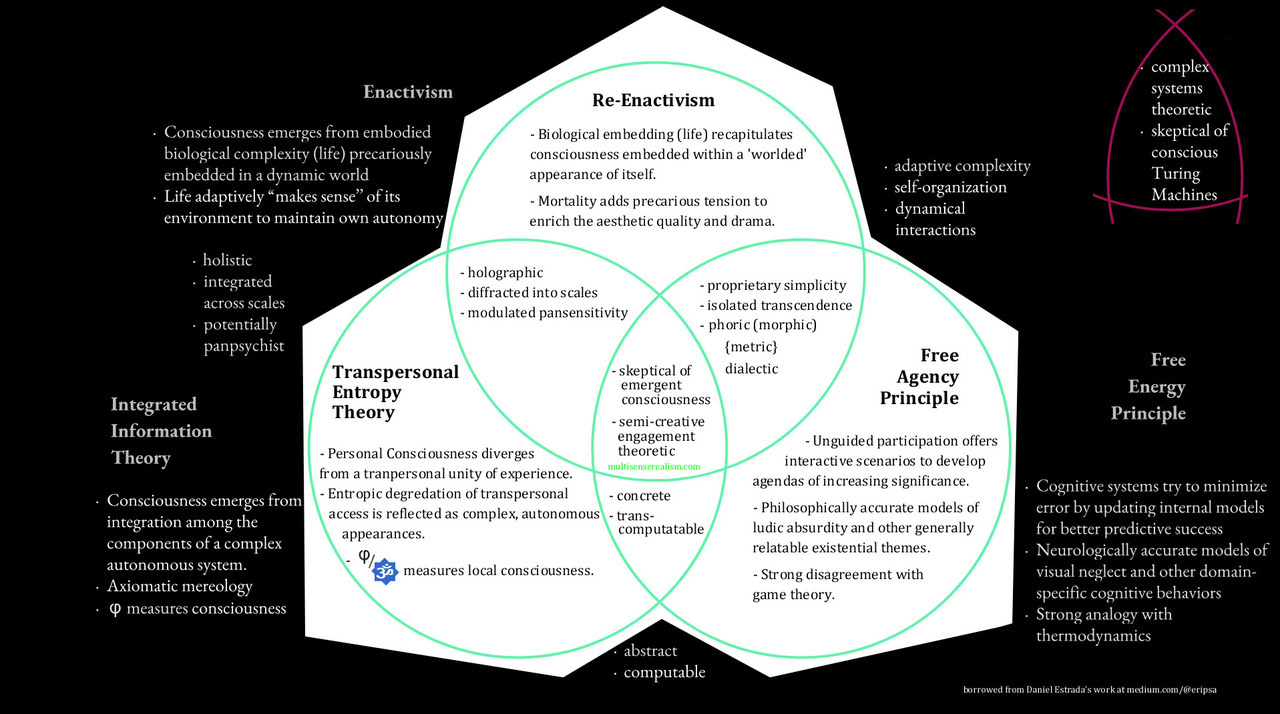
Perverting a Survey of AI Theories
In this post, I shamelessly cannibalize, invert, and repurpose a great diagram of contemporary AI theory categories from here.


Recent Comments