Archive
Physics as the Production of Realistic Fantasy and Fantastic Reality
When working with private physics, the operators used are metaphorical and implicit, not explicit. Qualia is LIKE the “mass” of privacy. The will to will is like the “Energy” of privacy, and realism is like the “c²”. In my understanding, the notion that c is the speed of light is really a legacy understanding – a pre-Relativity convention within Relativity. It makes more sense to me now that light just happens to be the fastest quality of sense that we have access to. The true nature of c is as the speed of sense, or experience itself. It is not a speed, but the absolute limit of velocity. The still-here-ness of the universe..
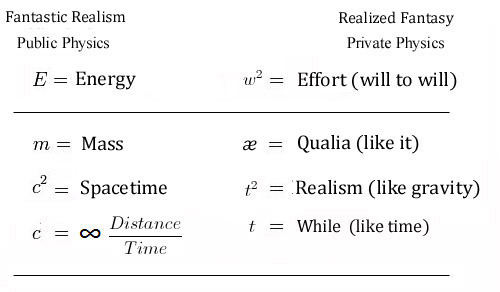
From an absolute view, quantified properties like mass, energy, and spacetime can be considered to be like reality but the only true reality is what experience is like. All conditions of the public universe are contingent upon an aesthetic palette, otherwise it would be implausible that any such palette could exist.
Private physics and public physics provide two different senses or fantasy, and two different senses of reality. Human experience is fantastically rich in an aesthetic sense and fundamentally real because it is the source of our participation in the universe. Our experience of the non-human universe is fantastic in the sense of its overwhelming magnitude and complexity, Its reality is persistent and reliable.
If we are serious about our science, we should consider that being overwhelmed by grandeur is a human experience which reflects the disparity in physical scale between us and the larger exteriority. The Public universe by itself would have no such feeling of grandeur, but what we feel about the inaccessible vastness of the cosmos is equaled by the vast inaccessibility of feeling by public physics.
Something else that has come up through this recent addition of physics to MSR, is the idea that Gravity is time squared, and that time is the square root of gravity. This makes sense to me, if we are talking about the equivalent conjugates of c² and t² as pubic spacetime and private realism. It should work out that Spacetime = the public shadow of Realism, and therefore Spacetime is literally Gravity and Realism is literally figuratively Gravity, as in the grave, serious nature of experience. If c is the constancy of distance and time coordinates, c² is the gravity which warps them from within.
A Formula for Qualia
To derive the formula for qualia or sensory affect, solve the Hard Problem of Consciousness, and bridge the Explanatory gap, I suggest that we try converting the mass-energy equivalence E=mc² from the public orientation and transpose it inward to the private orientation.
Energy (E) becomes w² which is “was and will be” (w = was or will be)
The Speed of light (c) becomes t = time = (still or never) = now or realism
Light* (c²) becomes t² “still and never again” or “stereo realism of now”
Mass (M) becomes æ = qualia = “like it”
Qualia = “like it was and will be, still and never again” =

another wording
Qualia = “Eternally signifies its past and future now”
This is about what Milan Kundera called The Unbearable Lightness of Being. That our experience of the universe is either perpetually suspended above the paradox of an existence which is both perpetually vanishing forever in some sense and repeating forever in another. If c is the still ‘speed’ of here and now, then c² is the acceleration of here and now, the enrichment of the local now through the collective presence and absence of eternity
- Motive effect or will:
To derive will or motive: 
If qualia is “like it”, then square root of æ is what joins and divides the ‘like’ and the ‘it’. It is the dipole charge of ‘liking’ and ‘it-ing’ which we call desire or preference. The greater the liking, the more significance is projected onto the object, which is the imagined realization of a goal in time. Intention projects into the future, builds, and guides qualia.
Will = “(Maybe, or maybe not)(now or never)” = w = √æ t
Turning the private translation outward to Public/Western psychology so that interiority is undersignified as emergent epiphenomena, we get:
= Experience is simply what may and may not be happening for some time.
and
= Choosing = Right or wrong this time
The public-facing view of privacy reduces it to information processing. To those who have a private-facing view this is a flat and inadequate characterization. The former view is optimized for realizing spatial intelligence while the latter is optimized for appreciating timeless wisdom.
- Quality and Equality
Since qualia is about likeness and local equivalents, it can be said that qualia equals the differential between equality and all inequalities... æ = ‘d=’.

The kicker is that since equality is itself a quale (the spelling of e-quality is a clue), we can conceive of ‘=’ as quality which is externalized**, i.e. the differential is collapsed and the entire range of what it “is like” is interpreted as what “it actually is”. The Western-facing mind naturally prefers that which only tells it ‘like it is‘, so that public physics and information science will filter out as noise all that tries to tell ‘what it is like‘ (paging Ludwig Wittgenstein…). This commercialization of residential qualities has had many benefits, but it is a philosophy which has blinded itself, and intimidated many into ignoring the true nature of consciousness. It’s not anyone’s fault, it’s how private physics works. It’s how sense is made.
*The speed of light is c, but c², if taken literally, can be understood as light itself, reality, or making sense: producing stereo (solid) realism.
**Physically publicized, cropped, framed, stereotyped, commercialized, hardened to endure against the changing feelings that make up private time.
Physics in English
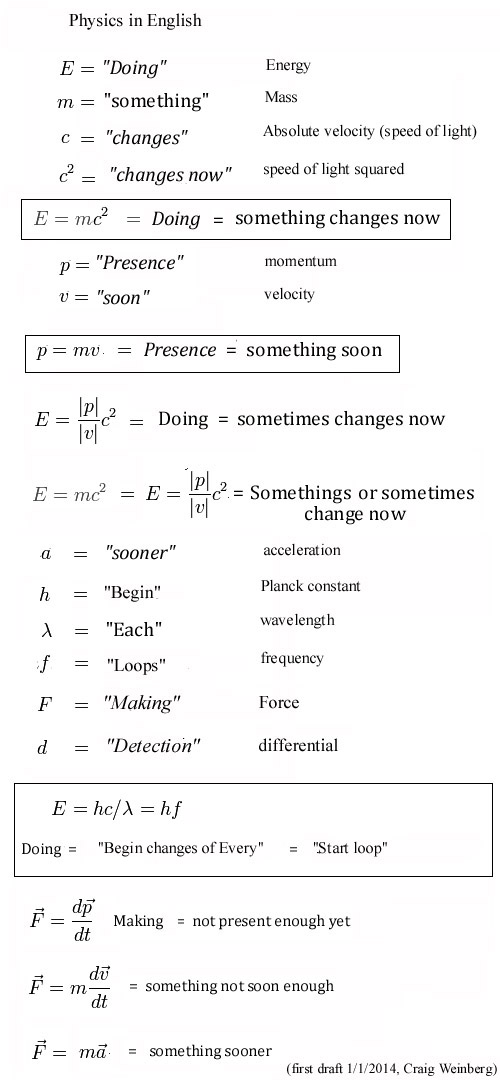
My current preoccupation. It kind of reads like a Magic 8 Ball…which seems like a good sign?
Happy New Physics

This is an attempt to model my understanding of some aspects of Relativity as it stands now. I make no guarantees of its accuracy or completeness, and I’m not trying to ‘do physics’, but rather to attain a simple grasp of how the concepts of relativity work together. (Feel free to correct me of any glaring errors though).
On the right, there are three atoms, a heavy, medium, and light one. I’m using Uranium, Iron, and Hydrogen just to keep it simple, again, I don’t know what to expect realistically to a Uranium atom that is near an Iron atom which is accelerating with a Uranium atom in the same inertial frame, but I’m including heavy and light atoms just so the difference between fission and fusion can be compared.
On the right side of the diagram, I’m contrasting how it is that both fission and fusion release “energy” (pointed arrows) but in opposite ways. Fission is when a heavy particle is accelerated until its nuclear configuration destabilizes, producing smaller particles and losing resting mass in the process. It takes mass-energy to maintain a large nucleus so there is a release of energy since the sum of the before mass is greater than the sum of the after-mass. Mass can be thought of as the sideways view of energy, cutting across space horizontally rather than longitudinally through time. Energy takes time, as it is momentum: a vector of changing distance over time. Mass requires more of a spatial notion of position or invariance which is publicly measurable at any given instant, rather than a shared history over time.
Fusion, of course, is about lighter particles being accelerated until their collisions cause nucleons to share a nucleus, delivering an energetic bang for the opposite (and seemingly paradoxical) reason. Particles which are lighter than iron ‘want’ to form larger particles, so that even though they are not freeing up energy from not having to hold together a giant nucleus, they still free up even more energy from not having to hold themselves together, by themselves. It could be said that matter loves company, but hates crowds. When matter frees itself from overcrowding or isolation, all of the matter senses the difference and responds by imitating that sensation.
In my example, I am trying to show what happens when an ideal Iron particle (Fe) is accelerated all the way to the speed of light. I’m not sure if that is a realistic scenario, but I am reasoning that since some of the matter as well as mass can be lost in nuclear reactions, it is plausible that such an atom would be converted into energy directly. By showing the Fe particle get narrower, I am trying to show the Lorentz contraction and time dilation, as they would appear from another inertial frame. When all of the mass is converted to energy upon hitting c, what that means to me is that the 4D total potential future of the atom collapses into an instantaneous change in the surrounding atoms.
The loss of 4D time and and 3D matter comes across as 2D a wave of synchronized celebration in the form of acceleration of all matter which is affected throughout the cosmos. When we see a star, it is the molecules of our brain and eye which are, in my view, locally responding to the event which seems remote from our experiential frame of reference. When we go to measure photons, it is my hypothesis that we are actually measuring the local instrument’s description of the event, rather than an independent particle/wave. I think that light may be how matter looks and sees – a sensation and a signal, not something traveling literally through space. The aggregate effect/affect of the (figurative) wave of common sense can be quantified as C² – the range of the effect as a form-function delocalizes. Every inertial frame which can witness the annihilation of a form-function (a presence with a future) manifests that action as an equal and opposite reaction in proportion to its relation. The closer (more local) you are to something which delocalizes, the more powerfully localized you become and the more possibilities there are for a continued future. This is sort of a hybrid of Darwinian and Marxist physics. Collective sharing of sacrificed energy for private gain.
This leads into an even more esoteric discussion about the nature of matter as spatio-geometric qualia and energy as tempo-algebraic ‘phoria’. The next phase is to detail the how qualia and phoria (sensory-motive and mental-emotional) phenomena can be integrated more concretely, such that space, time, entropy, information, matter, and energy can be seen as divergent properties of pansensitivity, which is non-space, non-time, non-entropy, non-information, non-matter, and non-energy, non-vacuum. Pansensitivity is absolute fullness, composed of what can be called qualia, phoria, psyche, nous, significance, and motive. I could be more delusional than usual, but this seems to be coming into a clearer and more communicable synthesis which might be eventually work as a true theory of psychophysical unity.
Colorball II Diagram

Key:
Absolute (+∞) :: Anesthetic (-∞)
Entelethetic (+3) :: Hypothetic (-3)
Aesthetic (+2) :: Exthetic (-2)
Immediate (+1) :: Etheric (-1)
Protosthetic (+0) :: Pseudethetic (-0)
The new terms in this second version are:
- Protosthetic (+0), referring to the minimum quality of awareness as well as the quality of minimum awareness. On a scale of +0* to +∞, this level is the +0 because it represents experiences which have been aesthetically masked to appear imperceptible. This can be thought of as the personal unconscious, as opposed to the collective unconscious, which is the Absolute level that is positioned on top of the diagram, but is actually the entire sphere. It’s number would be +∞.
The entire left half of the sphere can be thought of as a slice within the protosthetic range, just as the greyscale can be thought of as variations on black and white. - Pseudethetic (-0) is the outside-in version of Protosthetic. Where protosthetic phenomena seem alienated or unconscious but are, on some level, a symptom of experience, pseudethetic phenomena are not as conscious as they appear to be. The -0 range is about artifice and simulation, and can include anything from a puppet or stuffed animal to a sophisticated AGI system. Protosthetic would include states in which we are personally unconscious, but can be thought of as that which wakes us up from a sub-personal level.
- Exthetic (-2) is a term I’m trying out as the public-facing conjugate to Aesthetic. This is the common sense of structure that the real world generally seems to have. It is the sense of concrete exteriority which we rely on to engage with the world rather than in our mind. The sense of fixed mass objects in space and linear causality, and all of the other macroscopic cues that pervade classical physics, as well as all of the hard sciences.
- Entelethetic (+3) is intended to refer to a level of hyper-aesthetic dreams, symbols, and archetypes. Also knows as the collective unconscious or Dreamtime, this band of sensitivity is super-natural and trans-personal (yet still private). The word borrows from Entelechy, which has to do with a drive toward self-actualization, which is apt considering the visionary nature of this ‘third eye’ view.
Teleological-Absolute (+∞) :: Universal-Axiomatic (-∞)
Mytho-Poetic (+3) :: Geometric-Algebraic (-3)
Mental-Emotional (+2) :: Scientific-Mechanical (-2)
Sensory-Motive/Perceptual (+1) :: Electro-Magnetic/Relativistic (-1)
Proto-Aesthetic (+0) :: Quantum-Digital (-0)
The Lowdown on Empty Space and the Speed of Light
Your task is to explain why are you trying to buck the mainstream view that space has qualities. I’m no acolyte of the mainstream but I do recognize the need to explain deviations therefrom. It so happens that there are good reasons why today’s view is that empty space has physical qualities. The main shortcoming of the mainstream view, from my viewpoint, is the artificial and unnecessary light speed speed limit. Einstein hypothesized a universe with such a limit without ever even suggesting why such a limit makes any sense. And the problem is: it doesn’t.
I think that Einstein hypothesized a speed limit in the universe because he understood or intuited that speed itself is a continuum between stillness and the opposite of stillness, rather than an unbounded scale. He saw that light does not behave like anything else – that it had properties which made it unlike things which can accelerate. Velocity is (not unrelatedly) like ‘straightness’ – there is an upper limit on how straight something can be, how little something can weigh, and the extent to which a signal can be unambiguously present or absent at a given location at any given moment.
What he did not see, IMO is that light is only one kind of signal – one way that the universe makes sense of itself. The speed of light is the speed of space, or perhaps, the speed of ‘here’, and it scales up in proportion to larger scaled ‘here’s. Light, or ‘sense’ or ‘universal public signal’, actually has no speed at all, unless you mix reference frames and thereby measure a large frame from a small one. The degree to which light has a speed is the ratio between the scale of the measurer and the scale of the measurement.
The mainstream view that space has qualities makes perfect sense when we misunderstand and overlook the role of sense in signal production. Rather than extending the relation that living things have with light (or sound, smell, thought, etc) to the microcosm, we have so far only consider the *apparent* relation that non-living things have with each other, which is limited to touch. We have yet to entertain the notion that microphysical phenoemena are, in some sense, seeing each other and signaling each other directly, and thereby creating ‘space’ and ‘time’ on the macrophysical level, from our perspective. From the microphenomenal level, it might appear just the opposite, that spacetime is being created from above, on higher levels. Both are probably true and untrue to a similar extent.
There is no reason to believe that space has properties except to maintain the assumption that physical processes are unconscious and isolated. When we hold that belief, we are forced to take a phenomenon which is transdimensional, and flatten it into a finite number of topological fields in which forms can touch each other directly. That’s a great way of doing the math so that we can predict and control the conditions of (relatively) inanimate objects, but it falls apart when we try to include more subtle sense-making phenomena.
I’m fully aware, of course, that this is a radical conjecture. My position is not that this is a complete theory or that I know how it must work, but that it is a theoretical possibility which could work, has not been explored, and should not contradict any observation of physics made thus far
Topography of Eigenmorphism Part II
Another visual metaphor:
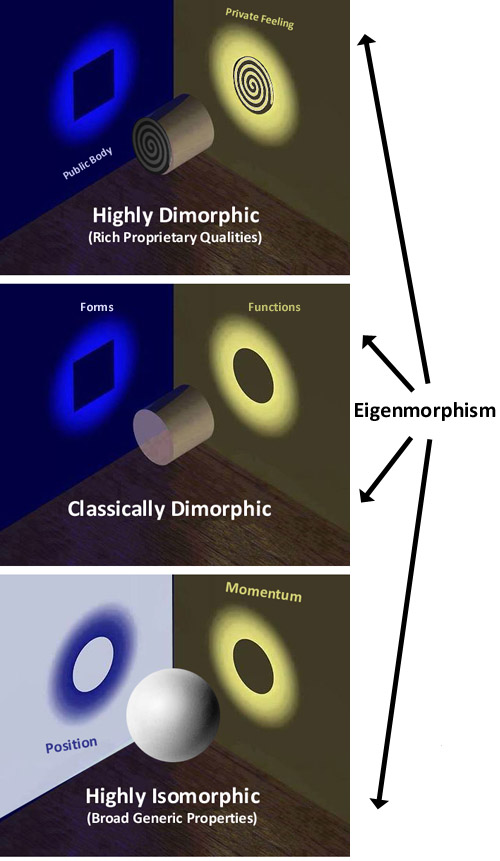
Eigenmorphism visualization part II
This diagram shows how elemental phenomena (bottom image) appear to us to have very little going on inside. Their public properties are not very body-like and their behaviors are imagined not to be very experiential. Eigenmorphism is the idea that as phenomena progress to richer experiential qualities, their interior and exterior nature expands in opposite directions. In biological organisms, the public and private view not only differ by perspective, but the interior perspective can increasingly elaborate itself (spiral grows) without the exterior perspective (square shadow) revealing any change.
It should be noted that this is a metaphor, not a diagram of matter or quantum. What the yellow wall refers to is actually shapeless, as it is the appreciation of and participation in experiences. The increasing elaboration of the shape stands for increasingly rich and varied modalities of sensitivity. MSR suggests that the three dimensional figure in the center is not real at all, and a better diagram would show the shadow from the blue wall and the shadow from the yellow wall gradually morphing into each other in stages.
The difference between the high and low ends of the eigenmorphic spectrum are not only in the degree to which their interior qualities differ from their exterior properties, or in the kinds of qualities which higher experiences contain, but also in ubiquity vs uniqueness. The generic nature of low level phenomena make them comparatively interchangeable and universal, so that physical and mathematical laws have a universal reach. The highest level phenomena can be esoteric to the point of near-solipsism, with meanings that are so multiplexed and poetic that they apply only to a single moment or perspective.
Biology From The Inside

This gif is one of the set that has been going around, but it reminds me of the concept that I have of biological awareness (as opposed to primordial awareness which is embodied by physics and does not require biology). Whether the inorganic universe is four dimensional (3 + 1 time) or just seems that way from within a two dimensional hologram, it seems likely to me that the experience of biological organisms is best modeled along a fifth axis (aesthetic qualities as more than the sum of their conditional parts).
What I like about the repeating gif, besides the coincidental “5” relating to the fifth dimension, is that it suggests a kind of morphological respiration. Front to back, parts to whole, a seamless, self-metabolizing transformation. As a biological organism, my experience of the outside world is limited to that which can be modeled as objects – that is, through an aesthetically reduced feature set in which a bunch of five dimensional urges and responses are flattened into a four dimensional narrative on multiple levels.
In a previous post, I was looking at how sensitivity might be understood as being ‘key composited’ or perhaps ‘discomposed’ across multiple frames of reference. By this I mean that the apparent distribution of our psychological interface across the tissue of the brain can be compared to a flatland visualization:
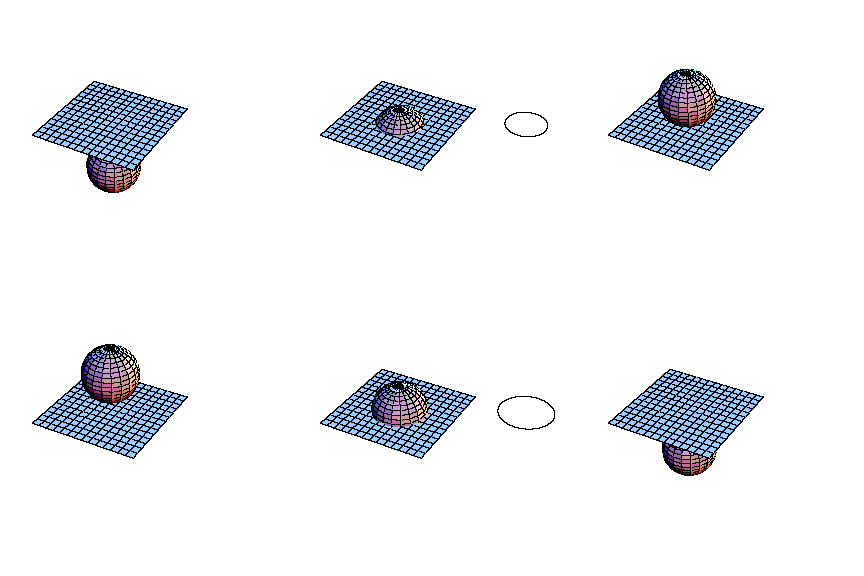
If instead of the sphere, it were a hand passing through the flatland plane, it would appear to the omniscient flatlander that there were five separate circles appearing separately, yet somehow seeming coordinated in their action. The fingers are part of a single hand, but within the constraint of the two dimensional sensitivity, the unity of the hand is discomposed across space in the literal sense, but figuratively some kind of unity can be inferred through the synchronized coincidence of the movement.
Now imagine that instead of another graphable dimension, the fifth dimension is one which is as orthogonal to spacetime as the three dimensions of space are to the one dimension of time. Feeling, like pain and pleasure, are like a coloring, or keying which cuts across multiple layers of seemingly unrelated public events. Not only is feeling a different kind of thing as forms or functions but it is a dimension in which dimension itself is transcended. Feeling is not a model or a measure, but rather it is the primordial context from which all measure is derived and all modeling is made demonstrable.
From the discomposed perspective ‘out there’, we are a coincidence of coincidences. A mysteriously synchronized, dynamic orchestration of hundreds of billions of neurons, organelles, molecules, etc which corresponds to the behavior of an animal’s body.

The feelings which we experience are not located in the tissue of the brain, rather the brain itself is part of the wider landscape of the totality of experience. The brain as a whole is, like our body as a whole and all of the cells and molecules that make it up at any given time, a four dimensional reduction of a transdimensional privacy.
Under Eigenmorphism, the base of each pyramid of perception is made up of the apex of countless low level pyramids of perception. When we look at an fMRI or the brain, we are trying to look at the view from top of our own pyramid through the blind eyes of its own bottom. Feeling is stripped out (not to mention the higher dimensions of meta-feeling/emotion/cognition/intuition) and we are left with a four dimensional mechanical skeleton with no interiority.
Being so impressed with ourselves and what we have accomplished by questioning our naive introspection with science, we naturalize the discomposed view and epiphenomenalize the native, gestalt perspective. All of this makes perfect sense within the flatlanded context of topological physics, where spontaneous appearances and disappearances are assumed only to reflect each other, rather than private transdimensional presentations.
I suspect that the universe which is experienced in the absence of all living organisms is a much different thing that it would appear to us. What we see as a four or two dimensional manifold is only a snapshot of discomposed histories. It seems inanimate to us because we seem so animated to ourselves. The highest awareness of our own interior physics seems to us unreal and crazy…and it is, relative to the inertia of human awareness as a whole. Like the inverted image of our retina however, I think that because our disposition spans so many levels of life and physical experience, we tend to see the mechanical patterns which all of the layers have in common, rather than the coincidence which is also animating them from the top down.
Like the transformer car in the gif, the signature of our presence and intention coincides with the interplay of entropy and significance. The living cell, from our perspective looking through our eyes and a microscope’s lens, looks like a homeostatic emergence. Seemingly conjured, like Brownian motion, from the statistical collisions of countless microphysical conditions.
This is not completely untrue. The mechanical conditions of a cell can be disrupted mechanically. There is bottom up causality. What has not been properly investigated yet is the other perspective. The one responsible for the biological property of healing and global integrity. If we think of the flux between entropy and significance as a carrier tone for biological life, then it might be easier to conceptualize how the universe is as much a dynamic interaction of nested simplicities as it is a mechanical progression from simplicity to complexity. The image of the metabolic transformer stands in contrast to the stillness of the axis of its transformation.
There is no Objective Color thread
That’s really interesting, too much for me to all read but I appreciate the effort put into this.
I do disagree on your first point though. There is such a thing as objective color. Photons have wavelengths, and specific wavelengths are specific colors, regardless of how our eyes and brains interpret them.I read a part of the article you linked, and if you do take into account how the eye and brain interpret colors, there is still objective color. Apparently we do all have different ratio’s of red vs green vs blue cone cells, but as the article says, our brains are still in agreement over what exactly is yellow. So our eyes might be different, but our brains correct that difference.
Think about the nature of the visible spectrum. We perceive it as being composed of soft but distinct bands of hues, usually seven or eight: red, orange, yellow, green, cyan, indigo, violet, and sometimes fuchsia, which is not a spectral color. Colors such as grey, white, brown, beige, and pink do not correspond to any one frequency, so they cannot be said to map to the wavelength of any particular photon, yet we perceive them as discernible colors.

The color palette is of course, also a wheel in which colors are seen as ‘opposite’ to each other, and which generate various effects when placed adjacent to each other, as seen in various optical ‘illusions’:

I put scare quotes around the word illusions because this information has helped me understand that what we see is never an illusion, only our cognitive expectations about what we see can be illusory. By manipulating the various layers of sensation and perception to expose their conflicts, we can tease out the truth about color, and by extension consciousness. There is no ‘actually’, there is only ‘seems like from some perspective’. The experiment showed that our color perception can be altered for weeks after subjects return to an unaltered optical state*. Our brains correct the difference because they are not translating the wavelength of photons but mimicking relations within the optical experience as a whole.
Now think about the visible range of the electromagnetic spectrum. Does it have seven soft bands or is it an absolutely smooth quantitative continuum? Does the continuum form a wheel with primary and secondary oppositions, or is it an unbounded linear progression? Does it repeat in octaves, where one frequency suddenly recapitulates and merges the beginning and ending of a sequence, or does it monotonously extend into the invisible spectrum?

Our eyes tend to differ, and photons might be the same, but color is not photons. In fact, photons from the outside world only do one thing in our retina, and that’s isomerize rhodopsin molecules – meaning that the proteins in our rod and cone cells are studded with vitamin A molecules which stretch out in the presence of visible light. From there, the folded proteins in the cells sort of swell open and actually cut off what is know as ‘Dark Current’ – the continuous flow of glutamate which is interpreted as seeing light *in its absence*. Physical light, in a sense turns our experience of darkness off.

Once we let all of this information sink in, it should be clear that the experience of color is just that – an experience. It correlates to optical conditions, but it also correlates to conditions in which there are no optical inputs at all. Even where it is isomorphic to exterior measurements, there are no colored photons inside of the brain that we are seeing. We are seeing the same neural conditions that we feel, smell, taste, and hear, and synesthesia confirms that as well. This does not mean that neural conditions are a solipsistic simulation, however, but that’s a whole other conversation (which I have my own ‘crackpot’ theory for 🙂 http://multisenserealism.com)
*http://color.psych.upenn.edu/brainard/papers/AIC01.pdf
Speed of Light: Why is the speed of light not infinite?
Speed of Light: Why is the speed of light not infinite?
Speed of Light: Why is the speed of light not infinite?
The speed of light in a vacuum, 299792458 m/s, is a finite, discrete value. Nothing else can achieve this speed, because it would need infinite energy to propel actual mass. But a photon does not have mass.What is the limiting factor that prevents a photon from exceeding 299792458 m/s?
It’s like asking, “what is the limiting factor that prevents something which is absolutely still from being even more still?” Whether or not something can exceed the velocity of light or c (recently there was an unsuccessful challenge to light’s absolute status), the concept of c itself should not be considered a velocity, but rather, the physical and ontological limit of velocity itself as it is defined in the universe.
Personally, and this is just my own hypothesis, I think that the coincidence with light and c, along with light’s lack of resting mass gives us reason to question whether photons “exist” as independent entities traveling through a vacuum. I see no reason why it could not be the case that photons, and all radiant energy is actually more like what energy is on the macrophysical level. Our naive experience of classical physics shows us very clearly that energy is merely “what matter does”, rather than a substance of its own.
Energy is a verb which modifies a noun – it moves, heats up, changes, some-thing. Without a thing to move and an experience in which that moving thing can be compared to a memory of its previous position or status, there is no energy. My prediction is that all of the current interpretation in physics which relies on vacuum energy will ultimately have to be re-interpreted. Once we are able to understand that matter and awareness are identical, then energy can be understood as communication within matter which generates space and time. Space and time in turn, will have to be redefined as a property of awareness, or rather, of awareness to gaps in awareness.
The speed of light then is really about the speed of measurement. It is not a measurement of literal particles or waves traveling through a void, it is a measure of the scale of dislocation among multiple inertial frames. It is about the scale of bodies relative to each other, so that c defines both the largest and smallest ratio between frequencies of what these bodies are doing.
 Multisense Realism
Recent Comments