Archive

Rosetta Codex

Following up on the Tree of Life post and MSR Legend post.
Multisense Tree of Life

Multisense Tree of Life
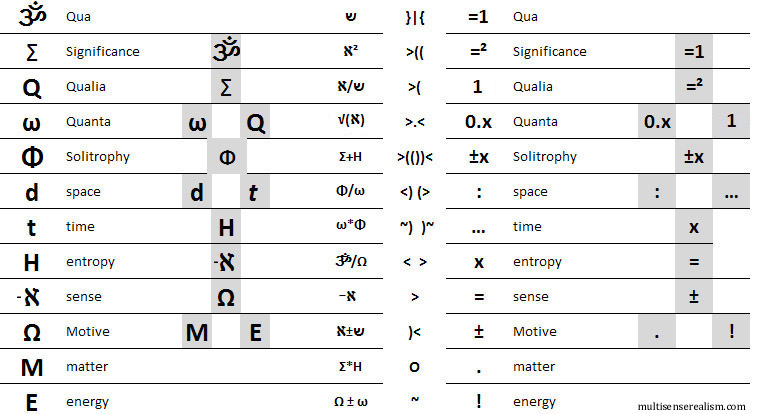
I noticed that this formulation was starting to take on Kabbalistic dimensions, so I put it into that form. There’s some new propositions to consider here that have come out of this. Beginning with sense, which I symbolize as -ℵ (negative Aleph) and as =. This is the fundamental concept of MSR and the idea of ℵ in mathematics as cardinality fits with this definition, since equality ‘is equal to’ anti-cardinality. Sense is the unity which underlies all multiplicity, so that it can indeed be thought of as a kind of negative cardinality – not unity, but pre-cardinality.
Moving up and to the right from sense, there is Qualia, now defined as -ℵ/ש (Aleph over Shin), where ש (Shin) refers to the diffraction of the Absolute ॐ (Om). This means that Q = -ℵ/ש or, private sense is the sense of a share of eternal being – it is “a” being. In Leibniz terms this is a monad, and it is also the origin of origination, and of the number 1. From these two entities, we have the two parts of the Absolute, which mathematically would be “=1”. Eternal being is the likeness of a being, i.e. the ability to pretend. (Insert Joseph Campbell’s myths and Carl Jung’s archetypes, shamanism, imagination, etc..,) Fiction is ‘like something’, just as Qualia is what it is like to be, or what being ‘seems like’.
Rounding out the primordial trinity from sense along with Qualia is Quanta and Motive. I call the Absolute ‘Qua’ to symbolize its relation as the reconciling parent of Qualia and Quanta. Quanta (ω, lower case omega), here meaning the essence of computation, is given the formula √(ℵ),(root of Aleph). This works surprisingly well. Originally I was going with 0.00…1 and then 0.x to represent Quanta, to specify that Quanta is always the tiniest fragment of Qualia – the drive toward absolutely monotonous precision, but always beneath the threshold of unity, of wholeness. All quanta are parts and abstractions; information-theoretic rather than aesthetic/sensory-motive.
This ended up working well with √(ℵ) (root of Aleph) as it makes clear the complementarity-antagonism with Quanta and sense. Computation is the essence of cardinality, of difference. The stepped reckoning of mechanism is an impersonation of sense, it has no capacity to negate the separations and to build feeling from fragmented quantities. Since negative Aleph (-ℵ) corresponds to 1, then Quanta would be the square root of -1, or i. I used the symbol >.< as well, to denote the clipping of sense through measurement: digitization. Quantification is fantastically useful because it paralyzes whatever it fixes its gaze on.
Motive, the third leaf of the sense trinity, has the formula ℵ±ש (Aleph plus/minus Shin), which emphasizes its similarity to Quanta and Qualia but with an irreducible difference, will. Will is the ± (plus/minus) which requires a participant to end what sense started (thus the use of Ω, Omega). To have a motive is to de-cide, to kill off all options except one. This is the ‘waveform collapse’ of QM, but it is also ordinary ‘free will’. Will is the connection between unconscious cardinality and the Absolute. We don’t know how to make our body move or our how to focus our mind’s attention, we simply become our mind or body and the universe does the rest. There is a cost to our efforts, however. In the drive toward Significance (Solitrophy, Φ), entropy is born.
The unchosen path of Motive becomes the unintentional twin of Significance. Significance, -ℵ² (Aleph squared), while mathematically would equal ℵ (Aleph) as 1, there is an irreducible numinosity to the power relation. Significance holds Q not only as the sense of one quality out of the Totality (ש) (Shin, Qua) but it holds one Q as equal to any number of qualities or meta-qualitative relationships. This is semiotics. Not just = but =². Not phoric (sense) but meta-phoric. Quanta is not phoric but metric – it takes the ² nesting of Significance (Σ) (Sigma) but negates the feeling, leaving only the essence of that figurative quality. Significance is sense squared, Quanta is the square root of pretend sense, the meta-phor is inverted. Figurative language is loose. It draws from associations from within the Totality. Quanta is the opposite, drawing from strictly disambiguated logic. It has no phoric or morphic content, no feelings or forms, only the skeletal coordinates associated with them.
If Significance is like the universal bank account of metaphors and of experiences which have meant something in particular, then Entropy is the compost heap of all of the unchosen and unchoosability in the universe. It’s symbol H is taken from Shannon’s Information theory, and its formula here is ॐ/-Ω, (Om divided by negative Omega). Using the ॐ Om rather than the ש Shin is to emphasize that this relates to the ‘return trip’, the catabolic, arterial part of the cosmic circulation. Shin has more of a sense of the diffraction and creativity of the whole. With Entropy, it is the Totality’s raw, untamed nature which is divided by negative motive. This correctly applies to the nature of Entropy as indifferent, literally and figuratively. No motive. This is where the universe doesn’t care.
Between H of Entropy and Σ of Significance winds the Φ of what I call Solitrophy. Solitrophy is what makes the difference between something that can care and something that can’t. Burning a pile of garbage and burning down a town might produce the same amount of energy and entropy, but burning down a town has a human cost which doesn’t show up on a spreadsheet. As aesthetic significance accumulates, the range between one outcome and another increases. A human being has more at stake, simply by being a human being with a vastly rich aesthetic experience, than it seem like an ant has, or even an anthill. Solitrophy describes this great anchor of all sanities, and builder of worlds (I call them, perceptual inertial frames or castes).
This leaves Matter, Energy, and Qua itself. Matter and Space are listed together, as are Energy and Time. This is to emphasize their relation in MSR, teasing apart their differences rather than conflating them relativistically. The difference between time and space is Solitrophic. It doen’t show up in physics, because physics, by definition is conducted to reduce Solitrophy to an absolute minimum. Physics is asolirexic. Here. Space is defined ω+H and Time as ω*Φ, so that space is about entropy’s quantitative expansion and time is about the quantification of the growth through Solitrophy. The effect of Quanta on Φ is to limit the ‘size of the now’ – the frequency and range of memory of any given participant. Space and time are perpendicular, so that all of eternity is represented spatially by Quanta’s filtering of sense, but that representation is a vanishingly thin slice. Space, by comparison, allows access to the entire continuum of scales which have been accumulated through Solitrophy, but not in a way which allows us to experience it directly.
Matter’s formula is Σ*H, describing mass – the significance of Entropy. As everything is reflected and juxtaposed within MSR, Matter, mass, and space are aspects of the same thing, They are the unintentional, automatic consequences of all spatial scales, collapsed into a single scale. That’s how you get bodies which collide on one inertial frame, but pass right through each other if they are relevant to vastly different scales. This is obviously a rule of thumb – just a way of understanding how space is really an artifact of matter’s sense of its own non-sense and how time is about how functional tropes (routines), constrain and define energy. Energy, therefore, has the formula Ω ± ω (Omega plus minus lowercase omega), with Ω being Motive, now here given another nesting (Ω is already ±. so Ω ± is ±±) and ω being Quanta. Energy is a motive to motivate, or perhaps from to motorize, i.e. to translate a private effect publicly. The Quanta here emphasizes that this translation from motive to motor involves modulating both the frequency and the amplitude of the effect. Energy turns motive effect into work and power.
Finally, the crown of the tree, is Qua. I have covered this a lot already, but here the relation between sense, Qualia, and the Absolute can be seen. If sense is =, and Qualia is 1, then the Absolute is ‘=1’. The inclusiveness of the Absolute is total. It is the largest possible inertial frame. Our personal experiences are part of the whole, and the whole is every part of us.
MSR Legend 3
One more of these for tonight, as i’m still in a semiotic frenzy, as I’m sure you can tell.
MSR Legend

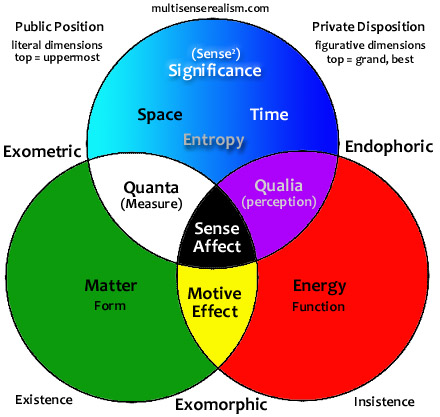
A first second draft of a Rosetta Stone for MSR terms, including the debut of new quasi-alchemical code.
Second draft 7/22/13, added Solitrophy and updated the formulas of time and space to clarify.
Breaking The Fourth Wall

Sense (in the Absolute sense) reveals itself reflexively as the Uni-verse, aka monad of non-orientable self-juxtaposition, aka, “the Pansensitive Meta-Lectic Solitrophic-Holarchic Multiphoric-Unametry”, provider of implicit unity (likeness) across multiplicity (private sensory afference) and explicit participation (public motor efference) through intentional animism and automatic mechanism.
reflexive
1. Directed back on itself.involution
entanglement; a spiraling inwards; intricacy
(mathematics) A function, transformation, or operator that is equal to its inverse, i.e., which gives the identity when applied to itself.tessellation
the careful juxtaposition of shapes in a pattern; “a tessellation of hexagons”.non-orientable
A surface S in the Euclidean spaceR3 is orientable if a two-dimensional figure (for example,) cannot be moved around the surface and back to where it started so that it looks like its own mirror image (
). Otherwise the surface is non-orientable.
The Möbius strip is a non-orientable surface
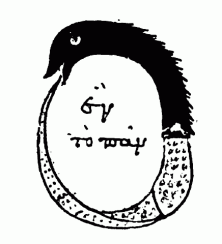
The Ouroboros or Uroboros is an ancient symbol depicting a serpent or dragon eating its own tail.
The Ouroboros often symbolize self-reflexivity or cyclicality, especially in the sense of something constantly re-creating itself, the eternal return, and other things such as the phoenix which operate in cycles that begin anew as soon as they end. It can also represent the idea of primordial unity related to something existing in or persisting from the beginning with such force or qualities it cannot be extinguished. While first emerging in Ancient Egypt, the Ouroboros has been important in religious and mythological symbolism, but has also been frequently used in alchemical illustrations, where it symbolizes the circular nature of the alchemist’s opus. It is also often associated with Gnosticism, and Hermeticism. Carl Jung interpreted the Ouroboros as having an archetypal significance to the human psyche.[citation needed] The Jungian psychologist Erich Neumann writes of it as a representation of the pre-ego “dawn state”, depicting the undifferentiated infancy experience of both mankind and the individual child.
Early alchemical ouroboros illustration. From the work of Cleopatra the Alchemist (Greco-Roman Egypt).Autopoiesis (from Greek auto-, meaning “self”, and poiesis, meaning “creation, production”) refers to a closed system capable of creating itself. The term was introduced in 1972 by Chilean biologists Humberto Maturana and Francisco Varela to define to the self-maintaining chemistry of living cells. Since then the concept has been also applied to the fields of systems theory and sociology.
Bootstrapping or booting refers to a group of metaphors which refer to a self-sustaining process that proceeds without external help.
The phrase appears to have originated in the early 19th century United States (particularly in the sense “pull oneself over a fence by one’s bootstraps”), to mean an absurdly impossible action, an adynaton.Trompe l’œil (French for deceive the eye) is an art technique that uses realistic imagery to create the optical illusion that depicted objects exist in three dimensions. Forced perspective is a comparable illusion in architecture.
Breaking the fourth wall is when a character acknowledges their fictionality, by either indirectly or directly addressing the audience. Alternatively, they may interact with their creator (the author of the book, the director of the movie, the artist of the comic book, etc.). This is more akin to breaking one of the walls of the set, but the existence of a director implies the existence of an audience, so it’s still indirectly Breaking The Fourth Wall. This trope is usually used for comedic purposes.


Mechanemorphism
(*update to The Competition page)
Antrhopmorphism and Mechanemorphism
1. What is meant by mechanemorphism?
Anthropomorphize = To attribute human form or personality to things not human
Mechanemorphize = To attribute machine form or impersonality to things not mechanical.
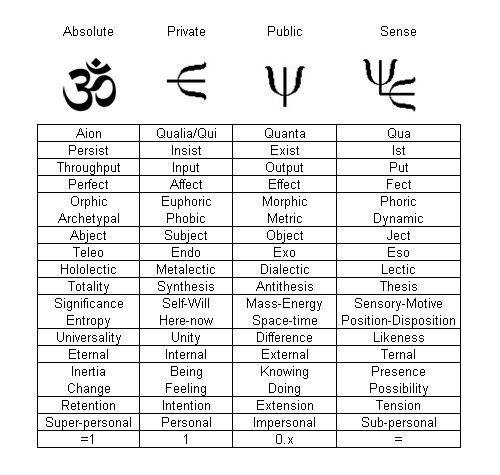
The Multisense Realism perspective is grounded in a philosophy of science which seeks to be more objective about objectivity itself. In Western models of consciousness, experience is generated by the objective mechanism, the forms and functions of the brain. As a result, the subjective experience itself, which does not seem mechanically necessary, becomes orphaned. I have heard it referred to as an illusion, an emergent property, epiphenomena, or even a spandrel (evolutionary side effect which plays no role in further developments). These kinds of terms are necessary to overlook the dualism which mechanemoprhism creates. It is a way of silencing or explaining away the very phenomenon which give rise to the inquiry into consciousness in the first place. This phenomenon of human inquiry is very much the opposite of mechanism. It is a personal participation which arises from meaning and motive rather than blind energy. It is a ‘Why?’ as well as a ‘How’.
When we, as upstanding citizens of the Western scientific consensus, mechanemorphize ourselves it is because we are considering only the public facing aspects of {the total phenomenon that we are} and finding them mechanistic. The conjecture of MSR is that because consciousness is more likely to use mechanism for differentiation and extension than machines are to use consciousness for anything (why would they?), we should not assume the public presentation of our own mechanism is the fundamental phenomenon. MSR suggests that perceptual relativity itself, the sense of the contrast between private qualia and public quanta, is in fact the most likely universal primitive. While human perception may be local to this planet during a relatively short era, perceptual relativity as a phenomenon is larger, older, and more universal than physics. Mechanism must be learned. Feeling and being is innate.
If we examine the nature of mechanism carefully, we should see that the essence of mechanism is unconsciousness. What is an automaton? What does it mean to automate a process? It means that we squeeze out all requirements for our own participation. It is a function which happens without us.
Why is that important? Because a machine will serve whatever master that it is constructed to serve. It will do the same thing over and over until it breaks, because it can’t tell the difference and it can’t care. The machine itself {the totality of the phenomenon that is the machine} has no presence as a genuine whole which is independent of our expectations of it. Outside of our uses of it, it is only an assembly of unrelated parts.
Natural phenomena are not assembled unconsciously, they are spun off and broken out from larger wholes. They are conceived through fusion and fission of their own sense and motive. As a result, the awareness of something like a human being, which is self-elaborated to an almost perverse degree, has a footprint in many different levels of awareness and interaction. While the public effect of what we are seems mechanistic to us, the private affect of who we are does not seem that way. If we were to recreate the universe and we wanted to recreate it faithfully, we would have to include this non-mechanistic experience, as it is the primary experience of the universe for ourselves, and perhaps for all participants in the universe as well.
To say that someone is ‘robotic’, or ‘acting like a machine’ is to say that they are impersonal, cold, relentless, unfeeling. These meanings are not there by accident, they are universal intuitions. As impartial scientists, we should recognize that it is no more scientific to presume that the universe is fundamentally mechanistic than it would be to presume that it is fundamentally anthropomorphic. We have many indications in non-ordinary consciousness, the placebo effect, quantum mechanics, synchronicity, and the anthropopological universality of spiritual concepts that objectivity is not a matter of what “simply is” but may in fact be, on a more primitive level, the complex interplay of “what seems to be the case”. There is no evidence that this ‘seeming’ can be taken for granted in a physical or mathematical system. There is no argument that I know of which should persuade a neutral party why mechanemorphism deserves more consideration than anthropomorphism as a default ontological assumption. Instead, MSR argues that this contrast of extremes known as anthropomorphism and mechanemorphism are a clue as to the template of the underlying nature of nature – that it is in fact an aesthetic agenda from which human subjectivity is directly descended.
 Multisense Realism
Recent Comments