Archive
Book Discussion: Aping Mankind (part one)

I have been reading Raymond Tallis’ Aping Mankind: Neuromania, Darwinitis, and The Misrepresentation of Humanity. I have not quite finished it yet but I wanted to post this while it is still fresh.
His critique of contemporary models of consciousness so exactly aligned with my own that I am glad that I did not read the book until now because I would have thought that I had lifted my entire opinion from his. Tallis sees with the same crystal clarity how neurology and evolution fail completely to address the fact of conscious experience itself. He uses some of the same terms I do, pointing out as I often do that a “re-presentation” can only exist as a way of transferring or transmitting a presentation and cannot itself replace the presentation.
The first half of the book makes the same case that I do for consideration of human experience as a completely different phenomenon from either Darwinian evolution (which he and I both respect completely in its original sense as pertaining to natural selection for species development, and the extension into heredity by genetic probability), neuroscientific materialism, or information-theoretic idealism.
Yes – I agree that consciousness is neither information, function, nor matter.
Yes – I agree the human consciousness may be fundamentally different from other species.
Yes – I agree that the compulsive overconfidence in evolution and neuroscience to explain human consciousness is misguided and ultimately pathological if taken literally (as he says, ‘Darwinitis’ and ‘Neuromania’)

Yes – I strongly agree with his characterization of exactly how the resultant philosophy of this amounts to closing the door on the validity of experience. The similarity between his “disappearance of appearance” (p. 140-145) to my “De-presentation” convinces me that we both see the Emperor’s New Clothes aspect of all of this in the same glaringly-obvious way. We both understand that despite the dismissive assurances, there is an unbridgeable chasm between what neural activity actually is and what it is supposed to produce (qualia, intention).
With the author’s medical background, I appreciate his critique of neuroscientific epistemology. While I’m not qualified to give an opinion on that, I do see his point that the success of neurological mapping of consciousness may be closer to a modern descendant of phrenology than we are led to believe.
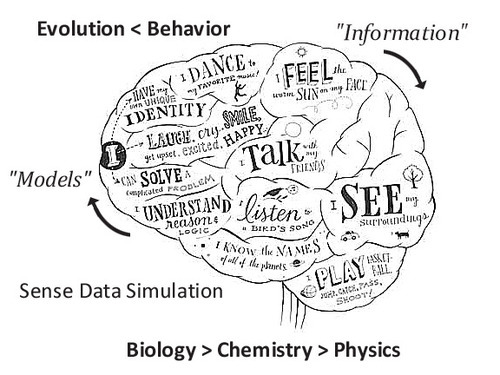
It does seem hard to justify the redundancy and ambiguity of neurotransmitter roles in the presumed functioning of consciousness. If I asked what neurotransmitter is most responsible for generating the feeling of reward, there doesn’t seem to be any that do not qualify. Arousal and reward applies equally to the Noradrenaline, Dopamine, and Cholinergic systems, with the Serotonin system’s correlation to “mood” easily applicable. If neuroscientific correlations with conscious experience were put up against pseudoscientific correlations I wonder how they would fare? How many scientists would submit to a reality show exhibition of medical vs astrological predictions like “Are You Smarter Than A Telephone Psychic?”
Not to diminish the medical application of neuroscience, but when it comes to stepping up to a theory of emotion and sensation, isn’t it a case of the pot calling the kettle unfalsifiable? Are we using fMRI’s and EEGs as a kind of occidental neuromancy – oracles of disorientation? Is the foundation of the neuron doctrine a placebo for scientists? I submit that any given group of ordinary people interpreting a canned astrological reading (or I Ching, numerology, etc), would have a similar level of consensus in a blind test against a group of neuroscientists trying to extrapolate character and destiny information from neurophysiological reports. Medical conditions, sure, but I would bet that when stacked up against Myers-Briggs or any kind of intuitive reading, the neuroscience is measurably more blind for predicting ordinary human personality characteristics.
When it comes to evolutionary genesis of consciousness, Tallis and I are also on the same page.
Think, after all, what unconscious mechanisms have actually achieved: the evolution of the material universe; the processes that are supposed to have created life and conscious organisms; the growth, development and most of the running of even highly conscious organisms such as ourselves. If you had to undertake something really difficult, for example growing in utero a brain with all its connections in place – consciousness is the last thing you would want to oversee the task. p. 176
In this light, we can see that consciousness is actually a disability that could only dilute the speed and efficiency of an automatic mental mechanism. In our weakness and prevarication, we waste precious time in making up our minds when a pure computation would simply yield the most probable success outcome and execute behavior accordingly.
He sees, as I do, that until there is awareness, what is the point of valuing ‘survival’? Without something to tell the difference between one species and another, what does it matter which invisible forms replace each other at any particular unexperienced time?
Tallis talks about the importance of seeing consciousness from the prospective view rather than the retrospective. Not taking consciousness for granted is the most critical aspect of approaching consciousness – to find consciousness from preconsciousness rather than taking the elements of consciousness for granted in justifying their own appearance. I have been calling this “The Elephant In Every Room” problem, and see it is the most significant hurdle that we face in building a 21st century understanding of consciousness.
I think that rigorously applying the prospect view of consciousness from preconsciousness is the only hope we have of not begging the question of the origin of awareness. Of course we can make a wireframe model of agents and actors operating in a world of interactive shadows (data), but why does this data need “us”? If you have actual information already, why invent some phenomenological layer of illusion and an illusory audience to imagine that it is not a simulation? (at least, until the illusory audience evolves to the point that it can teach itself to think that it is questioning the validity of the simulation…which somehow gives us the power to access another, unsimulated ‘reality’).
In his chapter “Bewitched by Language”, professor Tallis exposes the sentimental bias and wishful thinking behind computational models of intelligence. He gets the Symbol Grounding problem, as did Leibniz in his Windmill Argument and Searle’s Chinese Room thought experiment. (Personally I like my example of the polite trash can that waves ‘THANK YOU’ every time you use it). He sees that information is only real in the context of conscious entities using communication devices, and not a primitive substance of pseudo-substance that haunts the universe from the outside.
While Darwinitis requires its believers only to impute human characteristics to animals (and vice versa), Neuromania demands of its adepts that they should ascribe human characteristics to physical processes taking place in the brain. – p.183
…when you personify the brain and bits of brain, then it is easy to “brainify” the person. – p. 187
The author gives us the best and least understood arguments for the failure of contemporary science to grasp the explanatory gap and hard problem of consciousness. It is interesting then, that out of this perfect and wholehearted agreement, I come to diametrically opposite conclusions than he seems to be coming to – which I will get into in the next post.
In a Nutshell
By request, an attempt to sum up Multisense Realism in jargon-free language:
- The universe will seem to support either faith or reason. Reason requires belief in disbelief and faith requires disbelief in disbelief. In between reason and faith is reality, but neither reason without faith nor faith without reason can make sense of everything. The insistence that it can is ultimately a bias that tends to become crazy and dangerous if acted upon in real life as if it were the whole truth.
- All of the shortcomings of religion and science can be accounted for by each side mistaking objects for subjects and subjects for objects.
- We can fix this by looking at how we look at the universe, so that we take our own experience more literally and physical existence more figuratively. Photons become nothing but atomic experiences. Consciousness becomes the physical inertia of events which tie body, brain, world, and lifetime together.
- Consciousness is what divides the universe into symmetrical parts. It separates being, doing, and time from matter, energy, and space. This division makes it so that the former are presented as interior and ranging widely in quality, realism, and meaning while the latter is presented as exterior, real, and meaningless.
- This division replaces the idea of the Big Bang as an event in time and space, so that the Big Bang is the division of the universe into subjective times in objective places.
- The symmetry is not limited to subjective and objective groupings, so that consciousness can be used to focus on many different ways of making sense of itself and the universe.
Panpsychism Refutation Refuted
From Panpsychism thread on Quora
All arguments in favour of panpsychism emanate from the “comprehending mind”. They are the equivalent of a corrupt programme analysing itself for corruption. The corruption resides in the analytic tools so all results are suspect. There are many arguments in favour of panpsychism, as Paul King and Craig Weinberg have noted, but these arguments absolutely depend on a comprehending mind comprehending itself and becoming entangled with not-self. No external arguments support panpsychism. We can see that complexity throws up unexpected results. Consciousness is an unexpected and counterintuitive result of complexity. We simply don’t understand its genesis. But. The alternative is to suppose that nothing exists until you discover it (there was no gravity until Newton was hit by an apple). That is an absurd position. Panpsychism is a semantic byproduct of thought.
The fantastic thing about sense is that everything in the universe, including the universe itself, makes sense in more than one way. Your argument is completely sensible, and I know first hand because I made sense of things that way for most of my life. At some point, however, I discovered that there was a different way to look at it that makes more sense. Consider the following:
If arguments for panpsychism depend on a comprehending mind comprehending itself like a corrupt program analyzing itself, then arguments against panpsychism depend on the same thing: A bug-ridden debugger debugging itself.
“No external arguments support panpsychism. We can see that complexity throws up unexpected results.”
First of all, I’m not sure what an external argument is. All human arguments begin and end in the ‘comprehending mind’ of the human having them. Evidence from outside of our bodies for things that relate to objects outside of our minds, sure, absolutely. But there is no external evidence of consciousness to begin with. You can’t prove to me that you exist and feel like a person.
Panpsychism (or panprotopsychism) explains this surprisingly well. It’s because evidence is an experience within consciousness and not the other way around (please see my ‘pencil-in-water’ rebuttal: http://www.quora.com/Craig-Weinberg/Consciousness-Insights/160835). You can generate complexity given awareness, but without awareness as an a priori possibility, complexity cannot even generate complexity. Something needs to feel or experience something in order for there to be a difference between simple and complex in the first place. Complexity may throw up results that defy our expectations, but they don’t defy the universe’s expectations if you deny awareness as a primordial ground of being to have expectations within.
“Consciousness is an unexpected and counterintuitive result of complexity.”
Complexity itself is utterly sterile. Without awareness, no amount of stacking of uniform bricks will result in anything other than bricks. Without some form of pattern recognition, we cannot say even how many bricks there might be, what size they are, how long they have been sitting there, etc. There is really no difference between anything and nothing without pattern and experience.
“We simply don’t understand its genesis”
For the same reason that we don’t understand a square circle. Consciousness has no cause, causality is dependent upon experience, memory, and analytical associations among remembered experiences. Without any of those, the universe could only be a single instant of inchoate fragments. To say that we haven’t figured out its genesis yet is to my mind now, a naive assertion of religious faith – wishful thinking in the supremacy of Enlightenment Era approaches to science.
“The alternative is to suppose that nothing exists until you discover it (there was no gravity until Newton was hit by an apple). That is an absurd position.”
No, that is not the only alternative, and yes that position is absurd. It makes the hasty supposition of conflating human consciousness with awareness in general. When applied to criticism of panpsychism, this is a fallacy of begging the question since the panpsychic proposition is itself that awareness is a property that is irreducibly present in the universe, and for me, more importantly *as* the universe. You have to take the next step and realize that even though it wasn’t Newton, there was some first something (an atom? star? spacetime? the singularity?) that experienced gravity, and yes before that experience, gravity as we know it did not exist.
“Panpsychism is a semantic byproduct of thought.”
So are functionalism and materialism. Panpsychism addresses the universe directly, from the inside out. It begins with the Cartesian certainty, that if anything exists for sure around here, it is me. We cannot question that because it will only be ourselves doing the doubting. Only after having faith in our own sense, can we trust ourselves to make sense of empirical evidence from the world of our body. We see people get shot in the head and die. This gives us good reason to believe that a human mind supervenes on a human brain. In the last 500 years we have taken that kind of faith in matter to the extreme. It definitely works on a gross material level…at least until you start choking on the industrial and social backlash.
Now we stand poised on the edge of a next age of Enlightenment. This time the transition may be much more precarious than the last, as unlike in the 17th century, the discoveries are not in-your-face experimental demonstrations of principles that have a chance at shaking bright people out of their religious ignorance. This time, the 21st century discoveries may have to be reinterpretations of what we already thought we understood. We have to face the reality of a world, not that we bring into existence, but which has been brought into existence through billions of years of sense experience on different scales, and which anticipates a temporal unity in which all of those years and all that are to come are but a single moment of totality. This tension, between the retrocausality of the eternal now and the feed forward sense of linear causality, are, I think, where consciousness ‘comes from’. It is not panpsychism that is semantic, it is the entire universe. A sense of significance which divides itself into insignificant fragments which return back to their source on their own. A respiration meta-cycle of meaning and entropy oscillation. Thought is the product of panpsychism. Sense does not emerge from nonsense.
Bent Pencil
“Let us consider the pencil-in-water example. The representation of the pencil in your head is bent. The real pencil is not bent. That which misrepresents reality is, by definition, wrong.”
That is right in one sense, but only when you extend your naive realism (the pencil looks bent) to additional levels of biased realism (I can tell that it only looks bent, and I understand that it is possible for things to seem one way in one sense and a different way in another sense).
What this means is that when you say “The real pencil is not bent. That which misrepresents reality is, by definition, wrong.” you assume that there is a “real pencil” based purely on the bias of perceptual capacities of your human body. Your psychological capacities elevate that low level perception to a more subtle level of interpretation (which is still a form of perception of perception) in which you can entertain a difference between a real pencil and a visual appearance.
I submit that the bent pencil is, in a sense, a much more ‘real’ pencil than the understood straight pencil in that it reflects not only the distant object of physical surfaces of a pencil and water, but it conveys a condensed encyclopedia on optics and perception which lead directly to discoverable neurological truths.
It is the simplistic interpretation of a literal reality that ‘simply is’, independent of a perceptual experience of that reality which seems to be a misrepresentation of reality.
That’s right. Fiction is primordial, fact is contrived.
Philosophy of Mind Reblog
Reblogging a post on consciousness that I like, and trying to chart a course from it’s logical conclusion to one which I think makes more sense.
omegaphilosophia: Utilize Philosophy: On Consciousness
Our method for perceiving objects is to look upon them from the outside of them, though granted we may perceive the innards of an object, but even then we are outside the innards looking upon them. However, for ourselves, we appear to be an object inside our bodies looking outwards at phenomena….
Ah, so close. I love what he has done with explaining how even the innards of objects are really still just the outside of smaller objects. The snag comes toward the end, and this is the snag that I think most people encounter with consciousness, and that is taking awareness or sense for granted. The OP writes:
Let us return to the basic description of consciousness, which is “awareness of one’s own existence.”
I disagree here, and it is a subtle but critically important point. Consciousness is awareness period. ‘One’s own existence’ is part of the contents of experience. I can dream without the existence of a self or a dreamer. I can watch movies and be immersed in the story and world of the movie without being conscious of my own existence.
If the consciousness is an object that looks upon other objects from the inside of some object, how is it aware of its own existence?
It’s not an object. It’s the opposite. I would say that it is a subject but it’s not even that…consciousness is the source of subjectivity – the capacity for awareness itself. It is the non-object which contains (metaphorically) all subjects.
How is it aware of it’s existence? Through sense. Our sense ‘insists’ that we be made aware of influences which are potentially significant to ourselves, our body, our social group, our species, etc. Sense is the bridge between the self and the universe, but sense is also the continuum which manifests as self, universe, and the anomalous symmetrical continuum between them.
For consciousness appears to be aware of many objects, but none of them can firmly be considered consciousness. And consciousness doesn’t seem to possess the ability to look upon itself, and if it has, how will we know?
“How will we know?”, again, through sense. Truth makes sense. That’s how we can know anything, and there is no other way that anything has ever known anything. Knowledge is nothing but an agreement of multiple sense-making channels which convinces or fails to convince the executive senses (self) to internalize that agreement.
We become aware of the existence of other objects, physical or mental, by a perception of them. However, we claim such a thing as consciousness exist, without having any perception of such a phenomena;
If it helps, don’t think of consciousness as something that exists, but something that insists. Existence is a subset of insistence. We are a mind in a brain, but the only way we know what a brain is and how it might work are through the mind. It’s a Mobius loop of involuted, self-referential, redundantly redundant ontology (see also).
for we can not perceive consciousness physically nor mentally.
This is the trap of disorientation. It is overthinking it to try to perceive perception. Sense is the bottom layer, there is no description level beyond that as consciousness contains description itself. It is to say ‘I can’t move my arm because I can’t perceive how exactly I do that’. Right. That’s because it’s actually your arm. You just move it directly. No mechanism is required subjectively for you to move it – it’s like The Force…”reeach out with your feelings Luke”.
how can we claim to know the information we are receiving is true?
We don’t have to. We can say with absolute certainty that is seems true, and that is the epistemological standard for subjectivity, because subjectivity is not an object. It doesn’t work that way. Fact is actually a type of fiction, and fiction is the only fact (ie, existence is a function of perspective, which is a function of detection and response).
My personal fix to this dilemma is to be rid of the concept of consciousness completely.
This is the same solution offered by Daniel Dennett and others as well. It’s sort of setting yourself on fire to make it easier to find wood for the fireplace. How does one have a “personal fix” to “dilemmas” without being conscious?
This, however, would require some alteration to one’s model of reality, particularly a will caused solely by the brain. For we would no longer be able to claim we were in control of our bodies unless when we use the term “we” or “I”, we are referring to our brain.
Not so fast. My interpretation requires a bit more alteration to one’s (now nonexistent?) model of reality. Just because the mind and the brain are the same thing doesn’t mean that the brain is real and the mind isn’t. We command our brain consciously, and our brain commands us as well. We can’t claim that we can no longer claim something if that which we disclaim is the ability to claim anything at all in the first place. We don’t have the power to deny our awareness. It is not an option.
It all comes back to the initial assumptions:
Our method for perceiving objects is to look upon them from the outside of them, though granted we may perceive the innards of an object, but even then we are outside the innards looking upon them.
So far so good…
However, for ourselves, we appear to be an object inside our bodies
No, non, nein, nay, negative…. We have no appearance inside our bodies. We appear to be looking outside of our body, to feel things inside of our bodies with special personal significance that seems close to us, but at no time do we appear to ourselves natively as an object. We can embody objects or characters, or we could try to objectify who we are with terms like soul or essence, but ultimately we are not even that. We are the subject. We insist through time, but do not exist across space. Unsettling, yes, but this is how reality works. If you had to make the universe from scratch, you could not leave this most important feature out – how it feels to participate in a world, how narrative experiences work.
looking outwards at phenomena. This is not only the case for physical phenomena, but also for mental phenomena; for when we utilize the mechanics of imagination, we still appear to be an internal object looking upon some external phenomena (inside ourselves)
Same for dreams and imagination. We aren’t an internal object until we try to label ourselves as such. This is the ‘elephant in every room‘ phenomenon. All you have to do is understand that sense is what allows us to look through the mirror rather than look at just the silvered glass. It allows our subjectivity to extend through matter on many different scales simultaneously, providing discrete access with selective attention even as it condenses all of the meaning in a generalized presentation (I call a perceptual inertial frame, or you might say niche or world).
Once you see how this extension might work, from the figurative through the literal to the figurative, you can perhaps see how the literal and figurative nature of things can only be considered qualities of perception or qualia. What is solid rock for a human being is like a thin fog for a flying neutrino (if there even is such a thing). In the same way, our human thoughts and experiences may seem like evanescent puffs of nothingness fading through ‘time’, on some more inclusive inertial frame may seem like concrete crystalline towers of juicy, aromatic human suffering and joy. Musical monuments of lives being lived in visible 3-D terrain.
Consciousness is a real as a brick or a donkey’s ears. It’s also more than real and less than real, in its super-signifying projections of heroic perfection and fantastic delusions. The contents aren’t always consistent with every other inertial frame we live through. Not everything makes sense on every level. Some shows are just for us personally, and have no value for others or the world at large. Some shows are unreal but we can make them more substantial over time with attention and effort.
Antonio Damasio: The quest to understand consciousness
In this TED Video, about two thirds of the way through, he mentions something I didn’t know about the brain stem which I think supports both the idea of a sense-motive primitive in consciousness, and the idea that consciousness scales relativistically from being to being. He says:
“This is so specific that, for example, if you look at the part that is covered in red in the upper part of the brain stem, if you damage that as a result of a stroke, for example, what you get is coma or vegetative state, which is a state, of course, in which your mind disappears, your consciousness disappears. What happens then actually is that you lose the grounding of the self, you have no longer access to any feeling of your own existence, and, in fact, there can be images going on, being formed in the cerebral cortex, except you don’t know they’re there. You have, in effect, lost consciousness when you have damage to that red section of the brain stem.
But if you consider the green part of the brain stem, nothing like that happens. It is that specific. So in that green component of the brain stem, if you damage it, and often it happens, what you get is complete paralysis, but your conscious mind is maintained.”

I had previously posted this image which correlates the brain-spine morphology with head-tail morphology and implies an underlying isomorphism of concentric-polar or radial symmetry being related to afferent (inbound) perception and linear-projective or Cartesian x,y,z+t sequential relations being associated with outbound, efferent motives.

Even though we are so much larger and more sophisticated than mammalian gametes, this pattern of an active emitter and a passive collector remains surprisingly simple. The upper part of your brain stem gives you access to sense, the lower part lets your motives access your body (and by extension, the world).
As good as Damasio is at revealing the consequences of brain architecture, I think that he, and really everyone else that I have been paying attention to, are still unintentionally sweeping the hard problem under the carpet. In every case, possibility of awareness itself is taken for granted. Patterns have only to be present in the brain for us to assume that there would be some sort of ‘awareness’ of them as patterns and a capacity to ground that awareness somewhere else besides within the tissue of the brain. Sure, once you have a such thing as experience, we can understand how the brain can modulate, suppress, and organize that experience, but there is still no sign of anything that converts such quantitative neurological functions into anything other than what they seem to be in an MRI – groups of cells signalling each other. No different really than any organ except perhaps in sophistication.
To think about consciousness clearly, it is important to recognize the difference between the afferent-efferent (inbound-outbound) form of the communication and the sense-motive (qualia of afferent-efferent) content of experience. It is difficult to break the habit we have been acculturated to of seeing the world outside of our body as being the container of the self rather than the other way around, but with practice, we can begin to see how perception and experience have produced not just one world, but many worlds within worlds.
Chalmeroff Conjectures
Chalmeroff Scale Conjectures
Unity of variables: Degree of figurativeness in qualia equates to privacy of qualia.
- Subjects necessarily have access to more qualia which applies to their autobiographical experience than qualia which refers to external, publicly accessible experience.
- It is proposed that the more strictly personal a quale is, the greater the set of interconnected psychological associations that exists for the individual and the richer and more imaginative those associations can be.
- Mathematically, the more personal an experience is to us, the more ways we can shift its meaning, making qualitative floridity and associative fluidity directly proportional to privacy.
Correlation of figurative phenomenology with signal intensity:
Biological experiences such as satiation of hunger, sexual release, bladder/bowel containment and nausea, are inarguably marked by a stimulation-excitement-climax-refractory period sequence. This pattern seems simple , and is commonly expressed quantitatively in graphs such as these:
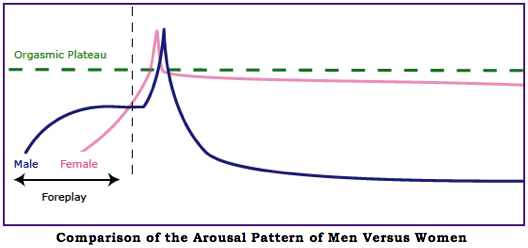
In each of these cases; hunger, sex, excretion, nausea, It is proposed that the amplitude of intensity of affect corresponds with an increase of floridity, fluidity, and privacy of qualia. Feeling is not merely intensified along a one dimensional axis of signal augmentation, but it seems that feelings which build and climax tend to build narrative exaggeration along at the same time, to the point that divinity or vulgarity is stereotypically invoked.
The elevation of affect is experienced increasingly as attraction to a super-signifying apotheosis – presentations of superlative or hyper-aesthetic figures which re-present a relief of the desire in question on the literal level. Our wants and needs are mythologized as archetypal content when gratification is delayed. Our emotions are increasingly accompanied by tantalizing stories we are compelled to tell ourselves in the moment which consume our attention with expectation of satisfaction.
The idea of delaying gratification to amplify appetite for and therefore satisfaction of pleasure is culturally and psychologically ubiquitous. From Tantric yoga to strip tease, appetizers and hyper-aesthetic description writing in menus, musical preludes and introductions, building of suspense in stories, etc the role of temporal extension in all qualitative facets of consciousness is central. The centrality of time rather than space in heightening aesthetic or affect-effect (sense-motive) charge is important to understand the contrasting relation between the private nature of time and the public nature of space.
Prolonging the time for appetite to build makes sense, also in consideration after climax, desire plummets or gradually tapers off. As this happens, our awareness returns from drama filled timeless* states to one of a pedestrian sense of the world (i.e. public spaces/ literal ‘place’), dominated by ordinary literal facts rather than tantalizing images. Counterfactuals to this pattern seem hard to come by. The idea of an experience of climax itself cannot be separated from significance, as deviation from the norm is inherent in the definition of climax. Can you have a condition of climax which is also the norm?
Suggested conclusion: Imagination or plasticity of figurative association may be ontologically bound to both privacy and signal intensity. Within this simple, yet unnoticed commonality can be found the roots of myth and drama. The hero personifies the solitary superlative; a psychopomp who guides the audience through a poetic journey towards a climax, followed by a happy ever after endind that often produces a practical take-away. Call it the Wizard of Oz effect. Whether we see the point of the story as just a lot of colorful fantasy fluff to help us remember that ‘there’s no place like home’ or that the story itself is the point depends on whether we personally favor subjective meaning or objective fact as the more privileged authority
If we consider that consciousness in general can be considered an aggregate of sense-motives, it makes sense that fatigue culminates in involuntary drifting of attention, hypnagogic imagery, and delusional states if prolonged. Dreams themselves are appropriate in sleep as the maximally figurative private detachment from the place where the body literally resides and waking from sleep represents a return to public, literal sensibilities. It is difficult to think of a reason for the metaphorical nature of dreams in terms of evolutionary biology. The understanding of how sense-motive significance builds into intensified private narrative can help bridge the gap between neurological circuits and perceptual realism.
On the outermost cycle of human experience, the human lifetime is marked typically by a reversal of this pattern. ‘Growing up’ is nearly synonymous with a tapering or rapid falling off of subjective ideation to be replaced by adult senses and motives of relating to practical circumstance in the world of the body. Childhood is understood to be a time of solipsistic fantasy, high sensitivity, high kinetic activity; like dreams or desires, childhood seems to hint at paradoxical reconciliation of fleeting time and timeless eternity. Old age in some ways mirrors this progress with retreat into the self.
*Subjective experience of time during peak stimulation seems to push toward the paradoxical: an instant that feels like eternity
Proposed unit of subjectivity: The Chalmeroff
The Chalmeroff is conceived as a unit of experiential privacy, and therefore qualitative depth of experience, such that ‘one Chalmeroff’ (1Ch) represents the largest conceivable inertial frame* of all possible qualitative experience – the qualitative monad or singularity of meta-sense** from which all qualia are diffracted.
It is proposed that qualia arises from the diffraction of this single, top-down qualitative pool of proprietary significance (think of it as the universe with all of the time and space vacuumed out of it…literally ‘instant cosmos’) as it organically seeks† to be reflected in its antithesis: bottom-up, quantitative formalism (public quanta), resulting in a range of bi-directional phenomenology:
one to many; private to public motive actions; ‘Ch’
multiplied by many to one; public to private non-motive reactions; ∞Ch
This can be expressed as a formula:
[(Sense + Motive) time = significance || (matter – energy) / space = entropy]²
It is proposed that a quale which exists at the level of infinite diffraction‡ is an absolutely ‘flat’ quale, and therefore a quantum event (minimum bit density of information) and has a maximum Chalmeroff value (infinite Chalmeroff levels: ∞Ch), since the Chalmeroff scale is negatively logarithmic, progressing through regress from the ‘everythingness’ of the Totality/Singularity (TS), which is the absolute largest inertial frame, to the barely-not-nothingness of quantum computation passing through infinite frames of spatiotemporal accumulation of sense-motive inertia reflected as mass-energy.
For instance, does this transmission qualify as an idea in the Chalmeroff range of singular Earthshaking significance (1.x Ch)?, a mediocre and common idea (x kCh)?, an incoherent delusion (x MCh)?, or a meaningless stream of binary data (∞Ch)? That the answer to these questions is subjective underscores the essential role of participation in qualitative experience. Sense that is not anchored in participation cannot authentically generate its own motive.
Sense-motive² → ‘istance’, istance² → meta-istance (awareness of istance) → that which weaves an inertial frame. Inertial frames are accumulated through spatio-temporal ingress which divides and multiplies the Chalmeroff TS into units. Ch→Hz (t). Frames are nested within one another so that relativity shapes foreground and background orientation by figurative frequency and literal scale.
*inertial frame in both the general relativity sense and a new proposed ‘panexperiential special relativity’.
**technically ‘sense’ here stands for meta ‘sense+motive’, ie, the qualia of afferent, received insistence plus efferent, projection toward existence.
† seek = motive
‡ microcosmic exhaustion of granularity. Call it a ‘Planck-Turing’ limit.
On Computationalism and Qualia Depth
On Computationalism and Qualia Depth
I conclude that Computationalism is almost correct, but because of the nature of consciousness, that means it is exactly incorrect. It is rooted in the seduction of ‘information’ as a concrete pseudosubstance. I think that arithmetic is the ‘flattest’ qualia that we can access, and therefore the most externally universal. Its universality gives us a wide capacity to mechanize objects but assembling machines from parts is the opposite of an organism, which organically divides from a whole.
Human consciousness, by comparison, is a towering accumulation of experiential ‘residues’, or perceptual inertia which I understand to be negentropy or significance; a concentration of qualitative richness. Interior phenomenology cannot ex-press its proliferation as increasing sophisticated forms nested in space, so it impresses itself as increasingly meaningful experiences, themes, and narratives. Not merely more complex or sophisticated, but seemingly more important and more real.
Computationalism leans almost exclusively on complexity (as a machina ex deus if you will) to impress itself into overlooking the impossibility of forms in space generating meaningful experience through time. What it fails to understand is that the richness of qualia is not complex, it is simple. Blue is blue. Pain is pain. There is no Fourier transform required to appreciate them. The key is to understand the symmetry:
(Sense + Motive) time = significance || (matter – energy) / space = entropy
Just as evolutionary biology grew the brain faster than the skull to cause cortical folding, the corresponding subjective capacity became exponentially more aesthetic. The will became more insistent on projecting itself externally. We became human.
Integrating Will Into Physics
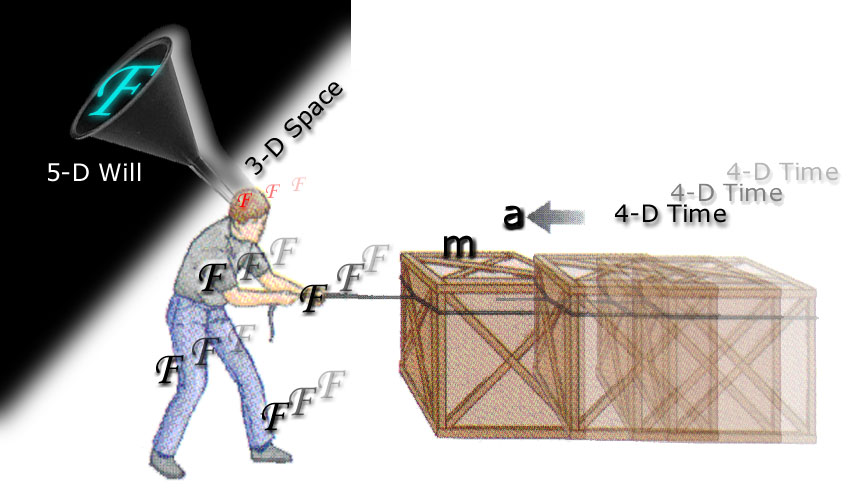
Another stab at describing the idea I was talking about in this post. Trying to get across the notion that will or motive begins as a five dimensional feeling (relative to a 3+1 dimensional physical exterior universe). Five dimensional because a single intention (here represented by a blue glowing F*) spans an entire intentional gesture. The intentional gesture can be thought of as being squeezed through a figurative funnel which condenses the subjective impulse from 5-D to 4-D. The impulse to exert effort extends beyond the Cartesian space and time vectors with qualitative experience.
Like the fourth dimension of time, feeling is independent of the other dimensions. A 2-D cartoon does not need to turn into a 3-D sculpture to exist in time. Time is understood then as a fourth dimension but not the fourth dimension. Feeling works the same way, it is another first dimension, so that it charges times, places, objects etc with a non-computational, qualitative significance. This significance has it’s own properties which makes sense of massive computations in terms of unique and concrete sensorimotive phenomenology. A 5d quality like ‘pain’ is in some way the same but in some way specific to each individual type of painful experience and each instantiation of that experience.
By reversing this many-to-one figurative sensitivity to qualia, we can model a one-to-many literal projection of will. Our method of output, will or attention, is an all purpose qualia of engaging our active participation in the narrative of our life. One form of stimulation which we apply to everything we ‘try’ and ‘do’.
Getting this feeling out of our heads and into the world of our body entails something like a parallel to serial signal translation. The intention which arises from the cumulative entanglement of a lifetime of experience and outcomes, has no meaningful 3-D expression on it’s own. All you can see from the outside is (represented by the red F’s in the subject’s head) would be 4D electromagnetic patterns in the 3D brain. These patterns form 4-D chain reactions across 3-D tissues, limbs, and finally objects. The decision to initiate this whole chain reaction however, is not accessible from the outside. The ‘why’ is a single top-level conscious impulse which, like Mass exploding into energy, explodes into many simultaneous and sustained ‘what’ and ‘how’ events of mass acceleration…different ‘where’ and ‘when’ coordinates in time space, etc.
*Blue F = Subjective sensorimotive stimulation to pull the crate.
Red Fs = Electromagnetic view of the Blue F. What is lost in 5d figurative significance is gained in 4d linear, literal power.
Black Fs = Force. Tension applied to the crate by muscle fibers, bone, rope, etc.
m = mass of the crate
 Multisense Realism
Recent Comments