Archive
Consciousness can be mindless, but Mind cannot be unconscious
The mind is the cognitive range of consciousness. Consciousness includes many more aesthetic forms than just mind.
Consciousness and The Interface Theory of Perception, Donald Hoffman
A very good presentation with lot of overlap on my views. He proposes similar ideas about a sensory-motive primitive and the nature of the world as experience rather than “objective”. What is not factored in is the relation between local and remote experiences and how that relation actually defines the appearance of that relation. Instead of seeing agents as isolated mechanisms, I think they should be seen as more like breaches in the fabric of insensitivity.
It is a little misleading to say (near the end) that a spoon is no more public than a headache. In my view what makes a spoon different from a headache is precisely that the metal is more public than the private experience of a headache. If we make the mistake of assuming an Absolutely public perspective*, then yes, the spoon is not in it, because the spoon is different things depending on how small, large, fast, or slow you are. For the same reason, however, nothing can be said to be in such a perspective. There is no experience of the world which does not originate through the relativity of experience itself. Of course the spoon is more public than a headache, in our experience. To think otherwise as a literal truth would be psychotic or solipsistic. In the Absolute sense, sure, the spoon is a sensory phenomena and nothing else, it is not purely public (nothing is), but locally, is certainly is ‘more’ public.
Something that he mentioned in the presentation had to do with linear algebra and using a matrix of columns which add up to be one. To really jump off into a new level of understanding consciousness, I would think of the totality of experience as something like a matrix of columns which add up, not to 1, but to “=1”. Adding up to 1 is a good enough starting point, as it allows us to think of agents as holes which feel separate on one side and united on the other. Thinking of it as “=1” instead makes it into a portable unity that does something. Each hole recapitulates the totality as well as its own relation to that recapitulation: ‘just like’ unity. From there, the door is open to universal metaphor and local contrasts of degree and kind.
*mathematics invites to do this, because it inverts the naming function of language. Instead of describing a phenomenon in our experience through a common sense of language, math enumerates relationships between theories about experience. The difference is that language can either project itself publicly or integrate public-facing experiences privately, but math is a language which can only face itself. Through math, reflections of experience are fragmented and re-assembled into an ideal rationality – the ideal rationality which reflects the very ideal of rationality that it embodies.
Deepak Chopra Responds to Pseudoscience Allegations
Deepak Chopra Responds to Pseudoscience Allegations
Another battle of the worldviews thread I have wound up in.
Immediation Riff
One of the trickiest hurdles to get around in considering consciousness is the assumption of qualia as a medium for communication. It is a natural mistake, particularly in the contemporary media-saturated culture which we inhabit, to see our visual experience as a kind of neurologically generated video screen, and our feelings and thoughts as the user level output of the brain’s biochemical computations.
There are two problems with this – one is that it cannot be true, and the second is that it may not be possible for everyone to understand why it cannot be true. The second problem is perhaps the most debilitating, as any argument I can give will be preaching to the choir for those who understand and will not make much sense to those who don’t (or can’t). After so many long debates with people who do not understand why it is impossible to have representation without presentation, or why it makes no sense to put a beautiful dashboard inside a computer driven car, I can say that I have still never seen it happen that someone is able to suddenly or even gradually ‘see the light’. Like gender preference, handedness or the ability to see Magic Eye 3D images, the trait of being able to conceptualize the irreducibility of qualia appears to be innate rather than learnable. There may be exceptions, but for the most part, people who are very interested in scientific approaches to consciousness are fixated on consciousness as a medium through which zoologically relevant facts are communicated, rather than the pervasively immediating pansensitivity that we call reality.
To be clear, human consciousness is not immediate relative to all other scales and layers of consciousness. Our personal awareness is mediated by countless other sub-personal micro sensitivities and super-personal meta-sensitvities, but every sense context is also irreducible on its own level. Every sensation is a direct participation with all that is. While it is true that our personal experience acts to mediate these other levels of experience, the last mile can only be immediate. If that were not the case, then there would have to be an infinite regress of translators and sub-translators, Cartesian theaters and their homuncular audiences, etc. It some point something has to feel something directly.
Related to this immediation is the idea of the Absolute. The Western view does not grasp the idea of unbound unity. The notion of a singularity is astrophysics in astrophysics and in futurism, but the connotation is mathematical rather than absolute. To understand sense as the Absolute, it must be conceived of as not merely the ‘one’ thing, but ‘the only thing’. Not isolated, but whole. The monad has no windows, not because it is alone but because eternal totality is already within ‘it’. It the same time, the Absolute is ‘solitrophic’ – it builds on its sensitivity to achieve saturation: significance. How can a complete whole build on itself? By restraining itself with its own pantomimed absence. This is spacetime, entropy, attenuation of sense. The catabolic reflection of significance. What feels is juxtaposed against presentations of unfeeling. It is through this alienation or diffraction that we get the appearance of matter and mechanism, as the immediacy of pansensitivity is mediated through metric relativity. Private unity is reflected as public multiplicity, and quality is re-presented through the reductive filter of quantity.
Consciousness, in Black and White
It occurs to me that it might be easier to explain my view of consciousness and its relation to physics if I begin at the beginning. In this case, I think that the beginning was in asking ‘What if the fundamental principle in the universe were a simple form of awareness rather than something else?’
Our choices in tracing the lineage of consciousness back seem to be limited. Either it ’emerged’ from complexity, at some arbitrary stage of biological evolution, or its complexity evolved without emergence, as elaboration of a simple foundational panpsychic property.
In considering which of these two is more likely, I suggest that we first consider the odd, unfamiliar option. The phenomenon of contrast as a good place to start to characterize the theme of awareness. Absolute contrasts are especially compelling. Full and empty, black and white, hot and cold, etc. Our language is replete with evidence of this binary hyperbole. Not only does it seem necessary for communication, but there seems also to be an artistic satisfaction in making opposites as robust as possible. Famously this tendency for exaggeration clouds our thinking with prejudice, but it also clarifies and makes distinction more understandable. In politics, mathematics, science, philosophy, and theology, concepts of a balance of opposites can be found as the embodiment of its essential concepts.
For this reason alone, I think that we can say with certainty that consciousness has to do with a discernment of contrasts. Beneath the linguistic and conceptual embodiments of absolute contrasts are the more zoological contrasting pairs – hungry and full, alive and dead, tired and alert, sick and healthy, etc. At this point we should ask, is consciousness complex or is it simple? Is the difference between pain and pleasure something that should require billions of cellular interactions over billions of years of evolution to arrive at accidentally, or does that seem like something which is so simple and primordial that nothing could ever ‘arrive’ at it?
Repetition is a special form of contrast, because whether it is an event which repeats cyclically through a sequence or a form which repeats spatially across a pattern, the underlying nature of what repeats is that it is in some sense identical or similar, and in another sense not precisely identical as it can be located in memory or position as a separate instance.
I use the phrase “repeats cyclically through a sequence” instead of “repeats sequentially through time” because if we take our beginning premise of simple qualities and capacities of awareness as preceding even physics, then the idea of time should be grounded in experience rather than an abstract metric. Instead of conceiving of time as a dimension in which events are contained, we must begin with the capacity of events to ‘know’ each other or in some way retain their continuity while allowing discontinuity. An event which repeats, such as a heartbeat or the circadian rhythms of sunlight, is fundamentally a rhythm or cycle. That is the actual sense experience. Regular, frequent, variation. Modulation of regularity.
Likewise, I use the phrase “repeats spatially across a pattern” instead of “repeats as a pattern across space” because again, we must flip the expectation of physics if we are to remain consistent to the premise of sense-first. What we see is not objects in space, it is shapes separated by contrasting negative shapes. What we can touch are solids, liquids, and gases separated from each other by contrasting sense of their densities. Here too, the sense of opposites dominates, separating the substantial from the insubstantial, heavy from light, hard from soft.
An important point to make here is that we are adapted, as human beings with bodies of a particular density and size, to feel the world that relates appropriately to our body. It is only through the hard lessons like plague and radiation that we have learned that indeed things which are too small for us to see or feel can destroy our bodies and kill us. The terror of this fact has inspired science to pursue knowledge with an aggressive urgency, and justifiably so. Scientists are heroes, informing medicine, transportation, public safety, etc as never before in the history of the world and inspiring a fantastic curiosity for knowledge about reality rather than ideas about God or songs about love. The trauma of that shattering of naive realism haunts our culture as whole, and has echoes in the lives of each generation, family, and individual. Innocence lost. The response to this trauma varies, but it is hard to remain neutral about. People either adapt to the cold hard world beyond themselves with fear or with anger. It’s an extension of self-consciousness which seems uniquely human and often associated with mortality. I think that it’s more than confronting their own death that freaks out the humans, it’s the chasm of unknowable impotence which frames our entire experience on all sides. We know that we don’t really know.
The human agenda becomes not merely survival and reproduction, but also to fill the existential chasm with answers, or failing answers, to at least feel fulfilled with dramatic feelings – with entertainments, achievements, and discoveries. We want something thrilling and significant to compensate for our now unforgettable discovery of our own insignificance. With modernism came a kind of Stockholm syndrome turn. We learned how to embrace the chasm, or at least to behave that way.
At the same time that Einstein began to call the entire foundation of our assumptions about physics into question, the philosophy of Neitzsche, along with the science of Darwin and Freud had begun to sink in politically. Revolutions from both the Left and Right rocked the world, followed in some nations by totalitarianism and total war. The arts were transformed by an unprecedented radicalism as well, from Duchamp, Picasso, and Malevich to Stravinsky and Le Corbusier. After all of the pageantry and tradition, all of the stifling politeness and patriarchy, suddenly Westerners stopped giving a shit about the past. All at once, the azimuth of the collective psyche pitched Westward all the way, toward annihilation in a glorious future. If humans could not live forever, then we will become part of whatever does live forever. The human agenda went transhuman, and everyone became their own philosophical free agent. God was indeed dead. For a while. But the body lives on.
The point of this detour was to underscore the importance of what we are in the world – the size and density of our body, to what we think that the world is. Not only do we only perceive a narrow range of frequencies of light and sound, but also of events. Events which are too slow or too fast for us to perceive as events are perceived as permanent conditions. What we experience exists as a perceptual relativity between these two absolutes. Like the speed of light, c, perception has aesthetic boundaries. Realism is personal, but it is more than personal also. We find agreement in other people and in other creatures which we can relate to. Anything which has a face earns a certain empathy and esteem. Anything that we can eat has a significance to us. Sometimes the two overlap, which gives us something to think about. Consciousness, at least the consciousness which is directed outwardly from our body, is all about these kinds of judgment calls or bets. We are betting that animals that we eat are not as significant as we are, so we enjoy eating them, or we are betting that such a thought is immoral so we abstain. Society reflects back these judgments and amplifies them through language, customs, belief systems, and laws. Since the modernist revolution, the media has blanketed the social landscape with mass production of cliches and dramatizations, which seems to have wound up leaking a mixture of vanity and schadenfreude, with endless reenactments, sequels, and series.
It is out of this bubble of reflected self-deflection that the current philosophies rooted in both reductionism and emergentism find their appeal. Beginning with the assumption of mechanism or functionalism as the universal principle, the task of understanding our own consciousness becomes a strictly empirical occupation. Though the daunting complexity of neuroscience cannot be overstated, the idea is that it is inevitable that we eventually uncover the methods and means by which data takes on its fancy experiential forms. The psyche can only be a kind of evolutionary bag of tricks which has developed to serve the agenda of biological repetition. Color, flavor, sound, as well as philosophy and science are all social peacock displays and data-compressing virtual appendages. The show of significance is an illusion, an Eloi veneer of aesthetics over the Morlock machinations of pure function.
To see oneself as a community of insignificance in which an illusion of significance is invested is a win-win for the postmodern ego. We get to claim arbitrary superiority over all previous incarnations, while at the same time claiming absolute humility. It’s a calculated position, and like a game theory simulation, it aims to minimize vulnerability. Facts are immutable and real, experiences are irrelevant. From this voyeuristic vantage point, the holder of mechanist views about free will is free to deny that he has it without noticing the contradiction. The emergent consciousness can speak glowingly out of both sides of its mouth of its great knowledge and understanding in which all knowledge and understanding is rendered void by statistical mechanics. Indeed the position offers no choice, having backed itself into a corner, but to saw off its own limbs with one hand and reattach them with another when it is not looking.
What is gained from this exercise in futility beyond the comfort that comes with conformity to academic consensus is the sense that whatever happens, it can be justified with randomness or determinism. The chasm has been tamed, not by filling it in or denying it, but by deciding that we are simply not present in the way that we think. DNA acts, neurons fire, therefore we are not thinking. Death is no different than life which has paused indefinitely. An interesting side effect is that as people are reduced to emergent machines, machines are elevated to sentient beings, and the circle is complete. We are not, but our products are. It seems to me the very embodiment of suburban neuroses. The vicarious society of invisible drones.
Just as 20th century physics exploded the atom, I would like to see 21st century physics explode the machine. Instead of releasing raw energy and fragmentation, I see that the blasting open of mathematical assumptions will yield an implosion into meaning. Pattern recognition, not information, is the true source of authenticity and significance. They are the same thing ultimately. The authenticity of significance and the significance of authenticity speak to origination and individuation over repetition. Not contrast and dialectic, not forces and fields, but the sense in which all of these facets are yoked together. Sense is the meta-syzygy. It is the capacity to focus multiplicity into unity (as in perception or afference) and the capacity for unity to project into multiplicity (participation or efference).
These are only metaphorical descriptions of function however. What sense really is and what it does can only be experienced directly. You make sense because everything makes sense…in some sense. That doesn’t happen by accident. It doesn’t mean there has to be a human-like deity presiding over all of it, to the contrary, only half of what we can experience makes sense intentionally, the other half (or slightly less) makes sense unintentionally, as a consequence of larger and smaller sequences which have been set in motion intentionally. We are the evidence. Sense is evident to us and there is nothing which can be evident except through sense and sense making.
Quora: What effect has the computer had on philosophy?
Quora: What effect has the computer had on philosophy?
What effect has the computer had on philosophy in general and philosophy of mind in particular?
Obviously, computing has facilitated a lot of scientific advances that allow us to study the brain. e.g., neuroscience research would not exist as it does today without the computer. However, I’m more interested in how theories of computation, computer science and computer metaphors have shaped brain research, philosophy of mind, our understanding of human intelligence and the big questions we are currently asking. (Quora)
I’m not familiar enough with the development of philosophy of mind in the academic sense to comment on it, but the influence of the computer on popular philosophy includes the relevance of themes such as these:
Simulation Dualism: The success of computer graphics and games has had a profound effect on the believability of the idea of consciousness-as-simulation. Films like The Matrix have, for better or worse, updated Plato’s Allegory of The Cave for the cybernetic era. Unlike a Cartesian style substance dualism, where mind and body are separate, the modern version is a kind of property dualism where the metaphor of the hardware-software relation stands in for the body-mind relation. As software is an ordered collection of the functional states of hardware, the mind or self is the similarly ordered collection of states of the brain, or neurons, or perhaps something smaller than that (microtubules, biophotons, etc).
Digital Emergence: From a young age we now learn, at least in a general sense, how the complex organization of pixels or bits leads to something which we see as an image or hear as music. We understand how combinations of generic digits or simple rules can be experienced as filled with aesthetic quality. Terms like ‘random’ and ‘virtual’ have become part of the vernacular, each having been made more relevant through experience with computers. The revelation of genetic sequences have further bolstered the philosophical stance of a modern, programmatic determinism. Through computational mathematics, evolutionary biology and neuroscience, a fully impersonal explanation of personhood seems imminent (or a matter of settled science, depending on who you ask). This emergence of the personal consciousness from impersonal unconsciousness is thought to be a merely semantic formality, rather than a physics or functional one. Just as the behavior of a flock of birds flying in formation can be explained as emerging inevitably from the movements of each individual bird responding to the bird in front of them, the complex swarm of ideas and feelings that we experience are thought to also emerge inevitably from the aggregate behavior of neuron processes.
Information Supremacy: One impact of the computer on society since the 1980’s has been to introduce Information Technology as an economic sector. This shift away from manufacturing and heavy industry seems to have paralleled a historic shift in philosophy from materialism to functionalism. It no longer is in fashion to think in terms of consciousness emerging from particular substances, but rather in terms of particular manipulations of data or information. The work of mathematicians and scientists such as Kurt Gödel, Claude Shannon, and Alan Turing re-defined the theory of what math can and cannot do, making information more physical in a sense, and making physics more informational. Douglas Hofstadter’s books such as Gödel, Escher, Bach: an Eternal Golden Braid continue to have a popular influence, bringing the ideas of strange loops and self referential logic to the forefront. Computationally driven ideas like Chaos theory, fractal mathematics, and Bayesian statistics also have gained traction as popular Big-Picture philosophical principles.
The Game of Life: Biologist Richard Dawkins’ The Blind Watchmaker (following his other widely popular and influential work, The Selfish Gene) utilized a program to illustrate how natural selection produces biomorphs from a few simple genetic rules and mutation probabilities. An earlier program Conway’s Game of Life, similarly demonstrates how life-like patterns evolve without input from a user, given only initial conditions and simple mathematical rules. Philosopher Daniel Dennett has been another extremely popular influence who maintains both a ‘brain-as-computer’ view and a ‘consciousness-as-pure-evolutionary-adaptation’ position. Dawkins coined the word ‘meme’ in The Selfish Gene, a word which has now itself become a meme. Dennett makes use of the concept as well, naming the repetitive power of memes as the blind architect of culture. Author Susan Blackmore further spread the meme meme with her book The Meme Machine. I see all of these ideas as fundamentally connected – the application of the information-first perspective to life and consciousness. To me they spell the farthest extent of the pendulum swing in philosophy to the West, a critique of naturalized subjectivity and an embrace of computational inevitability.
The Interior Strikes Back: When philosopher David Chalmers introduced the Hard Problem of Consciousness, he opened the door for a questioning of the eliminative materialism of Dawkins and Dennett. His contribution at that time, along with that of philosophers John Searle and Galen Strawson has been to show the limitation of mechanism. The Hard Problem asks innocently, why is there any conscious experience at all, given that these information processes are driven entirely by their own automatic agendas? Chalmers and Strawson have championed the consideration of panpsychism or panexperientialism – that consciousness is a fundamental ingredient in the universe like charge, or perhaps *the* fundamental ingredient of the universe. My own view, Multisense Realism is based on the same kinds of observations of Chalmers and Strawson, that physics and mathematics have a blind spot for some aspects, the most important aspects perhaps, of consciousness. Neuroscientist Raymond Tallis’ book Aping Mankind: Neuromania, Darwinitis and the Misrepresentation of Humanity provides a focused critique of the evidence upon which reductionist perspectives of human consciousness are built.
The bottom line for me is that computers, while wonderful tools, exploit a particular facet of consciousness – counting. The elaboration of counting into mathematics and calculus-based physics is undoubtedly the most powerful influence on civilization in the last 400 years, its success has been based on the power to control exterior bodies in public space. With the development of designer pharmaceuticals and more immersive internet experiences, we have good reason to expect that this power to control extends to our entire existence. With the computer’s universality as evidence that doing and knowing are indeed all there is to the universe, including ourselves, it is nonetheless difficult to ignore that beyond all that seems to exist, there is some thing or some one else who seems to ‘insist’. On further inspection, all of the simulations, games, memes, information, can be understood to supervene on a deeper level of nature. When addressing the ultimate questions, it is no longer adequate to take the omniscient voyeur and his ‘view from nowhere’ for granted. The universe as a program makes no sense without a user, and a user makes no sense for a program to develop for itself.
It’s not the reflexive looping or self-reference, not the representation or semiotics or Turing emulation that is the problem, it is the aesthetic presentation itself. We have become so familiar with video screens and keyboards that we forget that those things are for the user, not the computer. The computer’s world, if it had a world, is a completely anesthetic codescape with no plausible mechanism for or justification of any kind of aesthetic decoding as experience. Even beyond consciousness, computation cannot even justify a presentation of geometry. There is no need to draw a triangle itself if you already have the coordinates and triangular description to access at any time. Simulations need not actually occur as experiences, that would be magical and redundant. It would be like the government keeping a movie of every person’s life instead of just keeping track of drivers licenses, birth certificates, tax returns, medical records, etc. A computer has no need to actualize or simulate – again that is purely for the aesthetic satisfaction of the user.
But Which Eye Is The Binocular One?
“He must learn that his extreme powers of discrimination do not make him weak and inferior – but rather strong and superior.” – Matthew Oliver Goodwin
“Regione caecorum rex est luscus.” (In the land of the blind, the one-eyed man is king.)
– Desiderius Erasmus
Here is a tale about the ontology of perception, or as I like to call it, the laws of private physics. It takes place not in regione caecorum, but in regione luscus – that is, it takes place in the country or land of the one-eyed rather than the blind. In this land, there was once born someone who claimed to have a second eye, and through it, they could see a kind of “depth” and experience an aesthetic of personal engulfment which could not be accessed or appreciated with only a single eye.
The wise men of the land heard these claims and set out to prove, with their one eyed instruments and one eyed reasoning, whether or not this magical experience of stereoscopic vision could exist. As they suspected, their results confirmed that there was no depth nor sense of “embeddedness” which could be felt visually. Vision, they said, was incapable of representing volume.
Two Eyed Sally protested, but to no avail. It was plain to everyone that volume cannot be communicated without touching an object with your body directly. The eye does not touch objects directly, so sensing depth by vision is a hallucination and Sally is crazy.
One day another person was born who also claimed to have a second eye and could see that Sally had two eyes also but that everyone else had one eye. To this, the wise men responded in their most scientific and rational way, doing the only thing that can be done in such a circumstance…
“Burn the witches!”, they bellowed.
Many years passed, and after many witches were burned, very few people spoke about their second eye experiences anymore. When they did it was, obliquely, through stories and metaphors, or as comedy. Increasingly, the one-eyed view of the world had become more and more successful, explaining nearly everything and producing amazing devices like the split-view monocle which allowed one to have two slightly different views of the same thing, allowing people who learned to use the monocle to become much better coordinated. Two views were better than one.
At this point, one of the wisest wise men accidentally ingested a few micrograms of a semi-synthetic fungal extract, and began to hallucinate that he had a second eye. His perceptual solitude became perforated with the legendary aesthetic depths and subjective embeddedness. He reported his amazing experience, and before he knew it, people all over the world were duplicating his unintentional experiment intentionally.
Around the same time, other wise men were playing with light. For years, they had observed an unexpected interference pattern whenever light was projected through a mask with more than one slit. This reminded some of the more unconventional thinkers of the myth of binocular vision, and for a time it seemed that stereoscopy could be a legitimate phenomenon. Strangely, social events seemed to mirror this loosening of constraint and a kind of renaissance or ‘mind opening’ seemed to be blooming on every front.
The more clear-headed of the wise men however, those whose single eyed vision was particularly sharp and acute, warned of trouble. The very thought of people with double the normal amount of eyes, idling in some kind of sickening optical illusion was revolting and they set out to figure out exactly what was the fucking problem with these patterns and slits, and with the strange reports from the fungus eaters as well.
They devised ingenious experiments in which the stereoscopic patterns could be explained. By using instruments which only could see one thing at a time, the validity of the monoscopic model could be deduced. Terms like ‘wave function collapse’ and ‘decoherence’ were a soothing balm for the anxieties of the wise men.
Gradually the rash of thinkers who took stereoscopic delusions seriously were drummed out of the wise man academy, and depth of field was discredited. Instead of being studied as a strange physical phenomenon, depth perception became something else – an ‘epiphenomenon’. Epiphenomena of this kind are an ’emergent property’ which sort of ‘un-exists’ in a never-never land hidden away in neurons…or maybe calcium ions…or radiological zappity zaps.
Even if some of the sensations of stereoscopic vision felt real to some people, it would be because of the ability of these zappings to compare and extract information about each other. Such information might be useful after all, because it allows more data to be simulated at once and more data about the environment means a better chance at survival and reproduction. It could be that the people with the two eyed delusion were not witches or criminally insane after all, they are just unfortunate mutants who have a disability.
There was still some question, however, about how the light knew which slit was the right one to go through, and about whether it was the second eye which was the defective one or whether it just corrupted the first eye. Interpretations abounded about multiple universes and entangled eyeballs. All of these interpretations had in common the same thing: they concluded by re-asserting the validity of flat vision. They could all agree on one thing – that three dimensional sight was supernatural hogwash. The details of how and why were complicated and esoteric, but they are consistent and verifiable, (as long as you use instruments and experiments which are designed to filter out anything unscientific and ignore your own corrupted judgments).
“And so, little by little, a little later
These critics set to work
To make nonsense out of the sense of what we were doing.
And they succeeded.
They destroyed our hero’s faith in himself.
He didn’t have it any more.
After a few, disappointing times
In the big auditorium.
The light gone out of him.
We all stopped going.
And the man who had once seemed so tall
And who now seemed so much smaller
Left our town
Saying no, no, no
[…]
They put us back on the narrow path.
This is the way things have been in our town
For as long as anyone cares to remember.
By the way
How are things in your town?”
Unified Formulation
If you want a formula, here’s what I’ve got for you at this point. I’m not saying it’s pretty (to everyone), but think of what calculus looked like to Newton’s critics (not to compare myself to Newton):
The United Formulation for the equivalence of proprietary temporal-algebraic signifying phenomenology (ℵ↔Ω) and public spatio-topological relativity (ωª) is
ॐ ⊇ { ((ℵ↔Ω) ↑ºt ) ⊥ (ωª ↓ (H←d)) }
or
“Everything is the superset or equal to {(Psyche (multiplying through time) as ordinal qualities) juxtaposed (aka ‘versed’) against (Cosmos dividing Psyche through telescopically scaled relativistic spatial cardinality)}
TL;DR to follow:
*ॐ* stands for Asolute Totality-Singularity: A proposed maximum inertial frame : an Everythingness which exists as ground of being in contradistinction to it’s own self-diffraction. The formula explains the self-diffraction as a private phenomenological multiplication through time and public morphological division across space.
“ℵ↔Ω”
refers to the expansion of the range of possible experiences along an x axis from eidetic-metaphorical to entopic-literal phenomenology.
“↑ ºt”
refers to the elevation of qualitative rank through time. The universe which contains human society presumably contains the potential for deeper and richer experiences – more fantastic and more awful than a universe of only simple organisms or inorganic systems.
“⊥”
reflects the orthogonal/perpendicular nature between the temporal-subjective side of the equation and the spatial-objective side.
“ωª ↓”
is anomalously symmetric to ℵ↔Ω, such that ω is the bottom-up, outside-in perspective of fundamental particles which are nested within each other telescopically (ª), from microcosmic to astrophysical scales of mechanism. This reductive determinism (↓) presents the mirror image to the intentionality of “↑ ºt”, which motivates with promise (high º) and threat (high negative º).
“H←d”
describes thermodynamic entropy (H) and the arrow of time (←) which relentlessly crushes or grinds all somethings into anythings and nothings. The role of distance (d) or space is to magnify this process, allowing larger, denser accumulations of mass and wider fields of dispersal into dust.
From an information entropy perspective, “d” would be understood as the metaphorical ‘distance’ instead; the mismatch of sense channels across different scales leads to a loss of intelligibility that increases exponentially from the microcosmic scales up, so that what is perceived as space on the macro scale is literally a failure to communicate on lower levels. It is the accumulated gating of sensory-motive uncertainty (noise).
Meta and Root
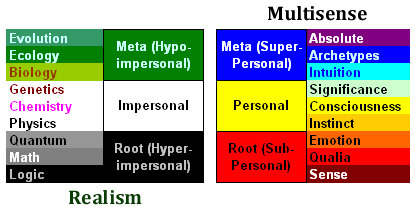
Here are some proposed scale/scope relations between interior phenomenology and exterior realism. The idea that mathematics is the root of quantum physics should be clear enough without much explanation. Taking that relation literally and applying it throughout, the sense of the whole picture can maybe be understood.
Math is to QM as Physics is to Math, as Chemistry is to Physics, etc. These, I propose are convenient break points on the ‘impersonal’ range of the universal continuum. These are nested algebraic topologies in spacetime. They are the exteriorized representations of the personal range experiences. There is a presentation-representation and agent-world relation here, so that the world in which a person relates to other persons is scoped as physics (classical mechanics and thermodynamics) chemistry and genetics. The impersonal view of a person is that: genetic, chemical, and physical activity in the body. Biology, ecology, and evolution extend this world into broader dis-identification categories – evolutionary species, environmental ecology, biological anatomy.
The impersonal side deals with structures extended in public space. The corresponding agents to these large scale worlds are the ephemeral, super-personal levels of awareness. Less real, but potentially more personally meaningful; characters, influences from culture, myth, family, etc are tied to ideas of the afterlife and luck – experiences above and beyond individual control.
Taking it down to the bottom third of the chart, the correlations work here too. Quantum is the world of emotion (which I describe as quorum mechanics – quantum is ‘atomic mood’), Math is the world of qualia (i.e. the interqualitative space – trigonometric functions, symmetries, algebraic equivalence), and Logic is the world of sense (the inevitable shadow of sense cast by the interaction of multiple participants).
[Hypo-Impersonal] Evolution :: Meta (Super-Personal) Absolute
[Hypo-Impersonal] Ecology :: Meta (Super-Personal) Archetypes
[Hypo-Impersonal] Biology :: Meta (Super-Personal) Intuition
[Impersonal] Genetics :: (Personal) Significance
[Impersonal] Chemistry :: (Personal) Consciousness
[Impersonal] Physics :: (Personal) Instinct
[Hyper-impersonal root] Quantum :: (Sub-personal root) Emotion
[Hyper-impersonal root] Math :: (Sub-personal root) Qualia
[Hyper-impersonal root] Logic :: (Sub-personal root) Sense
Zoe Drayson: The autonomy of the mental and the personal/subpersonal distinction
“I listen to lots of audio and try to package some of it for mass consumption on tumblr. I heard something I thought was really interesting today, but that I thought would NOT have mass appeal (the speaker was also… er… well, she was a good academic!). But I thought you would find it interesting.
It was about several different ways to consider “levels” (what I’ve often called “levels of complexity”). The context: a talk from a conference on the Personal vs Subpersonal distinction made by Dennett.
Here are some types of levels as I remember them:
- Whole and Parts… somewhat self-explanatory
- Functional Definition and Realization. So a mind might be functionally defined by what it does. And the “lower level” brain state is a Realization of that Mind.
- Simplification… a SubPerson (at a lower level) is similar to a Person (higher level), only with some simplification to avoid infinite regress (eventually arriving at purely mechanistic processes).
- Access. The Person (higher level) only has access to a subset of what the SubPerson has access to (Thus one of my subpersons might be aware of how my visual attention is focussed, while “I” am not, etc).
That’s from memory, so I hope I did the speaker justice (her name was Zoey Dreyson I think).
None of these quite matches what I think of as levels of complexity. I’d say my criteria for “qualifying as a new level” are higher than these. She almost hit it at one point when she suggested Water can be liquid, while H20 cannot… this might be an archetypal level switch for me.
In case you’re interested, here’s the website and the audio. Love to hear what you think, no rush of course.
Chris aka memeengine”
Hi Chris,
Thanks, yes interesting lecture. Here’s some notes and then I’ll throw in my comments:
- personal: mental states as functional roles (“Roles”)
- subpersonal: brain states that realize these roles in humans (“Realizers”)
‘autonomy of the mental’ in this philosophical context = ontological autonomy
nonreductive physicalism
cognitive science methodology: explain capacities of cog systems in terms of interacting cog subsystems (like car = sum of interacting car parts). Homuncular analysis-decomposition. Modularized cognition to sub, and sub-sub levels without regress.
in cog sci, whole person = person qua cognitive system
under the cog sci view, sub-personal levels or parts are vehicles for cognitive content, i.e. functionally individuated physical states bearing content. Therefore cognitive subsystems = sub-persons
1978 Steve Stitch labeled these instead of personal and sub-personal as
- doxastic states
- sub-doxastic states
[doxastic logic, like Bp & p to me seems to me an extremely narrow approach to a particular aspect of cognitive consciousness. I think that taking these kinds of programmatic structural views of belief and truth really turn the picture of consciousness upside down and assume binary systems as fundamental when there is no hint that such systems generate fluid wholes without an interpreter]
normative vs non-normative
cognitive whole vs cog partssub person level is further divided as being
- accessible to persons
- accessible to sub-persons
in role/realizer relation, higher & lower level properties related by realization relation – instantiated in same individual, share causal power
in the whole/parts relation, higher & lower level properties have different causal powers, instantiated in different individuals. Mereological. Composition. Water has liquidity and wetness that hydrogen and oxygen molecules don’t have.
- Functionalist school in phil of mind – personal level states defined by their functional role.
- cognitive science methodology – personal level capacities are explained by functional analysis.
functionalist metaphysics vs computationalist psychology
Lycan: homuncular functionalism – metaphysics inspired by cog sci methodology
role-realizer/part-whole conflation: who says what realization is? science or metaphysics?
some views claim realization implicit in decomposition [I would call this emergentism]
flat vs dimensioned realization. Science says realizers highly compex property. hardness of a diamond [emergent property]
levels: mereological and realization, supervenience, gnomic? ‘bridge laws’? structures all comport? not necessarily
Conclusion: What is important is to define the nature of realization relation. Who gets to do that? Seems to come down to metaphysical preferences.
Listening to this lecture really underscores for me how different the approach of multisense realism is to anything that is being discussed academically. To my mind, the role/realizer and part/whole relations are analogous to the character in a story – say Alice is trying to describe herself in terms of being composed of either the grammatical structure in the sentences of the story from which she emerges, or whether she is composed of the bleached and pressed wood pulp and ink that are considered page parts of the whole book.
Both approaches are wrong in exactly the opposite way. It is the same with idealism and materialism in general. Nothing means anything without perception and participation to begin with. There is, to my way of thinking, zero possibility of perception or participation experiences emerging from either
- Inked pages in a book (physical parts in a mereological relation realizing the emergent property of the whole)
- Words from the English language in a specific sequence (roles functioning at the personal level being realized by optical character forms configured at the sub-personal level)
The approach that is not even considered is that both the physically privileged page-book mereology and the logically privileged typesetting-linguistic mereology are related to each other only through an agent of perception-participation. This is the multisense realism view. Neither the philosophical functionalist nor the cognitive science computationalist sense of the personal and sub-personal relation can justify the existence of the relation itself. That’s because they leave out perception and participation entirely. It objectifies personal subjects and then pseudo-subjectifies objects as sub-persons without ever anchoring any of it in any kind of experiential realism. The thing that we care about is ignored completely. The hard problem is painted over with a choice of two flavors of the easy problem.
The only way around this, I’m afraid, is through it. Begin with the reality of Alice as the given. We don’t have to believe that she is anything more than a character or that her life is anything other than a story, but if the character and story were really the ground of being for Alice, then the book of pages (brain hardware) and the language typed through those pages (cognitive software) both make sense as ways of stabilizing, controlling, and reproducing aspects of the story. The book is what makes Alice in Wonderland a publicly accessible artifact and the words are what mediate from the public spatial sense to the private temporal sense. The private motive, in turn, to open the book, read the words, and imagine the characters and scenes in the story are what bind the symbols to the private sense experience. Body needs the book, mind needs the words, but story needs the willing self.
What this means is that all of the levels discussed in the lecture are not personal or sub-personal at all, but rather impersonal (surface-topological) and impersonal (syntactic-depth). I propose a whole other half of this picture of consciousness of which, to paraphrase Wittgenstein, we cannot speak, thereof we must remain silent. We can however, listen.
We cannot speak about the personal, but we can know what it is to be a person. We can realize ourselves directly, as an autonomous presence without converting ourselves into an external appearance or function. We can let human experience be human experience, and nothing less. The psyche, to continue with the Alice in Wonderland metaphor, has a protagonist – an Alice. It has other characters too, and themes, and a plot, etc…or does it? Does it literally ‘have a plot’, or are stories more of an experience with multiple frequency layers of events, memories, and expectations?
The story is nothing like either the words that relate them or the book that is the vehicle for the words. I can say ‘do you know Alice in Wonderland?’ and you can say yes, and describe some of the memorable scenes or quote lines or whatever – maybe you haven’t even read the book. The many forms that the story has been enacted, plays, cartoons, satire, songs, etc are all neither a part of the story or not a part of the story. The experience, the consciousness is orthogonal to both the physical formations and logical information associated with them. Of course, I am being absolutely literal here. Multisense realism is the idea that realism arises entirely from the orthogonality or perpendicular juxtaposition of private facing perception and public facing participation.
Once we can fully appreciate the magnitude of the shift that this model presents, going all the way up and down the microcosm-macrocosm, physics and phenomenology, we can perhaps expect to apply the orthogonality completely with confidence. Every atom is a page. Every molecule is a book. Every molecule and atom are publications of quantum-electromagnetic literature. Not only is there also a story which is told through that literature filled book, but there is also an omnipotent protagonist-author trying to awaken.This is an entirely different kind of sub-personal level. In the case of human consciousness, these micro-monads are sub-selves. Not things or ideas but influences, feelings, drives and complex dialectical drive-negation-drives, meta-feelings, histories of thought, interminable arguments…psychology, sociology.
This is what can’t be located by a functionalist or computationalist approach because they try to build a self from a bottom-up nothingness rather than a top-down everythingness. It’s not a new idea, but the application of the Absolute (Totality, Singularity, Supreme Monad, Ein Sof, Tao, Om, etc..) to physics in a literal way I think is actually necessary and feasible. From information science we can approach it as the essence of non-repeatability, or what I call solitropy. Start from there. From physics we can approach the cosmology as a Big Diffraction rather than a Big Bang. Recognize that spacetime makes more sense as a virtual incursion into a singularity of mass-energy than an as an explosion of mass-energy into a spacetime plenum which doesn’t exist yet.
 Multisense Realism
Recent Comments