Archive
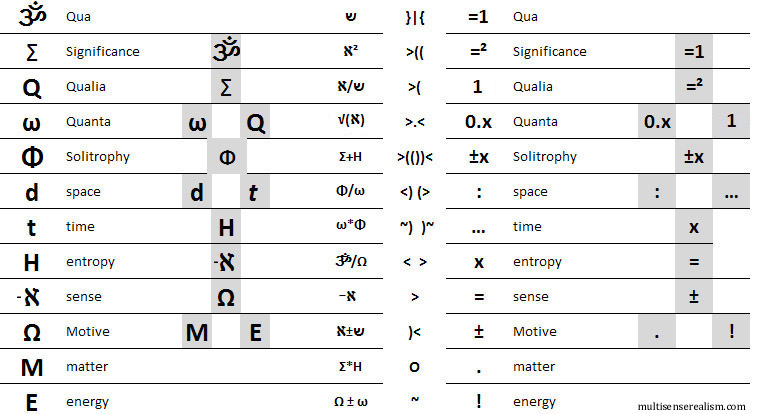
Rosetta Codex
Following up on the Tree of Life post and MSR Legend post.
MSR Legend
A first second draft of a Rosetta Stone for MSR terms, including the debut of new quasi-alchemical code.
Second draft 7/22/13, added Solitrophy and updated the formulas of time and space to clarify.
Breaking The Fourth Wall
Sense (in the Absolute sense) reveals itself reflexively as the Uni-verse, aka monad of non-orientable self-juxtaposition, aka, “the Pansensitive Meta-Lectic Solitrophic-Holarchic Multiphoric-Unametry”, provider of implicit unity (likeness) across multiplicity (private sensory afference) and explicit participation (public motor efference) through intentional animism and automatic mechanism.
reflexive
1. Directed back on itself.involution
entanglement; a spiraling inwards; intricacy
(mathematics) A function, transformation, or operator that is equal to its inverse, i.e., which gives the identity when applied to itself.tessellation
the careful juxtaposition of shapes in a pattern; “a tessellation of hexagons”.non-orientable
A surface S in the Euclidean spaceR3 is orientable if a two-dimensional figure (for example,) cannot be moved around the surface and back to where it started so that it looks like its own mirror image (
). Otherwise the surface is non-orientable.
The Möbius strip is a non-orientable surface
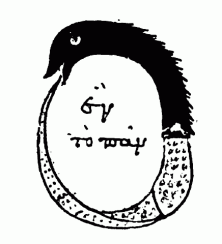
The Ouroboros or Uroboros is an ancient symbol depicting a serpent or dragon eating its own tail.
The Ouroboros often symbolize self-reflexivity or cyclicality, especially in the sense of something constantly re-creating itself, the eternal return, and other things such as the phoenix which operate in cycles that begin anew as soon as they end. It can also represent the idea of primordial unity related to something existing in or persisting from the beginning with such force or qualities it cannot be extinguished. While first emerging in Ancient Egypt, the Ouroboros has been important in religious and mythological symbolism, but has also been frequently used in alchemical illustrations, where it symbolizes the circular nature of the alchemist’s opus. It is also often associated with Gnosticism, and Hermeticism. Carl Jung interpreted the Ouroboros as having an archetypal significance to the human psyche.[citation needed] The Jungian psychologist Erich Neumann writes of it as a representation of the pre-ego “dawn state”, depicting the undifferentiated infancy experience of both mankind and the individual child.
Early alchemical ouroboros illustration. From the work of Cleopatra the Alchemist (Greco-Roman Egypt).Autopoiesis (from Greek auto-, meaning “self”, and poiesis, meaning “creation, production”) refers to a closed system capable of creating itself. The term was introduced in 1972 by Chilean biologists Humberto Maturana and Francisco Varela to define to the self-maintaining chemistry of living cells. Since then the concept has been also applied to the fields of systems theory and sociology.
Bootstrapping or booting refers to a group of metaphors which refer to a self-sustaining process that proceeds without external help.
The phrase appears to have originated in the early 19th century United States (particularly in the sense “pull oneself over a fence by one’s bootstraps”), to mean an absurdly impossible action, an adynaton.Trompe l’œil (French for deceive the eye) is an art technique that uses realistic imagery to create the optical illusion that depicted objects exist in three dimensions. Forced perspective is a comparable illusion in architecture.
Breaking the fourth wall is when a character acknowledges their fictionality, by either indirectly or directly addressing the audience. Alternatively, they may interact with their creator (the author of the book, the director of the movie, the artist of the comic book, etc.). This is more akin to breaking one of the walls of the set, but the existence of a director implies the existence of an audience, so it’s still indirectly Breaking The Fourth Wall. This trope is usually used for comedic purposes.
Updated Statement on Sense
It is my conjecture that ‘Nature’ can be defined as ordinary sense. Sense as in sensation, in cognitive orientation, in intuition, and in categorization (in which sense?). The word sense is just a word, so it is not exactly what I mean, but the ‘sense’ which is conveyed through all of those ‘senses’ gives a good hint of what is behind it. The capacity to feel and to do and to discern the difference between them. That fundamental physical capacity is beneath all form, all function – it is being itself; perception and participation. Without perception (sense, detection), there can be no possibility of participation, and therefore no matter, energy, or time.
Right now, largely because of the success of computers, it is popular to believe that information (‘data’) is the underlying reality behind physics. In my view, this is almost true, but in this case, being almost true means being exactly false. Data is not sense, it is not presentation, not aesthetic nor participatory. To the contrary, information without the presence of a sensory-motor experience is anesthetic, theoretical, and re-presentational. Information is a conceptual entity which we derive by projecting our own experience of being informed onto disembodied functions. It is not real. No byte of data has ever done anything, felt anything, known anything, or been anything on its own.
Math requires a host, as it is the orthogonal reflection of all of sense. Where sense is proprietary and signifying, math is universal and generic. Sense takes place ‘here’ and ‘now’, while math can only be used by sense to address ‘then’ and ‘there, there, and there’. Math is position without disposition – a skeletal inference abstracted from logical vectors. It is this anesthetic universality which makes it so powerful for science – it is the essence of mechanism, of impersonality – pure extension with no intention. It is nature’s perfect imposter.
Continues on The Competition page.
Bergsonian-Deleuzian Multiplicity and Gaede’s Ropes

Looking at the Bergsonian-Deleuzian concept of multiplicity, I can see that it shares the same underlying dialectic as Multisense Realism. I noticed that if I add some insight from Bill Gaede’s Rope model of the atom (YouTube 04:25), I can map electromagnetism to the Continuous-Discrete framework of Bergson.
Where Gaede conceives of a literal thread across the diameter and around the circumference of the atomic nucleus, I think that it should be flipped. Rather than a literal thread I see a capacity for felt participation: ‘motive’ or maybe ‘efference’. Electricity is not a thread across the atom, it the experience of jumping from one atom to another. The atoms themselves would not look like balls of magnetic yarn, but feel like obstacles within the private sense field or ‘afference’ of each atom. This corresponds to magnetic field and Difference in kind, however, it’s a loose correspondence. Sense and motive is electromagnetism from the inside, but it is also gravity and electromagnetism, feeling and knowing, being and doing. It’s the absolute fundamental.
Electricity, in the Gaede model, would correspond to that which defines the literal, linear, direct aesthetic. The symmetry and juxtaposition across the diameter of the atom appears to us as a quantum gear shifting mechanism. That’s because we are detecting it from the outside with other bodies, so there is always a spacetime gap to be hopped across. The loop-like aspect of the atom, by contrast It is both a spherical range of sensitivity in public space and a circuit of oscillating affect or disposition (private experience). To make a long story story short, the atom, in my model, is an interaction with continuous-private-aesthetic qualities and discrete-public-anesthetic (skipping) qualities, aka qualia and quanta. The larger cosmological picture involves the division of qualia from the Absolute (Qua), the diffraction of quanta from qualia (spacetime existence), and the saturation of reconstituted qualia (quanta existential spacetime entropy stripped out) on return to the Absolute.

This can work for a neuron as well as an atom, but again, loosely. Each frame of reference has its own unique vocabulary. A neuron is figuratively like Bill Gaede’s atom model. A galaxy or a solar system is similar also, as is the alchemical Caduceus, the chakra system, the ankh… None of them are identical, but the theme is similar. Winding and tightening, spinning and accelerating, contracting and relaxing.


Challenging Objectivity and the Object-Concept Duality
> “Existence and objecthood is not dependent or relative to an observer at all. Period. These concepts are OBJECTIVE (i.e. observer independent)”
We can’t know that scientifically since all we can know is through observation and inferences based on observation. Objecthood is a concept based on body relations and extensions thereof. Obviously there are phenomena which are independent of human observation, but that does not at all preclude the possibility that their objective seeming nature is not predicated on more general, non-human sense interactions.
>”Something is an object if it has SHAPE.Something exists if it has PHYSICAL PRESENCE (i.e. shape + location).”
This is not as cut and dried as it might seem also. If water evaporates, does it have a shape? If it does, we would have to say that it only does on a molecular level, which requires instruments to detect. Is an emotion any different? The shape of love could similarly be described by neurochemical molecular shapes on that microcosmic level. What then is the difference, other than the neurotranmsitters are located in the neurons and the water vapor is located in the air.
>”We don’t prove objecthood or existence. We assume it to explain a theory.”
Then the theory can only pertain to a universe in which existence is objective. We don’t know of any universe like that.
>”For instance, a shadow puppet or a flame may appear to have shape based on the illusory “boundary” we perceived formed by differences in light intensity, but a contrast in colors or in light is not an object.”
All boundaries may be objectively ‘illusory’. It all depends on what scale you are measuring whatever you think is a boundary. We infer solidity through a consensus of senses – tactile and visual mainly. Electron microscopes reveal smoothly shaped surfaces to be porous or irregular. Telescopes reveal distant smudges of light to be billions of separate stars. Shape is relative.
>”Shape is the only property of objects that is observer-independent. That’s why “that which has shape” is the only rational definition of the term.”
Not necessarily. Shape could just as easily be a low level perceptual consensus. The content of that perception represents ‘that which seems to be observer-dependent’.
MM >”Science is all about objects. We understand that ALL phenomena is the result of surface to surface contact between objects.”
Yes, science has been all about objects, but if we don’t progress beyond that then science will stagnate and become less relevant to our increasing understanding. Surface to surface contact is not really useful in explaining planetary orbits or something like communication. Surfaces themselves are conceptual, its just that our visual and tactile senses are inherently the most objectifying.
The weakness of the object-concept dualism is the same as any other dualism. How does one relate to the other? Take a clear concept like…Communism. If you want to explain the sudden changes in the behavior of populations in the history of Russia or China – the weapons deployed…lots of objects objectively banging around and bodies changing their shapes into mutilated cadavers – how do you do it?
I have proposed a better model. The conjugate to public objects is not concepts but private experiences. It is feeling, not ideas which allow us to take the intellectual experience of “Communism” and turn them into neurochemical signals which contract the voluntary muscle-objects of our body. Concepts don’t do anything by themselves, they are figures of our understanding.
It is sensation/feeling which sucks the ‘experiential entropy‘ out of public worlds (spatially-diffracted sense phenomena, aka quantitatively realized qualia, aka bodies) into private significance (low experiential entropy, reconstituted sensory-motive phenomena: qualia). Participation or motive (misconceived of as “energy” in non-humans and “will” in animals) does the same thing as perception in the opposite direction: it projects private experience outward, re-diffracting qualia through space public conditions.
I know how that sounds, but it actually does make sense if you care to understand it. Another problem with defining objects as phenomena with shape is that we can dream of things with shapes, but they are less like objects than shadows. Why? Because when we wake up, the dream is reconsidered from a higher experiential entropy framework – a more real realism which exposes the lower experiential entropy of the dream realism.
The dream is private experience, the shadow is a more public experience. A rainbow is a more public experience too, but it only has a shape if you look at it from the right angle. A rock is much more public. Ants interact with it as we expect we would if we were that size. It is still not an ‘object’ from an absolute perspective. At the atomic level there is no rock. There is no ‘collection’ of atoms as there is nothing to collect them in a coherent sense experience. Atoms don’t see a rock, they don’t touch a rock – the rock has no shape therefore without other rock sized objects with which to interact.
Absolute View vs Western View: Comparing Supreme Ultimate Diagrams
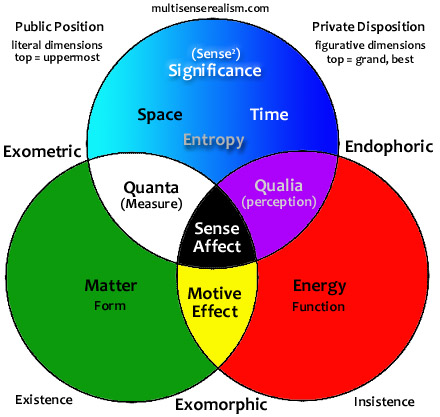
Contrasting two models of consciousness: The Multisense Realism model above uses an Absolute view, which accounts for all known phenomena, subjective and objective. Postulating a root “Qua” (aka, the Absolute, Totality) from which qualia are divided through quanta, Quanta is conceived of as a constraint on Qua, a partition within it. Qua is sense capacity or presence, and so Quanta is the diminished reflection of that capacity…non-sense, entropy, uncertainty, and an expectation of absence. I am trying to show this as the horizontal arrows between qualia, indicating that quanta is nothing more than a kind of negotiation protocol which allows qualia to coexist in the same public space while retaining their private integrity. This is a complete reversal of the Western view, which features Quanta in the role of Qua, as the arithmetic-logical source of all phenomena.
On the left side of the diagram, there is a very general sketch of how Qua recovers itself ‘with interest’ as a qualitative enhancement – a consequence of having reunited on the other side of entropy-disorientation. On a human level, our experience yields a net human significance. Civilization is the residue left behind, a collective perceptual inertial of technology which echoes the individual’s narrative journey of exposure to the exteriorized spaces and the celebrated return home. Significance is literally a promiscuity of association among qualia, a depth of feeling and meaning which compels participation. My view is that this principle motivates on many, if not every level of the cosmos, and is not limited to human beings or animals (even though arguably significance is exponentially more…significant for human beings, at least in our own eyes).
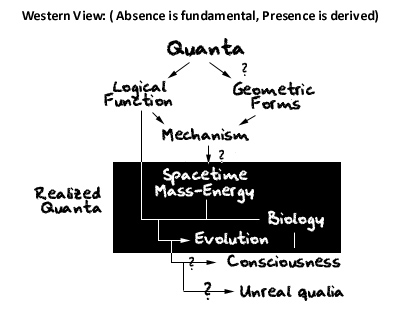
The Western view is a local rather than Absolute view. It does not account for sense or order itself, rather it begins from the assumption of physical matter and works backward to primitive mathematical functions. There are question marks included on the links which seem poorly understood or unjustified by the model as a whole. These include:
Why does geometry exist? I propose this as the Death of Computationalism. Along with the lack of support for Real numbers in computation, the universe or multiverse as a Turing emulation fails to account for the existence of forms like lines, circles, angles, etc. We know from our own computing and calculating devices that it is not necessary to physically draw a triangle in order to approximate correct computations about numbers which could correspond to triangular coordinates, so it really doesn’t make sense that any cosmic computation could or would invent geometric presentations of any kind. We don’t even need to get into questions of qualia, because computationalism fails to explain any sort of aesthetic forms to embody its functions. Mathematics is disembodied and anesthetic, and it works perfectly that way – no need for any strange magical fanfare.
Why do mathematical relations and laws give rise to physics? It’s all very well to have forms and functions mingle with each other as articulate mechanisms, but why should they ‘materialize’ as space-time, matter and energy?
The question of why consciousness exists when it does not appear to have any particular advantage over unconscious mechanism is a mystery. It is very difficult not to smuggle in our own retrospective view of consciousness as having enormous utility for our survival, but this is in no way an endorsement from the prospective view. If our immune system can orchestrate phenomenally complex responses to pathogens without a conscious experience attached to it, then why would a hominid’s humdrum quest for sustenance and reproduction lend itself to such an absurdly ornate aesthetic phenomenon? Indeed, if evolution can make a human brain, with all the trimmings, using unconscious methods, surely the operation of that brain would be better suited to that tried and true option.
The final question mark is related, but not identical. Even if you have consciousness as an option for some reason, and that option works better for humans than turtles or clouds of methane for some reason, why should such a phenomenon as consciousness produce feelings which are other than a record of the physical events which they represent? Why should there be different kinds of sensory experiences when all logical functions can be reduced more effectively to a single binary format of data processing? This alternative to reality is cast aside from the Western view, but what metaphysical never-never land is it cast to? How did we get outside of the real universe and into an ‘illusion’?
Manly P. Hall on Space
“To the ancient Brahman, to the ancient Hindu scholar, space was first of all a totality, a unity. It was not an absolute diffusion going on forever and ever, it was a totality without boundaries, as far as we can conceive boundaries. It was an all-ness that was also a one-ness.”
“There is somewhere out there a point or a condition in which the conceivable fades into the inconceivable. The knowable into the unknowable, that which has an existence in time retires into an eternity, and in this great collective concept of ultimates, ancient man established his definition of space. Space was ultimate. Space was unconditioned for it preceded condition.”
“Every part of itself full of light, every part of itself germinal and seminal, […] it is a completely rich, inconceivable kind of earth, an invisible earth in which everything grows, and everything has its taproots in space. From this one eternal condition, all other conditions must come. Thus this uncondition cannot be vacuum, cannot either be continuum as we know it, it must be total fullness. Space must be the most complete of all things. There can be no lack anywhere within it. There can be no lack anywhere within it. No strange bubbles in which it itself is empty.”
“These spaces are not emptiness, they are bridges of fullness, binding things together. Space also contains within itself the roots of binding and loosing. It does act as an eternal agent of binding. Nothing can escape from it, and in some way, beneath its invisible and apparently completely flexible azonic constitution, there is something that is fixed, something that is firm beyond all firmness, strong beyond strength, enduring beyond endurance. Thus space carries within it foundation, place, and in its own mysterious way, moving upon itself, it engenders time. For time is an unfolding, and moving of duration in space.”
Audio: Manly P. Hall – Astro-Theology- ( All 5 Parts in FULL)
Interesting how closely this description comes in some parts to quantum mechanical ideas of vacuum flux. In my view, these ideas are projected outward into a public realism (which is mentioned directly above as place, firmament, and spacetime) whereas a more accurate model would locate public realism within the sense that matter has of itself. Sense is the firmament, and the great orientation principle which binds not only matter within itself, but separates the focus in one experience from another.
My view locates time as a function of private recollection and expectation, not of a public unfolding. Ours is the sense which reads movement and disposition of sequence out of successive exposures of positions. The capacity to compare and discern, on a sub-personal level of perception, is what gives rise to the intelligibility of form and consequence on a personal level that can be recorded symbolically as time.
Space is indeed what anchors us to public communication between participants on all of the different levels of scale, from microcosm to the astrophysical, but not through the fullness of a magical plenum of space. The fullness is within matter, or rather, matter is the obstacle of the fullness of experience, and space is the absence of low level (microcosmic) connection of matter.
In a way, space can be imagined to be the monadic fullness just as well, since it is through the divisions among bodies that all experience coheres and disperses, but that is more of a second-order logical abstraction to me. The thesis is presence, the antithesis is absence, the synthesis is realism. Realism is matter, the re-presentation of presence across a gap. A gap, or space, is the attenuation of detectability, a rationing or diffracting of presence so that unity is preserved in some modality and severed in others. Space is information entropy – a threshold beyond which tactile, private unity gives way to tangible public contact and visibility.
Emergent properties can only exist within conscious experience.
…
Neither matter nor information can ‘seem to be’ anything. They are what they are.
It makes more sense that existence itself is an irreducibly sensory-motive phenomenon – an aesthetic presentation with scale-dependent anesthetic appearances rather than a mass-energetic structure or information processing function. Instead of consciousness (c) arising as an unexplained addition to an unconscious, non-experienced universe (u) of matter and information (mi), material and informative appearances arise as from the spatiotemporal nesting (dt) of conscious experiences that make up the universe.
Materialism: c = u(mdt) + c
Computationalism: c = u(idt) + c
Multisense Realism: u(midt) = c(c)/~!c.
Recent Posts
Archives
Tags
Absolute AI alternative physics alt physics anthropology art Artificial Intelligence big questions biocentrism brain Chinese Room computationalism computers consciousness cosmogony cosmology cosmos debate diagram dualism eigenmorphism Einstein emergence entropy explanatory gap free will graphics hard problem hard problem of consciousness information information theory language life light math mathematics metaphysics mind-brain multisense continuum Multisense Realism neuroscience panpsychism pansensitivity perception phenomenology Philip Goff philosophy philosophy of mind philosophy of science photon physics psychology qualia quantum quantum physics quora relativity science scientism Searle sensation sense simulation society sound spirituality strong ai subjectivity technology theory of everything time TSC universe video visionThis slideshow requires JavaScript.
Blogs I Follow
- The Third Eve
- Shé Art
- Astro Butterfly
- Be Inspired..!!
- Rain Coast Review
- Reflections
- Amecylia
- SHINE OF A LUCID BEING
- I can't believe it!
- Table 41: A Novel by Joseph Suglia
- Rationalising The Universe
- Conscience and Consciousness
- yhousenyc.wordpress.com/
- DNA OF GOD
- Paul's Bench
- This is not Yet-Another-Paradox, This is just How-Things-Really-Are...
- Creativity✒📃😍✌
- Catharine Toso
- Political Joint
- zumpoems


Recent Comments