Many Words Interpreted: A Glossary of MSR Terms
By request, a list of neologisms and special uses of common terms within Multisense Realism.
First edition.
Absolute – In many philosophical schools and mystical traditions, there is a concept of the Absolute. Often it is associated with God or nothingness, and there are many terms such as Om, Tao, Ein Sof, Totality, Being, Brahman, Zero Point Field which function as Transcendental Signifiers. In MSR, the Absolute has a more specific definition. Since sense is supposed to be more primitive than either physics or ontology, the Absolute is understood to be the ‘largest’ (most inclusive) inertial frame, which is also the greatest (most exclusive) perceptual frame. This concept of the Absolute can be described as ‘eternity with all of the space and time sucked out’, or ‘instantaneous eternity’, as the unity of all perceptions and experiences would have no sink or eraser to separate itself into multiple ‘nows’. The Absolute is not necessarily a ‘real’ thing, as reality itself is, under MSR, a confluence of sensory correspondences with and against the Absolute. While we are here in spacetime, bodies are real and the Absolute is make-believe. From the Absolute perspective, all phenomena, including bodies would be equally real and unreal. See also: Sole Entropy Well.
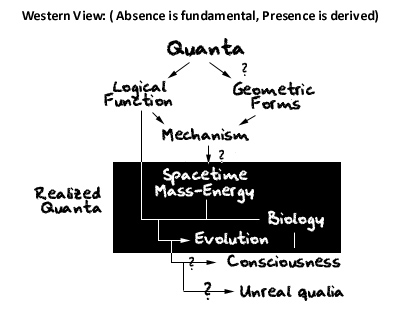
ACME-OMMM – Stands for Anything Can Mean Everything and Only Material Matters Matter. These represent the two proposed extremes of philosophical bias. In MSR, the ACME pole is always mapped on the right hand side (for Eastern or Oriental) of the continuum as the absolutist defense of naive idealism. In contemporary terms, this would include all purely spiritual conceptions of the universe in which physics is fictionalized or subsumed as thought-energy. The left hand or Western side of the continuum is the OMMM end, where all feeling and awareness is mechanized as accidental consequence of physical or mathematical law.
Aesthetic – Within MSR, the term aesthetic takes on a greater meaning than ordinary usage assumes. Just as general anesthesia is equivalent to unconsciousness and a local anesthetic is used to numb tactile sensation, and synesthesia describes the mixing of sensory modalities, the term aesthetic should be taken to mean the common quality which all direct awareness shares. All experiences are fundamentally aesthetic presentations or presences, within which anesthetic representations can be added (through symbolic logic, mathematics, intellectual modeling, etc)
Aesthetic presence or aesthetic presentation refers to a concrete experience marked by sensory qualities or qualia, such as a visible shape, tangible feel, flavor, color, sound, etc. It would not include abstract mathematical entities, forces, fields, statistics, computations, etc which could only be presumed to have an anesthetic, de-presentational influence, or else represent an aesthetic presence beyond our detection. Under MSR, only those experiences which have an aesthetic presence are genuinely ‘real’, while all other information-theoretic constructs are considered figures or representations within some aesthetic presentation. These words are only figures on a screen, and through the experience of seeing their shape, we are able to ‘hear a voice’ in our mind. If we were not present to read this text, they would have no pattern at all. The electronic states of the screen and computer would have no more significance than sand on a beach cycling through days and nights.
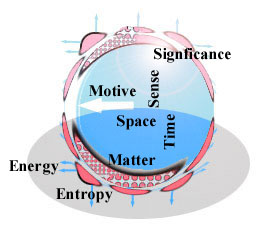
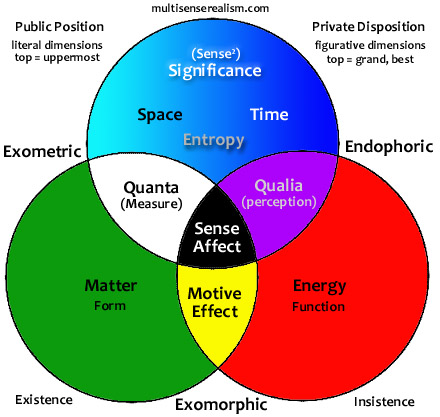
Aion, Psyche, Nous, Hyparxis – These are referred to in a this cosmogonic diagram in which the Classical Greek terms are paired with suggested modern equivalents. Under MSR, space is a localizing consequence of entropy (the attenuation of sense) and time is the expression of significance (limits on the saturation of sense). The combined plenum of space-entropy/time-significance can be thought of as Aion, meaning age but also the totality of self. The polar opposite of Aion in this view is Hyparxis, which has to do with being and subsistence and on the diagram is paired with mass, but it is intended here as the sense of mass as felt embodiment. Psyche and Nous correspond to qualia and quanta here, also with quanta also including a logical attitude.
Altruistic Monad – The Altruistic Monad has precedent in some mystical traditions such as Kabbalah. In MSR, the idea is that in some sense the Absolute is eternity ‘holding its breath’. Another metaphor is a clock that is so slow that after the end of forever it would still not have completed a single tick. In the mean time, the diffraction of the Monad (Totality of experience) into localized experiences within experiences continues on in a diffracting, self-diagonalizing manner. As the outermost and innermost inertial frame of all experience, the Absolute is in a sense sacrificing itself for the common good of the universe. See also Sole Entropy Well.
Anesthetic Representation – To understand the symbol grounding problem, it may be helpful to focus on the fact that computer program does not require a screen to run. In fact, a computer does not need to use graphic displays or even geometry to operate ‘as if’ those forms were present. This need not get into any esoteric philosophical discussion about consciousness, it is simply a fact that Turing emulations of geometric forms are not themselves geometric, they are shapeless configurations of binary code which can be expressed as musical notes or electrical signals just as easily as they can be screen drawings of shapes. If that were not the case, there would be no need for screens or sound cards as we could directly tap into the inherent aesthetic qualities of the data. The anesthetic property of data is, of course, the great strength of digital computation. This universal code, under Church-Turing thesis, allows any measurable data to be computed in the same (anesthetic, generic, universal) way. This anesthetic property is also the greatest weakness of digital, as it strips out all proprietary anchoring, and we will forever be chasing more secure authentication and control over intellectual property. Because only aesthetic presence can be ‘real’, all representations must borrow from an existing aesthetic modality (like sight or sound) to be presented. Representations are, therefore, not independent entities or experiences, they figures of common sense. Binary representations are figures of Absolutely common sense.
Anomalous Symmetry – Describes the relation between the physical and experiential as being symmetric (as electric and magnetic fields) but ontologically perpendicular or orthogonal at the macroscopic level. Experiential qualities are seen as primary and fundamental in an absolute sense (reversing Locke’s model of primary and secondary qualities), but through the ingression of entropy (as spacetime through the Big Diffraction), they diverge into eigenmorphism. In MSR jargon, the meta-phoric Absolute diffracts itself endophorically and exometrically to derive exomorphic representations at the bottom of the stack,
Aperture of Consciousness – Applied to states of human consciousness, particularly with the scope of human awareness. Using a camera metaphor, increased sensitivity (as in childhood or under a similarly vulnerable psychological state) is associated with short range sensory interest. The moment expands to an arbitrarily long duration, and emotions can feed back on themselves until the point of euphoria or panic. When the proposed (metaphorical) aperture of awareness is more contracted (as a sober and serious adult), the depth of field has a longer range, making the thought process more quantitative than qualitative – circumspect, strategic, logical, etc, but relatively cold, distant, and uncreative.
Apocatastatic Gestalt or Transrational Algebra – Taken from apocatastasis, meaning “reconstitution, restitution, or restoration to the original or primordial condition” and algebra, “al-jabr “restoration”, MSR posits that the nature of subjective experience is one in which gaps in sense (entropy, spacetime) are removed or elided. This is contrary to the conventional view that experience is assembled only from the bottom up, by neurochemical processes to arrive at an illusory whole. Instead, the perceptual event is a process which restores a distant or decomposed aesthetic to a sensible whole within the local frame of experience. It is transrational as the process is not driven only by logical algebras or topological manifolds, but by semantic content which is not necessarily spatiotemporally bound. This is more of an Ur-Algebra, from which algebras and geometries are produced, but the multiplexed nature of felt significance goes far beyond localized logic.
Arithmetic supremacy – The conviction that epistemology is limited to quantitative measurement, and that such measurements are objectively and universally true. This would be considered a monosense unrealism in MSR terms; a schema which de-presents realism as an emergent property of a fundamental representational code.
Authenticity vs Automaticity – The theme of orthogonality finds yet another expression in the contrast between that which is grounded in a unique and unrepeatable history and that which is mechanically generated. A forgery or paint by numbers painting for example, are inauthentic because they are produced by imitation of an existing pattern – there is no original pattern being generated. Automation relies on copying, but has no appreciation of the difference between an original and a copy. All computation is a simulation – a figurative index of generic symbols without proprietary or iconic transfer. To automate is to reduce an experience to a skeletal abstraction, a recording of a function to be repeated unconsciously or in a deterministically regulated way. From the human personal perspective, human consciousness relies on a lot of automatic sub-personal functions, however there is no reason to assume that like our own personhood, our sub-personhood is not also rooted in a fundamental authenticity. Our personal awareness seems notoriously unique in some sense. Identity appears to gain appeal through proprietary achievement rather than automatic operation.
Big Diffraction – Thinking of the Big Bang realistically, it would not be possible for a phenomenon which gives rise to space and time to begin from a location in space or time. Having no space from which to observe it from, and no moment to experience it in, the BB cannot be considered to have occurred as an event, nor can it have an exterior view. We are therefore still within the Big Bang, and it is an event which is always happening, or never happening – more the axis in the center of a spiral of time than a terminal point along a time line. Because of this, the BB cannot be an explosion into an evacuated space (which does not yet exist), so that it is more rational to suppose a kind of shattering or falling apart into time. Because the original Monad is beyond time, it is not shattered itself, but rather the sense of separation would be added on top of the essential unity, thus producing a diffraction pattern of variations on top of variations linking Absolute unity with the promise of Absolute dissolution.
Cardinal position, ordinal disposition – Contrasting cardinality and ordinality from mathematics and pairing them with spatiotemporal terms of position and disposition, a concise description of certain aspects of private and public realism can be arrived at. Cardinality gives us a pool of a particular size, in which each member is a generic but unique part. Pairing that with position gives an idea of bodies in space. Using a chess board as an example, the number of pieces and positions on the board would be the cardinal position. The moves that any given piece can make at any time would be the ordinal position. The Cardinal disposition would be the value of a piece by virtue of its rarity – so a pawn would have a lower cardinal disposition than bishop just because of the number available. In ordinal disposition, rank is formalized intentionally rather than statistically. The king has more value than a bishop, even if there is only one bishop left. This concept comes into play in the consideration of awareness and life originating in primordial improbability rather than the anthropic principle.
Chameleon brain – (or p-Zelig instead of a p-zombie), an artificial intelligence which would impersonate behaviors of whatever environment it was placed into. Unlike a philosophical zombie, (which would have no personal qualia but seem like it does from the outside), the chameleon brain would explicitly forbid having any particular qualia, since its entire processing would be devoted to computing cross-modal generalities. It is intentionally not trying to be a person, it is only trying to mirror anything – clouds, wolves, dandelions, whatever, according to the measurements it takes using a large variety of peripheral detectors. The point of this is to expose the leaky p-vacuum which assumes qualia as a inherent within information/computation.
Cosmoscopic – To round out traditional levels of description by scale as macroscopic and microscopic, cosmoscopic refers to phenomena which seem to us as laws of physics or mathematical truths. The cosmoscopic scale is the scale at which scale does not matter, as the vast overlap between nuclear physics and astrophysics suggests.
De-Presentation – In his book “Aping Mankind”, Raymond Tallis argues that the over reaching of neuroscience and evolution (he calls Neuromania and Darwinitis) has lead to a failure to consider humanity in its own terms. Taking that concept further, and making it more literal, de-presentation is the idea that reducing human consciousness to the intersection of neurochemical and evolutionary mechanisms effectively denies any worldly presentation of human experience. All that we have ever known or will ever know is de-presented as statistical fluctuations in a void.
Depth of field – See aperture of consciousness.
Disimmediation – What optical illusions, lens flares, continuity errors, breaking character, and winking at the camera have in common. A medium is a channel of communication or sensory experience in which other, non-presented experiences are inferred and represented. Because our human psychology is highly suggestible, we can readily ‘immediate‘, or suspend disbelief of a media source, allowing us to modulate how much we want to pretend that something which pretends to be real is real. There is something more, however, than just playing along with illusions or being disillusioned with a glitch in a technology. If we pay attention to the aesthetic particulars of the glitch – the scratches on the record, the pixelation of a digitally compressed video, we can see that they contain clues as to the mechanisms behind the media. Disimmediation is a window into other PIFs, to optics or computation, analog or digital recording, screenwriting and theatrical production, etc.
Eigenmorphism – A general term to describe a set of possible ways in which a phenomena can be transposed. In particular, pansensitivity makes use of eigenmorphism to describe how physical and phenomenal properties might be isomorphic on the micro level, but contra-morphic on the macro-level, and multivalent on the absolute level. If we think of an atom as having a microphenomenal experience, we tend to assume that the experience would have to be very primitive and relate directly to the physical forces acting upon the atom. That could be part of the bias expected under perceptual relativity, but if not, that would reflect a very different psychophysical translation than we see at the macro level, where the literal activity within a human brain has little to do with the experiential content of thoughts, feelings, and experiences. This dramatic difference is the basis to propose that between the macro, micro, and cosmological scales, there is an envelope of eigenstate like increments through which scale of form and content is modulated. Size can be measured not just by comparison of physical dimension, but also by the angle or gap between aesthetic depth and quantitative complexity. Simple structures have shallow experience, but deep experiences not only have complex structures but they have orders of magnitude more degrees of freedom from that structure. They have increased potential for imagination and privacy.
Emergence and Divergence – The concept of emergence and emergentism supposes that consciousness is an emergent property of physical or mathematical law. It is a popular concept, as everyone can understand how something like tool use could emerge from an opposable thumb. There are problems when applying this to consciousness however, since, unlike a hand holding a stone, there is no physical basis to expect a potential for “experience” to appear if it were not already present. Indeed, invisibility or teleportation would be a more plausible trait for an organism to evolve out of thin air. Divergence, then, is the consideration of primordial identity pansensitivity, in which the universe that we experience outside of our bodies is a subset of the totality of experience (Absolute), so that nothing can emerge ‘from nothing’ but rather it is reduced, diffracted, and divergent from everything.
Entropic frames / Holotrophic frames – The view of private and public phenomena which emphasizes layers of novelty-producing feeling juxtaposed with structured routines.
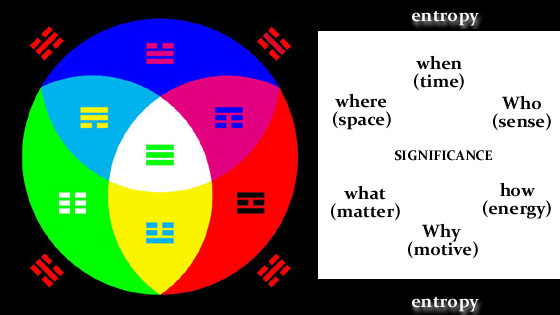
Entropy-Significance – The word entropy is used in different ways for different purposes. In MSR, entropy is used in a broad sense, encompassing thermodynamic, information, and aesthetic sensitivity. MSR posits that entropy is a consequence of significance, which also is used in a broad sense of meaning, aesthetic dynamism, and signal coherence. Loschmidt’s Paradox brings up the question of how the universe could perpetually be in a state of increasing entropy without an initial low entropy to start with. The Sole Entropy Well hypothesis offered here reverses the assumption of entropy as an increasing value so that it is significance which is absolute, and entropy which constitutes a local masking of it, The mask is what is expanding relative to the significance of the totality, but the totality is always gaining back what is lost through perception. Significance is the chunking up of experience made possible by the deprivations and isolations of spacetime diffraction. When we observe the public universe unraveling into entropy, it is our own appreciation of our position in the universe which contributes to the other side of the balance sheet. Entropy and significance are background and foreground, partners in Aion.
Everythingness – Through the hypothesis of Primodial Identity Pansensitivity and the Sole Entropy Well, the notion of a Universe From Nothing is turned on its head. All such notions arise from a leaky assumption of nothingness in which many sensible conditions are already present and taken for granted, such as oscillation, repetition, probability, multiplicity, etc. A true nothingness could contain no sense, no possibilities, no connection to anything at all, lest the nothingness would become contaminated with not-nothing. By flipping the assumption of nothingness, PIP begins with an Absolute totality that subdivides itself into multiple channels or diffractions, giving space and time as modulations of sense capacity. This Big Diffraction cosmology coincides with pre-scientific thought in Western Mysticism and Eastern Philosophy.
Exomorphic, Exometric, Endophoric, Phoric, Solitrophic – In some diagrams, these terms are used to specify the proposed symmetry through which primordial pansenitivity, with its ‘phoric’ sensibilities (phor, as in metaphor, semaphor, and euphoria has to do with carrying, as in carrying meaning) divides itself into three variations. Endophoric is the first diffraction, using rhythmic repetition to scale and separate experiences into more ‘interior’ feelings. This is the content of perception or qualia. If the Endophoric diffraction carries the phoric inward, what is left out is polarized from the perspective of qualia, making a second diffraction to the exomorphic (thermodynamic bodies/matter-energy) and the exometric (mathematical functions/space). Solitrophic is used to describe the production of individuation.
Experiential Entropy – Related to Entropy-Significance, experiential entropy describes the effect that distance, both literal and figurative, has on significance and personal identification. The incorporation of sensation into cosmology as a physical component which recovers diffracted significance by eliding space and time metaphorically is a huge undertaking, but this at least points to one way of approaching it.
Form-function – Adapted from interpretations of the Stone duality in which topologies are dual to logical algebras, form-function is used to refer to public phenomena. All that can be measured must have either a form with a position, or a function which can be inferred from the disposition of a form. In MSR, form-functions are seen as special cases within phoric pansensitivity, so that they do not exist in isolation but rather always as experiences to be appreciated aesthetically and participated in directly.
Fourth Wall – Breaking the fourth wall is a theatrical term that refers to an instance where a performer does something to indicate the unreality of the performance, such as wink at the audience or look directly into the camera and speak to the viewers. MSR seeks to break the fourth wall of philosophy of mind by addressing subjective experience directly, bypassing the omniscient voyeur with an improved philosophical vacuum.
Genius Palette – The inexplicable aspect of a sensory palette, such as the transition from red to yellow within the spectrum. The transition from blue to indigo is readily understandable by comparison, and corresponds to what we might expect from a smooth continuum of graduated wavelengths, however, the comparatively jarring shift from red to yellow is more difficult to justify. This unjustifiable quality could become understandable, perhaps under a more complete conscious state than human beings are ordinarily privy to, or perhaps this is an example pure creativity beyond all reason. At root, every sensory palette has a genius palette which separates it from all other sensory modalities. Synesthesia is fascinating as it shows that these palettes are permeable to each other, and that human consciousness can smoothly integrate words, numbers, and concepts with flavors, colors, sounds, and images.
Gepetto complex – A term to denote a confirmation bias toward Strong AI. The prominent divide between machines and living organisms is minimized or denied as the enthusiasm for computational theory is emphasized over all potential objections.
Holographic Celebrity – The etymology of the word celebrate contains the meaning “to frequent in great numbers” as well as “to publish; sing praises of; practice often”, and “kept solemn”. Thus there is a potential basis to connect popularity, frequency and fidelity. Whether an event is solemn of joyful, we say that the occasion is celebrated. Any event which is celebrated, or person who is a celebrity automatically implicates the ensemble of fictions and facts associated with it. Every time Martin Luther King day is celebrated, the issues of civil rights, race, and freedom, as well as the 1960s civil rights movement and his role in it, are, like a hologram, or perhaps a ceremonial candle, re-illuminated.
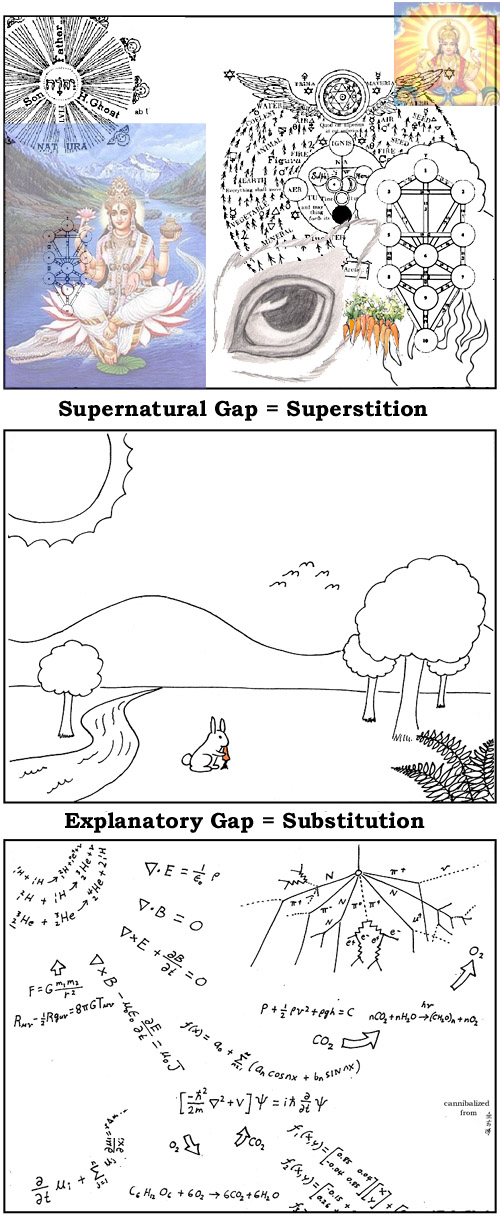
hypostition – A counter-logic to superstition in which a robotic, overly literal approach is applied to nature. Reductionism and pseudoskepticism combine for an overall cynical extremism in epistemology which effectively rules out all possibility but existentialism at best and nihilism at worst. Where the supersitious mind anthropomorphizes, the hypostitious mind mechanemorphizes. Everything that could be considered miraculous or special in some way is compulsively stripped of importance and dismissed as illusion, error, or trickery.
Immediation – The fusing or eliding of difference among perceptual inertial frames. Accepting a given sense channel as whole or true. This applies to our own consciousness as well, since under MSR, personal awareness is a high level sense channel (high level in that it includes or immediates many sense modalities). As a single sense modality, the cues of its disimmediation include dizziness, confusion, delirium, and ‘blacking out’. Our consciousness includes signs to represent its own absence.
Immediacracy –
1. A state of idealized interaction between individuals and the culture as a whole, which utilizes continuous and ubiquitous network availability and is unburdened by barriers to usability. A completely transparent, universal, participatory, and immersive communication medium.2. A principle by which information is prioritized to favor and to demand rapidity, convenience, and heightened naturalism. The rise of reality television and social networking can be said to have displaced more traditional forms of media with its immediacratic appeal.3. A process of artificial selection wherein decisions are based solely on the criteria of expedience. A broad social condition of evolutionary outcomes driven by short-term or petty consideration.
Immereology – Mereology is the study of the relation between wholes and parts (is a handle part of a mug or is it a thing of its own?). The idea of immereology is that private experience contains not only forms and functions which can be understood in terms of parts and wholes, but they can also contain the opposite types of phenomena. Deeply subjective experiences in particular seem to be fugues of feelings and expectations which are neither part, whole, nor non-part or whole.
Imposter – Discussed in this post, there is an expectation of authenticity which is not presented in quantitative function. The uncanny valley effect is an example of how artificial or mechanical imitations compare unfavorably with originals, and what that reveals about life and death, zombies, fame, and semiotics.
Information – Used in a new way within MSR. Breaking it down as in-form-ation, the ‘in’ and the ‘form’ correspond to the phoric and morphic respectively, while ‘ation’ corresponds to the metric. The purpose is to correct the impression that information is a commodity which can exist independently of perception. The contemporary usage of ‘information’ which leaves out awareness and interiority is actually a mislabeling of ‘formation’. Data, without being grounded in an aesthetic experience, is understood within MSR to be a figurative abstraction.
IPT, EPT, IPS, EPS – This diagram attempts to map consciousness from the individual’s perspective. Here, privacy is defined in terms of Interior and Exterior facing time, and the public body is defined in spatial terms of Internal and External exposure. The purpose of the diagram is to show how time exists as multiple wheel-like contexts of varying scale according to the frequency of repeating experiences. It is proposed that part of what individual consciousness does is to fracture space from time so that they are perceptually offset – a fugue of times funnel down to a conditional ‘now’, at which point the sense of ‘here’ becomes a nexus of intersecting ‘there’s,
Istence – As “Qua” is to qualia and quanta, “Istence” is a term proposed to describe a common umbrella above existence and insistence. In MSR, existence is generally reserved to describe public existence as a body or particle in space as seen from a private perspective, while insistence is a private experience which can be influence some public effect. Both insistence and existence are understood to diverge or diffract from istence, which unites and divides the two poles through sensory discernment and Ouroboran monism.
Light – Is light made of photons, optics, or visual experiences? MSR uses the term light to describe the sensible continuum which includes all three, as well as propose a new post-particle, post-velocity model of light in which photons themselves may be figurative experiences rather than literal physical form-functions.
Likeness – Etymologically, the word ‘like’ was used in the reverse order that we now use. “That dress likes you.” would mean that the dress looks good on you – it flatters you. Herein lies a hint about the connection between euphoric feelings that we ‘like’, and similarity across patterns. Two kinds of likeness share a common sense which refers to mutual reflection; symmetry, harmony, rhyme, and reason. Sense is what makes black and white like each other in one way and maximally unlike each other in another way. Likeness also figures into philosophical primitives such as difference and repetition. Likeness can be the opposite of both difference and repetition, as well as the opposite of indifference. It is a rediscovery of the primary unity which precedes difference, yet remains undiscoverable prior to differentiation. Likeness is the echo of the unrepeatable – a copy of originality which is also original.
Literal / Figurative – Generally used to further qualify the difference between public bodies and private experiences. The word ‘literal’ implies a discrete, factual presence, while ‘figurative’ emphasizes that a leap of intuition is required to fully appreciate some loose grouping of concepts or sensations. It is worth nothing that the ‘literal’ meaning of literal refers to reading and the literal meaning for figurative refers to concrete figures or shapes. Thus, the meaning on the etymological level is reversed on the contemporary semantic level.
Logic / Sense – Logic includes all indirect modes of sense making, where representations stand in for actual experiences. Sense includes logic (as it includes everything) but logic is the particular subset of sense reserved for the unfelt and impersonal. Logic is seen as the essence of objectivity, and as such, it has inherently reductionist mechanisms which filter out all references to direct awareness. Because logic is designed to be insulated from sense, any map of the world or of consciousness is bound to place intellectual rules, forms, and functions above feelings and aesthetics.
Mechanemorphism – Conceived as the polar opposite to anthropomorphism. A common criticism from the Western view of the world is that all other views are anthropomorphic, and thus naive and backwards. With mechanemorphism, there is a recognition that the opposite of bad can also be bad. Abandoning the view of a cosmic creator should not scientifically entail embracing a view of a clockwork cosmos, but it appears that by default most people will tend toward that without considering the possibility of confirmation bias and reactive reasoning.
Mediation Boundary – Closed captioning of music is an example of the failure of any particular medium to represent every kind of experience. Another example is the inability to portray subjective states such as drunkenness. An actor can behave as if they were drunk, or the image can be blurred or drift to suggest dizziness, but these are mere suggestions of heavy intoxication. There is no way to visually portray altered states of consciousness in their full dimension, unlike public places and people which can be rendered on film with high immediation.
Monosense Unrealism – The polar opposite of MSR, in the sense that it characterizes a philosophy of reductionism to a single aesthetic type (material, ideal, or information, usually). The result is a de-presentation of naive realism, such that it can only exist in as an unacknowledged and unreal dual to the favored monosense. Of eliminative materialism, for example, we might ask what is it that is being eliminated? In spiritual conception of the world as illusion (maya), we might ask what makes it different from the non-illusion which generates it?
Motive – If sense describes a fundamental receptivity which precedes being or feeling, motive describes the antithesis: doing, responding, opposing, negating, projecting, moving, etc. If sense is affect, then motive is effect. If sense is the head, then motive is the flagellum (or tail or body). Because human experience is so convoluted with layers of molecules, cells, organs, and bodies, our motive participation can be limited to private intentions, or it can be stepped down through the body as motor activity. Were we simpler organisms, or perhaps inorganic molecules, our motive might be more isomorphic to our motion. On that more primitive level, the gap between intention and unintention may be closed, and subjectivity and objectivity becomes, at least from our perspective, indiscernible. Whether that closing of the gap is a prejudice of perceptual relativity, or an ontological reality, or a mixture of the two remains an open question under eigenmorphism.
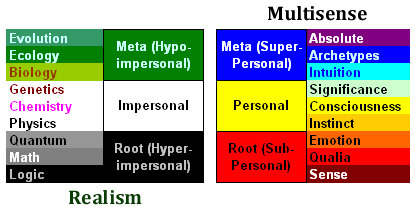
Multisense Continuum – Initially linked to a graphic mural, the proposed continuum is a spectrum to contain every category of phenomena in a sensible order. Ideally, the mural would be projected as a sphere, as the far Eastern and far Western edges meet (called the Profound Edge), as would the top and bottom (Polar Divide).
Multisense Realism (MSR) – Not a postulate of multiple realities or even multiple senses of ‘real’, MSR proposes that realism is derived as a secondary condition of overlapping sense channels (PIFs), which have been diffracted. Like a musical chord or the continuity of the visible spectrum, the wholeness which underlies realism arises from the reuniting of locally broken absolutes into stereomorphs (solid forms) . Reuniting is accomplished by successful disimmediation, stripping out (eliding) spacetime entropy through validation aesthetics (understanding, completeness, perfection, knowledge, mutual correspondence, etc).
Myth of Primordial Objectivity – The philosophical cliche which begins “If a tree falls in the forest and there is nobody around to hear it…” probably stems from an oversimplification of George Berkeley’s idealism in which he questions the assumption for objects as we imagine them to stand on their own without our imagining. In some ways, his view presaged (or perhaps contributed to) the Copenhagen interpretation of early quantum mechanics in which the Observer Principle was defined to account for Heisenberg’s Uncertainty. Unfortunately, views which include experiential and aesthetic dynamics are often trivialized in physics and mathematics, where, it can be argued, objectivity is a fundamental assumption. In math and physics, conditions ‘simply are’ whether or not they ‘seem to be’ in any particular experience. MSR seeks to rehabilitate the full force of Berkeleyan idealism by removing the constraint of human or even biological exceptionalism and arriving at a primordial identity pansensitivity.
Negative Aleph (-ℵ) – A symbol to represent sense used in diagrams. Mathematics uses Aleph numbers represent infinite cardinality. To translate the quantifiable aspects of sense into mathematical terms, the idea of negative cardinality has some appeal. Since cardinality conceives of such a primitive function of numbers (the sense of shapeless, yet precisely ordered “size” that we afford to pure quantities), in order to accurately place sense beneath measure and numbers, we might speak in terms of sense having incardinality, i.e. infinite pre-cardinality and infinite post-cardinality. Sense bleeds through quantitative partitions, as a spectrum bleeds across a diffraction grating or a melody bleeds across individual notes. No particular note is an indispensable part of a song, and any song can have many different renditions, each carrying some sense of style, intention, and character of the musician. In this way, the mathematically viable aspects of sense can be understood as ”the transmeasurable context of experience from which numbers (and all measurement of measurables) can arise”.
Non-Well-Founded Identity Principle – Using the theory of non-well-founded sets (groups in which the group is a member within itself), a number based concept is proposed to replace the standard A=A principle of identity. This is to reflect the extra care that is necessary to avoid assuming isolation and nothingness, which, under MSR, can only exist as a representation. See also Likeness and Sole Entropy Well.
Occam’s Catastrophe – Occam’s Razor is a popular rule of thumb in considering possible theories. The principle of parsimony – that simple explanations are most often the truest explanations would seem to be thrown out the window under MWI. It seems that Multi-Worlds Interpretations of QM would have an entire universe be conjured out of nowhere for every interaction of every crumb on a dust mite’s back…all to avoid the possibility that the universe could include intentional causes as well as probabilistic ones.
Omniscient voyeur – “The View From Nowhere” is the title of one of Thomas Nagel’s book. It references the ability of humans to view the world in a detached way, a view from ‘nowhere in particular’. While the capacity to objectify has been crucial for human intelligence and the development of science, it is not without a cost, particularly when approaching fundamentals such as the origin of consciousness and existence. Assuming objects without subjects can be understood to constitute a leaky philosophical vacuum, which may allow qualities that belong exclusively to awareness to be smuggled in where it does not belong and become prematurely naturalized in our minds. See also, the Myth of Primordial Objectivity.
Oriental vs Western – The accidental convention of using the right side for subjective phenomena and the left side for objective phenomena in mapping the multisense continuum turned out to have some interesting etymological and anthropological significance. The use of the term Western to relate to pragmatic, scientific, and commercial outlooks contrasts with stereotypically mysterious ‘Eastern” philosophy gives an unexpected cultural context to Philosophy of Mind. There is a cognitive connection which relates East to the sunrise and to orientation as well. By using Orient vs Western instead of Oriental vs Occidental, the intention is to amplify the split between traditional and modern. The story of modernism has been a Westward migration geographically, and metaphorically to the ‘Left”, toward objectified physics and deconstruction of the self.
Ouroboran monism – Uses the self-consuming metaphor of Ouroboros to describe how materialism, idealism, and dualism are all part of a single twisting or involuted continuum (like a Klein Bottle of Mobius loop). The result is a monism which is not only singular in its inclusiveness of all phenomena, it is also singular in its coherence on one level in spite of diffracting into multiplicities of self reflection/negation on another.
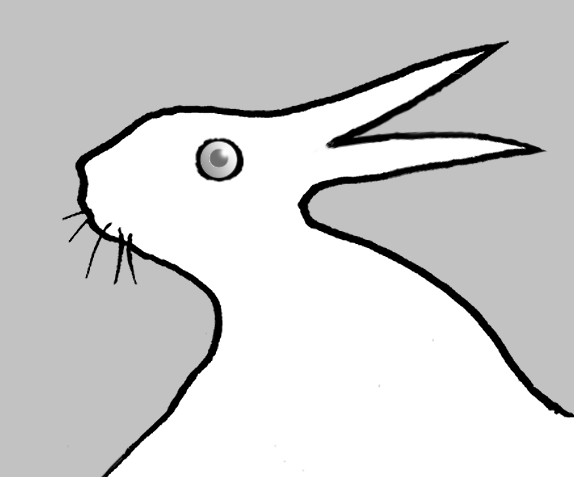
Over and under signification – Within materialism, subjectivity could be said to be under-signified. Within idealism, objectivity is treated in a similar way. Both extremes over-signify their own perspective at the expense of the other, however, this relation can be seen as just another face of perceptual relativity. Is it wrong to see the duck or is it wrong to see the rabbit? MSR attempts to bring this reconciliation within philosophy of mind by producing an ontological model based on the continuum of sense in which duck and rabbit are only two possibilities along a universal spectrum.
p-vacuum – see philosophical vacuum
p-Zelig – An alternative to philosophical zombie (p-zombie) , borrowing the name from the title of the Woody Allen about a character who takes on the physical traits of those around him. See chameleon brain.
Pansensitivity and Panmechanism – Taking a cue from panpsychism, panmechanism and pansensitivity are two new variations to represent the role of awareness in the universe. Pansensitivity specifies a primitive aspect of nature which is felt or detected in some way, but not necessarily as a ‘mental’ phenomenon or human-like experience. Panmechanism would assert the opposite primitive, that all phenomena is fundamentally unconscious. In spite of the popularity of panmechanistic views, the evidence of our own experience makes them difficult to take seriously unless some plausible link could be found to bridge the Explanatory Gap. MSR takes pansensitivity further, to Primordial Identity Pansensitivity.
Perceptual Inertia – MSR considers perception, including inner perceptions, to be the universal underpinning of physics. As such, it is proposed that experiences themselves accumulate a kind of aesthetic momentum. Local intentions, over time, acquire associations from other experiential frames. The weaving together of multiple perceptual histories is known in MSR as perceptual inertial frames, and the weaving itself is known as soltrophy.
Perceptual Inertial Frame (PIF) – In practice, this concept is similar to other philosophical concepts such as lebenswelt, umwelt, or niche in that it refers to the world as it is experienced by some subject. The perceptual inertial frame of a child is different from that of an adult, as would any age or social position have its own set of stereotypical qualities. Eigenmorphism describes how dissimilarity by scale, morphology, or history is a determining factor in how any given PIF presents every other PIF. This is roughly analogous to how optics can predict the anamorphic reflection of a reflective cylinder or the distortion of a fisheye lens. Tying in occasions of perception to the physics concept of inertial frames, the PIF model provides a framework for connecting universal and physical ontology to local experiential scope and quality, and it provides a possible scientific basis to investigate that connection further. See also eigenmorphism, solitrophy.
Perceptual Relativity – Perception is profoundly relativistic. Certain optical illusions can be used to help us understand concepts like opponent processing and multistable perception. What looks like dark grey next to white will look like light grey next to black, and indications of shadow and naturalistic form contribute also to perception. General and Special Relativity, in a very different way, assume perception-like definitions of physics. What is relativity if not some sensible relation? The main difference between the concept of inertial frames and multistable perception is that perception is private and presumed limited to living organisms, while physical groupings are public and considered universal to all material bodies. If that is true, it would make sense that both materialism and idealism (whether spiritual or information-theoretic) would mythologize presentation into fictional terms. Both material and ideal monisms, through their absolutist de-presentation of naive realism, subscribe to unacknowledged dualisms. Materialism and idealism do not explain each other, they only label each other illusions or emergent properties. Philosophy of Mind it seems, is itself a feature of perceptual relativity.
Perceptual Stack – Refers to the stack of perceptual inertial frames (PIFs) which constitute an experience or modality of consciousness. For example, what you are reading is a stack of perceptions ranging from the sub-personal (pixels > loops and lines) to the personal (letters > words > sentences > meaning) to the super-personal (coincidence and timing, metaphorical insights). See also Entropic frames / Holotrophic frames.
Philosophical Vacuum (p-vacuum) – It is said that Descartes formulated his famous cogito ergo sum (je pense, donc je suis: I think therefore I am) by methodically questioning every bit of reality that he could. Pretending that an evil demon was supplying him with “a complete illusion of an external world, including other minds”, Descartes found that he could doubt everything with the exception of his own thought. In modern contexts, philosophical approaches such as computationalism and eliminativism challenge the supremacy of the solipsistic approach, citing neurological or informational phenomena as underpinning conscious personal awareness. MSR seeks to empty the field of assumptions even farther, to the point of absolute incoherence – to the point at which sense itself cannot be questioned by virtue of the inherent sensibility of questions and doubt. The perfect philosophical vacuum can include only the minimum ingredient required to provide for itself. Called sense in MSR, this ingredient is suggested to be a primordial capacity to receive and appreciate affect and to participate or project effect. Information and physics are seen to require sense as a precursor, so that while Descartes may have been premature in assuming personal cognition as primordial, modern mechanism may be equally premature in assuming automation. As a cosmological foundation, sense is not limited to human experience or biological experience. To the contrary, all phenomena are deemed to extend from some experienced perspective on some level, since there can be no difference between that which can never be experienced and that which does not exist.
Post-Particle Physics, aka Quorum Mechanics – A reinterpretation of quantum mechanical phenomena as fundamental feelings through which private presentations and public representations are metabolized. By pansensitivity, measurable phenomena are presumed not to emerge from nothingness (or nothingness-like-fluctuations) but rather they diverge from everythingness through self-convoluting insensitivity. What is measured by physics is not reality, it is the body’s measurement of the interactions of other bodies and instruments, themselves already fixed and frozen as facades within a stack of perceiver-specific inertial frames. This inverts the assumptions of both materialism and computationalism, such that all realized forms and functions, all particles and waves, are, from the Absolute perspective, the expressed antithesis of the primordial identity (pansensitivity).
Presentation Problem – Since even before Descartes substance dualism, Philosophy of Mind has been preoccupied with the gap between nature and mankind. Many different thinkers have posed questions which relate to self and world, mind and body, or mind and brain. MSR posits an essential theme which runs across the most important philosophical problems in that they all are really asking how we can account for the presentation of experience as aesthetic phenomena. MSR posits a solution to this problem, which includes the Hard Problem of Consicousness, the Explanatory Gap, the Symbol Grounding Problem, and the Binding or Combination Problem whereby aesthetic sensory experience is actually the fundamental metaphysical agenda.
Totality
Primordial Identity Pansensitivity (PIP) – Asserts that pansensitivity is not only a pervasive physical force, it is the sole ontological primitive, from which all forces, fields, energies, and dimensions diverge. Under PIP, ontology itself supervenes on sense. Striving for the perfect philosophical vacuum, no premise of rationality or sanity is taken for granted, it must be constructed within a ‘bare metal operating system’ of sensory participation.
Primordial improbability – A strange idea which relates awareness to coincidence, mutation, and statistical probability. By inverting the assumption of probability as inevitable (which is really only a naive intuition as far as I can tell, and could relate to local conditions rather than Absolute conditions), improbability emerges as a kind of fixed immeasurability from which all measure and rational expectation emerges. The rational diverges from the trans-rational. In any statistical analysis, the probability that what is being analyzed is sentient is the least rational possibility. A technical analysis of a stock market, for example, could have exotic statistical causes ascribed to trading patterns, but could any proposed cause of a statistical pattern be more exotic than if the pattern itself reflects some kind of intentional awareness. Surely it would be insane to suggest that the stock market had a mind of its own and made decisions according to its mood, yet that is precisely the cause that we must accept to explain the coordination and coincidence of processes within our brain and body. Even if we go with an eliminative materialist explanation of mind, and call it an epiphenomenon, it would be no less strange and miraculous to have guessed that the stock market would be possessed of any similar epiphenomenology. The premise that order, life, and consciousness are somehow related to a vastness of improbability is intuitively appealing and scientifically supported already, but taking that to an extreme may yield an altogether revolutionary insight. Statistical relation, as the mechanism behind teleonomy (the machine of the machine, or the automation of automation) fits well as the the polar opposite against teleology. To sense and will intentionally is to initiate a proprietary and local break from the generic and universal, and this it’s manual control is the antithesis of automaticity by probability.
Private physics – Physicalism is not without its charms. Certainly the correlation of brain activity with subjective experience is strong enough to warrant a respect for physics in the realm of subjectivity. Even so, the vast differences between our private experience and what can be measured publicly combined with the undesirability of resorting to metaphysical influences provides ample justification for redefining all phenomena in the universe in terms of their privacy or publicity, while retaining the underlying concrete realism implied by the term ‘physics’. What we experience psychologically can only be physics, but physics, on some level of description, can only be psychological.
Profound Edge and Pedestrian Fold – Two conceptual meridians within the multisense continuum which are opposing midway points between subjectivity and objectivity. The pedestrian fold is what occurs ‘in front of our face’ as perceptions in a world of social human interaction. The profound fold is what might occur ‘behind our backs’ during extraordinary states of consciousness where personal experience seems fused with the Absoute, either directly as a mystical experience, or indirectly through understanding of complex mathematics. The contrast of ‘edge’ and ‘fold’ is intentional, as the former connotes a twilight or occult transition from private to public, while the latter is presented as a matter of fact.
Qua – The conceptual root of both quanta and qualia. Synonymous with the Absolute, sense, and pansensitivity, qua proposes that private feeling and public measurement diverge from a common sense, rather than emerge from a senseless process.
Quanta and qualia – Quanta is used here to mean quantum mechanical entities, numbers, and measurement in general. Qualia, means the ‘raw feels’ of sensation (i.e. the experience of the redness of red, as distinct from any information processing or biochemistry associated with producing that effect). Within MSR, qualia is distinct from sense only in that it has been diffracted one step so that it allows private intention. Quanta is the common residue of all diffraction – the public answer to the private question.
Qui – (who?) would be the hypothetical ‘other half’ of the quantum wavefunction, and can be represented (obnoxiously, but memorably) by the sideways letter psi. This signifies that aesthetic presence and qualitative appreciation (being and feeling) is orthogonal to the doing and knowing of quantum mechanics. Qui is not the measurement but the context of orientation from which measurement is experienced. It is explicitly neither wave, particle, form, or function, but neither is it non-wavelike, non-particle-like, formless, or unrelated to function. Qui is exactly what being alive is to us as human beings, except on a much more primitive level. It is the capacity to participate as an oscillating source of both animistic and mechanistic qualities.
Quorum mechanics – See post-particle physics
Range and scope – Reminds us to use sense metaphors rather than abstractions such as ‘force’, ‘field’, and ‘law’. MSR suggests that all behaviors that we can observe are, on some level, a comparison of sensitivities and motivations. A radio receiver does not receive an electromagnetic field through its antenna, rather the radio is a device to exploit the natural harmonic affinity between all materials (which makes it easy to carry, for example, the vibrations of vocal chords, to microphones, to electric circuits, to broadcast towers, receivers, headphones, eardrums, and neurochemical circuits).
Sensorimotive Electromagnetism – The conjecture that magnetic and electric fields are felt directly through matter as sensory affect (magnetism) and motive effect (electricity). It may be more correct to correlate sense and motive to the interior dynamics of particle and wave, since quantum level effects can be more fundamental than electromagnetic effects, however with PIP and Post-Particle Physics, electromagnetism could be the last ‘real’ level of physics, before we begin sinking into a misinterpretation of the common sense of matter for material presences themselves. The main point is to draw the parallels between sensory-motive receiving-projecting and the binary vs analog sensibilities of electromagnetism. This view reasons that since electromagnetic changes in the brain are so closely associated with changes in consciousness, electromagnetism itself may be a primitive form of awareness. It is only our indirect measurement of electromagnetism which misleads us into assuming that EM is non-sensory.
Sensory-Motive – In biology, afferent and efferent are terms used to distinguish the nerves which receive sensory input from the motor neurons which effect a response from muscle cells. The human brain stem, likewise, has an upper and lower region. When the former is damaged, it produces a vegetative coma state (no sense). When the lower region is damaged, it produces paralysis of the body but no interruption to consciousness. Seeing this part of a universal pattern, sensory-motive phenomena is proposed as the most local description of sense. There are many morphological analogs within biology – head and tail, flower and stem, tree and trunk, etc as well as elementary particle analogs of charge and spin. Because animals are convoluted on many levels between the elementary and the zoological scales, we can distinguish between inner control of attention (motive effect) and outer influence over the body in the public world of bodies (motor effect).
Sole Entropy Well – The MSR alternative interpretation of the Big Bang is knows as the Big Diffraction. The Sole Entropy Well model assumes the Big Diffraction interpretation of boundaryless transmultiplicity rather than a pointillist singularity, and adds a solution to Loschmidt’s paradox. The paradox notes the contradiction of a universe in which total entropy is perpetually increasing, and an initial condition in which low entropy appears out of nowhere. Boltzmann’s entropy curve suggests a statistical fluctuation in low entropy conditions, which, like the metastable vacuum flux and Many Worlds Interpretation cosmologies, produce a kind sleight of hand. Instead of failing to explain one universe, they presume to show how the creation of this universe could simply be the consequence of the existence of many universes (which also cannot be explained). Bypassing this false satisfaction, the Sole Entropy Well model proposes that entropy can only arise from a single source of all significance, and that source is the capacity for sense itself. If we are talking in information theory terms, we can use ‘signal’ instead of sense, such that the capacity to send and receive signals is the always the maximally significant signifier. The highest entropy would be the loss of the capacity to connect with anything in any sense – which would be annihilation. The universe, therefore is a continuum of sense (significance production) which expands into its own modulated insensitivity (entropy diffraction, aka spacetime). See also altruistic monad.
Solitrope – A local attractor which represents, in some sense, the Absolute. Home would be the solitrope for a family. Profit for a business. Water for a living organism. The promise of solace, salvation, safety. Take Leibniz’ Monadology and add a dollop of Process Philosophy and we get something like an advertisement for the Supreme Monad – a local oasis, perfectly appealing in its opposition to ‘the whips and scorns of time’.
Solitrophy (Solitropy) – If solitropy is the tendency to want to ‘pass Go and collect $200′, then solitrophy is the desire to do more and have more each time the cycle is complete. Solitrophy is used in some esoteric diagrams to imply the weaver of worlds from the thread of entropy and significance. Solitrophy is the unacknowledged aesthetic aspect of evolution – the proliferation of richer simplicities which belie the purely statistical emergence of complexity.
sub-personal, super-personal – A more general approach to integrating what has been called the Subconscious or Id and Superego or Collective Unconscious. See Sub-private.
Sub-private, private, super-private – Terms designed to weave together math, physics, and phenomenology because they focus on privacy as an ontological feature. If we want to look at awareness from a functional perspective (disclaimer: don’t do this unless you already understand that function must rely on the aesthetic qualities of sense to generate significance), we find that privacy is a plausible justification for the difference between physical and phenomenal aesthetics. See private physics.
Superposition of the Absolute – While the concept of superposition has enjoyed wide acceptance on the microcosmic level of quantum physics, the idea of the Totality of the universe being a kind of multistable perception has not been considered. The superposition of a wavefunction is tolerated because it helps us justify what we have measured of particles once they have decohered, but under PIP, the entire cosmos can be understood to be perpetually in superposition, or perhaps meta-superposition in which fully half of the universe is in superposition and subject to private interpretation (perceptual relativity), while the other half is an accumulation of measurable histories (bodies in space). If this were true, it invites the possibility that all wavefunctions share the identical, nested, non-well-founded superposition, one which can be understood as sense or perceptual relativity itself.
Super-Signifier – Stems from the hypothesis that gods or archetypes are figures which represent superlative qualities. This can be derived from an evolutionary psychology perspective, in which stories circulating about the qualities of people and places are exaggerated into a successively fictionalized hyperbole hierarchy. To amplify the significance of good and bad into super-significance, composites of personalities are condensed as heroes and villains, divine and evil, and finally absolute divinity. From a teleological perspective, mythology, which reigns even in modern contexts as celebrity and commercial branding, is a guiding, mandala like fetish that permeates our local privacy from what could be called super-privacy or eternal privacy (aka Jung’s Collective Unconscious, the Australian Aboriginal Dreamtime, etc).
Syzygy – The word syzygy can refer to either a literal alignment of three bodies, such as the Sun, Earth, and Moon during an eclipse, or figuratively as the yoking together of opposites, as in Jung’s animus and anima. Because the two meanings are opposites in the sense that the first is expressly physical and the second is psychological, the word syzygy is itself a syzygy in the second sense. The overlapping sense of mandala, monad, and syzygy is a strong theme in MSR, and many diagrams follow this pattern.
Transmeasurable or Transmultiplicity – The idea that measurability itself is only one sensible context among many, so that even infinite computation is dwarfed by finite experiential (aesthetic) qualities. . Mathematically this translates into the suggestion that all infinite sets are actually smaller than the Absolute set (which is aesthetic under PIP) , which is technically finite but transmeasurable. The primary colors for example, Red, Green, and Blue (or Red. Yellow, and Blue) contain or reflect vastly more ‘values’ than could any quantitative description of wavelength/frequency, even when that description is divided infinitely (or into virtual sub-Planck units). Because each part of the visible spectrum represents its own location within the continuum literally as well as all color combinations figuratively, the sense of finite primary and secondary hues evokes more value than could computable wavelengths alone, even though they are potentially infinite.
Unlikelihood – See Primordial Improbability
UPP Hypothesis – A variety of pansensitive alternatives to PIP.
Wholes through holes (Subtractive coherence or Transrational Gestalt Algebras) – The property of perception to present a simple but rich sensation rather than a complex data set. Unlike a symbol, where representational meaning is specified artificially, raw perceptions are instead understood to cohere on their own level in a bi-directional fashion. We can see this as we project images and meanings on what we see due to our personal awareness and cultural influences. The Rorschach effect is more indicative of private physics than Bayesian processes – the bottom up selection means nothing without a top down expectation of simplicity and wholeness.
Yellow Light – Used as a metaphor in describing how free will can be compatible with determinism and incompatible at the same time. In a traffic light, the red and green signals are taken to issue an unambiguously deterministic command. The yellow light points to the driver to use their own awareness and judgment. The yellow light is really a meta-signal that relates to the status of the what the signal is going to do. In the same way, our will allows us to try to inject more freedom to reinterpret signals and create unprecedented intentional effects.





 Multisense Realism



Recent Comments