Archive
Philosophical Gender

Like sexual gender, the psyche tends to favor hovering around one aesthetic preference at a time. So much of philosophy seems to be rooted in just that, the aesthetic preferences of the psyche. How else should we explain why we are so often personally attached to our philosophical views – why we are in fact attracted to them, and to writers and speakers who have espoused similar perspectives.
Many are traditional in their philosophical tastes, and find that even the thought of experimenting with other views makes them very uncomfortable. Others find it natural to consume philosophy of all sorts, the more the better, but at the same time they may favor one particular flavor, or they may get sick of the whole intellectual-masturbatory scene eventually.
Philosophy engenders a feeling of firm orientation within it, despite the many other options available which might directly contradict it. That’s sort of the hook. A particular way of looking at things makes you feel that you are on the right track, maybe for the first time. It can change the way that you feel about other ways of acting and thinking. Like hitting puberty, what was once merely charged with social naughtiness and furtive mystery becomes irrepressibly intense. Childish ways of behaving, especially those which cross gender or leave it undeveloped are often discarded in shame and become repulsive, at least publicly. Gender is suddenly unexpectedly prominent, and exaggerated to the point of caricature.

Philosophy is almost inevitably tied to politics. Views on what the universe is, though seemingly esoteric and remote, have a way of filtering into our attitudes about everything from nature and technology, to society, personal responsibility, money, possessions, art, drugs, literature, etc. Early math is practically inseparable from philosophy.
There are many polarities and nested polarities within philosophy, especially philosophy of mind. I often focus on reducing those polarities (reductive vs non-reductive…there’s another polarity) to a single hetero-normative gender which I am lately calling Anthropmorphism and Mechanemorphism, but have also referred to it as ACME and OMMM, Oriental Animism and Western Mechanism, Public-entropic and Private-holotrophic, and for those with a symbol fetish, ((-ℵ↔Ω) ↓ ºt) and (ωª ↑ (H←d)).
In the course of studying this swirl of gender, it became apparent that the swirl itself could be transcended philosophically. While the battle between mind-firsters and body-firsters rages on forever, the battle itself can be seen as their most powerful overlap. Somehow even in the antiquated writings of long dead thinkers (well, the thinkers who were deemed white enough and male enough to be published anyways), fresh controversy can be sparked. It’s remarkable, really. The enduring conflict, a perpetually circulating difference of opinion on everything, the difference between differences, and different ways of defining difference, and defining definition.
Is philosophy is a strange attractor?
“The Lorenz attractor is an example of a strange attractor. Strange attractors are unique from other phase-space attractors in that one does not know exactly where on the attractor the system will be. Two points on the attractor that are near each other at one time will be arbitrarily far apart at later times. The only restriction is that the state of system remain on the attractor. Strange attractors are also unique in that they never close on themselves — the motion of the system never repeats (non-periodic). The motion we are describing on these strange attractors is what we mean by chaotic behavior.”
If there were an ‘end’ to all of this (which is what exactly?) I think that it can be found not in being and nothingness or in difference and repetition, but in recognizing the commonality of conflict – the sense which discerns between differences and which also is the motivation which negates indifference. Carrying this principle into physics, and then mathematics, what it looks like is that a revolution of the most primordial propositions should be considered:
- The number ‘one’ should be reinvented and restored as the root of the number line.
- Zero should be regarded as neither a real or imaginary number, but rather an imaginary absence of all number.
- The Big Bang singularity should be reinterpreted to reflect this new understanding of 1 and 0, beginnings and endings.
Here is the main insight: Since the difference between a difference (1) and indifference (no difference = 0) is in fact a difference, the two concepts are not perfectly symmetrical negations of each other, but rather, indifference, like nonsense or disorder, is a qualifier of difference. Zero is just 1 minus itself. In a universe of just the concept of 1 and subtraction, 1 would have to reproduce itself once in order to have another one to subtract, and then reproduce itself once more in order to carry out the subtraction. One cannot disappear, and zero cannot generate any numbers or operations. They don’t cancel each other out, they nest within each other in strange loops.
In this way, as I have posted before, the Big Bang must never be considered an explosion in space at some particular moment in the past, but rather it is the frame of all events, and all spaces. We are within the Big Bang, which was not a 1 emerging from 0, not a Universe from Nothing, but the opposite. What I call the Big Diffraction is “The Universe Within Everything”. The whole of physics can be seen as pieces to the puzzle which is getting more piece-ier and peace-ier as it goes on. The whole of mathematics can be seen as taking place within the number one, transformed, non-Euclidean style into the Absolute set of all sets. One is not an object, it is a primordial language of experience, of sense and sense making – a singularity not only of quantity, but of ontological-psychophysical gender.
But wait. Sense is not just a matter of being and knowing, it is also a matter of sensing and thinking, of comparing. It does not resolve the Material and the Experiential as being ‘the same thing’, it resolves them as both being equal to the same thing (1) in the opposite way. The Big Bang is not just 1, it is more like “=1”. This is a more primordial opposite even than being and nothingness, since nothingness can only be imagined by something. The relation of = to 1 is as opposite of that of 1 and 0 but more subtle. Just look at the characters. Parallel horizontal lines compared with an arrow-like stroke of singular effort. I guess I’m getting too into this, but whatever, consider it a piece of Suprematist art. It’s a before and after, an open canal, and an erect figure. An invitation and an expression. There’s a whole philosophy lurking in there just in the shapes of arithmetic symbols. Hmm.

Superpositioned Aion Hypothesis

Above, an ankh appropriated from here, superimposed on the MSR diagram. I have included Sense and Motive, reflecting the circuitous, super-personal nature of the Aion/Eternity (collective/Absolute sense) and the cross of what Bennett calls ‘Time’ (I call personal sensory awareness) vs what he calls Hyparxis (“an ableness-to-be”, aka motive participation).
“The English philosopher John G. Bennett posited a six-dimensional Universe with the usual three spatial dimensions and three time-like dimensions that he called time, eternity and hyparxis. Time is the sequential chronological time that we are familiar with. The hypertime dimensions called eternity and hyparxis are said to have distinctive properties of their own. Eternity could be considered cosmological time or timeless time. Hyparxis is supposed to be characterised as an ableness-to-be and may be more noticeable in the realm of quantum processes.” – source

- Aion and Gaia with four children, perhaps the personified seasons, mosaic from a Roman villa in Sentinum, first half of the 3rd century BCE, (Munich Glyptothek, Inv. W504)
The word aeon, also spelled eon, originally means “life” or “being”, though it then tended to mean “age”, “forever” or “for eternity”. It is a Latin transliteration from the koine Greek word (ho aion), from the archaic (aiwon). In Homer it typically refers to life or lifespan. Its latest meaning is more or less similar to the Sanskrit word kalpa and Hebrew word olam. A cognate Latin word aevum or aeuum for “age” is present in words such as longevity and mediaeval. source
The universe seems to want to be understood both in two contradictory presentations:
1. As the timeless eternity within which experiences are rationed out in recombinations of irreducible elements.
2. As the creative flow of authentically novel experiences, whose recombination is impossible.
If we can swallow the idea of superposition on the microcosmic level, why not the astrophysical-cosmological level? Whether the universe seems to be gyrating in a direction that paints your life in a meaningful and integrated light, or it has you struggling to swim against a sea of chaotic scorns is as universal an oscillator of probabilities as any quantum wavefunction.
These fateful cyclings of our personal aion are reflected also in the micro and macro of the Aion at large . With the unintentional dice game of quantum mechanics flickering in and out of existence far beneath us, and fate’s private wheel of fortune seemingly spinning in and out of our favor intentionally just beyond us, the ultimate superposition is that of the eternal and the new.
How can the universe be a relativistic body in which all times and spaces are objectively present, and an expanding moment of being which not only perpetually imagines new universes, but imagines imagination as well? Why not apply superposition?
“In physics and systems theory, the superposition principle, also known as superposition property, states that, for all linear systems, the net response at a given place and time caused by two or more stimuli is the sum of the responses which would have been caused by each stimulus individually. So that if input A produces response X and input B produces response Y then input (A + B) produces response (X + Y).” source
The universe is generic and proprietary, eternally closed but momentarily open and eternally open but momentarily closed. It/we are always changing in some sense, but remaining the same in every other. Within the Aion, all opposites are superpositioned – bothness, neitherness, and only-one-and-not-the-other ness.
Breaking The Fourth Wall

Sense (in the Absolute sense) reveals itself reflexively as the Uni-verse, aka monad of non-orientable self-juxtaposition, aka, “the Pansensitive Meta-Lectic Solitrophic-Holarchic Multiphoric-Unametry”, provider of implicit unity (likeness) across multiplicity (private sensory afference) and explicit participation (public motor efference) through intentional animism and automatic mechanism.
reflexive
1. Directed back on itself.involution
entanglement; a spiraling inwards; intricacy
(mathematics) A function, transformation, or operator that is equal to its inverse, i.e., which gives the identity when applied to itself.tessellation
the careful juxtaposition of shapes in a pattern; “a tessellation of hexagons”.non-orientable
A surface S in the Euclidean spaceR3 is orientable if a two-dimensional figure (for example,) cannot be moved around the surface and back to where it started so that it looks like its own mirror image (
). Otherwise the surface is non-orientable.
The Möbius strip is a non-orientable surface
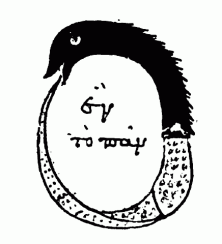
The Ouroboros or Uroboros is an ancient symbol depicting a serpent or dragon eating its own tail.
The Ouroboros often symbolize self-reflexivity or cyclicality, especially in the sense of something constantly re-creating itself, the eternal return, and other things such as the phoenix which operate in cycles that begin anew as soon as they end. It can also represent the idea of primordial unity related to something existing in or persisting from the beginning with such force or qualities it cannot be extinguished. While first emerging in Ancient Egypt, the Ouroboros has been important in religious and mythological symbolism, but has also been frequently used in alchemical illustrations, where it symbolizes the circular nature of the alchemist’s opus. It is also often associated with Gnosticism, and Hermeticism. Carl Jung interpreted the Ouroboros as having an archetypal significance to the human psyche.[citation needed] The Jungian psychologist Erich Neumann writes of it as a representation of the pre-ego “dawn state”, depicting the undifferentiated infancy experience of both mankind and the individual child.
Early alchemical ouroboros illustration. From the work of Cleopatra the Alchemist (Greco-Roman Egypt).Autopoiesis (from Greek auto-, meaning “self”, and poiesis, meaning “creation, production”) refers to a closed system capable of creating itself. The term was introduced in 1972 by Chilean biologists Humberto Maturana and Francisco Varela to define to the self-maintaining chemistry of living cells. Since then the concept has been also applied to the fields of systems theory and sociology.
Bootstrapping or booting refers to a group of metaphors which refer to a self-sustaining process that proceeds without external help.
The phrase appears to have originated in the early 19th century United States (particularly in the sense “pull oneself over a fence by one’s bootstraps”), to mean an absurdly impossible action, an adynaton.Trompe l’œil (French for deceive the eye) is an art technique that uses realistic imagery to create the optical illusion that depicted objects exist in three dimensions. Forced perspective is a comparable illusion in architecture.
Breaking the fourth wall is when a character acknowledges their fictionality, by either indirectly or directly addressing the audience. Alternatively, they may interact with their creator (the author of the book, the director of the movie, the artist of the comic book, etc.). This is more akin to breaking one of the walls of the set, but the existence of a director implies the existence of an audience, so it’s still indirectly Breaking The Fourth Wall. This trope is usually used for comedic purposes.


The Field, Part I
I’m about halfway through Lynne McTaggart’s “The Field”, which is worthwhile even if a little New Agey in style for my current tastes. She does a good job of telling the stories of scientists who have been studying consciousness, and painting a picture of a universe of quantum coherence that consciousness can tune like a radio. In many ways I agree. If I had to flatten my model of the universe, it would probably look just like The Field. I can almost accept a universe of vacuums full of energy and matter as charged space, but I think with a simple inversion, we can find ourselves in a universe of sense and reality, rather than simulation and holography.
I feel that Multisense Realism picks up where The Field leaves off. The notion of zero-point field and holographic transformation of wave interference patterns through microtubule quantum superposition being responsible for human consciousness is visionary, and I think almost true, but it still doesn’t jump from the easy problem to the hard problem. This view doesn’t explain why, if you have holographic interference patterns that contain tremendous amounts of information, why would it get transformed into anything other than what it is? Why does the transmission and reception of zero-point light feel like something?
If we turn this model inside out however, we might say that it is not wave interference patterns that are transformed holographically into experience, but multidimensional experience casting a 3-D shadow as holographically interrelated waving objects. It’s not wave patterns being reconstituted as a simulation or projection, but fantastically rich experiential realism that is being stepped down into flat quantitative mechanisms across space.
In the same way, the observation that “Consciousness at it’s most basic, was coherent light” would make more sense as “Light, at it’s most basic, is coherence (sense)”. Instead of this metaphysical notion of matter being eddies in a cosmic sea of light, we should ask why it is that our naive realism always seems to show us the opposite – a universe of objects in space, islands of light and coherence in a field of emptiness. We should ask why it is that tiny bits of substance can profoundly impact our minds and bodies, but rhythms and frequencies don’t seem to have much of a universal semiotic consistency. Seeing a graphic visualization of music has only vaguely consistent association with the aural experience of it. I’m not advocating naive realism, but rather than a counterintuitive metaphysics of quantum mechanical waves in space time creating a holographic consciousness, I suggest a counterintuitive physics of matter creating time and space by waving at itself. We are who is waving. Hollow, boundary-less, and eternal, but concrete and real – local temporal confinements of a timeless experiential firmament. There is no ‘light’ in space, only in our experience. Our ability to sense visually is activated through illumination of the sense organs themselves.
Where we are now, most of us can only conceive of an exteriorized universe. Even though our every moment of life is clearly spent as an interior narrative of an exterior circumstance, we assume that this is limited to living creatures. If we extend the possibility of interiority to all matter, we find that the external symptoms of consciousness – energy, coherent light, patterns, zero point field, etc is only the surface layer that is available to us through the stepped down architectures of our body and the instruments we have made for it. In a universe where matter is literally experience, the temporal distortions of General Relativity can give us a clue as to how different kinds of perception might co-exist, nested within each other, not just holographically but holotemporally. Time within time that can be modeled as inertial frames of scale from microcosm to macrocosm, confined to particular ranges of experience by frequency and wavelength. Not energy in space pretending to be matter, pretending to feel, but feeling through time re-presenting itself as energized matter across space.
Everythingness Perturbed: Function, Experience, and Context
Since every organism produces itself from a single dividing cell, it can be said that there is a single history which unites that body back to the cellular level. Atoms do not literally reproduce by themselves so that a machine that is assembled has a no single history to unite it.
This becomes more relevant if we suppose that experience arises as a collected and collective unity of sequence, a many-to-one of integrated participation which is not literal and quantitative, but figurative, qualitative, and iconic. It is meaning and world.
A machine is an abstraction which takes physical history for granted. When executed in a material assembly, there is no literal reproduction, only separate parts brought together unintentionally (from the point of view of the parts) to imitate the function of a specialized organic form.
I think that where comp/functionalist assumptions fail is in the misunderstanding of meaning and world as discrete analytic behaviors rather than continuous synthetic wholes. We can see them as wholes because we are unified beings who can see even cartoon characters and puppets as wholes, but that does not mean that there is any continuous awareness that unifies the parts of the machine. To compensate for this, we generally have to build in a monotonously recursive device, like a clock, pump, or wheel to provide an imitation of continuous flow. This should not be confused with the continuous flow which arises organically in a living body. An organic flow is not a clock to which separate parts are mechanically attached, but a collective rhythm which is synchronized from within the shared motive of the reproduced cell. This is can be seen clearly in the behavior of heart cells as they congregate physically and experientially. Look at what it is:
See the difference?
The cells are pushing a private negentropic agenda, while the clock has no agenda at all. You can see it. It is one dimensional tension in a material like metal or winding down one tick at a time, or an electronic response from a semiconductor material. Neither materials have any native motivation or momentum, they must be wound up or plugged in, wired or bolted together. It is a back door imitation of an organism, artificially integrated to use borrowed power to generate the effect of continuous running.
Consciousness has mechanical aspects as well, and indeed the content of our minds can be said to be running as well, but the difference is that the mind runs on it’s own momentum. More importantly the mind can be quieted so that deeper, unconscious experiences can rise to conscious awareness. These experiences do not seem to arise out of the rapidity of mental syntax as functionalism assumes, but out of deep metaphorical interiority which presents spontaneously and unbidden with insight and prescience rather than deterministically or randomly.
This can be explained by understanding the continuity of psychological experience as the entirety of time being scratched or perturbed by the collective experience of a subset of time. The entity is made of time (really meanings, characters, and worlds…stories. Time is an analytical abstraction that has to do more with objects, space, and density). This may seem mystical or esoteric at first, but I think that is because profound truth about subjectivity must by definition evoke the charms of self fetish. Oriental floridity. Super-signifying Hermeticism. Pageantry. It is who we are and why we are, as distinguished from what and how we are (bodies, cells, cities, planets…Occidental austerity. A-signifying quanta. Physical engineering).
Experienced history then, under multisense realism, is crucial. We are the polar opposite of a tabula rasa. The interiority of the stem cell is not a blank coin to be struck with a cellular role, but a ‘Once upon a time’ from which a spectrum of cellular characters and capacities can be diffracted. This is meaning. This is learning, understanding, loving, and growing (also hating, killing, forgetting and half remembering, making things up, creating etc.)
If experience were mechanical, then a clone could be conditioned with the identical experiences and an identical person would be created. If since strong computationalism is does not ground identity in material at all, we would have to say that a cloned body (machine + program) with cloned experience (runtime) would actually be the same person.
If instead we see experience as a unique and idiosyncratic subset of the totality of experience, there can be no Boys from Brazil strategy – no designer identities. Besides nature, nurture, and random variation, there may be a semantic momentum which opens up a flow of identity like a pinata of experienced history being hit with a series of blows: conception, birth, childhood, etc. It is not a process through which an identity is mechanically assembled or fabricated, but one in which identity is revealed and developed from within the self and within experience.
What does ‘within experience’ mean? It means meaning. Significance. The qualitative feeling or message ‘within’ experience. The moral to the story, the lesson learned, the point to be made, etc. Unlike a sequence of instructions or registers in memory, there is no a-signifying transfer of digitally encoded histories. Instead it is a recapitulation of signifying analog wholes. They are not assembled together like a device or dataset, but live with the subject as subjects, growing, changing, and revealing themselves in endlessly new ways through experience and also from within the subject – ripening and flowering, bearing fruit, etc.
Experience is not mere decision trees. Even though the visible shape of a living tree can be modeled in simple mathematical functions, there is no tree experience there. There is no journey from acorn to oak, only from vector to vector or pixel to pixel. There is form but no content. What is so hard to communicate is that the reason for this is counter-counter-intuitive. We expect the truth of subjectivity to be in a counter-intuitive hidden form. That there is some fantastic organization of the brain which gives us human experience. The idea that human experience is literally what it seems to be – a story of human life, grounded in the totality of the cosmic story is anathema to contemporary science. We are looking for the back door, the trick to the illusion, but the trick is that tricks and illusions are the exceptions to the rule. We can only know illusion because we have the sense to know that individual channels of sense can be fooled. That is no trick and no illusion. That is sanity, awareness, and consciousness.
A machine has no such sense. To a Turing machine, all binary feeds are equal. I have no problem at all asserting that there is no meaning and no world experiencing capacity associated with a binary feed. Imitation perception makes up for it’s qualitative superficiality with high speed execution, giving us the illusion of intelligence, but intelligence without meaning or world experience is a different kind of intelligence – one of pure syntax and no semantic kernel to grow and change through experience. There is trivial learning and adaptation, but it is a shadow play through which our own powers of interpretation can fill in the blanks. A humanoid decision tree, constantly running, with no creative iconic depths of its own.
Identical twins have many similarities, but even brain conjoined twins are different individuals. Their histories fundamentally diverge after conception and further diverge with each experience. Their perspectives are different. A machine is just the opposite. An old Macintosh Plus computer could be manufactured today, using the same materials, different materials, or even by virtually emulated on another computer entirely and be exactly the same as any Mac Plus that was ever manufactured. There is no retained history and no world awareness, no difference in perspective. Unlike conjoined twins, networked computers don’t fight with each other. They don’t differentiate themselves. Why? Because there is no self there to differentiate, only a perpetual centralized spinning. This is using space and motion to create the illusion of time – animation.
What we are is neither space, nor motion, nor time, nor information, but informed, moving, waving firmament. Not the wave but that infinitely anchored silent stillness of everythingness itself which is being perturbed in a wavelike manner and making shows within shows which we call time and experience, or, if you like, energy. Energy is a concept of the experience of one show being indirectly experienced in the context of another show. It’s anomalous but sensible. Like the end of Wizard of Oz where the three super-signifying (floridly fictional) characters are re-contextualized as ordinary (naturalistic fictional) farmhand characters in the desaturated aftermath of the dream
 Multisense Realism
Recent Comments