Archive
Bang!
If Big Bang was a singular event that created space, time and matter, then one must view the universe as a rapidly expanding billiards table of N dimensions with all events pre-determined. There can be no intervening force or new element of causality possible. There can be no uncertainty, and any notions of either free will or divine intervention are illusory.
If the Big Bang created time, then I think that it should not be thought of as an event (in time), but rather as the hub that all events have in common. The Big Bang never happened, it did happen, it is still happening, it hasn’t happened yet. Because we are measuring it from inside of spacetime, and using instruments that are limited to only the most generic spatial-quantitative measurements, our results reflect a narrowly defined model of the origin of causality itself. It is the fallacy of the instrument – we have a hammer of physics so everything that physics measures looks like a nail. What I propose instead is a Big Diffraction, where the birth of spacetime is an influx of dissociation into countless semi-permeable perceptual frames of reference that are united beyond spacetime.
If we place ourselves in the moment of the Big Bang, we cannot judge it on a human scale of time, since that scale of time had not been invented yet. If the universe itself is awareness, the first trillionths of a second of the invention of time are no less likely to feel like five minutes than they are an eternity. As the singularity breaks into multiplicity (Tzimtzum for fans of the Kabbalah), it is inventing the possibility of multiplicity for the first time. Eternity is spawning micro-eternities in which each micro-view is stretching out eternity so that it seems both ever longer and slower and seems to have originated in an ever more brief instant. Time is all about comparing frequencies of awareness – beats per measure. Time is relativistic because time is relativity itself – the framing of perceptual reference.
What we see through a telescope is an objectified version of the story of objectification that serves as a creation myth for the anti-mythology of functionalism. Free will was never inside of spacetime to begin with. It was not created, it creates. If free will is illusory, then it is that which is illusory which gives birth to realism and physics, not the other way around. The universe is a single thread of singing, signaling, significance-building experience,weaving and winding through a maze of its own self-imposed alienation. Divinity is optional, and free will is scarce, but the universe is only a billiard table if you limit the vocabulary of inquiry to that of billiard balls.

Topography of Eigenmorphism Part II
Another visual metaphor:
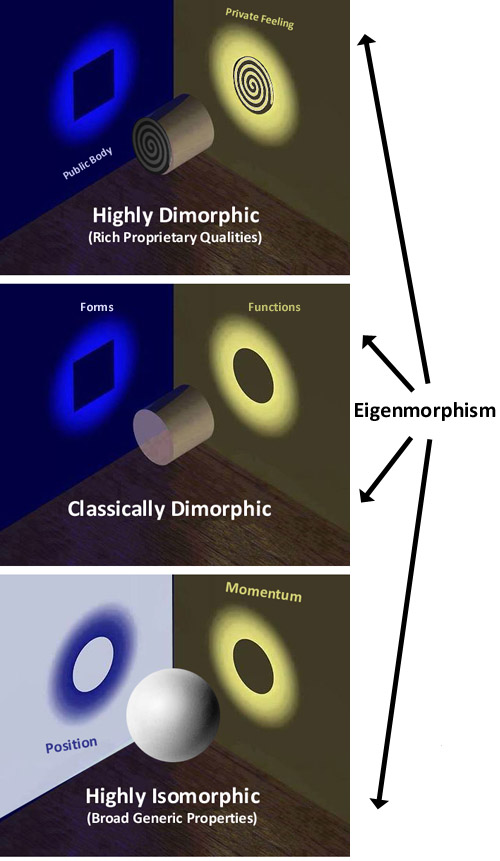
Eigenmorphism visualization part II
This diagram shows how elemental phenomena (bottom image) appear to us to have very little going on inside. Their public properties are not very body-like and their behaviors are imagined not to be very experiential. Eigenmorphism is the idea that as phenomena progress to richer experiential qualities, their interior and exterior nature expands in opposite directions. In biological organisms, the public and private view not only differ by perspective, but the interior perspective can increasingly elaborate itself (spiral grows) without the exterior perspective (square shadow) revealing any change.
It should be noted that this is a metaphor, not a diagram of matter or quantum. What the yellow wall refers to is actually shapeless, as it is the appreciation of and participation in experiences. The increasing elaboration of the shape stands for increasingly rich and varied modalities of sensitivity. MSR suggests that the three dimensional figure in the center is not real at all, and a better diagram would show the shadow from the blue wall and the shadow from the yellow wall gradually morphing into each other in stages.
The difference between the high and low ends of the eigenmorphic spectrum are not only in the degree to which their interior qualities differ from their exterior properties, or in the kinds of qualities which higher experiences contain, but also in ubiquity vs uniqueness. The generic nature of low level phenomena make them comparatively interchangeable and universal, so that physical and mathematical laws have a universal reach. The highest level phenomena can be esoteric to the point of near-solipsism, with meanings that are so multiplexed and poetic that they apply only to a single moment or perspective.
Biology From The Inside

This gif is one of the set that has been going around, but it reminds me of the concept that I have of biological awareness (as opposed to primordial awareness which is embodied by physics and does not require biology). Whether the inorganic universe is four dimensional (3 + 1 time) or just seems that way from within a two dimensional hologram, it seems likely to me that the experience of biological organisms is best modeled along a fifth axis (aesthetic qualities as more than the sum of their conditional parts).
What I like about the repeating gif, besides the coincidental “5” relating to the fifth dimension, is that it suggests a kind of morphological respiration. Front to back, parts to whole, a seamless, self-metabolizing transformation. As a biological organism, my experience of the outside world is limited to that which can be modeled as objects – that is, through an aesthetically reduced feature set in which a bunch of five dimensional urges and responses are flattened into a four dimensional narrative on multiple levels.
In a previous post, I was looking at how sensitivity might be understood as being ‘key composited’ or perhaps ‘discomposed’ across multiple frames of reference. By this I mean that the apparent distribution of our psychological interface across the tissue of the brain can be compared to a flatland visualization:
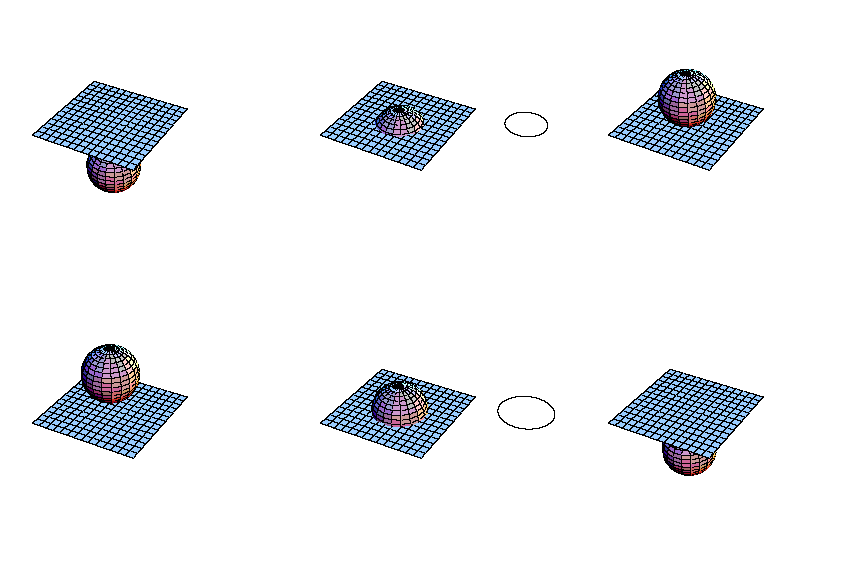
If instead of the sphere, it were a hand passing through the flatland plane, it would appear to the omniscient flatlander that there were five separate circles appearing separately, yet somehow seeming coordinated in their action. The fingers are part of a single hand, but within the constraint of the two dimensional sensitivity, the unity of the hand is discomposed across space in the literal sense, but figuratively some kind of unity can be inferred through the synchronized coincidence of the movement.
Now imagine that instead of another graphable dimension, the fifth dimension is one which is as orthogonal to spacetime as the three dimensions of space are to the one dimension of time. Feeling, like pain and pleasure, are like a coloring, or keying which cuts across multiple layers of seemingly unrelated public events. Not only is feeling a different kind of thing as forms or functions but it is a dimension in which dimension itself is transcended. Feeling is not a model or a measure, but rather it is the primordial context from which all measure is derived and all modeling is made demonstrable.
From the discomposed perspective ‘out there’, we are a coincidence of coincidences. A mysteriously synchronized, dynamic orchestration of hundreds of billions of neurons, organelles, molecules, etc which corresponds to the behavior of an animal’s body.

The feelings which we experience are not located in the tissue of the brain, rather the brain itself is part of the wider landscape of the totality of experience. The brain as a whole is, like our body as a whole and all of the cells and molecules that make it up at any given time, a four dimensional reduction of a transdimensional privacy.
Under Eigenmorphism, the base of each pyramid of perception is made up of the apex of countless low level pyramids of perception. When we look at an fMRI or the brain, we are trying to look at the view from top of our own pyramid through the blind eyes of its own bottom. Feeling is stripped out (not to mention the higher dimensions of meta-feeling/emotion/cognition/intuition) and we are left with a four dimensional mechanical skeleton with no interiority.
Being so impressed with ourselves and what we have accomplished by questioning our naive introspection with science, we naturalize the discomposed view and epiphenomenalize the native, gestalt perspective. All of this makes perfect sense within the flatlanded context of topological physics, where spontaneous appearances and disappearances are assumed only to reflect each other, rather than private transdimensional presentations.
I suspect that the universe which is experienced in the absence of all living organisms is a much different thing that it would appear to us. What we see as a four or two dimensional manifold is only a snapshot of discomposed histories. It seems inanimate to us because we seem so animated to ourselves. The highest awareness of our own interior physics seems to us unreal and crazy…and it is, relative to the inertia of human awareness as a whole. Like the inverted image of our retina however, I think that because our disposition spans so many levels of life and physical experience, we tend to see the mechanical patterns which all of the layers have in common, rather than the coincidence which is also animating them from the top down.
Like the transformer car in the gif, the signature of our presence and intention coincides with the interplay of entropy and significance. The living cell, from our perspective looking through our eyes and a microscope’s lens, looks like a homeostatic emergence. Seemingly conjured, like Brownian motion, from the statistical collisions of countless microphysical conditions.
This is not completely untrue. The mechanical conditions of a cell can be disrupted mechanically. There is bottom up causality. What has not been properly investigated yet is the other perspective. The one responsible for the biological property of healing and global integrity. If we think of the flux between entropy and significance as a carrier tone for biological life, then it might be easier to conceptualize how the universe is as much a dynamic interaction of nested simplicities as it is a mechanical progression from simplicity to complexity. The image of the metabolic transformer stands in contrast to the stillness of the axis of its transformation.
Orthomodular Panprimordialism

Playing around with a more math-friendly look and feel. Multisense Realism’s quant-flavored twin…Orthomodular Panprimordialism
I am really pushing it with the neologisms, but I am liking both of the recent adds, pansensitivity and now panprimordialism.
Pansensitivity is used to emphasize a position beyond panpsychism, idealism, and materialism where sensitivity becomes a palatable common capacity for all phenomena on its native scale.
Panprimordialism is used to emphasize the distribution of ‘one-ness’ across all phenomena, the relocating of all quantities to interrelated diffractions within the a sole, absolute singularity. This constitutes a figure-ground pivot from arithmetic assumptions which place zero or null as an absolute, such that all null values are considered a hypothetical representation of the sense of one’s self nullification.
The orthomodular lattice above gives some idea of that relation, with each node acting as the nexus for orderly juxtapositions within the overall monad.
Rosetta Codex

Following up on the Tree of Life post and MSR Legend post.
Multisense Tree of Life

Multisense Tree of Life
I noticed that this formulation was starting to take on Kabbalistic dimensions, so I put it into that form. There’s some new propositions to consider here that have come out of this. Beginning with sense, which I symbolize as -ℵ (negative Aleph) and as =. This is the fundamental concept of MSR and the idea of ℵ in mathematics as cardinality fits with this definition, since equality ‘is equal to’ anti-cardinality. Sense is the unity which underlies all multiplicity, so that it can indeed be thought of as a kind of negative cardinality – not unity, but pre-cardinality.
Moving up and to the right from sense, there is Qualia, now defined as -ℵ/ש (Aleph over Shin), where ש (Shin) refers to the diffraction of the Absolute ॐ (Om). This means that Q = -ℵ/ש or, private sense is the sense of a share of eternal being – it is “a” being. In Leibniz terms this is a monad, and it is also the origin of origination, and of the number 1. From these two entities, we have the two parts of the Absolute, which mathematically would be “=1”. Eternal being is the likeness of a being, i.e. the ability to pretend. (Insert Joseph Campbell’s myths and Carl Jung’s archetypes, shamanism, imagination, etc..,) Fiction is ‘like something’, just as Qualia is what it is like to be, or what being ‘seems like’.
Rounding out the primordial trinity from sense along with Qualia is Quanta and Motive. I call the Absolute ‘Qua’ to symbolize its relation as the reconciling parent of Qualia and Quanta. Quanta (ω, lower case omega), here meaning the essence of computation, is given the formula √(ℵ),(root of Aleph). This works surprisingly well. Originally I was going with 0.00…1 and then 0.x to represent Quanta, to specify that Quanta is always the tiniest fragment of Qualia – the drive toward absolutely monotonous precision, but always beneath the threshold of unity, of wholeness. All quanta are parts and abstractions; information-theoretic rather than aesthetic/sensory-motive.
This ended up working well with √(ℵ) (root of Aleph) as it makes clear the complementarity-antagonism with Quanta and sense. Computation is the essence of cardinality, of difference. The stepped reckoning of mechanism is an impersonation of sense, it has no capacity to negate the separations and to build feeling from fragmented quantities. Since negative Aleph (-ℵ) corresponds to 1, then Quanta would be the square root of -1, or i. I used the symbol >.< as well, to denote the clipping of sense through measurement: digitization. Quantification is fantastically useful because it paralyzes whatever it fixes its gaze on.
Motive, the third leaf of the sense trinity, has the formula ℵ±ש (Aleph plus/minus Shin), which emphasizes its similarity to Quanta and Qualia but with an irreducible difference, will. Will is the ± (plus/minus) which requires a participant to end what sense started (thus the use of Ω, Omega). To have a motive is to de-cide, to kill off all options except one. This is the ‘waveform collapse’ of QM, but it is also ordinary ‘free will’. Will is the connection between unconscious cardinality and the Absolute. We don’t know how to make our body move or our how to focus our mind’s attention, we simply become our mind or body and the universe does the rest. There is a cost to our efforts, however. In the drive toward Significance (Solitrophy, Φ), entropy is born.
The unchosen path of Motive becomes the unintentional twin of Significance. Significance, -ℵ² (Aleph squared), while mathematically would equal ℵ (Aleph) as 1, there is an irreducible numinosity to the power relation. Significance holds Q not only as the sense of one quality out of the Totality (ש) (Shin, Qua) but it holds one Q as equal to any number of qualities or meta-qualitative relationships. This is semiotics. Not just = but =². Not phoric (sense) but meta-phoric. Quanta is not phoric but metric – it takes the ² nesting of Significance (Σ) (Sigma) but negates the feeling, leaving only the essence of that figurative quality. Significance is sense squared, Quanta is the square root of pretend sense, the meta-phor is inverted. Figurative language is loose. It draws from associations from within the Totality. Quanta is the opposite, drawing from strictly disambiguated logic. It has no phoric or morphic content, no feelings or forms, only the skeletal coordinates associated with them.
If Significance is like the universal bank account of metaphors and of experiences which have meant something in particular, then Entropy is the compost heap of all of the unchosen and unchoosability in the universe. It’s symbol H is taken from Shannon’s Information theory, and its formula here is ॐ/-Ω, (Om divided by negative Omega). Using the ॐ Om rather than the ש Shin is to emphasize that this relates to the ‘return trip’, the catabolic, arterial part of the cosmic circulation. Shin has more of a sense of the diffraction and creativity of the whole. With Entropy, it is the Totality’s raw, untamed nature which is divided by negative motive. This correctly applies to the nature of Entropy as indifferent, literally and figuratively. No motive. This is where the universe doesn’t care.
Between H of Entropy and Σ of Significance winds the Φ of what I call Solitrophy. Solitrophy is what makes the difference between something that can care and something that can’t. Burning a pile of garbage and burning down a town might produce the same amount of energy and entropy, but burning down a town has a human cost which doesn’t show up on a spreadsheet. As aesthetic significance accumulates, the range between one outcome and another increases. A human being has more at stake, simply by being a human being with a vastly rich aesthetic experience, than it seem like an ant has, or even an anthill. Solitrophy describes this great anchor of all sanities, and builder of worlds (I call them, perceptual inertial frames or castes).
This leaves Matter, Energy, and Qua itself. Matter and Space are listed together, as are Energy and Time. This is to emphasize their relation in MSR, teasing apart their differences rather than conflating them relativistically. The difference between time and space is Solitrophic. It doen’t show up in physics, because physics, by definition is conducted to reduce Solitrophy to an absolute minimum. Physics is asolirexic. Here. Space is defined ω+H and Time as ω*Φ, so that space is about entropy’s quantitative expansion and time is about the quantification of the growth through Solitrophy. The effect of Quanta on Φ is to limit the ‘size of the now’ – the frequency and range of memory of any given participant. Space and time are perpendicular, so that all of eternity is represented spatially by Quanta’s filtering of sense, but that representation is a vanishingly thin slice. Space, by comparison, allows access to the entire continuum of scales which have been accumulated through Solitrophy, but not in a way which allows us to experience it directly.
Matter’s formula is Σ*H, describing mass – the significance of Entropy. As everything is reflected and juxtaposed within MSR, Matter, mass, and space are aspects of the same thing, They are the unintentional, automatic consequences of all spatial scales, collapsed into a single scale. That’s how you get bodies which collide on one inertial frame, but pass right through each other if they are relevant to vastly different scales. This is obviously a rule of thumb – just a way of understanding how space is really an artifact of matter’s sense of its own non-sense and how time is about how functional tropes (routines), constrain and define energy. Energy, therefore, has the formula Ω ± ω (Omega plus minus lowercase omega), with Ω being Motive, now here given another nesting (Ω is already ±. so Ω ± is ±±) and ω being Quanta. Energy is a motive to motivate, or perhaps from to motorize, i.e. to translate a private effect publicly. The Quanta here emphasizes that this translation from motive to motor involves modulating both the frequency and the amplitude of the effect. Energy turns motive effect into work and power.
Finally, the crown of the tree, is Qua. I have covered this a lot already, but here the relation between sense, Qualia, and the Absolute can be seen. If sense is =, and Qualia is 1, then the Absolute is ‘=1’. The inclusiveness of the Absolute is total. It is the largest possible inertial frame. Our personal experiences are part of the whole, and the whole is every part of us.
MSR Legend

A first second draft of a Rosetta Stone for MSR terms, including the debut of new quasi-alchemical code.
Second draft 7/22/13, added Solitrophy and updated the formulas of time and space to clarify.
Comparing Worldviews

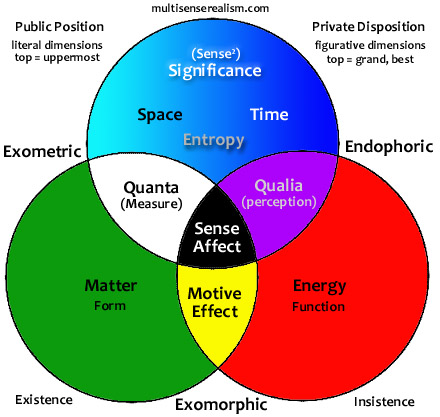
Side by side comparison of what seems to be the prevailing cosmology (above) and MSR (below). In the consensus worldview, aka Western post-modern view, quantitative function replaces all other modalities of sense and sense itself is absorbed into automatism. Energy is merged with matter as ‘particle-waves’ or ‘probability wave functions’, just as space is merged with time through relativity. Rather than a universe of concrete participation, the illusion of realism ’emerges’ from the evolving complexity of statistical interactions. At what level this emergence occurs, why it occurs, or how are left to future generations to explore.
Conspicuously absent are all traces of subjectivity, participation, and significance. Motive effect is understood only as a caused effect – the playing out of inevitable mechanical agendas which stem from a few ‘simple rules’. All forms of privacy are unknown and entropy is divorced from sensory interpretations. All sensations are thought to be partial revelations of an objective truth, so that any deviation from that empirical fact is considered an error.
MSR sees the absence of sense as a the gaping hole in this schema. While emergence is appropriate for understanding how many phenomena which appear to be novel are often found to be inevitable upon further inspection, it is entirely an entirely inappropriate machina ex deus for phenomena which have no plausible origin from the known functions of the system. The consequences of overlooking the key principle which unites all phenomena (sense), are that we wind up with an impoverished worldview, a Straw Man of cosmology in which we ourselves have no possible place.
Likelihood is the ultimate unlikelihood: Notes on sense as sole synthetic a priori manifestation of improbability
In the contemporary Western model of the universe, mechanism is presumed to be the sole synthetic a priori. The general noumenal schema which can only be considered an eternal given and without which no phenomena can arise. In particular, the mechanism of statistical probability is seen as the engine of all possibility. Richard Dawkins title “The Blind Watchmaker” is an apt description – a kind of deism with no deity. Lawrence Krauss’ “A Universe From Nothing” is another apt title. The implication of both is that the universality of statistical distribution is the inevitable and inescapable self-evident truth of all phenomena.
What is overlooked in these models is the nature of probability itself – the concept of likelihood, and indeed the concept of ‘like’. The etymology of the word probable extends from French and Latin meanings of ‘provable’ and ‘agreeable’, a sense of credibility. What we like and what we find acceptable are similar concepts which both relate to, well, similarity. Agreement and likeness are in agreement. The two words are a-like. What is like alikeness though? What is similar to similarity or equivalent to equivalence?
Consider the equal sign. “=” is a visual onomatopoeia. It is a direct icon which looks like what it represents. Two parallel lines which illustrate precise congruence by their relation to each other. It’s an effective sign only because no further description is possible. So ubiquitous is the sense of comparison by similarity that we can’t easily get under it. It simply is the case that one line appears identical to the other, and when something is identical to another thing, we can notice that, and it doesn’t matter if its a thought, feeling, sensation, experience…anything can be similar to something. It could be said also that anything can be similar to anything in some sense. The universe can’t include something which is not similar to the universe in the exact way in which constitutes its inclusion. Inclusion by definition is commonality and commonality is some kind of agreement.
Agreement is not a concept, it is the agent of all coherence, real and imagined – all forms and functions, all things and experiences are coherent precisely because they are ‘like’ other things and experiences, and that there is (to quote David Chalmers) ‘something that it is like’ to experience those phenomena. Without this ontological glue, this associative capacity which all participants in the universe share, there can be no patterns or events, no consistency or parts, only unrelated fragments. That would truly be a universe from nothing, but it would not be a universe.
The question then of where this capacity for agreement comes from is actually moot, since we know that nothing can come from anything which does not already possess this synthetic a priori capacity for inclusion – to cohere as that which seems similar in some sense to itself in spite of dissimilarity in other ways. Something that happens which is similar to something that happened at a different time is said to be happening again. A thing which is similar to another thing in a different location can be said to be ‘the same kind of thing’. This is what consciousness is all about and it is what physics, mathematics, art, philosophy, law, etc are all about. It is what nature is all about. The unity behind multiplicity and the multiplicity behind unity. Indra’s Net, Bohm’s Implicate Order, QM’s vacuum energy, etc, are all metaphors for this same quality…a quality which is embodied as metaphor itself in human psychology. Metaphor is meta-likeness. It links essential likeness across the existential divide. Metaphor bridges the explanatory gap, not by explanation, but by example. Like the = sign, the medium is the message.
Aside from their duty of ‘ferrying-over meaning’ from the public example to private experience and private example to public application, metaphors tell the story of metaphors themselves. Implicitly within each metaphor is the bootstrap code, the instruction set for producing metaphors. Metaphor is the meta-meme and memes are meta-metaphors. This self nesting is a theme (a meme theme, ugh) of sense, and a hint that sense itself is insuperable. Mathematically, you could say that the axiom of foundation is itself a non-well-founded set. The rule of rules does not obey any rules. Regularity is, by definition, the cardinal irregularity, as it can only emerge from its own absence if it emerges at all. If it does not emerge, then is still the cardinal exception to its own regularity since everything else in the universe does emerge from something. First cause then, by being uncaused itself, is the ultimate un-likelihood. First cause by definition is singular and cannot be like anything else and there can be nothing that it is like to be it. At the same time, everything that is not the first cause is like the first cause and there is something that it is like to be that difference from the first cause – some aesthetic dissimilarity which constitutes some sense of partial separation (diffraction).
To get at the probability which is assumed by the Western mindset’s mechanistic universe, we have to begin with the Absolutely improbable. This is akin to realizing that dark is the absence of light when it was formerly assumed that dark was only something which could be added to a light background. Improbability is the fundamental, the synthetic a priori from which commonality is derived. Statistical analysis is a second or third order abstraction, not a primary mechanism. The primary mechanism is likeness itself, not likelihood. Likelihood follows from likeness, which follows from Absolute uniqueness, from the single all-but-impossible Everythingness rather than a plurality of inevitable nothingness.
 Multisense Realism
Recent Comments