New to MSR?

May 1, 2016 Leave a comment

It might help to start with  my other writings on Quora: https://www.quora.com/profile/Craig-Weinberg

This site is more of a place for recording ideas before I forget them.

3ॐc

“Existence” = Availability

April 27, 2016 7 comments

“Reality” =  Maximum availability within any given frame of reference.
“Information” = An effective reference.

To be more precise, Availability = afferent/aesthetic availability. If a tree falls in a forest in a universe where hearing was impossible, sound is not available and therefore does not exist.

Maximum availability can refer to both the density of aesthetic saturation (i.e. extreme pain is extremely real) and the particular aesthetic qualities of duration, constancy, and publicity. The dream that you never wake up from is your reality. The dream that all people share and never wake up from is human realty.

Information is afferent signaling with efferent potential. The more potential for producing intentional effects, the more ‘informative’ the signal is. Information is not ‘really real’ as it only requires enough aesthetic saturation for the power to arrest attention (to be noticed or detected) and be made available to attention (focus and coherent interpretation). Informative data therefore are cohesive units of perturbation within a medium or channel of adhesive or affective sensitivity.

Special Diffractivity: c², c, and √c

April 26, 2016 2 comments

(updated 5/27/16)

This (reverent, yet shameless) riff on special relativity and its relation to general relativity is intended to also show light as a special representative case  relating to light as the visible subset of the more general conjecture of general diffractivity, which relates to all sensory, perceptual, and phenomenal content. I apologize in advance for the neologisms. – Craig Weinberg 4/26/2016

c²: Imaginary Light (“m² and t²”) | Cosmic-Meta-Cosmic scale
Phenomenal-metaphenomenal, surreal-supernatual, super-Mahasunna

Dreams and visions can confuse events. Dream content often features locations, characters, and objects which have ambiguous or superpositioned  identities (“superlocality m²”). They can also include spontaneously confabulated histories as well as content which seems to be visionary or prophetic in retrospect (“superchronology t²”).

c: Natural Light (m/s) | Macrocosmic-Electromagnetic scale
Phenomenal-optical, real-natural, between Mahasunna and Chidakasa

Our ordinary, waking experience of light is seen as “zero-interval linkages between events near and far”*, and seamlessly merges veridical optical conditions with phantasmic ‘illusions’. Natural light occurs at c, and tends to play a foundational role in realism for sighted humans. “Seeing is believing”, including the sight of so-called ‘optical illusions’, in which the criticality between optical and phenomenal light is exposed. Phenomenal light is judged to be illusory to the Western mind, but more as a revelation of the nature of light, perception, and consciousness to the Eastern mind.

√c: Physical Light | Electromagnetic-QED scale
Optical-Semaphenomenal, hemi-real-unnatural “Sub-Chidakasa ”

On this level of description, light is an invisible, intangible semi-substance which is inferred as either entangled particles with definite position or contextual waves with definite momentum. The measurement is therefore conceived not in terms of meters per second or distance over time, but as probabilistic wave functions in which the conservation of spatial entanglement and temporal contextuality are inversely proportioned. Relativity might be understood as a macroscopic manifestation of entanglement or perceptual cohesiveness (inertial frame) and contextuality or cognitive adhesiveness (as in Lorentz transformations),  I have proposed that our concept of photons should be inverted, so that they are conceived of not as particles in a void or vibrations of an electromagnetic field, but as figurative units of permittivity-permeability. I further suggest that a new unit, the phoron, be adopted informally to provide linkage across the phenomenal-optical (phoric), metaphoric, and semaphoric levels of description (frames of afference).

²c: Beams, rays, rainbows, specular reflections, glowing, halos

Light renders itself most directly and literally visible as dynamically contextualizing image transforms such as a rainbow, a change in brightness. This corresponds to the metaphotic, ²c level of description: visibility itself is made visible as “glowing” or shining and is associated with matter being glossy, transparent, or translucent.

c: Forms, colored objects, veridical images

At the photic level of description, light is transparent or seen-through. It ‘gets out of the way’ so that visibility is embodied/entangled with realism as the opaqueness of visible forms. This is the classical, natural, “c” level of description where light is the entanglement of Seer, seeing, and the seen. On this level of description (frame of afference) the metaphotic, ²c phenomena are understood to be mirage or illusion.

c√: Particle-Waves, frequency-wavelength, probability functions

Semaphotic light is an (invisible, intangible) information-theoretic pseudo-entity inferred from evidence of its effects on material instruments, and whose properties are defined mathematically. At the electromagnetic level of description, light is an oscillation of an invisible field which can be perceived as visible color or, as thermal intensity (infrared), or by the behaviors of instruments and material substances. At the quantum level, c√ light is a probabilistic wave function – a pure abstraction with purely concrete effects

*quote from David A. Grandy, The Speed of Light, Constancy + Cosmos

Please see the following PDFs for more information.

extract from 4.92

4.92 Diffractivity


TSC 2016 Materials

April 25, 2016 1 comment

Diffractivity_Poster

flyer


Slide show (PDF): v4.92-diffractivity.pdf


Does consciousness emerge from the brain?

March 18, 2016 11 comments
My response to this answer on Quora:
An excellent answer which sums up the current neuroscientific perspective, and which I intend to demolish 🙂
What if we set consciousness aside for a moment and use some other examples?
A conventional camera exposes film to visible light, yet the image is not visible. The visibility of the image depends on a process of chemical development, however that process is not changing the image-related information that is constituted by the microphysical states of the photographic emulsion. We can see therefore, that the image is not emergent from film. The film is perfectly capable of recording optical information without providing any visible image. This is a huge problem of eliminativism, computationalism, functionalism, and physicalism.
A similar example: Binary math vs geometry. For instance:
pcoae9gri
This image does not exist within your computer’s RAM or CPU. There is nothing shaped like a triangle or a face that is present in the physical hardware or its logical function which has color, shape, or faces. What is present is nothing but generic microelectronic switches which are capable of receiving and sending each other’s state. This arrangement handles all of our information processing needs, but it does not get us any closer to the image that you see above. For that we need a video screen, eyes, a sense of optical conditions, and a visual presentation. The computer of course needs none of these things to compute every detail of the .png file. It does not need to see anything, nor does it need to have any familiarity with geometry. The binary math works just as well with or without visibility or tangiblity. Logic does not need geometry.
By connecting the dots, I can easily see why emergence is false, and why when we use the term ’emergence’ we are actually referring to nothing more than appearances within consciousness, such that it can never apply to physics or logic in any way. Nothing can ’emerge’ within physicalism because physics can have no preferred frame or reference. The existence of a frame of reference in the absence of perception should also be understood to be a fairly obvious violation of parsimony, i.e., Occam’s Razor would shave off the possibility of sense perception if unsensed frames of reference were already performing every physical function in the brain. In theory, there is no reason why a brain could not perform every operation of our conscious mind unconsciously, just as we assume that a single zygote unconsciously performs every function of dividing into a living brain.
What is harder to understand is why some people, especially those in the hard sciences, completely fail to see this. After several years of consideration, however, I have arrived at what I think is a viable hypothesis: The skill set which tends toward expertise in physical systems and logical functions tends to be incompatible with the opposite skill set which is required to develop a robust theory of mind. Neuroscience is mind blind, so it (along with Dennett, Blackmore, etc) promotes a view of the mind without having the correct lens to gain objectivity on their own objectivity. Nobody is to blame, it’s just part of how the Continuum of Sense works. Color and flavor has no more business being undetectable in the brain than specific gravity or temperature are. Emergence is a post hoc contrivance to cover for the (huge, and critically important) blind spot of the brain-minded mind.

Continuum of Sense

March 18, 2016 3 comments

I have been writing for a long time now about what I call the Multisense Continuum, or the ACME-OMMM duality. In the course of developing this hypothesis, I have learned about other such efforts, detailed below, including a recent paper:

Rigidity-chaos semantic continuum
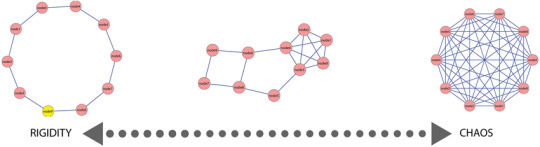
image

Drawing on network models, this is a promising approach, however the irony was apparent to me in the choice of terms. To see the opposite of psychological rigidity as chaos may be trivially true, however, it may also be that the chaos is a projection of the rigid, systemizing approach.

The model that I propose sees chaos as only one aspect, and not the most important aspect of the opposite of rigidity. This continuum is so universal, that I think it extends beyond ‘reality’ to embrace all of nature.
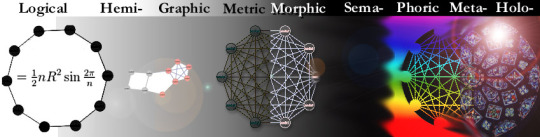
image

Here are some other variations:

Tough-Minded vs. Tender-Minded (William James)

interpreted the European divide between empiricists/positivists on the
one hand and German idealists/rationalist on the other hand in a
psychological way. He talked of the “tender-minded” and the
“tough-minded.” The tender-minded are the German idealists and
rationalists. (this linked source is gone, see new link for James’ original work)

The Divided Brain (Iain McGilchrist)

Psychiatrist Iain McGilchrist describes the real differences between the
left and right halves of the human brain. It’s not simply “emotion on
the right, reason on the left,” but something far more complex and
interesting.

Autistic-Psychotic Spectrum     (PDF)
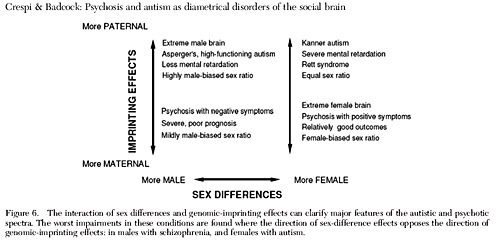
image

‘Thin-boundares” and “Thick-boundaries”

Significantly thinner boundaries compared to control groups have been
found in art students (Beal, 1989, Hartmann, 1991), music students, and
mixed groups of creative persons (Beal, 1989), frequent dream recallers
(Hartmann, 1991, Hartmann Elkin, & Garg 1991), adults with
nightmares (Hartmann, 1991, Levin, Galin, & Zywiak 1991; Galvin,
1993), adolescents with nightmares (Cowen and Levin, 1995), “lucid
dreamers” (Galvin, 1993), male as well as female fashion models (Ryan
2000), persons with unusual mystical experiences (Krippner,,
Wickramasekera, Wickramasekera, & Winstead, 1998), and persons with a
diagnosis of Borderline Personality Disorder, Schizoid Personality
Disorder or Schizotypal Personality Disorder (Hartmann, 1991).
Interestingly, although art students have much thinner boundaries than
average, this is not true of established artists, who have boundary
scores in the normal range (Beal, 1989).

Groups that score significantly “thicker” than average
on the BQ include naval officers, salespersons, lawyers, patients with a
diagnosis of Obsessive-compulsive Personality Disorder, persons
suffering from “Alexythymia” (Hartmann, 1991), and patients (from two
different sleep disorders centers) with a diagnosis of Sleep Apnea
(Hartmann, 1992).

Empathizing-Systemizing Continuum

Empathizing and systemizing traits were independent in women, but
largely dependent in men. In men, level of systemizing skill required by
field of study was directly related to social interactive and
mindreading deficits; men’s social impairments correlated with prolonged
go/no-go response times, and men tended to apply systemizing strategies
to solve problems of empathizing or global processing: rapid perceptual
disembedding predicted heightened sensitivity to facial emotion. In
women, level of systemizing in field was related to male-typical digit
ratios and autistic superiorities in detail orientation, but not to
autistic social and communicative impairments; and perceptual
disembedding was related to social interactive skills but independent of
facial emotion and visual motion perception.

…and my own bloggings:

Zooming in on Reductionism and Extremely Gendered Brains

War of the Worldviews

Multisense Continuum

Ironically, but unsurprisingly, the idea of the continuum of sense itself may only be coherent when approached from the ‘East side’ of the spectrum. This has to do with what is known as Theory of Mind.

What Is Really Real?

March 12, 2016 Leave a comment

If everything we hear, touch, smell, see are electrical impulses interpreted by our brain, then what is real out there?


In my view, to really answer that question we must forget everything that we think that we know about electrical impulses and brains and look at the phenomena again with fresh eyes. We must also ask questions about sensation and what is meant when we use the world “real”. Most importantly we must ask what our own capacities and biases are and what we can guess is true about reality and sensation vs what is true about our perspective as a human.
I think that I have answers to these questions, but they may not make sense unless you have asked them yourself. I would suggest that you first try to answer them yourself, even write out the answers, before consulting external sources, including this answer. Also write down what sources you think that your beliefs come from.
Question one: Why do most dreams seem real until you wake up?
Most people have probably had the experience of waking up and thinking, ‘Why would I not suspect that Mother Theresa falling asleep in my lap is impossible? She’s not even alive anymore.’ From this can we not conclude that our sense of realism is infinitely plastic? Even though some people may have lucid dreams where they do know that they are dreaming, or who do wake up after realizing that they are dreaming, it still does not explain why we can ever experience surreal, impossible, or nonsensical dreaming without questioning it. There is nothing that we can dream of which is so weird that it would cause us to question the reality of it. From this we must conclude that either our sense of realism is as much of an electrical hallucination as anything else we could sense. Is realism actually nothing more than failing to question one’s experience, or is there more to it than that?
Question two: How can you tell when you actually do wake up?
Many people have probably had the experience of false awakening, or a dream within a dream (even within a dream, within a dream, within a dream, etc). Each time you experience waking up in a dream, you have the feeling that you are awake but you are not, yet when you really do wake up, there seems to be an authenticity which is experienced directly and unmistakably. This sets up a curiously intransitive relation between false awakening and true awakening, namely, when we are dreaming, we can experience being awake, and we can doubt that we are awake, but when we really are awake, sane, and sober, we cannot fully doubt that we are awake. We can doubt it intellectually, and philosophically*, but this to me seems a very superficial kind of doubt which evaporates the moment that we are confronted with the sights, sounds, and feelings of our waking life. This suggests a contradiction to the first answer that I have give, bringing a third question:
Question three: How can we both know that all of our perception could be deception, but nevertheless feel that this knowledge is somehow insufficient to doubt the real world?
For this question, I think that the key is to realize that we have not taken skepticism far enough. If we consider that all perception is potentially deception, then we must also consider that this proposition itself is potentially deception. In other words, since we cannot know what is real, we cannot know that we cannot in some sense know what is real and in another sense not know. How do we know that nature doesn’t contradict itself?
At some point**, we have to admit that something is ‘given’ which cannot be doubted. Further we can conclude that what is given is not ‘knowledge’ but direct experience. However weak the veracity of our perception, knowledge is an even weaker proposition. Sellars attack on the myth of the given†, therefore, is itself deriving its own authority to attack from a myth of authority to attack which is itself under attack by his argument. His reasoning seems to exclude itself from criticism – assuming that scientific theories have access to a level of sanity about themselves which dreams could not simulate.
Question four: What do we really mean when we talk about ‘electrical impulses in the brain’?
When we talk about electricity, I think that we tend to have in mind something like sparks or lightning bolt. A bright, crackling appearance of a natural power or force which is independent of material objects but jumps between them at the speed of light. Further, theories developed by scientists such as Faraday and Maxwell explain this electric force in terms of perturbations or waves in an electromagnetic field. The electromagnetic field itself is invisible and intangible, so when we see lighting, hear thunder, or feel a shock, we are actually experiencing a second hand effect of matter rather than electricity itself.
To clarify:
This is not a picture of electricity, it is a picture of ionized air molecules colliding violently and releasing photons.
In a vacuum, there are no sparks and there is no sound. Sparks require a material medium which refracts light. Sound is always the collision of matter and is interrupted by a vacuum. While light is transmitted through a vacuum, there is no way to know for sure whether light is actually present in a vacuum, or whether photons are something else which can jump non-locally from place to place.
This is my own speculation, but it is not unprecedented. The Wheeler-Feynman absorber theory postulates that “every bit of radiation must be completely absorbed somewhere” (see Landon Carter’s answer to Can you explain Wheeler–Feynman absorber theory in layman’s terms?). If this is true, then it opens the door to radiation being an entanglement-disentanglement between ‘radiators’, even to the point of seeing space-time as emergent from it. Photons, electrons, even atoms themselves may not be true particles or wave in a vacuum, or fields or forces, but are more like examples of the ability to signal perceivability on the microphysical scale.
What I am suggesting is that absorber theory is on the right track, but does not go far enough. Not only is time meaningless for a photon (because of the constancy and insuperability of c) but even the assumption that some thing is emitted or absorbed could also be unfounded. Indeed, if my view is right, every equation and observation that we have about subatomic particles could be explained in terms of directly perceived micro-phenomenology.
This is not to say that “photons can see“, but that photons have no existence whatsoever other than as visibility (and thermodynamic tangibility) itself. Quantum fields and wave-functions mus then be considered purely abstract statistical entities which do not point to a deeper layer of inference beyond detection, but to the phenomenon of detection itself – to sensory-motor presentation. This uproots the entire foundation of both physicalism and functionalism to suggest the primacy of aesthetic participation behind any possibility of physical forms or logical functions. Sense is what the universe is made of, not stuff that makes sense, or that makes illusions of sense.
Rolling this back to ‘electrical impulses in the brain’, what we are really seeing when we look at an MRI is not electrical impulses, but electrical changes in the MRI instrument itself which are synchronized with the electrical changes of water molecules in brain tissue. This synchronization is not a collision of photons but a low level perceptual entanglement (which, in my hypothesis should be understood as a re-acquaintence or re-entanglement of spatiotemporally disentangled perceptual unity).
This is how I think that the brain works – we live our lives not as bodies or brains or electricity, but as the synchronization of changes which are diffracted across those various scales (Planck, atomic, organic, cellular, neurological, anthropological). These should not be thought of as scales primarily of space or distance but first of perceptual-partcipation, then time, then space. We are not bodies, or patterns of electrochemical information, or even pattern itself, but the capacity to perceive and participate which must rationally precede all appearance of ‘patterns’. Our brain activity is a 3+1 dimensional tip of an iceberg which transcends dimension itself, and which appears as a brain only because of the way that the limits of our human perception is even further limited by the sub-human bandwidth of our sensory organs.
From this, I conclude that what we perceive as the natural world, including brains, as well as everything that we infer from our perceptions, such as electromagnetism, are neither myth nor given but ‘myth-giving’ experiences. These experiences are, like our ordinary experiences, both concretely real within their own frame of reference and unreal from a ‘perceptually distanced’ or diffracted perceptual frame. A dream is a real dream, and only becomes unreal upon awakening into another dream which is more substantial and shared by more frames of reference. Reality should be understood as the real density of phenomenal overlap, such that there is not Reality so much as “Real Realism” – a quality of significance and coherence within a particular frame of perception in which the significance of the weight of perceptual experience accumulated through the entire history of experienced time (which would include all clock/calendar time, as well as all psychological time) is felt intuitively or instinctively.
Reality is real alright, but it is only the density of the constraints imposed by our condition as a human lifetime defining itself in the context of all other lives and times. I cannot prove what I am proposing to the satisfaction of reactionary skepticism (see Craig Weinberg’s answer to Is dualism no more than philosophical debris given the advances in neuroscience?) however I think that it is possible to reinterpret all of physics, mathematics, and information science successfully in this sense-first framework. Language and etymology are a valuable tool, since we can look at common-sense associations across cultures. Metaphors link literal, public facing phenomena such as weight or gravity with private facing phenomena such as importance or seriousness. There is, in my estimation, a whole other universe of connection between the sense of what is ‘out there’ and the sense of what is ‘in here’, which I try to scratch the surface of in my writing.
*Pyrrho, the founder of Skepticism is worth mentioning here, he
“founded a new school in which he taught fallibilism, namely that every object of human knowledge involves uncertainty. Thus, he argued, it is impossible ever to arrive at the knowledge of truth. It is related that he acted on his own principles, and carried his skepticism to such an extreme, that his friends were obliged to accompany him wherever he went, so he might not be run over by carriages or fall down precipices. It is likely, though, that these reports were invented by the Dogmatists whom he opposed. ” Internet Encyclopedia of Philosophy
** Descartes famously arrived at his cogito “I think therefore I am” as a result of taking his Cartesian doubt to its limit. Doubt, after all, cannot itself be doubted, and a belief in disbelief is still a belief.
† Another philosopher living in the 20th century, Wilfrid Sellars, was influential for his “Attack on the Myth of the Given”. Where Descartes skepticism led him to view himself as unquestionable, Sellars saw perception as inseparable from conception, so that just as an ambiguous image can appear to be a duck or a rabbit, our theory about what we are looking at cannot be subtracted from the experience of looking at it. Because of this, his view is that scientific theory can supersede the empirical reports of our senses. In my terms, he is saying that sense-making is more fundamental than sense experience.


Does Neuroscience Crush Dualism?

March 11, 2016 3 comments

Is dualism no more than philosophical debris given the advances in neuroscience?

Dualism perhaps, but so too are Physicalism and Positivism obsolete philosophies given advances in neuroscience, physics, and psychology. Idealism, Panpsychism, and Non-Dualism are, in my view, still far ahead of neuroscience and cognitive science as far as being on the right track philosophically.It is very common for people who have a Physicalist view to confuse Non-Physicalist views with Dualism, Solipsism, Anthropocentrism, Theism and Naive Realism. In some cases there is cause for this confusion, but it is more common in my experience that it is a psychological projection or Straw Man argument against the view which is diametrically opposed to their own.There is a psychological dimension to this which is important. Jung’s identification of the Shadow projection, “the thing a person has no wish to be” provides a model for how hostility and prejudice can arise, even in the most scientific mind. Other very useful concepts include the Empathizing-Systemizing Continuum or Psychotic-Autistic Spectrum.

In short, the mind which is extremely Systemizing by default tends to suppress its potentials for Empathizing, resulting in a rigid, combative cynicism against anything which is perceive as anti-scientific (really Anti-Systemizing). Extremely Empathizing minds have identical response to what they perceive as Anti-Empathizing so that neither side can actually listen to the other’s perspective and both parties argue past each other. I call these reactionary and radical extremes OMMM and ACME respectively (Only Material Mechanisms Matter and Anything Can Mean Everything)  War of the Worldviews.

tumblr_inline_o3w5nhebeo1qe3q3v_540

Even neuroscience itself can be used to understand the limits of the current Neuroscientific approach. Brain lateralization, though held in disfavor after being overly hyped for several years, still has profound neuroscientific value (as explained in the video The divided brain). Animals with brains seem to split their consciousness between narrow, logical focus on the most immediate details of perception and broad environmental sensitivity.William James talked about ‘Tough-Minded’ vs ‘Tender-Minded’ philosophies.

[…]he interpreted the European divide between empiricists/positivists on the one hand and German idealists/rationalist on the other hand in a psychological way. He talked of the “tender-minded” and the “tough-minded.” The tender-minded are the German idealists and rationalists. Tough-Minded vs. Tender-Minded: William James’ Pragmatism and the Empiricist-Rationalist Divide

More recently Ernest Hartmann expanded it to a more general notion of ‘thin-boundares” and “thick-boundaries” in his book Boundaries: A New Way to Look at the World.

In my own understanding, I reconcile both ends of the spectrum to try to understand the underlying unity, which I identify as ordinary ‘Sense’. The qualities of thick/tough and thin/tender are seen as a consequence of direct Sensing and indirect Sense-Making modes of Sense which have evolved, and continue to evolve novelty and self-enrichment on many levels simultaneously.

This turns out to be along the lines of what many schools of Western Mysticism and Eastern Philosophy have taught, except  where they used Spiritual terms, my approach draws on semiotics and general systems theory. What many traditions identify as God or Spirit, I see as an Aesthetic Foundation or Pansensitivity which accounts for both Theistic and Atheistic appearances without collapsing into relativism. Sense is Absolute, and Relative-but-not-Absolutely Relative.For those Systemizing readers whose blood pressure is already climbing at reading this, you might want to stop while you’re ahead, before I add more fuel to the fire. Warning, silly sounding neologisms ahead…

Materialist Monism is actually Crypto-Cartesianism.

In other words, the conventional scientific worldview treats consciousness as an ’emergent property’ or ‘information processing’ without grounding those terms in physics itself. Since Physicalism and Functionalism reduce nature to unconscious, automatic interaction of forces and probabilities, all appeals to emergence or integration are really metaphysical appeals to panpsychism. The OMMM answer to Dualism, Solipsism, Anthropocentrism, Theism and Naive Realism are the diametrically pathological exaggerations: Nihilism, Nilipsism, Mechanemorphism, Anti-Theism, and Anti-Realist Sophism.

In the perpetual argument between the two extremes, the Superstitious Charlatan archetype is projected by its antagonist, the Substitutious Inquisitor. For every ACME appeal to God or Spirit, the OMMM counter-appeals to a mechanical substitute. Nothing can be considered ‘special’ except the negation of the ‘special’ through compulsive debunking. Words like ‘merely’, and ‘simply’ are thrown around liberally, as are epithets of ‘nonsense’, ‘rubbish’, ‘postmodernism’, and ‘word-salad’. Feelings and thoughts are merely electrochemical patterns in a brain. For everything imaginative or mysterious there is condescension and venomous hostility. For everything personal or subjective there is an impersonal object to substitute.

The final irony of course is that in seeking to nullify the personal self*, the denier of human specialness paints a mental picture of a universe of radical anthropocentrism. In this universe where all phenomena, even evanescent neutrinos and dark matter are absolutely real, there is only one phenomenon, one delusion conjured** by the brain function of Homo sapiens, which is absolutely unreal, and which contains all of the direct experience of Reality we can ever have. Instead of perception, we have deception† and instead of a phenomenal, sensible universe, we have a dualism consisting of two nihilverses – one devoid of life and consciousness, the other devoid of reality and truth.

*or Science forbid, “Soul”!

**Emergently, and Naturally of course

†with one ‘scientific’ exception

Are Ideas Physically Manifested in the Brain?

January 31, 2016 Leave a comment

My answer to on Quora.

I don’t think that ideas can be said to be physically manifested, unless we extend physics to include phenomenology. Neurons, brains, and bodies* can all be reduced to the behavior of three dimensional structures in space. In this context, behavior is really the function of those 3D structures over time, and function is a chronological sequence (so a fourth dimension or 3D+1D) of changes in those structures. All such changes can be described in terms of movements of structural units, typically atoms or molecules, as they are rearranged according to deterministic and random-seeming chain reactions. The existence of ‘ideas’ or consciousness within such a system is, to paraphrase William James, “an illegitimate birth in any philosophy that starts without it, and yet professes to explain all facts by continuous evolution.

This is to say that there is no logical entailment which can explain how we get from a phenomenon which can be imagined to be composed of countless particle collisions that look like like this:

tumblr_o1jofi0rbl1v6nrrmo1_400

to something else. This gap, known in Philosophy of Mind as the Explanatory Gap, and the existence of that something else in the first place (known as the Hard Problem of Consciousness) are the two insurmountable obstacles for anti-idealistic worldviews**.

What many computer scientists may not appreciate is that while the theoretical underpinnings of information science point to brains being reducible to simple arithmetic functions, this reduction cuts both ways. If we can reduce everything that a brain does to a computation which can be embodied on any material substrate, that also means that no semantic content is required, other than low level digital logic. Just as all of the content of the internet can be routed by dumb devices which have no appreciation of images or dialogue, so too can the entire content of the brain be reproduced without any thoughts, feelings, or ideas.

Once we have used a mathematical or physical schema to encode our communication, there is no functional benefit to be gained by decoding it into any form other than computation. The computation alone – invisible, intangible, silent facts about the parts of a calculating machine in relation to each other (3D+1) is all that is necessary or sufficient to execute whatever behaviors will allow an animal’s body to survive and reproduce. Once we have converted conscious experience to localized machine signals, the signals alone are enough to generate any physical effect, without signifying any non-local content. This is what Searle was talking about with the Chinese Room, and is known as the symbol grounding problem.

In consideration of the above, the answer to the question is “no”. What is present in the brain can only be a-signifying material relations, not ideas. The connection between matter and ideas cannot be accessed in terms of physics or information, but only in the direct aesthetic participation which we call ‘consciousness’. In my view, it is not consciousness which is emergent from information or mechanisms, but information and mechanisms which are ‘diffracted’ or alienated from consciousness.

*not to mention windmills, computers, and rooms with people translating messages that they don’t understand from a book.

**These would include materialism, eliminativism, logical positivism, behaviorism, empiricism, verificationism, functionalism, computationalism, and emergentism.


Information Theory 1.1

January 25, 2016 Leave a comment

1/25/2016 Information Theory Update

Here are some notes which I hope will provide a more concise understanding about the nature of computation, logic, and mathematics.

Information theories such as those offered by Shannon and Turing give us cause to see an underlying universality of information which is rooted in simple Arithmetic truths such as addition, multiplication, and integers. These arithmetic truths are theories with can be applied successfully to computing machines without regard to their physical substrate*. While this offers a method to deploy universal principles to the control of a specific mechanism, the control which is offered is different in kind from the literal (motor) control of the hardware. Motor control of computer hardware can be accomplished electromagnetically or classically (as with analog clocks with gears powered by spring tension or a gravity pendulum), and now quantum-mechanically to some extent, but not directly by math. Mathematics cannot turn a computer on or keep it running, it can only provide a non-local set of rules which can be localized through motor control.

This is critically important to understand when considering the possibility of Artificial Intelligence: Computation can only be absolutely general or absolutely specific. When we implement a logic circuit, we are not literally imposing philosophical logic on a circuit, rather we are only interpreting the physical changes of a device metaphorically. In short, a logic circuit cannot literally represent a state of 1/0 or True/False, it can only literally present a concrete state of being switched to Stop (Off) or Go (On). This is the territory of computation – what is known as Layer 1 in the seven layer OSI network model**. All higher layers are not physical territories but logical maps – human abstractions projected by software engineers and application users.

osi-model

For this reason, no computing machine can represent the middle ranges between the absolute generality of mathematical theory and the absolute specificity of a machine’s physical condition. It’s all above-the-line of personal awareness (oceanic metaphor) or below-the-line (granular semaphores). We can get a lot of utility out of these devices, however we can’t get any empathy from them. They can’t care about anything or anyone, since ‘they’ are purely in our imagination.

The philosophically relevant part of what I’m proposing applies to the prospects for generating natural intelligence artificially. AGI that feels as well as thinks is not necessarily desirable, but if my view is on the right track, computers becoming sentient is not something that we need to worry about. It won’t happen. Why? Because mathematics is not accessing the Physical layer from the top down but from the beneath the bottom layer. This means that even though we can use a computing device to validate truth conditions, we can only validate those truths with refer literally to the concrete states of the machine, and those truths which refer figuratively to the universal arithmetic relations. Nothing that a computer does needs to be *about* anything beyond the machine’s physical state, and so any appearance of emotion, intention, sensitivity, etc are purely hypothetical and would violate parsimony. Church-Turing Thesis lays out the framework for universal computing, but in saying that all functions of calculation can be reduced to a-signifying digital steps, we are also saying that all semantic meanings shall be reduced to blind syntax. It cuts both ways.

Isn’t the brain just a biological computer?

No. This is an obsolete idea, for a lot of reasons which I won’t get into here, but suffice it to say, the brain is an organ within a living body which developed organically from a single self-replicating, self-modifying cell. Machines, by contrast, are assembled artificially from naturally unaffiliated substances and parts. That’s not a reason to discount the possibility of sentience through silicon, but it is a reason to go beyond knee-jerk presumptions that continue to dominate thinking about AI. While Turing’s genius is only now beginning to receive the appreciation it deserves, the shortcomings of his Imitation Game approach have not yet been widely understood.

Alan Turing can be pardoned for his reliance on mid-century Behaviorism as a psychological model, since it was very popular at the time and also because, along with others, I suspect that his natural instincts were quite systemizing/autistic. This carries over in modern populations, with autistic-masculine influences far overwhelming the psychotic-feminine influences in computer science and engineering fields. As a result, we have a lot of strong, controlling voices which insist upon reducing psychology to mechanistic terms, and all dimensions of consciousness to processing of logical information. This is so pervasive that any casual conversation online which challenges the supremacy of first-order logic will tend to erupt into a firestorm that ends with something like “Yeah I’m done here. You’re just spouting nonsense“.

To this end, I find this pyramid model for debate at least as important as the other models of information networking:

argument_pyr

My call for civility in discussion is not mere political correctness or over-sensitivity, but rather a purely pragmatic consideration. Unlike a computer, the human mind loses its capacity for curiosity and fairness when it falls into aggression. People talk over each other and assert their opinions ever more rigidly and repetitively rather than thinking creatively. This mirrors the action of computation itself – recursive enumeration masquerading as communication.

A great many people think they are thinking when they are merely rearranging their prejudices. – William James

*Not entirely true. The physical substrate of a machine requires precision and solidity. We cannot build a computer out of clouds or fog, it needs to be made of something physical which stays put and which has at least one absolutely persistent read/write capacity. Traditional logic circuits must be implemented physically through a rigid skeleton of readable coordinates.

**It has been popular in recent years to proclaim that the OSI Model is dead. The feeling is that TCP/IP is the predominant protocol suite being used in the real world, and it doesn’t match up with OSI, so we should dump OSI in favor of something like this:

hybrid-model

I do see the appeal of this, however, agree with this author that “OSI teaches more of the reasoning behind making multiple layers and what they do. Collapsing the traditional model for the sake of making it look like TCP/IP is going to cause more harm than good.” – Tom Hillingsworth

The Third Eve

Who we are becoming.

Shé Art

The Art of Shé D'Montford

Astro Butterfly

Transform your life with Astrology

Be Inspired..!!

Listen to your inner self..it has all the answers..

Rain Coast Review

Thoughts on life... by Donald B. Wilson

Perfect Chaos

Steven Colborne's Philosophical Theology Blog

Amecylia

Multimedia Project: Mettā Programming DNA

SHINE OF A LUCID BEING

Astral Lucid Music - Philosophy On Life, The Universe And Everything...

Rationalising The Universe

one post at a time

Conscience and Consciousness

Academic Philosophy for a General Audience

yhousenyc.wordpress.com/

Exploring the Origins and Nature of Awareness

DNA OF GOD

BRAINSTORM- An Evolving and propitious Synergy Mode~!

Musings and Thoughts on the Universe, Personal Development and Current Topics

Copyright © 2016 by JAMES MICHAEL J. LOVELL, MUSINGS AND THOUGHTS ON THE UNIVERSE, PERSONAL DEVELOPMENT AND CURRENT TOPICS. ALL RIGHTS RESERVED. UNAUTHORIZED USE AND/OR DUPLICATION OF THIS MATERIAL WITHOUT EXPRESS AND WRITTEN PERMISSION FROM THIS SITE’S AUTHOR AND/OR OWNER IS STRICTLY PROHIBITED.

Paul's Bench

Ruminations on philosophy, psychology, life

This is not Yet-Another-Paradox, This is just How-Things-Really-Are...

For all dangerous minds, your own, or ours, but not the tv shows'... ... ... ... ... ... ... How to hack human consciousness, How to defend against human-hackers, and anything in between... ... ... ... ... ...this may be regarded as a sort of dialogue for peace and plenty for a hungry planet, with no one left behind, ever... ... ... ... please note: It may behoove you more to try to prove to yourselves how we may really be a time-traveler, than to try to disprove it... ... ... ... ... ... ...Enjoy!

Creativity✒📃😍✌

“Don’t try to be different. Just be Creative. To be creative is different enough.”

Political Joint

A political blog centralized on current events

zumpoems

Zumwalt Poems Online