Archive
A Formula for Qualia
To derive the formula for qualia or sensory affect, solve the Hard Problem of Consciousness, and bridge the Explanatory gap, I suggest that we try converting the mass-energy equivalence E=mc² from the public orientation and transpose it inward to the private orientation.
Energy (E) becomes w² which is “was and will be” (w = was or will be)
The Speed of light (c) becomes t = time = (still or never) = now or realism
Light* (c²) becomes t² “still and never again” or “stereo realism of now”
Mass (M) becomes æ = qualia = “like it”
Qualia = “like it was and will be, still and never again” =

another wording
Qualia = “Eternally signifies its past and future now”
This is about what Milan Kundera called The Unbearable Lightness of Being. That our experience of the universe is either perpetually suspended above the paradox of an existence which is both perpetually vanishing forever in some sense and repeating forever in another. If c is the still ‘speed’ of here and now, then c² is the acceleration of here and now, the enrichment of the local now through the collective presence and absence of eternity
- Motive effect or will:
To derive will or motive: 
If qualia is “like it”, then square root of æ is what joins and divides the ‘like’ and the ‘it’. It is the dipole charge of ‘liking’ and ‘it-ing’ which we call desire or preference. The greater the liking, the more significance is projected onto the object, which is the imagined realization of a goal in time. Intention projects into the future, builds, and guides qualia.
Will = “(Maybe, or maybe not)(now or never)” = w = √æ t
Turning the private translation outward to Public/Western psychology so that interiority is undersignified as emergent epiphenomena, we get:
= Experience is simply what may and may not be happening for some time.
and
= Choosing = Right or wrong this time
The public-facing view of privacy reduces it to information processing. To those who have a private-facing view this is a flat and inadequate characterization. The former view is optimized for realizing spatial intelligence while the latter is optimized for appreciating timeless wisdom.
- Quality and Equality
Since qualia is about likeness and local equivalents, it can be said that qualia equals the differential between equality and all inequalities... æ = ‘d=’.

The kicker is that since equality is itself a quale (the spelling of e-quality is a clue), we can conceive of ‘=’ as quality which is externalized**, i.e. the differential is collapsed and the entire range of what it “is like” is interpreted as what “it actually is”. The Western-facing mind naturally prefers that which only tells it ‘like it is‘, so that public physics and information science will filter out as noise all that tries to tell ‘what it is like‘ (paging Ludwig Wittgenstein…). This commercialization of residential qualities has had many benefits, but it is a philosophy which has blinded itself, and intimidated many into ignoring the true nature of consciousness. It’s not anyone’s fault, it’s how private physics works. It’s how sense is made.
*The speed of light is c, but c², if taken literally, can be understood as light itself, reality, or making sense: producing stereo (solid) realism.
**Physically publicized, cropped, framed, stereotyped, commercialized, hardened to endure against the changing feelings that make up private time.
Physics in English
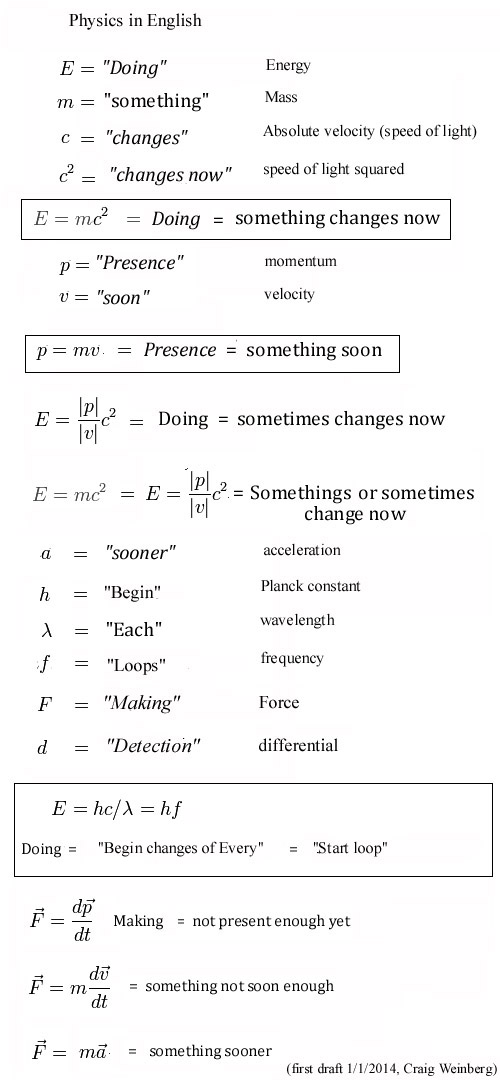
My current preoccupation. It kind of reads like a Magic 8 Ball…which seems like a good sign?
Tessellated Relativity
Whether it is material movement across space or sensory excitement through time, energy must always be a verb. We call it force or work, but that is a shortcoming of the Western fetish for nouns. Really, in my view all energy must be a *forcing* or *working* verb. While I fully appreciate the accusation that this is naive realism, I suggest that this is a foundational symmetry which can be inverted only for figurative purposes. No real energy should be considered noun-like, and all standard model visualizations which contradict this should be regarded as unreal. For this reason, I think that the assumption of the photon as an entity is an obstacle to rehabilitating the standard model to one which integrated the physics of privacy. In an ironic twist, we will have to re-educate ourselves to get used to the idea that the qualia of light and color is real, and photons are imaginary descriptions from an impossible frame of reference (the voyeur public subject).
What are the consequences of energy like? Radiance. Flow. Waves. What are waves? Either a frequency through time or a repeating shape across space. We know, however, that we don’t see photons as oscillating shapes, we see them as a shining, glowing, reflecting, or gleaming in our vision or a warming or burning in our feeling. That’s all about time. Looking at the sun, the intensity increases over time as our retina becomes more and more stimulated. The same is not true of mass. Mass ‘just sits there’ at some position in space. Unlike looking at the sun, the intensity of mass does not increase by itself over time, but rather it increases inversely to distance through space (gravity).
In a post energy particle model, mass and energy modify structures (matter in space) and qualify experiences (sensation through time), and are not free standing quantities emerging from a vacuum. Mass is convergent on a point within a structure, and energy is divergent from c (non-space, non-time) as a frequently recurring stimulus. I was thinking of calling this module of MSR “Tessellated Relativity”, as the inertial frames swing spacemass-ward and time-energyward, yielding the position v momentum exclusivity.
If that’s all true – and I think that it might be on the right track, then it can be used to illuminate the workings of how qualia and sensitivity are equivalent to transparency/entanglement with larger frames of time and higher spatial perspectives.
Happy New Physics

This is an attempt to model my understanding of some aspects of Relativity as it stands now. I make no guarantees of its accuracy or completeness, and I’m not trying to ‘do physics’, but rather to attain a simple grasp of how the concepts of relativity work together. (Feel free to correct me of any glaring errors though).
On the right, there are three atoms, a heavy, medium, and light one. I’m using Uranium, Iron, and Hydrogen just to keep it simple, again, I don’t know what to expect realistically to a Uranium atom that is near an Iron atom which is accelerating with a Uranium atom in the same inertial frame, but I’m including heavy and light atoms just so the difference between fission and fusion can be compared.
On the right side of the diagram, I’m contrasting how it is that both fission and fusion release “energy” (pointed arrows) but in opposite ways. Fission is when a heavy particle is accelerated until its nuclear configuration destabilizes, producing smaller particles and losing resting mass in the process. It takes mass-energy to maintain a large nucleus so there is a release of energy since the sum of the before mass is greater than the sum of the after-mass. Mass can be thought of as the sideways view of energy, cutting across space horizontally rather than longitudinally through time. Energy takes time, as it is momentum: a vector of changing distance over time. Mass requires more of a spatial notion of position or invariance which is publicly measurable at any given instant, rather than a shared history over time.
Fusion, of course, is about lighter particles being accelerated until their collisions cause nucleons to share a nucleus, delivering an energetic bang for the opposite (and seemingly paradoxical) reason. Particles which are lighter than iron ‘want’ to form larger particles, so that even though they are not freeing up energy from not having to hold together a giant nucleus, they still free up even more energy from not having to hold themselves together, by themselves. It could be said that matter loves company, but hates crowds. When matter frees itself from overcrowding or isolation, all of the matter senses the difference and responds by imitating that sensation.
In my example, I am trying to show what happens when an ideal Iron particle (Fe) is accelerated all the way to the speed of light. I’m not sure if that is a realistic scenario, but I am reasoning that since some of the matter as well as mass can be lost in nuclear reactions, it is plausible that such an atom would be converted into energy directly. By showing the Fe particle get narrower, I am trying to show the Lorentz contraction and time dilation, as they would appear from another inertial frame. When all of the mass is converted to energy upon hitting c, what that means to me is that the 4D total potential future of the atom collapses into an instantaneous change in the surrounding atoms.
The loss of 4D time and and 3D matter comes across as 2D a wave of synchronized celebration in the form of acceleration of all matter which is affected throughout the cosmos. When we see a star, it is the molecules of our brain and eye which are, in my view, locally responding to the event which seems remote from our experiential frame of reference. When we go to measure photons, it is my hypothesis that we are actually measuring the local instrument’s description of the event, rather than an independent particle/wave. I think that light may be how matter looks and sees – a sensation and a signal, not something traveling literally through space. The aggregate effect/affect of the (figurative) wave of common sense can be quantified as C² – the range of the effect as a form-function delocalizes. Every inertial frame which can witness the annihilation of a form-function (a presence with a future) manifests that action as an equal and opposite reaction in proportion to its relation. The closer (more local) you are to something which delocalizes, the more powerfully localized you become and the more possibilities there are for a continued future. This is sort of a hybrid of Darwinian and Marxist physics. Collective sharing of sacrificed energy for private gain.
This leads into an even more esoteric discussion about the nature of matter as spatio-geometric qualia and energy as tempo-algebraic ‘phoria’. The next phase is to detail the how qualia and phoria (sensory-motive and mental-emotional) phenomena can be integrated more concretely, such that space, time, entropy, information, matter, and energy can be seen as divergent properties of pansensitivity, which is non-space, non-time, non-entropy, non-information, non-matter, and non-energy, non-vacuum. Pansensitivity is absolute fullness, composed of what can be called qualia, phoria, psyche, nous, significance, and motive. I could be more delusional than usual, but this seems to be coming into a clearer and more communicable synthesis which might be eventually work as a true theory of psychophysical unity.
A Couple of Physics Clips
Great short video that fits into the Twins Paradox. If we imagine that which ever set of particles seems to be moving is a small clock or calendar which seems to be slowing, then it helps me make my point about elapsed time not being elastic. For the cat aligned with the electrons, time always passes normally, but for the cat, the positively charged clocks are slowing down as the repulsive force increases and the motion of the particles in space speed up.
This helps me get an intuitive feel for what is supposed to be going on also. This idea of motion being sticky, so that the greater the ratio between your velocities (not just acceleration), the harder that ratio pulls on time…time in the remote frame of reference is tightening up as the spatiotemporal balance tips from temporal equality to spatial inequality.
The paradox is that, as we see, the tightening of time goes both ways, so that for the cat, it is already June but the wire’s calendar says April. For the wire, it is June and the cat’s calendar says April instead. When these two come together, I don’t see how the time difference would be undone, since the untightening of time would not jump ahead and recover elapsed time, it would only return to parity with the other frame of reference.
No account of the Twins Paradox mentions this though, and they all focus on just one of the two reference frames. The twin who comes back to Earth is younger than the one who stayed home. To me that is true only from the Earth twin’s perspective. From the space twin’s perspective, he returns to a relatively younger Earth than he would expect without relativity and a twin who is younger than he is.
I like these better than the other gee-whiz-science or physics videos that I’ve seen. I still have no reason to doubt my view that the whole standard model needs to be re-interpreted so that it bends into virtuality toward the bottom. There should be a new kind of relativity, where the realism of the phenomenon – its publicity, is a relativistic vector rather than a flat axiom. I would like to see a video which focus exclusively on exactly how we are measuring subatomic phenomena with the same level of infinitesimal detail.
This is what science cares about, right? “What is REALLY REAL?”…so, give reality a number, and notice how unreal quarks gluon flux is compared to protons, and how unreal protons are to molecules. Then notice how quarks are real to each other, but not to molecules, etc. This is, in my opinion, what the universe is made of: Not the mathematical invariance which cuts across all frames of reference, but the aesthetic variance of the frames themselves – experience is really real, on every frame of reference, except when the expectations of one frame are projected onto another.
The Lowdown on Empty Space and the Speed of Light
Your task is to explain why are you trying to buck the mainstream view that space has qualities. I’m no acolyte of the mainstream but I do recognize the need to explain deviations therefrom. It so happens that there are good reasons why today’s view is that empty space has physical qualities. The main shortcoming of the mainstream view, from my viewpoint, is the artificial and unnecessary light speed speed limit. Einstein hypothesized a universe with such a limit without ever even suggesting why such a limit makes any sense. And the problem is: it doesn’t.
I think that Einstein hypothesized a speed limit in the universe because he understood or intuited that speed itself is a continuum between stillness and the opposite of stillness, rather than an unbounded scale. He saw that light does not behave like anything else – that it had properties which made it unlike things which can accelerate. Velocity is (not unrelatedly) like ‘straightness’ – there is an upper limit on how straight something can be, how little something can weigh, and the extent to which a signal can be unambiguously present or absent at a given location at any given moment.
What he did not see, IMO is that light is only one kind of signal – one way that the universe makes sense of itself. The speed of light is the speed of space, or perhaps, the speed of ‘here’, and it scales up in proportion to larger scaled ‘here’s. Light, or ‘sense’ or ‘universal public signal’, actually has no speed at all, unless you mix reference frames and thereby measure a large frame from a small one. The degree to which light has a speed is the ratio between the scale of the measurer and the scale of the measurement.
The mainstream view that space has qualities makes perfect sense when we misunderstand and overlook the role of sense in signal production. Rather than extending the relation that living things have with light (or sound, smell, thought, etc) to the microcosm, we have so far only consider the *apparent* relation that non-living things have with each other, which is limited to touch. We have yet to entertain the notion that microphysical phenoemena are, in some sense, seeing each other and signaling each other directly, and thereby creating ‘space’ and ‘time’ on the macrophysical level, from our perspective. From the microphenomenal level, it might appear just the opposite, that spacetime is being created from above, on higher levels. Both are probably true and untrue to a similar extent.
There is no reason to believe that space has properties except to maintain the assumption that physical processes are unconscious and isolated. When we hold that belief, we are forced to take a phenomenon which is transdimensional, and flatten it into a finite number of topological fields in which forms can touch each other directly. That’s a great way of doing the math so that we can predict and control the conditions of (relatively) inanimate objects, but it falls apart when we try to include more subtle sense-making phenomena.
I’m fully aware, of course, that this is a radical conjecture. My position is not that this is a complete theory or that I know how it must work, but that it is a theoretical possibility which could work, has not been explored, and should not contradict any observation of physics made thus far
 Multisense Realism
Recent Comments