Archive
Fundamental Sensory Dynamics: A New Perspective on Reality
I used ChatGPT to write a synopsis of my ideas on how Multisense Realism can be used to reimagine physical theory so that it is not based on unproved and unprovable assumptions of the existence of unconscious, disenchanted mechanisms. It was an interesting conversation but went off the rails toward the end as GPT failed to generate an image for this post.
Integrated Overview of Fundamental Sensory Dynamics (FSD)
Core Conjecture:
Fundamental Sensory Dynamics (FSD) asserts that what conventional physics labels as mass, energy, fields, and forces are not ontologically fundamental. Instead, they are abstractions masking a deeper reality constituted by the interplay of Sense and Motive—the irreducible qualities of conscious experience.
Sense as the Ontological Primitive
- Universal Qualia as Reality:
In FSD (and Multisense Realism), there is no separate “data” to be transduced by sense organs. Rather, the appearance of qualia—the vivid, intrinsic qualities of experience—is the sole ontological manifestation of existence. - Role of Sense Organs:
Instead of generating data that is later “converted” into experience, sense organs in this framework serve to limit, filter, lens, focus, and/or amplify these fundamental sense appearances. They mediate transitions between different scales of conscious experience—for instance, from microphenomenal (the most elemental level) to phenomenal (the level of personal, vivid experience), or from a universal (holophenomenal) to a more localized, differentiated (multiphenomenal) mode. - Diffractivity over Emergence:
Inverting the conventional assumption of emergence, FSD replaces it with the concept of divergence or diffractivity (cf. Craig Weinberg), suggesting that what appears as emergent complexity is instead the natural divergence of universal qualia into a structured hierarchy of experiences.
Motive as the Dynamic Primitive
- Replacing “Energy” with Motivational Qualities:
FSD replaces the classical concept of energy with intrinsic motivational qualities inherent in conscious experience. What is traditionally described as a “force” is reinterpreted as an aesthetic prompt—a qualitative influence that appears within experience. - Internalizing the Prompt:
The detected prompt in a conscious experience is not a mere external push; it is internalized, and its transformation into a motive prompt depends on the conscious awareness of the possibility for motor response. This is not a simple mechanical push but a dynamic interplay of aesthetic qualities. - Example in Human Experience:
Consider music: it is experienced as rich aural qualia that evoke motivational or emotional qualities. The intensity and character of these motivational impressions, combined with an intrinsic awareness of the capacity for physical movement (e.g., dancing), yield semi-intentional motor responses. This dual aspect reflects the interplay between personal/phenomenal levels and the underlying subpersonal/microphenomenal layers of conscious experience.
Reinterpreting Conventional Constructs
- Mass, Fields, and Forces:
Rather than being inert, geometric quantities, mass and conventional fields (electromagnetic, gravitational, etc.) are re-envisioned as convenient mathematical descriptions of the constraints or limitations on the free expression of sense and motive. For example, the vacuum permittivity and magnetic permeability can be inverted in this paradigm to reflect the degree to which the fundamental context of universal qualia is obstructed or diluted. The speed of light, then, is not merely a velocity limit but a measure of the unobstructed propagation of sense and motive. - Quantum Phenomena Revisited:
Quantum entanglement, contextuality, and superposition are recast as reflections of holistic sensory-motive dynamics. Instead of invoking probabilistic or multiverse interpretations, these phenomena are understood as manifestations of a participatory, aesthetic dynamics underlying all interactions.
Summary of the Revised Conjecture
FSD contends that the cosmos is not built from inert, quantitative constructs but from a fundamental substrate (really just ‘strate’) of conscious experience. In this view, what we interpret as mass, energy, fields, and forces are heuristics that describe how universal qualia (Sense) and their intrinsic motivational qualities (Motive) interact. The observed limitations on the propagation of these influences—traditionally expressed as permittivity, permeability, and the speed of light—are reinterpreted as measures of how sense and motive are modulated, filtered, or obstructed by physical forms.
Concise Summaries
1. Common Sense Description:
“Fundamental Sensory Dynamics proposes that the universe isn’t built from inert stuff like mass or force but from a deep layer of experience. Instead of external energy pushing matter, what we see as fields and forces are actually the result of universal sense appearances and their inherent motivational qualities, which are filtered and expressed by our sense organs. This view turns traditional emergence on its head, suggesting that our experiences diverge from a unified, fundamental consciousness rather than emerge from lifeless matter.”
2. Academic Description:
“Fundamental Sensory Dynamics is a conjectural framework positing that the canonical physical constructs of mass, energy, fields, and forces are emergent abstractions overlying a more primitive substrate: universal qualia and their intrinsic motivational dynamics. In this paradigm, sense is not the transduction of external data but the direct manifestation of experience, while traditional energy is reinterpreted as motivational influence. Conventional parameters—such as permittivity, permeability, and the speed of light—are reformulated as measures of the modulation and transmission of sensory-motive interactions. This approach inverts emergentist assumptions by framing complexity as divergence (or diffractivity) from an absolute, holistic experiential field.”
Response to Pawel Pachniewski’s hard problem of metaphysics, part one
This is part one of my response to just the very beginning of Pawel’s essay (or post or whatever we are calling what we’re doing here). It was getting too long and melting my brain so I decided to just get it out in parts as I can find more time and energy to absorb and respond. It may not even be necessary to go further since my response is really directed only at the problems I see with the unacknowledged premises prior to the beginning of the argument. I may not take issue with the argument itself, if we lived in a universe where those premises were true.
I apologize also for proceeding in this insufferable manner of dissecting Pawel’s excellent writing sentence by sentence. Obviously that is not optimal, it’s just too much for my mind to hold on to at one time any other way.
Without further ado then…
>“then what else could there be out there that could be hidden in plain sight like consciousness hides in plain sight for the non-conscious?”
https://mentalcontractions.com/2022/10/27/the-hard-problem-of-metaphysics/
As far as I can tell, there is no non-conscious. I propose that what we imagine or assume is non-conscious, like a rock, is actually part of a conscious experience on a much different timescale. In our brief lifetime, and even briefer capacity of perceptual attention, the Earth and its minerals appear as concrete objects, or more precisely tangible presentations… in the tactile sense modality… of a personal conscious experience.
While we are having a human life experience, we cannot experience geological timescales directly, but experience only parts of them as aesthetically frozen snapshots within an anthropological > zoological perceptual time window. We experience a rock because we cannot experience the spectacular history of this planet and solar system in its native geological timescale. that timescale of eons is much too slow relative to our direct perceptual window. For the same reason, we can’t experience the minerals that the rock is composed of in their native chemical timescale: it’s too fast for our perceptual window.
The scale of size is a hint also, with geological timescales corresponding to phenomena that we see as physically larger than we can experience directly. Changes to entire planets and changes to single molecules correspond to phenomena that we experience as being physically larger and smaller than we can perceive directly.
I call this relativistic lensing Eigenmorphism and have tried to clarify what I think it should mean.
So no, the rock we see and touch is not conscious, but it isn’t a thing-that-is-non-conscious in an absolute sense. We experience a rock as an appearance (a tangible appearance in the tactile sense, and also as a three-dimensional-seeming image with clear boundaries and surfaces in our stereoscopic visual sense) but there is nothing that the universe is like for that appearance we see.
Likewise there is nothing that the universe is like for any of the objects we can touch or images we can see – not planets, not bodies, not brains, not cells, not vast arrays of transistors, not emojis or stuffed animals, or numbers. In my understanding, there are no ‘things-that-are-conscious’ in an absolute sense, there are only conscious experiences that ‘thingify’ each other.
All of the appearances we perceive to be tangible objects or intangible concepts (like numbers) are, I propose, eigenmorphic snapshots of conscious experiences on timescales that are extremely disparate from our own. The degree of eigenmorphism accounts for the difference between objects that we see as alive versus inanimate. Inanimate is an illusion in an absolute sense, but real in practice locally. As long as the conscious experience we are using is a human experience, the inanimate appearances we encounter are for all practical purposes, faithful and real. We can’t walk through a wall just because its solidity isn’t presented in all timescales and modes of perception. In the timescales of perception that our body exists (zoological > biological > chemical > physical), that wall (chemical > physical) has no choice but to resist merging with our body. The resistance is happening at the level of chemical timescale awareness…too fast for us to experience directly just as the screen image of an old TV or CRT appears stable rather than as a single illuminated pixel tracking horizontally across each vertical line of the screen mask.
> “From a complete description of the universe we seem to be able to exhaustively derive a totality of all facts about the universe, save for one key phenomenon: consciousness.”
Again, this presumes that there is any other phenomenon besides consciousness – which is an assumption that seems very natural, almost undeniable, from our perspective. The question though is whether that undeniable seeming assumption is due to the nature of reality, or of the nature of consciousness in general, or to the nature of OUR limited scope of perception within consciousness. I’m arguing for the latter. If it is true that appearances of non-consciousness are a lensing artifact of the *limits* of our sense (insensitivity) and not of sense in general, then it would stand to reason that we would fail to assume consciousness outside of that scope. In my view, the whole point of having a mortal, limited, zoological experience of having an animal body is to escape the fact of the eternal totality of consciousness. We’re here on a sort of anti-vacation-vacation to taste some of the aesthetic treasures of concentrated deprivation and reunification.
>“Scientifically and philosophically, it is broadly accepted that humans are conscious in the sense that we have inner phenomenal lives – a what-its-likeness to our existence or at the very least, according to some, an illusion thereof.”
Here, I reject both the validity of concepts just because they happen to seem broadly accepted at some given moment and culture and the concept of qualia as ‘what-its-likeness’. The idiom ‘what it’s like‘ doesn’t mean anything that we can work with intellectually. It’s a folk expression that doesn’t define or describe qualia but only creates an empty placeholder of what ‘it‘ does. In my Multisense Realism philosophizing, I give the ‘it’ and the ‘like’ rigiorous clarity and context. It is aesthetic-participatory phenomena, and it is diffracted from the eternal, ongoing totality of the same phenomena through a process that creates and preserves such phenomena, both from the ‘top down’ rather than being assembled by microphenomenal, microphysical, or computational units from the ‘bottom up’.
I don’t deny bottom-up re-assembly of qualia, such as we are seeing right now on this video screen, but I see these instances of the summing of parts as possible only where there is already a sensory anticipation of a holistic/whole perception that is being diffracted top down from the totality. This has tremendous implications for anything artificial, imitated, or simulated, as I discuss in writings about AI.
>“You get kicked in the shin, it hurts.”
Indeed, it hurts even in a dream, to some extent. Also, if you’re awake, enough anesthetic can make getting kicked in the shin painless. I mention this to stave off any qualia-physics identity theory that assumes that hurting just is the neurochemical cascade resulting from getting kicked in the shin.
Of course, anesthetics work by interrupting the neurochemical cascade, but we can still clearly separate the tactile and visible qualities of those tangible appearances (molecular objects staying in the cell body rather than being released into a synapse, etc), from the painful qualities that makes us feel like we need to scream. Indeed pain is not an empty carrier of instructions to scream*, it is a vivid, visceral aesthetic reality – one that I am saying is as fundamental a part of the totality of aesthetic phenomena as galaxies and atoms.
>“it doesn’t seem like its existence can in principle be derived or known from any description of the universe”
I think that is because the totality of qualia IS the universe, and consciousness is qualia describing (qualifying and signifying) itself to itself, or to the diffracted experiences of itself.
>“To know of experience, one must undergo experience. It is only by this metaphysical relation we bear to consciousness that we know of it.”
Sure, and we should remember that knowing is also nothing but an experience itself. Unconscious processes would have no way to ‘know’ anything, or any reason to try. We can only know of the appearance of non-consciousness through undergoing experience also. We are conscious of consciousness because we are consciousness on one level experiencing the limits of its own sensitivity.
>“Stated more broadly, it cannot be easily ruled out that in fact other potentially significant phenomena are entirely obscured from us”
Certainly, however, it also cannot be ruled out that all phenomena that are obscured from us are not just more qualia beyond our local scope of sensitivity.
>“This argument rests on consciousness as a phenomenon only being knowable through being itself – that it cannot be inferred through other means.”
My response to that argument is that there may not be any other means. No phenomenon can be knowable through ‘being’ itself unless that phenomenon, including its ‘being’ is already consciousness/qualia. All ‘means’ are participatory appearances within conscious experiences. If we aren’t directly participating in our own timescale/sensitivity scope then the participatory appearance may be elided to some degree and replaced by the voyeuristic transformation/objectification as mere mechanism or function, motion, etc.
>“That when we scream in pain there are not just observable signals that travel from A to B in our body triggering behaviors”
Here too, I reject the use of the term ‘signals’ that are something that can be observed. What is actually observed is a non-narrative collection of events that seem to us to occur in a sequential chain from some scope (usually microscopic) of sense (usually sight). Molecules are released from cell A and then cell B releases molecules, not because of any signal or trigger, but just because of the consequences of what physical properties do to other physical properties.
We don’t know why that’s happening. It could be that it simply happens, or that there is a physical but unexperienced ‘force’ like electromagnetism making it happen, or that what we see as cells, are, like rocks, are part of a vast ocean of conscious experiences on other timescales (biological, chemical rather than our native personal, anthropological timescales). If it’s happening because of an unexperienced mechanical force, then there IS NO “SIGNAL”. There is no “triggering” of behaviors. Why would there be, and how would it be generated mechanically/anesthetically? Electromagnetism, in a purely physical universe, would not need to signal itself to magnetize. It would not need to choose to move toward or away from itself, it would automatically act that way.
The idea of biological or physical signals is an anthropomorphic projection that we use to unintentionally smuggle sensitivity into phenomena that we are assuming have no sensitivity and need no sensitivity. In an unexperienced physical world (setting aside for the moment the impossibility of that, since in my understanding, there is no physical world other than the totality of conscious experience that share common sensitivity scopes), a rock rolling down a hill to collide with another rock would not ‘trigger’ the second rock to roll, as no signal would be required from the first. There would already be a-signifying (not signals), automatic properties like mass and force to explain the exchange of apparent velocities. The appearance of an additional signal or trigger would be no less of a non-sequitur than an elephant appearing whenever rocks collide.
The alternative that I propose is that ‘signals’ are always and only qualitative/aesthetic-participatory by ontological necessity, and that they are indeed the fabric of all possible real phenomena. Qualia is the ontological substrate of the ontos.
To be continued…
*Physically, screaming would just be another unexperienced chain reaction of muscle tissue contraction, expulsion of air, vibration of larynx tissues and error that has no sound unless experienced by a conscious experience using a body that includes organs that will vibrate acoustically and then a perceptual capacity to experience those tangible vibrations in the entirely different aesthetic modality of hearing/sound, and further in the zoological aesthetic modality of hearing + feeling + understanding another animal’s scream.

The Haptic Universe
If I’m on the right track in thinking of existence as an irreducibly sensing phenomenon, then the idea of particles can be replaced with the idea of coordinated sense happenings, or haptics. Haptics, not atoms or quarks or data, form the skeleton of realism, uniting the sense of touch and tangibility with the sense of causality, proprioception and any other aesthetic sense modalities that are available.

Whether we are dreaming or awake, the properties of realism are conserved. Rupert Sheldrake’s idea of Morphic Resonance can be modified as Haptic Resonance. Possibly electromagnetism can be reinterpreted as electrohaptic and magnetohaptic properties – which are properties of haptics rather than of disembodied force-field perturbations of vacuum spacetime. The universe is not an empty container within which matter and energy happen, the universe is an eternal multisense happening with material and energetic sense qualities.
Qualia Basics
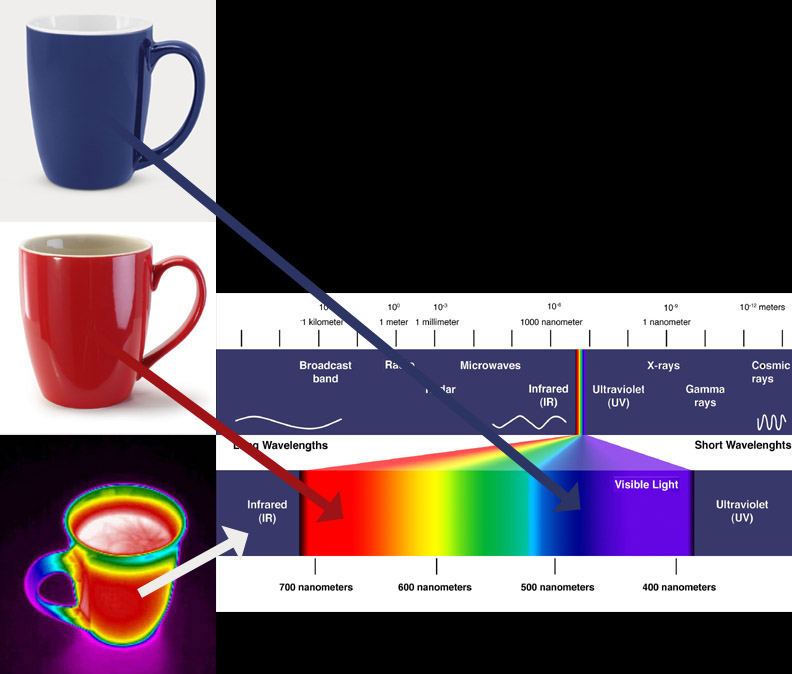
A quick way to clarify what qualia is for those who are opposed to the term on the grounds that it doesn’t mean anything.
Top mug: Blue qualia image based on electromagnetic radiation near the 490 nanometer range of the electromagnetic spectrum.
Center mug: Red Qualia image based on electromagnetic radiation near the 690 nanometer range of the electromagnetic spectrum.
Bottom mug: Multicolored Qualia image based on electromagnetic radiation near the 780 nanometer range of the electromagnetic spectrum.
What you see is qualia, not electromagnetic radiation. You can see red qualia in your dreams or visual imagination, but you couldn’t see electromagnetic radiation in the visible range there because it doesn’t physically exist in your brain. Electromagnetism is invisible and is a property transmitted by tangible, mechanical, photoelectric effects on matter in public space.
Visible light is qualia which can be *stimulated to appear* through tangible, mechanical photo-electric effects on matter in public space, but the qualia itself is not that stimulation. The qualia itself is a visible, aesthetic-participatory phenomenon that depends on your ability to access an intangible palette of visible hues, the extent of which is unknowable (there are at least three primary colors, but there may be many more, or infinitely many more, or new ones all the time…we don’t know.)
Emergent properties can only exist within conscious experience.
…
Neither matter nor information can ‘seem to be’ anything. They are what they are.
It makes more sense that existence itself is an irreducibly sensory-motive phenomenon – an aesthetic presentation with scale-dependent anesthetic appearances rather than a mass-energetic structure or information processing function. Instead of consciousness (c) arising as an unexplained addition to an unconscious, non-experienced universe (u) of matter and information (mi), material and informative appearances arise as from the spatiotemporal nesting (dt) of conscious experiences that make up the universe.
Materialism: c = u(mdt) + c
Computationalism: c = u(idt) + c
Multisense Realism: u(midt) = c(c)/~!c.
Recent Posts
Archives
Tags
Absolute AI alternative physics alt physics anthropology art Artificial Intelligence big questions biocentrism brain Chinese Room computationalism computers consciousness cosmogony cosmology cosmos debate diagram dualism eigenmorphism Einstein emergence entropy explanatory gap free will graphics hard problem hard problem of consciousness information information theory language life light math mathematics metaphysics mind-brain multisense continuum Multisense Realism nature neuroscience panpsychism pansensitivity perception phenomenology Philip Goff philosophy philosophy of mind philosophy of science photon physics psychology qualia quantum quantum physics quora relativity science scientism Searle sensation sense simulation society sound strong ai subjectivity technology theory of everything time TSC universe video visionThis slideshow requires JavaScript.
Blogs I Follow
- The Third Eve
- Shé Art
- Astro Butterfly
- Be Inspired..!!
- Rain Coast Review
- Amecylia
- SHINE OF A LUCID BEING
- Table 41: A Novel by Joseph Suglia
- Rationalising The Universe
- Conscience and Consciousness
- yhousenyc.wordpress.com/
- DNA OF GOD
- Musings and Thoughts on the Universe, Personal Development and Current Topics
- Paul's Bench
- This is not Yet-Another-Paradox, This is just How-Things-Really-Are...
- Creativity✒📃😍✌
- Catharine Toso
- Political Joint
- zumpoems
- dhamma footsteps
 Multisense Realism
Recent Comments