Archive
If human beings are nothing more than matter, why are you conscious as yourself?
If human beings are nothing more than matter, why are you conscious as yourself?
Quora question:
Philosophy: If human beings are nothing more than matter, why are you conscious as yourself?
The implication of materialism is that we are in essence wet robots, without free will, just chemical reactions. But if this is true and we are conscious, then does it logically follow that all chemical reactions have “consciousness” to some degree? If the human mind is just an extremely advanced computer, then at what point does “consciousness” occur?
We don’t know that chemical reactions are unconscious, but if they were, then it makes sense that the entire universe would also be unconscious. It is very tricky to examine the issue of consciousness and to draw parallels within common experience without unintentionally smuggling in our own expectations from consciousness itself. This is the Petito principii or circular reasoning which derails most fair considerations of consciousness before they even begin in earnest.
Unlike a clock which is made up of gears, or a particular sized pile of hay, the addition of consciousness has no conceivable consequence to the physical function of a body. While we can observe a haystack burst into flames because it has grown too hot, we cannot look at the behavior of a human body see any special difference from the behavior of any other physical body. There is complexity, but complexity alone need not point to anything beyond an adjacency of simple parts and isolated chains of effects.
Just as no degree of complication within a clock’s mechanism would suddenly turn into a Shakespearean sonnet, the assumption of universal substitution is not necessarily appropriate for all phenomena, and for consciousness in particular. To get a color image, for instance, we need to print in colored dots, not black and white. Color TV programs cannot be broadcast over a monochrome display without losing their color.
Unlike chemical or mechanical transformation, the nature of awareness is not implicated in the shuffling of material particles from one place or another. Any natural force can be used to do that. We have no scientific reason to insist that conscious participation and aesthetic appreciation is derived from some simpler functioning of complex systems. To the contrary, ‘complexity’, and ‘system’ can only make sense in the context of a window of perception and attention. Without some teleological intent to see one part as part of a whole, and to compare remembered events with current perceptions, there is no such thing as ‘function’ at all.
There are several important points wrapped up in this question, which I will try to sum up.
1. The failure to consider consciousness metaphysically.
This is the most important and most intractable issue, for three reasons:
- because it is difficult for anyone to try to put their mind outside of mind. It’s annoying, and winds up feeling foolish and disoriented.
- because it is difficult in particular for the very people who need most to get past the difficulty. I have found that most people who are good with logic and scientific reasoning are not necessarily capable of doing what others can. The skillset appears to be neurological, like handedness or gender orientation.
- because those who do have difficulty with thinking this way are often not used to intellectual challenges that escape their grasp, their reaction is so defensive that they react with intolerance. It’s not their fault, but it cannot be cured it seems. Some people cannot see 3-D Magic Eye art. Some cannot program their way out of a paper bag. In this case it is the ability to consider consciousness from a prospective rather than a retrospective view which can prove so inaccessible to so many people, that frothing at the mouth and babbling about unicorns, magic, and the supernatural is considered a reasonable and scientific, skeptical response. Of course, it is none of those things, but it takes a lot of patience and courage to be able to recognize one’s own prejudices, especially when we are used to being the ones telling others about their biases.
2. The taboo against metaphysics, panpsychism, and transrationality
Long after Einstein, Gödel, and Heisenberg shattered the Humpty Dumpty certainties of classical math and physics, we are still trying to piece him back together. Regardless of how much we learn about the strange properties of matter, time, energy, biology, and neurology, there are a huge number of very intelligent people who are convinced that we will only know the truth about the universe when it all looks like a vast deterministic mechanism.
The compulsion to reduce awareness to passive mathematical or physical states is ironic, given that the defense of automaticity is often accompanied by very hands on personal intention. Even when it is pointed out that arguing against free will is futile (since someone without free will could not change their own opinion about it even if they wanted to, let alone someone else’s opinion), the mind of the determined determinist will always find a way of insist upon being in the right, even when they are ultimately sawing of the limb that they are sitting on.
When it comes to anything that suggests the possibility of non-human awareness, many people not only become personally uncomfortable, but they become socially uncomfortable as well. The taboo against unconventional views on science (even when backed by anthropological universality) is so pervasive and xenophobic that it is career suicide for a working scientist to publicly acknowledge them in any but the most condescending tones.
3. The pathetic fallacy
The pathetic fallacy is to take a metaphor in which some inanimate object is given a human quality (“The camera loves you”), and take it literally. While I count myself among those who once saw computation and pattern as being the only ingredient necessary for awareness or life, my understanding now is that no pattern can exist without a capacity for pattern recognition. The ability to receive and make sense of the real world is not a matter of generic relations of disembodied bits of “information”, but is in fact the concrete reality of the cosmos. The universe does not exist for us humans, but it cannot exist as silent, unconscious, intangible physics for billions of years and then suddenly invent the whole of sensation, emotion, intuition, cognition, etc, just for some hominids on this backwater planet. It now strikes me as profoundly anthropocentric to imagine that the entire universe could be devoid of perceptual content until life evolved.
In my view, the universe itself is nothing but a continuum of qualities of consciousness. These qualities, however, relate to experienced contexts. We cannot take the human-ness out of a human and put it into a machine. Biology has mechanisms and performs computation, but if that’s all it was doing then the inside of the brain would look like logic, not like sex and violence and musical theater.
Unintentional Symbolism: * and #

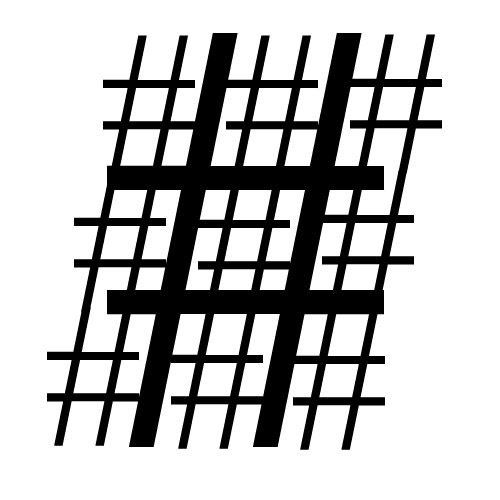
Part of my approach to making new sense of the universe involves indulging in meditations on unintentional symbolism. Any pattern that catches my attention is a potential subject for intuition voodoo. Usually it pays off eventually, even when it seems absurd at first.
In this case, I was thinking about the # and * symbols that were inserted into our visual culture obliquely, as extra buttons on the telephone which flanked the 0. Taking this as my cue to relate this to the multisense continuum, I compared the symbols graphically, etymologically, and semantically.
The pound sign (hash, hashtag, number sign) seems to me a dead ringer for the Western-mechanistic pole of the continuum, while the asterisk (star) fits quite nicely as the Oriental-animistic pole.
Here’s how it breaks down:
# – number sign, so quantitative and generic. The symbol is one of four lines crossing each other at right angles to yield nine implicit regions of space. The slant provides a suggestion of orientation – a forward lean that disambiguates spatial bias and implies, subliminally, an arrow of time.
In the age of Twitter and Instagram, the hashtag has become an important cultural influence. It is interesting with respect to mechanism in that it refers to accessing a machine’s sorting algorithms. It is a note to the network of how this term should be handled. We have appropriated this satirically so that we recapture it for our own entertainment, but also as a kind of show of affection for and familiarity with the technology.
In direct contrast, the * is am icon which is used to interrupt one level of attention to direct the reader to another level – a footnote. Instead of relating to numbers, the * is a wildcard that can be related to any string. It stands for “all that is preceded by or follows”. Contrary to the cellular modularity of #, the * is a mandala. It implies kaliedoscopic sensibility and fractal elaboration. It is a symbol of radiance, growth, life, unity, etc.
There’s some interesting threads that connect the * with mathematical terms such as Kleene closure (more commonly known as the free monoid construction). Just the words ‘free monoid construction’ ring in my ears as an echo of what I call solitrophy – the constructive progress of teleological unity…the creation and solution of problems.
Also the use of *asterisk* for heightened emphasis links it to the significance of euphoria or magnified feeling (and the euphoria that is associated with significance or magnified prestige/importance). Wikipedia mentions the use of # by editors to represent where space should be added on galley proofs. The use of * is, by contrast associated with repetition of a particular thing – a replication. This is a tenuous but deep connection to the origins of space and time in the difference between syntactic-public sense and semantic-private sense.
The name ‘pound sign’ seems to be fairly mysterious. It does not seem to be related conclusively to either the English currency or the Avoirdupois weight. Both references, however, have very tempting subliminal associations to the Western pole of empirical domination. On the other side, the name asterisk means ‘little star’, from Greek and Latin. I can read into that a reference to ‘as above, so below’, as the twinkling point of light reproduces in miniature that which is the grand solar source of life on Earth.
The Paranormal
As far as the paranormal goes, my approach is not to insist upon collapsing extraordinary experiences into binary terms of real or unreal. To the contrary, I see realism as a quality within consciousness such that its limitations reflect the nature of consciousness itself. By that I mean that our personal awareness has a sub-personal boundary and a super-personal boundary, both of which involve opposite views of coincidence. At the sub-personal bound, coincidence emerges stochastically and meaninglessly as an assertion of the instantaneous. At the super-personal bound, coincidences diverge synchronistically and teleologically as part of a ‘larger now’. The more super-personal we look, the more the real and unreal are blurred, and the more the experience reflects what I call ‘the physics of privacy’ rather than public physics.
Obstruction of Solitude: A Guide To Noise
“And then…all the noise! All the noise, noise, noise, noise!
If there’s one thing I hate…all the noise, noise, noise, noise!
And they’ll shriek, squeak, and squeal racing round on their wheels,
Then dance with jin-tinglers tied onto their heels!” – The Grinch“Karma police, arrest this man
He talks in maths
He buzzes like a fridge
He’s like a detuned radio” – Radiohead
It might be asked, “Why should we care about noise?” Two reasons come to mind.
1) To reduce, contain, or otherwise avoid it.
2) To understand what isn’t noise, and why we prefer that.
Real Noise
The general use of the word noise refers to an unpleasant sound. Even on this most literal level, there is a sense of denial about the extent to which unpleasant qualities are subjective. The stereotypical parent, upon hearing the stereotypical teenager’s musical taste being played at high volume, may yell something like “Turn off that infernal noise!”. There is a sense that the sound demands to be labeled objectively as a terrible thing to listen to, rather than as a sound which presents itself differently according to one’s state of mind or development.
At the same time, we cannot rule out all objective, or at least pseudo-objective qualities related to signal and noise. A garage recording of a metal band or a jackhammer attacking the pavement can be uncontroversially defined as being ‘noisy’, particularly in comparison to other, more gentle sounds. ‘Real noise’, then, seems to have a range of subjective and objective qualifiers. Loud, percussive sounds are inherently noisy to us humans, and we have reason to assume the same is true for animals and even plants:
“Dorothy Retallack tried experimenting with different types of music. She played rock to one group of plants and, soothing music to another. The group that heard rock turned out to be sickly and small whereas the other group grew large and healthy. What’s more surprising is that the group of plants listening to the soothing music grew bending towards the radio just as they bend towards the sunlight.” – source
Whether we enjoy loud, percussive sounds is a matter of taste and context. Even the most diehard metal fan probably does not want to hear their favorite band blasting at five o’ clock in the morning from a passing car. Being able to control what we listen to contributes to our perception of it as noise.
Obstruction, Distraction, Destruction, and Leaks
Whether a piece of music offends our personal taste, or it is simply so loud that we can’t ‘hear ourselves think’, the experience of being distracted seems central to its status as noise. In the parlance of sound engineers, and later Silicon Valley schmoozers, the ‘signal to noise ratio’ describes this feature of noise to distract or divert attention from the intended communication. Noise not only obstructs access to the signal, the disturbance that it causes also detracts from the quality of the signal itself. If the signal to noise ratio is poor enough, it may not be worth the effort for the receiver to try to interpret it, and communication is destroyed.
This sense of noise as an obstacle to communication extends beyond audio or electronic signals to any context where information is accessed, transmitted, or stored. In his influential work on telecommunications, Clause Shannon described information entropy as those features of a signal which are costly to compress. Typically it is those patterns which cannot be easily discerned as either part of the intentional signal or part of the background noise. Despite the tremendous computational resources available for mobile communication, the signal quality on mobile devices are still generally inferior to land lines. Between microphone gating that clips off conversation instead of ambient street sounds and the loss of packets due to radio broadcast conditions or network routing conditions, it is amazing that it sounds as good as it does, but it is still a relatively leaky way to transmit voices.
Neural Noise and Withdrawal
Every sense has its own particular kind of noise. Vision has glare, blur, phosphene patterns (‘seeing stars’). Touch has non-specific tingling or itching. Olfactory and gustatory senses encounter foul odors or bad aftertastes. Feelings like nausea and dizziness which are unrelated to food or balance conditions are a kind of noise (noise is etymologically related to nausea and noxious). Part of the effect of withdrawal from an addiction that the brain becomes overly sensitized to irritating stimuli in general. It’s almost like an allergic response in that the systems which would ordinarily protect us from threats is distracted by a false threat and turned on itself. Our sensitivity to the environment, having been hijacked by an external supply of pleasurable signals, has built up a tolerance for those super-saturated instructions.
With any kind of addiction, even healthy ones like exercise or washing your hands, the nature of sense is to accommodate and normalize perceptions which are present regularly. Because the addiction provides positive reinforcement regularly, there is an artificially low noise ratio which invites your senses to recalibrate to listen more closely to the noise (which would be quite adaptive evolutionarily, you would want to still hear that tiger or smell that smoke even when you enjoy a lifestyle of hedonism and decadence). When the source of positive distraction is removed, the sensitivity to negative distraction is still cranked up to 11, which of course, taps into the original motivation to escape the negative distractions of life with an addiction in the first place. We want something to soothe our nerves, to numb the sensitivity and quiet the noise.
A Recipe For Noise
There seem to be general patterns which are common to many kinds of noise. Noise can either be an obstructing presence, or a conspicuous absence (like the dropouts on a phone call). It can be a public or a private condition which clouds judgment, invites impatience, frustration, and intolerance. Noise can be that which is incoherent, irrelevant, redundant, or inappropriate. Some signals can be temporarily irrelevant or incoherent, while others are permanently so. Besides being too loud, an audio noise can also be soft, such as a hiss or other aesthetic defect that exposes leaky conditions in the recording process. The context is important, as with withdrawal from addiction, our senses are more attuned to the relativity of sensation rather than objective measurement. Grey looks darker next to black than it does next to white.
Our ability to use our attention to pivot from foreground to background is part of what defines the difference between signal and noise, or sense and nonsense. We can all relate to the Charlie Brown effect, where the words that a teacher says are reduced to unintelligible vocalizations. As you read these words now, you may be scanning over so much tedious verbiage that looks like generic wordiness more than any particular message. Any signal can be a noise if you don’t pay attention to it in the right way, and any noise can be used as a meaningful code or symbol. Perhaps there is a way to get over our addictions a little easier if we can learn to see our irritation and cravings as a sign that we are on the right path to restoring our neurological gain.
Many Cures
The destruction of information or the suppression of noise is not as simple as it may seem. Take, for example, the difference between analgesic, anesthetic, and narcotic effects. Pain can be relieved systemically, locally, or simply by being made to seem irrelevant. It can be selectively suppressed or wiped out as part of an overall deadening of sensation. There are other ways to get pain relief besides pharmaceuticals as well. Athletes or soldiers are known to perform with severe injuries, and many people have endured astonishing hardships for the sake of their family without being fully aware of the pain they were in. While there may be endogenous pharmacology going on which accounts for the specific pain suppression, it is ultimately the context which the subject is conscious of which drives the release of endorphins and other neurotransmitters.
Semiotics of Noise
Looking at noise from a Piercean perspective, it can be seen as a failure of semiosis – a broken icon, symbol, or index. A broken index would be something like tinnitus or a phantom limb. The signal we are receiving does not correspond to the referent that we expect, and in fact corresponds only to a problem with the signaling mechanism, or some deeper problem. A signal which is broken as an index but can be understood meaningfully as a symptom of something else (maybe the tinnitus is due to a sinus infection) has reverted from a teleological index to a teleonomic* index. It coincides with a condition, but does not represent it faithfully in any way. It is noise in the sense that the expected association must be overlooked intentionally to get to the unintentional association to a symptom.
A broken index would also be one which we deem irrelevant. This type of noise, which would include the proliferation of automatic alerts, false alarms, flashing lights, spam, etc. There may be nothing wrong with what what the message is saying, but considerations of redundancy, and context inappropriateness makes it clear that what a computer thinks is important and what we think is important are very different things. This type of noise fails at the pragmatic level. It’s not that we don’t understand the message, or that its not for us, it’s that we don’t want to do anything about it.
Broken icons and symbols would similarly be made incoherent, irrelevant, or inappropriate by lacking enough syntactic integrity or semantic content to justify positive attention. Fragmented texts or degenerated signs can fail to satisfy functionally or aesthetically, either on their own, or due to intrusions from outside of the intended communication channel. The overall function of noise is to decompose. Like the odor of something that has spoiled, disorder and decay are symptoms of entropy. In the schema of cosmic metabolism, entropy is the catabolic phase of forms and functions – a kind of toll exacted by space and time which ensures that whatever rises to the threshold of existence and importance, will eventually destabilize, its differences de-tuning to indifference.
What Noise Tells Us About Signals
If we begin with the premise that signal and noise are polar opposites, then it may be useful to look at the opposite of some of the terms and concepts that have just been discussed. If noise is irrelevant, inappropriate, incoherent, and redundant, then the qualities which make something significant or important should include being relevant, appropriate, coherent, and essential. Where noise obstructs, distracts, and destroys, sense instructs, attracts, and constructs. Where noise is noxious and disgusting, signals soothe and give solace.
In the larger picture of self and consciousness, it is our solitude that is threatened by noise. Solitude, like solidity and structure are related to low entropy. It is the feeling of strong continuity and coherence, a silent background from which all moments of sound and fury are foregrounded. It is what receives all signals and insulates all noise. Integrated information? Maybe. The Philosopher’s Stone? Probably.
*teleonomy describes conditions of causality which are driven by blind statistics rather than sensible function. Evolution, for example, is a teleonomy since it does not care which species live or die, it is only those who happen to have been better suited to their ecological niche which end up reproducing most successfully.
Sensory-Motive Zodiac


Wittgenstein, Physics, and Free Will
JE: My experience from talking to philosophers is that WIttgenstein’s view is certainly contentious. There seem to be two camps. There are those seduced by his writing who accept his account and there are others who, like me, feel that Wittgenstein expressed certain fairly trivial insights about perception and language that most people should have worked out for themselves and then proceeded to draw inappropriate conclusions and screw up the progress of contemporary philosophy for fifty years. This latter would be the standard view amongst philosophers working on biological problems in language as far as I can see.
Wittgenstein is right to say that words have different meanings in different situations – that should be obvious. He is right to say that contemporary philosophers waste their time using words inappropriately – any one from outside sees that straight away. But his solution – to say that the meaning of words is just how they are normally used, is no solution – it turns out to be a smoke screen to allow him to indulge his own prejudices and not engage in productive explanation of how language actually works inside brains.
The problem is a weaseling going on that, as I indicated before, leads to Wittgenstein encouraging the very crime he thought he was clever to identify. The meaning of a word may ‘lie in how it is used’ in the sense that the occurrences of words in talk is functionally connected to the roles words play in internal brain processes and relate to other brain processes but this is trivial. To say that meaning is use is, as I said, clearly a route to the W crime itself. If I ask how do you know meaning means use you will reply that a famous philosopher said so. Maybe he did but he also said that words do not have unique meanings defined by philosophers – they are used in all sorts of ways and there are all sorts of meanings of meaning that are not ‘use’, as anyone who has read Grice or Chomsky will have come to realise. Two meanings of a word may be incompatible yet it may be well nigh impossible to detect this from use – the situation I think we have here. The incompatibility only becomes clear if we rigorously explore what these meanings are. Wittgenstein is about as much help as a label on a packet of pills that says ‘to be taken as directed’.
But let’s be Wittgensteinian and play a language game of ordinary use, based on the family resemblance thesis. What does choose mean? One meaning might be to raise in the hearer the thought of having a sense of choosing. So a referent of ‘choose’ is an idea or experience that seems to be real and I think must be. But we were discussing what we think that sense of choosing relates to in terms of physics. We want to use ‘choose’ to indicate some sort of causal relation or an aspect of causation, or if we are a bit worried about physics still having causes we could frame it in terms of dynamics or maybe even just connections in a spacetime manifold. If Wheeler thinks choice is relevant to physics he must think that ‘choose’ can be used to describe something of this sort, as well as the sense of choosing.
So, as I indicated, we need to pin down what that dynamic role might be. And I identified the fact that the common presumption about this is wrong. It is commonly thought that choosing is being in a situation with several possible outcomes. However, we have no reason to think that. The brain may well not be purely deterministic in operation. Quantum indeterminacy may amplify up to the level of significant indeterminacy in such a complex system with so powerful amplification systems at work. However, this is far from established and anyway it would have nothing to do with our idea of choosing if it was just a level of random noise. So I think we should probably work on the basis that the brain is in fact as tightly deterministic as matters here. This implies that in the situation where we feel we are choosing THERE IS ONLY ONE POSSIBLE OUTCOME.
The problem, as I indicated is that there seem to be multiple possible outcomes to us because we do not know how are brain is going to respond. Because this lack of knowledge is a standard feature of our experience our idea of ‘a situation’ is better thought of as ‘an example of an ensemble of situations that are indistinguishable in terms of outcome’. If I say when I get to the main road I can turn right or left I am really saying that I predict an instance of an ensemble of situations which are indistinguishable in terms of whether I go right or left. This ensemble issue of course is central to QM and maybe we should not be so surprised about that – operationally we live in a world of ensembles, not of specific situations.
So this has nothing to do with ‘metaphysical connotations’ which is Wittgenstein’s way of blocking out any arguments that upset him – where did we bring metaphysics in here? We have two meanings of choose. 1. Being in a situation that may be reported as being one of feeling one has choice (to be purely behaviourist) and 2. A dynamic account of that situation that turns out not to agree with what 99.9% of the population assume it is when they feel they are choosing. People use choose in a discussion of dynamics as if it meant what it feels like in 1 but the reality is that this use is useless. It is a bit like making burnt offerings to the Gods. That may be a use for goats but not a very productive one. It turns out that the ‘family resemblance’ is a fake. Cousin Susan who has pitched up to claim her inheritance is an impostor. That is why I say that although to ‘feel I am choosing’ is unproblematic the word ‘choice’ has no useful meaning in physics. It is based on the same sort of error as thinking a wavefunction describes a ‘particle’ rather than an ensemble of particles. The problem with Wittgenstein is that he never thought through where his idea of use takes you if you take a careful scientific approach. Basically I think he was lazy. The common reason why philosophers get tied in knots with words is this one – that a word has several meanings that do not in fact have the ‘family relations’ we assume they have – this is true for knowledge, perceiving, self, mind, consciousness – all the big words in this field. Wittgenstein’s solution of going back to using words the way they are ‘usually’ used is nothing more than an ostrich sticking its head in the sand.
So would you not agree that in Wheeler’s experiments the experimenter does not have a choice in the sense that she probably feels she has? She is not able to perform two alternative manoeuvres on the measuring set up. She will perform a manoeuvre, and she may not yet know which, but there are no alternatives possible in this particular instance of the situation ensemble. She is no different from a computer programmed to set the experiment up a particular way before particle went through the slits, contingent on a meteorite not shaking the apparatus after it went through the slits (causality is just as much an issue of what did not happen as what did). So if we think this sort of choosing tells us something important about physics we have misunderstood physics, I beleive.
Nice response. I agree almost down the line.
As far as the meaning of words go, I think that no word can have only one meaning because meaning, like all sense, is not assembled from fragments in isolation, but rather isolated temporarily from the totality of experience. Every word is a metaphor, and metaphor can be dialed in and out of context as dictated by the preference of the interpreter. Even when we are looking at something which has been written, we can argue over whether a chapter means this or that, whether or not the author intended to mean it. We accept that some meanings arise unintentionally within metaphor, and when creating art or writing a book, it is not uncommon to glimpse and develop meanings which were not planned.
To choose has a lower limit, between the personal and the sub-personal which deals with the difference between accidents and ‘on purpose’ where accidents are assumed to demand correction, and there is an upper limit on choice between the personal and the super-personal in which we can calibrate our tolerance toward accidents, possibly choosing to let them be defined as artistic or intuitive and even pursuing them to be developed.
I think that this lensing of choice into upper and lower limits, is, like red and blue shift, a property of physics – of private physics. All experiences, feelings, words, etc can explode into associations if examined closely. All matter can appear as fluctuations of energy, and all energy can appear as changes in the behavior of matter. Reversing the figure-ground relation is a subjective preference. So too is reversing the figure-ground relation of choice and determinism a subjective preference. If we say that our choices are determined, then we must explain why there is a such thing as having a feeling that we choose. Why would there be a difference, for example, in the way that we breathe and the way that we intentionally control our breathing? Why would different areas of the brain be involved in voluntary control, and why would voluntary muscle tissue be different from smooth muscle tissue if there were no role for choice in physics? We have misunderstood physics in that we have misinterpreted the role of our involvement in that understanding.
We see physics as a collection of rules from which experiences follow, but I think that it can only be the other way around. Rules follow from experiences. Physics lags behind awareness. In the case of humans, our personal awareness lags behind our sub-personal awareness (as shown by Libet, etc) but that does not mean that our sub-personal awareness follows microphysical measurables. If you are going to look at the personal level of physics, you only have to recognize that you can intend to stand up before you stand up, or that you can create an opinion intentionally which is a compromise between select personal preferences and the expectations of a social group.
Previous Wittgenstein post here.
Perspectives on Gravity
“The universe is shaped exactly like the Earth,
If you go straight long enough you’ll end up where you were.” – Modest Mouse
Science
Newton conceived of universal gravitation as a ratio of mass to distance.
“…every point mass in the universe attracts every other point mass with a force that is directly proportional to the product of their masses and inversely proportional to the square of the distance between them.”
Einstein revolutionized classical gravity with General Relativity, merging space with time and formulating the equivalence of mass and energy. Rather than a rigid Cartesian plenum of 3-D space and a one dimensional timeline, Einstein saw a flexible, four dimensional ‘mollusk’ of spacetime contoured by the relations of matter and energy. GR, along with Special Relativity, made the universe a much stranger place, with time dilation, black holes, the relativity of simultaneity, and the constancy of the speed of light as a universal absolute.
Since quantum theory begins at the other end of the cosmological continuum of size, there has been a continuity problem between sub-nuclear physics and astrophysics. Quantum doesn’t match up with relativity very well, so the quest to find a bridge between the two has been a prominent open question for contemporary physics.
Here are a some brief signposts along that highway between QM and GR:
In most, though not all, theories of quantum gravity, the gravitational field itself is also quantized. Since the contemporary theory of gravity, general relativity, describes gravitation as the curvature of spacetime by matter and energy, a quantization of gravity seemingly implies some sort of quantization of spacetime geometry. Insofar as all extant physical theories rely on a classical spacetime background, this presents not only extreme technical difficulties, but also profound methodological and ontological challenges for the philosopher and the physicist. Though quantum gravity has been the subject of investigation by physicists for over eighty years, philosophers have only just begun to investigate its philosophical implications.
Gravity makes quantum superposition decohere into classical physics.
Weak gravitational waves that fill the Universe are enough to disturb quantum superpositions and ensure that large objects behave according to classical physics. […] Many theorists now believe that macroscopic superpositions, in which numerous quantum components must maintain a precise relationship with each other, are disrupted by continual environmental influences. Such disturbances, acting differently on each component of a superposition, “decohere” it into a classical state that is, say, dead or alive, but not both. Even a system as small as an atom requires extraordinary protection from stray electromagnetic fields in the lab to remain in a superposition. Since gravitational fields are both pervasive and inescapable, researchers have proposed that they play a fundamental role in ensuring that macroscopic systems behave in a classical way.
We confirm, in this context, that the dynamics of a Brownian particle driven by space-time dependent fluctuations evolves towards Hamiltonian chaos and fractional diffusion. The corresponding motion of the particle has a time-dependent and nowhere vanishing acceleration. Invoking the equivalence principle of general relativity leads to the conclusion that fractional diffusion is locally equivalent to a transient gravitational field. It is shown that gravity becomes renormalizable as Newton’s constant converges towards a dimensionless quantity.
Modified Newtonian Dynamics (MOND) were proposed to explain the galaxy rotation problem. Unexpectedly, when it was first observed, the velocity of rotation of galaxies appeared to be uniform: Newton’s theory of gravity predicts that the farther away an object is from the center of the galaxy it belongs to, the lower its velocity will be (for example, the velocity of a planet orbiting a star decreases as the distance between them increases). These observations gave birth to the idea that a halo of invisible stuff was surrounding each galaxy: dark matter.
In this new model, the gravitational field still increases as you near the black hole’s core. But unlike previous models, this doesn’t end in a singularity. Instead gravity eventually reduces, as if you’ve come out the other end of the black hole and landed either in another region of our universe, or another universe altogether. Despite only holding for a simple model of a black hole, the researchers – and Ashtekar – believe the theory may banish singularities from real black holes too.
Metaphors and Symmetries
Switching gears from the scientific sense of gravity to the personal sense, there are some worthwhile themes to explore. The etymology of gravity links heaviness with seriousness. Gravity relates to grave, and groove. Digging ditches and engraving (scratching). The association with burial and death probably accounts for the connection from grave to words like serious, severe, and swear. The idea of a sworn oath or an engraved ring relates to a sense of a permanent pledge. There is an intent to hold on steadily against all odds, or all distraction. The root of swear crosses over to answer also – a hint that ‘saying’ something out loud can have serious or permanent consequences.
Serious or grave subjects are often called ‘heavy’ or ‘dense’ while frivolous topics are ‘light’ or refer to things which are airy (fluff, puff pieces). Insubstantial or insincere talk is ‘blowing smoke’. Both the literal and figurative meanings of heavy (literal = heavy weight; figurative = heavy important) have light as an antonym, but it is light in two different figurative senses. The antonym of the literal sense of light is dark, which comes back around to gravity in the form of black holes, where the intensity of gravity does not allow light to escape. It could be said that a black hole is a star’s grave.
Under the influence of gravity, weight, density, and pressure increase. Movement becomes more difficult and slow. More power is required to exert the same force. Metaphorically there is a lot of crossover – feelings of stress are compared to being ‘under a lot of pressure’ is associated with risk or powerlessness. Resistance and inertia figure in, as does entropy. Under pressure, time becomes more valuable, and the tolerance for distractions (nonsense), is lowered. Ideally, the significance of the goal should be worth the effort. Monumental investments expect monumental results.
If electromagnetism is the ‘Spring ‘ of matter’s energy, then gravity is its Fall. If energy is a fountain which lights the matter into significance, then gravity is the drain which flattens entropy and reverses its disposition into a one dimensional, time slowing presence – mass. Said another way, gravity is the metabolism of spacetime, and the embodied force of entropy.
Dr. Thanu Padmanabhan of the Inter-University Center for Astronomy and Astrophysics in Pune, India said Gravity “is the thermodynamic limit of the statistical mechanics of “atoms of space-time.”
Erik Verlinde, 48, a respected string theorist and professor of physics at the University of Amsterdam, is quoted as saying that gravity is “entropic force.”
Gravity’s symmetry with electromagnetism extends to the metaphysical. The etymology of the words burden and bear go back to the word for ‘birth’. Themes of give and take, and birth and death, wrap around each other. The idea of curvature, of entropy statistically evening out odd statistics and jagged exceptions is an expression of magnitude and relativity. The pull of gravity doesn’t make things spin or orbit, but since the number of velocities that a body can have is so much greater than the number of ways a body can be stationary, entropy ensures that most everything is moving somewhere, and gravity pulls light things close to heavy things faster than heavy things are pulled to light things, causing the lighter moving thing to wrap its path around the heavier mass in an ellipse.
With a black hole, and on Earth, gravity and entropy suggests a connection to loss and absence. Ultimately, gravity shows that even absence turns back on itself, since it can only ever be the sense of its own absence – the presence of the absence of presence. Sense can only diminish relative to itself, it can only appear to be slow or missing by comparison. Gravity is about falling, collapsing, and squeezing the space and time out of incidents to make them co-incidents with shared inertia. Gravity is the force of pseudointentionality, the entropy of entropy. If perception elides its blindness and entropy to concentrate significance, gravity elides in the opposite way, through quantitative density. Anomalies are crushed and drowned into smooth curves until they explode. Stars explode into clouds which collect into other stars, scars of stars, and galactic spiral clouds of stars.
Are teleonomy, evolution, entropy, and gravity the same thing? If electromagnetism and energy represent uniqueness and creativity on every level, gravity and entropy are a statistical rounding off of all of that uniqueness across all the inertial frames. It settles everything into hierarchies of magnitude on the outside and figurative scales of greatness (importance) on the inside.
Extra Credit
Gravity isn’t directly related to time. Although much our timekeeping is modeled after astronomical cycles, neither the rotation of the Earth nor its heliocentric orbit are caused by gravity alone. It seems easy to mistakenly guess that planets have gravity because they spin, as if it were some kind of centripetal force, but the gravity would be almost the same if Earth were not spinning, and gravity itself is not causing the spin in the first place. What we think is that planets condensed from moving clouds of cosmic debris, and when they become smaller, the motion becomes faster (conservation of angular momentum, like a figure skater pulling their arms in for the faster spin).
As far as gravity is concerned, the Earth and Sun only need be drawn together, all orbits, spins, and tilts in the solar system are the residual effects of the events which initially accelerated the cloud of matter into motion or changed its direction. The tilt of the Earth is thought to be the result of collisions with other massive objects during its early history. Without the tilt, you would have no seasons as every position of the Earth’s orbit would produce no noticeable difference. Same with the spin. Gravity doesn’t care if the Earth spins or not.
What gravity does do for time is provide conditions of relative permanence that would not exist otherwise. Without gravity we could still keep track of cycles of time, but they would be forever be changing completely as our view of the universe changes permanently from a non-orbiting planet hurtling aimlessly through space. Gravity provides a frame of circularity which allows greater degrees of order in our perception. Gravity doesn’t make time, but it makes it more relevant.
If You See Wittgenstein on the Road… (you know what to do)
Me butting into a language based argument about free will:
> I don’t see anything particularly contentious about Wittgenstein’s claim that the meaning of a word lies in how it is used.
Can something (a sound or a spelling) be used as a word if it has no meaning in the first place though?
>After all, language is just an activity in which humans engage in order to influence (and to be influenced by) the behaviour of other humans.
Not necessarily. I imagine that the origin of language has more to do with imitation of natural sounds and gestures. Onomatopoeia, for example. Clang, crunch, crash… these are not arbitrary signs which derive their meaning from usage alone. C. S. Pierce was on the right track with discerning between symbols (arbitrary signs whose meaning is attached by use alone), icons (signs which are isomorphic to their referent), and index (signs which refer by inevitable association as smoke is an index of fire). Words would not develop out of what they feel like to say and to hear, and the relation of that feeling to what is meant.
>I’m inclined to regard his analysis of language in the same light as I regard Hume’s analysis of the philosophical notion of ‘substance’ (and you will be aware that I side with process over substance) – i.e. there is no essential essence to a word. Any particular word plays a role in a variety of different language games, and those various roles are not related by some kind of underlying essence but by what Wittgenstein referred to as a family resemblance. The only pertinent question becomes that of what role a word can be seen to play in a particular language game (i.e. what behavioural influences it has), and this is an empirical question – i.e. it does not necessarily have any metaphysical connotations.
While Wittgenstein’s view is justifiably influential, I think that it belongs to the perspective of modernism’s transition to postmodernity. As such, it is bound by the tenets of existentialism, in which isolation, rather than totality is assumed. I question the validity of isolation when it comes to subjectivity (what I call private physics) since I think that subjectivity makes more sense as a temporary partition, or diffraction within the totality of experience rather than a product of isolated mechanisms. Just as a prism does not produce the visible spectrum by reinventing it mechanically – colors are instead revealed through the diffraction of white light. Much of what goes on in communication is indeed language games, and I agree that words do not have an isolated essence, but that does not mean that the meaning of words is not rooted in a multiplicity of sensible contexts. The pieces that are used to play the language game are not tokens, they are more like colored lights that change colors when they are put together next to each other. Lights which can be used to infer meaning on many levels simultaneously, because all meaning is multivalent/holographic.
> So if I wish to know the meaning of a word, e.g. ‘choice’, I have to LOOK at how the word is USED rather than THINK about what kind of metaphysical scheme might lie behind the word (Philosophical Investigations section 66 and again in section 340).
That’s a good method for learning about some aspects of words, but not others. In some case, as in onomatopoeia, that is the worst way of learning anything about it and you will wind up thinking that Pow! is some kind of commentary about humorous violence and has nothing to do with the *sound* of bodies colliding and it’s emotional impact. It’s like the anthropologist who gets the completely wrong idea about what people are doing because they are reverse engineering what they observe back to other ethnographers interpretations rather than to the people’s experienced history together.
> So, for instance, when Jane asks me “How should I choose my next car?” I understand her perfectly well to be asking about the criteria she should be employing in making her decision. Similarly with the word ‘free’ – I understand perfectly well what it means for a convict to be set free. And so to the term ‘free will’; As Hume pointed out, there is a perfectly sensible way to use the term – i.e. when I say “I did it of my own free will”, all I mean is that I was not coerced into doing it, and I’m conferring no metaphysical significance upon my actions (the compatibilist notion of free will in contrast to the metaphysical notion of free will).
Why would that phrase ‘free will’ be used at all though? Why not just say “I was not coerced” or nothing at all, since without metaphysical (or private physical) free will, there would be no important difference between being coerced by causes within your body or beyond your body. Under determinism, there is no such thing as not being coerced.
> The word ‘will’ is again used in a variety of language games, and the family resemblance would appear to imply something about the future (e.g. “I will get that paper finished today”). When used in the free will language game, it shares a significant overlap with the choice language game. But when we lift a word out of its common speech uses and confer metaphysical connotations upon it, Wittgenstein tells us that language has ceased doing useful work (as he puts it in the PI section 38, “philosophical problems arise when language goes on holiday”).
We should not presume that work is useful without first assuming free will. Useful, like will, is a quality of attention, an aesthetic experience of participation which may be far more important than all of the work in the universe put together. It is not will that must find a useful function, it is function that acquires use only through the feeling of will.
> And, of course, the word ‘meaning’ is itself employed in a variety of different language games – I can say that I had a “meaningful experience” without coming into conflict with Wittgenstein’s claim that the meaning of a word lies in its use.
Use is only one part of meaning. Wittgenstein was looking at a toy model of language that ties only to verbal intellect itself, not to the sensory-motor foundations of pre-communicated experience. It was a brilliant abstraction, important for understanding a lot about language, but ultimately I think that it takes the wrong things too seriously. All that is important about awareness and language would, under the Private Language argument, be passed over in silence.
> Regarding Wheeler’s delayed choice experiment, the experimenter clearly has a choice as to whether she will deploy a detector that ignores the paths by which the light reaches it, or a detector that takes the paths into account. In Wheeler’s scenario that choice is delayed until the light has already passed through (one or both of) the slits. I really can’t take issue with the word ‘choice’ as it is being used here.
I think that QM also will eventually be explained by dropping the assumption of isolation. Light is visual sense. It is how matter sees and looks. Different levels of description present themselves differently from different perspectives, so that if you put matter in the tiniest box you can get, you give it no choice but to reflect back the nature of the limitation of that specific measurement, and measurement in general.
 Multisense Realism
Recent Comments