Archive
Playing Cards With Qualia
Here is an example to help illustrate what I think is the relationship between information and qualia that makes the most sense.

Here I am using the delta (Δ) to denote “difference”, n to mean “numbers” or information, kappa for aesthetic “kind” or qualia, and delta n degree (Δn°) for “difference in degree”.
The formula on top means “The difference between numbers and aesthetic qualities is not a difference in degree. This means that there is no known method by which a functional output of a computation can acquire an aesthetic quality, such as a color, flavor, or feeling.
Reversing the order in the bottom formula, I am asserting that the difference between qualia and numbers actually is only a difference in degree, not a difference in kind. That means that we can make numbers out of qualia, by counting them, but numbers can’t make qualia no matter what we do with them. This is to say also that subjects can reduce each other to objects, but objects cannot become subjects.
Let’s use playing cards as an example.
Each card has a quantitative value, A-K. The four suits, their colors and shapes, the portraits on the royal cards…none of them add anything at all to the functionality of the game. Every card game ever conceived can be played just as well with only four sets of 13 number values.
The view which is generally offered by scientific or mathematical accounts, would be that the nature of hearts, clubs, diamonds, kings, etc can differ only in degree from the numbers, and not in kind. Our thinking about the nature of consciousness puts the brain ahead of subjective experience, so that all feelings and qualities of experience are presumed to be representations of more complicated microphysical functions. This is mind-brain identity theory. The mind is the functioning of the brain, so that the pictures and colors on the cards would, by extension, be representations of the purely logical values.
To me, that’s obviously bending over backward to accommodate a prejudice toward the quantitative. The functionalist view prefers to preserve the gap between numbers and suits and fill it with faith, rather than consider the alternative that now seems obvious to me: You can turn the suit qualities into numbers easily – just enumerate them. The four suits can be reduced to 00,01,10, and 11. A King can be #0D, an Ace can be 01, etc. There is no problem with this, and indeed it is the natural way that all counting has developed: The minimalist characterization of things which are actually experienced qualitatively.
The functionalist view requires the opposite transformation, that the existence of hearts and clubs, red and black, is only possible through a hypothetical brute emergence by which computations suddenly appear heart shaped or wearing a crown, because… well because of complexity, or because we can’t prove that it isn’t happening. The logical fallacy being invoked is Affirming the Consequent:
If Bill Gates owns Fort Knox, then he is rich.
Bill Gates is rich.
Therefore, Bill Gates owns Fort Knox.
If the brain is physical, then it can be reduced to a computation.
We are associated with the activity of a brain.
Therefore, we can be reduced to a computation.
To correct this, we should invert our assumption, and look to a model of the universe in which differences in kind can be quantified, but differences in degree cannot be qualified. Qualia reduce to quanta (by degree), but quanta does not enrich to qualia (at all).
To take this to the limit, I would add the players of the card game to the pictures, suits, and colors of the cards, as well as their intention and enthusiasm for winning the game. The qualia of the cards is more “like them” and helps bridge the gap to the quanta of the cards, which is more like the cards themselves – digital units in a spatio-temporal mosaic.
Square Spiral Diagram
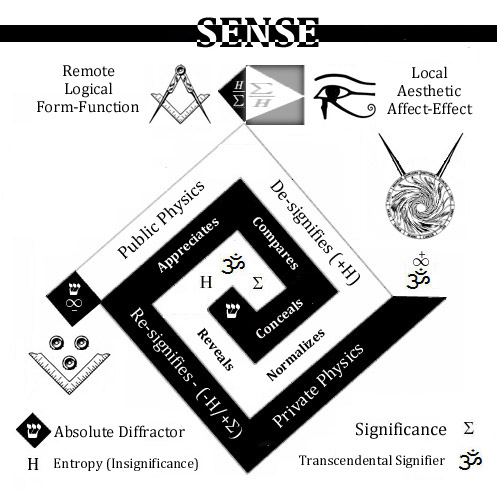
This square spiral logo is coming in handy, but my apologies if it is getting monotonous. This is an informal flow chart of what might be called cosmological metabolism. The interplay between H and Σ describe the catabolic and anabolic principles (Entropy and Significance). The idea here is that the primordial identity or principle behind everything is sense, and that through the alienation or diffraction of sense, followed by re-uniting, significance is gained.
Sense can be understood as accumulating from the bottom up, as complexity and sophistication of experience, and also as a splitting off from the Totality. Consciousness can be understood as a nesting of coincidence which accelerates itself. Time is a comparison of coincidences in which a logical distance is inferred, while space is presented as a logical context within which objects or forms coincide directly. Clock time, therefore is a spatialization of our inner experience – a masking of private, lifelong harmonics which are semantic and quasi-narrative. The gaps of time give structure to the autobiographical dream.
Sense bridges the gap between one time and another, across distance or separation, connecting public and private. Sense tears itself down so it can build improvement. Our public view of physics eradicates meaning inadvertently by hiding coincidence. Because sense is the primordial identity, coincidence can be thought of as the existential expression of what is essentially transformations of meaning and aesthetic quality. When we spread it out over space and time, it looks like coincidence, but if we keep spreading it out, it looks like unrelated incidents. The refinement of these unrelated incidents into generic, meaningless functions, is what is physics and math are about – however, because the nature of sense is self-reflective and self-revealing, the blueprint of its grandest coincidences can be seen, even in their absence.
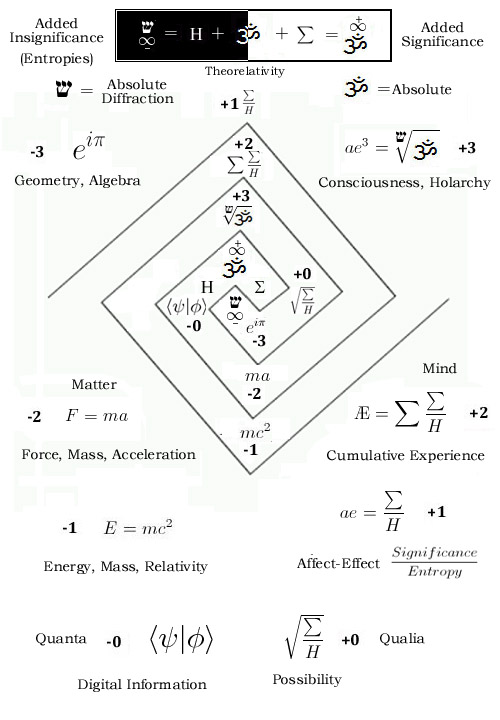
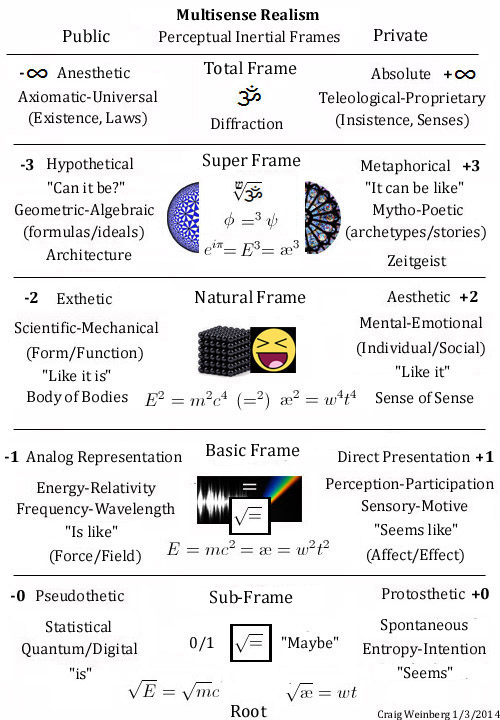
Physics as the Production of Realistic Fantasy and Fantastic Reality
When working with private physics, the operators used are metaphorical and implicit, not explicit. Qualia is LIKE the “mass” of privacy. The will to will is like the “Energy” of privacy, and realism is like the “c²”. In my understanding, the notion that c is the speed of light is really a legacy understanding – a pre-Relativity convention within Relativity. It makes more sense to me now that light just happens to be the fastest quality of sense that we have access to. The true nature of c is as the speed of sense, or experience itself. It is not a speed, but the absolute limit of velocity. The still-here-ness of the universe..
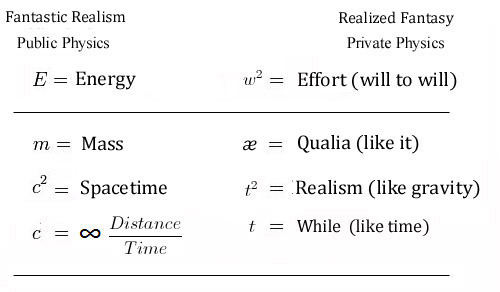
From an absolute view, quantified properties like mass, energy, and spacetime can be considered to be like reality but the only true reality is what experience is like. All conditions of the public universe are contingent upon an aesthetic palette, otherwise it would be implausible that any such palette could exist.
Private physics and public physics provide two different senses or fantasy, and two different senses of reality. Human experience is fantastically rich in an aesthetic sense and fundamentally real because it is the source of our participation in the universe. Our experience of the non-human universe is fantastic in the sense of its overwhelming magnitude and complexity, Its reality is persistent and reliable.
If we are serious about our science, we should consider that being overwhelmed by grandeur is a human experience which reflects the disparity in physical scale between us and the larger exteriority. The Public universe by itself would have no such feeling of grandeur, but what we feel about the inaccessible vastness of the cosmos is equaled by the vast inaccessibility of feeling by public physics.
Something else that has come up through this recent addition of physics to MSR, is the idea that Gravity is time squared, and that time is the square root of gravity. This makes sense to me, if we are talking about the equivalent conjugates of c² and t² as pubic spacetime and private realism. It should work out that Spacetime = the public shadow of Realism, and therefore Spacetime is literally Gravity and Realism is literally figuratively Gravity, as in the grave, serious nature of experience. If c is the constancy of distance and time coordinates, c² is the gravity which warps them from within.
A Formula for Qualia
To derive the formula for qualia or sensory affect, solve the Hard Problem of Consciousness, and bridge the Explanatory gap, I suggest that we try converting the mass-energy equivalence E=mc² from the public orientation and transpose it inward to the private orientation.
Energy (E) becomes w² which is “was and will be” (w = was or will be)
The Speed of light (c) becomes t = time = (still or never) = now or realism
Light* (c²) becomes t² “still and never again” or “stereo realism of now”
Mass (M) becomes æ = qualia = “like it”
Qualia = “like it was and will be, still and never again” =

another wording
Qualia = “Eternally signifies its past and future now”
This is about what Milan Kundera called The Unbearable Lightness of Being. That our experience of the universe is either perpetually suspended above the paradox of an existence which is both perpetually vanishing forever in some sense and repeating forever in another. If c is the still ‘speed’ of here and now, then c² is the acceleration of here and now, the enrichment of the local now through the collective presence and absence of eternity
- Motive effect or will:
To derive will or motive: 
If qualia is “like it”, then square root of æ is what joins and divides the ‘like’ and the ‘it’. It is the dipole charge of ‘liking’ and ‘it-ing’ which we call desire or preference. The greater the liking, the more significance is projected onto the object, which is the imagined realization of a goal in time. Intention projects into the future, builds, and guides qualia.
Will = “(Maybe, or maybe not)(now or never)” = w = √æ t
Turning the private translation outward to Public/Western psychology so that interiority is undersignified as emergent epiphenomena, we get:
= Experience is simply what may and may not be happening for some time.
and
= Choosing = Right or wrong this time
The public-facing view of privacy reduces it to information processing. To those who have a private-facing view this is a flat and inadequate characterization. The former view is optimized for realizing spatial intelligence while the latter is optimized for appreciating timeless wisdom.
- Quality and Equality
Since qualia is about likeness and local equivalents, it can be said that qualia equals the differential between equality and all inequalities... æ = ‘d=’.

The kicker is that since equality is itself a quale (the spelling of e-quality is a clue), we can conceive of ‘=’ as quality which is externalized**, i.e. the differential is collapsed and the entire range of what it “is like” is interpreted as what “it actually is”. The Western-facing mind naturally prefers that which only tells it ‘like it is‘, so that public physics and information science will filter out as noise all that tries to tell ‘what it is like‘ (paging Ludwig Wittgenstein…). This commercialization of residential qualities has had many benefits, but it is a philosophy which has blinded itself, and intimidated many into ignoring the true nature of consciousness. It’s not anyone’s fault, it’s how private physics works. It’s how sense is made.
*The speed of light is c, but c², if taken literally, can be understood as light itself, reality, or making sense: producing stereo (solid) realism.
**Physically publicized, cropped, framed, stereotyped, commercialized, hardened to endure against the changing feelings that make up private time.
Physics in English
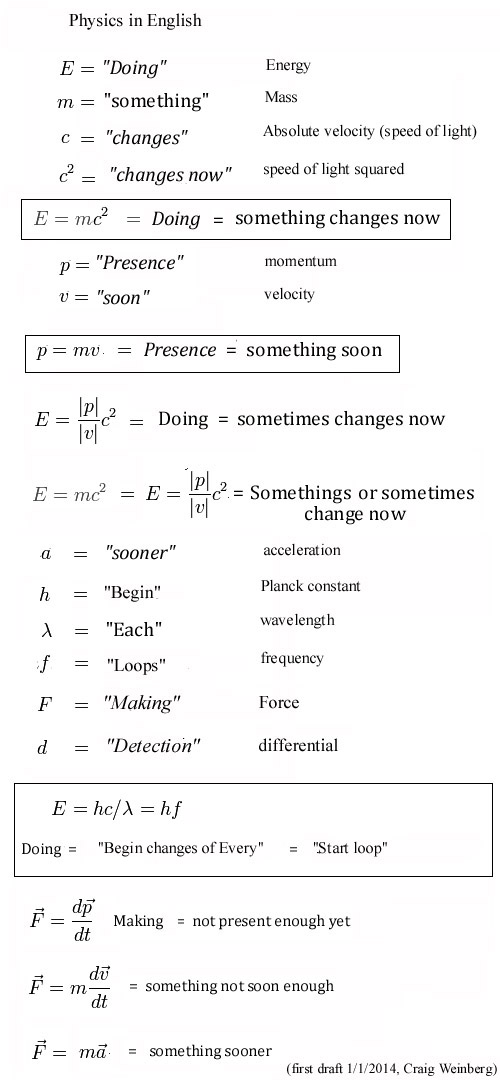
My current preoccupation. It kind of reads like a Magic 8 Ball…which seems like a good sign?
Tessellated Relativity
Whether it is material movement across space or sensory excitement through time, energy must always be a verb. We call it force or work, but that is a shortcoming of the Western fetish for nouns. Really, in my view all energy must be a *forcing* or *working* verb. While I fully appreciate the accusation that this is naive realism, I suggest that this is a foundational symmetry which can be inverted only for figurative purposes. No real energy should be considered noun-like, and all standard model visualizations which contradict this should be regarded as unreal. For this reason, I think that the assumption of the photon as an entity is an obstacle to rehabilitating the standard model to one which integrated the physics of privacy. In an ironic twist, we will have to re-educate ourselves to get used to the idea that the qualia of light and color is real, and photons are imaginary descriptions from an impossible frame of reference (the voyeur public subject).
What are the consequences of energy like? Radiance. Flow. Waves. What are waves? Either a frequency through time or a repeating shape across space. We know, however, that we don’t see photons as oscillating shapes, we see them as a shining, glowing, reflecting, or gleaming in our vision or a warming or burning in our feeling. That’s all about time. Looking at the sun, the intensity increases over time as our retina becomes more and more stimulated. The same is not true of mass. Mass ‘just sits there’ at some position in space. Unlike looking at the sun, the intensity of mass does not increase by itself over time, but rather it increases inversely to distance through space (gravity).
In a post energy particle model, mass and energy modify structures (matter in space) and qualify experiences (sensation through time), and are not free standing quantities emerging from a vacuum. Mass is convergent on a point within a structure, and energy is divergent from c (non-space, non-time) as a frequently recurring stimulus. I was thinking of calling this module of MSR “Tessellated Relativity”, as the inertial frames swing spacemass-ward and time-energyward, yielding the position v momentum exclusivity.
If that’s all true – and I think that it might be on the right track, then it can be used to illuminate the workings of how qualia and sensitivity are equivalent to transparency/entanglement with larger frames of time and higher spatial perspectives.
Happy New Physics

This is an attempt to model my understanding of some aspects of Relativity as it stands now. I make no guarantees of its accuracy or completeness, and I’m not trying to ‘do physics’, but rather to attain a simple grasp of how the concepts of relativity work together. (Feel free to correct me of any glaring errors though).
On the right, there are three atoms, a heavy, medium, and light one. I’m using Uranium, Iron, and Hydrogen just to keep it simple, again, I don’t know what to expect realistically to a Uranium atom that is near an Iron atom which is accelerating with a Uranium atom in the same inertial frame, but I’m including heavy and light atoms just so the difference between fission and fusion can be compared.
On the right side of the diagram, I’m contrasting how it is that both fission and fusion release “energy” (pointed arrows) but in opposite ways. Fission is when a heavy particle is accelerated until its nuclear configuration destabilizes, producing smaller particles and losing resting mass in the process. It takes mass-energy to maintain a large nucleus so there is a release of energy since the sum of the before mass is greater than the sum of the after-mass. Mass can be thought of as the sideways view of energy, cutting across space horizontally rather than longitudinally through time. Energy takes time, as it is momentum: a vector of changing distance over time. Mass requires more of a spatial notion of position or invariance which is publicly measurable at any given instant, rather than a shared history over time.
Fusion, of course, is about lighter particles being accelerated until their collisions cause nucleons to share a nucleus, delivering an energetic bang for the opposite (and seemingly paradoxical) reason. Particles which are lighter than iron ‘want’ to form larger particles, so that even though they are not freeing up energy from not having to hold together a giant nucleus, they still free up even more energy from not having to hold themselves together, by themselves. It could be said that matter loves company, but hates crowds. When matter frees itself from overcrowding or isolation, all of the matter senses the difference and responds by imitating that sensation.
In my example, I am trying to show what happens when an ideal Iron particle (Fe) is accelerated all the way to the speed of light. I’m not sure if that is a realistic scenario, but I am reasoning that since some of the matter as well as mass can be lost in nuclear reactions, it is plausible that such an atom would be converted into energy directly. By showing the Fe particle get narrower, I am trying to show the Lorentz contraction and time dilation, as they would appear from another inertial frame. When all of the mass is converted to energy upon hitting c, what that means to me is that the 4D total potential future of the atom collapses into an instantaneous change in the surrounding atoms.
The loss of 4D time and and 3D matter comes across as 2D a wave of synchronized celebration in the form of acceleration of all matter which is affected throughout the cosmos. When we see a star, it is the molecules of our brain and eye which are, in my view, locally responding to the event which seems remote from our experiential frame of reference. When we go to measure photons, it is my hypothesis that we are actually measuring the local instrument’s description of the event, rather than an independent particle/wave. I think that light may be how matter looks and sees – a sensation and a signal, not something traveling literally through space. The aggregate effect/affect of the (figurative) wave of common sense can be quantified as C² – the range of the effect as a form-function delocalizes. Every inertial frame which can witness the annihilation of a form-function (a presence with a future) manifests that action as an equal and opposite reaction in proportion to its relation. The closer (more local) you are to something which delocalizes, the more powerfully localized you become and the more possibilities there are for a continued future. This is sort of a hybrid of Darwinian and Marxist physics. Collective sharing of sacrificed energy for private gain.
This leads into an even more esoteric discussion about the nature of matter as spatio-geometric qualia and energy as tempo-algebraic ‘phoria’. The next phase is to detail the how qualia and phoria (sensory-motive and mental-emotional) phenomena can be integrated more concretely, such that space, time, entropy, information, matter, and energy can be seen as divergent properties of pansensitivity, which is non-space, non-time, non-entropy, non-information, non-matter, and non-energy, non-vacuum. Pansensitivity is absolute fullness, composed of what can be called qualia, phoria, psyche, nous, significance, and motive. I could be more delusional than usual, but this seems to be coming into a clearer and more communicable synthesis which might be eventually work as a true theory of psychophysical unity.
Reverse Fallacies for Considerations of Consciousness
Special pleading is a formal logical fallacy where a participant demands special considerations for a particular premise of theirs. Usually this is because in order for their argument to work, they need to provide some way to get out of a logical inconsistency – in a lot of cases, this will be the fact that their argument contradicts past arguments or actions. Therefore, they introduce a “special case” or an exception to their rules.
While this is acceptable in genuine special cases, it becomes a formal fallacy when a person doesn’t adequately justify why the case is special.
[…] the “naturalistic fallacy” is close to but not identical with the fallacious appeal to nature, the claim that what is natural is inherently good or right, and that what is unnatural is inherently bad or wrong.
The Normative Fallacy occurs, rather, when someone attempts to argue that something is not the case or is the case based on a set of ideological, ethical, moral, political, or other normative commitments.
Cargo Cult: The speech is reproduced in the book Surely You’re Joking, Mr. Feynman! and on many websites. Feynman based the phrase on a concept in anthropology, the cargo cult, which describes how some pre-scientific cultures interpreted technologically advanced visitors as religious or supernatural figures who brought boons of cargo. Later, in an effort to call for a second visit the natives would develop and engage in complex religious rituals, mirroring the previously observed behavior of the visitors manipulating their machines but without understanding the true nature of those tasks. Just as cargo cultists create mock airports that fail to produce airplanes, cargo cult scientists conduct flawed research that superficially resembles the scientific method, but which fails to produce scientifically useful results.
Here is an excerpt from the book.
In the South Seas there is a cargo cult of people. During the war they saw airplanes land with lots of good materials, and they want the same thing to happen now. So they’ve arranged to imitate things like runways, to put fires along the sides of the runways, to make a wooden hut for a man to sit in, with two wooden pieces on his head like headphones and bars of bamboo sticking out like antennas—he’s the controller—and they wait for the airplanes to land. They’re doing everything right. The form is perfect. It looks exactly the way it looked before. But it doesn’t work. No airplanes land. So I call these things cargo cult science, because they follow all the apparent precepts and forms of scientific investigation, but they’re missing something essential, because the planes don’t land.
Feynman cautioned that to avoid becoming cargo cult scientists, researchers must avoid fooling themselves, be willing to question and doubt their own theories and their own results, and investigate possible flaws in a theory or an experiment. He recommended that researchers adopt an unusually high level of honesty which is rarely encountered in everyday life, and gives examples from advertising, politics, and behavioral psychology to illustrate the everyday dishonesty which should be unacceptable in science.
I’m posting this because it should be pointed out that fallacies can run in both directions. The entire array of Western philosophical argumentation is rooted in the deepest assumption of all – that what we feel and think is unreliable, therefore suspicious, but what happens outside of ourselves, or what we agree that we perceive happening outside of ourselves is above suspicion, by definition. Since there can never be a case where we are right and physics is wrong, all who seek to make a hypothesis about the fundamental nature of subjectivity are put in the awkward position of being judged in their own power to participate in conscious experience by the normative expectations of a system of knowledge which specifically and exhaustively removes all possible traces of subjectivity.
Because the expectation of science itself, as it is currently practiced, obstructs its own view of consciousness with ideology that is assumed to be inescapable and natural, the logical fallacies which are designed protect science are operating in reverse. Any model which suggests phenomenal awareness is a phenomenon being more primitive than objective structures and laws is rejected out of hand as having no evidence. There is no way to put forth the observation that consciousness cannot be under suspicion when it seems entirely likely that no evidence of consciousness outside of its own reports of itself can ever exist. We must instead examine why, if our own delusion and fallacious reasoning is ultimately a product of neurochemistry and evolutionary biology, should we be able to trust our brain’s folk epistemology called science? We might say, well, we know science works because of the evidence – the technology. True, but where but in our own shared experience can evidence be understood? If nature was making the same kind of mistakes that we do, how would we know? Especially given the nature of recent science, where dark matter and energy can suddenly appear and swallow the known universe, and quantum theory has, in some sense, suspended the rule of non-contradiction.
When it comes to consciousness, the Strong AI project has become a Cargo Cult. By imitating the architecture of the brain or of the logical syntax of its behavior, we hope that the consciousness cargo will show up. Instead of an appeal to nature, we now have a bold and unchallenged appeal to science – The claim that what is testable is inherently real, and that what has not yet been made testable and may not be testable is inherently irrelevant. I propose a new logical fallacy – the Abnormative fallacy, which occurs when someone attempts to argue that something is not the case or is the case based on a set of commitments to doctrines which are cynical, robotic, formalistic and held above suspicion by popular inertia. Finally I propose the fallacy of General Pleading, to expose this normative bias stemming from the privilege and power of the dominant perspective which denies the possibility that consciousness is a special case, or THE special case, by definition.
 Multisense Realism
Recent Comments