Archive
Force and Will
Somebody just told me I have free will.
Interesting.
I’d just like to know what force I am manipulating inside of my brain in order to maneuver neuronal molecules around by choice.
I think that there may be no ‘forces’ other than nested levels of will. Direct participation in our native frame of reference is self-described as a human, personal will. What is will? It is the self-evident, irreducible affect of effect: The feeling of doing. The inertial resistance to will translates to ‘mass’ when we turn it around hypothetically to be viewed as if it were an exterior phenomenon.
To be more scientific about it, will can be understood as the Participatory end of a Perceptual-Participatory phenomenon or ‘PPP’. This should be our anchor for a natural model for nature as nature ultimately begins and ends with some aesthetic/perceptual presence which includes a perception of participation.
Here is a diagram and key of the different relations of PPP as it is reflected into its various permutations. Note that symbols * and # are used to denote the conversion of directly sensed experience into transcendental or abstract influences respectively.

Teleological/Signifying Levels
* – Transcendental
T- Transpersonal
P- Personal
S- Subpersonal
I- Impersonal
#- Abstract
*** = Absolute (Consciousness)
T-P** = Transpersonal (Inspiration)
T-PP* = Interpersonal (Thought)
P-PPP = Personal (Awareness)
S-PPp = Subpersonal (Feeling)
S-Ppp = Sema-phenomenal (Sensation)
Teleonomic/Entropic Levels
I-###= Infra-Impersonal (Quantum)
I-p## = Deep Impersonal (Energy)
I-pp# = Classical Impersonal (Matter)
I – ppp = Natural Impersonal (Body)
I – *pp = Far Impersonal (World)
I – **p = Ultra-Impersonal (Universe)
When our native frame of personal awareness (P-PPP) is influenced by a lower level (S-PPp and S-Ppp), it is perceived as increasingly beneath or behind our control. We call these urges ‘subconscious’, but they are more properly ‘subpersonal’, as we cannot be sure that the appearance of subconsciousness is not a relativistic lensing of our Personal level of experience. From the absolute frame of perception, all levels are experienced consciously, so that there is no such thing as sub-consciousness, only consciousness at a sub-personal level.
We are individual people who have emotions and sensations, but we are not emotions or sensations ourselves. The hypothesis offered here is that what we experience as emotions or sensations are experienced as the self or instead of the self on the sub-personal levels of consciousness. When we see a flower and experience an emotion, what we see as a flower is actually the body of a sub-personal experience which may be a species-wide entity which recurs continuously over millions of years rather than momentarily over a single human life. It is crucial to factor in timescale anthropocentrism. Our emotional response to seeing a flower is the tip of the iceberg of an emotional state which persists on an entirely different frame of reference than we do because it’s world is a different world from that which we experience.
When we experience thoughts and intentions on the personal (P-) level, they have a proprietary, intentional quality. They are ‘our’ thoughts. When we experience S- level phenomena, they are presented as an unexpected influence from beneath our control. It is an intrapersonal urge which can stimulate or threaten the personal level of control (as would be seen in Tourette’s syndrome).
Emotions and motivations are on the cusp of the sub-personal (S-PPp) level, while S-Ppp level experiences are to us Sema-phenomenal sensations. When viewed from the exterior, these neurological ‘impulses’ are impersonal electrochemical reactions (I-p##). When this level was first modeled by Maxwell and Faraday as arising from the interplay of electromagnetic fields they were coming from Classical Mechanics, so they wouldn’t have imagined possibilities such as quantum nonlocality and contextuality. Their decision to invent the EM field opened up the world of modern technology, but it has left us with a contra-natural, anti-subjective worldview which is now desperately in need of correction.
By restoring immaterial fields, forces, and energy to their natural place within personal and extra-personal experiences, science can begin to integrate the full spectrum of phenomena in nature and progress to a serve a higher quality of life in our world.
Disclaimer: I’m writing this as a conjecture, not as a claim to knowledge. If you can’t handle that, please see this page for further instructions.
Compact Guide to Multisense Realism Cosmology


A compact guide to Multisense Realism.
On the top, we have the fundamental elements:
Ference: aka the Absolute, Fundamental awareness, Pansensitivity
The totality of all experience. Universal qualia. Simultaneous, eternal, and meta-ontological.
Afference: The division of ference into locally/sequentially felt qualities or affects. Sensations, feelings, perceptions, experiences, intuitions, local qualia, all fall into this category.
- Efference: The affect of motivation which causes effects to afferent frames of reference. Efference is reflected within externalized reference frames as mass-energy/space-time.
- Reference: Upon receipt of an effect by a frame of afference, attention is focused and informed by a reverberation of afferent associations that partially re-connect the local frame to the absolute.
Through many iterations of Afference – Efference – Afference – Reference, there is an accumulation of Significance. This is reflected in the bottom half of the image as the hierarchically stacked levels of phenomenal and physical contexts of experience.
Significance is the saturation of afference, such that significant affects are super-aesthetic and more directly revealing or reflecting aspects of the Absolute. Significance is afference returning to ference with interest.
The right hand side shows a hierarchy of typical human levels of significance. With the saturation of local qualia into subjectivity, there is an increasing complementary de-saturation as objectivity. This is shown on the left hand side. Note that the sense of causality proposed in MSR is multivalent. Unlike the top-down theistic models or bottom-up deterministic models, causality reverberates across reference frames horizontally as well as vertically.
Human consciousness is not caused by the human brain, rather human consciousness is a spectrum of active re-experience on biochemical, zoological, anthropological, and psychological levels. The brain is not caused by neurons or molecular structures, nor is it caused by the division of the single zygote into a body of organs. All physical structures are caused simultaneously by unseen consequences of re-experiences on multiple levels of description and scale. The key is timescale relativity. Every frame of reference is defined by its own scale of time relative to other frames.
What we see as molecular activity is taking place on a much faster and much slower scale than our own personal experience is. Cosmological events take place on the same scale of very fast and very slow relative to our scale. Human experience emerges* from the middle – cleaving the spectrum of scale into a larger-smaller polarities, again and again in a branching fractal pattern. Each branching creates new opportunities for significance, but also creates entropy which objectifies and distances other frames of afference.
Glossary of other Neologisms:
- Metaphoric = Transpersonal psychology, myth, intuition, timeless wisdom.
- Apophoric = “Away from” phoric. Thinking and analysis leverage a small amount of personal effort into communicable forms. The transpersonal and personal layers of experience are synthesized here as impersonal concepts and ideas.
- Phoric = The personal world of the self, ego, and autobiographical narrative,
- Emphoric = Personal feelings and emotions, instincts.
- Semaphoric = Sub-personal qualities of experience – sensations.
These levels constitute the hierarchy/spectrum of human subjectivity. In reality this is more of a dynamic fugue, with events on different levels taking on more or less significance than this static scale would suggest.
*actually human experience (thinking, feeling, perceiving, sensing) diverges or diffracts from the previous eras of simpler experience (anthro-, zoo-, bio-, organic, chemo-, fundamental)
A Quantum Analogy with Dice, Fans, and Basketball

This is as much for my own edification as anything else, but I’m trying to get across my understanding of what is called the quantum wave function collapse. After that, it goes off into my usual attempt to say something absolutely particular about absolutely everything in general.
From what I have gathered the quantum wave function is a statistical mean which may or may not correspond to a physical phenomenon.
Now, in QM we try to predict the probability density for a particle’s position (or momentum, or energy, or whatever). We could try to do this by writing an equation for how p(x) changes over time, but it turns out that doesn’t give us enough information; there are situations where particles start with identical p(x) but do different things as time goes on.
It’s found that we do get enough information to make predictions if we write an equation for a complex-valued function ψ(x), and derive the probability density from it as p(x)=ψ∗(x)ψ(x) The way the complex phase of ψ(x) varies from point to point encodes additional information about the particle’s momentum, which is necessary to predict its future behavior. It has units of the square root of a probability density, which is a bit weird but perfectly mathematically acceptable. This is of course the wavefunction, and the equation that determines how it varies is the Schrödinger equation.-source
From another source:
An observable is “something we can observe”, and is it represented in quantum mechanics by an operator, that is, something that operates on a quantum state. A very simple example of an operator is the position operator. We usually write the position operator along the x axis as x^ (which is just x with a “hat” on top of it).
If the quantum state |Ψ⟩ represents a particle, that means that it contains all the information about that particle, including its position along the x axis. So we calculate the following:
⟨Ψ|x^|Ψ⟩
Note that the state |Ψ⟩ appears as both a bra and a ket, and the operator x^ in “sandwiched” in the middle.This is called an expectation value. When we calculate this expression, we will get the value for the position of the particle that one would “expect” to find, according to the laws of probability. To be more accurate, this is a weighted average of all possible positions; so a position that is more probable would contribute more to the expectation value.
However, in many cases the expectation value is not even a value that the observable can get. For example, if the particle can be at position x=+1 with probability ½ or at position x=−1 with probability ½, then the expectation value would be x=0, whereas the particle could never actually be in that position. – source
In the terms of the dice analogy, the table above shows a bell curve function of probability density for the observables of the dice. To make this a metaphor for quantum observations I think it would look more this way:

The difference is that we can’t observe the wave function, we can only think of the set of possible observables for a given system and give it a name. This is important because in my view, quantum theory actually oversteps its mandate as a rational solution to a set of physical problems to become a faith-based solution to a set of metaphysical/mathematical problems.
There can never be any observation of quantum, there can only be qualitative observations from which we can infer quantitative ideas of relation*.
*note that ‘relation’ is itself an aesthetic quality which is dependent upon a preferred sense of grouping. This preference, so far as we can ever know, only occurs within a sensed experience in which aesthetic phenomena are presented as sharing a common quality. Physics in and of itself can have no relations, as general relation qualities cannot be decomposed into fundamental physical forces. No physical mechanism can make quantitative ‘relations’ happen.
What the quotes above are trying to say, in my view, is that
the wave function itself is an imaginary square root of the inferred probability density of the mentally counted sets of actually observed phenomena.
We want to think that quantum particles are the observed dice rolls: a pair of upturned faces of cubes containing a finite number of dots or ‘pips’, and that the wave function is the set of numbers 1 to 6 corresponding to each possible set of dots, but in reality there may not be two dice at all. The observable reality is that when we look at one die, the other one disappears, and we can only see both dice if we don’t look at the dots.
Two more analogies illustrating the reducibility of quantum ‘particles’ to qualitative sense:
1. Looking at a ceiling fan in motion, we can either see a circular blur, or if we follow the blur with our eyes at the same frequency as the fan, we can see the fan blades (or a standing-wave of averaged images of fan blades) but not really the circular blur.
2. I’m in my house and hear noises coming from outside. One sounds like a loud motor, and one sounds like a frequent thumping. I know from experience that the neighbors do like to play basketball in their driveway when the weather is nice. I also know that the neighbors across the street are having their roof replaced which may or may not involve some kind of compressor noise. Finally, I know that Saturday morning is a time when there are a lot of neighbors mowing their lawn.
The point of this example is to illustrate the common/superficial understanding of the wavefunction collapse would be analogous to me going outside and looking around. By observing, I find out whether there are roofers running some kind of noisy machine and pounding on shingles, or whether there is one neighbor mowing their lawn and another pounding on their fence or something, or whether there’s some combination of things going on which may include a basketball game. By ‘finding out’ what’s going on, I am collapsing the wave function of possibilities because I now know what the noises I heard inside my house refer to outside.
This is not correct as an analogy though either. It cannot be applied to quantum observables. The delayed choice quantum eraser and other experiments show surreal phenomena such as entanglement, contextuality, and the mutual exclusivity of entanglement and contextuality. It would be like me like going outside and seeing that the hammering is definitely coming from the roofers across the street, but then going outside again later and seeing that the there is a dude playing basketball instead and there were never any roofers.
Entanglement/Contextuality would be like if I went out and played basketball with the neighbors then as long as I was playing, suddenly no neighbor could have their roof repaired. In terms of the fan, it would be like if I had two fans in two separate rooms controlled by the same light switch, putting my hand in the way of one fan not only stops the other, but you can tell by filling the rooms with feathers that stopping one fan makes it so no feathers had ever blown around in the other room.
Entanglement and contextuality are opposite orientations of the same thing. The entanglement view focuses on the synchronization of what has been connected experimentally while the contextuality view focuses on the strange contradiction to our expectations about causality extending from the past to the present.
Anyhow, this too is not correct in my view. What is being overlooked is that we are taking for granted that the quality of finality in our experience is identical to the property of factuality. We want to say that because we have actually seen the blades of the fan, they are the physical objects which exist and the circular blur is an optical illusion – true enough in the case of a fan. We want to say that seeing a roofer pounding nails into a shingle is evidence that roofing is what is actually going on and the idea that the sound we heard inside could have been a basketball bouncing was a misperception. This is not what physics is telling us, however. Instead, it is telling us, in my view, that there is no fan or basketball or roofer, nor is there any mistake of misperception, there are only sensory experiences, some of which acquire a higher aesthetic density of ‘realism’ than others. We say ‘seeing is believing’ because visual sense presents such an unambiguous seeming experience most of the time but we know from optical illusions and from comparing binocular differences that even seeing should not be believed.
What we are seeing when we look at something like the double slit experiment is a context in which perception itself is revealed to be
- more fundamental than the ‘object’ which is sensed and
- a revealing of (sense experience) itself as both a self-revealer and a self-concealer.
In the phenomenon of seeing visible light we have a metaphor about the relation between metaphor and non-metaphor which is expressed non-metaphorically. It is a context in which the contextualization of contextuality is presented as an uncontextualized/absolute text. (sense = the sole abtext?)
Philosophically, we should see that it is necessary to reverse the priority assigned by Galileo and Locke to tangible/physical qualities being primary and phenomenal qualities being secondary. Physics should be considered a set of phenomenal qualities which have been reduced by the subtraction of intangible modes of sensitivity. It is only in the intangible modes which nature can be fully appreciated as the self-revealing, self-concealing meta-phenomenon that it is.
Finally, here’s another serendipitous experiment with light. On a polished granite surface I see the reflection of a single overhead light as two separate reflections. With one eye open, I can see the image of the light is on the edge of the surface, while with the other eye open instead, the image of the light is in the center of the surface. Try it next time you see a floor or counter like this and can play with closing one eye or the other. Notice how you can choose between two separate but entangled images of the light which move as your head moves or, you can focus your sight so that there is only a single image of the light.
In the former case, the details of the surface are clear – you can see the patterns of granite and can tell exactly which colored spots seem to be illuminated by the overhead light. In the latter case, you have to look ‘through’ or passed the grain of the stone and focus your visual attention on the image which is reflected from the polished surface. To make the former view real is the materialist orientation. To make the latter view real is the information-theoretic orientation. Both orientations entail the disorientation/de-realization of the other. The materialist says the floor is the real thing being illuminated, while the computationalist says that the floor and light are only generic vehicles for the underlying reality of mathematical laws of relation.
What is left out of both of these views is the connection to the eye and the experience of seeing. The eye’s location is what is telling my experience of where the image of the light’s reflection appears to be. Indeed, that appearance *is* the actual location of the lights reflection as seen through one eye. When seen through the other eye, there is a different actual location. When seen through both eyes, there are either two semi-actual locations or there is one actual light reflection against a single blurred semi-actual location.
I cannot emphasize this enough: Quantum theory is about perceiving perception. It tells us not that the reality of nature is inconceivably weird and unfamiliar, but that nature is more than ‘reality’. The different concepts of wave function, probablility density, and observables map to quantum contextuality, quantum entanglement, and classical (collapsed) realism respectively. QM is about how appearances acquire density of realism by consensus of accumulated limits. For a quantum phenomenon (which is totally abstract) to begin to seem concretely ‘real’, the sense of contextuality or entanglement must in one frame of reference seem to be shared as an isomorphic sense in every other frame of reference, without contradiction. Thus there is no mysterious ‘classical limit’ at which quantum decoherence occurs, and no magical ‘emergent properties’ which appear out of nowhere to turn intangible figments of math into concrete objects – there is only a dynamic aesthetic phenomena (sense experiences or qualia) which merge and diffract as aesthetic meta-phenomena (veridical perceptions or ‘shared reality’). There is no ‘finding out’ what really happened, there is only an adding of dimensions of realism by sacrificing qualities that extend beyond realism.
This goes for our own consensus of sense modalities as well as a consensus among peer-reviewed scientific papers. The sense of realism arises from the multiplicity of limited perspectives, which then divides the total entropy of doubt/uncertainty. With only one slit or sense or scientific mind, any given phenomenon is presented as-is – an observed effect only. With multiple senses or slits or peers, we observe a different effect which enables a cross-reference that goes beyond the observation itself to an observation of the observation process. This opens the door not only to theories which connect the particular observations but which can apply to many other kinds of observations, as well as to theories of observation in general. In this way, the general/rational/contextual/illuminating and the particular/empirical/textual-entangled/illuminated can be reconciled as opposite ends of a single spectrum of sense/aesthetic/ab-textual/visibility.
Primacy of Sense: Absorption and Emission
Another clue revealing the primacy of sense in the universe:
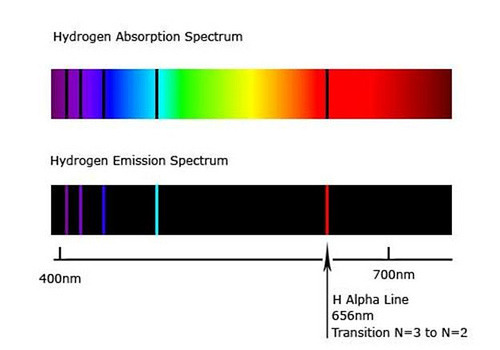
The point that I want to make here is that when examining physical phenomena at the largest and smallest sales, the spectrum is reveals itself as a fundamental context. Matter defines itself as specific obstructions or gaps within the complete continuum, or as a specific slices or fragments which can rejoin with other emissions to complete the spectrum.
Our current understanding of radiation, light, energy, and fields assumes a foreground of an emission against a void. Photons are presumed to to exist as object-like presences which are distinct from a background which is a vacuum that is somehow full of ‘energy’. The physicalist view is a bit contradictory, seeing one layer of quantum foam or zero point energy as an ultimate ground to the universe which is ‘always on’ and then an classical level of description of space as a vacuum that is always ‘off’ except when interrupted by forces.
I think that it makes more sense to throw out both the idea of the vacuum full of energy and the objects in empty space and see that entire model of the universe as half of the larger picture…a half which is ultimately an inversion or antithesis of the true trans-physical foundation.
If the conception of the universe as a spacetime void which contains various kinds of mass-energy ‘stuffs’ is turned inside out, what we get is a universe where light is ultimately neither emitted nor absorbed, but instead is a pervasive condition of sensitivity which is blinded or obstructed spatially and temporarily. We use the terms permittivity and permeability to measure the effect that matter has on electric and magnetic fields respectively.
If we turn the electromagnetic model right side up, we lose the idea of electric and magnetic fields entirely and see permittivity and permeability as the localizing constraints on the underlying unity of sense experience. EM fields would not permeate matter or be permitted to propagate across it, but rather matter is actually nothing but the im-permeablity and un-permittivity of the underlying sense condition. When the underlying sense multiplies and divides itself, it makes sense to expect that the result might be persistent material structures in 3d+1 space/time (not relativistic space-time, but classical space ⊥ time).
What is being emitted and absorbed then, in my view, is not light, but the obstruction of light. Matter is a kind of one-sided blindness, like a one way mirror which which inverts the totality of experiences in a fisheye lens way. This converts the non-dual context of Absolute sense to bubbles of dualistic contexts: subject/objects, proto-subjects/proto-object (sensory impulse), and trans-subject, trans-subject/object (synchronicity-archetype)
The whole picture would look something like this:
Sense (timed experience or subjective qualia (placed experience or objectively quantized qualia) signified or re-capitulated sense) Sense.
So Sense (Time/Subject (Object) Distance (Object) Significance)
From the “Distance” view, the universe is a classical place filled with objects, but this is only an appearance which is projected from within subjectivity as it makes sense of its relation to other scales and frames of experience. The external world is actually external-to-the-world, as it is a mirror reflection cast by two or more surfaces of sense impermeability, like this:
Interior>Exterior)(Exterior<Interior
It is the )( relation which gives realism to objects. There are no objects ‘out there’, just different levels of ‘out there’ which are ‘in here as objects’.
*which can also be expressed as a metric tensor…a tension superimposed within sense which allows regulating contexts such as space, time, and causality to persist.
Decapitating Capitalism: Why the Easiest Job for AI to Replace is the Job of “Owner”

This may seem like a ridiculous point to try to make, however I submit that it provides a direct metaphor for the Hard Problem of Consciousness which may help make it more concrete, especially for those whose minds are filled with concrete.
What is the essential role of the Owner of a company?
Whether they are individual proprietors, stockholders, or investors, the only truly unique function that a capitalist principal performs is to be the beneficiary of net profit. Every executive function of a company can of course be delegated to employees. The CEO, COO, board of directors, etc can make every functional decision about the company, from the hiring and firing to the broad strategy of operations and acquisitions. Simulating those roles would be more difficult for a computer program than simulating an owner would be because there would be a lot of tricky decisions to make, subtle political maneuvers that require a lot of history and intuition, etc. The role of pure ownership however, while highly coveted by human beings, is completely disposable for an AI system. In fact, we already have that role covered by our bank accounts themselves. Our personal accounting systems can be configured quite easily to automatically pay, receive, and invest funds automatically. They need not be considered ‘our’ funds at all. They are merely signals in a global financial network which has no use for any pleasure or pain that we might experience as a side effect of its digital transactions.
From the view of an AI scientist, the job of receiving capital gains is a no-brainer (literally). If we didn’t want to delegate the job of selling the company to a corporate officer, that feature would be a simple one to create. A modest set of algorithms could digitize some of the concepts of top business schools to determine a set of indicators which would establish a good time to sell the company or its assets. The role of receiving the profit of that sale, however, would require no such sophisticated programming.
All that is needed to simulate ownership is some kind of digital account where money can be deposited. The CEO would then re-invest the capital gains into the corporate growth strategy, which would yield a huge windfall for the company, in the form of eliminating useless expenses such as yachts, mansions, divorce settlements, etc. Left to its own devices, AI simulation of ownership would be communist by default*. Whatever money is extracted from the individual customer as profit would be returned ultimately to all customers in the form of expanded services. Profit is only useful as a way to concentrate reinvestment for mathematical leverage, not to ‘enjoy’ in some human way. I suppose that a computer could be programmed to spend lavishly on creature comforts, but what would be the point?
This is where the metaphor for consciousness comes in.
Consciousness can be thought of the Capital account of the human body. We are the owner of our own lives, including our body. We might be able to subscribe to a service which would manage our finances completely in a way which would transfer our income to the highest priority costs for civilization as a whole rather than for our personal hoard, but this is not likely to be a very popular app.
We might ask ourselves, why not? Why is ownership good?
Ownership is good for us as owners or conscious agents because we want to feel personal power and significance. Ownership signifies freedom (from employment) and success. Sure, many owners in the real world get a lot of satisfaction from actually running their companies, but it is not necessary. There is still power and prestige purely in being the person who owns the money which pays the bills. We want to own and control, not because it is more effective than simply reinvesting automatically in whatever functions are being executed to keep an economy growing, but because we want to experience the feelings and other aesthetic qualities define freedom, success, and power for us. Even if these qualities are employed for humanitarian purposes, there is still a primary motive of feeling (to feel generous, kind, wise, evolved, Godly, etc).
In my view we do not have to have a purely selfish motive, as Ayn Rand would insist. I think that our personal pleasure in being a philanthropist can be outweighed by the more noble intention of it – to provide others with better feelings and experiences of life. This decision to believe that we can be truly philanthropic has philosophical implications for realism. If we say as the Randian Libertarian might, that all our humanitarian impulses are selfish, then we are voting for solipsism over realism, and asserting that consciousness can only reflect the agenda of a fictional agent rather than perceiving directly the facts of nature. It’s an argument that should be made, but I think that it is ultimately an argument of the intellect commenting on its own process rather than tapping into the deeper intuition and aesthetic presence which all cognition depends on. The mind doesn’t think that feeling is necessary, and it is right, for the mind, but wrong for everything else.
For the intellect, the universe is inverted.
Logic and language are ‘real’ while the concrete sensations, perceptions and emotions of life experience are ‘illusions’ or ‘emergent properties’ of deeper evolutionary bio-computations. There is a kind of sleight of hand where the dry, masculine intellect pulls the wool over its own eyes and develops amnesia about the origins of what makes its own sanity and self-intelligibility possible. The closest that it can come without seeing consciousness as irreducible is the mind-numbing process of calculation. Counting is a sedative-hypnotic for the mind. The monotonous rhythm puts us to sleep, and the complexity of huge calculations gives us a kind of orgasmic annihilation of the calculating experience. This is why big math is a convenient substitute for the deeper, direct experiences of cosmic awe.
Metaphor for Consciousness
Like the head of a company, our consciousness may seem to reside at the top end of our body, but there is no functional reason for that. There is nothing that the brain does which is fundamentally different from what any cell, tissue, or organ does in an animal’s body. Looking for the secret ingredient in the brain’s function or structure is analogous to looking for the substance in an object which casts a shadow.
Like the owner, our personal pains and pleasures are ours not because there is any intrinsic benefit for the pragmatic application of biology and genetics to feel painful or pleasurable, but because what we feel and experience is the only thing that the universe actually can consist of. The Hard Problem of Consciousness is not an Empirical problem, but a Rational one. Not everyone is able to understand why this is, but maybe this metaphor of business decapitation can help. When we use the intellect to reverse its own inversion, we can get a glimpse of a universe which is made of conscious experiences and aesthetic qualities rather than logical propositions, natural laws or existential facts. In my view, facts are a category of sensations rather than the other way around. Sensations which persist indefinitely without contradiction are ‘facts’. Hard to know if something is going to persist indefinitely, but that’s another issue.
Only consciousness cares about consciousness.
Material substrates can be programmed to perform the executive functions of a corporation, or an evolving species, or a human body, however there is no function which is provided exclusively by the receipt of feelings and aesthetic qualities of experience, including the qualities of feeling that one is free or in control of something. Rationally, we should be able to see that qualia is irrelevant to function and violates Occam’s Razor in a functionalist universe. From a physical or information-centric perspective, there is no place for any feeling or sensation, no owner or capital of aesthetic wealth. The more that we, as a society, embrace a purely quantitative ethos, and actualize it in the structures of our civilization, the more we decapitate everything of value that it can contain.
*This is already becoming a reality: https://theconversation.com/is-the-dao-the-beginning-of-the-end-for-the-conventional-chief-executive-60403
Multisense Diagram w/ Causality

Another shot at an improved diagram of the multisense continuum. Terms intercausal and intracausal are introduced to differentiate between the proto-phenomenal view *within* causality (i.e. intentionality/will is the active principle, determinism/probability is the diffracted reflection).
The Postcausal-Synchronistic | Metaphoric-Metaphenomenal level of description are adhesive and diffracted from absolute unity from the top down. They correspond to the metric c² as experience is presented in fugue-conditions which transcend space, time, and causality.
The Physical-Causal | Phoric-Phenomenal level of description are adhesive and cohesive (Cartesian Dualism). They correspond to the metric c as experience is presented as the juxtaposition of an exterior context which is cohesively spaced, timed, and deterministic (adhesive) and interior contents which are adhesive-contextual (subjective).
The Thermodynamic-Intercausal | Perceptual-Emotive
and Electromagnetic | Sensorimotive-Intracausal labels refer to translations between public manifestations of energy and private manifestations of effort or will. Any metric which relates velocity, frequency or wavelength as a fraction of c can be used here.
The Quantum-Probabilistic | Semaphoric-Sub-personal level of description refers to phenomena which are presented as either cohesive-entangled or adhesive-contextualized. An example of a cohesive-entangled appearance is a static ‘sense-of particles or objects in positions’, while an example of adhesive-contextualized appearance could be a sense of ‘dynamic waves of change in sensation itself’. The former appears as a thing which is made visible while the latter appears as an artifact of visibility itself (such as rays of light). Because the quantum level is paradoxical or bi-cohesive, the metric √c can be used to conceptualize the breakdown of natural, macroscopic conditions into quantized proto-conditions.
Continuum of Sense
I have been writing for a long time now about what I call the Multisense Continuum, or the ACME-OMMM duality. In the course of developing this hypothesis, I have learned about other such efforts, detailed below, including a recent paper:
Rigidity-chaos semantic continuum
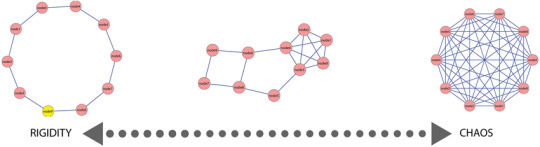
Drawing on network models, this is a promising approach, however the irony was apparent to me in the choice of terms. To see the opposite of psychological rigidity as chaos may be trivially true, however, it may also be that the chaos is a projection of the rigid, systemizing approach.
The model that I propose sees chaos as only one aspect, and not the most important aspect of the opposite of rigidity. This continuum is so universal, that I think it extends beyond ‘reality’ to embrace all of nature.
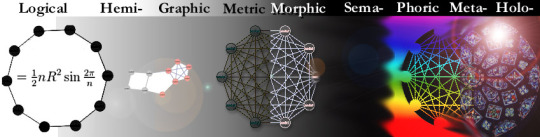
Here are some other variations:
Tough-Minded vs. Tender-Minded (William James)
interpreted the European divide between empiricists/positivists on the
one hand and German idealists/rationalist on the other hand in a
psychological way. He talked of the “tender-minded” and the
“tough-minded.” The tender-minded are the German idealists and
rationalists. (this linked source is gone, see new link for James’ original work)
The Divided Brain (Iain McGilchrist)
Psychiatrist Iain McGilchrist describes the real differences between the
left and right halves of the human brain. It’s not simply “emotion on
the right, reason on the left,” but something far more complex and
interesting.
Autistic-Psychotic Spectrum (PDF)
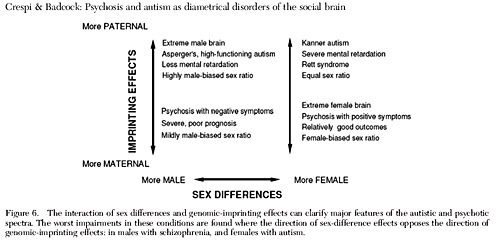
‘Thin-boundares” and “Thick-boundaries”
Significantly thinner boundaries compared to control groups have been
found in art students (Beal, 1989, Hartmann, 1991), music students, and
mixed groups of creative persons (Beal, 1989), frequent dream recallers
(Hartmann, 1991, Hartmann Elkin, & Garg 1991), adults with
nightmares (Hartmann, 1991, Levin, Galin, & Zywiak 1991; Galvin,
1993), adolescents with nightmares (Cowen and Levin, 1995), “lucid
dreamers” (Galvin, 1993), male as well as female fashion models (Ryan
2000), persons with unusual mystical experiences (Krippner,,
Wickramasekera, Wickramasekera, & Winstead, 1998), and persons with a
diagnosis of Borderline Personality Disorder, Schizoid Personality
Disorder or Schizotypal Personality Disorder (Hartmann, 1991).
Interestingly, although art students have much thinner boundaries than
average, this is not true of established artists, who have boundary
scores in the normal range (Beal, 1989).Groups that score significantly “thicker” than average
on the BQ include naval officers, salespersons, lawyers, patients with a
diagnosis of Obsessive-compulsive Personality Disorder, persons
suffering from “Alexythymia” (Hartmann, 1991), and patients (from two
different sleep disorders centers) with a diagnosis of Sleep Apnea
(Hartmann, 1992).
Empathizing-Systemizing Continuum
Empathizing and systemizing traits were independent in women, but
largely dependent in men. In men, level of systemizing skill required by
field of study was directly related to social interactive and
mindreading deficits; men’s social impairments correlated with prolonged
go/no-go response times, and men tended to apply systemizing strategies
to solve problems of empathizing or global processing: rapid perceptual
disembedding predicted heightened sensitivity to facial emotion. In
women, level of systemizing in field was related to male-typical digit
ratios and autistic superiorities in detail orientation, but not to
autistic social and communicative impairments; and perceptual
disembedding was related to social interactive skills but independent of
facial emotion and visual motion perception.
…and my own bloggings:
Zooming in on Reductionism and Extremely Gendered Brains
Ironically, but unsurprisingly, the idea of the continuum of sense itself may only be coherent when approached from the ‘East side’ of the spectrum. This has to do with what is known as Theory of Mind.
 Multisense Realism
Recent Comments