Archive
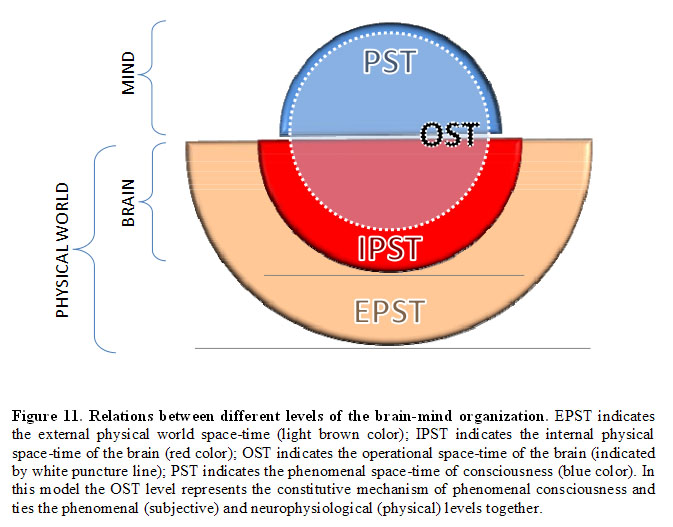

The first image is from a paper called Natural World Physical, Brain Operational,and Mind Phenomenal Space-Time. I haven’t read it yet, but from the looks of the image it seems like a step in the right direction. I have cannibalized their diagram to try to encapsulate the Multisense Realism model.
The bottom half remains almost unchanged, except for the removal of Time. In the original, the assumption was that SpaceTime is objectively real, but in my view this is an obstacle to understanding the relation between the public and private ranges of physics. The center of the bullseye then, in the modified chart, is the intersection of public space and private time, such that it reflects the ordinary sense we have of the public moment being infinitely fleeting so that the only remaining residue of any public moment is sustained exclusively through private memory. If we apply a strict literal read of public realism, the presence of the past is confined to a pure fiction of human sentiment. Past events must be inferred from material evidence and reconstructed deductively (forensics, archaeology).
The bottom half of the bullseye then recognizes this truth, that in fact public realism is devoid of temporal continuity, and exists as spatially nested bodies relative to the perspective of any particular private participant. The deeper into the IPS circle we get, the more the public structures of the brain are defined by electromagnetic and chemical activity which do not make sense without an inferred Time element. At this point, the EPT phenomenology similarly takes on its distributive spatial descriptions, such that private sensory affects are accessible as public motor effects. There is no transduction or homunculus translation, no cause and effect, the hypothesis is that there is a dual or multi-aspect spectrum of aesthetics.
The top of the bullseye is much more ambitious and experimental. I have rotated the private phenomenonlogy along a z-axis to underscore that sensory-motive experience is literally perpendicular or orthogonal to spacetime. The original diagram takes for granted that phenomenal consciousness should be considered to resemble space-time. It really doesn’t. To the contrary, our spatiotemporal memories merge seamlessly with imaginary places and times, or non-places and non-times. When we are sequestered from public interactions, we lose spatial and temporal continuity as daydream dissolves into dream or delusion and realism dissipates altogether. Significantly this total loss of realism is not generally missed. “Waking up” in a lucid dream, is typically not a cause of distress where we are terrified at having no idea where our body is, but tends to be very enjoyable and we would prefer to remain in the dream for as long as possible.
I apologize for the crazy looking bicycle gears look to the EPT and IPT, but I think it gives a hint of the kind of vast multivalence which would have to be included if we were to try to model visually the nature of private physics, which is implicitly anti-form and anti-function. (I call it Transrational Algebra or Apocatastatic Gestalt).
I have tried to give the impression of the presence of the past and anticipation of the future within what I call the ‘perceptual inertial frame’ known as ‘now’. Is now today? Is it last ten minutes? Is it 2013? Yes. It’s all of those things. The pointillised gears near the left hand side are labeled with a ‘memory’ bracket, indicating the complex nesting nature of temporal nesting. You can read these words without consciously remembering how to read English, but if you recall a particular memory, that gestalt can contribute to the feeling of the now, and can combine with other recollected associations, both conscious and subconscious. The nesting of meaning does not seem to have a finite capacity, and significance is constellated apocatastatically – as a rejoining of broken parts…increasingly transparent and reflective of other significant moments rather than dense and opaque with overloaded resource demands. This is just a fancy way of saying that our conscious experience is the tip of the iceberg of a vast reservoir of experiences which extends beyond our personal lives and into anthropology, zoology, biology, chemistry and physics.
On the far left is the legend showing the extension of private experience into public presentations necessitates an anesthetic gating or attenuation of sensory affect and motor effect. This is another fancy way of saying that public space is about defining limits to your private sense of omniscience and omnipotence…literally putting you in your place among countless local and universal agendas.
But Which Eye Is The Binocular One?
“He must learn that his extreme powers of discrimination do not make him weak and inferior – but rather strong and superior.” – Matthew Oliver Goodwin
“Regione caecorum rex est luscus.” (In the land of the blind, the one-eyed man is king.)
– Desiderius Erasmus
Here is a tale about the ontology of perception, or as I like to call it, the laws of private physics. It takes place not in regione caecorum, but in regione luscus – that is, it takes place in the country or land of the one-eyed rather than the blind. In this land, there was once born someone who claimed to have a second eye, and through it, they could see a kind of “depth” and experience an aesthetic of personal engulfment which could not be accessed or appreciated with only a single eye.
The wise men of the land heard these claims and set out to prove, with their one eyed instruments and one eyed reasoning, whether or not this magical experience of stereoscopic vision could exist. As they suspected, their results confirmed that there was no depth nor sense of “embeddedness” which could be felt visually. Vision, they said, was incapable of representing volume.
Two Eyed Sally protested, but to no avail. It was plain to everyone that volume cannot be communicated without touching an object with your body directly. The eye does not touch objects directly, so sensing depth by vision is a hallucination and Sally is crazy.
One day another person was born who also claimed to have a second eye and could see that Sally had two eyes also but that everyone else had one eye. To this, the wise men responded in their most scientific and rational way, doing the only thing that can be done in such a circumstance…
“Burn the witches!”, they bellowed.
Many years passed, and after many witches were burned, very few people spoke about their second eye experiences anymore. When they did it was, obliquely, through stories and metaphors, or as comedy. Increasingly, the one-eyed view of the world had become more and more successful, explaining nearly everything and producing amazing devices like the split-view monocle which allowed one to have two slightly different views of the same thing, allowing people who learned to use the monocle to become much better coordinated. Two views were better than one.
At this point, one of the wisest wise men accidentally ingested a few micrograms of a semi-synthetic fungal extract, and began to hallucinate that he had a second eye. His perceptual solitude became perforated with the legendary aesthetic depths and subjective embeddedness. He reported his amazing experience, and before he knew it, people all over the world were duplicating his unintentional experiment intentionally.
Around the same time, other wise men were playing with light. For years, they had observed an unexpected interference pattern whenever light was projected through a mask with more than one slit. This reminded some of the more unconventional thinkers of the myth of binocular vision, and for a time it seemed that stereoscopy could be a legitimate phenomenon. Strangely, social events seemed to mirror this loosening of constraint and a kind of renaissance or ‘mind opening’ seemed to be blooming on every front.
The more clear-headed of the wise men however, those whose single eyed vision was particularly sharp and acute, warned of trouble. The very thought of people with double the normal amount of eyes, idling in some kind of sickening optical illusion was revolting and they set out to figure out exactly what was the fucking problem with these patterns and slits, and with the strange reports from the fungus eaters as well.
They devised ingenious experiments in which the stereoscopic patterns could be explained. By using instruments which only could see one thing at a time, the validity of the monoscopic model could be deduced. Terms like ‘wave function collapse’ and ‘decoherence’ were a soothing balm for the anxieties of the wise men.
Gradually the rash of thinkers who took stereoscopic delusions seriously were drummed out of the wise man academy, and depth of field was discredited. Instead of being studied as a strange physical phenomenon, depth perception became something else – an ‘epiphenomenon’. Epiphenomena of this kind are an ’emergent property’ which sort of ‘un-exists’ in a never-never land hidden away in neurons…or maybe calcium ions…or radiological zappity zaps.
Even if some of the sensations of stereoscopic vision felt real to some people, it would be because of the ability of these zappings to compare and extract information about each other. Such information might be useful after all, because it allows more data to be simulated at once and more data about the environment means a better chance at survival and reproduction. It could be that the people with the two eyed delusion were not witches or criminally insane after all, they are just unfortunate mutants who have a disability.
There was still some question, however, about how the light knew which slit was the right one to go through, and about whether it was the second eye which was the defective one or whether it just corrupted the first eye. Interpretations abounded about multiple universes and entangled eyeballs. All of these interpretations had in common the same thing: they concluded by re-asserting the validity of flat vision. They could all agree on one thing – that three dimensional sight was supernatural hogwash. The details of how and why were complicated and esoteric, but they are consistent and verifiable, (as long as you use instruments and experiments which are designed to filter out anything unscientific and ignore your own corrupted judgments).
“And so, little by little, a little later
These critics set to work
To make nonsense out of the sense of what we were doing.
And they succeeded.
They destroyed our hero’s faith in himself.
He didn’t have it any more.
After a few, disappointing times
In the big auditorium.
The light gone out of him.
We all stopped going.
And the man who had once seemed so tall
And who now seemed so much smaller
Left our town
Saying no, no, no
[…]
They put us back on the narrow path.
This is the way things have been in our town
For as long as anyone cares to remember.
By the way
How are things in your town?”
Updated Introduction
3. Overview
I am always trying to sum up multisense realism in a simple way, as I think it ultimately is pretty simple, but it is hard to put it simply because it requires that we overturn some core assumptions about how we look at the self and the universe.
I consider my model to be neither dualist nor monist, but an “Ouroboran” monism, meaning that physics itself is the capacity for sensory experience and discernment and that it is involuted in a reflexive, “umbilical” relation to itself. The idea is that experience and matter are the private and public ranges of physical phenomena. The involution (like a Klein bottle or Möbius strip) refers to the orthogonal or perpendicular juxtaposition between sensorimotive-based private experience and spacetime-based public realism.
If we begin with this diagram which I have pilfered from memeengine:

and then progress, like those schizophrenic cat portraits, into the mind bending rabbit hole that is Multisense Realism…

Here, I am trying to introduce the notion of a continuum between the three ‘ism’s above, to indicate that the cosmos supports all three inherently because it is that juxtaposition/symmetry which is actually more primary than any of them. Not the symmetry itself – which is more of a mathematical relation that is somewhat abstract, but the capacity to detect and respond to patterns like symmetry – the capacity to sense and participate in the universe. What I wound up with was more of a yin yang taijutsu arrangement which maybe hints at an East side where experience is purely subjective, a West side which is all representations of what is presumed purely objective, and a midrange which is about perception as a body in the world of comparably scaled bodies.

Not content with that, I went on to try to get more of the flavor of it with nested scale bodies in a Cartesian grid of blue vector arrows representing energy and function (the disowned idealism of the West haunts the machine as ‘energy’ and ‘information’). On the East side, there is the solipsistic fisheye distortion which is all cluttered up with my conceptions of sub-personal, super-personal, and the arrow of motive power.

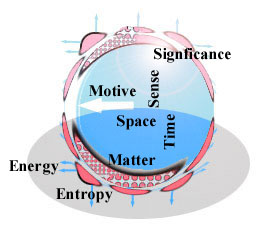
Wrapping this mess up, I put the atomic dots where they belong, on the inside surface of the experiential bubble of the Absolute. Make sense? Haha.
In Multisense Realism, all of physics is understood to relate to the capacity to discern between public and private views of phenomena. Public physics appears to us as ‘matter and energy’ on the outside and ‘perception and participation’ on the inside. The gap which makes this involution or twist possible is the modulation between the presence and absence or sensory presence, with the absence being what is called entropy or spacetime (which become essentially the same thing under this model of physics). To make things more confusing, this modulation of entropy and sensitivity is nested within many layers of itself, as a fractal. A cell encapsulates a world of molecular interaction. An organ encapsulates a world of cells, etc.
What started as an observation about the common positions that people seem to take within philosophy of mind debates became a hypothesis about the continuum of public and private sense experience, a re-interpretation of light, cosmology, consciousness, and the introduction of new concepts like significance and solitropy.
These two images try to capture the overall picture of how all major features of the cosmos can smoothly fit together.

Multisense Perception Model

Another crazy looking attempt at organizing the multisense model of perception. The top diagram emphasizes how the contemporary model assumes that all phenomenal interaction is at the particle level, effected via tangible collisions of microcosmic bodies in spacetime. Higher level experiences are imagined to be epiphenomenal abstractions tied to each other through exclusively bottom up logical mechanical functions. In this model, it must be admitted that consciousness can only be a metaphysical layer of unexplained illusion.
In the bottom diagram, the dualism of private experience in white on black, and public spacetime realism in black on white gives an idea of the involuted or ‘Ouroboran’ relation between the two aesthetics. The center region depicts the public stack of spatiotemporal scale relations from microcosm to macrocosm (particles<>cells<>tissues<>sense organs/organisms). The Caduceus like split helix implies a loose hierarchical, bidirectional overlap of interlocking forms and functions on different scales and their implicit interaction with the corresponding private experiences on corresponding levels (personal, sub-personal interiorities corresponds to macrocosmic, microcosmic exteriors).
The label ‘Sensory-Motor Experiences’ at the base designates that the totality can be understood literally as sensory motor phenomena but the label and dashed halo at the top refers to the figurative capacities for empathy, semiosis, social quorum and teleology.
In this model, all layers are phenomenal and physical and consciousness or sense is a fully enfranchised, participant in physics on every level. Interaction is multivalent and multi-directional, bottom up, top down, inside out, outside in, past forward, future back.
Deleuze’s The Logic of Sense, Part I
Deleuze, The Logic of Sense
Some quotes from the book and comments.
“It is only by breaking open the circle, as in the case of the Möbius strip, by unfolding and untwisting it, that the dimension of sense appears for itself, in its irreducibility, and also in its genetic power as it animates an a priori internal model of the proposition.”
Some important themes here: The irreducibility of sense, the connection with closure and involution, topology and animation. There is a sense of the meta-juxtaposition of self-similarity that is at the heart of the universality and specificity of sense.
“It is surprising to find that Carroll’s entire logical work* is directly about signification, implications, and conclusions, and only indirectly about sense – precisely, through the paradoxes which signification does not resolve, or indeed which it creates. On the contrary, the fantastic work is immediately concerned with sense and attaches the power of the paradox to it. This corresponds to the two states of sense, de facto and de jure, a posteriori and a priori, one by which the circle of the proposition is indirectly inferred, the other by which it is made to appear for itself, by unfolding the circle along the length of the border between propositions and things.”
*Lewis Carroll was the pseudonym of Charles Dodgson, who also published mathematical literature under that name.
The multisense model has been to try to simplify this cleaving and reconciling. By identifying private time as the direct form of sensemaking and public space as the indirect form, the orthogonality between the two is also their union. I appreciate his pointing out of the two sides of Lewis Carroll, and how they speak to direct and indirect sense.
Quoting from Carroll:
He thought he saw an Elephant
That practiced on a fife:
He looked again, and found it was
A letter from his wife.
“At length I realize,” he said,
“The bitterness of Life!”He thought he saw a Buffalo
Upon the chimney-piece:
He looked again, and found it was
His Sister’s Husband’s Niece.
“Unless you leave this house,” he said,
“I’ll send for the Police!”He thought he saw a Kangaroo
That worked a coffee-mill:
He looked again, and found it was
A Vegetable-Pill.
“Were I to swallow this,” he said,
“I should be very ill!”He thought he saw a Coach-and-Four
That stood beside his bed:
He looked again, and found it was
A Bear without a Head.
“Poor thing,” he said, “poor silly thing!
It’s waiting to be fed!”
…
He thought he saw a Garden-Door
That opened with a key:
He looked again, and found it was
A Double Rule of Three:
“And all its mystery,” he said,
“Is clear as day to me!”He thought he saw an Argument
That proved he was the Pope:
He looked again, and found it was
A Bar of Mottled Soap.
“A fact so dread,” he faintly said,
“Extinguishes all hope!”– Lewis Carroll, The Mad Gardener’s Song

The poem is discussed early on, with its rhythmic juxtaposition of buoyant fantasy and grim realism, or perhaps mania and depression. The analysis offered brings out deeper duality between concrete entities in the world and spoken words…how the abstraction of words contains and deflates the broad absurdity of imagination. Words silence the child’s inner world with the adulteration of logic. Direct sense is overpowered by circumspection of logical, indirect sense through time and experience.
“The duality in the proposition is not between two sorts of names, names of stasis and names of becoming, names of substances or qualities and names of events; rather, it is between two dimensions of the proposition, that is, between denotation and expression, or between the denotation of things and the expression of sense. It is like the two sides of a mirror, only what is on one side has no resemblance to what is on the other.”
That last line is perhaps the most critical point of the multisense realism approach. I have referred to it as anomalous symmetry. A dual aspect monism where the sense of public space is a reflection of the sense of private time, but in a completely different – really orthogonal way.
“The philosopher Avicenna distinguished three states of essence: universal in relation to the intellect which thinks it in general; and singular in relation to the particular things in which it is embodied. But neither of these two states is essence itself. An animal is nothing other than an animal (“animal non est nisi animal tantum”) being indifferent to the universal and to the singular, to the particular and to the general. The first state of essence is essence signified by the proposition, in the order of the concept and of conceptual implications. The second state of essence is essence as designated by the proposition in the particular things in which it is involved. But the third state of essence is essence as sense, essence as expressed – always in this dryness (animal tantum) and this splendid neutrality. It is indifferent to the universal and to the singular, to the general and to the particular, to the personal and the collective; it is also indifferent to affirmation and negation, etc. In short, it is indifferent to all opposites. This is so because all of these opposites are but modes of the proposition considered in its relations of denotation and signification, and not the traits of the sense which it expresses. Is it, then, the status of the pure event, or of the fatum which accompanies it, to surmount all the oppositions in this way? Neither private nor public, neither collective nor individual…, it is more terrible and powerful in this neutrality, to the extent that is all of these things at once.”
Many of the diagrams employed here (supreme ultimate diagrams) feature sense ‘surmounting’ essence and existence. This echoes Deleuze noting here the supremacy of sense in its detachment from the oppositions which are generated within it.
p. 35 “…he writes about the addition of impossible propositions to the possible (signification) and the real (denotation). I conceive of absurdity and the far East end of a continuum of sense rather than a category. An absurd proposition makes sense on some levels or parts but presents an abstract disjunction or mutually exclusive juxtaposition. It is a type of nonsense that refers to itself, and therefore makes a kind of negative sense, as opposed to nonsense as noise lacking signal.”
In my view, propositions can be more or less absurd, more plausible, and even more or less concretely real. The so called primary and secondary attributes of Locke suggest a hierarchy of realism which is intuitive. Qualities that can be measured reliably using inanimate objects as instruments are seen to be primary aspects of realism. Secondary are colors, flavors, etc which vary from person to person and culture to culture. They are subjective but still object-facing. It is interesting that he too refers to sense as a continuum with an Eastern end.
p. 53 The distinction is not between two sorts of events, it is between the event, which is ideal by nature, and its spatio-temporal realization in a state of affairs. The distinction is between event and accident. Events are ideational singularities which communicate in one and the same Event. They have therefore an eternal truth, and their time is never the present which realizes them and makes them exist. Rather it is the unlimited Aion, the Infinitive in which they subsist and insist. Events are the only idealities. To reverse Platonism is first and foremost to remove essences and to substitute events in their place, as jets of singularities.
p.60 For only thought finds it possible to affirm all chance and to make chance into an object of affirmation.
Interesting commentary which can be seen to relate directly to the multisense diagram depicting Sense on the top edge opposing chance or “?” on the bottom. In a way, it is the role of thought to assign the degree of chance affirmation – it is the eye of mandatory intentionality in the hurricane of semi-intentional potentiality. Thought is the capacity to interpret chance, ie to consciously foreground pattern as significant.
p.61 …what is this time which need not be infinite but only “infinitely subdivisible”? We have seen that past, present, and future were not at all three parts of a single temporality, but that they rather formed two readings of time, each one of which is complete and excludes the other: on one hand, the always limited present, which measures the action of bodies as causes and the state of their mixtures in depth (Chronos); on the other, the essentially unlimited past and future, which gather incorporeal events, at the surface, as effects (Aion).
Great stuff. If I understand the terminology correctly, Chronos can be identified with spacetime and Aion as timespace or dreamtime. Aion is the native, direct modality of experience which is interior and metaphorical. Chronos is the involution of Aion, the orthogonal cross-section of the totality as public literal exterior. Chronos is the perpetually fleeting snapshot that cuts through the mechanical interactions of bodies within bodies (inertial frames within frames) as a generic ‘now’. By contrast, the Aion is the uncut flow of multiplexed influences seeking manifestation. The two interact as coherence-decoherence in Chronos spacetime and decoherence-recoherence through Aion dreamtime.
P. 64. Carroll would say that they are the multiplication table and the dinner table. The Aion is precisely the border of the two, the straight line which separates them; but it is also the plain surface which connects them, an impenetrable window or glass.
This gets very esoteric, but my model differs here from Deleuze in that I see two opposite kinds of borders on opposite ends of Aion – one, is the pedestrian fold between, as he says, the multiplication table and the dinner table (figurative vs literal sense of table) and the other I call the profound edge, where the twist between literal and figurative vanishes ‘behind our backs’ as unconscious or trance-like numinous states of unity. This is the eidetic transformation, where hypnotic re-orientation can take place. Here we find the simulacra nature of consciousness, the unrealism of reality is exposed nakedly while we are otherwise occupied. Aion and Chronos are the profound edge and the pedestrian fold, the back door and front door to narrative (temporal) realism.
In Chronos, ambiguity is shunted off into errors of perception and measurement, so that infinite regress is drowned in decoherence. In Aion, paradox is reconciled through unconsciousness – the level upon which paradox is encountered is ultimately evanescent into greater and lesser levels. The dreamer falls asleep or wakes up, ending the dream. The scientist or philosopher cannot end the dream, and must distract the inquiry with argumentation and formalism.
p. 72 It is thus pleasing that there resounds today that sense is never a principle or an origin, but that it is produced. It is not something to discover, to restore, and to re-employ; it is something to produce by a new machinery. It belongs to no height or depth, but rather to a surface effect, being inseparable from the surface which is its proper dimension. It is not that sense lacks depth or height, but rather that height and depths lack surface, that they lack sense, or have it only by virtue of an “effect” which presupposes sense.
Here I disagree. I think that sense here is considered in too narrow of a ‘sense’ in this passage, limited as sensation or cognition at the point of contact. While sensation does indeed transpire at the surface, it is the translucence of sense which lends the significance of the depths beneath it. I can agree that sense is something to produce by a new machinery, but that every part of the machinery is also a sense experience on another layer/scope/frame. It is not the machinery level which produces sense, it is the level from which the machine’s use is initiated which which recovers new sense for itself, not only as a product but as an extension or revelation of the self through the objects of the machinery. New experience opens a window into new worlds of potential experience, and new doors of actual experience by the self. Surface and depth define each other. It is the sense of their contrast which acts as an originating principle. How could it be otherwise? What is sense other than the capacity to appreciate the contrast fully?
What Deleuze may have overlooked is that depth is nothing but an accumulation of surface effects. Indeed, there is nothing else besides sense that could be said to be responsible for the manifestation of the unsensed. The connection that he has not yet made is that what is surface to us is depth to another frame of reference, and vice versa. Marine organisms make sense in liquid, but it is the lighter fluid of air which poses a boundary for their world. Cells within bodies presumably exist in a universe of haptic (tactile perception of shapes) phenomenology. Surface, under multisense realism, is in the eye of the beholder, a naive realism apportioned out by scale ratios and perceptual entropy summation. Sense does not occur at the surface, sense juxtaposes itself as a surface/depth, as space manifold/unfolding time.
p. 81 Sense is always an effect produced in the series by the instance which traverses them. This is why sense, such as it is gathered over the line of the Aion, has two sides which correspond to the dissymmetrical sides of the paradoxical element: one tending toward the series determined as signifying, the other tending toward the series determined as signified.
Nice assimilation between sensation and semiosis. The idea of sense being activated or defining itself through the consequence of a breaching event. Negative mechanism. Dark current. The implicate order becomes explicit under conditions of interruption. The category does not exist until something insists upon defining itself against the schema. Sense as immunomorphic system.
P.87 Body-sieve, fragmented body, and dissociated body – these are the three primary dimensions of the schizophrenic body…In this collapse of the surface, the entire world loses its meaning.
I don’t entirely agree. While in a sense the surface of realism fails, I would not say that the world loses its meaning. Rather the world is transparent to any and every possible meaning. I suspect that here Deleuze is taking the often noted word-salad quality of schizophrenic communication too literally. In my opinion, such expression is as much a compulsive syntactic self-stimulation – in rhyme and repetition, as it is revealing of genuine attempts to make coherent sense. It is the depth which collapses into the surface, nakedly exposed without regard to the competing depths represented by social convention.
This commentary on schizophrenic sense strikes me also as stereotyped and idealized. I would imagine that actual diagnosed cases of schizophrenia vary in their linguistic manifestations to some degree. This chapter seems to isolate schizophrenia itself as a single author whose work stands in a particular contradistinction to common sense uses of language.
There may be something that Deleuze is pointing out by idealizing schizophrenic sense which is important. The dichotomy between Carroll’s use of satire to play with sense and the schizophrenic transgressions against sense. He frequently notes the malicious, even violent themes in schizophrenic expression in contrast to the carefully crafted ‘nonsense’ of the Alice stories.
The entire section “Fourteenth Series of Double Causality” seems especially opaque to me. He seems to be voicing vague dissatisfaction with Husserl and Kant but not really offering much in the way of a coherent view of causality. He seems to be struggling with a desire to appease physics while retaining an ambivalent substance dualism “The events of a liquid surface refer to the inter-molecular modifications as their real cause, but also to the variations of a surface tension on which they depend as their (ideational or “fictive” quasi-cause”. He talks about a “double causality, referring on one hand to mixtures of bodies which are its cause and, on the other, to other events which are its quasi-cause”, while maintaining that the corporeal cause is linked through surface dynamics to the incorporeal quasi-cause.
My impression is that Deleuze has a shortsighted view of sense here, eloquently (if obliquely) tuned into many nuances of sense, but still viewing human sense essentially as a monolith. In light of so much recent evidence of sensemaking in other species and in microorganisms, it would seem that there is no reason to presume that what seems like quasi-cause on one level would not be experienced as corporeal cause on another. Not double causality, but multiple intercausality.
Once the incorporeal/ideational is freed from the expectation of pseudosubstantiation, it can be understood as the temporal-private basis from which spatial-public extension is propagated (through sense). The ideational is not incorporeal, rather the corporeal is the orthogonal condensation of subjectivity. Both are physically and concretely real, each being the anomalous reflection of the other. The idea of in incorporeality arises from the reliance of objectification as the primary basis for modeling mistakenly turned on the act of modeling itself, failing to meet its own contrived expectations and subordinating its own efficacy as ‘quasi’ or fictive. When we have the idea to stomp on an anthill, the consequences for thousands of ants are not ‘quasi’ or fictive.
In his Fifteenth Series of Singularities, Deleuze makes a case for phenomenology as a function of surfaces. “the surface is the locus of sense“. He quotes Gilbert Simondon, “To belong to interiority does not mean only to ‘be inside,’ but to be on the ‘in-side’ of the limit…”
I agree that the surface defines the active region of sense, as the functional sense of sense can be described as input/output, the point of contact between sensory singularities (monads/selves/nuclei/bodies) would necessarily be on the periphery or skin. From a more objective point of view, we might say that it is not sense that happens on the surface, but rather surfaceness though which sense presents its most self-reflective presentations.
There is no reason to imagine that the depths of bodies are any less sensitive on their own inertial frame, and it is perfectly reasonable to expect that our aggregate sense of ourselves as human beings would include mainly a skin-deep precipitate of the totality of the experience of our sub-selves. Without any eruptive emergencies from within, the backgrounding of bodily depths in our waking consciousness as complex organisms is unsurprising. There is nothing else other than sense which could theoretically define the depths or connect them sensibly to the peripheries. It is all sense, but not all our sense. The distinction here is not between sense and nonsense but realism and unrealism. The sense which is most real to us is that which has the greatest proximity to our personal, collective, and morphological inertial frame. That which is most distal to our perceptual inertial frame is presented to us as unreal.
In Sixteenth Series of the Static Ontological Genesis, he sketches out a rather convoluted seeming schema of the interrelation of monads, persons, and worlds which I think lacks clarity. The multisense view of selves as temporal privacies casting a spatial public shadow on many levels seems to me a simpler and readily verifiable model.
That’s almost halfway. Time for a break but I plan to come back to this soon.
Primordial Syzygy
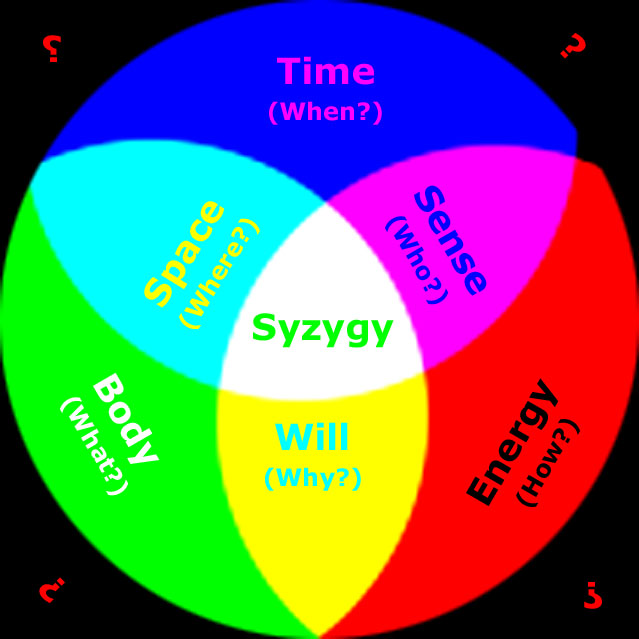
syz·y·gy
[siz-i-jee] noun, plural -gies.
1.Astronomy . an alignment of three celestial objects, as the sun, the earth, and either the moon or a planet: Syzygy in the sun-earth-moon system occurs at the time of full moon and new moon.
2. any two related things, either alike or opposite.
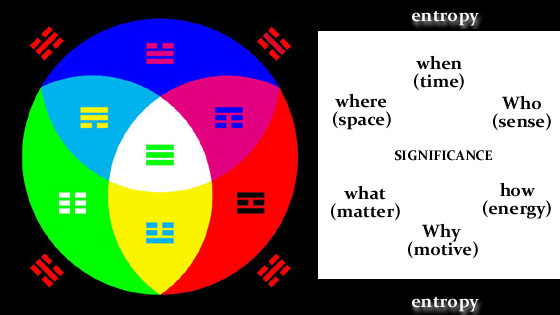
This is the primordial syzygy for multisense realism. The overlapping RGB regions can be grouped in different ways to bring out different meanings.
The primary spectral hues with the perimeter orientation are juxtaposed with the pastel hues having center-radial orientation. This produces a dialectic of subjective introversion versus objective extroversion as well as a three syzygies:
Subject Thesis (Who & Why, Sense & Motive, Pink & Yellow) minus Space (Subjects are always ‘here’)
Object Antithesis (What & How, Matter & Energy, Green & Red) minus Time (Objects are always ‘now’)
Realism Synthesis (When & Where, Time & Space, Light Blue & Deep Blue) is inferred by triangulating Subject & Object
Using this symmetry to solve the Hard Problem and bridge the Explanatory Gap:
Think of the living brain as the what and how of what we are, and consciousness is the who and the why. Neither supervenes on the other but, neither are they separable entirely. Like the syzygy, they are elements which are separate in some sense, united in some sense, overlapping and underlapping in some sense, defined by each other in some sense, and defining a super-signifying whole which is more than the sum of its parts in another sense.
Consider that of the seven billion people alive today, each one has a different identity and life, yet we all share more or less the same physiology. We cannot expect to locate the who & why of our identity in the what and how terms of our body.
The question marks outside of the circle represent the another dialectic, between the anthropic significance of the syzygy and the a-signifying mechanism of entropy.
”?” is used to connote the unconscious fully. Not merely the absence of awareness but the absence of the capacity for awareness of the absence. There is nothing there to signify a label of nothingness or oblivion, it simply is not anything.
Syzygy vs ?:
acceleration vs inertia
sequence vs consequence
significance vs entropy
pattern vs coincidence
initiative vs randomness
signal vs noise
orientation vs disorientation
teleology (purpose) vs teleonomy (evolution)
animism vs mechanism
augmentation vs cancellation
positive vs negative
multiplication vs division
Tags: consciousness, cosmology, explantory gap, hard problem of consciousness
 Multisense Realism
Recent Comments