Archive
Consciousness and The Interface Theory of Perception, Donald Hoffman
A very good presentation with lot of overlap on my views. He proposes similar ideas about a sensory-motive primitive and the nature of the world as experience rather than “objective”. What is not factored in is the relation between local and remote experiences and how that relation actually defines the appearance of that relation. Instead of seeing agents as isolated mechanisms, I think they should be seen as more like breaches in the fabric of insensitivity.
It is a little misleading to say (near the end) that a spoon is no more public than a headache. In my view what makes a spoon different from a headache is precisely that the metal is more public than the private experience of a headache. If we make the mistake of assuming an Absolutely public perspective*, then yes, the spoon is not in it, because the spoon is different things depending on how small, large, fast, or slow you are. For the same reason, however, nothing can be said to be in such a perspective. There is no experience of the world which does not originate through the relativity of experience itself. Of course the spoon is more public than a headache, in our experience. To think otherwise as a literal truth would be psychotic or solipsistic. In the Absolute sense, sure, the spoon is a sensory phenomena and nothing else, it is not purely public (nothing is), but locally, is certainly is ‘more’ public.
Something that he mentioned in the presentation had to do with linear algebra and using a matrix of columns which add up to be one. To really jump off into a new level of understanding consciousness, I would think of the totality of experience as something like a matrix of columns which add up, not to 1, but to “=1”. Adding up to 1 is a good enough starting point, as it allows us to think of agents as holes which feel separate on one side and united on the other. Thinking of it as “=1” instead makes it into a portable unity that does something. Each hole recapitulates the totality as well as its own relation to that recapitulation: ‘just like’ unity. From there, the door is open to universal metaphor and local contrasts of degree and kind.
*mathematics invites to do this, because it inverts the naming function of language. Instead of describing a phenomenon in our experience through a common sense of language, math enumerates relationships between theories about experience. The difference is that language can either project itself publicly or integrate public-facing experiences privately, but math is a language which can only face itself. Through math, reflections of experience are fragmented and re-assembled into an ideal rationality – the ideal rationality which reflects the very ideal of rationality that it embodies.
Epistemology and Ontology
“I think you’re conflating with Ontology/Metaphysics with Epistemology.”
Epistemology only becomes possible with a degree of ontological distance. Within our own most immediate experience, there can be no question of anything hidden or unhidden. “Here and now” is self-evident – it is maximally predictable and maximally unpredictable. It is only when we have the space of “There and then” that we can speculate on what and how knowledge/information differs from chaos/entropy. It is insensitivity which opens a breach of possibility and theory.
Questioning the Sufficiency of Information
Searle’s “Chinese Room” thought experiment tends to be despised by strong AI enthusiasts, who seem to take issue with Searle personally because of it. Accusing both the allegory and the author of being stupid, the Systems Reply is the one offered most often. The man in the room may not understand Chinese, but surely the whole system, including book of translation, must be considered to understand Chinese.
Here then is simpler and more familiar example of how computation can differ from natural understanding which is not susceptible to any mereological Systems argument.
If any of you have use passwords which are based on a pattern of keystrokes rather than the letters on the keys, you know that you can enter your password every day without ever knowing what it is you are typing (something with a #r5f^ in it…?).
I think this is a good analogy for machine intelligence. By storing and copying procedures, a pseudo-semantic analysis can be performed, but it is an instrumental logic that has no way to access the letters of the ‘human keyboard’. The universal machine’s keyboard is blank and consists only of theoretical x,y coordinates where keys would be. No matter how good or sophisticated the machine is, it will still have no way to understand what the particular keystrokes “mean” to a person, only how they fit in with whatever set of fixed possibilities has been defined.
Taking the analogy further, the human keyboard only applies to public communication. Privately, we have no keys to strike, and entire paragraphs or books can be represented by a single thought. Unlike computers, we do not have to build our ideas up from syntactic digits. Instead the public-facing computation follows from the experienced sense of what is to be communicated in general, from the top down, and the inside out.
How large does a digital circle have to be before the circumference seems like a straight line?
Digital information has no scale or sense of relation. Code is code. Any rendering of that code into a visual experience of lines and curves is a question of graphic formatting and human optical interaction. With a universe that assumes information as fundamental, the proximity-dependent flatness or roundness of the Earth would have to be defined programmatically. Otherwise, it is simply “the case” that a person is standing on the round surface of the round Earth. Proximity is simply a value with no inherent geometric relevance.
When we resize a circle in Photoshop, for instance, the program is not transforming a real shape, it is erasing the old digital circle and creating a new, unrelated digital circle. Like a cartoon, the relation between the before and after, between one frame and the “next” is within our own interpretation, not within the information.
Physics as the Production of Realistic Fantasy and Fantastic Reality
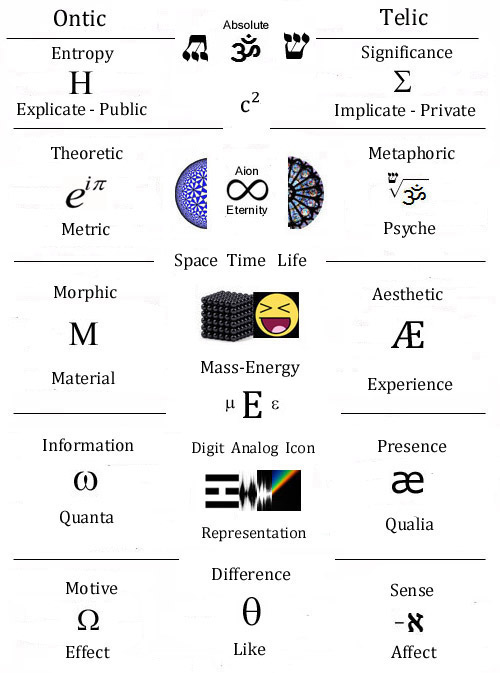
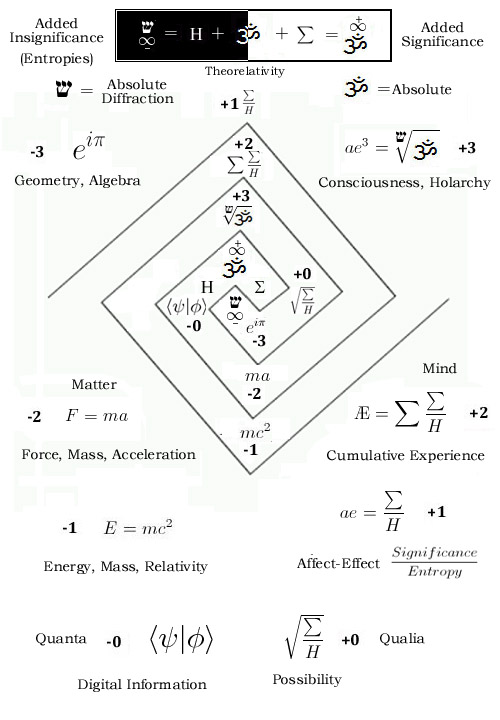
When working with private physics, the operators used are metaphorical and implicit, not explicit. Qualia is LIKE the “mass” of privacy. The will to will is like the “Energy” of privacy, and realism is like the “c²”. In my understanding, the notion that c is the speed of light is really a legacy understanding – a pre-Relativity convention within Relativity. It makes more sense to me now that light just happens to be the fastest quality of sense that we have access to. The true nature of c is as the speed of sense, or experience itself. It is not a speed, but the absolute limit of velocity. The still-here-ness of the universe..
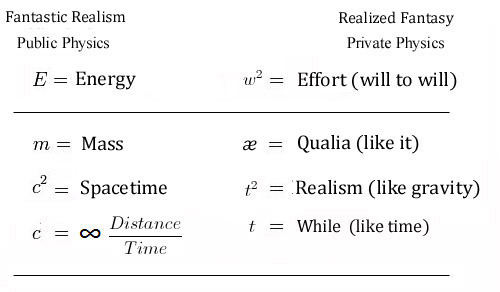
From an absolute view, quantified properties like mass, energy, and spacetime can be considered to be like reality but the only true reality is what experience is like. All conditions of the public universe are contingent upon an aesthetic palette, otherwise it would be implausible that any such palette could exist.
Private physics and public physics provide two different senses or fantasy, and two different senses of reality. Human experience is fantastically rich in an aesthetic sense and fundamentally real because it is the source of our participation in the universe. Our experience of the non-human universe is fantastic in the sense of its overwhelming magnitude and complexity, Its reality is persistent and reliable.
If we are serious about our science, we should consider that being overwhelmed by grandeur is a human experience which reflects the disparity in physical scale between us and the larger exteriority. The Public universe by itself would have no such feeling of grandeur, but what we feel about the inaccessible vastness of the cosmos is equaled by the vast inaccessibility of feeling by public physics.
Something else that has come up through this recent addition of physics to MSR, is the idea that Gravity is time squared, and that time is the square root of gravity. This makes sense to me, if we are talking about the equivalent conjugates of c² and t² as pubic spacetime and private realism. It should work out that Spacetime = the public shadow of Realism, and therefore Spacetime is literally Gravity and Realism is literally figuratively Gravity, as in the grave, serious nature of experience. If c is the constancy of distance and time coordinates, c² is the gravity which warps them from within.
A Formula for Qualia
To derive the formula for qualia or sensory affect, solve the Hard Problem of Consciousness, and bridge the Explanatory gap, I suggest that we try converting the mass-energy equivalence E=mc² from the public orientation and transpose it inward to the private orientation.
Energy (E) becomes w² which is “was and will be” (w = was or will be)
The Speed of light (c) becomes t = time = (still or never) = now or realism
Light* (c²) becomes t² “still and never again” or “stereo realism of now”
Mass (M) becomes æ = qualia = “like it”
Qualia = “like it was and will be, still and never again” =

another wording
Qualia = “Eternally signifies its past and future now”
This is about what Milan Kundera called The Unbearable Lightness of Being. That our experience of the universe is either perpetually suspended above the paradox of an existence which is both perpetually vanishing forever in some sense and repeating forever in another. If c is the still ‘speed’ of here and now, then c² is the acceleration of here and now, the enrichment of the local now through the collective presence and absence of eternity
- Motive effect or will:
To derive will or motive: 
If qualia is “like it”, then square root of æ is what joins and divides the ‘like’ and the ‘it’. It is the dipole charge of ‘liking’ and ‘it-ing’ which we call desire or preference. The greater the liking, the more significance is projected onto the object, which is the imagined realization of a goal in time. Intention projects into the future, builds, and guides qualia.
Will = “(Maybe, or maybe not)(now or never)” = w = √æ t
Turning the private translation outward to Public/Western psychology so that interiority is undersignified as emergent epiphenomena, we get:
= Experience is simply what may and may not be happening for some time.
and
= Choosing = Right or wrong this time
The public-facing view of privacy reduces it to information processing. To those who have a private-facing view this is a flat and inadequate characterization. The former view is optimized for realizing spatial intelligence while the latter is optimized for appreciating timeless wisdom.
- Quality and Equality
Since qualia is about likeness and local equivalents, it can be said that qualia equals the differential between equality and all inequalities... æ = ‘d=’.

The kicker is that since equality is itself a quale (the spelling of e-quality is a clue), we can conceive of ‘=’ as quality which is externalized**, i.e. the differential is collapsed and the entire range of what it “is like” is interpreted as what “it actually is”. The Western-facing mind naturally prefers that which only tells it ‘like it is‘, so that public physics and information science will filter out as noise all that tries to tell ‘what it is like‘ (paging Ludwig Wittgenstein…). This commercialization of residential qualities has had many benefits, but it is a philosophy which has blinded itself, and intimidated many into ignoring the true nature of consciousness. It’s not anyone’s fault, it’s how private physics works. It’s how sense is made.
*The speed of light is c, but c², if taken literally, can be understood as light itself, reality, or making sense: producing stereo (solid) realism.
**Physically publicized, cropped, framed, stereotyped, commercialized, hardened to endure against the changing feelings that make up private time.
Tessellated Relativity
Whether it is material movement across space or sensory excitement through time, energy must always be a verb. We call it force or work, but that is a shortcoming of the Western fetish for nouns. Really, in my view all energy must be a *forcing* or *working* verb. While I fully appreciate the accusation that this is naive realism, I suggest that this is a foundational symmetry which can be inverted only for figurative purposes. No real energy should be considered noun-like, and all standard model visualizations which contradict this should be regarded as unreal. For this reason, I think that the assumption of the photon as an entity is an obstacle to rehabilitating the standard model to one which integrated the physics of privacy. In an ironic twist, we will have to re-educate ourselves to get used to the idea that the qualia of light and color is real, and photons are imaginary descriptions from an impossible frame of reference (the voyeur public subject).
What are the consequences of energy like? Radiance. Flow. Waves. What are waves? Either a frequency through time or a repeating shape across space. We know, however, that we don’t see photons as oscillating shapes, we see them as a shining, glowing, reflecting, or gleaming in our vision or a warming or burning in our feeling. That’s all about time. Looking at the sun, the intensity increases over time as our retina becomes more and more stimulated. The same is not true of mass. Mass ‘just sits there’ at some position in space. Unlike looking at the sun, the intensity of mass does not increase by itself over time, but rather it increases inversely to distance through space (gravity).
In a post energy particle model, mass and energy modify structures (matter in space) and qualify experiences (sensation through time), and are not free standing quantities emerging from a vacuum. Mass is convergent on a point within a structure, and energy is divergent from c (non-space, non-time) as a frequently recurring stimulus. I was thinking of calling this module of MSR “Tessellated Relativity”, as the inertial frames swing spacemass-ward and time-energyward, yielding the position v momentum exclusivity.
If that’s all true – and I think that it might be on the right track, then it can be used to illuminate the workings of how qualia and sensitivity are equivalent to transparency/entanglement with larger frames of time and higher spatial perspectives.
Colorball II Diagram

Key:
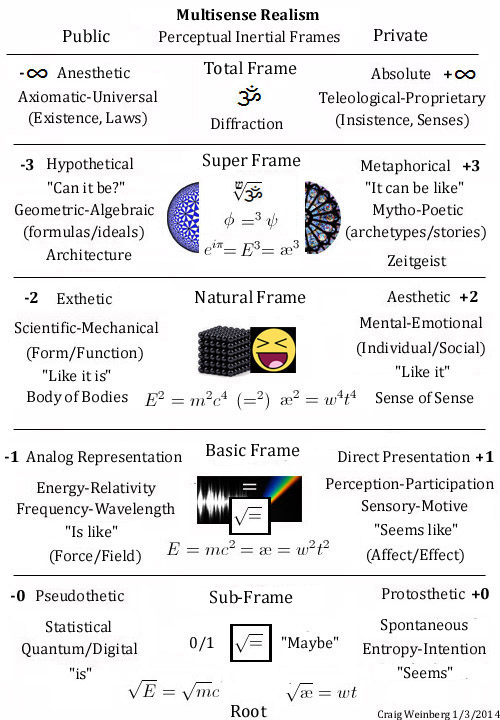
Absolute (+∞) :: Anesthetic (-∞)
Entelethetic (+3) :: Hypothetic (-3)
Aesthetic (+2) :: Exthetic (-2)
Immediate (+1) :: Etheric (-1)
Protosthetic (+0) :: Pseudethetic (-0)
The new terms in this second version are:
- Protosthetic (+0), referring to the minimum quality of awareness as well as the quality of minimum awareness. On a scale of +0* to +∞, this level is the +0 because it represents experiences which have been aesthetically masked to appear imperceptible. This can be thought of as the personal unconscious, as opposed to the collective unconscious, which is the Absolute level that is positioned on top of the diagram, but is actually the entire sphere. It’s number would be +∞.
The entire left half of the sphere can be thought of as a slice within the protosthetic range, just as the greyscale can be thought of as variations on black and white. - Pseudethetic (-0) is the outside-in version of Protosthetic. Where protosthetic phenomena seem alienated or unconscious but are, on some level, a symptom of experience, pseudethetic phenomena are not as conscious as they appear to be. The -0 range is about artifice and simulation, and can include anything from a puppet or stuffed animal to a sophisticated AGI system. Protosthetic would include states in which we are personally unconscious, but can be thought of as that which wakes us up from a sub-personal level.
- Exthetic (-2) is a term I’m trying out as the public-facing conjugate to Aesthetic. This is the common sense of structure that the real world generally seems to have. It is the sense of concrete exteriority which we rely on to engage with the world rather than in our mind. The sense of fixed mass objects in space and linear causality, and all of the other macroscopic cues that pervade classical physics, as well as all of the hard sciences.
- Entelethetic (+3) is intended to refer to a level of hyper-aesthetic dreams, symbols, and archetypes. Also knows as the collective unconscious or Dreamtime, this band of sensitivity is super-natural and trans-personal (yet still private). The word borrows from Entelechy, which has to do with a drive toward self-actualization, which is apt considering the visionary nature of this ‘third eye’ view.
Teleological-Absolute (+∞) :: Universal-Axiomatic (-∞)
Mytho-Poetic (+3) :: Geometric-Algebraic (-3)
Mental-Emotional (+2) :: Scientific-Mechanical (-2)
Sensory-Motive/Perceptual (+1) :: Electro-Magnetic/Relativistic (-1)
Proto-Aesthetic (+0) :: Quantum-Digital (-0)
 Multisense Realism
Recent Comments