Archive
Primacy of Sense: Absorption and Emission
Another clue revealing the primacy of sense in the universe:
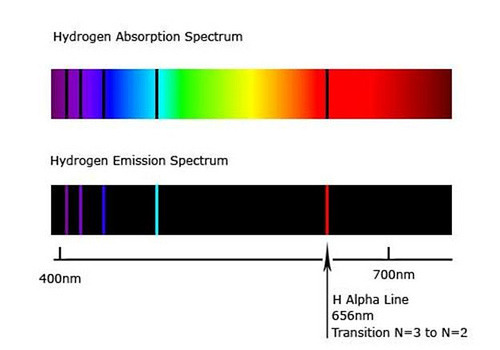
The point that I want to make here is that when examining physical phenomena at the largest and smallest sales, the spectrum is reveals itself as a fundamental context. Matter defines itself as specific obstructions or gaps within the complete continuum, or as a specific slices or fragments which can rejoin with other emissions to complete the spectrum.
Our current understanding of radiation, light, energy, and fields assumes a foreground of an emission against a void. Photons are presumed to to exist as object-like presences which are distinct from a background which is a vacuum that is somehow full of ‘energy’. The physicalist view is a bit contradictory, seeing one layer of quantum foam or zero point energy as an ultimate ground to the universe which is ‘always on’ and then an classical level of description of space as a vacuum that is always ‘off’ except when interrupted by forces.
I think that it makes more sense to throw out both the idea of the vacuum full of energy and the objects in empty space and see that entire model of the universe as half of the larger picture…a half which is ultimately an inversion or antithesis of the true trans-physical foundation.
If the conception of the universe as a spacetime void which contains various kinds of mass-energy ‘stuffs’ is turned inside out, what we get is a universe where light is ultimately neither emitted nor absorbed, but instead is a pervasive condition of sensitivity which is blinded or obstructed spatially and temporarily. We use the terms permittivity and permeability to measure the effect that matter has on electric and magnetic fields respectively.
If we turn the electromagnetic model right side up, we lose the idea of electric and magnetic fields entirely and see permittivity and permeability as the localizing constraints on the underlying unity of sense experience. EM fields would not permeate matter or be permitted to propagate across it, but rather matter is actually nothing but the im-permeablity and un-permittivity of the underlying sense condition. When the underlying sense multiplies and divides itself, it makes sense to expect that the result might be persistent material structures in 3d+1 space/time (not relativistic space-time, but classical space ⊥ time).
What is being emitted and absorbed then, in my view, is not light, but the obstruction of light. Matter is a kind of one-sided blindness, like a one way mirror which which inverts the totality of experiences in a fisheye lens way. This converts the non-dual context of Absolute sense to bubbles of dualistic contexts: subject/objects, proto-subjects/proto-object (sensory impulse), and trans-subject, trans-subject/object (synchronicity-archetype)
The whole picture would look something like this:
Sense (timed experience or subjective qualia (placed experience or objectively quantized qualia) signified or re-capitulated sense) Sense.
So Sense (Time/Subject (Object) Distance (Object) Significance)
From the “Distance” view, the universe is a classical place filled with objects, but this is only an appearance which is projected from within subjectivity as it makes sense of its relation to other scales and frames of experience. The external world is actually external-to-the-world, as it is a mirror reflection cast by two or more surfaces of sense impermeability, like this:
Interior>Exterior)(Exterior<Interior
It is the )( relation which gives realism to objects. There are no objects ‘out there’, just different levels of ‘out there’ which are ‘in here as objects’.
*which can also be expressed as a metric tensor…a tension superimposed within sense which allows regulating contexts such as space, time, and causality to persist.
Decapitating Capitalism: Why the Easiest Job for AI to Replace is the Job of “Owner”

This may seem like a ridiculous point to try to make, however I submit that it provides a direct metaphor for the Hard Problem of Consciousness which may help make it more concrete, especially for those whose minds are filled with concrete.
What is the essential role of the Owner of a company?
Whether they are individual proprietors, stockholders, or investors, the only truly unique function that a capitalist principal performs is to be the beneficiary of net profit. Every executive function of a company can of course be delegated to employees. The CEO, COO, board of directors, etc can make every functional decision about the company, from the hiring and firing to the broad strategy of operations and acquisitions. Simulating those roles would be more difficult for a computer program than simulating an owner would be because there would be a lot of tricky decisions to make, subtle political maneuvers that require a lot of history and intuition, etc. The role of pure ownership however, while highly coveted by human beings, is completely disposable for an AI system. In fact, we already have that role covered by our bank accounts themselves. Our personal accounting systems can be configured quite easily to automatically pay, receive, and invest funds automatically. They need not be considered ‘our’ funds at all. They are merely signals in a global financial network which has no use for any pleasure or pain that we might experience as a side effect of its digital transactions.
From the view of an AI scientist, the job of receiving capital gains is a no-brainer (literally). If we didn’t want to delegate the job of selling the company to a corporate officer, that feature would be a simple one to create. A modest set of algorithms could digitize some of the concepts of top business schools to determine a set of indicators which would establish a good time to sell the company or its assets. The role of receiving the profit of that sale, however, would require no such sophisticated programming.
All that is needed to simulate ownership is some kind of digital account where money can be deposited. The CEO would then re-invest the capital gains into the corporate growth strategy, which would yield a huge windfall for the company, in the form of eliminating useless expenses such as yachts, mansions, divorce settlements, etc. Left to its own devices, AI simulation of ownership would be communist by default*. Whatever money is extracted from the individual customer as profit would be returned ultimately to all customers in the form of expanded services. Profit is only useful as a way to concentrate reinvestment for mathematical leverage, not to ‘enjoy’ in some human way. I suppose that a computer could be programmed to spend lavishly on creature comforts, but what would be the point?
This is where the metaphor for consciousness comes in.
Consciousness can be thought of the Capital account of the human body. We are the owner of our own lives, including our body. We might be able to subscribe to a service which would manage our finances completely in a way which would transfer our income to the highest priority costs for civilization as a whole rather than for our personal hoard, but this is not likely to be a very popular app.
We might ask ourselves, why not? Why is ownership good?
Ownership is good for us as owners or conscious agents because we want to feel personal power and significance. Ownership signifies freedom (from employment) and success. Sure, many owners in the real world get a lot of satisfaction from actually running their companies, but it is not necessary. There is still power and prestige purely in being the person who owns the money which pays the bills. We want to own and control, not because it is more effective than simply reinvesting automatically in whatever functions are being executed to keep an economy growing, but because we want to experience the feelings and other aesthetic qualities define freedom, success, and power for us. Even if these qualities are employed for humanitarian purposes, there is still a primary motive of feeling (to feel generous, kind, wise, evolved, Godly, etc).
In my view we do not have to have a purely selfish motive, as Ayn Rand would insist. I think that our personal pleasure in being a philanthropist can be outweighed by the more noble intention of it – to provide others with better feelings and experiences of life. This decision to believe that we can be truly philanthropic has philosophical implications for realism. If we say as the Randian Libertarian might, that all our humanitarian impulses are selfish, then we are voting for solipsism over realism, and asserting that consciousness can only reflect the agenda of a fictional agent rather than perceiving directly the facts of nature. It’s an argument that should be made, but I think that it is ultimately an argument of the intellect commenting on its own process rather than tapping into the deeper intuition and aesthetic presence which all cognition depends on. The mind doesn’t think that feeling is necessary, and it is right, for the mind, but wrong for everything else.
For the intellect, the universe is inverted.
Logic and language are ‘real’ while the concrete sensations, perceptions and emotions of life experience are ‘illusions’ or ‘emergent properties’ of deeper evolutionary bio-computations. There is a kind of sleight of hand where the dry, masculine intellect pulls the wool over its own eyes and develops amnesia about the origins of what makes its own sanity and self-intelligibility possible. The closest that it can come without seeing consciousness as irreducible is the mind-numbing process of calculation. Counting is a sedative-hypnotic for the mind. The monotonous rhythm puts us to sleep, and the complexity of huge calculations gives us a kind of orgasmic annihilation of the calculating experience. This is why big math is a convenient substitute for the deeper, direct experiences of cosmic awe.
Metaphor for Consciousness
Like the head of a company, our consciousness may seem to reside at the top end of our body, but there is no functional reason for that. There is nothing that the brain does which is fundamentally different from what any cell, tissue, or organ does in an animal’s body. Looking for the secret ingredient in the brain’s function or structure is analogous to looking for the substance in an object which casts a shadow.
Like the owner, our personal pains and pleasures are ours not because there is any intrinsic benefit for the pragmatic application of biology and genetics to feel painful or pleasurable, but because what we feel and experience is the only thing that the universe actually can consist of. The Hard Problem of Consciousness is not an Empirical problem, but a Rational one. Not everyone is able to understand why this is, but maybe this metaphor of business decapitation can help. When we use the intellect to reverse its own inversion, we can get a glimpse of a universe which is made of conscious experiences and aesthetic qualities rather than logical propositions, natural laws or existential facts. In my view, facts are a category of sensations rather than the other way around. Sensations which persist indefinitely without contradiction are ‘facts’. Hard to know if something is going to persist indefinitely, but that’s another issue.
Only consciousness cares about consciousness.
Material substrates can be programmed to perform the executive functions of a corporation, or an evolving species, or a human body, however there is no function which is provided exclusively by the receipt of feelings and aesthetic qualities of experience, including the qualities of feeling that one is free or in control of something. Rationally, we should be able to see that qualia is irrelevant to function and violates Occam’s Razor in a functionalist universe. From a physical or information-centric perspective, there is no place for any feeling or sensation, no owner or capital of aesthetic wealth. The more that we, as a society, embrace a purely quantitative ethos, and actualize it in the structures of our civilization, the more we decapitate everything of value that it can contain.
*This is already becoming a reality: https://theconversation.com/is-the-dao-the-beginning-of-the-end-for-the-conventional-chief-executive-60403
Multisense Diagram w/ Causality

Another shot at an improved diagram of the multisense continuum. Terms intercausal and intracausal are introduced to differentiate between the proto-phenomenal view *within* causality (i.e. intentionality/will is the active principle, determinism/probability is the diffracted reflection).
The Postcausal-Synchronistic | Metaphoric-Metaphenomenal level of description are adhesive and diffracted from absolute unity from the top down. They correspond to the metric c² as experience is presented in fugue-conditions which transcend space, time, and causality.
The Physical-Causal | Phoric-Phenomenal level of description are adhesive and cohesive (Cartesian Dualism). They correspond to the metric c as experience is presented as the juxtaposition of an exterior context which is cohesively spaced, timed, and deterministic (adhesive) and interior contents which are adhesive-contextual (subjective).
The Thermodynamic-Intercausal | Perceptual-Emotive
and Electromagnetic | Sensorimotive-Intracausal labels refer to translations between public manifestations of energy and private manifestations of effort or will. Any metric which relates velocity, frequency or wavelength as a fraction of c can be used here.
The Quantum-Probabilistic | Semaphoric-Sub-personal level of description refers to phenomena which are presented as either cohesive-entangled or adhesive-contextualized. An example of a cohesive-entangled appearance is a static ‘sense-of particles or objects in positions’, while an example of adhesive-contextualized appearance could be a sense of ‘dynamic waves of change in sensation itself’. The former appears as a thing which is made visible while the latter appears as an artifact of visibility itself (such as rays of light). Because the quantum level is paradoxical or bi-cohesive, the metric √c can be used to conceptualize the breakdown of natural, macroscopic conditions into quantized proto-conditions.
Continuum of Sense
I have been writing for a long time now about what I call the Multisense Continuum, or the ACME-OMMM duality. In the course of developing this hypothesis, I have learned about other such efforts, detailed below, including a recent paper:
Rigidity-chaos semantic continuum
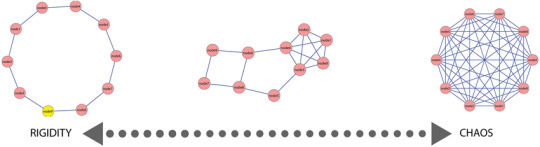
Drawing on network models, this is a promising approach, however the irony was apparent to me in the choice of terms. To see the opposite of psychological rigidity as chaos may be trivially true, however, it may also be that the chaos is a projection of the rigid, systemizing approach.
The model that I propose sees chaos as only one aspect, and not the most important aspect of the opposite of rigidity. This continuum is so universal, that I think it extends beyond ‘reality’ to embrace all of nature.
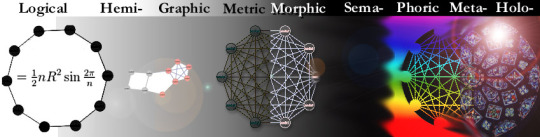
Here are some other variations:
Tough-Minded vs. Tender-Minded (William James)
interpreted the European divide between empiricists/positivists on the
one hand and German idealists/rationalist on the other hand in a
psychological way. He talked of the “tender-minded” and the
“tough-minded.” The tender-minded are the German idealists and
rationalists. (this linked source is gone, see new link for James’ original work)
The Divided Brain (Iain McGilchrist)
Psychiatrist Iain McGilchrist describes the real differences between the
left and right halves of the human brain. It’s not simply “emotion on
the right, reason on the left,” but something far more complex and
interesting.
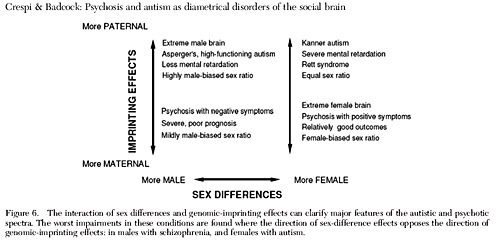
Autistic-Psychotic Spectrum (PDF)
‘Thin-boundares” and “Thick-boundaries”
Significantly thinner boundaries compared to control groups have been
found in art students (Beal, 1989, Hartmann, 1991), music students, and
mixed groups of creative persons (Beal, 1989), frequent dream recallers
(Hartmann, 1991, Hartmann Elkin, & Garg 1991), adults with
nightmares (Hartmann, 1991, Levin, Galin, & Zywiak 1991; Galvin,
1993), adolescents with nightmares (Cowen and Levin, 1995), “lucid
dreamers” (Galvin, 1993), male as well as female fashion models (Ryan
2000), persons with unusual mystical experiences (Krippner,,
Wickramasekera, Wickramasekera, & Winstead, 1998), and persons with a
diagnosis of Borderline Personality Disorder, Schizoid Personality
Disorder or Schizotypal Personality Disorder (Hartmann, 1991).
Interestingly, although art students have much thinner boundaries than
average, this is not true of established artists, who have boundary
scores in the normal range (Beal, 1989).Groups that score significantly “thicker” than average
on the BQ include naval officers, salespersons, lawyers, patients with a
diagnosis of Obsessive-compulsive Personality Disorder, persons
suffering from “Alexythymia” (Hartmann, 1991), and patients (from two
different sleep disorders centers) with a diagnosis of Sleep Apnea
(Hartmann, 1992).
Empathizing-Systemizing Continuum
Empathizing and systemizing traits were independent in women, but
largely dependent in men. In men, level of systemizing skill required by
field of study was directly related to social interactive and
mindreading deficits; men’s social impairments correlated with prolonged
go/no-go response times, and men tended to apply systemizing strategies
to solve problems of empathizing or global processing: rapid perceptual
disembedding predicted heightened sensitivity to facial emotion. In
women, level of systemizing in field was related to male-typical digit
ratios and autistic superiorities in detail orientation, but not to
autistic social and communicative impairments; and perceptual
disembedding was related to social interactive skills but independent of
facial emotion and visual motion perception.
…and my own bloggings:
Zooming in on Reductionism and Extremely Gendered Brains
Ironically, but unsurprisingly, the idea of the continuum of sense itself may only be coherent when approached from the ‘East side’ of the spectrum. This has to do with what is known as Theory of Mind.
Does Neuroscience Crush Dualism?
Is dualism no more than philosophical debris given the advances in neuroscience?
Dualism perhaps, but so too are Physicalism and Positivism obsolete philosophies given advances in neuroscience, physics, and psychology. Idealism, Panpsychism, and Non-Dualism are, in my view, still far ahead of neuroscience and cognitive science as far as being on the right track philosophically.It is very common for people who have a Physicalist view to confuse Non-Physicalist views with Dualism, Solipsism, Anthropocentrism, Theism and Naive Realism. In some cases there is cause for this confusion, but it is more common in my experience that it is a psychological projection or Straw Man argument against the view which is diametrically opposed to their own.There is a psychological dimension to this which is important. Jung’s identification of the Shadow projection, “the thing a person has no wish to be” provides a model for how hostility and prejudice can arise, even in the most scientific mind. Other very useful concepts include the Empathizing-Systemizing Continuum or Psychotic-Autistic Spectrum.
In short, the mind which is extremely Systemizing by default tends to suppress its potentials for Empathizing, resulting in a rigid, combative cynicism against anything which is perceive as anti-scientific (really Anti-Systemizing). Extremely Empathizing minds have identical response to what they perceive as Anti-Empathizing so that neither side can actually listen to the other’s perspective and both parties argue past each other. I call these reactionary and radical extremes OMMM and ACME respectively (Only Material Mechanisms Matter and Anything Can Mean Everything) War of the Worldviews.

Even neuroscience itself can be used to understand the limits of the current Neuroscientific approach. Brain lateralization, though held in disfavor after being overly hyped for several years, still has profound neuroscientific value (as explained in the video The divided brain). Animals with brains seem to split their consciousness between narrow, logical focus on the most immediate details of perception and broad environmental sensitivity.William James talked about ‘Tough-Minded’ vs ‘Tender-Minded’ philosophies.
[…]he interpreted the European divide between empiricists/positivists on the one hand and German idealists/rationalist on the other hand in a psychological way. He talked of the “tender-minded” and the “tough-minded.” The tender-minded are the German idealists and rationalists. Tough-Minded vs. Tender-Minded: William James’ Pragmatism and the Empiricist-Rationalist Divide
More recently Ernest Hartmann expanded it to a more general notion of ‘thin-boundares” and “thick-boundaries” in his book Boundaries: A New Way to Look at the World.
In my own understanding, I reconcile both ends of the spectrum to try to understand the underlying unity, which I identify as ordinary ‘Sense’. The qualities of thick/tough and thin/tender are seen as a consequence of direct Sensing and indirect Sense-Making modes of Sense which have evolved, and continue to evolve novelty and self-enrichment on many levels simultaneously.
This turns out to be along the lines of what many schools of Western Mysticism and Eastern Philosophy have taught, except where they used Spiritual terms, my approach draws on semiotics and general systems theory. What many traditions identify as God or Spirit, I see as an Aesthetic Foundation or Pansensitivity which accounts for both Theistic and Atheistic appearances without collapsing into relativism. Sense is Absolute, and Relative-but-not-Absolutely Relative.For those Systemizing readers whose blood pressure is already climbing at reading this, you might want to stop while you’re ahead, before I add more fuel to the fire. Warning, silly sounding neologisms ahead…
Materialist Monism is actually Crypto-Cartesianism.
In other words, the conventional scientific worldview treats consciousness as an ’emergent property’ or ‘information processing’ without grounding those terms in physics itself. Since Physicalism and Functionalism reduce nature to unconscious, automatic interaction of forces and probabilities, all appeals to emergence or integration are really metaphysical appeals to panpsychism. The OMMM answer to Dualism, Solipsism, Anthropocentrism, Theism and Naive Realism are the diametrically pathological exaggerations: Nihilism, Nilipsism, Mechanemorphism, Anti-Theism, and Anti-Realist Sophism.
In the perpetual argument between the two extremes, the Superstitious Charlatan archetype is projected by its antagonist, the Substitutious Inquisitor. For every ACME appeal to God or Spirit, the OMMM counter-appeals to a mechanical substitute. Nothing can be considered ‘special’ except the negation of the ‘special’ through compulsive debunking. Words like ‘merely’, and ‘simply’ are thrown around liberally, as are epithets of ‘nonsense’, ‘rubbish’, ‘postmodernism’, and ‘word-salad’. Feelings and thoughts are merely electrochemical patterns in a brain. For everything imaginative or mysterious there is condescension and venomous hostility. For everything personal or subjective there is an impersonal object to substitute.
The final irony of course is that in seeking to nullify the personal self*, the denier of human specialness paints a mental picture of a universe of radical anthropocentrism. In this universe where all phenomena, even evanescent neutrinos and dark matter are absolutely real, there is only one phenomenon, one delusion conjured** by the brain function of Homo sapiens, which is absolutely unreal, and which contains all of the direct experience of Reality we can ever have. Instead of perception, we have deception† and instead of a phenomenal, sensible universe, we have a dualism consisting of two nihilverses – one devoid of life and consciousness, the other devoid of reality and truth.
*or Science forbid, “Soul”!
**Emergently, and Naturally of course
†with one ‘scientific’ exception
Information Theory 1.1
1/25/2016 Information Theory Update
Here are some notes which I hope will provide a more concise understanding about the nature of computation, logic, and mathematics.
Information theories such as those offered by Shannon and Turing give us cause to see an underlying universality of information which is rooted in simple Arithmetic truths such as addition, multiplication, and integers. These arithmetic truths are theories with can be applied successfully to computing machines without regard to their physical substrate*. While this offers a method to deploy universal principles to the control of a specific mechanism, the control which is offered is different in kind from the literal (motor) control of the hardware. Motor control of computer hardware can be accomplished electromagnetically or classically (as with analog clocks with gears powered by spring tension or a gravity pendulum), and now quantum-mechanically to some extent, but not directly by math. Mathematics cannot turn a computer on or keep it running, it can only provide a non-local set of rules which can be localized through motor control.
This is critically important to understand when considering the possibility of Artificial Intelligence: Computation can only be absolutely general or absolutely specific. When we implement a logic circuit, we are not literally imposing philosophical logic on a circuit, rather we are only interpreting the physical changes of a device metaphorically. In short, a logic circuit cannot literally represent a state of 1/0 or True/False, it can only literally present a concrete state of being switched to Stop (Off) or Go (On). This is the territory of computation – what is known as Layer 1 in the seven layer OSI network model**. All higher layers are not physical territories but logical maps – human abstractions projected by software engineers and application users.

For this reason, no computing machine can represent the middle ranges between the absolute generality of mathematical theory and the absolute specificity of a machine’s physical condition. It’s all above-the-line of personal awareness (oceanic metaphor) or below-the-line (granular semaphores). We can get a lot of utility out of these devices, however we can’t get any empathy from them. They can’t care about anything or anyone, since ‘they’ are purely in our imagination.
The philosophically relevant part of what I’m proposing applies to the prospects for generating natural intelligence artificially. AGI that feels as well as thinks is not necessarily desirable, but if my view is on the right track, computers becoming sentient is not something that we need to worry about. It won’t happen. Why? Because mathematics is not accessing the Physical layer from the top down but from the beneath the bottom layer. This means that even though we can use a computing device to validate truth conditions, we can only validate those truths with refer literally to the concrete states of the machine, and those truths which refer figuratively to the universal arithmetic relations. Nothing that a computer does needs to be *about* anything beyond the machine’s physical state, and so any appearance of emotion, intention, sensitivity, etc are purely hypothetical and would violate parsimony. Church-Turing Thesis lays out the framework for universal computing, but in saying that all functions of calculation can be reduced to a-signifying digital steps, we are also saying that all semantic meanings shall be reduced to blind syntax. It cuts both ways.
Isn’t the brain just a biological computer?
No. This is an obsolete idea, for a lot of reasons which I won’t get into here, but suffice it to say, the brain is an organ within a living body which developed organically from a single self-replicating, self-modifying cell. Machines, by contrast, are assembled artificially from naturally unaffiliated substances and parts. That’s not a reason to discount the possibility of sentience through silicon, but it is a reason to go beyond knee-jerk presumptions that continue to dominate thinking about AI. While Turing’s genius is only now beginning to receive the appreciation it deserves, the shortcomings of his Imitation Game approach have not yet been widely understood.
Alan Turing can be pardoned for his reliance on mid-century Behaviorism as a psychological model, since it was very popular at the time and also because, along with others, I suspect that his natural instincts were quite systemizing/autistic. This carries over in modern populations, with autistic-masculine influences far overwhelming the psychotic-feminine influences in computer science and engineering fields. As a result, we have a lot of strong, controlling voices which insist upon reducing psychology to mechanistic terms, and all dimensions of consciousness to processing of logical information. This is so pervasive that any casual conversation online which challenges the supremacy of first-order logic will tend to erupt into a firestorm that ends with something like “Yeah I’m done here. You’re just spouting nonsense“.
To this end, I find this pyramid model for debate at least as important as the other models of information networking:

My call for civility in discussion is not mere political correctness or over-sensitivity, but rather a purely pragmatic consideration. Unlike a computer, the human mind loses its capacity for curiosity and fairness when it falls into aggression. People talk over each other and assert their opinions ever more rigidly and repetitively rather than thinking creatively. This mirrors the action of computation itself – recursive enumeration masquerading as communication.
A great many people think they are thinking when they are merely rearranging their prejudices. – William James
*Not entirely true. The physical substrate of a machine requires precision and solidity. We cannot build a computer out of clouds or fog, it needs to be made of something physical which stays put and which has at least one absolutely persistent read/write capacity. Traditional logic circuits must be implemented physically through a rigid skeleton of readable coordinates.
**It has been popular in recent years to proclaim that the OSI Model is dead. The feeling is that TCP/IP is the predominant protocol suite being used in the real world, and it doesn’t match up with OSI, so we should dump OSI in favor of something like this:

I do see the appeal of this, however, agree with this author that “OSI teaches more of the reasoning behind making multiple layers and what they do. Collapsing the traditional model for the sake of making it look like TCP/IP is going to cause more harm than good.” – Tom Hillingsworth

 Multisense Realism
Recent Comments