Archive
Chthonic Tree
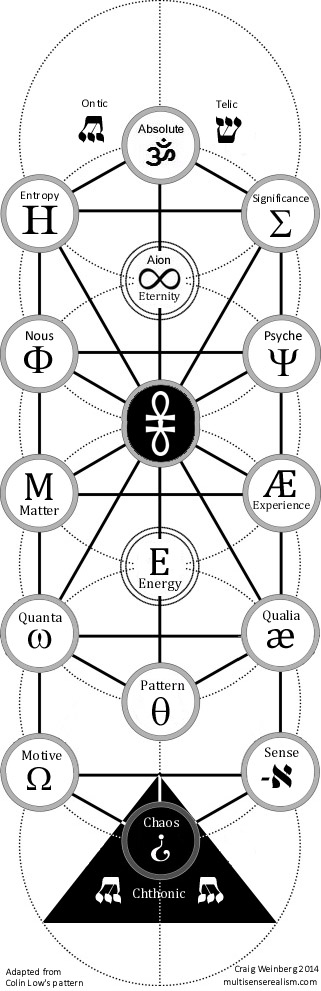
(Double Ankh = “Illumination” or “Deeply Examined Life”).
Chess, Media, and Art
I was listening to Brian Regan’s comedy bit about chess, and how a checkmate is such an unsatisfying ending compared to other games and sports. This is interesting from the standpoint of the insufficiency of information to account for all of reality. Because chess is a game that is entirely defined by logical rules, the ending is a mathematical certainty, given a certain number of moves. That number of moves depends on the computational resources which can be brought to bear on the game, so that a sufficiently powerful calculator will always beat a human player, since human computation is slower and buggier than semiconductors. The large-but-finite number of moves and games* will be parsed much more rapidly and thoroughly by a computer than a person could.
This deterministic structure is very different (as Brian Regan points out) from something like football, where the satisfaction of game play is derived explicitly from the consummation of the play. It is not enough to be able to claim that statistically an opponent’s win is impossible, because in reality statistics are only theoretical. A game played in reality rather than in theory depends on things like the weather and can require a referee. Computers are great at games which depend only on information, but have no sense of satisfaction in aesthetic realism.
In contrast to mechanical determinism, the appearance of clichés presents a softer kind of determinism. Even though there are countless ways that a fictional story could end, the tropes of storytelling provide a feedback loop between audiences and authors which can be as deterministic -in theory- as the literal determinism of chess. By switching the orientation from digital/binary rules to metaphorical/ideal themes, it is the determinism itself which becomes probabilistic. The penalty of making a movie which deviates too far from the expectations of the audience is that it will not be well received by enough people to make it worth producing. Indeed, most of what is produced in film, TV, and even gaming is little more than a skeleton of clichés dressed up in more clichés.
The pull of the cliché is a kind of moral gravity – a social conditioning in which normative thoughts and feelings are reinforced and rewarded. Art and life do not reflect each other so much as they reflect a common sense of shared reassurance in the face of uncertainty. Fine art plays with breaking boundaries, but playfully – it pretends to confront the status quo, but it does so within a culturally sanctioned space. I think that satire is tolerated in Western-objective society because of its departure from the subjective (“Eastern”) worldview, in which meaning and matter are not clearly divided. Satire is seen as both not as threatening to the material-commercial machine, which does not depend on human sentiments to run, and also the controversy that satire produces can be used to drive consumer demands. Something like The Simpsons can be both a genuinely subversive comedy, as well as a fully merchandized, commercial meme-generating partner of FOX.
What lies between the literally closed world of logical rules and the figuratively open world of surreal ideals is what I would call reality. The games that are played in fact rather than just in theory, which share timeless themes but also embody a specific theme of their own are the true source of physical sustenance. Reality emerges from the center out, and from the peripheries in.
*“A guesstimate is that the maximum logical possible positions are somewhere in the region of +-140,100,033, including trans-positional positions, giving the approximation of 4,670,033 maximum logical possible games”
Consciousness and The Interface Theory of Perception, Donald Hoffman
A very good presentation with lot of overlap on my views. He proposes similar ideas about a sensory-motive primitive and the nature of the world as experience rather than “objective”. What is not factored in is the relation between local and remote experiences and how that relation actually defines the appearance of that relation. Instead of seeing agents as isolated mechanisms, I think they should be seen as more like breaches in the fabric of insensitivity.
It is a little misleading to say (near the end) that a spoon is no more public than a headache. In my view what makes a spoon different from a headache is precisely that the metal is more public than the private experience of a headache. If we make the mistake of assuming an Absolutely public perspective*, then yes, the spoon is not in it, because the spoon is different things depending on how small, large, fast, or slow you are. For the same reason, however, nothing can be said to be in such a perspective. There is no experience of the world which does not originate through the relativity of experience itself. Of course the spoon is more public than a headache, in our experience. To think otherwise as a literal truth would be psychotic or solipsistic. In the Absolute sense, sure, the spoon is a sensory phenomena and nothing else, it is not purely public (nothing is), but locally, is certainly is ‘more’ public.
Something that he mentioned in the presentation had to do with linear algebra and using a matrix of columns which add up to be one. To really jump off into a new level of understanding consciousness, I would think of the totality of experience as something like a matrix of columns which add up, not to 1, but to “=1”. Adding up to 1 is a good enough starting point, as it allows us to think of agents as holes which feel separate on one side and united on the other. Thinking of it as “=1” instead makes it into a portable unity that does something. Each hole recapitulates the totality as well as its own relation to that recapitulation: ‘just like’ unity. From there, the door is open to universal metaphor and local contrasts of degree and kind.
*mathematics invites to do this, because it inverts the naming function of language. Instead of describing a phenomenon in our experience through a common sense of language, math enumerates relationships between theories about experience. The difference is that language can either project itself publicly or integrate public-facing experiences privately, but math is a language which can only face itself. Through math, reflections of experience are fragmented and re-assembled into an ideal rationality – the ideal rationality which reflects the very ideal of rationality that it embodies.
Playing Cards With Qualia
Here is an example to help illustrate what I think is the relationship between information and qualia that makes the most sense.

Here I am using the delta (Δ) to denote “difference”, n to mean “numbers” or information, kappa for aesthetic “kind” or qualia, and delta n degree (Δn°) for “difference in degree”.
The formula on top means “The difference between numbers and aesthetic qualities is not a difference in degree. This means that there is no known method by which a functional output of a computation can acquire an aesthetic quality, such as a color, flavor, or feeling.
Reversing the order in the bottom formula, I am asserting that the difference between qualia and numbers actually is only a difference in degree, not a difference in kind. That means that we can make numbers out of qualia, by counting them, but numbers can’t make qualia no matter what we do with them. This is to say also that subjects can reduce each other to objects, but objects cannot become subjects.
Let’s use playing cards as an example.
Each card has a quantitative value, A-K. The four suits, their colors and shapes, the portraits on the royal cards…none of them add anything at all to the functionality of the game. Every card game ever conceived can be played just as well with only four sets of 13 number values.
The view which is generally offered by scientific or mathematical accounts, would be that the nature of hearts, clubs, diamonds, kings, etc can differ only in degree from the numbers, and not in kind. Our thinking about the nature of consciousness puts the brain ahead of subjective experience, so that all feelings and qualities of experience are presumed to be representations of more complicated microphysical functions. This is mind-brain identity theory. The mind is the functioning of the brain, so that the pictures and colors on the cards would, by extension, be representations of the purely logical values.
To me, that’s obviously bending over backward to accommodate a prejudice toward the quantitative. The functionalist view prefers to preserve the gap between numbers and suits and fill it with faith, rather than consider the alternative that now seems obvious to me: You can turn the suit qualities into numbers easily – just enumerate them. The four suits can be reduced to 00,01,10, and 11. A King can be #0D, an Ace can be 01, etc. There is no problem with this, and indeed it is the natural way that all counting has developed: The minimalist characterization of things which are actually experienced qualitatively.
The functionalist view requires the opposite transformation, that the existence of hearts and clubs, red and black, is only possible through a hypothetical brute emergence by which computations suddenly appear heart shaped or wearing a crown, because… well because of complexity, or because we can’t prove that it isn’t happening. The logical fallacy being invoked is Affirming the Consequent:
If Bill Gates owns Fort Knox, then he is rich.
Bill Gates is rich.
Therefore, Bill Gates owns Fort Knox.
If the brain is physical, then it can be reduced to a computation.
We are associated with the activity of a brain.
Therefore, we can be reduced to a computation.
To correct this, we should invert our assumption, and look to a model of the universe in which differences in kind can be quantified, but differences in degree cannot be qualified. Qualia reduce to quanta (by degree), but quanta does not enrich to qualia (at all).
To take this to the limit, I would add the players of the card game to the pictures, suits, and colors of the cards, as well as their intention and enthusiasm for winning the game. The qualia of the cards is more “like them” and helps bridge the gap to the quanta of the cards, which is more like the cards themselves – digital units in a spatio-temporal mosaic.
Square Spiral Diagram
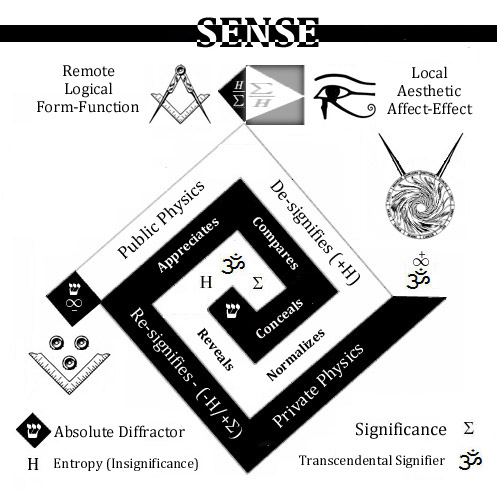
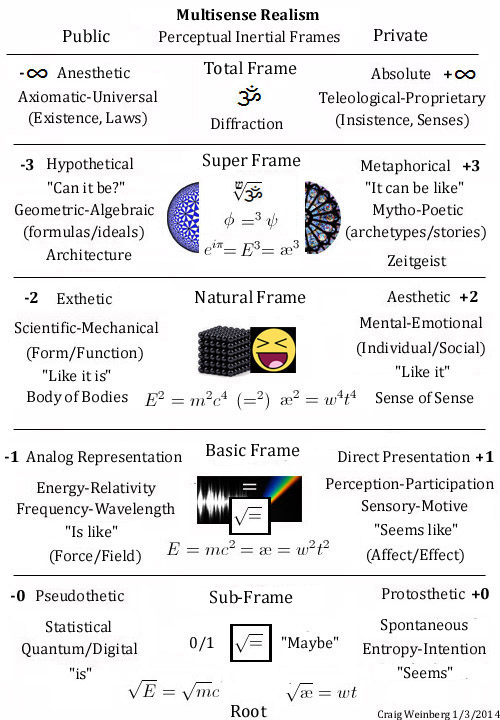
This square spiral logo is coming in handy, but my apologies if it is getting monotonous. This is an informal flow chart of what might be called cosmological metabolism. The interplay between H and Σ describe the catabolic and anabolic principles (Entropy and Significance). The idea here is that the primordial identity or principle behind everything is sense, and that through the alienation or diffraction of sense, followed by re-uniting, significance is gained.
Sense can be understood as accumulating from the bottom up, as complexity and sophistication of experience, and also as a splitting off from the Totality. Consciousness can be understood as a nesting of coincidence which accelerates itself. Time is a comparison of coincidences in which a logical distance is inferred, while space is presented as a logical context within which objects or forms coincide directly. Clock time, therefore is a spatialization of our inner experience – a masking of private, lifelong harmonics which are semantic and quasi-narrative. The gaps of time give structure to the autobiographical dream.
Sense bridges the gap between one time and another, across distance or separation, connecting public and private. Sense tears itself down so it can build improvement. Our public view of physics eradicates meaning inadvertently by hiding coincidence. Because sense is the primordial identity, coincidence can be thought of as the existential expression of what is essentially transformations of meaning and aesthetic quality. When we spread it out over space and time, it looks like coincidence, but if we keep spreading it out, it looks like unrelated incidents. The refinement of these unrelated incidents into generic, meaningless functions, is what is physics and math are about – however, because the nature of sense is self-reflective and self-revealing, the blueprint of its grandest coincidences can be seen, even in their absence.
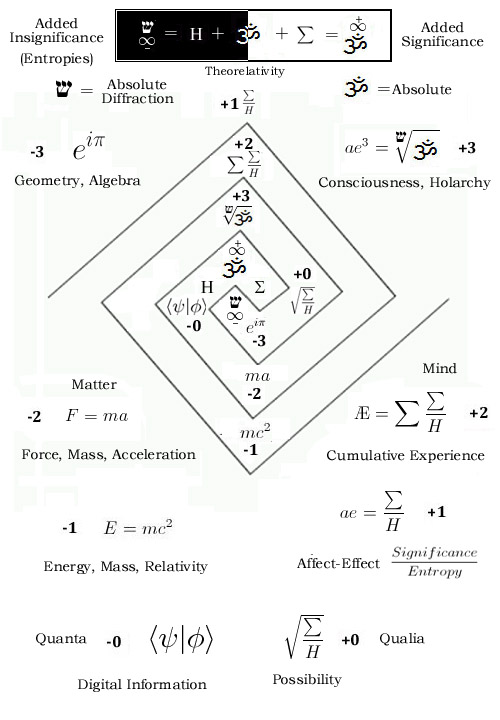
Physics as the Production of Realistic Fantasy and Fantastic Reality
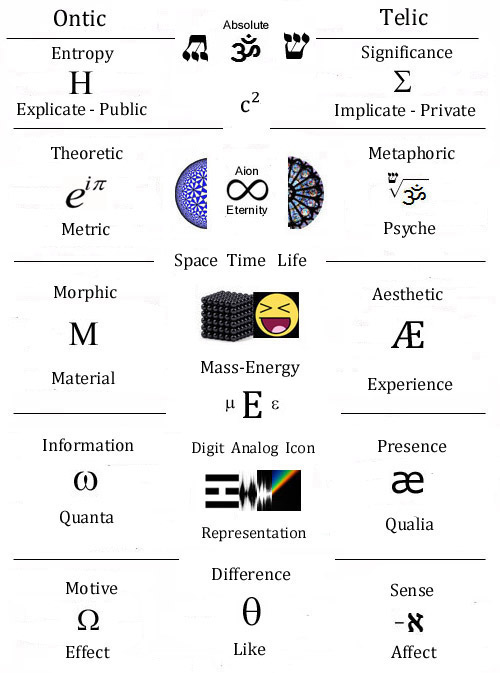
When working with private physics, the operators used are metaphorical and implicit, not explicit. Qualia is LIKE the “mass” of privacy. The will to will is like the “Energy” of privacy, and realism is like the “c²”. In my understanding, the notion that c is the speed of light is really a legacy understanding – a pre-Relativity convention within Relativity. It makes more sense to me now that light just happens to be the fastest quality of sense that we have access to. The true nature of c is as the speed of sense, or experience itself. It is not a speed, but the absolute limit of velocity. The still-here-ness of the universe..
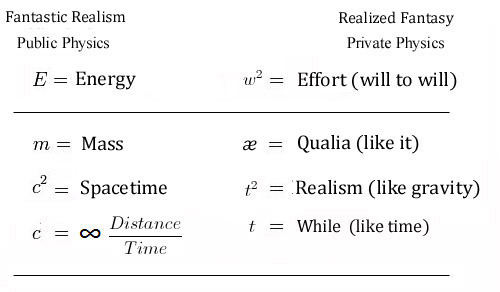
From an absolute view, quantified properties like mass, energy, and spacetime can be considered to be like reality but the only true reality is what experience is like. All conditions of the public universe are contingent upon an aesthetic palette, otherwise it would be implausible that any such palette could exist.
Private physics and public physics provide two different senses or fantasy, and two different senses of reality. Human experience is fantastically rich in an aesthetic sense and fundamentally real because it is the source of our participation in the universe. Our experience of the non-human universe is fantastic in the sense of its overwhelming magnitude and complexity, Its reality is persistent and reliable.
If we are serious about our science, we should consider that being overwhelmed by grandeur is a human experience which reflects the disparity in physical scale between us and the larger exteriority. The Public universe by itself would have no such feeling of grandeur, but what we feel about the inaccessible vastness of the cosmos is equaled by the vast inaccessibility of feeling by public physics.
Something else that has come up through this recent addition of physics to MSR, is the idea that Gravity is time squared, and that time is the square root of gravity. This makes sense to me, if we are talking about the equivalent conjugates of c² and t² as pubic spacetime and private realism. It should work out that Spacetime = the public shadow of Realism, and therefore Spacetime is literally Gravity and Realism is literally figuratively Gravity, as in the grave, serious nature of experience. If c is the constancy of distance and time coordinates, c² is the gravity which warps them from within.
A Formula for Qualia
To derive the formula for qualia or sensory affect, solve the Hard Problem of Consciousness, and bridge the Explanatory gap, I suggest that we try converting the mass-energy equivalence E=mc² from the public orientation and transpose it inward to the private orientation.
Energy (E) becomes w² which is “was and will be” (w = was or will be)
The Speed of light (c) becomes t = time = (still or never) = now or realism
Light* (c²) becomes t² “still and never again” or “stereo realism of now”
Mass (M) becomes æ = qualia = “like it”
Qualia = “like it was and will be, still and never again” =

another wording
Qualia = “Eternally signifies its past and future now”
This is about what Milan Kundera called The Unbearable Lightness of Being. That our experience of the universe is either perpetually suspended above the paradox of an existence which is both perpetually vanishing forever in some sense and repeating forever in another. If c is the still ‘speed’ of here and now, then c² is the acceleration of here and now, the enrichment of the local now through the collective presence and absence of eternity
- Motive effect or will:
To derive will or motive: 
If qualia is “like it”, then square root of æ is what joins and divides the ‘like’ and the ‘it’. It is the dipole charge of ‘liking’ and ‘it-ing’ which we call desire or preference. The greater the liking, the more significance is projected onto the object, which is the imagined realization of a goal in time. Intention projects into the future, builds, and guides qualia.
Will = “(Maybe, or maybe not)(now or never)” = w = √æ t
Turning the private translation outward to Public/Western psychology so that interiority is undersignified as emergent epiphenomena, we get:
= Experience is simply what may and may not be happening for some time.
and
= Choosing = Right or wrong this time
The public-facing view of privacy reduces it to information processing. To those who have a private-facing view this is a flat and inadequate characterization. The former view is optimized for realizing spatial intelligence while the latter is optimized for appreciating timeless wisdom.
- Quality and Equality
Since qualia is about likeness and local equivalents, it can be said that qualia equals the differential between equality and all inequalities... æ = ‘d=’.

The kicker is that since equality is itself a quale (the spelling of e-quality is a clue), we can conceive of ‘=’ as quality which is externalized**, i.e. the differential is collapsed and the entire range of what it “is like” is interpreted as what “it actually is”. The Western-facing mind naturally prefers that which only tells it ‘like it is‘, so that public physics and information science will filter out as noise all that tries to tell ‘what it is like‘ (paging Ludwig Wittgenstein…). This commercialization of residential qualities has had many benefits, but it is a philosophy which has blinded itself, and intimidated many into ignoring the true nature of consciousness. It’s not anyone’s fault, it’s how private physics works. It’s how sense is made.
*The speed of light is c, but c², if taken literally, can be understood as light itself, reality, or making sense: producing stereo (solid) realism.
**Physically publicized, cropped, framed, stereotyped, commercialized, hardened to endure against the changing feelings that make up private time.
 Multisense Realism
Recent Comments