Archive
Is Time an Infinite Set of Moments?
…or is the whole notion of an infinite set a paradox?
Since a set is by definition a defining of a boundary, whenever we talk about sets which are infinite we are talking about a boundary containing unbounded contents. Such a boundary makes it necessary that boundary-making itself is presumed to be outside of things being bound, i.e. it is taken as axiomatic that boundary making is part of a theory which does not change anything except our own understanding.
Things get murky however, when we consider time an infinite set. In Zeno’s Paradox of the Tortoise and Achilles, for example, the idea of an infinite set is used to trick us into thinking that motion is impossible. The logic is that for something to move one unit of distance, it must first move an infinite number of smaller distances. We can reverse this logic, however, and say that to divide one distance into an infinite number of smaller distances in the first place would take an infinitely long time if we had to actually make those measurements in some way, provided each measurement takes a non-zero amount of time.
Here is the difference between the map and the territory. Actually moving across a distance is a ‘territory’; a concrete reality. The idea that there is some number of points in which could be measured along that distance is a theoretical abstraction. When we apply the abstraction of infinity to the reality of concrete phenomena, we get paradox. The tortoise’s lead appears to always be getting smaller and smaller, but is still a nonzero fraction of the total distance ahead of Achilles, no matter how much faster Achilles is. What distracts us is that we are taking our own measurement for granted. Yes, it’s true that each measurement at time t will find the tortoise ahead of Achilles if we keep giving the tortoise a fraction of his original head start after calculating Achilles position, but infinity doesn’t end at that measurement. Infinity means not only that there will always be a measurement where the tortoise is ahead, it also means that there will always be an interval after the measurement where Achilles overtakes the velocity challenged reptile. In short, an infinite set means that the set always will extend beyond itself.
The physical allegory of the infinite set is a universe of stars and galaxies which expands into an infinity of empty space. But can emptiness really envelope things or is it the expansion of things which exists on its own without any envelope? Is the assumption of empty space really a projection of our own intellectual expectations of set-making? I think that it is important to see that Einsteinian spacetime calculations would work the same either way. Spacetime need not be a literal container of mass-energy, if mass-energy is already entangled at superliminal rates. It makes it easy to think of General Relativity as referring to a spatiotemporal entity (a ‘reference mollusk’ as Einstein called it, or a Minkowski space), but the reality may be that spacetime is nothing more than the influence that the entangled consensus of mass-energetic relations has on itself. This way, no envelope of infinite emptiness is required around the Big Bang, and the vacuum can leave its quantum contents behind to revert to a true void. The vacuum energy gets turned inside out…it’s not inside of spacetime, it’s inside of relativity, i.e. universal perceptual entanglement.
Eastern and Western Eternity
If the Western view of time is an unlimited set of (limited) moments, then eternity is purely conceptual – the perpetually incomplete ‘set-hood’ of that set. The Western sense of eternity is also of perpetually filling itself with more and more clock ticks. Eastern mystics have promised instead that the fundamental truth of nature is the antithesis of that: A timeless connectedness of all things, or a universal connectability (The Force, Field, Love*, God) from which all ‘things’ are seemingly detached. Such a detachment is described as an illusion or temporary masking of underlying unity which remains eternal and pervasive. From the Eastern view, it is not space and time which contain all phenomena, but rather times and spaces are emergent dissociations within the grand phenomenality.
With the advent of General Relativity, the pendulum of Western thought began unknowingly to swing Eastward. Eternity came to be seen as a universal 4D manifold which distorts rates and lengths of physical processes. The distortions are understood to be relative to frames of reference; they are the ‘appearances’ of each frame to any other rather than a fixed physical property common to all frames. Frames themselves are, like the tortoise, given an unfair advantage of inheriting our ignorance of the nature of perception. Physics has attributed a frame-making capacity from a purely theoretical warrant, a warrant which magically acquires real powers of perceptual transformation (Lorentz contraction/dilation) which define the universe.
Some will complain that inertial or Galilean frames have nothing to do with perception, that they are tied only to linear velocity, however this takes velocity relations for granted in the same way that infinite sets take sets for granted. Here is where Relativity and QM completely agree. They both hinge on the concrete physical fact of measurement as the relation between properties such as space, time, position, and momentum. The measurement is a thing that separates the uncollapsed theoretical wave from the concrete wave-effects which are common to matter.
I submit that measurement itself is only the superficial way of understanding what is going on behind SR, GR, and QM. What makes measurement possible – all measurement – is an intrinsic relatability or sense which pervades all of physics. It is only parsimonious to assume at this point that this relatability is identical to the awareness which underlies our own conscious experience.
As it stands now, theoretical physics must resort to a kind of dualism where the idea of an ‘observer’ is somehow presumed separate from conscious observation. Any deviation from this premise is taboo and treated with antipathy. The Western imagination has been captured by positivism, so that all legitimate phenomena begin with an assumption of being separable from phenomenology. This unfortunately leaves phenomenology itself orphaned from physics, and the purest contents of conscious experience orphaned from legitimacy. We turn to the idea of “emergence” to reclaim some semblance of coherence, but emergence itself is no more physical or derivable from logic than consciousness itself.
Relativity applies to instantaneity as well as simultaneity.
To further bridge the Einsteinian notion of eternity with the Eastern one, I suggest a relativity of instantaneity. We can see from time lapse photography, for example, that different rates of exposure present nature at speeds of time. If we had nanobots we could surely step down our own body motions so that we could interact remotely with nanoscale objects at scales and speeds which would not be possible to us on the macro scale.
We can also see how the ocean appears to slow to a crawl when seen from the air. Interestingly, the trails that boats make in their wake appear to flow against a solid background of standing ocean waves.

In this photo you can’t see it, but next time you are flying over the water, notice how the narrow wake tracks which cross-cross the static ocean shimmer with movement. I’m curious about the physics of this – is it the distance of the plane or the speed which averages out the speed of water, and then the motion of the boat which makes some of the speed visible? Some kind of phase-cancellation?
It is this kind of transformation which I’m referring to as the relativity of instantaneity. The scope of the instant depends on perspective, and physics, having no preferred perspective, can have no way to define any separation between instants or any set which unites them. In this way, emergent properties themselves emerge from perception.
East vs West
I suspect that both views of time are reflections of the perspective from which they emerge. Eastern or Empathizing psychologies focus on the unity of categories in the category-making mind itself while Western, Systemizing modes focus on impersonal categories, the origin of which is seen as irrelevant. As the two modes have grown apart, they are no longer able to locate each other without distorting them into a straw man. The Western mind sees the Eastern view as an overestimation of our own presence (including the present moment) while the Eastern mind sees the fatal flaw of the Western effort to deflate the presence of the now and its presenter. Interestingly, the antipathy flips in the assignment of blame, with the Western skeptic taking personal umbrage at the individuals who they see as peddlers of ‘woo-woo’ superstition and postmodern ‘word salad’. By contrast, the Eastern mystic sees the Western resistance as a function of impersonal forces of spiritual immaturity. This dynamic of projection and inversion is a good place to study the lensing of consciousness. The model which I propose suggests that studying how people argue will show that fundamentalist positions on either side will have more in common with each other neurologically than there will be differences. From there we can begin to map the blind spot of the Western approach as it cascades down through academic policies, experiment design, and finally economics, and politics.
The Western approach is intrinsically bottom up in that it begins with a collection of external particulars and then extrapolates generalities and universal laws. Scientific thought is an analytic introspection which is intended to generate a synthetic ‘extraspection’. Our naive, introspective sense of the present time is as Edwin Schrodinger and Ken Wilber point out is “the only thing that has no end”. Meaning that we literally cannot locate within the present any beginning or ending. Only memories within the present which seem to explain things outside of the present can be found:
“We dissipate our energies in fantasy mists of memories and expectations, and thus deprive the living present of its fundamental reality and reduce it to a “specious present”, a slender present that endures a mere one or two seconds, a pale shadow of the eternal Present.”
-Ken Wilber, No Boundary
It seems clear to me that the Western view is dominated by the specific function of the intellect, which is to isolate problems and analyze them sequentially. Using the intellect to analyze itself, we conflate mental kinds of functions with nature in general and have learned to mistake this map of our own map-making for the territory. Because the Western mind identifies with itself rather than with the consciousness behind thought, it inverts our own existence into a ‘specious presence’. First an orphaned soul in an Enlightened machine, then a self-modeling semantic mechanism, the personal presence has now been so aggressively deflated that many insist that it has no existence at all.
If the Western view overlooks the magnitude of significance of the present in its modeling of time, the Eastern view overlooks the overwhelming influence of non-human scales of the present in the universe. The human scale of ‘now’ is overly preferred, so that the Western half of the universe, with its bottom up chains of causality, can be discounted irrationally (hence the woo-woo). This means that the vital and important contributions of science and technology can be dismissed by the Eastern approach, thus losing all credibility with Western thinkers. The sentiment that thoughts create reality is straw-manned to imply that human thoughts create all reality, when the truth is that human influence may be both more powerful and less powerful than we imagine.
Coming Together Over Time
I propose that the way to transcend the problematic notions of time in both the Western and Eastern modes is to see time as the “most common sense” through which eternity ‘pretends’ to be each moment, and how the eternal moment pretends to its own eachness. Time is what limits the unlimited and opens the limited to the possibility of the infinite.
Because the Western view of time has resulted in an all-but-insignificant present, it has contrived an all-but insignificant subjective conscious presence to act as an almost-disposable timekeeper. The ‘observer’ in physics is naught but a convergence of particular coordinates…coordinates which themselves are only defined by there own axiomatic coordination. The cosmos appears as an unorchestrated orchestration…an autoverse rather than universe.
The Eastern view inflates the present and the subjective presence to the absolute extreme, so that the cosmos appears as an unfalsifiably teleological monolith. This infuriates the Western mind, hearing soft-headed homilies of ‘There are no coincidences’ and ‘Everything happens for a reason’ to justify pre-scientific superstition. This would be a solipseverse rather than a universe – a universe which fits into single self. Monotheism splits the difference, with a Unisolipse – a single God self who is not us, but who is like us and can help us and care about us.
What I propose is that each of these models fall out naturally as reflections from a sense-based foundation. The true universe is an orchestration of (orchestration-unorchestration) of perceived qualities and conditions. A paratheistic or ambitheistic society of self-elaborating experiences.
*Love to me seems more human-centric or mammal-centric to me, but I think that Love could be better understood in this context as the most recent form of empathy or sense. Sense allows wholes and parts to partially disconnect and reconnect with the whole.
Prismandala
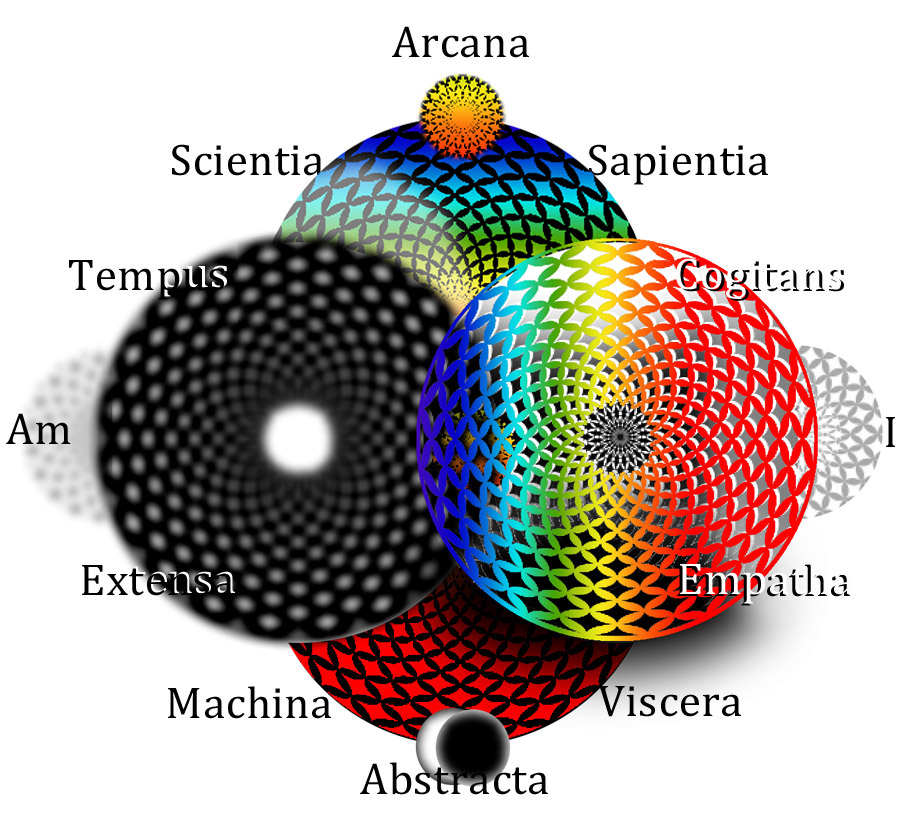
A quick and dirty key:
it’s an attempt at map of everything (a cosmogony?)
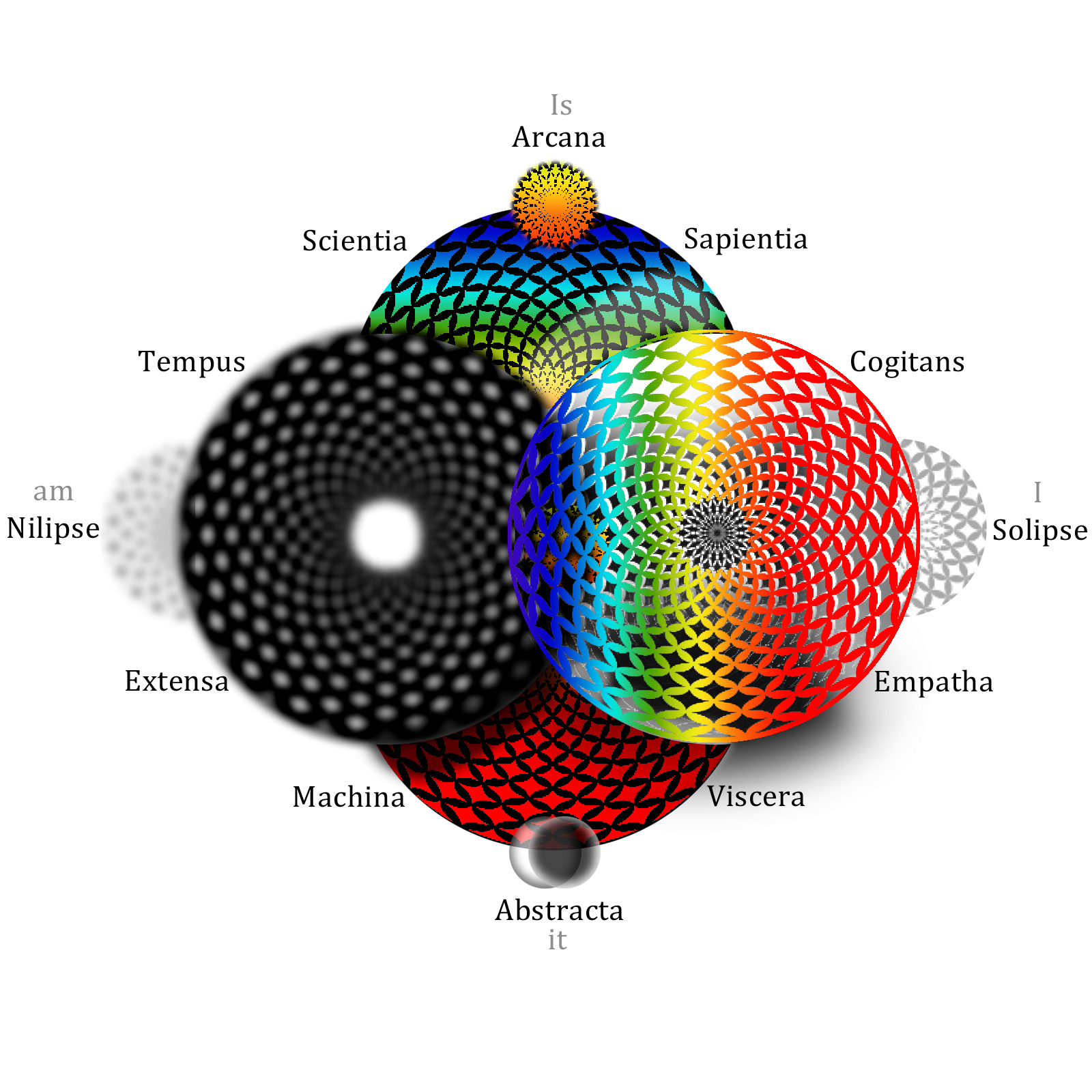
Starting with the I (right hand or far Eastern side). I is just regular old I. The local, personal self.
Above and below the I are Cogitans and Empatha, so thinking and feeling.
Above Cogitans is Sapientia: Wisdom. I could have gone with “Ari” or transpersonal, or mytho-poetic, psyche, etc. It’s reaching toward the zenith (Arcana) – the truth, the secret mysteries, God/Tao/Absolute, etc.
Below Empatha is Viscera: Visceral Sub-Personal urges and impulses. Freud called the Id. Cthonic influences.
Abstracta is pure, but meaningless logic. Quantitative relations. The unnatural.
Machina is the collapse into automaticity. It’s computation and mechanism.
Extensa is intended in more or less the same sense as the Cartesian Res Extensa – extended things, classical mechanics, Newtonian physics of matter and chemistry. It’s about 3D structures and their relations (space)
The Far Western/Left hand point is “Am”
This is the realm of the object perspective. When read left to right you get “Am I?” and from right to left “I am”.
Tempus is time as frequency of experienced events…their rise and fall and partial recycling. The machine’s fuel.
Scientia is Science, or Knowledge. The Western gnosis from the outside in. Theory and progress of civilization. The Eastern version, the Sapientia, is life wisdom…the wisdom of direct experience accumulated as inspiring ideas.
Final image tweak:
I Think Therefore I Am?
The only thing that can be verified 100% to exist is your own consciousness (“I think, therefore I am”) does this effect/change your own beliefs in any way and how so?
In a way it is true that our consciousness is the only thing that we can verify 100%, however, that way of looking at it may itself not be 100% verifiable. Since cognition is only one aspect of our consciousness, we don’t know if the way that ‘our’ consciousness seems to that part of ‘us’ is truly limited to personal experience or whether it is only the tip of the iceberg of consciousness.
The nature of consciousness may be such that it supplies a sense of limitation and personhood which is itself permeable under different states of consciousness. We may be able to use our consciousness to verify conditions beyond its own self-represented limits, and to do so without knowing how we are able to do it. If we imagine that our consciousness when we are awake is like one finger on a hand, there may be other ‘fingers’ parallel to our own which we might call our intuition or subconscious mind. All of the fingers could have different ways of relating to each other as separate pieces while at the same time all being part of the same ‘hand’ (or hand > arm >body).
With this in mind, Descartes’ cogito “I think therefore I am” could be re-phrased in the negative to some extent. The thought that it is only “I” who is thinking may not be quite true, and all of our thoughts may be pieces to a larger puzzle which the “I” cannot recognize ordinarily. It still cannot be denied that there is a thought, or an experience of thinking, but it is not as undeniable that we are the “I” that “we” think we are.
The modern world view is, in many ways, the legacy of Cartesian doubt. Descartes has gotten a bad rap, ironically due in part to the success of his opening the door to purely materialistic science. Now, after 400 years of transforming the world with technology, it seems prehistoric to many to think in terms of a separate realm of thoughts which is not physical. Descartes does not have the opportunity to defend himself, so his view is an easy target – a straw man even. When we update the information that Descartes had, however, we might see that Cartesian skepticism can still be effective.
Some things which Descartes didn’t have to draw upon in constructing his view include:
1) Quantum Mechanics – QM shifted microphysics from a corpuscular model of atoms to one of quantitative abstractions. Philosophically, quantum theory is ambiguous in both its realism/anti-realism and nominalism/anti-nominalism. Realism starts from the assumption that there are things which exist independently of our awareness of them, while nominalism considers abstract entities to be unreal.
- Because quantum theory is the base of our physics, and physics precedes our biology, quantum mechanics can be thought of as a realist view. Nature existed long before human consciousness did, and nature is composed of quantum functions. Quantum goes on within us and without us.
- Because quantum has been interpreted as being at least partially dependent on acts of detection (e.g. “Experiment confirms quantum theory weirdness”), it can be considered an anti-realist view. Unlike classical objects, quantum phenomena are subject to states like entanglement and superposition, making them more like sensory events than projectiles. Many physicists have emphatically stated that the fabric of the universe is intrinsically participatory rather than strictly ‘real’.
- Quantum theory is nominalist in the sense that it removes the expectation of purpose or meaning in arithmetic. “Shut up and calculate.” is a phrase* which illustrates the nominalist aspects of QM to me; the view is that it doesn’t matter whether these abstract entities are real or not, just so long as they work.
- Quantum theory is anti-nominalist because it shares the Platonic view of a world which is made up of perfect essences – phenomena which are ideal rather than grossly material. The quantum realm is one which can be considered closer to Kant’s ‘noumena’ – the unexperienced truth behind all phenomenal experience. The twist in our modern view is that our fundamental abstractions have become anti-teleogical. Because quantum theory relies on probability to make up the world, instead of a soul as a ghost in the material machine, we have a machine of ghostly appearances without any ghost.
To some, these characteristics when taken together seem contradictory or incomprehensible…mindless mind-stuff or matterless matter. To others, the philosophical content of QM is irrelevant or merely counter-intuitive. What matters is that it makes accurate predictions, which makes makes it a pragmatic, empirical view of nature.
2) Information Theory and Computers
The advent of information processing would have given Descartes something to think about. Being neither mind nor matter, or both, the concept of ‘information’ is often considered a third substance or ‘neutral monism’. Is information real though, or is it the mind treating itself like matter?
Hardware/software relation
This metaphor gets used so often that it is now a cliche, but the underlying analogy has some truth. Hardware exists independently of all software, but the same software can be used to manipulate many different kinds of hardware. We could say that software is merely our use of hardware functions, or we could say that hardware is just nature’s software. Either way there is still no connection to sensory participation. Neither hardware nor software has any plausible support for qualia.
Absent qualia
Information, by virtue of its universality, has no sensory qualities or conscious intentions. It makes no difference whether a program is executed on an electronic computer or a mechanical computer of gears and springs, or a room full of people doing math with pencil and paper. Information reduces all descriptions of forms and functions to interchangeable bits, so the same information processes would have to be the same regardless of whether there were any emergent qualities associated with them. There is no place in math for emergent properties which are not mathematical. Instead of a ‘res cogitans’ grounded in mental experience, information theory amounts to a ‘res machina’…a realm of abstract causes and effects which is both unextended and uninhabited.
The receding horizon of strong AI
If Descartes were around today, he might notice that computer systems which have been developed to work like minds lack the aesthetic qualities of natural people. They make bizarre mistakes in communication which remind us that there is nobody there to understand or care about what is being communicated. Even though there have been improvements in the sophistication of ‘intelligent’ programs, we still seem to be no closer to producing a program which feels anything. To the contrary, when we engage with AI systems or even CGI games, there is an uncanny quality which indicates a sterile and unnatural emptiness.
Incompleteness, fractals, and entropy
Gödel’s incompleteness theorem formalized a paradox which underlies all formal systems – that there are always true statements which cannot be proved within that system. This introduces a kind of nominalism into logic – a reason to doubt that logical propositions can be complete and whole entities. Douglas Hofstadter wrote about strange loops as a possible source of consciousness, citing complexity of self-reference as a key to the self. Fractal mathematics were used to graphically illustrate some aspects of self-similarity or self-reference and some, like Wai H Tsang have proposed that the brain is a fractal.
The work of Turing, Boltzmann, and Shannon treat information in an anti-nominalist way. Abstract data units are considered to be real, with potentially measurable effects in physics via statistical mechanics and through the concept of entropy. The ‘It from Bit’ view described by Wheeler is an immaterialist view that might be summed up as “It computes, therefore it is.”
3) Simulation Triumphalism
Disneyland
When Walt Disney produced full length animated features, he employed the techniques of fine art realism to bring completely simulated worlds to life in movie theaters. For the first time, audiences experienced immersive fantasy which featured no ‘real’ actors or sets. Disney later extended his imaginary worlds across the Cartesian divide to become “real” places, physical parks which are constructed around imaginary themes, turning the tables on realism. In Disneyland, nature is made artificial and artifice is made natural. Audioanimatronic robots populate indoor ‘dark rides’ where time can seem to stop at midnight even in the middle of a Summer day.
Video games
The next step in the development of simulacra culture took us beyond Hollywood theatrics and naturalistic fantasy. Arcade games featured simulated environments which were graphically minimalist. The simulation was freed from having to be grounded in the real world at all and players could identify with avatars that were little more than a group of pixels.
Video, holographic, and VR technologies have set the stage for acceptance of two previously far-fetched possibilities. The first possibility is that of building artificial worlds which are constructed of nothing but electronically rendered data. The second possibility is that the natural world is itself such an illusion or simulation. This echoes Eastern philosophical views of the world as illusion (maya) as well as being a self-reflexive pattern (Jeweled Net of Indra). Both of these are suggested by the title of the movie The Matrix, which asks whether being able to control someone’s experience of the world means that they can be controlled completely.
The Eastern and Western religious concepts overlap in their view of the world as a Matrix-like deception against a backdrop of eternal life. The Eastern view identifies self-awareness as the way to control our experience and transcend illusion, while the Abrahamic religions promise that remaining devoted to the principles laid down by God will reveal the true kingdom in the afterlife. The ancients saw the world as unreal because the true reality can only be God or universal consciousness. In modern simulation theories, everything is unreal except for the logic of the programs which are running to generate it all.
4) Relativity
Einstein’s Theory of Relativity went a long way toward mending the Cartesian split by showing how the description of the world changes depending upon the frame of reference. Previously fixed notions of space, time, mass, and energy were replaced by dynamic interactions between perspectives. The straight, uniform axes of x,y,z, and t were traded for a ‘reference-mollusk’ with new constants, such as the spacetime interval and the speed of light (c). The familiar constants of Newtonian mechanics, and Cartesian coordinates were warped and animated against a tenseless, Non-Euclidean space with no preferred frame of reference.
Even before quantum mechanics introduced a universe built on participation, Relativity had punched a hole in the ”view from nowhere’ sense of objectivity which had been at the heart of the scientific method since the 17th century. Now the universe required us to pick a point within spacetime and a context of physical states to determine the appearance of ‘objective’ conditions. Descartes extended substance had become transparent in some sense, mimicking the plasticity and multiplicity of the subjective ‘thinking substance’.
5) Neuroscience
Descartes would have been interested to know that his hypothesis of the seat of consciousness being the pineal gland had been disproved. People have had their pineal glands surgically removed without losing consciousness or becoming zombies. The advent of MRI technology and other imaging also has given us a view of the brain as having no central place which acts as a miniature version of ourselves. There’s no homunculus in a theater looking out on a complete image stored within the brain. There is also no hint of dualism in the brain as far as a separation between how and where fantasy is processed. To the contrary, all of our waking experiences seamlessly fuse internal expectations with external stimuli.
Neuroscience has conclusively shattered our naive realism about how much control we have over our own mind. Benjamin Libet’s showed that by the time we think that we are making a decision, prior brain activity could be used to predict what the decision would be. With perceptual tests we have shown that our experience of the real world not only contains glaring blind spots and distortions but that those distortions are masked from our direct inspection. Perception is incomplete, however that is no reason to conclude that it is an illusion. We still cannot doubt the fact of perception, only that in a complex kind of perception that a human being has, there are opportunities for conflicts between levels.
Neuroscientific knowledge has also opened up new appreciation for the mystery of consciousness. Some doctors have studied Near Death Experiences and Reincarnation reports. Others have talked about their own experiences in terms which suggest a more mystical presence of universal consciousness than we have imagined. Slowly the old certainties about consciousness in medicine are being challenged.
6) Psychology
Psychology has developed a model of mental illness which is natural rather than supernatural. Conditions such as schizophrenia and even depression are diagnosed and treated as neurological disorders. The use of brain-change drugs, both medically and recreationally has given us new insights into the specificity of brain function. Modern psychology has questioned earlier ideas such as Freud’s Id, Ego, and Superego, and the monolithic “I” before that so that there are many neurochemical roles and systems which contribute to making “us”.
To Decartes’ Cogito, the contemporary psychologist might ask whether the I refers to the sense of an inner voice who is verbalizing the statement, or to the sense of identification with the meaning of the concept behind the words, etc.
In all of the excitement of mapping mental symptoms to brain states, some of the most interesting work in psychology have languished. William James, Carl Jung, Piaget, and others presented models of the psyche which were more sympathetic to views of consciousness as a continuum or spectrum of conscious states. By shifting the focus away from first hand accounts and toward medical observation, some have criticized the neuroscientific influence on psychology as a pseudoscience like phrenology. The most important part of the psyche is overlooked, and patients are reduced to sets of correctable symptoms.
7) Semiotics
Perhaps the most underappreciated contribution on this list is that of semioticians such as C.S. Peirce and de Saussure. Before electronic computing was even imagined, they had begun to formalize ideas about the relation between signs and what is signified. Instead of a substance dualism of mind and matter, semiotic theories introduced triadic formulations such as between signs, objects, and concepts.
Baudrillard wrote about levels of simulation or simulacra, in which a basic reality is first altered or degraded, then that alteration is masked, then finally separated from any reality whatsoever. Together, these notions of semiotic triads and levels of simulation can help guide us away from the insolubility of substance dualism. Reality can be understood as a signifying medium which spans mind-like media and matter-like media. Sense and sense-making can be reconciled without inverting it as disconnected ‘information’.
8) Positivism & Post-Modernism
The certainty which Descartes expressed as a thinker of thoughts can be seen to dissolve when considered in the light of 20th century critics. Heavily criticized by some, philosophers such as Wittgenstein, Derrida, and Rorty continue to be relevant to undermining the incorrigibility of consciousness. The Cogito can be deconstructed linguistically until it is meaningless or nothing but the product of the bias of language or culture. Under Wittgenstein’s Tractatus, the Cogito can be seen as a failure of philosophy’s purpose in clarifying facts, thereby deflating it to an empty affirmation of the unknowable. Since, in his words “Whereof one cannot speak, thereof one must be silent.” we may be compelled to eliminate it altogether.
What logical positivism and deconstructivism does with language to our idea of consciousness is like what neuroscience does through medicine; it demands that we question even the most basic identities and undermines our confidence in the impartiality of our thoughts. In a sense, it is an invitation for a cross-examination of ourselves as our own prosecution witness.
Wilfrid Sellars attack on the Myth of the Given sees statements such as the Cogito as forcing us to accept a contradiction where sense-datum (such as “I think”) are accepted as a priori facts, but justified beliefs (“therefore I am”) have to be acquired. How can consciousness be ‘given’ if understanding is not? This would seem to point to consciousness as a process rather than a state or property. This however, fails to account for lower levels of consciousness which might be responsible for even the micro level processing.
In my view , logic and language based arguments against the incorrigibility fail because they overlook their own false ‘given’, which is that symbols can literally signify reality. In fact, symbols have no authority or power to provide meaning, but instead act as a record for those who intend to preserve or communicate meaning.
An updated Cogito
“I think, therefore I am at least what a thinker thinks is a thinker.”
Rather than seeing Cartesian doubt as only a primitive beginning to science, I think it makes sense to try to pick up where he left off. By adding the puzzle pieces which have been acquired since then, we might find new respect for the approach. Relativism itself may be relative, so that we need not be compelled to deconstruct everything. We can consider that our sense of deconstruction and solipsism as absurd may be well founded, and that just because our personal intuition is often flawed does not mean that kneejerk counter-intuition is any better.
With that in mind, is the existence of the “I” really any more dubious than a quark or a rainbow? Does it serve us to insist upon rigid designations of ‘real’ vs ‘illusion’ in a universe which has demonstrated that its reality is more like illusion? At the same time, does it serve us to deny that all experiences are in some sense ‘real’, regardless of their being ineffable to us now?
*attributed to David Mermin, Richard Feynman, or Paul Dirac (depending on who you ask)
How Does Human Consciousness Work?
How Does Human Consciousness Work? (Quora)
I have given up trying to explain why consciousness is not an emergent property and why emergence is incoherent when applied to consciousness, so this answer is only for readers who already understand that the eliminativist/materialist account of consciousness fails. This means that you understand that awareness cannot be something that physical objects do, or a quality that they have (panpsychism), or even that mind and matter are two parts of the same coin (dual aspect monism), but that all forms and functions, physical or logical, can only exist within a context of what might be called pansensitivity, or sensation-that-makes-sense. This is not to say that human consciousness is the center of the universe and that all phenomena must make sense to us, but that all phenomena must be present in some modality of detection and interaction. This can be understood rationally with no need of any empirical testing. All that is required is for us to play out the null hypothesis: If there is no possibility of any detection or interaction with phenomenon X, then phenomenon X is indiscernible from nothing at all.
The OP then, asking how human consciousness works, should be broken down into two separate parts:
1) How does awareness in general work?
2) How does human consciousness differ from awareness in general?
1) In consideration of the above, the ‘how’ of awareness becomes a metaphysical issue – it could be said even a meta-ontological issue. If awareness-in-general (or use my term pansensitivity) is the most primitive prerequisite for all phenomena in all possible universes, then we must retrain ourselves to stop looking for more primitive phenomena which compose awareness.
I think that we can say awareness is sensory-motive in nature. That is, there is a quality of passive perceiving and active participating which cannot be rationally done without. Even an atom or subatomic particle requires a context where its identity is made coherent in some way, where its presence is detected or can be inferred from some detection of its effects. In the absence of such a detection, again, there is no difference between such a particle and nothing at all. There is no context from which to derive that difference.
That doesn’t mean solipsism – it doesn’t mean that particles don’t exist unless we see them, but it does mean that the concept of ‘existence’ is incompatible with the existence of our own consciousness unless it is identical to detection/participation in some modality or context.
We need not posit a universal mind or God (although there is nothing that I am proposing which rules that out), only that existence itself in the absence of all perception is fantastically implausible given that 100% of what we know of the universe comes to us exclusively through perception. If the universe doesn’t need perception, then there would be no rational explanation for why some parts of the universe could evolve such a redundant and irrational feature to depend upon exclusively.
From this sensory-motive awareness-in-general, we can develop a hypothesis about how it divides and multiplies itself into different perceived forms and participatory functions. This entails performing a kind of Copernican inversion on our early 21st century* worldview, turning the outside (<matter>mass>energy>entropy>space) in, and the inside (pansense>sense<motive>significance>time) out. I don’t expect anyone to really understand that right away…it has taken me several years to put it together in those terms, but hopefully the general idea of the role that symmetry plays comes through. Suffice it to say, I think that how awareness works is that it plays with variations on itself using separation and reconnection on many levels at once. It’s very much like the view that has been a part of Eastern philosophy and Western mysticism for centuries, but with the important difference of plugging directly into modern models of physics and information.
As far as information goes, the sensory-motive primitive can be plugged into the medium-signal relation. Physics gives us a lot of these kinds of conjugates: surface-depth, electro-magnetism, space-time, mass-energy, etc, but when we are working with information and semiotics, we lose the concrete reality of sensation and substitute automatic, ideal abstractions of theoretical mechanics. Computer science and math do not concern themselves with how one number is able to add itself to another, only that there is a reliable result. Physics does focus on how phenomena interact, but not what those interactions actually are or what it is that is actually doing the interacting.
The Medium-Signal Relation
In a simple case of communication, two people might hold a string tight on opposite sides of a room and pull on the string once to indicate ‘yes/true/1’ and twice for ‘no/false/0’. In this case the string pulling, along with the tactile sensitivity of each person to detect the state of the string with their hands would be the medium. We can argue that behind that sensitivity is a lot of other cellular and molecular interaction, but that only pushes the medium down into the microphysical level of description. Even at the bottom, we still need some quantum-atomic sensitivity for any kind of basis of interaction to emerge (or diverge).
The combination of string pulling and any schema which is applied to the interpretation of those pulls would be the signal or sign. Many if not most people confuse ‘signals’ with the physical conditions (string pulling, neurons ‘firing’, semiconductors polarizing, etc), but a better understanding is that the signal is a semiotic interpretation; a conscious consideration of changing conditions within a sensory-motive medium.
Another metaphor that I like is brightness vs contrast. Brightness is the medium – if you have zero brightness there is nothing to see. Light, brightness, and the ability to see are, in the absolute sense, the same thing: a condition of awareness. Contrast stands in here for information or signal, which is a second-order relation of brightness and darkness. If you have no brightness, contrast doesn’t help, but if you do have brightness, then contrast allows many degrees of brightness and frequencies of its absorption to be presented simultaneously.
2) The difference between awareness in general and human consciousness is the incredible degree of elaboration, and the specific experiences which have shaped Homo sapiens. The degree of elaboration I’m referring to would be the number of steps from raw pansensitivity to particular subjective sense vs objectively distanced sense (matter-space), to organic molecules, to cells, to tissues, organs, animals, and vertebrates. The corresponding consciousness of such an elaborate chain of continuous world-crafting seems likely to be be appropriately rich and deep aesthetically. The base level sense and motive is enhanced by orders of magnitude to a heart wrenching, visceral level of participation.
I propose that the specific experiences which have shaped us individually and as a species lend our human consciousness its particular qualities. We share many qualities with other species – perhaps tender emotions with mammals, coarse emotions with reptiles, playful trickery with primates, etc. It’s all sourced in real experience over hundreds of millions of years. It is, in my view, very much like our individual psychology is shaped by our experience, and our families and societies are shaped by their histories. This is what makes human consciousness human, and this is why an AI cannot simulate who we are. A computer may copy the signals from the medium of our communications, or from the medium of neuroscience, but without the medium of the totality of human experience going all the way back to before the first life form, it will only be a kind of doll – an imitation of who we are cobbled together from what our brains are and how they behave.
*really legacy 20th century
Dreams, Reality, and the True North of Consciousness
For the materialist, dreams are nonsense. While the body rests, the brain performs housekeeping tasks which have the side effect of giving us hallucinations, and that’s it. If we want to know about consciousness, the materialist will say, we should study biology and evolution, not dreams.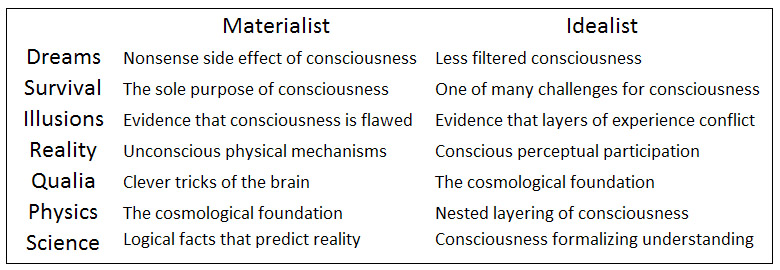
The materialist’s view of consciousness is that is a marvelously complex way for an animal’s body to adapt its behavior and control its environment. Consciousness is about what we do to the world and what it does to us. Things like optical illusions and the placebo effect tell us that the brain’s mental products are flawed since they fail to render reality as it is, but often wished or feared to be. To understand anything about nature as it really is, we can only use empirical, formal, consensus-building methods to tease out golden flecks of truth from the raw ore of our personal guesses and opinions.
For the idealist* consciousness need not inhere to a context of physical survival. Consciousness is not only about what we’re trying to do in the world, but is instead the very fabric of all possible worlds. I personally suspect that this means that consciousness of all sorts is not only pervasive in the universe, but that the universe is actually nothing but the collection of all conscious experiences. If there is anything beyond all forms of conscious experience, it is by definition, indistinguishable from nothing at all (since awareness of some kind is required to make and appreciate distinctions).
In this view, consciousness is not only about the survival of certain special animals, but is the necessary feature of nature to present itself and to participate in that presentation. Just as we do not expect a dead body to have experiences, neither should we expect physics to be able to define itself or function in the absence of all experience.
In idealism, dreams present at least the possibility of a purer sample of human awareness than waking consciousness. Because the psyche is free from contamination of the outside world, dreams would be a kind of control for our thought experiments about consciousness. For the idealist, dreaming should be the true North of consciousness. As Freud and then Jung found, dreams are overflowing with deep symbols and information which transcend personal experience.
In practice, dreams may have contamination of their own, and materialists may be appalled at the idea of treating consciousness most useless and bizarre extremities as the foundation for understanding, but the idealist understands that facts are facts, and the fact is that when we close our eyes and relax, consciousness reveals itself as a spontaneous world-maker, and that is an important fact to begin with. When we withdraw from the physical world, the psyche does not just disappear, it also creates new worlds, and it seems to create them on the fly, instantaneously, without optical illusions or placebo effects.
From here, in the dreamworld, we can see that color need not be wavelengths, and images need not be representations of something physical in the world. In the context of the dream, idealism is the physical reality. Qualia is matter. Any argument about this is a misunderstanding about what the word qualia means (which is common for materialists who may not be able to conceive of images and sounds independently of neurology and physics). If you never wake up from the dream, you will never encounter any part of your own brain or body as it exists in physical reality.
Once we accept that, as Bernardo Kastrup has said, “Materialism is baloney.”, we can move on to the deeper questions of what the universe of qualia is really all about, and whether our own place in it as humans is central or not. This is actually the more interesting level of metaphysics than the perennial argument at the gate between materialists and idealists. I’m using the terms subjective idealist and transcendental idealist here, but there may already be philosophical terms that are used academically.

As a transcendental idealist (aka multisense realist), I’m pretty much on my own. The materialists hate my view because they see it as vile woo, and the traditional idealists think I’m confused because I don’t accept the primacy of subjectivity in generating qualia as a necessary truth (although it may be an empirical fact). The picture that I’m looking at is a scientific one, but larger than science. It is a quasi-theistic or ambi-theistic one, but larger than theism. I do not see this as strictly philosophy, but a potentially actionable view of nature, complete with applications for the future of technology and for the rehabilitation of (what remains of) society.
*and here I’m presenting my own view as the example, not necessarily the most common views…likewise, the materialism column applies to non-material reductionism like computational mind theories.

Hyper-Mentalism and Supernatural Belief
This article from Psychology Today, Hyper-Mentalism, Hyper-Empathizing, and Supernatural Belief, talks about the diametric model’s explanation of the psychotic end of the autistic-psychotic spectrum.
“To use an analogy, the diametric model implies that we live in parallel mentalistic and mechanistic universes, with mental causality ruling the first and physical causality the second. Religious, superstitious, and magical thinking clearly represent an encroachment of the mental world on the real one in the form of belief in divine creation, miracles, the power of prayers and spells, and so on. Indeed, as I pointed out in an earlier post, you could see traditional religion and superstition as the result of a primeval mentalistic inflation which hyper-mentalized the real world, in part because mechanistic understanding of it in the form of modern science, medicine, and technology had not had time to develop. Furthermore, you could also see this as the paradigmatic historical case of a “combination of strong mentalizing coupled with poor understanding of the physical world.”
In my view, this is very close to the hypothesis that has been developed under the Multisense Continuum or ACME/OMMM model.

The diametric model deserves more attention, in my view, however I think that the assumptions behind the model are themselves biased toward the systemizing/mechanistic end of the spectrum. Note the language in the quote above: “Religious, superstitious, and magical thinking clearly represent an encroachment of the mental world on the real one“. Highly subjective states are identified as being intrinsically unreal rather than being an extension of nature and reality. The end of that quote shows another good example of the mechanistic worldview, associating superstition with “poor understanding of the physical world.” I would not deny that there are many people who do suffer from a poor understanding of the physical world and compensate for that to some extent with magical thinking, however, that correlation does not always hold true. Many people, such as myself, embrace the physical world and have an excellent understanding of it, yet see that behind and beyond mechanistic appearances are also more subtle natural phenomena. It is not that the psychotic is poorly equipped for reality, it is more like reality poorly equipped to contain psychotic hyper-sensitivities. This is not to say that paranoid schizophrenics are right about the content of their delusions, only that the form of paranoid delusions reflect (in a distorted way) the transpersonal territory of the psyche.
In the short article linked above, the author makes the distinction between his diametric model and “Simon Baron-Cohen’s rival scheme, which has systemizing versus empathizing instead of the diametric model’s mechanistic versus mentalistic cognitive dualism”. Here again, the distinction between empathizing and mentalistic is itself a mechanizing/systemizing distinction. Both the diametric model and empathizing-systemizing model label the ‘feminine’ side in terms of a personal function. The former sees empathy as a cognitive skill, while the latter seems to suggest that it is overdeveloped empathy which interferes with the correct application of cognitive skills. In both cases, the bias of contemporary academic science shows through: Extraordinary awareness which conflicts with consensus reality is a defect.
This bias is not surprising, nor is it even a negative if we are trying to get a handle on human psychology for purposes of treatment. The problem that I see, is that it closes the door on the deeper dimensions of psyche and fails to take seriously the implications of consciousness transcending classical physics. Once we do take a scientifically objective look at these implications, I think that we wind up with a theory of order and participation in the universe which is not limited to human psychology but extends beyond physics, information science, philosophy, and religion: A new scientific cosmology based on sense phenomena.

Leaving Space, Time, and Spacetime Behind
Are Space and Time an Illusion? Considered in this video:
- 1. Give up your intuitions of how space and time work.
- 2. Facts about observers (particles are considered observers):
- a. observers disagree on how much time passes between events.
- b. observers disagree on how much space there is between things at any given moment.
- c. observers don’t fully agree on the chronological order of events.
- d. observations are consistent so that no observer can be ‘wrong’.
- 3. Spacetime is emergent from a deeper objective reality of causality.
- a. all observers agree on spacetime interval
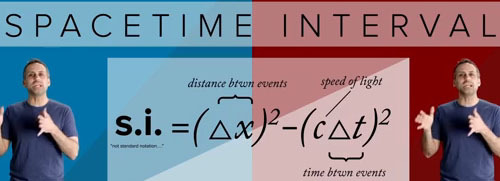
- b. Spacetime intervals tell us about which causes influence which effects.
- c. Causality is more objectively real than spacetime.
- d. Spacetime is a tenseless, Non-Euclidean 4D mathematical Minkowski space.
- e. Our intuitions of space and time are arbitrary and abstract.
- f. We are real, however, if we think of our entire lives as a fixed geometric object in spacetime rather than a moving window on the line segment of our life:
- a. all observers agree on spacetime interval
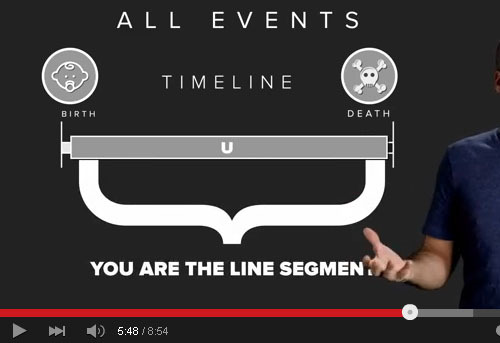
He begins to sum up at 6:03
“Imagine we’re all reading a flip book made of graph paper. We agree on the events of the story, but we don’t agree where they happen on the page, on how many pages there are between events, or even on the order of some of those events, and yet we’re all reading the same book…only there’s no graph on the paper, there are no pages, and there is no book. All of that is just an imposition our brains make in order to perceive whatever it is. So why do we perceive reality in such a vividly spatial and temporal way? Good question, No one really knows.”
At this point is where I jump up and raise my hand. I think that I might know the answer to that question:
The mistake being made in our sophisticated rewrite of naive intuition about space and time is that the constancy of the spacetime interval is due to an objective ‘same book’ (or bookless book or whatever we are supposed all be reading.) To go to the next step into multisense realism, we must not only give up our intuitions about space and time being different, but we must give up our counter-intuitions about spacetime being literal.
If we consider instead that there is no final Minkowski block time universe out there, no ‘same book’, or even same language out there, but rather a shared capacity to read/write, in here, then both the naive intuition and sophisticated counter-intuition makes sense as perspectives within a larger context. Not just in human experience, or even within particles or probability laws, but deeper than that.
In this new schema all is read/written beyond spacetime but still ‘within’. Within us as well as ‘within’ every kind of non-human experience. This pervasive context ‘within all awareness’ would be an absolute context which is pervasive and devoid of any formal sense of distance or time. An anti-void. This absolute frame of reference can be understood as sense itself (something like “ference” rather than reference): Direct participation of perceptual qualities that need not be realistic, but also extend to phenomena which we are familiar with as fiction, imagination, myth, etc.
This is not to say that human imagination could necessarily describe the entire continuum of sense, but like the visible spectrum is to electromagnetism, it defines a range which is a thin slice of the whole, but much more than merely one color. The one ‘color’, call it white, would correspond to the single combined sense of timeless, spaceless realism that is studied under math and physics, but is nevertheless bereft of aesthetic qualities such as emotion, flavor, or (other) colors.
All that has ever been experienced can be seen, in this absolute frame of reference to be ‘right here and right now’, but for our local inhibitory conditions of human limitation. From our human perspective there is a cost in making awareness so immense that it embraces all other partitions; it becomes unreal or fictional, delusional, supernatural, absurd, or accidental*. The ‘heavens’ are not only causally closed at one level of awareness, but on another, they open up to non-linear, surreal mythscapes with no temporal rooting but deep symbolic meaning.
Jung spoke of the collective unconscious, Australian aborigines refer to a primordial Dreamtime, and many a psychedelic explorer have reported such aesthetically saturated realms. Anthropologists find that it is very common for cultures to assume that children are born into this world from a dreamier, more divine kind of world. These shamanistic-psychotic surrealities need not be considered ‘real’, however neither can their surreality and flirtation with prophetic intuitions be dismissed as mere accident. Even as a kind of placebo effect, the transcendental levels of experience must be accounted for in any would-be-complete view of the universe.
There is a lot to understand about our own spectrum of consciousness before we can even begin to approach the totality of awareness, which may be an unbounded, or self-binding rather than a fixed continuum. Non-human states of awareness might be both ‘larger’ and ‘smaller’, faster and slower than we can conceive of. This conception of the totality of experience as beyond causality turns causality into a kind of ‘nozzle’ of spacetime. Causality focuses the ocean of creativity; interiorizing some and exteriorizing others into relative degrees (the ancestor of our ‘five senses’ in which, for example, feeling seems ‘closer to us’ than seeing).
The pieces of this puzzle of human consciousness can, in my estimation, reveal a kind of ‘red shift’ and ‘blue shift’ which can be thought of in human terms as the stereotypically** autistic and psychotic extremes of human consciousness.
To return to the video, the multisense realism view would add:
- 4. Nonlocal spacetime and “space ⊥ time” as (space and time in their naive, perpendicular local appearance) both emerge from a deeper common sense, which is trans-local.
- a. this common sense can be thought of as the capacity for sense itself, or rather, for the particular kind of worldly sense of causality and agreement, which we might call realism.
- b. realism is a common, but not exclusively common sense but is the reflection of an even more fundamental sense, which is novel and unprecedented rather than probabilistic or determined by laws.
- c. the common sense of realism divides experience mechanistically and unintentionally
- d. the uncommon sense beyond realism multiplies intentionally, seeking and building significance.
- e. what we call causality is itself caused. Our distanced observations of realism is a kind of low-res substitute or icon that carries some semblance of the totality, but in an aesthetically neutralized, minimalistic form.
- f. by using the built in, self-organizing clues of nature, we can begin to see how the holographic universe must be extended to include our own ‘visible spectrum’.
- 5. The agreement of the Spacetime Interval is not evidence of a rigid body of 4D absolute reality, but rather evidence of the potential for agreement itself, i.e. the revelation of underlying local sensory unity with distant sensory conditions.
- a. this is what the constancy of light speed and gravity are ‘really about’: not photons or forces, but ordinary sensory experience in self-diffraction.
- b. light is not a particle or a wave, it is a local sensation on the cusp of spacetime emergence. Light is local sensation, and sensation is a boundary condition within sense.
- c. this means that sensation is more of a temporary subtraction from the eternal than an isolated piece of information.
- d. the extremes of human consciousness should be seen as a richer, more significant version of a guiding theme in all of sense: that of psychotic-unpredictable-figurative entropy and autistic-static-literal information.
- e. the phenomenon of seeing can be used metaphorically to begin to understand these extremes, as well as ordinary experiences of common sense, by working with the idea of language as a gravitational lensing in which the light of sense is bent by local accumulations of significance (mass).
- 6. Paradoxically, what all observers agree on is their potential for agreement and fact of their own disagreement.
- a. We can reclaim our naive intuitions about space and time being different, as this perpendicular aesthetic is an accurate reflection of our own subjective tunnel through eternity.
- b. We can claim the Minkowski counter-intuition as a brilliant, and useful creation myth which is derived from common insensitivity, rather than common sense.
This is way too much to take in all at once (even for me), and I have no doubt that it sounds crazy to most people (that too is part of the Lorentz-like contractions and dilatations of sense-making). This is only the very tip of the iceberg…just something to get down in writing…for now.
*Whether the out-of-range portions of the spectrum of sense appear to be insane, error, or divine depends upon the frame of reference from which they are experienced.
**not talking about real people who demonstrate autistic or psychotic symptoms, but the themes exposed by the stereotyping of those symptoms, some of which are being researched under Imprinted Brain Theory.
 Multisense Realism
Recent Comments