Archive
Square Spiral Diagram
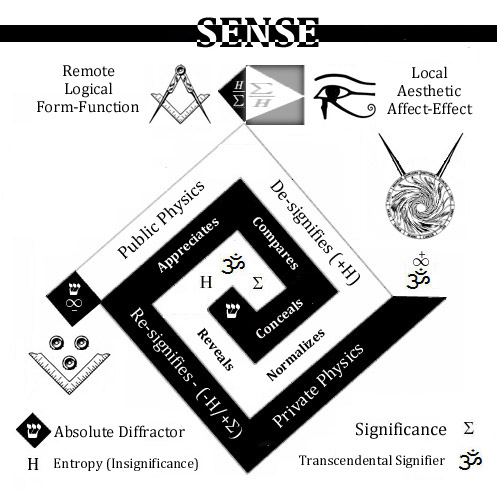
This square spiral logo is coming in handy, but my apologies if it is getting monotonous. This is an informal flow chart of what might be called cosmological metabolism. The interplay between H and Σ describe the catabolic and anabolic principles (Entropy and Significance). The idea here is that the primordial identity or principle behind everything is sense, and that through the alienation or diffraction of sense, followed by re-uniting, significance is gained.
Sense can be understood as accumulating from the bottom up, as complexity and sophistication of experience, and also as a splitting off from the Totality. Consciousness can be understood as a nesting of coincidence which accelerates itself. Time is a comparison of coincidences in which a logical distance is inferred, while space is presented as a logical context within which objects or forms coincide directly. Clock time, therefore is a spatialization of our inner experience – a masking of private, lifelong harmonics which are semantic and quasi-narrative. The gaps of time give structure to the autobiographical dream.
Sense bridges the gap between one time and another, across distance or separation, connecting public and private. Sense tears itself down so it can build improvement. Our public view of physics eradicates meaning inadvertently by hiding coincidence. Because sense is the primordial identity, coincidence can be thought of as the existential expression of what is essentially transformations of meaning and aesthetic quality. When we spread it out over space and time, it looks like coincidence, but if we keep spreading it out, it looks like unrelated incidents. The refinement of these unrelated incidents into generic, meaningless functions, is what is physics and math are about – however, because the nature of sense is self-reflective and self-revealing, the blueprint of its grandest coincidences can be seen, even in their absence.
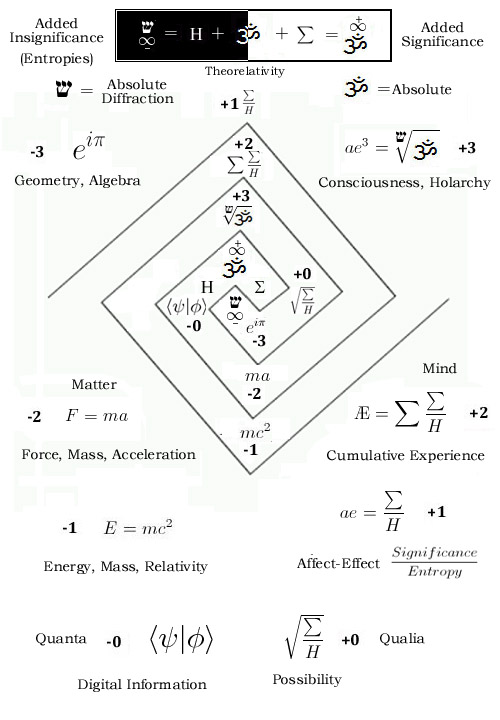
Physics as the Production of Realistic Fantasy and Fantastic Reality
When working with private physics, the operators used are metaphorical and implicit, not explicit. Qualia is LIKE the “mass” of privacy. The will to will is like the “Energy” of privacy, and realism is like the “c²”. In my understanding, the notion that c is the speed of light is really a legacy understanding – a pre-Relativity convention within Relativity. It makes more sense to me now that light just happens to be the fastest quality of sense that we have access to. The true nature of c is as the speed of sense, or experience itself. It is not a speed, but the absolute limit of velocity. The still-here-ness of the universe..
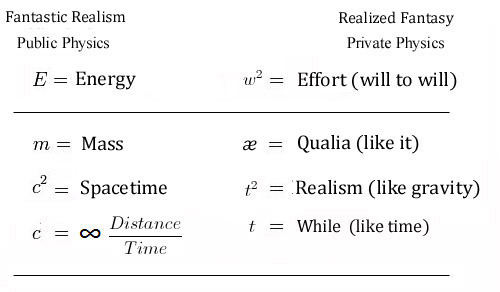
From an absolute view, quantified properties like mass, energy, and spacetime can be considered to be like reality but the only true reality is what experience is like. All conditions of the public universe are contingent upon an aesthetic palette, otherwise it would be implausible that any such palette could exist.
Private physics and public physics provide two different senses or fantasy, and two different senses of reality. Human experience is fantastically rich in an aesthetic sense and fundamentally real because it is the source of our participation in the universe. Our experience of the non-human universe is fantastic in the sense of its overwhelming magnitude and complexity, Its reality is persistent and reliable.
If we are serious about our science, we should consider that being overwhelmed by grandeur is a human experience which reflects the disparity in physical scale between us and the larger exteriority. The Public universe by itself would have no such feeling of grandeur, but what we feel about the inaccessible vastness of the cosmos is equaled by the vast inaccessibility of feeling by public physics.
Something else that has come up through this recent addition of physics to MSR, is the idea that Gravity is time squared, and that time is the square root of gravity. This makes sense to me, if we are talking about the equivalent conjugates of c² and t² as pubic spacetime and private realism. It should work out that Spacetime = the public shadow of Realism, and therefore Spacetime is literally Gravity and Realism is literally figuratively Gravity, as in the grave, serious nature of experience. If c is the constancy of distance and time coordinates, c² is the gravity which warps them from within.
A Formula for Qualia
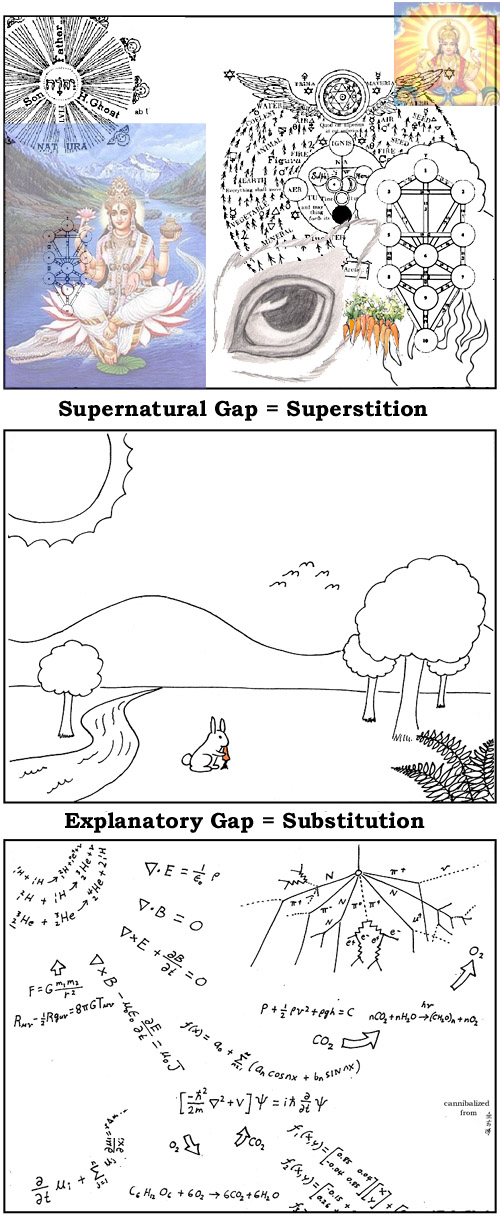
To derive the formula for qualia or sensory affect, solve the Hard Problem of Consciousness, and bridge the Explanatory gap, I suggest that we try converting the mass-energy equivalence E=mc² from the public orientation and transpose it inward to the private orientation.
Energy (E) becomes w² which is “was and will be” (w = was or will be)
The Speed of light (c) becomes t = time = (still or never) = now or realism
Light* (c²) becomes t² “still and never again” or “stereo realism of now”
Mass (M) becomes æ = qualia = “like it”
Qualia = “like it was and will be, still and never again” =

another wording
Qualia = “Eternally signifies its past and future now”
This is about what Milan Kundera called The Unbearable Lightness of Being. That our experience of the universe is either perpetually suspended above the paradox of an existence which is both perpetually vanishing forever in some sense and repeating forever in another. If c is the still ‘speed’ of here and now, then c² is the acceleration of here and now, the enrichment of the local now through the collective presence and absence of eternity
- Motive effect or will:
To derive will or motive: 
If qualia is “like it”, then square root of æ is what joins and divides the ‘like’ and the ‘it’. It is the dipole charge of ‘liking’ and ‘it-ing’ which we call desire or preference. The greater the liking, the more significance is projected onto the object, which is the imagined realization of a goal in time. Intention projects into the future, builds, and guides qualia.
Will = “(Maybe, or maybe not)(now or never)” = w = √æ t
Turning the private translation outward to Public/Western psychology so that interiority is undersignified as emergent epiphenomena, we get:
= Experience is simply what may and may not be happening for some time.
and
= Choosing = Right or wrong this time
The public-facing view of privacy reduces it to information processing. To those who have a private-facing view this is a flat and inadequate characterization. The former view is optimized for realizing spatial intelligence while the latter is optimized for appreciating timeless wisdom.
- Quality and Equality
Since qualia is about likeness and local equivalents, it can be said that qualia equals the differential between equality and all inequalities... æ = ‘d=’.

The kicker is that since equality is itself a quale (the spelling of e-quality is a clue), we can conceive of ‘=’ as quality which is externalized**, i.e. the differential is collapsed and the entire range of what it “is like” is interpreted as what “it actually is”. The Western-facing mind naturally prefers that which only tells it ‘like it is‘, so that public physics and information science will filter out as noise all that tries to tell ‘what it is like‘ (paging Ludwig Wittgenstein…). This commercialization of residential qualities has had many benefits, but it is a philosophy which has blinded itself, and intimidated many into ignoring the true nature of consciousness. It’s not anyone’s fault, it’s how private physics works. It’s how sense is made.
*The speed of light is c, but c², if taken literally, can be understood as light itself, reality, or making sense: producing stereo (solid) realism.
**Physically publicized, cropped, framed, stereotyped, commercialized, hardened to endure against the changing feelings that make up private time.
Tessellated Relativity
Whether it is material movement across space or sensory excitement through time, energy must always be a verb. We call it force or work, but that is a shortcoming of the Western fetish for nouns. Really, in my view all energy must be a *forcing* or *working* verb. While I fully appreciate the accusation that this is naive realism, I suggest that this is a foundational symmetry which can be inverted only for figurative purposes. No real energy should be considered noun-like, and all standard model visualizations which contradict this should be regarded as unreal. For this reason, I think that the assumption of the photon as an entity is an obstacle to rehabilitating the standard model to one which integrated the physics of privacy. In an ironic twist, we will have to re-educate ourselves to get used to the idea that the qualia of light and color is real, and photons are imaginary descriptions from an impossible frame of reference (the voyeur public subject).
What are the consequences of energy like? Radiance. Flow. Waves. What are waves? Either a frequency through time or a repeating shape across space. We know, however, that we don’t see photons as oscillating shapes, we see them as a shining, glowing, reflecting, or gleaming in our vision or a warming or burning in our feeling. That’s all about time. Looking at the sun, the intensity increases over time as our retina becomes more and more stimulated. The same is not true of mass. Mass ‘just sits there’ at some position in space. Unlike looking at the sun, the intensity of mass does not increase by itself over time, but rather it increases inversely to distance through space (gravity).
In a post energy particle model, mass and energy modify structures (matter in space) and qualify experiences (sensation through time), and are not free standing quantities emerging from a vacuum. Mass is convergent on a point within a structure, and energy is divergent from c (non-space, non-time) as a frequently recurring stimulus. I was thinking of calling this module of MSR “Tessellated Relativity”, as the inertial frames swing spacemass-ward and time-energyward, yielding the position v momentum exclusivity.
If that’s all true – and I think that it might be on the right track, then it can be used to illuminate the workings of how qualia and sensitivity are equivalent to transparency/entanglement with larger frames of time and higher spatial perspectives.
Happy New Physics

This is an attempt to model my understanding of some aspects of Relativity as it stands now. I make no guarantees of its accuracy or completeness, and I’m not trying to ‘do physics’, but rather to attain a simple grasp of how the concepts of relativity work together. (Feel free to correct me of any glaring errors though).
On the right, there are three atoms, a heavy, medium, and light one. I’m using Uranium, Iron, and Hydrogen just to keep it simple, again, I don’t know what to expect realistically to a Uranium atom that is near an Iron atom which is accelerating with a Uranium atom in the same inertial frame, but I’m including heavy and light atoms just so the difference between fission and fusion can be compared.
On the right side of the diagram, I’m contrasting how it is that both fission and fusion release “energy” (pointed arrows) but in opposite ways. Fission is when a heavy particle is accelerated until its nuclear configuration destabilizes, producing smaller particles and losing resting mass in the process. It takes mass-energy to maintain a large nucleus so there is a release of energy since the sum of the before mass is greater than the sum of the after-mass. Mass can be thought of as the sideways view of energy, cutting across space horizontally rather than longitudinally through time. Energy takes time, as it is momentum: a vector of changing distance over time. Mass requires more of a spatial notion of position or invariance which is publicly measurable at any given instant, rather than a shared history over time.
Fusion, of course, is about lighter particles being accelerated until their collisions cause nucleons to share a nucleus, delivering an energetic bang for the opposite (and seemingly paradoxical) reason. Particles which are lighter than iron ‘want’ to form larger particles, so that even though they are not freeing up energy from not having to hold together a giant nucleus, they still free up even more energy from not having to hold themselves together, by themselves. It could be said that matter loves company, but hates crowds. When matter frees itself from overcrowding or isolation, all of the matter senses the difference and responds by imitating that sensation.
In my example, I am trying to show what happens when an ideal Iron particle (Fe) is accelerated all the way to the speed of light. I’m not sure if that is a realistic scenario, but I am reasoning that since some of the matter as well as mass can be lost in nuclear reactions, it is plausible that such an atom would be converted into energy directly. By showing the Fe particle get narrower, I am trying to show the Lorentz contraction and time dilation, as they would appear from another inertial frame. When all of the mass is converted to energy upon hitting c, what that means to me is that the 4D total potential future of the atom collapses into an instantaneous change in the surrounding atoms.
The loss of 4D time and and 3D matter comes across as 2D a wave of synchronized celebration in the form of acceleration of all matter which is affected throughout the cosmos. When we see a star, it is the molecules of our brain and eye which are, in my view, locally responding to the event which seems remote from our experiential frame of reference. When we go to measure photons, it is my hypothesis that we are actually measuring the local instrument’s description of the event, rather than an independent particle/wave. I think that light may be how matter looks and sees – a sensation and a signal, not something traveling literally through space. The aggregate effect/affect of the (figurative) wave of common sense can be quantified as C² – the range of the effect as a form-function delocalizes. Every inertial frame which can witness the annihilation of a form-function (a presence with a future) manifests that action as an equal and opposite reaction in proportion to its relation. The closer (more local) you are to something which delocalizes, the more powerfully localized you become and the more possibilities there are for a continued future. This is sort of a hybrid of Darwinian and Marxist physics. Collective sharing of sacrificed energy for private gain.
This leads into an even more esoteric discussion about the nature of matter as spatio-geometric qualia and energy as tempo-algebraic ‘phoria’. The next phase is to detail the how qualia and phoria (sensory-motive and mental-emotional) phenomena can be integrated more concretely, such that space, time, entropy, information, matter, and energy can be seen as divergent properties of pansensitivity, which is non-space, non-time, non-entropy, non-information, non-matter, and non-energy, non-vacuum. Pansensitivity is absolute fullness, composed of what can be called qualia, phoria, psyche, nous, significance, and motive. I could be more delusional than usual, but this seems to be coming into a clearer and more communicable synthesis which might be eventually work as a true theory of psychophysical unity.
Colorball II Diagram

Key:
Absolute (+∞) :: Anesthetic (-∞)
Entelethetic (+3) :: Hypothetic (-3)
Aesthetic (+2) :: Exthetic (-2)
Immediate (+1) :: Etheric (-1)
Protosthetic (+0) :: Pseudethetic (-0)
The new terms in this second version are:
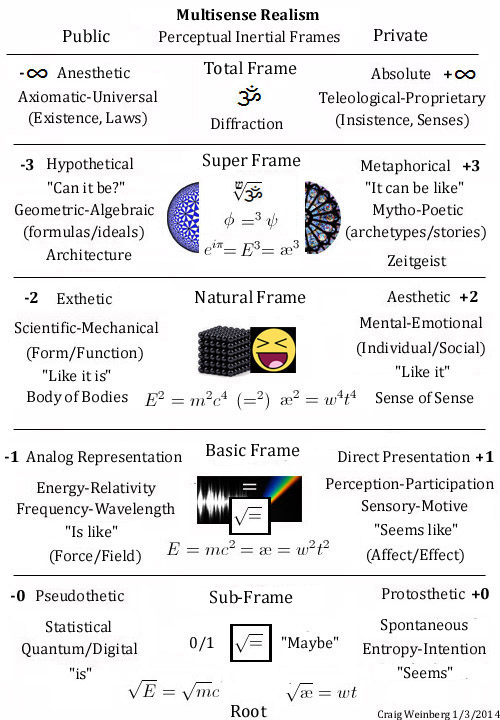
- Protosthetic (+0), referring to the minimum quality of awareness as well as the quality of minimum awareness. On a scale of +0* to +∞, this level is the +0 because it represents experiences which have been aesthetically masked to appear imperceptible. This can be thought of as the personal unconscious, as opposed to the collective unconscious, which is the Absolute level that is positioned on top of the diagram, but is actually the entire sphere. It’s number would be +∞.
The entire left half of the sphere can be thought of as a slice within the protosthetic range, just as the greyscale can be thought of as variations on black and white. - Pseudethetic (-0) is the outside-in version of Protosthetic. Where protosthetic phenomena seem alienated or unconscious but are, on some level, a symptom of experience, pseudethetic phenomena are not as conscious as they appear to be. The -0 range is about artifice and simulation, and can include anything from a puppet or stuffed animal to a sophisticated AGI system. Protosthetic would include states in which we are personally unconscious, but can be thought of as that which wakes us up from a sub-personal level.
- Exthetic (-2) is a term I’m trying out as the public-facing conjugate to Aesthetic. This is the common sense of structure that the real world generally seems to have. It is the sense of concrete exteriority which we rely on to engage with the world rather than in our mind. The sense of fixed mass objects in space and linear causality, and all of the other macroscopic cues that pervade classical physics, as well as all of the hard sciences.
- Entelethetic (+3) is intended to refer to a level of hyper-aesthetic dreams, symbols, and archetypes. Also knows as the collective unconscious or Dreamtime, this band of sensitivity is super-natural and trans-personal (yet still private). The word borrows from Entelechy, which has to do with a drive toward self-actualization, which is apt considering the visionary nature of this ‘third eye’ view.
Teleological-Absolute (+∞) :: Universal-Axiomatic (-∞)
Mytho-Poetic (+3) :: Geometric-Algebraic (-3)
Mental-Emotional (+2) :: Scientific-Mechanical (-2)
Sensory-Motive/Perceptual (+1) :: Electro-Magnetic/Relativistic (-1)
Proto-Aesthetic (+0) :: Quantum-Digital (-0)
Metaphor, Electricity, Sun and Moon…
Electrophoric Magnetemorphism
If you had walked up to someone living in prehistoric times and had a conversation about the Sun and the Moon, it would probably be an easy way of talking about the concept of opposites. It’s an embodied metaphor which is almost absurdly plain. The Sun, a featureless disk of blinding radiance, unchanging yet burning – it looks like it could be a circular window into pure and infinite energy. The Moon is like everything that the Sun is not like. Its changing phases reveal shapes and features on the surface, sometimes orb-like, sometimes disc-like. The Moon’s darkness reveals that it reflects and receives the Sun’s light rather than produces its own, and because of that, and its association with the night and the tides, seems cool, and silvery to the sun’s golden warmth. Moonlight isn’t bright enough to allow us to see color, as noted in that Moody Blues song:
Cold hearted orb that rules the night
Removes the colours from our sight
Red is gray and yellow, white
But we decide which is right
And which is an illusion
How surprised a prehistoric astronomer would be to travel into the 21st century AD and find that all of that is complete horseshit. We now understand that most of what makes the Sun and Moon perfectly alike and unlike, from their similar apparent size to their duality, to their role in marking time and mytho-poetic extremes are purely coincidental. We just so happen to orbit one star, and be orbited by one natural satellite. The ratio of distance to size just happens to equal out so that the discs in the sky can often appear to be the same size, especially in conjunction. Indeed, the Sun is not only just an unremarkable star, but stars are just balls of exploding gas – huge spheres that have life cycles of their own.
There are some things that both the archaic and modern astronomer could use as a basis to preserve some symmetry of comparison. The Earth is to the Sun as the Moon is to the Earth as far as orbits are concerned. The Earth metabolizes the Suns energy with a biosphere generated atmosphere, where the Moon mainly reflects it.
The way that we treat the Sun and Moon now, compared to the way that humans had always treated them before science can be understood as a four dimensional dipole – a circuit through time, or really a meta-circuit since the dipole begins with a polar mytho-poetic understanding and ends with an elliptical mass-energetic understanding. Which leads me to some crazed ideas about electrostatic and magnetic force.
Notes on magnetism:
Watching the Khan Academy Introduction to Magnetism, I feel like I am finally making some headway into understanding the difference between electric and magnetic force. As he explains in the video, magnetic fields have are dipoles, they have North and South poles no matter how you break them up*. Electrostatic force is about positive and negative charge, but they can stand alone…at least (I’m thinking), alone at any given time.
What’s the difference? If we think of magnetic force as a spatial dipole, because its polarity is always adjacent, then why not think of electric charge as a dipole across time? But wait, it gets better. Because time is not fixed and is open ended, the electric metaphor poses charge like a question which can be answered at any time, and which wants to be answered and asked again and again. For the positively charged mass, negative charge exists as an image, an expectation of a presence which is currently absent but must eventually be present in the fullness of time (eternity, if necessary).
It could be said that the electric force, figuratively if not literally (but maybe literally, given a rehabilitated view of physics), creates time. It is the animation of circuitry. Electricity is algebraic and logical as it arcs from vector to vector directly, like a lightning bolt, hopping across gaps in logical steps. It is a path finder and path maker.
The magnetic force would then make sense as the creator or projector of space. It is the container of time, flattening cycles to circles. The magnetic force doesn’t draw lines, it aligns and orients, receives and presents spatial aesthetics to and from surrounding territories. If electricity is sensory motivation, then magnetism is motive sensation – a spatial feeling and knowing to match electrostatic being and doing.
Through Maxwell and then Einstein, we understand that these two modalities of interaction are the same thing but phase shifted by relativistic frame of reference. My understanding now leans toward seeing electricity as marking the “arctic” polar extremes in reference frames; the Innermost Metaphorical and the Outermost Binary kinds of relation, while magnetism presents the “tropic” counterpoint, describing how smaller and larger scaled bodies are nested within each other. Current flowing through a wire creates a magnetic force around the wire, it’s about the embodiment of the wire as a whole and how it relates to other macroscopically. The electric force is universal and infinitesimal, but it has no sense of figure and form, no orientation (needs a Ground).
This nugget came across my screen recently…it kind of makes sense, but I’ll leave that to you to interpret.
In Larry Niven’s story “The Kiteman,” we learn that the most important maxim in the Smoke Ring is: “East takes you Out, Out takes you West, West takes you In, In takes you East. North and South bring you back.”
Parting shot: Relativity is based on frames of reference, while Quantum Theory uses digital probability – eigenstates. Like magnetism and electricity, they are both the same thing seen from a different frame of reference. Together they describe how ‘reference’ is ‘framed’, but they both share the same blind spot, which is explaining what ‘ference’ is that these frames ‘re-fer’ to. I think that ference can only be one thing – not energy, and not information (which are really metaphors for spatial-magnetic and temporal-algebraic), but awareness itself: sensory-motive aesthetics.
*Some claim there might be magnetic monopoles also.
 Multisense Realism
Recent Comments