Archive
m-zombie: A Challenge to Computationalism
Have a look at this quick video, or get the idea from this gif:
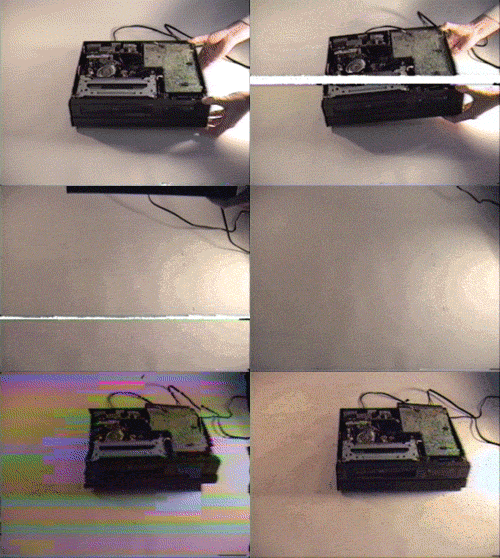
Since the VCR can get video feedback of itself, is there any computational reason why this doesn’t count as a degree of self awareness?
Turning the Systems Reply to the Chinese Room on its head, I submit that if we consider the Chinese room to be an intelligent *system*, then we must also consider the system of VCR+camera pointed at itself to be a viable AGI as well.
The correlation of corrupted video feed with the actual physical attacks on the system must be construed as awareness, especially since the video effects are unique and specifically correlated so as to present a complex vocabulary of responses. If functionalism rejects the evidence of this correlation as being experienced qualitatively, then it must posit the existence of an m-zombie (machine zombie), in which the system unintentionally mimics the responses expected from sentient computations from a sub-computational level.
Semiotics: What are the implications of the Saussurian sign (signifier/signified) for a theory of meaning?
In my theory of meaning, Saussurian concepts of signifier and signified are a good start, but I propose a fundamental change. In his answer, Keith Allpress offers:
here is where I think we stand:
Shannon removed content from meaning but using bits.
Saussure claimed that language creates meaning.
and points out the limitations of post-modern/relativistic/deconstructionist approaches. I would say that the computationalist approach is similarly limited, in that there is no compelling reason that ‘it from bit’ should apply to all aspects of meaning. I think that what is missing from these two approaches is the same thing, only seen from opposite sides. To understand more about that thing, we can begin by asking:
“What cares about the difference?”
I think where Saussure and modern semiotics in general went too far is in presuming representation without presentation. The error of the computationalist view is even more subtle, as it presumes presentation as an emergent property, thereby taking it outside of the realm of science, but without admitting it. To me, this is a very seductive but misguided approach which leads directly to the Emperor’s emergent clothes.
Taking the term ‘signifier’, we can crack the kernel of truth that semiotics-as-cosmology is based on. Just as it is not incorrect to call someone who is driving a car a ‘driver’, neither is driver a complete description of the role of human beings in the world. What is missing? What *cares* that something is missing? What fills the gap is what I call aesthetic participation, or sensory-motive presence. In my view, before ‘information’ (a difference that makes a difference per Bateson) or sign, there must be the raw sensitivity to detect and interpret such ‘differences’ or ‘signs’ and to *care* about those differences. What we have done, by reifing pattern as objectively real things which are recognized, or de-realizing things as subjectively constructed patterns is to void the existence of sense and sense-making itself.
Not to get too cheeky, but what I propose is that beneath Bateson’s adage is a deeper context from which information and signs emerge: an aesthetic phenomenon which likes its own likeness by making its own differences. I call this primordial pansensitivity, or ‘sense’ and the particular quality of appreciation that it cares about I call ‘significance’. Significance cannot be automated, it must be earned directly through intimate acquaintance. It may sound like I am talking about human intimacy here, but I mean nothing of the sort. By acquaintance (stealing that word from Chalmers), I mean sensory-motive encounters on a fundamental level: before humans, before biology, and before even matter. The universe has to make sense before anything can make sense of it.
The aesthetic agenda is purely hedonistic. It is to develop ever richer textures and modalities of appreciation. While the universe is replete with repeating patterns, it never seems to repeat its particular, proprietary holons. A whirlpool, hurricane, and galaxy all share the same unmistakable topology, but nobody would mistake one for the other. Not just the scale but everything that constitutes their appearance and role in the universe is different. In calling the universe signs or bits we are losing the appreciation and proprietary character. The unique and worthwhile becomes generic and inevitable. It ultimately is to make meaning meaningless.
Names (representations) can be related to each other in ways that nature (presentations) cannot be. The equal sign is itself a name for one of these relations. In nature nothing can be absolutely equal to anything else. All of nature is unrepeatably unique in a literal sense, but will seem to be made of repetition and variation from any particular perspective within it. In this way, the postmodernists are right. We have only the presence of our own ability to feel that can be known absolutely as it is. Everything else that exists for us, within our individually customized experience has some degree of approximation/representation.
What makes this even more complicated and confusing is that there are different levels of sense-making whcih can contradict each other. We would like to think of signs as simply a case of dictionary definitions were signs literally signifiy what we expect they should signify. Even the identity principle of A = A is subject to a deeper degree of expectation about what A and = mean in different contexts. We can look at a surreal painting and say ‘that is a painting of something impossible’, but it is only our expectation that the paint shapes refer to something other than themselves which is being misled. What surrealism signifies is not ‘real’, but neither is it nothing.
Where the computationalists are right is in seeing the uniformity of arithmetic principles across all phenomena which can be measured. Reducing all transactions to bits obviously has been tremendously transformative in this century. By banishing the aesthetic qualities (qualia) to an emergent never-never land, however, we have been seduced by the representation of measure (quanta). Simulation-type theories now abound, in which the entire history of human experience (including the development of science, but shh…) is marginalized as a confabulation/illusion/model and the only true reality one which can never been contacted in any way except through theoretical abstraction. We either live in an unreal world, or the world which we now think is real is not the one that we actually live in. We are being asked to believe that meaning is meaningless and that the only alternative to solipsism is a kind of ‘nilipsism’* in which even our ennui is yet another meaningless function of the program.
To turn the page on this era of de-presentation**, I suggest that we look at the roots of semiotics more deeply, and recognize that signs themselves depend upon a deeper context of sensation and sense-making which goes beyond even physics or human experience.
*a word I made up to describe the philosophy that the self (ipse) must be reduced to a non-entity.
**another neologism that I use to refer to what Raymond Tallis calls the ‘Disappearance of Appearance’…the overlooking of the phenomenon of aesthetic presence itself.
Nested Pansensitivity Interpretation

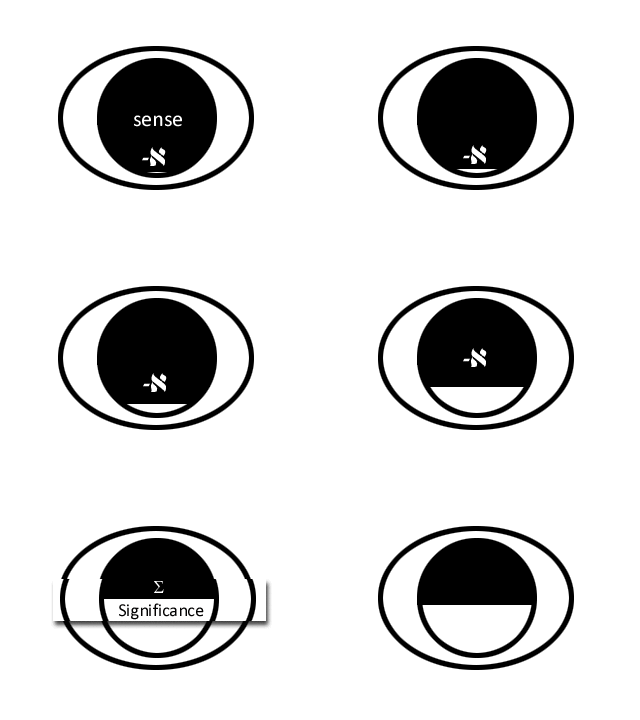
Here is an early sketch of the basic concepts of the sense-based physics in Multisense Realism (MSR). The aspects of MSR that deal with elemental conditions now fall under the heading “Nested Pansensitivity Interpretation (NPI)”. This is intended to pre-figure quantum theory, and is also referred to as quorum mechanics or post-particle physics. It is a general systems concept, so that it can apply to events on any scale, not just microphysical. The simple gifs are intended only as a metaphor – not as literal physical particles or functions. The rising bar of sense could refer to light, sound, emotion, a story unfolding, etc. It’s about the meta-ontology through which metaphysical expectations such as cycles and events arise.
In the top gif, the relation of sense, motive, effort, and effect is shown. Sense, being the primordial resource, is represented by this oscillation of light and dark, but it should be noted that this refers to the appreciation of feeling or sensing, not a literal mechanism which oscillates. Primordial pansensitivity must pre-figure time, cycles, identification of light and dark, etc. All of those tropes of sense (symmetry, opposites, etc) are types of significance (as shown in the second gif).
In the top gif, the center circle is nested within a concentric ellipse to denote one of what I suspect are the most primitive types of significance – the distinction between interiority and exteriority. As sense builds to a peak, it can become focused as a motive. We have countless motives within and at the fringes of our awareness as human beings, but what is being shown here is a conjecture about the nature of any part of the universe, even in the complete absence of human beings, biological life, and physical matter. I use the Omega symbol (Ω) for Motive because a) it’s cool, and b) it references exteriority and teleology obliquely, being that it is the last letter of the Greek alphabet. Motive is the part of sense which is targeted for action. The symbol itself obliquely references exteriority as well, appearing as a breached circle or as a white bulb emerging. Using the minus Aleph symbol (-ℵ) has been my convention because of it’s connection to ‘before the first’, and ‘before the expectation of infinite cardinality’. Counting requires logic, which requires multiple nested cycles of sense, motive, effort, effect, and significance to be abstracted.
Alien Hand/Limb Syndrome
“The alien hand syndrome, as originally defined, was used to describe cases involving anterior corpus callosal lesions producing involuntary movement and a concomitant inability to distinguish the affected hand from an examiner’s hand when these were placed in the patient’s unaffected hand. In recent years, acceptable usage of the term has broadened considerably, and has been defined as involuntary movement occurring in the context of feelings of estrangement from or personification of the affected limb or its movements. Three varieties of alien hand syndrome have been reported, involving lesions of the corpus callosum alone, the corpus callosum plus dominant medial frontal cortex, and posterior cortical/subcortical areas. A patient with posterior alien hand syndrome of vascular aetiology is reported and the findings are discussed in the light of a conceptualisation of posterior alien hand syndrome as a disorder which may be less associated with specific focal neuropathology than are its callosal and callosal-frontal counterparts.” – http://jnnp.bmj.com/content/68/1/83.full
This kind of alienation from the function of a limb would seem to contradict functionalism. If functionalism identifies consciousness with function, then it would seem problematic that a functioning limb could be seen as estranged from the personal awareness, is it is really no different from a zombie in which the substitution level is set at the body level. There is no damage to the arm, no difference between one arm and another, and yet, its is felt to be outside of one’s control and its sensations are felt not to be your sensations.
This would be precisely the kind of estrangement that I would expect to encounter during a gradual replacement of the brain with any inorganic substitute. At the level at which food becomes non-food, so too would the brain become non-brain, and any animation of the nervous system would fail to be incorporated into personal awareness. The living brain could still learn to use the prosthetic, and ultimately imbue it with its own articulation and familiarity to a surprising extent, but it is a one way street and the prosthetic has no capacity to find the personal awareness and merge with it.
Tip of the Iceberg
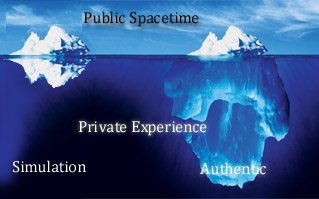
Another look at how the uncanny valley relates to the explanatory gap.
Attack and Redemption of Computational Theory of Mind
- 1. There is nothing at all which cannot be reduced to an encounter*, and that encounters can be presented directly (phenomenally) or re-presented indirectly (physically or semiotically).
- 2. That the nature of encounters can be described as aesthetic re-acquaintance, nested sensory-motive participation, or simply sense.**
- 3. In consideration of 1, sense is understood in all cases to be pre-mechanical, pre-arithmetic, and inescapably fundamental.
My challenge then, is for CTM to provide a functional account of how numbers encounter each other, and how they came to be separated from the whole of arithmetic truth in the first place. We know that an actual machine must encounter data through physical input to a hardware substrate, but how does an ideal machine (e.g. Turing machine, Universal Machine or program) encounter data? How does it insulate itself from data which is not relevant to the machine?
Failing a satisfactory explanation of the fundamental mechanism behind computation, I conclude that:
- 4. The logic which compels us to seek a computational or mechanical theory of mind is rooted in an expectation of functional necessity.
- 5. This logic is directly contradicted by the absence of critical inquiry to the mechanisms which provide arithmetic function.
- 6. CTM should be understood to be compromised by petito principii fallacy, as it begs its own question by feigning to explain macro level mental phenomena through brute inflation of its own micro level mental phenomena which is overlooked entirely within CTM.
- 7. In consideration of 1-6, it must be seen that CTM is invalid, and should possibly be replaced by an approach which addresses the fallacy directly.
The next three points have to do with my own hypothesis (Multisense Realism), submitted here only for those who might ne interested.
- 8. PIP (Primordial Identity Pansensitivity) offers a trans-theoretical explanation in which the capacity for sense encounters is the sole axiom.
PIP is the conjecture that sensitivity is the sole capability that is required for all phenomena. If we wanted to conceptualize a ‘unit’ of this pansensitivity, I suggest the aforementioned terms ‘aesthetic encounter’, ‘sensory-motive participation’, ‘re-acquaintance’, etc, or any other neologism which suggests a pre-monadic generator of pre-self and self-like perspectives.
My conjecture is that self is a type of symmetry within sense. There is no self except for self vs not-self. What is distributed by pansensitivity is not solipsism, but opportunities to modulate self-like symmetries. Selfhood is a particular form of sense distribution in which the symmetry between the absolute and the conditional is recapitulated twice. From the absolute perspective, the self becomes a branch toward isolated locality, while from the conditioned perspective, the self (the condition) stands in for the absolute.
- 9. CTM can be rehabilitated, and all of its mathematical science can be redeemed by translating into PIP terms, which amounts to reversing the foundations of number theory so that they are sense-subordinate.
Here I am talking about turning the assumptions of mathematical theory on its head. Platonic forms, for instance, would be conceived of as superficial emblems of sense rather than profound and perfect absolutes. Sacred geometry, while imbued with numinous meaning locally to a self (as it reflects the symmetry to which it owes its elaboration), but from the absolute perspective, sacred geometry is akin to a test pattern – crystallized reflections of aesthetic depth, but containing no depths themselves.
- 10. This effectively renders CTM a theory of mind-like simulation, rather than simulating macro level minds, however, mind-simulation proceeds from PIP as a perfectly viable cosmological inquiry, albeit from an impersonal, theoretical platform of sense.
All that I mean here is that because CTM trades in symbols of reflected sense-making rather than sense encounters, it doesn’t ever have a chance of capturing the important features of consciousness. It can, however, capture important features of how consciousness is distributed.
EDIT: Details added for clarity –
*Encounter can be thought of as ‘stimuli’, but need not include any information. It can be thought of as ‘qualia’ but it need not include any subject or object. The intention here is to reduce all phenomena to its absolute minimum – an opportunity for modes and motives for discernment to arise.
**This sounds jargony, for sure, but I’m inventing a precise vocabulary here, so as to avoid being misconstrued as a standard argument for what might be called ‘pseudo-subtance idealism’ (everything is made of energy, love, vibration, fields, etc) or information panpsychism (conscious experiences are produced by complex systems, functional states, etc).
John Weldon’s “To Be”
If you say yes to the scientist, you are saying that originality is an illusion and simulation is absolute. Arithmetic can do so many things, but it can’t do something that can only be done once. Think of consciousness as not only that which can’t be done more than once, it is that which cannot even be fully completed one time. It doesn’t begin or end, and it is neither finite nor infinite, progressing or static, but instead it is the fundamental ability for beginnings and endings to seem to exist and to relate to each other sensibly. Consciousness is orthogonal to all process and form, but it reflects itself in different sensible ways through every appreciation of form.
The not-even-done-onceness of consciousness and the done-over-and-overness of its self reflection can be made to seem equivalent from any local perspective, since the very act of looking through a local perspective requires a comparison with prior perspectives, and therefore attention to the done-over-and-overness – the rigorously measured and recorded. In this way, the diagonalization of originality is preserved, but always behind our back. Paradoxically, it is only when we suspend our rigid attention and unexamine the forms presented within consciousness and the world that we can become the understanding that we expect.
“There is no information without representation”
My rebuttal to this from New Empiricism
Information is one of the most poorly defined terms in philosophy but it is a well defined concept in physical theory. How can it be that a clear idea in one branch of knowledge can be murky in another?
The physical meaning of information is succinctly summarised in the Wikibook on “Consciousness Studies”:
“The number of distinguishable states that a system can possess is the amount of information that can be encoded by the system.”
In most cases a “state of a system” boils down to arrangements of objects, either material objects laid out in the world or sequences of objects such as the succession of signals in a telephone line. So information is represented by physical things laid out in space and time. There is no information without this representation as an arrangement of physical objects.
Information can be processed by machines. As an example, computers use the “distinguishable states” of charge in electrical components to perform a host of useful tasks. They use the state of electrical charge in electronic components because charge can be manipulated rapidly and can be impressed on tiny components, however, computers could use the states of steel balls in boxes or carrots flowing on conveyor belts to achieve the same effect, albeit more slowly. There is nothing special about electronic computers beyond their speed, complexity and compactness. They are just machines that contain three dimensional arrangements of matter.
Philosophers use information in a much less well-defined fashion. Philosophical information is far more fuzzy and involves the quality of things such as hardness or blueness. So how does philosophical blueness differ from a physical information state?
Physical information about the world is a generalised state change that is related to particular events in the world and could be impressed on any substrate such as steel balls etc.. This allows information to be transmitted from place to place. As an example, a heat sensor in England could trigger a switch that opens a trapdoor that drops a ball that is monitored on a camera that causes changes in charge patterns in a computer that are transmitted as sounds on a radio in the USA. If the sound on the radio makes a cat jump and knock over a vase then it is probably valid to look at the vase and say “its hot in England”. So physical information is related to its source by the causal chain of preceding steps. Notice that each of these steps is a physical event so there is no information without representation as a state in the real world.
In the philosophical idea of information “hot” or “cold” are particular states in the mind. Our mental states are not uniquely related to the state of the world outside our bodies. As an example, human heat sensors are fickle so a blindfolded person might contain the state called “cold” when their hand is placed in water at 60 degrees or ice water at zero degrees. Our “cold” is subjective and does not have a fixed reference point in the world. Our own information is a particular state that could be induced by a variety of events in the world whereas physical information can be a variety of states triggered by a particular event in the world.
To summarise, information in physics is a state change in any substrate. It can be related to the state change in another substrate if a causal chain exists between the two substrates. Information in the mind is the state of the particular substrate that forms your particular mind.
Your mind is a state of a particular substrate but a “state” is an arrangement of events. The crucial questions for the scientist are “what events?” and “how many independent directions can be used for arranging these events?”. We can tell from our experience that at least four independent axes (or “dimensions”) are involved.
Note
The fact that there is no information without representation of the information as a physical state means that peculiar non-physical claims such as Cartesian Dualism and Dennett’s “logical space” are not credible.
Daniel C Dennett. (1991). Consciousness Explained. Little, Brown & Co. USA. Available as a Penguin Book.
Dennett says: “So we do have a way of making sense of the idea of phenomenal space – as a logical space. This is a space into which or in which nothing is literally projected; its properties are simply constituted by the beliefs of the (heterophenomenological) subject.” Dennett is wrong because if the space contains information then it must be instantiated as a physical entity, if it is not instantiated then it does not exist and Dennett is simply denying the experience that we all share to avoid explaining it. Either we have simultaneous events or are just a single point, if we have simultaneous events the space of our experience exists.
“So information is represented by physical things laid out in space and time.”
Why would physical things ‘represent’ anything though? Without some sensory interpretation that groups such things together so that they appear “laid out in space and time”, who is to say that there could be any ‘informing’ going on?
“computers use the “distinguishable states” of charge in electrical components to perform a host of useful tasks.”
Useful to whom? The beads of an abacus can be manipulated into states which are distinguishable by the user, but there is no reason to assume that this informs the beads, or the physical material that the beads are made of. Computers do not compute to serve their own sense or motives, they are blind, low level reflectors of extrinsically introduced conditions.
“Your mind is a state of a particular substrate but a “state” is an arrangement of events. ”
States and arrangements are not physical because they require a mode of interpretation which is qualitative and aesthetic. Just as there can be no disembodied information, there can be no ‘states’ or ‘arrangements’ which are disentangled from the totality of sensible relations, and from specific participatory subsets therein. Information is a ghost – an impostor which reflects this totality in a narrow quantitative sense which is eternal but metaphysical, and a physical sense which is tangible and present but in which all aesthetic qualities are reduced to a one dimensional schema of coordinate permutation. Neither information nor physics can relate to each other or represent anything by themselves. It is my view that we should flip the entire assumption of forms and functions as primitively real around, so that they are instead derived from a more fundamental capacity to appreciate sensory affects and participate in motivated effects. The primordial character of the universe can only be, in my view metaphenomenal, with physics, information, and subjectivity as sensible partitions of the whole.
Metaphysical vs Metaphenomenal
One of the most contentious areas in philosophy revolves around what I consider to be a misconception about the relation between the physical and phenomenal. In particular, the term ‘metaphysical’ forces supernatural connotations onto what would otherwise be non-ordinary but natural experiences and states of mind. I think that the problem is in failing to recognize the physical and phenomenal as each having their own ranges which both overlap and oppose each other. What I mean is, synchronicity and precognition are not metaphysical, they are metaphenomenal. The surprising part is that this means that the ordering of events in which we participate is actually a subjective experience nested within many other subjective and perhaps trans-subjective subjective experiences on different scales. Einstein talked about the relativity of simultaneity, and the metaphenomenal (aka collective unconscious) works in a similar way.
When we make time physical without acknowledging the role that phenomenology has in producing both the form and content of “time”, we introduce a false universal voyeur which effectively flattens all aesthetic qualities and participation into a one dimensional vector in one direction. By taking the term metaphysical, we unintentionally validate this flattened view of the universe in which physics is nature, and phenomenology, particularly deep or non-ordinary phenomenology, can only be non- or meta- physical and therefore supernatural, aka superstitious, aka illusory. If we look at how physics treats its own non-ordinary phenomena, such as quantum entanglement, quasars, and dark energy, we do not see the term ‘illusion’ or ‘folk astronomy’ being thrown around. Their strangeness is acknowledged in a way which invites curiosity rather than fear. The mystery is safely projected into the impersonal realm of physics and the super-impersonal realm of theoretical physics. By contrast, the metaphenomenal range is super-personal or transpersonal, containing experiences which challenge our conventional expectations about the realism of physical bodies, locality, and time.
It is not incorrect to say that for these reasons the metaphenomenal can be considered metaphysical, however I think that is where we are placing the emphasis on the wrong set of properties. Instead of using experiences such as intuition, synchronicity, and even divination as scientific clues to a super-personal range of awareness, we are distracted by the apparent contradiction to physics (as if ordinary awareness did not contradict physics already). To rehabilitate our perspective, I suggest considering the relation between the different ranges of physical (ontic) and phenomenal (telic) phenomena in this way:
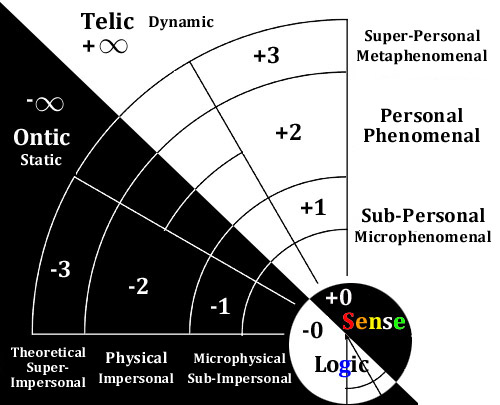
The term ‘paranormal’ is, like supernatural and metaphysical, the same kind of misnomer. If we see physics as a product of more primitive phenomenal sense, then it is consciousness itself which is doing the normalizing, so that it cannot be considered ‘normal’ itself. In another sense, since it is our consciousness which is defining normalcy, it does indeed identify its own regularity and meta-regularities and challenges those definitions as well. The metaphenomenal serves not only as an extension of the personal psyche into the collective unconscious, but also as a line in the sand beyond which sanity is not guaranteed.
Microphysical and Microphenomenal
The same thing occurs in another way, in an opposite way, on the bottom end of my chart. The sub-personal roots of microphenomenology and the sub-impersonal seeds of microphysics are the bottom up layers of causality and are more directly related than the top layers. The sub-personal (sub-conscious, id) urges and the microphysical (binary, semaphore-digital) are low level signs which are used to literally motivate and control. It is a common language of pushing things around.
To be able to exercise control it is necessary first to be able to see that which is to be controlled as separate in some sense from that which controls. There must be a way to sense them as ‘things’ or as a kind of inertial field which resists your intentions to cause a sensible effect. This experience of ‘things outside the self’ is the beginning of motivation, desire, intelligence, etc. In this way, motive and mechanism are born. The teeth in your mouth and the teeth of a gear exploit the same mechanical power to physically endure and prevail.
In the schema I propose, the fabric of the universe is tessellated or braided into these levels of nested counterpoint. The higher level objectifies the lower level into things because the higher level enjoys a more complete, but distanced panoramic view. The predator’s perspective engulfs the prey’s perspective. Biological organisms also objectify other living things and their own living body as higher than non-living things. Organisms with nervous systems take it one step beyond, seeing their own lives as a kind of meta-thing to direct as separate from the body. The human brain corresponds to a further, and perhaps ultimate mutation on the theme of self-reflection. There are physical implications for all of this but they have to do with time more than materials and structure. The expansion of time gives us more raw experiential material, more moments and more awareness of past and future within each moment. Technology and leisure make a virtuous cycle, bringing innovations which give us more things to do with our minds and bodies, and with the world.
Robert Anton Wilson wrote about the Jumping Jesus phenomenon – that it took X number of years for the first person to be born who had the impact of a Jesus or a Buddha, and how we now have several of them living at any particular moment. Buckminster Fuller and Terrence McKenna are among those who had this hyper-enthusiasm for the future which underlies today’s Singularity ethos. The ever ‘tightening gyre’, the transcendental object at the end of history, etc. It would seem, however, that at the same time, this enthusiasm is somehow perpetually deluded, and forever producing time wasting, leisure robbing coercions as well. As the acceleration increases, so does the mass, and a kind of stalemate plus or minus is maintained.
Conclusion
By shifting from the ad hoc, monolithic model of phenomenology as a kind of malfunctioning folk physics, or as physics belonging to an illusion that must be overcome spiritually, I propose a sense-based, multivalent view in which the metaphenomenal is understood to be both less than and more than physically real with high orthogonality, and the microphysical is understood to be less than and more than cosmologically meaningful with high isomrophism. The (one) mistake that David Chalmers made, in my opinion, is in accidentally introducing the idea of a zombie rather than a doll to the discussion of AI. Similar to error of the terms metaphysical and supernatural, the zombie specifies an expectation of personal level consciousness which is absent, rather than sub-personal level consciousness which is present on the microphysical levels. We can understand more clearly that a doll is not conscious on a personal level, no matter how many things it can say, or how many ways its limbs can be articulated. On the micro-physical level however, the material which makes up the doll expresses some sensory experience. It can be melted or frozen, broken or burned, etc. The material knows how to react to its environment sensibly and appropriately, and this is how material is in fact defined – by its sensible relations to material conditions. Just as we can assemble a 3D image on a 2D screen out of dumb pixels, so too can be automate a 5D human impostor on a 4D behavior stream of a doll.
By properly locating the micro-level physics beneath the personal-level phenomenology, we can see that beneath the micro-level physics there can be an even more primitive micro-phenomenology. On the top end as well, beyond the ontological truths of mathematics and logic, there are teleological apprehensions of aesthetics and meaning – without necessarily invoking a God personality (although that can work too, I just don’t see it as making as much sense as transpersonal Absolute).
*the super-impersonal is similar to the metaphenomenal in that it is difficult and esoteric, but opposite in that it is extrinsic rather than intrinsic. Where the metaphenomenal uses symbols as archetypes, loaded with metaphor and occult mystery, the superimpersonal (which would be more correct to call metaphysical) uses arcane mathematical and logical expressions. These are a kind of anti-metaphor as they relate to precisely defined, universally understood public information. The whole point is to expose the theory and completely, so that anyone is welcome to try to learn how to understand and use them, without any initiation rituals or strange pictures.
Computation as Shadow of Consciousness

I’m borrowing a (fantastic) image from
Incredible Shadow Art Created From Junk by Tim Noble & Sue Webster.
to make a point about the Map-Territory distinction and how it pertains to simulated intelligence.
Although a computer simulation produces an output over time, that does not mean that it is four dimensional (Time can be an additional dimension on any number of dimensions – a cartoon can be 2D but still last fifteen minutes.) By using the terms N and N-1 dimensional, I’m trying to make the point that no matter how extensive the measurements we make and how compelling their coherence seems to be, it can still be one dimension flatter than the original without our knowing it.
In the case of consciousness, I would say that it absolutely cannot be defined or described quantitatively, so that it truly is N dimensional, or trans-dimensional. Whatever number of dimensions we want to ascribe to some aspect of consciousness, that description will always be n-1 to the real thing. That is, in my understanding, the nature of representation – a destructive reduction of a presentation through a lower level (n-1 or n-x) medium which can be reconstructed by at the higher level if, and only if, there is a higher level interpreter.
Some might object to the metaphor on the grounds that computation is not like a shadow, since changing a computation has predictable effects, while changing a shadow’s appearance does not effect the object. That’s true, but again, in this case, I am using N dimensional phenomena, so that interactiveness is part of the conservation of the temporal, before and after/cause and effect axis. In such a scenario, the flatland effect itself is modified somewhat and there are more dimensions shared. More shared dimensions = more conservation of sensory-motive agreement, however, there is also more that is not shared (feeling, sensations, colors, understanding, for example).
Some who are more familiar with the spectacular capabilities of cutting edge computation might object to the over-simplification, and say that I am criticizing an older generation of approaches to machine learning. There is some truth to that, but in the rarefied air of higher math, we get into what I call the super-impersonal level of intelligence. By comparison, the super-personal level of awareness could be described as mythic or poetic. Synchronicity can be concentrated through divination techniques like Ouija boards and Tarot cards. The Platonic ‘realm’ accessed through ultra-sophisticated computation are, in my view, a dual of that kind of divination, except rooted in the generic and repeatable rather than the instantaneous and volitional. The computer is an oracle to impersonal truths about truth itself, and can build locally applicable strategies from there, however, it cannot factor in any kind of personal feeling or intention.
The computational oracle is much more seductive than divination, since it does not leave the interpretation up to the audience. The computational oracle’s output is to be interpreted as objective fact…which is tremendously useful of course, when we are talking about objects. The danger is when we start believing what it has to say about subejcts. As correct as the computer is about objective truth, it is equally incorrect about people. In the same/opposite way, the Ouija board is neither correct nor incorrect, but offers possibilities that tantalize the imagination.
 Multisense Realism
Recent Comments