Archive
De-Presentation
(Reblogging myself)
The key to understanding what is wrong with the contemporary occidental view of consciousness is that it is so enamored with the idea of representation that it overlooks presentation itself. To say that feeling, seeing, and thinking are mere representations for neurological processes makes perception irrelevant, superfluous, metaphysical, and unexplainable. It makes more sense to me that the neurological processes and the conscious experiences they are associated with are both presentations in their own right, and also representations of each other.
Music is a good example. The experience of hearing music is the presentation that we care about. We can record music by any number of encoding methods, but all of them are only representations of music if they end up being listened to by a person who can hear music. If not, they are meaningless digital etchings or published notations. To say that these generic data sets are the actual music and our enjoyment of the song is just a ‘representation’ of the data or the physical consequence of reconstituting the data through an acoustic mechanism is an arbitrary and unscientific prejudice.
This item that I posted a couple days ago illustrated how dominant the verbal-semantic sense channel is our consciousness:

Our default tendency is to privilege the abstraction of language over the concrete reality of visual sense. This is a clue to how consciousness works, with conflicting agendas and dynamic protocols of influence. The brain is nothing like a digital computer. It has no discrete values and computations stored in registers. It’s made of affiliated groups of living cells which can learn, guess, feel, grow, have preferences, etc.
These affiliations present us and our bodies with many figurative channels through which perception and participation is input and output, shared seamlessly in both bottom-up and top-down interactions. Your eyes tell you B-L-U-E in one sense, but they show you green through another. You have learn to consciously override the default privilege of the cognitive semantic channel, even though it is incorrect by its own logic, to honor the minority voice of the factual perception.
I think that this is exactly what is going on with the occidental or OMMM view of consciousness. Our ‘west-handed’ objective cognition is so dominant that it has to stop itself from running roughshod over the ‘east-handed’ subjective awareness, even when the subject is subjectivity itself. The occidental mind would rather accept the nonsense proposition that its acceptance or rejection of propositions is random or deterministic than entertain the possibility of the self as genuine agency. By focusing on awareness only as means to an end (evolutionary biology, functionalism, materialism, computationalism) the concrete experience of perception is de-presented to an epiphenomenon in our consideration. It’s similar to religious fundamentalism, even though it is based on belief in disbelief rather than naive belief. Extreme religiosity also advocates a de-presentation of the world to privilege the contrary ontology (idealism). Instead of the self deferring its existence to a-signifying mechanics, religious de-presentation of the self favors of a super-signifying spiritual agenda (heaven, maya, reincarnation, redemption) which has the same result of making the individual an inconsequential fragment of a greater agenda. The occidental true believer, pitched toward some flavor of transhumanism, promises the same paradise of virtualized perception as the oriental true believer; all of the superlative qualities of perception of an external realism but with the absolute safety and omnipotence associated with introspective experience. The best of both worlds.
With multisense realism, we avoid the pathological unrealism of de-presentational monosense and discover the option of being grounded both in the here and now as well as being free and significant in the eternal there and then without confusing or conflating the two. We can enjoy the full range of scientific sophistication without sacrificing any of the magic and mystery of our uniquely wonderful/horrible life journey.
Multisense Perception Model
20th Century Perception Model
Visual sense is an ’emergent’ (unexplained) ‘representation’ of neurological computations based on optics and conditioning.
Photons smack into molecules in the rod and cone cells into the retina which mechanically trigger a succession of electrochemical ‘signals’ through the cells of the optic nerve and visual cortex.
The process is deterministic and passive until it gets to the cortex, where the signals are actively interpreted through cognitive associations, memory, innately hardwired pattern matching, etc. The final computations are interpreted in such a way as to somehow re-present a simplified reconstruction of the aggregate distribution of trillions of photons, their energy states, location, and geometric groupings into a dynamic narrative.
What this model fails to consider is that there is no original presentation to be simulated. It takes for granted the very perception process it purports to explain, leaving the ‘Hard Part’ to fend for itself in the dark hole left from the extraction of the cerebral Homunculus. It is not clear why such a representation would be useful if the brain can both encode and decode the information it contains, nor is it explained where this final reconstructive simulation takes place…where do the colors come from?
Multisense Perception Model

Once we turn reality right-side up, so that the information and data is the abstract representation of the concrete images, colors, and forms which present themselves to us visually, we can see that the photon model may not be the best model as far as visual perception is concerned.
In the Multisense model, human scale awareness is parallel and concurrent with the subordinate levels of sense being experienced by organs, cells, and molecules. There are no collisions of photons, only photosensitive molecules responding interactively with the changes in their physical environment. They are blooming and shrinking in synch with all of the exposed surfaces that are illuminating them. We are seeing though our eyes, their cells, and their molecules – all of them direct descendants of a single dividing zygote – all of them parts of ‘us’.
In the picture, the pink represents receptive sensitivity and the yellow is intentional motive. We see someone smile and are able to feel an emotion through the smile just as we are able to see an image through pixels or cells. Our sense capacities bridge the gap – mirror neurons, sure, but mirroring what? Signals are what? Feelings. That’s all they are. Experiences. Ours are big and deep and complicated but I think that the principle is the same all the way down to the atom. We see, we feel, we respond.
There is no quantum smile ensemble that physically travels from one person’s mouth to another person’s eye. It would certainly seem like their must be if we looked at it from a completely foreign perspective. We would assume, as physicists do, a purely literal universe of mechanical possibilities and devise exhaustive analyses to predict smile probabilities. Those probabilities would probably work quite well. It is certainly possible to figure out unifying principles of how often and under what circumstances smiles are returned and how glances become entangled.
If instead we take our own experience as a template for real experiences of electromagnetic activity in a biochemical context (and isn’t that what it really is?) and imagine that it evolved from a hierarchy of simpler subjective forms, we arrive at a microcosm which has a figurative, interpretive side as well as a literal, mechanical side. It’s not that hard to conceive of to me. Matter and space on the outside, sense and time on the inside. What’s the big problem?
The key is to realize that the sense of the inside is very different, 100% opposite in fact, from the sense of the outside. It scales up differently. Interior sense doesn’t accumulate like Lego blocks, adding more and more discrete details on different scales. It works the opposite way, condensing qualitatively so that each moment presents a rich, multiplexed narrative of worlds and characters. It peels away appearances to point to deeper semantic connections.
Think of how we recognize a smile in another person’s face with layers of subtle meaning – projected emotions and motives which we share. We can tell when other primates smile too, but it gets a little more fanciful the further out from our own species we go. It seems like a dog or a dolphin is smiling, but who knows for sure. All we can do is have a sense of what might be sharable.
On an atomic level, I would imagine a much more mathematical range of possibilities, but that could just be anthropocentric. What we see of an atom’s smile through a photomultiplier may not be even 1% of the story, just as the movement of facial muscles and optical recognition circuitry in the brain are not even 1% of who we are and why we smile.
A recent discov…
A recent discovery in neuroscience identifies a connection between microtubules and synaptic memory:
ScienceDaily (Mar. 9, 2012) — Despite a century of research, memory encoding in the brain has remained mysterious. Neuronal synaptic connection strengths are involved, but synaptic components are short-lived while memories last lifetimes. This suggests synaptic information is encoded and hard-wired at a deeper, finer-grained molecular scale.
In an article in the March 8 issue of the journal PLoS Computational Biology, physicists Travis Craddock and Jack Tuszynski of the University of Alberta, and anesthesiologist Stuart Hameroff of the University of Arizona demonstrate a plausible mechanism for encoding synaptic memory in microtubules, major components of the structural cytoskeleton within neurons.
Microtubules are cylindrical hexagonal lattice polymers of the protein tubulin, comprising 15 percent of total brain protein. Microtubules define neuronal architecture, regulate synapses, and are suggested to process information via interactive bit-like states of tubulin. But any semblance of a common code connecting microtubules to synaptic activity has been missing. Until now.
Key to the discovery is how “in long-term potentiation (LTP), a cellular and molecular model for memory, post-synaptic calcium ion (Ca2+) flux activates the hexagonal Ca2+-calmodulin dependent kinase II (CaMKII)”.
What is CaMKII?
“Ca2+-calmodulin dependent kinase II (CaMKII), a dodacameric holoenzyme containing 2 hexagonal sets of 6 kinase domains.”
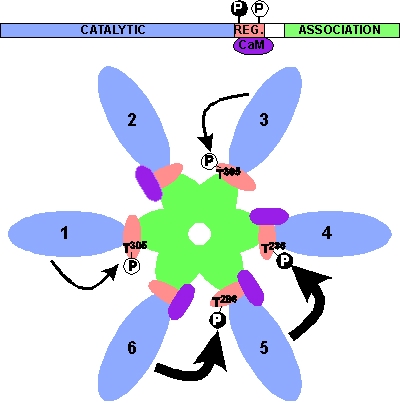
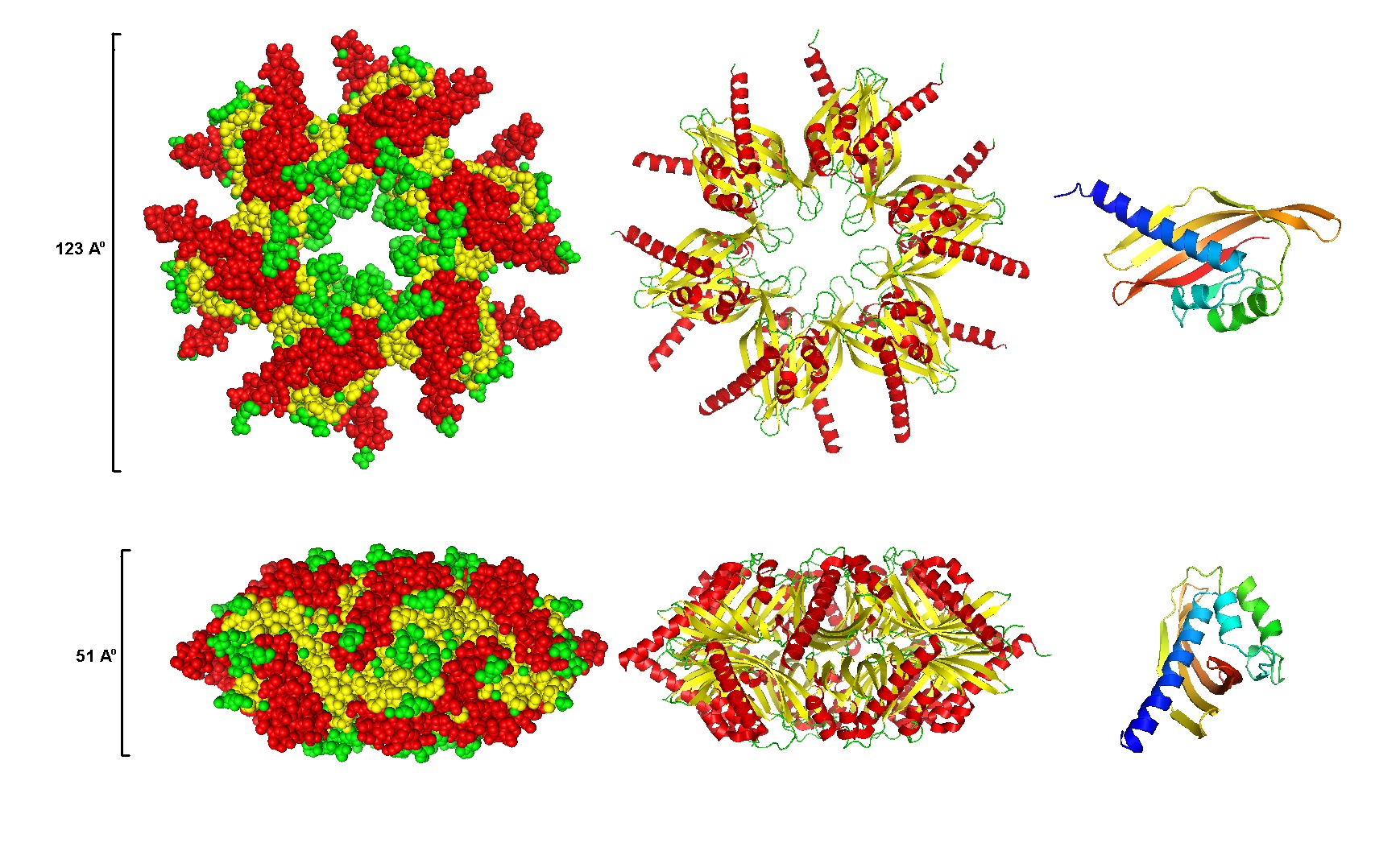
“The term “holoenzyme” can also be applied to enzymes that contain multiple protein subunits, such as the DNA polymerases; here the holoenzyme is the complete complex containing all the subunits needed for activity.” – Wiki
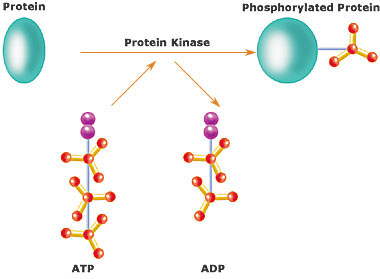
*a kinase[1] is a type of enzyme that transfers phosphate groups from high-energy donor molecules, such as ATP,[2] to specific substrates, a process referred to as phosphorylation.
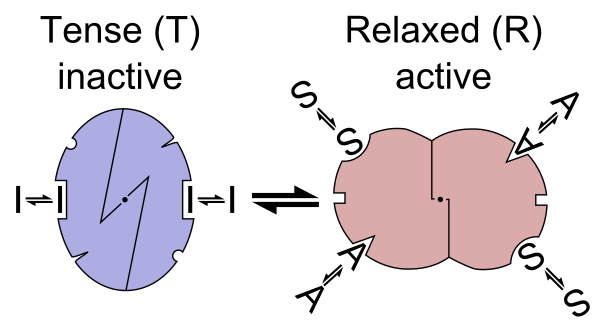
The hexagonal symmetry of these molecular mandalas are very familiar to me, as is the MWC model in terms of Tension and Relaxation (with Agonist, Inhibitor, and Substrate relations).
This theme is echoed in another fundamental structure of memory encoding, the bipolar junction transistor:
 Neither the holoenzyme, the transistor, or any other symmetric tri-element models related to information (like RNA/DNA, semiotic trichotomy) address a how or why any of these digital units become feelings, images, etc. No sign of any translation/conversion homunculus performing this little bit of mechanically superfluous, metaphysical imagineering. We infer forms being transduced from one encoding schema to another, but at no point do they reach their semantic destination.
Multisense realism picks up where these descriptions leave off. In enzyme reactions as in electronics, the underlying theme of holding and releasing is understandable to us, as it is a universal theme which we can make sense of on many levels in our own experience. The commonality then, can be described in subjective terms as sense: the experiential syzygy of stability (which is essential and continuous) and variation (which is existential and discrete).
When we experience directly, it can be described in terms of sense and motive, whereas our indirect experience is splintered into many nested perceptions and understandings on different physical scales and levels (physical, chemical, biological, somatic, geological, stellar, galactic, etc)
The experience of a living human being is not a collection of molecular ‘information’ fragments in the brain, it is the unique wholeness which permeates the entire interpretation and operation of the molecules, cells, organs, etc from the moment of zygotic mitosis until death which remains irreducible. Not a soul, but a participant in a story of stories. Not a machine, but a sequence of self-recognizing sequences.
This idiosyncratic resonance, rather than only being augmented gradually as objective ‘whats’ and ‘hows’ in space also extends as a ‘who’ and a ‘why’ which is etched subtractively into eternity (experienced as ‘time’). The resonance cannot be separated from the objects and events, anymore than shadows can be separated from lights, they are different aspects of the same thing.
Integrating Will Into Physics
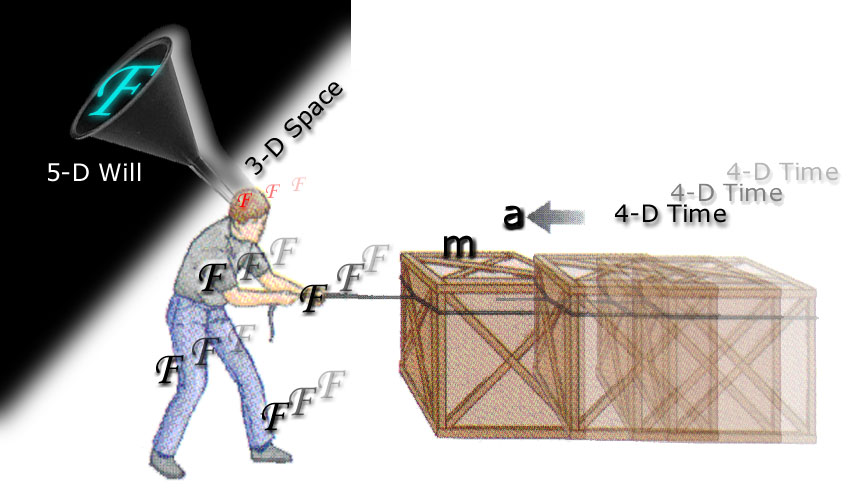
Another stab at describing the idea I was talking about in this post. Trying to get across the notion that will or motive begins as a five dimensional feeling (relative to a 3+1 dimensional physical exterior universe). Five dimensional because a single intention (here represented by a blue glowing F*) spans an entire intentional gesture. The intentional gesture can be thought of as being squeezed through a figurative funnel which condenses the subjective impulse from 5-D to 4-D. The impulse to exert effort extends beyond the Cartesian space and time vectors with qualitative experience.
Like the fourth dimension of time, feeling is independent of the other dimensions. A 2-D cartoon does not need to turn into a 3-D sculpture to exist in time. Time is understood then as a fourth dimension but not the fourth dimension. Feeling works the same way, it is another first dimension, so that it charges times, places, objects etc with a non-computational, qualitative significance. This significance has it’s own properties which makes sense of massive computations in terms of unique and concrete sensorimotive phenomenology. A 5d quality like ‘pain’ is in some way the same but in some way specific to each individual type of painful experience and each instantiation of that experience.
By reversing this many-to-one figurative sensitivity to qualia, we can model a one-to-many literal projection of will. Our method of output, will or attention, is an all purpose qualia of engaging our active participation in the narrative of our life. One form of stimulation which we apply to everything we ‘try’ and ‘do’.
Getting this feeling out of our heads and into the world of our body entails something like a parallel to serial signal translation. The intention which arises from the cumulative entanglement of a lifetime of experience and outcomes, has no meaningful 3-D expression on it’s own. All you can see from the outside is (represented by the red F’s in the subject’s head) would be 4D electromagnetic patterns in the 3D brain. These patterns form 4-D chain reactions across 3-D tissues, limbs, and finally objects. The decision to initiate this whole chain reaction however, is not accessible from the outside. The ‘why’ is a single top-level conscious impulse which, like Mass exploding into energy, explodes into many simultaneous and sustained ‘what’ and ‘how’ events of mass acceleration…different ‘where’ and ‘when’ coordinates in time space, etc.
*Blue F = Subjective sensorimotive stimulation to pull the crate.
Red Fs = Electromagnetic view of the Blue F. What is lost in 5d figurative significance is gained in 4d linear, literal power.
Black Fs = Force. Tension applied to the crate by muscle fibers, bone, rope, etc.
m = mass of the crate
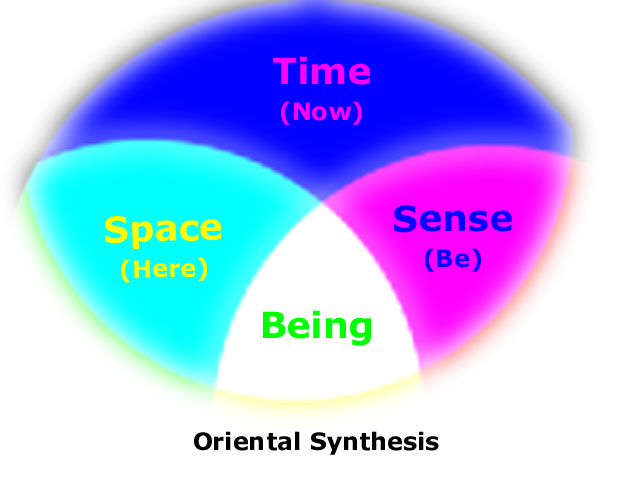

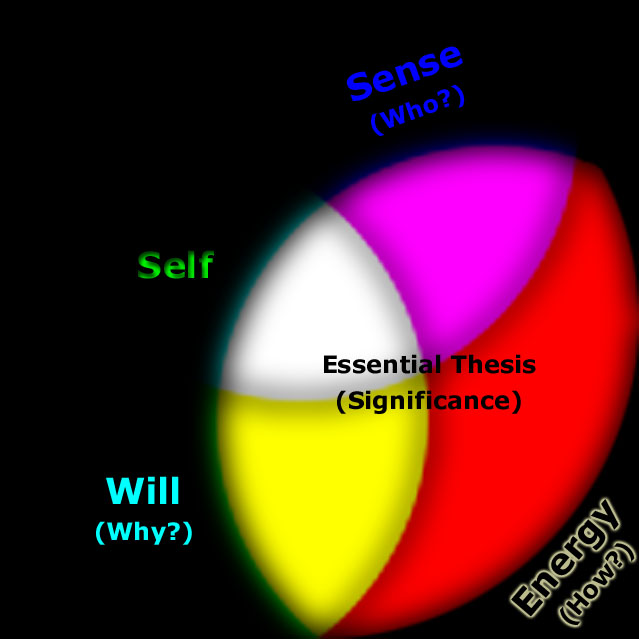
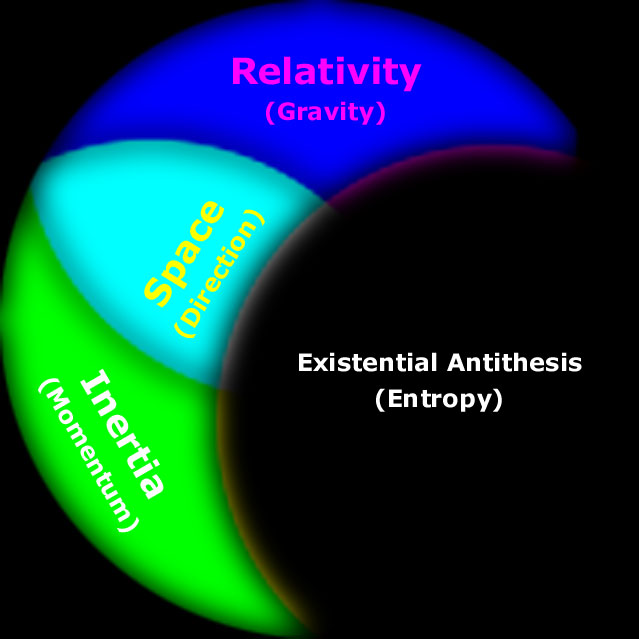
Meaningful Groupings of the Multisense Syzygy
Essential Thesis
Emphasizes Subject Realism: Sensorimotive Perception & Participation
Existential Antithesis
Emphasizes Object Realism: Electromagnetic & Quantum Mechanism
Oriental Synthesis
Be Here Now. Abstract celestial themes.
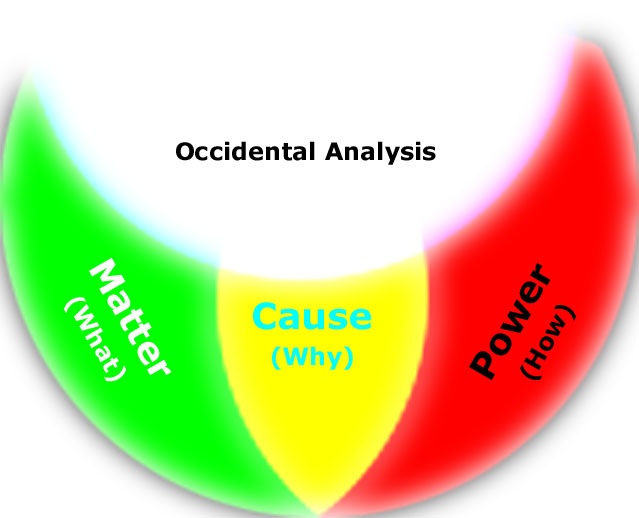
Occidental Analysis
Instrumental Reasoning. Concrete material themes.
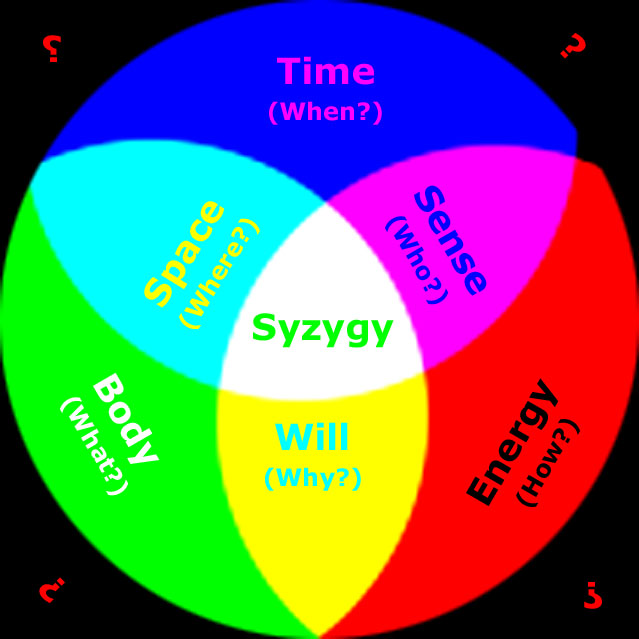
Primordial Syzygy
syz·y·gy
[siz-i-jee] noun, plural -gies.
1.Astronomy . an alignment of three celestial objects, as the sun, the earth, and either the moon or a planet: Syzygy in the sun-earth-moon system occurs at the time of full moon and new moon.
2. any two related things, either alike or opposite.
This is the primordial syzygy for multisense realism. The overlapping RGB regions can be grouped in different ways to bring out different meanings.
The primary spectral hues with the perimeter orientation are juxtaposed with the pastel hues having center-radial orientation. This produces a dialectic of subjective introversion versus objective extroversion as well as a three syzygies:
Subject Thesis (Who & Why, Sense & Motive, Pink & Yellow) minus Space (Subjects are always ‘here’)
Object Antithesis (What & How, Matter & Energy, Green & Red) minus Time (Objects are always ‘now’)
Realism Synthesis (When & Where, Time & Space, Light Blue & Deep Blue) is inferred by triangulating Subject & Object
Using this symmetry to solve the Hard Problem and bridge the Explanatory Gap:
Think of the living brain as the what and how of what we are, and consciousness is the who and the why. Neither supervenes on the other but, neither are they separable entirely. Like the syzygy, they are elements which are separate in some sense, united in some sense, overlapping and underlapping in some sense, defined by each other in some sense, and defining a super-signifying whole which is more than the sum of its parts in another sense.
Consider that of the seven billion people alive today, each one has a different identity and life, yet we all share more or less the same physiology. We cannot expect to locate the who & why of our identity in the what and how terms of our body.
The question marks outside of the circle represent the another dialectic, between the anthropic significance of the syzygy and the a-signifying mechanism of entropy.
”?” is used to connote the unconscious fully. Not merely the absence of awareness but the absence of the capacity for awareness of the absence. There is nothing there to signify a label of nothingness or oblivion, it simply is not anything.
Syzygy vs ?:
acceleration vs inertia
sequence vs consequence
significance vs entropy
pattern vs coincidence
initiative vs randomness
signal vs noise
orientation vs disorientation
teleology (purpose) vs teleonomy (evolution)
animism vs mechanism
augmentation vs cancellation
positive vs negative
multiplication vs division
Tags: consciousness, cosmology, explantory gap, hard problem of consciousness
Power Over The Known Universe
“Physics is the study of the structure of consciousness. The “stuff” of the world is mindstuff.” – Physicist Sir Arthur Eddington
I agree. Where I disagree with computationalism is that I see the stuff of the mind as not just numberstuff, but sense. Not only no stuff at all, but the antithesis of stuff. Not emptiness (the lack of stuff), but the insoluble solvent of stuffness itself. Where arithmetic is represented as methodical encoding, sense guesses and makes it up as it goes along.
It seems enigmatic and mysterious because it is a thesis which is blind to itself except through its reflected antithesis, which is not mysterious or enigmatic but public and declarative. This does not mean that we can’t understand what it is and communicate effectively about that understanding.
We can use the symmetry as a mirror to reflect light into the dark of our blind thesis. Both comp and materialism ignore the symmetry and assume that subjectivity is part of a material or an arithmetic thesis, which leads to the Explanatory Gap, Hard Problem, and Symbol Grounding problem. Instead, if we focus on the symmetry itself we can infer the qualities of the Hard Solution, which is of course, inference and symmetry themselves. This is what sense is all about. Connecting the dots. Taking a leap of faith. Bridging the gap. It is not a wild ass guess, but a puzzle to be solved, an itch to be scratched, a need to be filled.
How I think it works is through a multisense realism. Inferences accumulate a figurative history which is retained in the now. What we learn is stored literally in our ongoing perception. These living histories or channels of sense are woven together as worlds or perceptual inertial frames. The trick is that weaving such a world elevates the subjective perception above what they have woven, so that they can see through the motives of worlds beneath them while the subject becomes invisible or opaque (also glamorous, magnificent) to the less significant subjects. What it looks like to the elevated subject is determinism. Knowledge and power.
By seizing or appropriating this power over lesser worlds, the subject disenchants her antithesis and amplifies her own – in the form of increasingly effective motive force. The power to see through things brings a power to see things through. Decisiveness, strategic foresight, intelligence. Transparency informs the eye, the aye, and the I to progress its own preferences and willfulness. It takes the reigns and questions what used to be a simple public fact (‘man cannot fly’) and turns it into private ideas (‘seems like maybe man can fly with a propeller and wings’) until eventually one of those ideas lead to other ideas that ultimately transform a private history of thought into new public fact. Using knowledge for power is what technology is.
The idea of betting on something important is a simple way of remembering what sense and motive is all about. Having something of value to bet is the first requirement. You have to be able to care about the difference between winning and losing. There needs to be a sense of meaning or significance. Being able to exercise some causally efficacious participation in the world is the other requirement. To make a leap of faith, to guess. Qualia and free will. Signs and designs. When viewed from a distance however, we mechanemorphize it electromagnetically as current and power. Physically as mass and acceleration or matter and energy (which I think means that ‘light’ is really acceleration, btw). Mass is significance made literal, as perceived indirectly from an elevated frame. If perceived directly instead, weightiness and power are figurative qualities of experienced intensity.
Henry Markram: Supercomputing the brain’s secrets
I’m very much in favor of this kind of research but I find it telling that the speaker mentions at the beginning one of the reasons why simulating brains is important. He says that we can’t keep testing on animals forever. A noble sentiment only if we presume that the computational simulation is in fact ‘less than’ an animal. Here is revealed the truth about computationalism, that it doesn’t take itself seriously. The pretense that life and feeling can be emulated mechanically is only possible when we think of consciousness in the terms of a toy model. This model sees consciousness as ‘what a brain does’ from the beginning, without any comprehension of the chasm between that set of neurological activities and the invisible world which is experienced through those activities.
If the brain simulation were capable of functioning as a living brain, any change in the program or manipulation of the simulation could result in loops of unimaginable suffering for the simulation. Studying the effects of torture on such a simulation of would logically be no better than torturing an animal, even worse, since the poor digital creature would never die or escape the captivity of it’s torturers.
Obviously this is not a serious consideration for AI. Nobody actually believes that what they are assembling out of coded symbols is literally alive or aware, despite how convincingly they claim to have proved it to themselves. It is a model.
When we seek to reverse engineer a conscious experience from the material mechanisms of neurology, we can rightfully expect to learn many important things about consciousness, but as the blurry images in the video might foreshadow, we can’t learn who it is that is conscious, how their world feels, etc.
It is hopeful to me that they are realizing that it is the electromagnetic patterns themselves which ‘contain’ consciousness, but they still miss completely the deeper implications of this. As it stands now, extraction of semi-coherent images from modeled electromagnetism represents hope for honing in on the formulas to translate EM coordinates into visual qualia (and other qualia by extension) but this hope fails to recognize the infinite regress of the homunculus fallacy. We see the rose, but the simulation does not. The simulation can be paused, copied and pasted, looped, edited, etc, but feeling doesn’t work that way. We have not modeled the sensorimotive experience at all. Instead we have created a dynamic CGI with which we can project our own interpretations about perception. Without those interpretations from our first hand subjective perceptions, there is still no sign of any experience within the model. It’s still only pixels and memory registers switching on and off. I suspect that the further this project progresses, the more we will have to resist the increasingly obvious failure of the model to behave meaningfully like a conscious living organism does. I think it will be fantastic, however, for neurology and for extending and improving our lives.
Everythingness Perturbed: Function, Experience, and Context
Since every organism produces itself from a single dividing cell, it can be said that there is a single history which unites that body back to the cellular level. Atoms do not literally reproduce by themselves so that a machine that is assembled has a no single history to unite it.
This becomes more relevant if we suppose that experience arises as a collected and collective unity of sequence, a many-to-one of integrated participation which is not literal and quantitative, but figurative, qualitative, and iconic. It is meaning and world.
A machine is an abstraction which takes physical history for granted. When executed in a material assembly, there is no literal reproduction, only separate parts brought together unintentionally (from the point of view of the parts) to imitate the function of a specialized organic form.
I think that where comp/functionalist assumptions fail is in the misunderstanding of meaning and world as discrete analytic behaviors rather than continuous synthetic wholes. We can see them as wholes because we are unified beings who can see even cartoon characters and puppets as wholes, but that does not mean that there is any continuous awareness that unifies the parts of the machine. To compensate for this, we generally have to build in a monotonously recursive device, like a clock, pump, or wheel to provide an imitation of continuous flow. This should not be confused with the continuous flow which arises organically in a living body. An organic flow is not a clock to which separate parts are mechanically attached, but a collective rhythm which is synchronized from within the shared motive of the reproduced cell. This is can be seen clearly in the behavior of heart cells as they congregate physically and experientially. Look at what it is:
See the difference?
The cells are pushing a private negentropic agenda, while the clock has no agenda at all. You can see it. It is one dimensional tension in a material like metal or winding down one tick at a time, or an electronic response from a semiconductor material. Neither materials have any native motivation or momentum, they must be wound up or plugged in, wired or bolted together. It is a back door imitation of an organism, artificially integrated to use borrowed power to generate the effect of continuous running.
Consciousness has mechanical aspects as well, and indeed the content of our minds can be said to be running as well, but the difference is that the mind runs on it’s own momentum. More importantly the mind can be quieted so that deeper, unconscious experiences can rise to conscious awareness. These experiences do not seem to arise out of the rapidity of mental syntax as functionalism assumes, but out of deep metaphorical interiority which presents spontaneously and unbidden with insight and prescience rather than deterministically or randomly.
This can be explained by understanding the continuity of psychological experience as the entirety of time being scratched or perturbed by the collective experience of a subset of time. The entity is made of time (really meanings, characters, and worlds…stories. Time is an analytical abstraction that has to do more with objects, space, and density). This may seem mystical or esoteric at first, but I think that is because profound truth about subjectivity must by definition evoke the charms of self fetish. Oriental floridity. Super-signifying Hermeticism. Pageantry. It is who we are and why we are, as distinguished from what and how we are (bodies, cells, cities, planets…Occidental austerity. A-signifying quanta. Physical engineering).
Experienced history then, under multisense realism, is crucial. We are the polar opposite of a tabula rasa. The interiority of the stem cell is not a blank coin to be struck with a cellular role, but a ‘Once upon a time’ from which a spectrum of cellular characters and capacities can be diffracted. This is meaning. This is learning, understanding, loving, and growing (also hating, killing, forgetting and half remembering, making things up, creating etc.)
If experience were mechanical, then a clone could be conditioned with the identical experiences and an identical person would be created. If since strong computationalism is does not ground identity in material at all, we would have to say that a cloned body (machine + program) with cloned experience (runtime) would actually be the same person.
If instead we see experience as a unique and idiosyncratic subset of the totality of experience, there can be no Boys from Brazil strategy – no designer identities. Besides nature, nurture, and random variation, there may be a semantic momentum which opens up a flow of identity like a pinata of experienced history being hit with a series of blows: conception, birth, childhood, etc. It is not a process through which an identity is mechanically assembled or fabricated, but one in which identity is revealed and developed from within the self and within experience.
What does ‘within experience’ mean? It means meaning. Significance. The qualitative feeling or message ‘within’ experience. The moral to the story, the lesson learned, the point to be made, etc. Unlike a sequence of instructions or registers in memory, there is no a-signifying transfer of digitally encoded histories. Instead it is a recapitulation of signifying analog wholes. They are not assembled together like a device or dataset, but live with the subject as subjects, growing, changing, and revealing themselves in endlessly new ways through experience and also from within the subject – ripening and flowering, bearing fruit, etc.
Experience is not mere decision trees. Even though the visible shape of a living tree can be modeled in simple mathematical functions, there is no tree experience there. There is no journey from acorn to oak, only from vector to vector or pixel to pixel. There is form but no content. What is so hard to communicate is that the reason for this is counter-counter-intuitive. We expect the truth of subjectivity to be in a counter-intuitive hidden form. That there is some fantastic organization of the brain which gives us human experience. The idea that human experience is literally what it seems to be – a story of human life, grounded in the totality of the cosmic story is anathema to contemporary science. We are looking for the back door, the trick to the illusion, but the trick is that tricks and illusions are the exceptions to the rule. We can only know illusion because we have the sense to know that individual channels of sense can be fooled. That is no trick and no illusion. That is sanity, awareness, and consciousness.
A machine has no such sense. To a Turing machine, all binary feeds are equal. I have no problem at all asserting that there is no meaning and no world experiencing capacity associated with a binary feed. Imitation perception makes up for it’s qualitative superficiality with high speed execution, giving us the illusion of intelligence, but intelligence without meaning or world experience is a different kind of intelligence – one of pure syntax and no semantic kernel to grow and change through experience. There is trivial learning and adaptation, but it is a shadow play through which our own powers of interpretation can fill in the blanks. A humanoid decision tree, constantly running, with no creative iconic depths of its own.
Identical twins have many similarities, but even brain conjoined twins are different individuals. Their histories fundamentally diverge after conception and further diverge with each experience. Their perspectives are different. A machine is just the opposite. An old Macintosh Plus computer could be manufactured today, using the same materials, different materials, or even by virtually emulated on another computer entirely and be exactly the same as any Mac Plus that was ever manufactured. There is no retained history and no world awareness, no difference in perspective. Unlike conjoined twins, networked computers don’t fight with each other. They don’t differentiate themselves. Why? Because there is no self there to differentiate, only a perpetual centralized spinning. This is using space and motion to create the illusion of time – animation.
What we are is neither space, nor motion, nor time, nor information, but informed, moving, waving firmament. Not the wave but that infinitely anchored silent stillness of everythingness itself which is being perturbed in a wavelike manner and making shows within shows which we call time and experience, or, if you like, energy. Energy is a concept of the experience of one show being indirectly experienced in the context of another show. It’s anomalous but sensible. Like the end of Wizard of Oz where the three super-signifying (floridly fictional) characters are re-contextualized as ordinary (naturalistic fictional) farmhand characters in the desaturated aftermath of the dream
Quora on Memory and Words
Are words like memories and memories like words?
It seems like an odd question. Sort of like asking ‘Are screenplays like entertainment and entertainment like screenplays?’. In a broad sense, everything is like memories. The whole content of the universe could be thought of as the persistence of coherent phenomena through time…discoverable patterns struck within patterns. To narrow it down to human memory gets into different overlapping neurological categories; short term, long term, declarative, implicit, autobiographical, sensory caching, etc. Those are more about our particular phenomenology of pattern recognition and recollection, which seems to be tightly associated with words, but also images, sounds, smells, etc.
I can think of words as like dehydrated experiences, or crystallized pointers to evoke a narrative flow. Memory implies traces of factual experiences in the past, whereas words more often weave a fictional perspective on the past, present, and future. Words are semiotic devices which focus and reflect semantic content through syntactic forms – two different senses of informing which both rely on memory. Perhaps this is where their power to recapitulate sense-making comes from. By presenting a linguistic-symbolic expression which is relatively impersonal coupled with => a proprietary personal motive, a reflection of sensory wholeness is achieved, using the products of sense themselves (optical icons, vocalized sounds) as a body. ‘See what => I’m saying?’ ‘Know what => I mean?’
A word then can be used to encapsulate fragments from any of my personal memories, stories, ideas, texts, knowledge, thoughts etc and through that encapsulation provide the keys to be reconstructed in someone else. The meaning figuratively rides on our shared associations, language, and common sense, so that it is not literally transmitted through space as ‘information’ but rather elides space entirely by a process of local sensory reification. Words can be seen ‘there’ but can only be understood ‘here’.
Memory is also a local understanding but does not require the external-facing symbolic packaging. It doesn’t need to be reified in someone else’s head, only recalled subjectively. Of course we can remember words too, and all words are by definition memories (we have to remember what words the language we intend to speak contains), but memories extend beyond words. The effectiveness of words can obscure our understanding of memory. We are used to seeing the world so much through this logical symbolic process that we tend to see all of consciousness in this light. Memory does not have to be experienced consciously but words do. In fact memory may not have to be experienced at all to be influential. Reading these words for instance is predicated on some implicit memory of how to read English, but to assume that literally implies a database of kindergarten memories being accessed in real time read/writes does not tell the story of our experience. That may be true in one sense, but my hunch is that it works differently also. I think that the memory itself may become an iconic part of who we are, more like looking through colored glass gives us different ways which we can see the world.


Recent Comments