Archive
Qualia and Attention (Sense and Motive)
Color, Qualia, and Attention: A Non-standard Interpretation
Austen Clark, University of Connecticut.
Abstract. A standard view in philosophy of mind is that qualia and phenomenal character require consciousness. This paper argues that various experimental and clinical phenomena can be better explained if we reject this assumption. States found in early visual processing can possess qualitative character even though they are not in any sense conscious mental states. This non-standard interpretation bears the burden of explaining what must be added to states that have qualitative character in order to yield states of sensory awareness or sensory experience. I argue that the study of selective attention reveals resources that can be useful in that project. Two traditional objects are briefly considered.
An interesting line of thought on the role of selective awareness or paying attention in defining what we mean by qualia. The author brings up blindsight and describes the difference between the Standard Interpretation (quoting David Chalmers “‘To be conscious’ in this sense is roughly synonymous with ‘to have qualia’…”) and his Non-Standard interpretation which allows for a measure of ‘liquidity’ in sensation as modulated by attention. In this way, Clark explains how phenomena like blindsight can give us functional sight capacities without the phenomenological experience of seeing.
I suggest another Non-Standard interpretation, different from both mentioned views, in which it is not a question of whether it is qualia or not but whose qualia it is. In blindsight, I would say that the subject is not consciously aware of the optical stimuli at all, so there is no qualia for them, but that doesn’t mean that there are not experiences at the sub-conscious, or sub-personal level which have qualia.
What has been damaged is the connection between one area of the brain and another, but rather than a monolithic model of consciousness that sees a short-circuit preventing all access to identifying signals, I suggest a model of human consciousness that uses many overlapping channels of perception and meta-perception. Just as we may know something but have difficulty recalling it into conscious awareness, we feel the connection tantalizingly ‘on the tip of our tongue’. A quick Googling or mention by someone else can yield an instant positive match. There is a continuum of possible extents to which we are aware of what we are aware or not aware of. What falls outside of our direct awareness in one sense modality can manifest in other sense channels or even cached in general intuitive potential sense which does not present itself unless prompted.
Where Clark gets into attending to or directing focus, he says “to ‘pay attention to’ x is to alter the configuration of gates and channels inside one’s head so that representations of x, and not of other things, receive the benefit of further central processing.”. I like the direction he is going with pointing out the inhibitory function of attention and compare it with my own ideas about subtractive mechanics. I would model paying attention as a manipulation of your own ‘tolerance aperture’. The more you pay attention to something, the more tolerant you become to changes outside of your focus so that intense changes can still get your attention but the threshold for it is directly proportional to the intensity of your focus.
In addition to a higher threshold for distraction, I would say that there is a contraction of proprietary investment. We can sit on our leg in a funny way for a long time, vaguely aware of our discomfort, but for that time when we are otherwise mentally occupied, the discomfort is somewhat disowned. We may in fact be passively dissociating our entire leg on a temporary basis.
Besides the nuanced tug of war between personal level or executive processing level of awareness and the subconscious levels, I would have to say that even our top level awareness is part of a larger schema of consciousness than we can empirically test. Just as we may sense that a word is on the tip of our tongue, we may feel that something feels off about the whole day but we don’t know what. We may not even be aware that we feel that way until something happens that crystallizes the foreshadowed event.
These kinds of passive constellations of unfelt feelings or unknown intuitions I include in the concept of inertial frames of perception. Rather than redrawing our life anew every moment, I think that we retain our experiences like a tapestry, we are the embodiment of it in fact, so that when something changes us the part which is changed feels it directly. The memory of who we were and are is addressed directly, as if pulling on the thread that runs through many areas of the weave.
Tying these concepts of selective attention and perception, I turn to my concept of sense-motive dynamics. Clark says “In the guard caught unawares the channels between the receipt of sensory information and the engagement of selective attention, are, unfortunately, closed, or at least attenuated”. The receipt of sensory information corresponds to afferent (incoming) sensation or ‘sense’ while the outbound ‘engagement of selective attention’ is what I call ‘motive’. The transition from passive receipt to active engagement can be understood when we see that the notion of mere receipt of sense data is not adequate. That kind of description only accounts for ‘information’ and not who it is that is being informed. It presumes a modular-fragmented information processing model rather than an integral-gestalt significance model. Experience is not generic ‘input’, it is participatory theater on many levels of simultaneous interpretation.
Where he talks about perceptual representations having a figurative liquidity, I say let it be concrete. What we pay attention to are not representations but presentations in their own right – human scale presentations with anthropological caliber significance. What is increased through the intensity, exclusivity, and proprietary investment of our attention is the motive power of those presentations. This is the interior correlate to energy. I have referred to energy as ‘the show’ – how the vast latent potential of all events is actualized as a ‘here and now’ live show. We do the same thing with our awareness, converting one form of attention to another, concentrating our oceanic sense passivity into a narrow motive sequence.
Antonio Damasio: The quest to understand consciousness
In this TED Video, about two thirds of the way through, he mentions something I didn’t know about the brain stem which I think supports both the idea of a sense-motive primitive in consciousness, and the idea that consciousness scales relativistically from being to being. He says:
“This is so specific that, for example, if you look at the part that is covered in red in the upper part of the brain stem, if you damage that as a result of a stroke, for example, what you get is coma or vegetative state, which is a state, of course, in which your mind disappears, your consciousness disappears. What happens then actually is that you lose the grounding of the self, you have no longer access to any feeling of your own existence, and, in fact, there can be images going on, being formed in the cerebral cortex, except you don’t know they’re there. You have, in effect, lost consciousness when you have damage to that red section of the brain stem.
But if you consider the green part of the brain stem, nothing like that happens. It is that specific. So in that green component of the brain stem, if you damage it, and often it happens, what you get is complete paralysis, but your conscious mind is maintained.”

I had previously posted this image which correlates the brain-spine morphology with head-tail morphology and implies an underlying isomorphism of concentric-polar or radial symmetry being related to afferent (inbound) perception and linear-projective or Cartesian x,y,z+t sequential relations being associated with outbound, efferent motives.

Even though we are so much larger and more sophisticated than mammalian gametes, this pattern of an active emitter and a passive collector remains surprisingly simple. The upper part of your brain stem gives you access to sense, the lower part lets your motives access your body (and by extension, the world).
As good as Damasio is at revealing the consequences of brain architecture, I think that he, and really everyone else that I have been paying attention to, are still unintentionally sweeping the hard problem under the carpet. In every case, possibility of awareness itself is taken for granted. Patterns have only to be present in the brain for us to assume that there would be some sort of ‘awareness’ of them as patterns and a capacity to ground that awareness somewhere else besides within the tissue of the brain. Sure, once you have a such thing as experience, we can understand how the brain can modulate, suppress, and organize that experience, but there is still no sign of anything that converts such quantitative neurological functions into anything other than what they seem to be in an MRI – groups of cells signalling each other. No different really than any organ except perhaps in sophistication.
To think about consciousness clearly, it is important to recognize the difference between the afferent-efferent (inbound-outbound) form of the communication and the sense-motive (qualia of afferent-efferent) content of experience. It is difficult to break the habit we have been acculturated to of seeing the world outside of our body as being the container of the self rather than the other way around, but with practice, we can begin to see how perception and experience have produced not just one world, but many worlds within worlds.
Chalmeroff Conjectures
Chalmeroff Scale Conjectures
Unity of variables: Degree of figurativeness in qualia equates to privacy of qualia.
- Subjects necessarily have access to more qualia which applies to their autobiographical experience than qualia which refers to external, publicly accessible experience.
- It is proposed that the more strictly personal a quale is, the greater the set of interconnected psychological associations that exists for the individual and the richer and more imaginative those associations can be.
- Mathematically, the more personal an experience is to us, the more ways we can shift its meaning, making qualitative floridity and associative fluidity directly proportional to privacy.
Correlation of figurative phenomenology with signal intensity:
Biological experiences such as satiation of hunger, sexual release, bladder/bowel containment and nausea, are inarguably marked by a stimulation-excitement-climax-refractory period sequence. This pattern seems simple , and is commonly expressed quantitatively in graphs such as these:
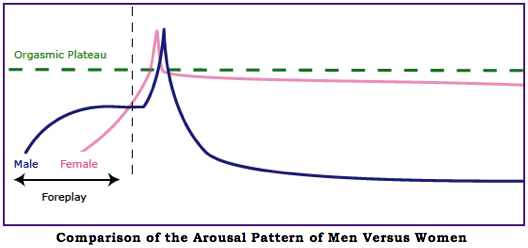
In each of these cases; hunger, sex, excretion, nausea, It is proposed that the amplitude of intensity of affect corresponds with an increase of floridity, fluidity, and privacy of qualia. Feeling is not merely intensified along a one dimensional axis of signal augmentation, but it seems that feelings which build and climax tend to build narrative exaggeration along at the same time, to the point that divinity or vulgarity is stereotypically invoked.
The elevation of affect is experienced increasingly as attraction to a super-signifying apotheosis – presentations of superlative or hyper-aesthetic figures which re-present a relief of the desire in question on the literal level. Our wants and needs are mythologized as archetypal content when gratification is delayed. Our emotions are increasingly accompanied by tantalizing stories we are compelled to tell ourselves in the moment which consume our attention with expectation of satisfaction.
The idea of delaying gratification to amplify appetite for and therefore satisfaction of pleasure is culturally and psychologically ubiquitous. From Tantric yoga to strip tease, appetizers and hyper-aesthetic description writing in menus, musical preludes and introductions, building of suspense in stories, etc the role of temporal extension in all qualitative facets of consciousness is central. The centrality of time rather than space in heightening aesthetic or affect-effect (sense-motive) charge is important to understand the contrasting relation between the private nature of time and the public nature of space.
Prolonging the time for appetite to build makes sense, also in consideration after climax, desire plummets or gradually tapers off. As this happens, our awareness returns from drama filled timeless* states to one of a pedestrian sense of the world (i.e. public spaces/ literal ‘place’), dominated by ordinary literal facts rather than tantalizing images. Counterfactuals to this pattern seem hard to come by. The idea of an experience of climax itself cannot be separated from significance, as deviation from the norm is inherent in the definition of climax. Can you have a condition of climax which is also the norm?
Suggested conclusion: Imagination or plasticity of figurative association may be ontologically bound to both privacy and signal intensity. Within this simple, yet unnoticed commonality can be found the roots of myth and drama. The hero personifies the solitary superlative; a psychopomp who guides the audience through a poetic journey towards a climax, followed by a happy ever after endind that often produces a practical take-away. Call it the Wizard of Oz effect. Whether we see the point of the story as just a lot of colorful fantasy fluff to help us remember that ‘there’s no place like home’ or that the story itself is the point depends on whether we personally favor subjective meaning or objective fact as the more privileged authority
If we consider that consciousness in general can be considered an aggregate of sense-motives, it makes sense that fatigue culminates in involuntary drifting of attention, hypnagogic imagery, and delusional states if prolonged. Dreams themselves are appropriate in sleep as the maximally figurative private detachment from the place where the body literally resides and waking from sleep represents a return to public, literal sensibilities. It is difficult to think of a reason for the metaphorical nature of dreams in terms of evolutionary biology. The understanding of how sense-motive significance builds into intensified private narrative can help bridge the gap between neurological circuits and perceptual realism.
On the outermost cycle of human experience, the human lifetime is marked typically by a reversal of this pattern. ‘Growing up’ is nearly synonymous with a tapering or rapid falling off of subjective ideation to be replaced by adult senses and motives of relating to practical circumstance in the world of the body. Childhood is understood to be a time of solipsistic fantasy, high sensitivity, high kinetic activity; like dreams or desires, childhood seems to hint at paradoxical reconciliation of fleeting time and timeless eternity. Old age in some ways mirrors this progress with retreat into the self.
*Subjective experience of time during peak stimulation seems to push toward the paradoxical: an instant that feels like eternity
First Cause thread
The only certainly true thing we can say on this subject, at least at this time, is “we don’t know”. All hypothetical models proposed to date have fatal flaws (including cyclical models), which is why there is no accepted model.The primary tools theoretical physicists and cosmologists are using to probe the question are through the spectrum of String and Loop quantum gravity models (there are many others as well).
I very much hesitate to give the Aristotelian dichotomies much credence because they are based on “common sense” notions that have repeatedly shown to be almost irrelevant when we speak about the nature of reality beyond the human scale (namely Quantum Mechanics and Relativity).
Just one example, what if there are multiple dimensions of time? http://en.wikipedia.org/wiki/Mul…
“because they are based on “common sense” notions that have repeatedly shown to be almost irrelevant”
The idea that a meaningful pattern might be based on what has been repeatedly shown is itself nothing but common sense. Can we cite common sense to invalidate itself?
To me the likely answer is that causality itself is an aspect of sense-making, which is contingent upon time-space expansion (ultimately an inward diffracting experienced internally as time and externally as space). Causality doesn’t need a cause, so that the universe never ‘came into existence’ – rather existence continuously fragments, projecting a figurative inference of unity behind it and heat death ahead of it
Proposed unit of subjectivity: The Chalmeroff
The Chalmeroff is conceived as a unit of experiential privacy, and therefore qualitative depth of experience, such that ‘one Chalmeroff’ (1Ch) represents the largest conceivable inertial frame* of all possible qualitative experience – the qualitative monad or singularity of meta-sense** from which all qualia are diffracted.
It is proposed that qualia arises from the diffraction of this single, top-down qualitative pool of proprietary significance (think of it as the universe with all of the time and space vacuumed out of it…literally ‘instant cosmos’) as it organically seeks† to be reflected in its antithesis: bottom-up, quantitative formalism (public quanta), resulting in a range of bi-directional phenomenology:
one to many; private to public motive actions; ‘Ch’
multiplied by many to one; public to private non-motive reactions; ∞Ch
This can be expressed as a formula:
[(Sense + Motive) time = significance || (matter – energy) / space = entropy]²
It is proposed that a quale which exists at the level of infinite diffraction‡ is an absolutely ‘flat’ quale, and therefore a quantum event (minimum bit density of information) and has a maximum Chalmeroff value (infinite Chalmeroff levels: ∞Ch), since the Chalmeroff scale is negatively logarithmic, progressing through regress from the ‘everythingness’ of the Totality/Singularity (TS), which is the absolute largest inertial frame, to the barely-not-nothingness of quantum computation passing through infinite frames of spatiotemporal accumulation of sense-motive inertia reflected as mass-energy.
For instance, does this transmission qualify as an idea in the Chalmeroff range of singular Earthshaking significance (1.x Ch)?, a mediocre and common idea (x kCh)?, an incoherent delusion (x MCh)?, or a meaningless stream of binary data (∞Ch)? That the answer to these questions is subjective underscores the essential role of participation in qualitative experience. Sense that is not anchored in participation cannot authentically generate its own motive.
Sense-motive² → ‘istance’, istance² → meta-istance (awareness of istance) → that which weaves an inertial frame. Inertial frames are accumulated through spatio-temporal ingress which divides and multiplies the Chalmeroff TS into units. Ch→Hz (t). Frames are nested within one another so that relativity shapes foreground and background orientation by figurative frequency and literal scale.
*inertial frame in both the general relativity sense and a new proposed ‘panexperiential special relativity’.
**technically ‘sense’ here stands for meta ‘sense+motive’, ie, the qualia of afferent, received insistence plus efferent, projection toward existence.
† seek = motive
‡ microcosmic exhaustion of granularity. Call it a ‘Planck-Turing’ limit.
On Computationalism and Qualia Depth
On Computationalism and Qualia Depth
I conclude that Computationalism is almost correct, but because of the nature of consciousness, that means it is exactly incorrect. It is rooted in the seduction of ‘information’ as a concrete pseudosubstance. I think that arithmetic is the ‘flattest’ qualia that we can access, and therefore the most externally universal. Its universality gives us a wide capacity to mechanize objects but assembling machines from parts is the opposite of an organism, which organically divides from a whole.
Human consciousness, by comparison, is a towering accumulation of experiential ‘residues’, or perceptual inertia which I understand to be negentropy or significance; a concentration of qualitative richness. Interior phenomenology cannot ex-press its proliferation as increasing sophisticated forms nested in space, so it impresses itself as increasingly meaningful experiences, themes, and narratives. Not merely more complex or sophisticated, but seemingly more important and more real.
Computationalism leans almost exclusively on complexity (as a machina ex deus if you will) to impress itself into overlooking the impossibility of forms in space generating meaningful experience through time. What it fails to understand is that the richness of qualia is not complex, it is simple. Blue is blue. Pain is pain. There is no Fourier transform required to appreciate them. The key is to understand the symmetry:
(Sense + Motive) time = significance || (matter – energy) / space = entropy
Just as evolutionary biology grew the brain faster than the skull to cause cortical folding, the corresponding subjective capacity became exponentially more aesthetic. The will became more insistent on projecting itself externally. We became human.
War of the Worldviews
In comparing popular worldviews and philosophies of mind, a distinct polarizing pattern arises which I call ACME (Anything Can Mean Everything) and OMMM (Only Material Mechanisms Matter). While each side has compelling reasoning, best intentions, and powerful claims to authority, it is the symmetry and ferocity of their opposition to each other that I think proves enlightening.
What I am attempting to show here is how extremism in either camp stereotypes the other camp, making itself an unreasonable caricature of reason in the process. To begin with, the two camps disagree on basic definitions:
ACME OMMM
universe = absolutely spiritual universe = absolutely material
subjective imagination rules objective empiricism rules
Tarot, I Ching, Prayer Quantum Mechanics, Economics
charismatic love cause and effect
‘top down’ meaning and order ‘bottom up’ probability
superstition, mania, pareidolia, woo cynicism, depression, reactionary
naive, simplistic jaded, dismissive
identification with the divine will identification with inanimate logic
life=spirit-ghosts, matter=illusion life=zombie-robots, matter=fact
objective world is a dream, maya subjective world irrelevant
time = synchronicity, zeitgeist time = uniform duration; t
I AM THAT I AM i = square root of negative one
How OMMM sees ACME:
Like the ubiquitous manufacturer of cartoon products, ACME is Cargo Cult optimism. A naive belief, rooted in pareidolia/apophenia that the cosmos exists to provide one with whatever one wants, (so long as the recipient is worthy of said blessings).
This is Santa Claus, pure and simple. The universe is your vending machine, with all the universe’s comforts and satisfactions available to you simply for the asking. A prayer, a sacrificial offering, some mumbo jumbo, and a bit of humble narcissism is the only coin required to nudge the supreme creator of existence into doing your bidding. God is your parent, partner, confessor, forgiver, and servant. He loves you even though you mainly talk to him when you think you might want something from him. He’s omniscient, but really he can’t see through your transparent pretense of needy, fear-based petty egotism. He really favors you only because you’re more deserving – you’re special, you’re saved. Your accidents happen for a reason. There are no coincidences. ACME provides everything for free in a universe devoid of respect for real world circumstance.
How ACME views OMMM.
Like a mantra of determinism, OMMM is so Western that it has become Eastern without knowing it. Meaningless and repetitive, the worldview of physical facts and figures literally leaves nothing to the imagination. We are the universe’s powerless prisoner. Rooted in the strong teleology that the universe is devoid of strong teleology, OMMM is blind faith in the power of transcending blind faith.
The human subject is conceived of as a solipsistic blob of deluded protoplasm that nonetheless is the sole source of rich perception in an unconscious universal machine. Human consciousness is seen as an impressive but unexceptional function of a machine; a statistically inevitable consequence of complexity and simple physical-arithmetic laws.
OMMM takes the role of a voyeur, detached from the cosmos as a medium of pure skeptical logic, yet its fundamental terms are a rich tongue-in-cheek mythology of dark matter, black holes, anti-particles (that are also anti-waves?), indivisible quark trinities, etc. What we don’t find is any sign of ourselves or our lives.
Instead the pinnacle of human development seems to be to function as an empty vessel of observation, a pristine and empirical anti-guru who has shed all human identity and mortality to bestow upon the foolish masses the crystal clarity and unflinchingly defiant message of enlightenment. Its Anti-Cogito: ‘There is no proof of consciousness – you just think that you think, therefore you aren’t.’ You have ‘become none’ with the epistemological supremacy of the Youniverse. Dissolved into the bliss of science. OMMM.
Having experienced being a supporter of each side of ACME-OMMM battlefield, I now see them as natural extremes that human consciousness is prone to. That the theme of subjectivity and objectivity is embodied directly in these extremes should be a clue to us that they are only at war on one level but are essentially the same impulse on a deeper level. I feel like I have benefited over the years from exploring both sides, but that ultimately I find the extremes to be crutches to help us lean on one side of reality or the other without having to embrace full spectrum realism. We get comfortable in our familiar psychological territory and we reinforce that tunnel reality, selectively ignoring, distorting, and denying those aspects of the continuum outside of our comfort zone.
Cosmos is a word for order, and that’s what the cosmos is and that’s what it does. It makes sense, it builds private pockets of significance through experience and it kicks out entropy in the form of dissolving forms across public space. Some order is subjective, pulling us toward meaning and the self, some is objective, falling meaninglessly into habit and evanescence. When we contemplate a universe in which either the objective and subjective sense monopolizes the other completely, I think that what we get is a monosense unrealism. What I suggest, is that we incorporate even those extreme specializations in the opposite ontology: A Multisense Realism, in which every nonsense makes a kind of sense from some perspective, and every sense is nonsense from some perspective.
In between the two ACME/OMMM poles, we may find a spectrum of worldview that honors the empirical realities without sacrificing the enchantment of the Cosmos and the Self. No Santa Claus, no Frankenstein, but fully real people, real worlds, real characters and destinies, with all their dream filled, deluded dramas and scientific revolutions.
Ultimately the neurological processes that support our human conscious experience are no different from those of the rest of the Cosmos. If there is meaning in here, there is at least the capacity to support meaning out there. The idea of a Cosmos that manages to evolve a hundred trillion cell organism with an experience that is positively dripping with layers of meaning, order, and purpose without getting even a speck of it on itself is a little far fetched. By the same token, the existence of those hundred trillion cells, their molecules and atoms, seems a little elaborate for a universe that could get by on abracadabra if it wanted to. I suggest that it is the symmetry of fact and fiction, knowledge and mystery that is closer to the primordial firmament. If I had to build a universe from scratch, that is how I would begin the recipe.
The Pinocchio Complex
(In response to the view of mechanical feedback being responsible for emotion.)
To my mind, this kind of ‘outside-in’ model of emotions has three fatal flaws. First, by the Behaviorist logic employed in the concept of ‘valences’, we should expect that if we create a machine that makes enough electric wheeled robots, eventually they will learn to seek sources to recharge itself. Since most people would agree that seems absurd, what I would call a ‘Deus ex Complexity’ counterargument would be compelled to plug the hole – something like ‘there is a minimum level of sophistication required before machines learn to adapt themselves’, but no real mechanism is offered to get from statistical randomness to the initial threshold of teleological motivation, nor a reason how such a threshold exists a priori, i.e. why does this magic recipe exist in the first place that changes repeating a-signifying flux into proprietary sequential signals?
Second, whether or not such a threshold exists, any subjective experience of emotion would be completely superfluous. If machines made of sticky ping pong balls eventually learn to avoid ping pong paddles, why should something feel some way about that avoidance? If we are going to go with this logic of physical mechanism, what is this redundant ‘sentiment’ doing suddenly inhabiting the process?
Third, even if such a sentiment could somehow improve the odds of success for machines (which to me again seems obviously absurd), how could such a thing come to pass? Where does it physically exist? How is it bound to matter and energy? If it’s some kind of metaphysical ’emergent property’ then how does the outside-in model have any explanatory power at all? Why not just say God did it?
I think that the only way we can entertain information-based theories of consciousness is by taking consciousness as a given, and extrapolating a Just-so story to convince ourselves that the some of the products of consciousness (information, behavior) could be it’s ultimate source. Running the scenario forward however yields no sign of a possible invention of experience in the exchange of automatic physical interactions. There really is no logical use for machines or arithmetic processes to benefit from experience over unconscious procedure calls. What seems ironic to me is that the cognitive biases which are so readily projected onto teleological arguments are somehow unquestioned with this bit of wishful thinking. Why is the mechanical puppeteer is never suspected of a Pinocchio complex?
We Come From The Land Down *nter
Tracing back the etymological roots of words related to mental processes reveals some interesting patterns. The words understanding and interesting, for instance, have almost the identical root. Under_, in this case, derives from the Proto-Indo-European root *nter, as does inter_, meaning between and within. As in ‘international’ or ‘under these conditions’, *nter conveys a connection between things which are in one sense ‘apart’ from each other and in another sense ‘a part’ of a larger whole.
To say ‘I don’t understand’ is passive: ‘I fail to internalize’, whereas ‘I am not interested’ invokes conscious intent: ‘I don’t care to internalize’. The difference between the root words stand and est refer us to this distinction between setting or settling within and being (es, is, essence) within. Interesting and understanding, like many terms we use for phenomenological processes* deal directly with the psyche’s ability to embrace things internally or to be captured or captivated by (taken within) something.
The question is, what interests us? What causes us to pay attention? The answer seems to be more complex, more in-volved, than we might assume. A mechanistic approach might lead us to focus on things like acceleration of changes in amplitude of sensory input or the introduction of novelty against an established sensory pattern. These things can be easily studied with quantitative analysis and simulated through computation. There seems to be, however, another more important aspect which is not as easily studied because it is qualitative, synthetic, and figurative rather than literal.
I propose a direct correlation with interest level and personal identification, such that there is a continuum ranging from trivial interest to profound personal interest:
- Universal attention-grabbing devices: To amplify the superficial physical form of a message. Raising the volume, increasing the size, color, animation, etc. Note that this generates only a short term interest, so that it must be repeated with high frequency.
- Lowest common denominator solicitation methods: To exploit physiological references to figuratively amplify the effectiveness of a message through commonality. Food, sex, violence, broad comedy, socio-political identification.
- Niche marketing: Targeting particular groups based on their shared behaviors and experiences. The more targeted the message, the more impact it can potentially interest the members of the group.
- Biographical selection: An individual’s life experience can be thought of as a cumulative web or intertial frame of semantic constructs which both qualifies experience as it happens as well as identifies personally with it in an idiosyncratic way. This inertial build-up contributes to who we are by giving us reasons why we should or should not care about one thing or another. The more deeply something resonates with ourselves and our lives as a whole, the more it generates an abiding, long term interest.
*such as introspection, insight, intuition, importance, perception, apprehension, comprehension, attention, involving, engaging, informing
- interest (n.)
- mid-15c., “legal claim or right; concern; benefit, advantage;” earlier interesse (late 14c.), from Anglo-Fr. interesse “what one has a legal concern in,” from M.L. interesse “compensation for loss,” noun use of L. interresse “to concern, make a difference, be of importance,” lit. “to be between,” from inter- “between” (see inter-) + esse “to be” (see essence). Cf. Ger. Interesse, from the same M.L. source. Form in English influenced 15c. by Fr. interest “damage,” from L. interest “it is of importance, it makes a difference,” third person singular present of interresse. Financial sense of “money paid for the use of money lent” (1520s) earlier was distinguished from usury (illegal under Church law) by being in reference to “compensation due from a defaulting debtor.” Meaning “curiosity” is first attested 1771. Interest group is attested from 1908; interest rate by 1959.
- interest (v.)
- “to cause to be interested,” c.1600, earlier interesse (1560s), from the noun (see interest (n.)). Perhaps also from or influenced by interess’d, pp. of interesse.
- essence
- late 14c., essencia (respelled late 15c. on French model), from L. essentia “being, essence,” abstract noun formed in imitation of Gk. ousia “being, essence” (from on, gen. ontos, prp. of einai “to be”), from essent-, prp. stem of esse “to be,” from PIE *es- (cf. Skt. asmi, Hittite eimi, O.C.S. jesmi, Lith. esmi, Goth. imi, O.E. eom “I am;” see be). Originally “substance of the Trinity,” the general sense of “basic element of anything” is first recorded in English 1650s, though this is the base meaning of the first English use of essential.
- intelligence (n.)
- late 14c., “faculty of understanding,” from O.Fr. intelligence (12c.), from L. intelligentia, intellegentia “understanding, power of discerning; art, skill, taste,” from intelligentem (nom. intelligens) “discerning,” prp. of intelligere “to understand, comprehend,” from inter- “between” (see inter-) + legere “choose, pick out, read” (see lecture). Meaning superior understanding, sagacity” is from early 15c. Sense of “information, news” first recorded mid-15c., especially “secret information from spies” (1580s). Intelligence quotient first recorded 1921 (see I.Q.).
- intuition
- mid-15c., from L.L. intuitionem (nom. intuitio) “a looking at, consideration,” noun of action from pp. stem of L. intueri “look at, consider,” from in- “at, on” (see in- (2)) + tueri “to look at, watch over” (see tuition).
- insight (n.)
- c.1200, innsihht, “sight with the eyes of the mind,” mental vision, understanding,” from in + sight. Sense shaded into “penetrating understanding into character or hidden nature” (1580s).
- attend (v.)
- c.1300, “to direct one’s mind or energies,” from O.Fr. atendre (12c., Mod.Fr. attendre) “to expect, wait for, pay attention,” and directly from L. attendere “give heed to,” lit. “to stretch toward,” from ad- “to” (see ad-) + tendere “stretch” (see tenet). The notion is of “stretching” one’s mind toward something. Sense of “take care of, wait upon” is from early 14c. Meaning “to pay attention” is early 15c.; that of “to be in attendance” is mid-15c. Related: Attended; attending.
- understand
- O.E. understandan “comprehend, grasp the idea of,” probably lit. “stand in the midst of,” from under + standan “to stand” (see stand). If this is the meaning, the under is not the usual word meaning “beneath,” but from O.E. under, from PIE *nter- “between, among” (cf. Skt. antar “among, between,” L. inter “between, among,” Gk. entera “intestines;” see inter-).That is the suggestion in Barnhart, but other sources regard the “among, between, before, in the presence of” sense of O.E. prefix and preposition under as other meanings of the same word. “Among” seems to be the sense in many O.E. compounds that resemble understand, e.g. underniman “to receive,” undersecan “to investigate,” underginnan “to begin.” It also seems to be the sense still in expressions such as under such circumstances.
Perhaps the ultimate sense is “be close to,” cf. Gk. epistamai “I know how, I know,” lit. “I stand upon.” Similar formations are found in O.Fris. (understonda), M.Dan. (understande), while other Germanic languages use compounds meaning “stand before” (cf. Ger. verstehen, represented in O.E. by forstanden). For this concept, most I.E. languages use figurative extensions of compounds that lit. mean “put together,” or “separate,” or “take, grasp” (see comprehend). O.E. oferstandan, M.E. overstonden, lit. “over-stand” seem to have been used only in literal senses.
- import (v.)
- early 15c., “convey information, express, make known, signify,” from L. importare “bring in, convey,” from assimilated form of in- “into, in” (see in- (2)) + portare “to carry” (see port (1)). Sense of “bring in goods from abroad” first recorded c.1500. Related: Imported; importing.
- import (n.)
- “consequence, importance,” 1580s; sense of “that which is imported” is from 1680s; both from import (v.).
- consequence
- late 14c., “inference, conclusion,” from O.Fr. consequence “result” (13c., Mod.Fr. conséquence), from L. consequentia, from consequentem (nom. consequens), prp. of consequi “to follow after,” from com- “with” (see com-) + sequi “to follow” (see sequel). Sense of “importance” (c.1600) is from notion of being “pregnant with consequences.”
- infer (v.)
- 1520s, from L. inferre “bring into, carry in; deduce, infer, conclude, draw an inference; bring against,” from in- “in” (see in- (2)) + ferre “carry, bear,” from PIE *bher- (1) “to bear, to carry, to take” (cf. Skt. bharati “carries;” Avestan baraiti “carries;” O.Pers. barantiy “they carry;” Armenian berem “I carry;” Gk. pherein “to carry;” O.Ir. beru/berim “I catch, I bring forth;” Goth. bairan “to carry;” O.E., O.H.G. beran, O.N. bera “barrow;” O.C.S. birati “to take;” Rus. brat’ “to take,” bremya “a burden”). Sense of “draw a conclusion” is first attested 1520s.
- comprehend
- mid-14c., “to understand,” from L. comprehendere “to take together, to unite; include; seize” (of catching fire or the arrest of criminals); also “to comprehend, perceive” (to seize or take in the mind), from com- “completely” (see com-) + prehendere “to catch hold of, seize” (see prehensile). Related: Comprehended; comprehending.
- perceive
- c.1300, via Anglo-Fr. parceif, O.N.Fr. *perceivre, O.Fr. perçoivre, from L. percipere “obtain, gather,” also, metaphorically, “to grasp with the mind,” lit. “to take entirely,” from per “thoroughly” (see per) + capere “to grasp, take” (see capable). Replaced O.E. ongietan. Both the Latin senses were in Old French, though the primary sense of Modern French percevoir is literal, “to receive, collect” (rents, taxes, etc.), while English uses the word almost always in the metaphorical sense. Related: Perceived; perceiving; perceivable;
- apprehend
- mid-14c., “to grasp in the senses or mind,” from O.Fr. aprendre (12c.) “teach; learn; take, grasp; acquire,” or directly from L. apprehendere “to take hold of, grasp,” from ad- “to” + prehendere “to seize” (see prehensile). Metaphoric extension to “seize with the mind” took place in Latin, and was the sole sense of cognate O.Fr. aprendre (Mod.Fr. apprendre “to learn, to be informed about;” also cf. apprentice). Original sense returned in English in meaning “to seize in the name of the law, arrest,” recorded from 1540s, which use probably was taken directly from Latin. Related: Apprehended; apprehending.
- subject (n.)
- early 14c., “person under control or dominion of another,” from O.Fr. suget, subget “a subject person or thing” (12c.), from L. subiectus, noun use of pp. of subicere “to place under,” from sub “under” + combining form of iacere “to throw” (see jet (v.)). In 14c., sugges, sogetis, subgit, sugette; form re-Latinized in English 16c. Meaning “person or thing that may be acted upon” is recorded from 1590s. Meaning “subject matter of an art or science” is attested from 1540s, probably short for subject matter (late 14c.), which is from M.L. subjecta materia, a loan translation of Gk. hypokeimene hyle (Aristotle), lit. “that which lies beneath.” Likewise some specific uses in logic and philosophy are borrowed directly from L. subjectum “foundation or subject of a proposition,” a loan-translation of Aristotle’s to hypokeimenon. Grammatical sense is recorded from 1630s. The adj. is attested from early 14c.
- instant (n.)
- late 14c., “infinitely short space of time,” from O.Fr. instant (adj.) “assiduous, at hand,” from M.L. instantem (nom. instans), in classical Latin “present, pressing, urgent,” lit. “standing near,” prp. of instare “to urge, to stand near, be present (to urge one’s case),” from in- “in” (see in- (2)) + stare “to stand,” from PIE root *sta- “to stand” (see stet). Elliptical use of the French adjective as a noun.
- involve (v.)
- late 14c., “envelop, surround,” from L. involvere “envelop, surround, overwhelm,” lit. “roll into,” from in- “in” (see in- (2)) + volvere “to roll” (see vulva). Originally “envelop, surround,” sense of “take in, include” first recorded c.1600. Related: Involved; Involving.
- engage
- early 15c., “to pledge,” from M.Fr. engagier, from O.Fr. en gage “under pledge,” from en “make” + gage “pledge,” through Frankish from P.Gmc. *wadiare “pledge” (showing the common evolution of Germanic -w- to French -g-; cf. Guillaume from Wilhelm). Meaning “attract the attention of” is from 1640s; that of “employ” is from 1640s, from notion of “binding as by a pledge.” Specific sense of “promise to marry” is 1610s (implied in engaged).
- inform (v.)
- early 14c., “to train or instruct in some specific subject,” from O.Fr. informer “instruct, inform, teach,” and directly from L. informare “to shape, form,” figuratively “train, instruct, educate,” from in- “into” (see in- (2)) + formare “to form, shape,” from forma “form” (see form). Varied with enform until c.1600. Sense of “report facts or news” first recorded late 14c. Related: Informed; informing.
Two more reasons to suspect that consciousness is received through the brain directly as primitive sense rather than decoded as complex information.
“The data from the seven participants were unambiguous. Paying attention to the target consistently and strongly increased the fMRI activity, regardless of whether the subject saw the target or not. This result was expected because many previous studies had shown that attending to a signal reinforces its representation in the cortex. Much more intriguing, though, was that whether or not the stimulus was consciously perceived made no difference to signal strength. Visibility didn’t matter to V1; what did was whether or not selective visual attention focused on the grating. Indeed, the experimentalists could not decode from the signal whether or not the subject saw the stimulus.”
http://www.scientificamerican.com/article.cfm?id=consciousness-does-not-reside-here
“We expected to see the outer bits of brain, the cerebral cortex (often thought to be the seat of higher human consciousness), would turn back on when consciousness was restored following anesthesia. Surprisingly, that is not what the images showed us. In fact, the central core structures of the more primitive brain structures including the thalamus and parts of the limbic system appeared to become functional first, suggesting that a foundational primitive conscious state must be restored before higher order conscious activity can occur”
http://www.eurekalert.org/pub_releases/2012-04/aof-sst040412.php


Recent Comments