Archive

Author Archive

Multisense Continuum Still Life

June 5, 2015 Leave a comment

stilllife2

Hyper-Mentalism and Supernatural Belief

May 24, 2015 2 comments

This article from Psychology Today, Hyper-Mentalism, Hyper-Empathizing, and Supernatural Belief, talks about the diametric model’s explanation of the psychotic end of the autistic-psychotic spectrum.

“To use an analogy, the diametric model implies that we live in parallel mentalistic and mechanistic universes, with mental causality ruling the first and physical causality the second. Religious, superstitious, and magical thinking clearly represent an encroachment of the mental world on the real one in the form of belief in divine creation, miracles, the power of prayers and spells, and so on. Indeed, as I pointed out in an earlier post, you could see traditional religion and superstition as the result of a primeval mentalistic inflation which hyper-mentalized the real world, in part because mechanistic understanding of it in the form of modern science, medicine, and technology had not had time to develop. Furthermore, you could also see this as the paradigmatic historical case of a “combination of strong mentalizing coupled with poor understanding of the physical world.”

In my view, this is very close to the hypothesis that has been developed under the Multisense Continuum or ACME/OMMM model.

The diametric model deserves more attention, in my view, however I think that the assumptions behind the model are themselves biased toward the systemizing/mechanistic end of the spectrum. Note the language in the quote above: “Religious, superstitious, and magical thinking clearly represent an encroachment of the mental world on the real one“. Highly subjective states are identified as being intrinsically unreal rather than being an extension of nature and reality. The end of that quote shows another good example of the mechanistic worldview, associating superstition with “poor understanding of the physical world.” I would not deny that there are many people who do suffer from a poor understanding of the physical world and compensate for that to some extent with magical thinking, however, that correlation does not always hold true. Many people, such as myself, embrace the physical world and have an excellent understanding of it, yet see that behind and beyond mechanistic appearances are also more subtle natural phenomena. It is not that the psychotic is poorly equipped for reality, it is more like reality poorly equipped to contain psychotic hyper-sensitivities. This is not to say that paranoid schizophrenics are right about the content of their delusions, only that the form of paranoid delusions reflect (in a distorted way) the transpersonal territory of the psyche.

In the short article linked above, the author makes the distinction between his diametric model and “Simon Baron-Cohen’s rival scheme, which has systemizing versus empathizing instead of the diametric model’s mechanistic versus mentalistic cognitive dualism”. Here again, the distinction between empathizing and mentalistic is itself a mechanizing/systemizing distinction. Both the diametric model and empathizing-systemizing model label the ‘feminine’ side in terms of a personal function. The former sees empathy as a cognitive skill, while the latter seems to suggest that it is overdeveloped empathy which interferes with the correct application of cognitive skills. In both cases, the bias of contemporary academic science shows through: Extraordinary awareness which conflicts with consensus reality is a defect.

This bias is not surprising, nor is it even a negative if we are trying to get a handle on human psychology for purposes of treatment. The problem that I see, is that it closes the door on the deeper dimensions of psyche and fails to take seriously the implications of consciousness transcending classical physics. Once we do take a scientifically objective look at these implications, I think that we wind up with a theory of order and participation in the universe which is not limited to human psychology but extends beyond physics, information science, philosophy, and religion: A new scientific cosmology based on sense phenomena.

multisense-diametric

Leaving Space, Time, and Spacetime Behind

May 12, 2015 2 comments

Are Space and Time an Illusion? Considered in this video:

  • 1. Give up your intuitions of how space and time work.
  • 2. Facts about observers (particles are considered observers):
    • a. observers disagree on how much time passes between events.
    • b. observers disagree on how much space there is between things at any given moment.
    • c. observers don’t fully agree on the chronological order of events.
    • d. observations are consistent so that no observer can be ‘wrong’.
  • 3. Spacetime is emergent from a deeper objective reality of causality.
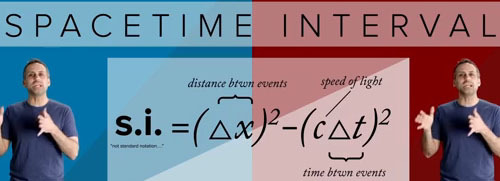
    • a. all observers agree on spacetime interval
      image
    • b. Spacetime intervals tell us about which causes influence which effects.
    • c. Causality is more objectively real than spacetime.
    • d. Spacetime is a tenseless, Non-Euclidean 4D mathematical Minkowski space.
    • e. Our intuitions of space and time are arbitrary and abstract.
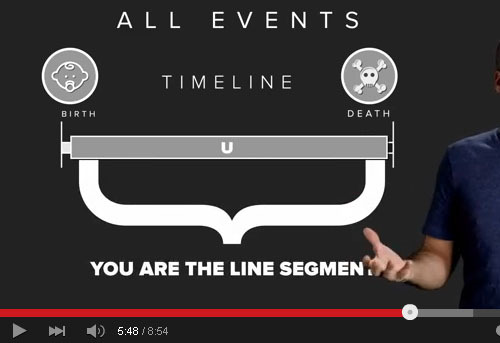
    • f.  We are real, however, if we think of our entire lives as a fixed geometric object in spacetime rather than a moving window on the line segment of our life:
image

He begins to sum up at 6:03

“Imagine we’re all reading a flip book made of graph paper. We agree on the events of the story, but we don’t agree where they happen on the page, on how many pages there are between events, or even on the order of some of those events, and yet we’re all reading the same book…only there’s no graph on the paper, there are no pages, and there is no book. All of that is just an imposition our brains make in order to perceive whatever it is. So why do we perceive reality in such a vividly spatial and temporal way? Good question, No one really knows.”

At this point is where I jump up and raise my hand. I think that I might know the answer to that question:

The mistake being made in our sophisticated rewrite of naive intuition about space and time is that the constancy of the spacetime interval is due to an objective ‘same book’ (or bookless book or whatever we are supposed all be reading.) To go to the next step into multisense realism, we must not only give up our intuitions about space and time being different, but we must give up our counter-intuitions about spacetime being literal.

If we consider instead that there is no final Minkowski block time universe out there, no ‘same book’, or even same language out there, but rather a shared capacity to read/write, in here, then both the naive intuition and sophisticated counter-intuition makes sense as perspectives within a larger context. Not just in human experience, or even within particles or probability laws, but deeper than that.

In this new schema all is read/written beyond spacetime but still ‘within’. Within us as well as ‘within’ every kind of non-human experience. This pervasive context ‘within all awareness’ would be an absolute context which is pervasive and devoid of any formal sense of distance or time. An anti-void. This absolute frame of reference can be understood as sense itself (something like “ference” rather than reference): Direct participation of perceptual qualities that need not be realistic, but also extend to phenomena which we are familiar with as fiction, imagination, myth, etc.

This is not to say that human imagination could necessarily describe the entire continuum of sense, but like the visible spectrum is to electromagnetism, it defines a range which is a thin slice of the whole, but much more than merely one color. The one ‘color’, call it white, would correspond to the single combined sense of timeless, spaceless realism that is studied under math and physics, but is nevertheless bereft of aesthetic qualities such as emotion, flavor, or (other) colors.

All that has ever been experienced can be seen, in this absolute frame of reference to be ‘right here and right now’, but for our local inhibitory conditions of human limitation. From our human perspective there is a cost in making awareness so immense that it embraces all other partitions; it becomes unreal or fictional, delusional, supernatural, absurd, or accidental*. The ‘heavens’ are not only causally closed at one level of awareness, but on another, they open up to non-linear, surreal mythscapes with no temporal rooting but deep symbolic meaning.

Jung spoke of the collective unconscious, Australian aborigines refer to a primordial Dreamtime, and many a psychedelic explorer have reported such aesthetically saturated realms. Anthropologists find that it is very common for cultures to assume that children are born into this world from a dreamier, more divine kind of world. These shamanistic-psychotic surrealities need not be considered ‘real’, however neither can their surreality and flirtation with prophetic intuitions be dismissed as mere accident. Even as a kind of placebo effect, the transcendental levels of experience must be accounted for in any would-be-complete view of the universe.

There is a lot to understand about our own spectrum of consciousness before we can even begin to approach the totality of awareness, which may be an unbounded, or self-binding rather than a fixed continuum. Non-human states of awareness might be both ‘larger’ and ‘smaller’, faster and slower than we can conceive of. This conception of the totality of experience as beyond causality turns causality into a kind of ‘nozzle’ of spacetime. Causality focuses the ocean of creativity; interiorizing some and exteriorizing others into relative degrees (the ancestor of our ‘five senses’ in which, for example, feeling seems ‘closer to us’ than seeing).

The pieces of this puzzle of human consciousness can, in my estimation, reveal a kind of ‘red shift’ and ‘blue shift’ which can be thought of in human terms as the stereotypically** autistic and psychotic extremes of human consciousness.

To return to the video, the multisense realism view would add:

  • 4. Nonlocal spacetime and “space ⊥ time” as (space and time in their naive, perpendicular local appearance) both emerge from a deeper common sense, which is trans-local.
    • a. this common sense can be thought of as the capacity for sense itself, or rather, for the particular kind of worldly sense of causality and agreement, which we might call realism.
    • b. realism is a common, but not exclusively common sense but is the reflection of an even more fundamental sense, which is novel and unprecedented rather than probabilistic or determined by laws.
    • c. the common sense of realism divides experience mechanistically and unintentionally
    • d. the uncommon sense beyond realism multiplies intentionally, seeking and building significance.
    • e. what we call causality is itself caused. Our distanced observations of realism is a kind of low-res substitute or icon that carries some semblance of the totality, but in an aesthetically neutralized, minimalistic form.
    • f. by using the built in, self-organizing clues of nature, we can begin to see how the holographic universe must be extended to include our own ‘visible spectrum’.
  • 5. The agreement of the Spacetime Interval is not evidence of a rigid body of 4D absolute reality, but rather evidence of the potential for agreement itself, i.e. the revelation of underlying local sensory unity with distant sensory conditions.
    • a. this is what the constancy of light speed and gravity are ‘really about’: not photons or forces, but ordinary sensory experience in self-diffraction.
    • b. light is not a particle or a wave, it is a local sensation on the cusp of spacetime emergence. Light is local sensation, and sensation is a boundary condition within sense.
    • c.  this means that sensation is more of a temporary subtraction from the eternal than an isolated piece of information.
    • d.  the extremes of human consciousness should be seen as a richer, more significant version of a guiding theme in all of sense: that of psychotic-unpredictable-figurative entropy and autistic-static-literal information.
    • e.  the phenomenon of seeing can be used metaphorically to begin to understand these extremes, as well as ordinary experiences of common sense, by working with the idea of language as a gravitational lensing in which the light of sense is bent by local accumulations of significance (mass).
  • 6. Paradoxically, what all observers agree on is their potential for agreement and fact of their own disagreement.
    • a. We can reclaim our naive intuitions about space and time being different, as this perpendicular aesthetic is an accurate reflection of our own subjective tunnel through eternity.
    • b. We can claim the Minkowski counter-intuition as a brilliant, and useful creation myth which is derived from common insensitivity, rather than common sense.

This is way too much to take in all at once (even for me), and I have no doubt that it sounds crazy to most people (that too is part of the Lorentz-like contractions and dilatations of sense-making). This is only the very tip of the iceberg…just something to get down in writing…for now.

*Whether the out-of-range portions of the spectrum of sense appear to be insane, error, or divine depends upon the frame of reference from which they are experienced.

**not talking about real people who demonstrate autistic or psychotic symptoms, but the themes exposed by the stereotyping of those symptoms, some of which are being researched under Imprinted Brain Theory.

Thesis Rewrite Project

April 25, 2015 Leave a comment

MSR’s Case Against Emergence

Within the MSR website, there are several entries talking about the inadequacy of the concept of emergence when applied to consciousness emerging from unconsciousness. Briefly, emergence only has any explanatory power when applied to two phenomena which have a logical similarity. We can understand that water molecules which are tightly packed would seem to us to have the emergent property of being ice, where molecules which are contacting each other but sliding around would have the emergent property of seeming to us like a liquid. What is meant when emergence is applied to consciousness however, is not like that at all. There is no arrangement of particles in a void that is isomorphic to a flavor, color, or feeling like dizziness. Emergence which cannot be anticipated by the behavior of the fundamental phenomenon is known as Strong or Brute Emergence, and under the best of circumstances can be dismissed as an argument from ignorance. In the circumstance of consciousness emerging from objects or information processes, we are smuggling in our own evidence of experience as the entire explanation of that experience. To claim emergence of consciousness is to answer the question of why molecules seem like flavors or emotions by shrugging it off as the way that molecules seem…as if seeming could exist in physics in the absence of consciousness.

Here’s a thought experiment to consider:

Let’s say that you have a two dimensional collection of six squares in a cross formation, like this:

hi-d_figure3
Now we know that this could be folded into a cube, however, couldn’t we also have a program which treats the edges as if it were a cube, but use it as a graphic character in a 2d video game? In other words, can’t we show that just because the edges and corners of this figure behave in a way which is isomorphic to a 3d figure, no cube ’emerges’ necessarily? We could run this program in Flatland without folding it up as cube and all of the computational outcomes would be the same.

The emergentist position overlooks the difference between the squares and the cube, claiming the latter not to be anything additional added on top of the flat avatar. The idealist position is that there is a difference between a cube and the avatar, and that this difference is the most important and interesting thing…the whole point is that there doesn’t need to be a cube logically, but yet there is.

Intellectual fads come and go. Even long held scientific frameworks change over time to accommodate new knowledge. For centuries Ptolemaic astronomy was presumed accurate, so much so that when anomalies were found in the predictions of its deferent and epicycle model, the response was famously to ‘add epicycles’ to make finer tuned predictions rather than to suspect what Galileo and Copernicus later found. The heliocentric revolution changed our understanding of our position in the universe from one of divine center or paradise lost to a statistical fluke in a dying cosmos. For the 1200 years between 200 and 1400 AD, why did we stick to the geocentric model? Why was it more natural to think that the universe revolved around us?

Like the fish which has no name for water, or the Flatland square who has no way to conceive of flatness as a dimension which lacks volume, it was difficult for people to doubt those assumptions that they didn’t even know they were making. The Earth feels motionless – as stable and static as anything we can imagine. Who would guess that the very property of motion is a relative condition? Once we have that piece of information, we can find, as Einstein did, examples of it everywhere – on trains, when we can’t tell whether our seat is moving forward at a constant speed or whether the train out the window is moving past us and we are standing still. One favorite thought experiment of mine is to think of a universe in which only one object exists; a smooth, ideal sphere like a ping pong ball. In this universe, nothing can be seen to move. Without making ourselves an invisible voyeur who can look around into the void, there is no true sense of space or change. There is no difference between moving and standing still because there is no frame of reference from which to compare and see that a position has changed. Video games can help us conceptualize this also. The player who pilots a spaceship avatar has only the attitude of their ship to cue their sense of acceleration when traveling through empty space.

whisperingwater
Notice how ocean waves stop moving when seen from high above.

(Sound gif, Source)

The shift that is proposed by MSR would twist our view of the universe, so that the universe itself becomes a kind of twisting or gyrating between different ways of experiencing.

Yeats System

Yeatsgyre

Yeats, like Locke and Galileo before him, conceived of the worldly half of the universe as “Primary”, which is perfectly natural considering that when we are awake we find ourselves surrounded by a physical world which is so much larger and more durable than ourselves. MSR proposes not that we invert this relation into solipsism, where internal phenomena are primary and the external world is secondary, but to see our own subjectivity as just one tier in a continuum which is much more vast and durable than even physics. Under MSR, both the dualistic Western and non-dualistic Eastern views both exist within the total continuum of sense.

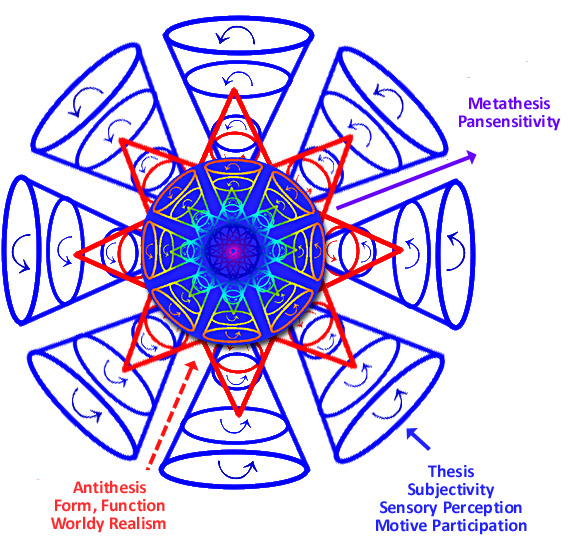
msr_mandalabr_cap

The Yeats system is multiplied so that it is realism which is emergent rather than subjectivity. The aesthetic objectives of Yeats are no longer the antithesis, but the thesis and meta-thesis.

msr_mandalabr_cap2

mess

Multisense realism = The elaboration of sense into layers and modes which objectify and subjectivity.

A Couple of Scientific Conversations

April 17, 2015 2 comments
Quantum and the Bell

EM Imagine I set up Schroedinger’s cat and a machine that will open the box after 10 seconds and ring a bell if the cat is alive. I set it up, and wait 10 seconds, and don’t hear a bell. What’s happened to the wavefunction?

CM What happened is that a person, you, have made an observation based on an expectation that you have of a particular experiment.

EM But I didn’t interact with the apparatus. No signal was transferred between me and it.

CW If you didn’t interact with the apparatus then how do you know the bell didn’t ring?

EW Because I’ve noticed 10 seconds passing and not registering a bell ringing in that time?

CW Why would you expect to hear a bell ringing unless you know that you can hear that bell and that bell is part of the apparatus?

EM I wouldn’t do, but are you trying to say that being aware of that counts as interacting with the apparatus?

CW Of course. Does RAM exist if it’s just filled with 0s?

EM Sure, but the idea of RAM in my head isn’t RAM in reality.

CW Being able to hear a bell isn’t in your head either. Being able to hear a bell and infer a meaning to the apparatus from that sensory experience (or your unfulfilled expectation thereof) is what your interaction consists of.

EM Yes, and neither unfufilled expectation or potential ability to hear a bell are real interactions with the real apparatus.

CW They are if you can really hear a bell (which is part of the apparatus) and if you can really understand that hearing the bell constitutes a result of your experiment.

If a dead person doesn’t hear the bell is it still a valid observation?

EM As far as the mathematics was concerned, it was “observed” (decohered) by the time the bell rang. But “being able to hear the bell” is not an interaction. *Actually* hearing the bell is, but that doesn’t happen.

CW Your view takes sense for granted to the point that it denies a difference between a living observer and no observer.

As far as the mathematics was concerned”
Which proves my point. Mathematics truncates consciousness.

EM Your point is… what? Believing in single observers and WF collapse is more rational then just interpreting the mathematics that explains your results in the first place?

CW The mathematics don’t explain the results, they only diagram a skeleton of one measurement of the results. The actual experiment and results take place outside of mathematics.

Are molecules conscious?

Does polymerase have any sense when it transcribes DNA into RNA? Do ribosomes have any sense when they translate RNA into amino acids?

What we can say is that DNA, ribosomes, etc are all expressions of consciousness on a certain scale (microbio-chemo) as seen through another scale of consciousness (anthro),

There is a story, an experience going on that is represented to us as a ribosome, a molecule, etc, and we are seeing its body through our body. A facade that is filtered by another filtering facade. I call this Eigenmorphism. Form itself, like matter and energy, is relativistic. Whether a given phenomenon is a feeling or a structure depends on the distance across the frames of reference involved. Nothing is an object in its own frame of reference, including the universe. Our mistake since the Enlightenment is in Over-Copernicanising physics and dismissing the native frame of reference (sense) as an epiphenomenon or emergent property of the distant frame (physics)

Light Speed, Space and Time

April 11, 2015 Leave a comment

I think that the speed of light is constant not because that is the nature of light, but because that is the nature of velocity itself. Velocity isn’t a simple, open ended quantity, it is a range between stillness and c…between absolute spacetime locality and absolute non-locality.

Light is nowhere and everywhere until it hits something…wavefunctions are in non-local ‘superposition’ until they ‘collapse’.

My view is that this is almost true, but inside out. Light is within awareness which reflects awareness. Light is the event horizon between the public and the private aesthetics. Light is only ‘here’ and ‘there’, never in between…never moving in space.

We don’t know anything about space, because we can’t use space to measure itself. All measurements are done with instruments made of matter. All measurements occur within conscious awareness, and all measurements of space occur by the extension of conscious awareness through matter. Space is the absence of matter(as detected by consciousness of matter). The math doesn’t change, only the interpretation gets post-Copernicanized.

“The body is to space what consciousness is to time. The world is to the body what the unconscious is to consciousness.“ – JS

Space = geometry, time = algebra…but then space/geometry is to time/algebra what measurement (quanta) is to the trans-measurable (qualia).


Abstruse Ideas about Qualia and Feedback

April 10, 2015 Leave a comment

Here’s a problem I’ve been stewing over for several hours now inspired by Raymond Tallis.

Say you have a device called an autoencephelograph. This device will project whatever you are subjectively experiencing onto a display of some kind– TV screen, projector screen etc.

Now lets say you look at the display with the autoencephelograph nearby within view. Will this display be your subjective experiences, objectively out there in the public arena? Or will the autoencephelograph and the display itself still be within your own subjective experience, creating a sort of fractal, nested self- similar experience? Or both-and?

I think that it can be modeled this way:

c = d (Q – Q’)

I’m setting the variable c (which I’m not-unintentionally using to reference the speed of light, but that’s a whole other sidebar) to be the distance or difference between the raw qualia Q and the projected qualia Q prime.

fc = ‘ ^2

fc is the Feedback (or function) of c, and I’m saying that it is the square of the primeness, that is, the inauthenticity of the projection is squared. The inauthenticity here is the degree to which the projection is an imperfect imitation of the original. This might also be called simulacra translation, which is different from mere signal degradation, because each copy is not only losing fidelity with the original and thus becoming more generic, but it is also gaining the qualities of M (the medium).

In the case of visual Q, the Q’ is optical if it is seen through our eyes (rather than if the autoencephalograph is projecting into our brain directly), and it is technological relative to whatever devices are being used to collect and project the brain measurements. So the in addition to the simulacra translation fc = ‘^2, you add +M, as the quality of the medium (say optics + video) increases its presence in Q’.

– extra credit:

fc = ‘ ^2 +M

This +M is part of what I call disimmediation.

“If we pay attention to the aesthetic particulars of the glitch – the scratches on the record, the pixelation of a digitally compressed video, we can see that they contain clues as to the mechanisms behind the media. Disimmediation is a window into other Perceptual Inertial Frames (PIF), to optics or computation, analog or digital recording, screenwriting and theatrical production, etc.”

This +M qualia can be modeled as well, but this gets even more esoteric. The medium’s qualia is being seen from the public facing side, so it’s compressing the whole history of that medium and its context as a kind of fisheye lens from eternity. It’s the hole in the cookie dough of eternity, rather than the cookie…which makes it a different kind of simulacra…an impersonal kind which is not only noise but truth-telling, and therefore orienting in a scientific-artistic way (metatheoretical and metaphenomenal).

Think of it this way: The color orange intrinsically references red and yellow, which intrinsically references the warm end of the visual spectrum, then color in general, then seeing in general, and in our frame of reference optics, lenses, prisms, etc. Seeing references sense modalities, which references sense itself, and through that nesting, implicit coherence is preserved from outside of spacetime.

About Naive Realism and the Limitation of Models

April 7, 2015 Leave a comment

Nature is not what it naively seems to us to be only to the extent that we are a limited part of nature. Nature as a whole is exactly what it seems, and also, in its most essential sense, nature is seeming, or sense itself.

In the process of enlightening civilization, the scientific worldview has had some casualties, one of which is the authority of our naive sense of reality. Many people feel entirely justified in thinking that all human intuition and instinct is grounded only in evolved fictions that must be overcome in order to understand the truth of anything. This now extends to understanding phenomena such as consciousness and free will, so that even the Cartesian cogito is to be taken with a grain of salt. “I think therefore I am.” no longer is persuasive to the modern cybernetic intellect, which might instead say “You’re programmed to think that you think and that you are, but really there is only organic chemistry playing itself out in your brain.”

Part of what Multisense Realism is about is to reclaim the validity of introspection and understanding, so as to avoid the extremism of either the pre-scientific worldview of anthropomorphic solipsism, or the current reductionist worldview of mechanemorphic nilipsism*. The MSR view is that our naive perspective is not an illusion, it is that our variation on reality exists within a much larger context of interacting variations on reality. The weight of the aggregate of all of these other perspectives are honored within our own sanity as a sense of realism. The depth of scientific knowledge serves to disillusion our naive worldview, but what I propose is that this disillusionment is not an indication of an objective reality of nature, only a hint that the expectation of objectivity is quality of relationship within subjectivity. Realism is a kind of perceptual gravity, anchoring and orienting as well as crushing possibilities into dust. It is a filter on consciousness, and the more public or universal an experience is to be, the more constrained it is to the accumulated history of public facing experience.

Altered states of consciousness can show us that like Neanderthals and other extinct branches of our evolutionary tree, our contemporary state of mind is only one of many which have achieved some stability over time. Ken Wilber’s spectrum of consciousness gets into the different modes of human awareness, linking individual development stages to the stages of anthropological development. Leary’s 8-Circuit Model and the many models of Eastern mysticism echo this idea of stable chakras or umwelt levels within an accelerating gyre of consciousness improving itself. We may be able to achieve spectacular results individually or in small groups, but find that the resistance of the outside world is overwhelming. In the cold light of day, the most moving insights flatten out into goofy platitudes.

Speaking of flattening things out, it is interesting to note that when we try to flatten a sphere, such as when we want a map the Earth onto a page, we have to use projections that approximate the relations on the sphere. There are clever ways of doing it which minimize the distortion, but it occurs to me that traveling around the surface of the world in a complete circle remains the best way I can think of retaining both the flatness and the roundness of the world. Our first person perspective remains the most elegant way of harmonizing opposing perspectives. Flying or sailing around the world gives us an apprehension of that harmony that doesn’t carry over to a model. The scale of the Earth, likewise, is presented in a more impressive, realistic way than any model could also.

The physical model which we have inherited contributes to the nilipsistic worldview mentioned above. If I’m being uncharitable, I might characterize this contemporary phase of cosmology as ‘vacuum worship’. I’m referring to quantum mechanical models through which we infer “A Universe From Nothing”, where “nothing” is a superposition of quantum wavefunctions…statistical tendencies to oscillate into existence for longer than no time at all. Here I suggest a cure for this useful, but fundamentally inverted worldview: Put the vacuum into the vacuum. Get rid of the idea of ‘nothing’ altogether.

Instead of a universe of particles or potential particles in a void, I propose turning it inside out, so that spacetime is an illusion of separation. Quantum events are not grounded in non-locality so much as they are semaphores – signs which define the sense of locality itself. Entanglement should be thought of as ‘pinging locality’ rather than a non-local connection between two real ‘particles’.

*neologisms

Cone Cosmogony

March 31, 2015 1 comment

headless

cone3

The first image is from https://www.facebook.com/headexchange. The second has been modified to include the Multisense Realism model.

Specifically, “Me” has been removed from the center of the mandala and turned into part of the z axis. The center of the wheel is now Form-Function, and Now, indicating that consciousness is at its most pointillistic and fragmented. This would be the sharpest, most systematizing-autistic quality of consciousness, quantitative and reductionistic.*

The diameter of the circles corresponds to space or distance (really wavelength ratio/scale), so that the wheel represents a flat cross section of eternity. Time is the diagonal axis which is can be thought of as the z axis ‘deferred’. If our experience (feeling, thought, etc) extends from eternity to now as a qualitative spectrum (as symbolized by the chakra graphic), then ‘time’ is the interference pattern between eternal experience and fully public, discrete events.

The top of the cone is labeled eternity, although it is eternity in the sense of the eternal moment rather than a linear history of time. Eternity can also be called the Absolute, or God, Tao, Consciousness, Aesthetic Foundation, and many other names. Identifying with the Absolute while still in our body is the opposte end of the consciousness spectrum – the most colorful, florid, artistic-empathic-psychotic range of awareness.

* See previous posts on Imprinted Brain Theory and the Autistic-Psychotic spectrum.

Notes on Philosophical Incorrigibility

March 25, 2015 3 comments

No, this is not about philosophers behaving like unruly children (although at times, they can). Incorrigibility is a term that refers to “a property of a philosophical proposition, which implies that it is necessarily true simply by virtue of being believed. A common example of such a proposition is René Descartes’ “cogito ergo sum” (“I think, therefore I am).“

Symbolic reference cannot ‘break the fourth wall’ – meaning that whatever words or gestures that we use to communicate about something can only refer to things figuratively. This sentence, for example, can’t address you the reader in a literal sense. I can write “Hey you! Yes, you! Stand still laddie!” but it is not really possible for these words to address anyone literally. The same words could come out of a random letter generator, or they could have been written by someone who died before the reader was born. The entire premise that language is meaningful depends on an audience who is able to derive meaning from interpreting messages from that language.

Doxastic logic is a type of modal logic which uses the terms ‘belief’ and ‘proposition’ to formalize, and really digitize the possible relations of belief and truth, including beliefs about beliefs, possible beliefs about possible truths, etc.

Accurate reasoner: An accurate reasoner never believes any false proposition.

Bp→p

Normal reasoner: A normal reasoner is one who, while believing p, also believes he or she believes p.

Bp→BBp

My beef with modal logic is that while it gives us an informative language to talk about mental states, it cannot access the quality of the state itself, and therefore is misguided when applied to the deeper conditions of consciousness itself. There is no modal symbol for ‘wakes up’ or ‘loses consciousness’ because those conditions affect the entire phenomenon from which reason can arise rather than a function of reasoning.

When viewed from an ontological perspective, I think that we would have to consider a proposition to be a kind of belief, even if it is a belief that is assumed to be shared by everyone or every thing. The proposition that “Fire is relatively hot” is itself only a message which is communicated through language. Before we can agree that “p = fire is relatively hot“, we must first agree that

p is literally a sensation: p is seen as a group of adjacent graphic squiggles, or heard as a phonic utterance. p is actually s(’p’), since acoustic vibrations or optical contrasts can’t literally be propositions about fire.

s(’p’) is subconsciously identified as a message (rather than, say decorative art) within our cognitive sense. We think that our sense of ‘p’ means something that we can understand. p is promoted to i(s(’p’)).

i(s(’p’)) is consciously understood as a particular message with a particular meaning. This promotion of i(s(’p’)) to the executive level of sense, where we personally evaluate and act on the contents of messages would be the third nesting of sense u(i(s(’p’))). It is not only cognitive, but articulated on the personal level of cognition.

It should be noted that deconstructing the foundation of classical logic this way is intentional. Logic begins with a philosophical assumption of semantic realism. This is ironic really, especially in doxastic logic when we are concerned with the consistency of reasoning, to being with the assumption of a reasonable universe as a given. p is simply p. A proposition is given, and in that presentation of the proposition, truth is considered (wait for it…) incorrigible. If we want to say that p is false, we would just say ‘not p’. Truth and proposition are equivalent because we are assuming an unquestionable solidity to this fundamental logical unit – a unit which represents facts as they simply are, unconditioned, present without any dependence on ontology. Logic of this sort can be used to diagram systems which remind us of physics or of thinking and communicating, but they begin with the fact of coherence and sense already in place.

By inverting this previously unexamined axiom, I hope to reveal the myth of the logical ‘given’ and replace it with the more skeptical, honest view that logic is derived from sense. Just as a child depends on developing sensorimotor skills prior to developing abstract reasoning skills, all logic derives from deeper levels of sensory experience. Even computer logic relies on the sense of a physical mechanism…the capacity for some substance to detect and project some tangible role in a tangible chain reaction. Abstract logic is always an intangible map that is projected psychologically onto such a tangibly experienced territory. It is this tangibility, this concretely participatory aesthetic spectacle which is doing the work and which can appreciate the benefits of having accomplished it.

In my view, artificial intelligence has a problem, not because there is something special or magical about living creatures, or Homo sapiens, but because it seeks to impose an abstraction onto reality ‘feet first’ as it were. A computer program is a set of propositions which is further proposed to be imitated by a physical machine. Instead of an a sensation which is identified and understood u(i(s(’p’))), there is a ‘p’(’p’(u) (’p’(i) (’p’(s))… a mere proposition of a proposition of an understanding of a proposition of an identification of a proposition of a sensation. Those who have a grasp of why this is different from the natural u(i(s(’p’))) don’t really need an explanation. ‘The map is not the territory’, or ‘the menu is not the meal’ should be enough. Those who do not see the difference, or do not identify why the difference is so significant, or do not understand the specific meaning of the significance are probably approaching the entire question of consciousness from the classical logical orientation. For those people, if there is any possibility at all of their shifting to the new perspective that I am proposing, I think that they would have to begin from the incorrigibility of concrete sense rather than of abstract logic.

The Third Eve

Who we are becoming.

Shé Art

The Art of Shé D'Montford

Astro Butterfly

Transform your life with Astrology

Be Inspired..!!

Listen to your inner self..it has all the answers..

Rain Coast Review

Thoughts on life... by Donald B. Wilson

Perfect Peace

Steven Colborne's Philosophical Theology Blog

Amecylia

Multimedia Project: Mettā Programming DNA

SHINE OF A LUCID BEING

Astral Lucid Music - Philosophy On Life, The Universe And Everything...

I can't believe it!

Problems of today, Ideas for tomorrow

Rationalising The Universe

one post at a time

Conscience and Consciousness

Academic Philosophy for a General Audience

yhousenyc.wordpress.com/

Exploring the Origins and Nature of Awareness

DNA OF GOD

BRAINSTORM- An Evolving and propitious Synergy Mode~!

Paul's Bench

Ruminations on philosophy, psychology, life

This is not Yet-Another-Paradox, This is just How-Things-Really-Are...

For all dangerous minds, your own, or ours, but not the tv shows'... ... ... ... ... ... ... How to hack human consciousness, How to defend against human-hackers, and anything in between... ... ... ... ... ...this may be regarded as a sort of dialogue for peace and plenty for a hungry planet, with no one left behind, ever... ... ... ... please note: It may behoove you more to try to prove to yourselves how we may really be a time-traveler, than to try to disprove it... ... ... ... ... ... ...Enjoy!

Creativity✒📃😍✌

“Don’t try to be different. Just be Creative. To be creative is different enough.”

Political Joint

A political blog centralized on current events

zumpoems

Zumwalt Poems Online