Grelling–Nelson paradox
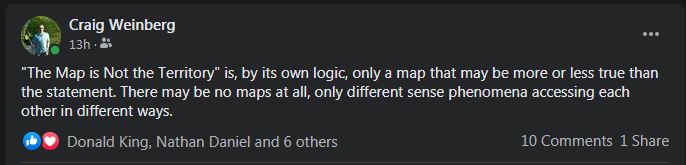
This is to record a train of thought that began with my posting: “The Map is Not the Territory” is, by its own logic, only a map that may be more or less true than the statement. There may be no maps at all, only different sense phenomena accessing each other in different ways.”
A comment:

And my repsonse…
Thanks, I hadn’t heard of that before. It fits in with a line of thinking that I woke up with. Thinking about mirrors. Do mirrors exist or are there only objects like silvered glass that can be used to reflect something else? Do reflections exist or are they just separate instances of physical light? This leads to a sidebar about the difference between tactile sense and visible sense, and how images transcend the classical limitations of tangibility and can be in more than one place at the same time, weightlessly.
Thinking about looking at the Sun in a mirror and how it is still potentially blinding, and how that illustrates that physical reflection has a tangible component as well as a visible one. A flashlight uses a reflective/mirrored dome to deflect the radiation of the electrified bulb toward the center of the ‘beam’. Mainly though, I’m interested in pointing out how our current/legacy scientific worldview overlooks and disqualifies sense modality.
Physicalism compulsively seeks to reduce the intangible to equations describing the tangible in intangible terms that are in some sense isomorphic or autological to them but in another sense perfectly anti-morphic or heterological to them. If there is one thing that all abstract formula have in common it is that they are the antithesis of all of the concrete substances that can be touched and held. Yet despite the purity of that opposition, some essential unity can be translated intellectually between one and the other
Part of what I try to do with Multisense Realism is to break free of the mania for reduction to maximum tangibility (by means of maximally intangible language) and look instead at the more obvious co-existence of a wide spectrum of multiple aesthetic modalities of sense and sensemaking that seamlessly *and* ‘seamfully’ unite tangible concrete physical objects and intangible abstract ideal concepts under a larger umbrella of trans-tangible aesthetic-participatory sensory-motive percepts*.
So, the Grelling-Nelson paradox is to me another angle on this…another reflection on how our legacy of rigid logical labeling takes language too literally (that is, too concretely) and mistakes words for meanings and meanings for words. When we find these Easter Eggs of contradiction or paradox we are almost surprised that language doesn’t behave like other things in the world. We are offended that language seems to break its own seeming promise to faithfully reflect anything that we aim it at. Of course, this is a mistaken assumption. Language makes no such promise. Semantic paradoxes expose the fact that language itself is syntactic, not semantic, and that at some level we are the conscious agents who are using our power to symbolize and associate metaphorically words into meanings and meanings into words. The words themselves aren’t doing it. The map is its own territory, both faithfully and unfaithfully translating sense and sense making modalities through another sense making modality which is especially designed or conditioned to send and receive but to remain relatively unsent and unreceived themselves.
*seemingly


 Multisense Realism
Perhaps the reason many people so easily ignore the idea that language itself cannot entirely translate, or fully represent reality is that it can seem quite threatening to the comfortable feeling that language provides as that which comprehends as a way to transcend the limits of subjective experience. Language allows us to take a lot for granted, but maybe we have become too dependent on the comfort it provides that also allows us to perceive falsely feel and believe through language games of identity and agreement.
I see language as a two-way tool though that both limits and expands. Language is not the whole of reality, but it does expand the nature of our awareness, and especially shared awareness. It’s helpful to respect its limits though by not mistaking it for reality and by becoming more aware of how it inhabits our being and to a large degree, colors our perceptions and beliefs.